Q541.Given below are four sentences in jumbled order. Pick the option that gives their correct order.
A. She looked very excited when she saw me get off the bus.
B. It was quite a long time since I had met my grandmother.
C. I found her standing at the village bus stand to receive me.
D. She hugged me and tears of joy flowed down her cheeks.
- ABDCA
- BCDAB
- CBCAD
- DCADB
Show answer
Concept: Background first, then the order of events at the bus stand.
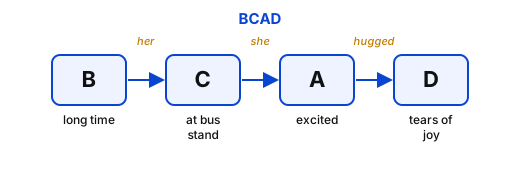
- B: it was long since I had met grandmother – background.
- C: I found her waiting at the bus stand.
- A: she looked excited when I got off the bus; D: she hugged me with tears of joy.
- Order: B-C-A-D.
Trick: Background → arrival → reaction → climax (hug).
Answer: (C) BCAD
अवधारणा: पहले पृष्ठभूमि, फिर बस स्टैंड पर घटनाओं का क्रम।
- B: दादी से लंबे समय से नहीं मिला – पृष्ठभूमि।
- C: वह बस स्टैंड पर इंतज़ार कर रही थीं।
- A: बस से उतरते देख उत्साहित; D: गले लगाया। क्रम: B-C-A-D।
ट्रिक: पृष्ठभूमि → पहुँचना → प्रतिक्रिया → गले लगना।
उत्तर: (C) BCAD
SSC CPO Paper IIEnglish Language and ComprehensionPara jumblesSSC CPO Paper II 2021 · 26 Jul Shift 1
Q542.Select the correct direct form of the given sentence.
He told you that he would discuss the matter that evening.
- AYou said to him, “I will discuss the matter this evening.”
- BYou said to him, “He would discuss the matter today evening.”
- CHe said to you, “I will discuss the matter today evening.”
- DHe told to you, “He will discuss the matter that evening.”
Show answer
Concept: Indirect → direct: 'told you' → 'said to you'; he → I; would → will; 'that evening' → 'this evening/today evening'.
- Speaker is 'he', listener 'you': 'He said to you, "…"'.
- 'he would discuss' → 'I will discuss'.
- 'that evening' → time word of the present. Option C is the only one with the right speaker, pronoun and tense.
- A reverses speaker and listener; B and D keep 'He' and/or past forms.
Trick: First fix the speaker–listener, then the pronoun, then the tense.
Answer: (C) He said to you, “I will discuss the matter today evening.”
अवधारणा: Indirect → direct: 'told you' → 'said to you'; he → I; would → will; 'that evening' → आज शाम।
- वक्ता 'he', श्रोता 'you': 'He said to you, "…"'।
- 'he would discuss' → 'I will discuss'।
- केवल विकल्प C में वक्ता, pronoun और tense सही हैं।
- A में वक्ता-श्रोता उलटे; B, D में 'He'/past रूप बने रहे।
ट्रिक: पहले वक्ता-श्रोता, फिर pronoun, फिर tense।
उत्तर: (C) He said to you, “I will discuss the matter today evening.”
SSC CPO Paper IIEnglish Language and ComprehensionDirect and indirect speechSSC CPO Paper II 2021 · 26 Jul Shift 1
Q543.Select the most appropriate one-word substitution for the given group of words.
A fictitious name used by an author
- Ahomonym
- Bnamesake
- Cpseudonym
- Dalibi
Show answer
Concept: A pseudonym (pen name) is a fictitious name used by an author, e.g. Munshi Premchand (Dhanpat Rai).
- pseudo = false, -nym = name.
- Homonym = word with same spelling/sound but different meaning; namesake = person with the same name; alibi = proof of being elsewhere.
Yaad rakhein: Pseudo = fake → pseudonym = fake name.
Answer: (C) pseudonym
अवधारणा: Pseudonym (उपनाम/कलम नाम) = लेखक द्वारा प्रयुक्त काल्पनिक नाम, जैसे मुंशी प्रेमचंद (धनपत राय)।
- pseudo = झूठा, -nym = नाम।
- Homonym = समान वर्तनी/ध्वनि पर भिन्न अर्थ; namesake = हमनाम; alibi = कहीं और होने का प्रमाण।
याद रखें: Pseudo = नकली → pseudonym = नकली नाम।
उत्तर: (C) pseudonym
SSC CPO Paper IIEnglish Language and ComprehensionOne word substitutionSSC CPO Paper II 2021 · 26 Jul Shift 1
Q544.Select the correct direct form of the given sentence.
The Principal asked Kamal how it was that he was always late for school.
- AThe Principal said to Kamal, “How is it that you are always late for school?”
- BThe Principal said to Kamal, “How it was that he was always late for school?”
- CThe Principal said to Kamal, “How are you always late for school?”
- DThe Principal said to Kamal, “How it is he was always late for school?”
Show answer
Concept: An indirect wh-question has statement order; in direct speech it returns to question order and present tense.
- 'how it was that he was' → "How is it that you are …?"
- he → you (Kamal is addressed).
- B and D keep statement order/past tense; C drops 'is it that' and changes the expression.
Trick: Indirect: how it was … ⇄ Direct: How is it …?
Answer: (A) The Principal said to Kamal, “How is it that you are always late for school?”
अवधारणा: Indirect wh-प्रश्न statement क्रम में होता है; direct में प्रश्न क्रम और present tense लौट आता है।
- 'how it was that he was' → "How is it that you are …?"
- he → you (Kamal से बात)।
- B, D में statement क्रम/past; C में 'is it that' हटा दिया।
ट्रिक: Indirect: how it was … ⇄ Direct: How is it …?
उत्तर: (A) The Principal said to Kamal, “How is it that you are always late for school?”
SSC CPO Paper IIEnglish Language and ComprehensionDirect and indirect speechSSC CPO Paper II 2021 · 26 Jul Shift 1
Q545.Identify the segment in the sentence which contains a grammatical error.
He could not / get a job / despite of / his best efforts.
- Adespite of
- BHe could not
- Cget a job
- Dhis best efforts
Show answer
Concept: 'Despite' is itself a preposition and is never followed by 'of'. Use 'despite' or 'in spite of'.
- 'despite of' is wrong.
- Correct: 'He could not get a job despite his best efforts.'
- Other segments are correct.
Yaad rakhein: despite = in spite of (never 'despite of').
Answer: (A) despite of
अवधारणा: 'Despite' स्वयं preposition है, इसके बाद 'of' नहीं आता। 'despite' या 'in spite of' लिखें।
- 'despite of' गलत।
- सही: 'He could not get a job despite his best efforts.'
- बाकी भाग सही।
याद रखें: despite = in spite of ('despite of' कभी नहीं)।
उत्तर: (A) despite of
SSC CPO Paper IIEnglish Language and ComprehensionError spottingSSC CPO Paper II 2021 · 26 Jul Shift 1
Q546.Given below are six sentences A-F, of which A and F are static and B-E have been jumbled. Pick the option that gives the correct order of the jumbled sentences.
A. When the train pulled in at Chennai Central, it took Velu some time to get off.
B. So, he sat down on a nearby bench that was unoccupied.
C. In all his eleven years he had not seen so many people except at the village fair.
D. When he finally stood on the platform, his legs felt wobble.
E. He put his small bundle beside him on the bench and looked around.
F. Near him, a group of people sat on their luggage staring at a TV hanging from the roof.
- AADBECF
- BABECDF
- CACBDEF
- DAEDCBF
Show answer
Concept: Track Velu's movements step by step and the pronoun/reference links.
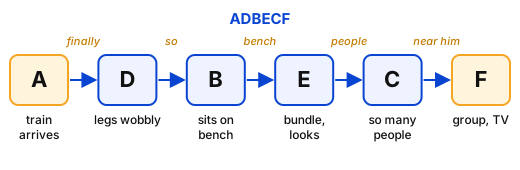
- A: train arrives; D: 'When he finally stood on the platform' his legs felt wobbly.
- B: 'So' he sat on a bench (because of wobbly legs).
- E: put his bundle beside him on the bench and looked around; C: he had never seen so many people.
- F: near him, people staring at a TV. Order: A-D-B-E-C-F.
Trick: 'So' in B gives the result of D's wobbly legs.
Answer: (A) ADBECF
अवधारणा: Velu की हर गतिविधि और संदर्भ-संबंध क्रम से देखें।
- A: ट्रेन पहुँची; D: प्लेटफ़ॉर्म पर खड़ा हुआ, पैर काँप रहे थे।
- B: 'So' वह बेंच पर बैठ गया।
- E: बेंच पर गठरी रखी, चारों ओर देखा; C: इतने लोग कभी नहीं देखे थे।
- F: पास में लोग TV देख रहे थे। क्रम: A-D-B-E-C-F।
ट्रिक: B का 'So', D के काँपते पैरों का परिणाम है।
उत्तर: (A) ADBECF
SSC CPO Paper IIEnglish Language and ComprehensionPara jumblesSSC CPO Paper II 2021 · 26 Jul Shift 1
Q547.Select the correct active form of the given sentence.
The animals in the zoo should not be fed.
- ADon’t fed the animals in the zoo.
- BDon’t be feeding the animals in the zoo.
- CFeed not the animals in the zoo.
- DDon’t feed the animals in the zoo.
Show answer
Concept: A passive with 'should not be + V3' giving advice/prohibition is turned into a negative imperative: Don't + V1 + object.
- Object 'the animals in the zoo' returns to object position.
- Active: 'Don't feed the animals in the zoo.'
- 'Don't fed' uses V2; 'Don't be feeding' is not standard; 'Feed not' is archaic.
Yaad rakhein: Negative command = Do not/Don't + V1.
Answer: (D) Don’t feed the animals in the zoo.
अवधारणा: 'should not be + V3' वाला निषेध passive → negative imperative: Don't + V1 + object।
- object 'the animals in the zoo' फिर object बनेगा।
- Active: 'Don't feed the animals in the zoo.'
- 'Don't fed' में V2; 'Don't be feeding' मानक नहीं; 'Feed not' पुराना रूप।
याद रखें: Negative आदेश = Don't + V1.
उत्तर: (D) Don’t feed the animals in the zoo.
SSC CPO Paper IIEnglish Language and ComprehensionActive and passive voiceSSC CPO Paper II 2021 · 26 Jul Shift 1
Q548.Select the most appropriate option to substitute the underlined segment in the given
sentence. If there is no need to substitute it, select ‘No substitution’.
His fine voice has never heard in this hall again.
- Awill never be heard
- Bnever be heard
- Cwill never hear
- DNo substitution
Show answer
Concept: The voice is the subject 'his fine voice', which cannot hear – it is heard. So the verb must be passive; 'again' suggests the future.
- 'has never heard' is active – wrong for a non-living subject that receives the action.
- Correct: 'His fine voice will never be heard in this hall again.'
- 'never be heard' lacks the auxiliary; 'will never hear' is active.
Trick: Ask: does the subject do the action or receive it? Receive → passive.
Answer: (A) will never be heard
अवधारणा: Subject 'his fine voice' स्वयं सुनती नहीं, सुनी जाती है – इसलिए passive चाहिए; 'again' भविष्य का संकेत है।
- 'has never heard' active है – गलत।
- सही: 'His fine voice will never be heard in this hall again.'
- 'never be heard' में auxiliary नहीं; 'will never hear' active है।
ट्रिक: Subject क्रिया करता है या सहता है? सहता है → passive।
उत्तर: (A) will never be heard
SSC CPO Paper IIEnglish Language and ComprehensionSentence improvementSSC CPO Paper II 2021 · 26 Jul Shift 1
Q549.Identify the segment in the sentence which contains a grammatical error.
She speaks / very highly / of both her / daughter-in-laws.
- Avery highly
- Bof both her
- Cdaughter-in-laws
- DShe speaks
Show answer
Concept: In compound nouns like daughter-in-law, the plural is formed on the main noun: daughters-in-law.
- 'both her' needs a plural → daughters-in-law, not 'daughter-in-laws'.
- Similarly: sons-in-law, passers-by, commanders-in-chief.
- Other segments are correct.
Yaad rakhein: Pluralise the main word: daughters-in-law.
Answer: (C) daughter-in-laws
अवधारणा: daughter-in-law जैसे compound noun में plural मुख्य noun पर लगता है: daughters-in-law।
- 'both her' के बाद plural चाहिए → daughters-in-law।
- इसी तरह: sons-in-law, passers-by, commanders-in-chief।
- बाकी भाग सही।
याद रखें: मुख्य शब्द को plural करें: daughters-in-law।
उत्तर: (C) daughter-in-laws
SSC CPO Paper IIEnglish Language and ComprehensionError spottingSSC CPO Paper II 2021 · 26 Jul Shift 1
Q550.Select the correct passive form of the given sentence.
Do not allow strangers into the society complex.
- AStrangers should not be allowed into the society complex.
- BLet strangers must not allow into the society complex.
- CStrangers should not have been allowed into the society complex.
- DLet strangers should be not allowed into the society complex.
Show answer
Concept: A negative imperative of prohibition/advice ('Do not allow …') is made passive with 'should not be + V3' (or 'Let … not be + V3').
- Object 'strangers' becomes the subject.
- Do not allow → should not be allowed.
- 'Strangers should not be allowed into the society complex.'
- C ('should not have been') refers to the past; B and D are ungrammatical.
Yaad rakhein: Don't + V1 + object → Object + should not be + V3.
Answer: (A) Strangers should not be allowed into the society complex.
अवधारणा: निषेध आदेश ('Do not allow …') का passive 'should not be + V3' से बनता है।
- object 'strangers' subject बनेगा।
- Do not allow → should not be allowed।
- 'Strangers should not be allowed into the society complex.'
- C भूतकाल दर्शाता है; B, D व्याकरण से गलत।
याद रखें: Don't + V1 + object → Object + should not be + V3.
उत्तर: (A) Strangers should not be allowed into the society complex.
SSC CPO Paper IIEnglish Language and ComprehensionActive and passive voiceSSC CPO Paper II 2021 · 26 Jul Shift 1
Q551.Select the most appropriate synonym of the given word.
DISGRACE
- Adispute
- Bdishonour
- Cdiscord
- Ddisgust
Show answer
Concept: ‘Disgrace’ means loss of respect or honour; shame.
- Dishonour = loss of honour/respect – exact synonym.
- Dispute = argument; discord = disagreement.
- Disgust = strong dislike – a feeling, not shame.
Trick: dis + grace (honour) ≈ dis + honour.
Answer: (B) dishonour
अवधारणा: ‘Disgrace’ का अर्थ है अपमान, बदनामी, इज़्ज़त खोना।
- Dishonour = अपमान/अनादर – सटीक पर्यायवाची।
- Dispute = विवाद; discord = मतभेद।
- Disgust = घृणा – यह भावना है, अपमान नहीं।
ट्रिक: dis + grace (सम्मान) ≈ dis + honour।
उत्तर: (B) dishonour
SSC CPO Paper IIEnglish Language and ComprehensionSynonymsSSC CPO Paper II 2021 · 26 Jul Shift 1
Q552.Select the most appropriate meaning of the underlined idiom in the given sentence.
When the miscreants saw the police they beat a retreat.
- Aran away
- Bprotested strongly
- Cattacked fiercely
- Dmarched ahead
Show answer
Concept: The idiom ‘beat a retreat’ means to withdraw or run away quickly from danger.
- Miscreants saw the police → they fled.
- ‘Attacked fiercely’, ‘marched ahead’ are the opposite idea.
- ‘Protested strongly’ has no link with retreat.
Trick: retreat = move back → beat a retreat = run away.
Answer: (A) ran away
अवधारणा: ‘Beat a retreat’ मुहावरे का अर्थ है खतरा देखकर तुरंत भाग जाना / पीछे हट जाना।
- बदमाशों ने पुलिस को देखा → वे भाग गए।
- ‘Attacked fiercely’, ‘marched ahead’ उल्टा अर्थ देते हैं।
- ‘Protested strongly’ का retreat से कोई संबंध नहीं।
ट्रिक: retreat = पीछे हटना → beat a retreat = भाग खड़े होना।
उत्तर: (A) ran away
SSC CPO Paper IIEnglish Language and ComprehensionIdioms and PhrasesSSC CPO Paper II 2021 · 26 Jul Shift 1
Q553.Select the most appropriate option to substitute the underlined segment in the given
sentence. If there is no need to substitute it, select ‘No substitution’.
It is time we should have done something useful.
- Awould do
- Bhave done
- CNo substitution
- Ddid
Show answer
Concept: After ‘It is time’ / ‘It is high time’ + subject, we use the simple past tense (unreal past) to show that the action is already late.
- Structure: It is time + subject + V2.
- So: It is time we did something useful.
- ‘should have done’, ‘have done’, ‘would do’ break this rule.
Trick: It is (high) time + we/he + V2 (past form).
Answer: (D) did
अवधारणा: ‘It is time’ / ‘It is high time’ + subject के बाद simple past (V2) आता है – यह बताता है कि काम में पहले ही देर हो चुकी है।
- संरचना: It is time + subject + V2।
- इसलिए: It is time we did something useful।
- ‘should have done’, ‘have done’, ‘would do’ इस नियम के विरुद्ध हैं।
ट्रिक: It is (high) time + subject + V2।
उत्तर: (D) did
SSC CPO Paper IIEnglish Language and ComprehensionSentence ImprovementSSC CPO Paper II 2021 · 26 Jul Shift 1
Q554.Select the most appropriate option to fill in the blank.
Poverty was staring her ______ the face.
- Ato
- Bon
- Cat
- Din
Show answer
Concept: The fixed idiom is ‘stare someone in the face’ = to be obvious or very near and threatening.
- ‘Poverty was staring her in the face’ = she was close to poverty.
- The idiom always takes ‘in the face’.
- ‘to/on/at the face’ are not used in this idiom.
Yaad rakhein: stare / look someone in the face.
Answer: (D) in
अवधारणा: Fixed idiom है ‘stare someone in the face’ = बिल्कुल सामने/निकट होना (खतरे की तरह)।
- ‘Poverty was staring her in the face’ = गरीबी उसके सिर पर खड़ी थी।
- यह मुहावरा हमेशा ‘in the face’ लेता है।
- ‘to/on/at the face’ इस मुहावरे में प्रयोग नहीं होते।
याद रखें: stare / look someone in the face।
उत्तर: (D) in
SSC CPO Paper IIEnglish Language and ComprehensionPrepositions / IdiomsSSC CPO Paper II 2021 · 26 Jul Shift 1
Q555.Select the most appropriate meaning of the underlined idiom in the given sentence.
In times of economic recession, the demand for goods is on the wane.
- Aon the decline
- Bout of control
- Con the rise
- Dat the peak
Show answer
Concept: ‘On the wane’ means decreasing or becoming weaker.
- ‘Wane’ = to decrease (like the moon after full moon).
- In a recession demand falls → on the decline.
- ‘On the rise’, ‘at the peak’ are opposites; ‘out of control’ is unrelated.
Yaad rakhein: wax = grow, wane = shrink.
Answer: (A) on the decline
अवधारणा: ‘On the wane’ का अर्थ है घटते जाना / कमज़ोर पड़ना।
- ‘Wane’ = घटना (जैसे पूर्णिमा के बाद चंद्रमा)।
- मंदी (recession) में माँग घटती है → on the decline।
- ‘On the rise’, ‘at the peak’ विलोम हैं; ‘out of control’ असंबंधित है।
याद रखें: wax = बढ़ना, wane = घटना।
उत्तर: (A) on the decline
SSC CPO Paper IIEnglish Language and ComprehensionIdioms and PhrasesSSC CPO Paper II 2021 · 26 Jul Shift 1
Q556.Identify the segment in the sentence which contains a grammatical error.
The news / of his involvement / in illegal activities / have shocked everybody.
- AThe news
- Bin illegal activities
- Chave shocked everybody
- Dof his involvement
Show answer
Concept: ‘News’ looks plural but is an uncountable singular noun, so it takes a singular verb.
- Subject = ‘The news’ (singular).
- ‘have shocked’ → should be ‘has shocked’.
- Correct: The news of his involvement in illegal activities has shocked everybody.
Yaad rakhein: news, mathematics, physics, measles → singular verb.
Answer: (C) have shocked everybody
अवधारणा: ‘News’ दिखने में plural है पर uncountable singular noun है, इसलिए singular verb लेता है।
- Subject = ‘The news’ (singular)।
- ‘have shocked’ → ‘has shocked’ होना चाहिए।
- सही: The news of his involvement in illegal activities has shocked everybody।
याद रखें: news, mathematics, physics, measles → singular verb।
उत्तर: (C) have shocked everybody
SSC CPO Paper IIEnglish Language and ComprehensionSubject-Verb AgreementSSC CPO Paper II 2021 · 26 Jul Shift 1
Q557.Select the most appropriate option to substitute the underlined segment in the given
sentence. If there is no need to substitute it, select ‘No substitution’.
He is determined in expanding his business.
- Adetermined to expand
- Bdetermined at expansion
- CNo substitution
- Ddetermining for expanding
Show answer
Concept: ‘Determined’ is followed by a to-infinitive: determined to + V1.
- Correct pattern: be determined to do something.
- So: He is determined to expand his business.
- ‘determined in/at/for’ are wrong prepositions here.
Yaad rakhein: determined / eager / anxious + to + V1.
Answer: (A) determined to expand
अवधारणा: ‘Determined’ के बाद to + V1 (infinitive) आता है।
- सही संरचना: be determined to do something।
- इसलिए: He is determined to expand his business।
- ‘determined in/at/for’ यहाँ गलत preposition हैं।
याद रखें: determined / eager / anxious + to + V1।
उत्तर: (A) determined to expand
SSC CPO Paper IIEnglish Language and ComprehensionSentence ImprovementSSC CPO Paper II 2021 · 26 Jul Shift 1
Q558.Select the correct active form of the given sentence.
The breakfast will have been finished by nine.
- AThey will finish the breakfast by nine.
- BThey will be finishing the breakfast by nine.
- CThey will have finished the breakfast by nine.
- DThey will have finish the breakfast by nine.
Show answer
Concept: Passive ‘will have been + V3’ is future perfect; its active form is ‘will have + V3’.
- Passive: The breakfast will have been finished by nine.
- Active subject: They; object: the breakfast.
- Active: They will have finished the breakfast by nine.
Trick: Future perfect: will have + V3 (active) ↔ will have been + V3 (passive).
Answer: (C) They will have finished the breakfast by nine.
अवधारणा: Passive ‘will have been + V3’ future perfect है; इसका active ‘will have + V3’ होगा।
- Passive: The breakfast will have been finished by nine।
- Active में कर्ता: They; कर्म: the breakfast।
- Active: They will have finished the breakfast by nine।
ट्रिक: Future perfect: will have + V3 (active) ↔ will have been + V3 (passive)।
उत्तर: (C) They will have finished the breakfast by nine.
SSC CPO Paper IIEnglish Language and ComprehensionActive and Passive VoiceSSC CPO Paper II 2021 · 26 Jul Shift 1
Q559.Select the correct passive form of the given sentence.
You have to see it to believe it.
- AIt has to be seen to be believed.
- BIt has to be seen to being believed.
- CIt needs to being seen to be believed.
- DIt have to be seen to believe.
Show answer
Concept: Infinitive ‘to + V1’ becomes ‘to be + V3’ in the passive; ‘have to’ stays as it is.
- Object ‘it’ becomes subject: It has to …
- to see → to be seen; to believe → to be believed.
- Passive: It has to be seen to be believed.
Trick: to + V1 → to be + V3.
Answer: (A) It has to be seen to be believed.
अवधारणा: Infinitive ‘to + V1’ passive में ‘to be + V3’ बनता है; ‘have to’ → ‘has to’ (subject ‘It’ के अनुसार)।
- कर्म ‘it’ कर्ता बनता है: It has to …
- to see → to be seen; to believe → to be believed।
- Passive: It has to be seen to be believed।
ट्रिक: to + V1 → to be + V3।
उत्तर: (A) It has to be seen to be believed.
SSC CPO Paper IIEnglish Language and ComprehensionActive and Passive VoiceSSC CPO Paper II 2021 · 26 Jul Shift 1
Q560.Select the most appropriate meaning of the underlined idiom in the given sentence.
The embezzlement in the company’s accounts has come to light.
- Abeen rewarded
- Bbeen concealed
- Cbeen revealed
- Dbeen punished
Show answer
Concept: ‘Come to light’ means to become known or be revealed.
- The embezzlement (fraud) became known → it has been revealed.
- ‘Been concealed’ is the opposite.
- ‘Rewarded’, ‘punished’ do not mean becoming known.
Yaad rakhein: come to light = come out in the open.
Answer: (C) been revealed
अवधारणा: ‘Come to light’ का अर्थ है प्रकाश में आना, उजागर होना।
- गबन (embezzlement) उजागर हो गया → been revealed।
- ‘Been concealed’ (छिपाया गया) विलोम है।
- ‘Rewarded’, ‘punished’ का अर्थ उजागर होना नहीं है।
याद रखें: come to light = सामने आ जाना।
उत्तर: (C) been revealed
SSC CPO Paper IIEnglish Language and ComprehensionIdioms and PhrasesSSC CPO Paper II 2021 · 26 Jul Shift 1

