Read the given passage and answer the questions that follow. Archaeologists have uncovered two ‘exceptional’ temples in a major ancient Greek city that changed hands several times over the centuries and whose history stretches back around 2,600 years. The remains of the temples were uncovered at the archaeological site of Paestum, which is located on the western coast of southern Italy in the province of Salerno in the region of Campania, the country's Ministry of Culture announced. Paestum was an important settlement in Magna Graecia, the name the Romans used to refer to the coastal areas of southern Italy that were inhabited by Greek speakers. These regions had been extensively populated by Greek settlers, starting from around the 8th century BC, Paestum is thought to have been founded around 600 BC by settlers from Sybaris—the most populous city of Magna Graecia. Paestum, which was originally called Poseidonia by the Greeks, thrived for around two centuries before being conquered by the Lucanians—an Italic tribe—in around 400 BC. The settlement subsequently came under Roman rule in 273 BC when it was renamed Paestum. The city eventually went into decline and was finally abandoned during the Middle Ages after being sacked by Muslim raiders in the 9th century. It was largely forgotten before the site was rediscovered in the 18th century.
The archaeological site is renowned for its three remarkably well-preserved ancient Greek temples in the Doric order—an early classical architectural style. These major temples— dedicated to the deities Hera, Athena and Poseidon, respectively—were all built between roughly 550 BC and 450 BC.
The newly uncovered temples, which were also constructed in the Doric style, were unearthed in the western area of the ancient settlement, close to the city walls and located just a few hundred feet from the sea. The latest discovery broadens our understanding of the ancient settlement, as well as the evolution of Doric architecture in Poseidonia and Magna Graecia in general, according to the ministry.
Q41.Which of the following is the name of a province in Italy?
- APaestum
- BSybaris
- CCampania
- DSalerno
Show answer
Concept: Factual detail – geographic terms in the passage.
- Paestum is 'located on the western coast of southern Italy in the province of Salerno in the region of Campania'.
- So Salerno is the province; Campania is a region, Paestum the site and Sybaris an ancient city.
Trick: Site → province → region: Paestum → Salerno → Campania.
Answer: (D) Salerno
अवधारणा: तथ्यात्मक प्रश्न – गद्यांश में भौगोलिक शब्द।
- Paestum 'located … in the province of Salerno in the region of Campania' है।
- अतः Salerno province है; Campania region है, Paestum स्थल और Sybaris प्राचीन नगर।
ट्रिक: Site → province → region: Paestum → Salerno → Campania
उत्तर: (D) Salerno
SSC CPO Paper IIEnglish Language and ComprehensionReading ComprehensionSSC CPO Paper II 2025 · 30 Apr Shift 3
Read the given passage and answer the questions that follow. Archaeologists have uncovered two ‘exceptional’ temples in a major ancient Greek city that changed hands several times over the centuries and whose history stretches back around 2,600 years. The remains of the temples were uncovered at the archaeological site of Paestum, which is located on the western coast of southern Italy in the province of Salerno in the region of Campania, the country's Ministry of Culture announced. Paestum was an important settlement in Magna Graecia, the name the Romans used to refer to the coastal areas of southern Italy that were inhabited by Greek speakers. These regions had been extensively populated by Greek settlers, starting from around the 8th century BC, Paestum is thought to have been founded around 600 BC by settlers from Sybaris—the most populous city of Magna Graecia. Paestum, which was originally called Poseidonia by the Greeks, thrived for around two centuries before being conquered by the Lucanians—an Italic tribe—in around 400 BC. The settlement subsequently came under Roman rule in 273 BC when it was renamed Paestum. The city eventually went into decline and was finally abandoned during the Middle Ages after being sacked by Muslim raiders in the 9th century. It was largely forgotten before the site was rediscovered in the 18th century.
The archaeological site is renowned for its three remarkably well-preserved ancient Greek temples in the Doric order—an early classical architectural style. These major temples— dedicated to the deities Hera, Athena and Poseidon, respectively—were all built between roughly 550 BC and 450 BC.
The newly uncovered temples, which were also constructed in the Doric style, were unearthed in the western area of the ancient settlement, close to the city walls and located just a few hundred feet from the sea. The latest discovery broadens our understanding of the ancient settlement, as well as the evolution of Doric architecture in Poseidonia and Magna Graecia in general, according to the ministry.
Q42.The passage is mainly about:
- Athe city of Paestum
- Bthe recently discovered two ancient temples
- Cthe major temples of Poseidonia
- Dthe history of a Greek settlement
Show answer
Concept: Main idea – the news that the passage is built around.
- It opens with archaeologists uncovering 'two exceptional temples' and ends with what this new discovery means.
- The city's history (A, D) and the older major temples (C) are background to this discovery.
Trick: First line + last line together reveal the main idea.
Answer: (B) the recently discovered two ancient temples
अवधारणा: मुख्य विचार – जिस ख़बर के आसपास गद्यांश बना है।
- शुरुआत 'two exceptional temples' की खोज से और अंत इस नई खोज के महत्व से।
- नगर का इतिहास (A, D) और पुराने प्रमुख मंदिर (C) केवल पृष्ठभूमि हैं।
ट्रिक: पहली + अंतिम पंक्ति मिलाकर मुख्य विचार मिलता है
उत्तर: (B) the recently discovered two ancient temples
SSC CPO Paper IIEnglish Language and ComprehensionReading ComprehensionSSC CPO Paper II 2025 · 30 Apr Shift 3
Read the given passage and answer the questions that follow. Archaeologists have uncovered two ‘exceptional’ temples in a major ancient Greek city that changed hands several times over the centuries and whose history stretches back around 2,600 years. The remains of the temples were uncovered at the archaeological site of Paestum, which is located on the western coast of southern Italy in the province of Salerno in the region of Campania, the country's Ministry of Culture announced. Paestum was an important settlement in Magna Graecia, the name the Romans used to refer to the coastal areas of southern Italy that were inhabited by Greek speakers. These regions had been extensively populated by Greek settlers, starting from around the 8th century BC, Paestum is thought to have been founded around 600 BC by settlers from Sybaris—the most populous city of Magna Graecia. Paestum, which was originally called Poseidonia by the Greeks, thrived for around two centuries before being conquered by the Lucanians—an Italic tribe—in around 400 BC. The settlement subsequently came under Roman rule in 273 BC when it was renamed Paestum. The city eventually went into decline and was finally abandoned during the Middle Ages after being sacked by Muslim raiders in the 9th century. It was largely forgotten before the site was rediscovered in the 18th century.
The archaeological site is renowned for its three remarkably well-preserved ancient Greek temples in the Doric order—an early classical architectural style. These major temples— dedicated to the deities Hera, Athena and Poseidon, respectively—were all built between roughly 550 BC and 450 BC.
The newly uncovered temples, which were also constructed in the Doric style, were unearthed in the western area of the ancient settlement, close to the city walls and located just a few hundred feet from the sea. The latest discovery broadens our understanding of the ancient settlement, as well as the evolution of Doric architecture in Poseidonia and Magna Graecia in general, according to the ministry.
Q43.What was Magna Graecia?
- AA Greek city in Italy.
- BAn ancient Roman settlement.
- CThe coastal areas of southern Italy inhabited by Greek speakers.
- DA province where Lucanians—an Italic tribe lived.
Show answer
Concept: Definition given in the passage.
- 'Magna Graecia, the name the Romans used to refer to the coastal areas of southern Italy that were inhabited by Greek speakers.'
- It was a region, not a single city (A), not a Roman settlement (B), not the Lucanians' province (D).
Yaad rakhein: Magna Graecia = 'Great Greece' – Greek-speaking coastal southern Italy.
Answer: (C) The coastal areas of southern Italy inhabited by Greek speakers.
अवधारणा: गद्यांश में दी गई परिभाषा।
- 'Magna Graecia, the name the Romans used to refer to the coastal areas of southern Italy that were inhabited by Greek speakers.'
- यह एक क्षेत्र था, एक नगर (A) नहीं, Roman बस्ती (B) नहीं, Lucanians का प्रांत (D) नहीं।
याद रखें: Magna Graecia = 'Great Greece' – दक्षिणी इटली का यूनानी-भाषी तटीय क्षेत्र
उत्तर: (C) The coastal areas of southern Italy inhabited by Greek speakers.
SSC CPO Paper IIEnglish Language and ComprehensionReading ComprehensionSSC CPO Paper II 2025 · 30 Apr Shift 3
Read the given passage and answer the questions that follow. Archaeologists have uncovered two ‘exceptional’ temples in a major ancient Greek city that changed hands several times over the centuries and whose history stretches back around 2,600 years. The remains of the temples were uncovered at the archaeological site of Paestum, which is located on the western coast of southern Italy in the province of Salerno in the region of Campania, the country's Ministry of Culture announced. Paestum was an important settlement in Magna Graecia, the name the Romans used to refer to the coastal areas of southern Italy that were inhabited by Greek speakers. These regions had been extensively populated by Greek settlers, starting from around the 8th century BC, Paestum is thought to have been founded around 600 BC by settlers from Sybaris—the most populous city of Magna Graecia. Paestum, which was originally called Poseidonia by the Greeks, thrived for around two centuries before being conquered by the Lucanians—an Italic tribe—in around 400 BC. The settlement subsequently came under Roman rule in 273 BC when it was renamed Paestum. The city eventually went into decline and was finally abandoned during the Middle Ages after being sacked by Muslim raiders in the 9th century. It was largely forgotten before the site was rediscovered in the 18th century.
The archaeological site is renowned for its three remarkably well-preserved ancient Greek temples in the Doric order—an early classical architectural style. These major temples— dedicated to the deities Hera, Athena and Poseidon, respectively—were all built between roughly 550 BC and 450 BC.
The newly uncovered temples, which were also constructed in the Doric style, were unearthed in the western area of the ancient settlement, close to the city walls and located just a few hundred feet from the sea. The latest discovery broadens our understanding of the ancient settlement, as well as the evolution of Doric architecture in Poseidonia and Magna Graecia in general, according to the ministry.
Q44.Which of the following questions CANNOT be answered on the basis of the above passage?
- AWhere were the two ancient temples unearthed recently?
- BWhen was the ancient town of Poseidonia founded and by whom?
- CWhich earlier temples were discovered at the same archaeological site?
- DTo which deities are the newly found temples dedicated?
Show answer
Concept: Unanswerable question – find what the passage does not state.
- A: western area near the city walls – given. B: around 600 BC by settlers from Sybaris – given. C: temples of Hera, Athena, Poseidon – given.
- For the new temples the passage only says they are Doric; their deities are not mentioned, so D cannot be answered.
Trick: Do not mix the old temples' deities with the new temples.
Answer: (D) To which deities are the newly found temples dedicated?
अवधारणा: उत्तर न दिया जा सकने वाला प्रश्न – जो गद्यांश में नहीं है, उसे खोजें।
- A: शहर की दीवारों के पास पश्चिमी भाग – दिया है। B: लगभग 600 BC, Sybaris के लोगों द्वारा – दिया है। C: Hera, Athena, Poseidon के मंदिर – दिया है।
- नए मंदिरों के बारे में केवल Doric शैली बताई है; उनके देवता नहीं बताए, अतः D का उत्तर नहीं मिलता।
ट्रिक: पुराने मंदिरों के देवताओं को नए मंदिरों से न मिलाएँ
उत्तर: (D) To which deities are the newly found temples dedicated?
SSC CPO Paper IIEnglish Language and ComprehensionReading ComprehensionSSC CPO Paper II 2025 · 30 Apr Shift 3
Read the given passage and answer the questions that follow. Archaeologists have uncovered two ‘exceptional’ temples in a major ancient Greek city that changed hands several times over the centuries and whose history stretches back around 2,600 years. The remains of the temples were uncovered at the archaeological site of Paestum, which is located on the western coast of southern Italy in the province of Salerno in the region of Campania, the country's Ministry of Culture announced. Paestum was an important settlement in Magna Graecia, the name the Romans used to refer to the coastal areas of southern Italy that were inhabited by Greek speakers. These regions had been extensively populated by Greek settlers, starting from around the 8th century BC, Paestum is thought to have been founded around 600 BC by settlers from Sybaris—the most populous city of Magna Graecia. Paestum, which was originally called Poseidonia by the Greeks, thrived for around two centuries before being conquered by the Lucanians—an Italic tribe—in around 400 BC. The settlement subsequently came under Roman rule in 273 BC when it was renamed Paestum. The city eventually went into decline and was finally abandoned during the Middle Ages after being sacked by Muslim raiders in the 9th century. It was largely forgotten before the site was rediscovered in the 18th century.
The archaeological site is renowned for its three remarkably well-preserved ancient Greek temples in the Doric order—an early classical architectural style. These major temples— dedicated to the deities Hera, Athena and Poseidon, respectively—were all built between roughly 550 BC and 450 BC.
The newly uncovered temples, which were also constructed in the Doric style, were unearthed in the western area of the ancient settlement, close to the city walls and located just a few hundred feet from the sea. The latest discovery broadens our understanding of the ancient settlement, as well as the evolution of Doric architecture in Poseidonia and Magna Graecia in general, according to the ministry.
Q45.Select the correct sequence of events.
a. the city of Poseidonia founded by the Greeks
b. coastal areas of Southern Italy populated by Greek settlers c. Romans rule the city and call it Paestum
d. the Lucanians—an Italic tribe- conquer the city of Poseidonia e. the city is abandoned
f. Muslim invaders destroy the city
- Ab a d c f e
- Bd c b a e f
- Ca b c e f d
- Db a c e d f
Show answer
Concept: Chronological ordering – arrange events by their dates in the passage.
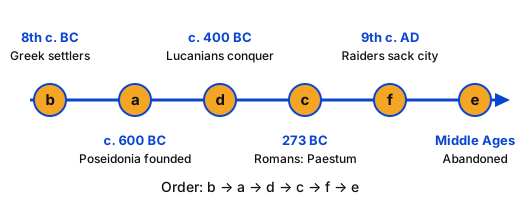
- b: Greek settlers from the 8th century BC; a: Poseidonia founded c. 600 BC.
- d: Lucanians conquer c. 400 BC; c: Roman rule 273 BC, renamed Paestum.
- f: sacked by Muslim raiders in the 9th century; e: finally abandoned in the Middle Ages – b a d c f e.
Trick: Only option (A) starts with 'b a d' – quick elimination.
Answer: (A) b a d c f e
अवधारणा: कालक्रम – गद्यांश की तिथियों के अनुसार घटनाएँ क्रमबद्ध करें।
- b: 8वीं सदी BC से यूनानी बसने वाले; a: लगभग 600 BC में Poseidonia की स्थापना।
- d: लगभग 400 BC में Lucanians का कब्ज़ा; c: 273 BC में Roman शासन, नाम Paestum।
- f: 9वीं सदी में Muslim raiders द्वारा लूट; e: Middle Ages में परित्याग – b a d c f e।
ट्रिक: केवल विकल्प (A) 'b a d' से शुरू होता है – जल्दी elimination
उत्तर: (A) b a d c f e
SSC CPO Paper IIEnglish Language and ComprehensionReading ComprehensionSSC CPO Paper II 2025 · 30 Apr Shift 3
Read the given passage and answer the questions that follow. Shamsuddin and Ahmed Jallaluddin travelled with me to Ramanathapuram to enroll me in Schwartz High School and to arrange for my boarding there. Somehow, I did not take to the new setting. The town of Ramanathapuram was a thriving, factious town of some fifty thousand people, but the coherence and harmony of Rameswaram was absent. I missed my home and grabbed every opportunity to visit Rameswaram. The pull of educational opportunities at Ramanathapuram was not strong enough to nullify the attraction of poli, a South Indian sweet my mother made. In fact, she used to prepare twelve distinctly different varieties of it, bringing out the flavour of every single ingredient used in the best possible combinations.
Despite my homesickness, I was determined to come to terms with the new environment because I knew my father had invested great hopes in my success. My father visualised me as a Collector in the making and I thought it my duty to realise my father’s dream, although I desperately missed the familiarity, security and comforts of Rameswaram. Jallaluddin used to speak to me about the power of positive thinking and I often recalled his words when I felt homesick or dejected. I tried hard to do as he said, which was to strive to control my thoughts and my mind and, through these, to influence my destiny. Ironically, that destiny did not lead me back to Rameswaram, but rather, swept me farther away from the home of my childhood.
Once I settled down at the Schwartz High School, Ramanathapuram, the enthusiastic fifteen-year-old within me re-emerged. My teacher, Iyadurai Solomon, was an ideal guide for an eager young mind that was yet uncertain of the possibilities and alternatives that lay before it. He made his students feel very comfortable in class with his warm and open- minded attitude. He used to say that a good student could learn more from a bad teacher than a poor student from even a skilled teacher.
Q46.In the first three paragraphs of the passage, what is the recurring thought in the mind of the author?
- AThe power of positive thinking
- BThe father’s expectations of his son
- CHomesickness and wish to adjust
- DJoining a new school
Show answer
Concept: Recurring thought – the idea present across the paragraphs.
- Para 1: 'I missed my home' – homesickness. Para 2: 'Despite my homesickness, I was determined to come to terms with the new environment'.
- Para 3: 'Once I settled down…' – he adjusts. So the recurring thought is homesickness and the wish to adjust.
Trick: Recurring = appears again and again – 'homesick' occurs repeatedly.
Answer: (C) Homesickness and wish to adjust
अवधारणा: बार-बार आने वाला विचार – अनुच्छेदों में मौजूद भाव।
- अनुच्छेद 1: 'I missed my home' – घर की याद। अनुच्छेद 2: 'Despite my homesickness, I was determined to come to terms with the new environment'।
- अनुच्छेद 3: 'Once I settled down…' – वह ढल जाता है। अतः भाव: homesickness और adjust करने की इच्छा।
ट्रिक: Recurring = बार-बार – 'homesick' शब्द कई बार आया
उत्तर: (C) Homesickness and wish to adjust
SSC CPO Paper IIEnglish Language and ComprehensionReading ComprehensionSSC CPO Paper II 2025 · 30 Apr Shift 3
Read the given passage and answer the questions that follow. Shamsuddin and Ahmed Jallaluddin travelled with me to Ramanathapuram to enroll me in Schwartz High School and to arrange for my boarding there. Somehow, I did not take to the new setting. The town of Ramanathapuram was a thriving, factious town of some fifty thousand people, but the coherence and harmony of Rameswaram was absent. I missed my home and grabbed every opportunity to visit Rameswaram. The pull of educational opportunities at Ramanathapuram was not strong enough to nullify the attraction of poli, a South Indian sweet my mother made. In fact, she used to prepare twelve distinctly different varieties of it, bringing out the flavour of every single ingredient used in the best possible combinations.
Despite my homesickness, I was determined to come to terms with the new environment because I knew my father had invested great hopes in my success. My father visualised me as a Collector in the making and I thought it my duty to realise my father’s dream, although I desperately missed the familiarity, security and comforts of Rameswaram. Jallaluddin used to speak to me about the power of positive thinking and I often recalled his words when I felt homesick or dejected. I tried hard to do as he said, which was to strive to control my thoughts and my mind and, through these, to influence my destiny. Ironically, that destiny did not lead me back to Rameswaram, but rather, swept me farther away from the home of my childhood.
Once I settled down at the Schwartz High School, Ramanathapuram, the enthusiastic fifteen-year-old within me re-emerged. My teacher, Iyadurai Solomon, was an ideal guide for an eager young mind that was yet uncertain of the possibilities and alternatives that lay before it. He made his students feel very comfortable in class with his warm and open- minded attitude. He used to say that a good student could learn more from a bad teacher than a poor student from even a skilled teacher.
Q47.According to the teacher, Iyadurai Solomon, what was most important for learning?
- ATo be a good student
- BA good teacher
- CTo be comfortable in class
- DTo be open-minded
Show answer
Concept: Inference from the teacher's saying.
- Solomon said 'a good student could learn more from a bad teacher than a poor student from even a skilled teacher'.
- So the student's own quality matters most – being a good student; comfort and open-mindedness describe his teaching style.
Trick: Good student + bad teacher beats poor student + skilled teacher → the student matters.
Answer: (A) To be a good student
अवधारणा: शिक्षक के कथन से अनुमान।
- Solomon कहते थे 'a good student could learn more from a bad teacher than a poor student from even a skilled teacher'।
- अर्थात सबसे महत्त्वपूर्ण है विद्यार्थी का अच्छा होना; comfort और open-mindedness उनकी शिक्षण शैली थी।
ट्रिक: अच्छा छात्र + कमज़ोर शिक्षक > कमज़ोर छात्र + कुशल शिक्षक → छात्र मायने रखता है
उत्तर: (A) To be a good student
SSC CPO Paper IIEnglish Language and ComprehensionReading ComprehensionSSC CPO Paper II 2025 · 30 Apr Shift 3
Read the given passage and answer the questions that follow. Shamsuddin and Ahmed Jallaluddin travelled with me to Ramanathapuram to enroll me in Schwartz High School and to arrange for my boarding there. Somehow, I did not take to the new setting. The town of Ramanathapuram was a thriving, factious town of some fifty thousand people, but the coherence and harmony of Rameswaram was absent. I missed my home and grabbed every opportunity to visit Rameswaram. The pull of educational opportunities at Ramanathapuram was not strong enough to nullify the attraction of poli, a South Indian sweet my mother made. In fact, she used to prepare twelve distinctly different varieties of it, bringing out the flavour of every single ingredient used in the best possible combinations.
Despite my homesickness, I was determined to come to terms with the new environment because I knew my father had invested great hopes in my success. My father visualised me as a Collector in the making and I thought it my duty to realise my father’s dream, although I desperately missed the familiarity, security and comforts of Rameswaram. Jallaluddin used to speak to me about the power of positive thinking and I often recalled his words when I felt homesick or dejected. I tried hard to do as he said, which was to strive to control my thoughts and my mind and, through these, to influence my destiny. Ironically, that destiny did not lead me back to Rameswaram, but rather, swept me farther away from the home of my childhood.
Once I settled down at the Schwartz High School, Ramanathapuram, the enthusiastic fifteen-year-old within me re-emerged. My teacher, Iyadurai Solomon, was an ideal guide for an eager young mind that was yet uncertain of the possibilities and alternatives that lay before it. He made his students feel very comfortable in class with his warm and open- minded attitude. He used to say that a good student could learn more from a bad teacher than a poor student from even a skilled teacher.
Q48.After reading the given passage it can be inferred that it is an extract from:
- Aa travelogue
- Ban article
- Can autobiography
- Da biography
Show answer
Concept: Literary form – first-person account of one's own life.
- The writer uses 'I', 'my father', 'my mother' and describes his own school days – an autobiography (extract from A.P.J. Abdul Kalam's 'Wings of Fire').
- A biography is written by someone else about a person; it is not a travelogue or article.
Trick: First person 'I' about own life → autobiography.
Answer: (C) an autobiography
अवधारणा: साहित्यिक रूप – अपने जीवन का प्रथम-पुरुष वर्णन।
- लेखक 'I', 'my father', 'my mother' का प्रयोग कर अपने स्कूली दिनों का वर्णन करता है – आत्मकथा (autobiography), A.P.J. Abdul Kalam की 'Wings of Fire' से।
- Biography किसी और द्वारा लिखी जाती है; यह travelogue या article नहीं।
ट्रिक: 'I' में अपना जीवन → autobiography
उत्तर: (C) an autobiography
SSC CPO Paper IIEnglish Language and ComprehensionReading ComprehensionSSC CPO Paper II 2025 · 30 Apr Shift 3
Read the given passage and answer the questions that follow. Shamsuddin and Ahmed Jallaluddin travelled with me to Ramanathapuram to enroll me in Schwartz High School and to arrange for my boarding there. Somehow, I did not take to the new setting. The town of Ramanathapuram was a thriving, factious town of some fifty thousand people, but the coherence and harmony of Rameswaram was absent. I missed my home and grabbed every opportunity to visit Rameswaram. The pull of educational opportunities at Ramanathapuram was not strong enough to nullify the attraction of poli, a South Indian sweet my mother made. In fact, she used to prepare twelve distinctly different varieties of it, bringing out the flavour of every single ingredient used in the best possible combinations.
Despite my homesickness, I was determined to come to terms with the new environment because I knew my father had invested great hopes in my success. My father visualised me as a Collector in the making and I thought it my duty to realise my father’s dream, although I desperately missed the familiarity, security and comforts of Rameswaram. Jallaluddin used to speak to me about the power of positive thinking and I often recalled his words when I felt homesick or dejected. I tried hard to do as he said, which was to strive to control my thoughts and my mind and, through these, to influence my destiny. Ironically, that destiny did not lead me back to Rameswaram, but rather, swept me farther away from the home of my childhood.
Once I settled down at the Schwartz High School, Ramanathapuram, the enthusiastic fifteen-year-old within me re-emerged. My teacher, Iyadurai Solomon, was an ideal guide for an eager young mind that was yet uncertain of the possibilities and alternatives that lay before it. He made his students feel very comfortable in class with his warm and open- minded attitude. He used to say that a good student could learn more from a bad teacher than a poor student from even a skilled teacher.
Q49.‘The town of Ramanathapuram was a thriving, factious town.’ Here ‘factious’ means:
- Awhere people lived in harmony
- Bwhere people were divided
- Cwhere people were rich
- Dwhere people were dissatisfied
Show answer
Concept: Vocabulary in context – 'factious' comes from 'faction' (a group within a group).
- 'Factious' = full of factions, divided by quarrelling groups.
- The next line confirms: 'the coherence and harmony of Rameswaram was absent' – so people were divided, not in harmony.
- Do not confuse with 'factitious' (artificial) or 'fractious' (irritable).
Trick: faction → factious = divided into groups.
Answer: (B) where people were divided
अवधारणा: संदर्भ में शब्दार्थ – 'factious' 'faction' (गुट) से बना है।
- 'Factious' = गुटों से भरा, आपसी झगड़ों से बँटा हुआ।
- अगली पंक्ति: 'the coherence and harmony of Rameswaram was absent' – लोग बँटे थे, सद्भाव में नहीं।
- 'factitious' (कृत्रिम) या 'fractious' (चिड़चिड़ा) से न मिलाएँ।
ट्रिक: faction → factious = गुटों में बँटा
उत्तर: (B) where people were divided
SSC CPO Paper IIEnglish Language and ComprehensionReading ComprehensionSSC CPO Paper II 2025 · 30 Apr Shift 3
Read the given passage and answer the questions that follow. Shamsuddin and Ahmed Jallaluddin travelled with me to Ramanathapuram to enroll me in Schwartz High School and to arrange for my boarding there. Somehow, I did not take to the new setting. The town of Ramanathapuram was a thriving, factious town of some fifty thousand people, but the coherence and harmony of Rameswaram was absent. I missed my home and grabbed every opportunity to visit Rameswaram. The pull of educational opportunities at Ramanathapuram was not strong enough to nullify the attraction of poli, a South Indian sweet my mother made. In fact, she used to prepare twelve distinctly different varieties of it, bringing out the flavour of every single ingredient used in the best possible combinations.
Despite my homesickness, I was determined to come to terms with the new environment because I knew my father had invested great hopes in my success. My father visualised me as a Collector in the making and I thought it my duty to realise my father’s dream, although I desperately missed the familiarity, security and comforts of Rameswaram. Jallaluddin used to speak to me about the power of positive thinking and I often recalled his words when I felt homesick or dejected. I tried hard to do as he said, which was to strive to control my thoughts and my mind and, through these, to influence my destiny. Ironically, that destiny did not lead me back to Rameswaram, but rather, swept me farther away from the home of my childhood.
Once I settled down at the Schwartz High School, Ramanathapuram, the enthusiastic fifteen-year-old within me re-emerged. My teacher, Iyadurai Solomon, was an ideal guide for an eager young mind that was yet uncertain of the possibilities and alternatives that lay before it. He made his students feel very comfortable in class with his warm and open- minded attitude. He used to say that a good student could learn more from a bad teacher than a poor student from even a skilled teacher.
Q50.Which person in the author’s life guided him to control his thinking?
- AShamsuddin
- BHis teacher in the new school
- CJallaluddin
- DHis father
Show answer
Concept: Factual detail – who taught him to control his thoughts.
- 'Jallaluddin used to speak to me about the power of positive thinking… which was to strive to control my thoughts and my mind'.
- His teacher Solomon made students comfortable; his father hoped he would become a Collector; Shamsuddin only accompanied him.
Trick: Positive thinking / control of mind → Jallaluddin.
Answer: (C) Jallaluddin
अवधारणा: तथ्यात्मक प्रश्न – विचारों पर नियंत्रण किसने सिखाया।
- 'Jallaluddin used to speak to me about the power of positive thinking… which was to strive to control my thoughts and my mind'।
- शिक्षक Solomon छात्रों को सहज करते थे; पिता उन्हें Collector देखना चाहते थे; Shamsuddin केवल साथ गए थे।
ट्रिक: Positive thinking / मन पर नियंत्रण → Jallaluddin
उत्तर: (C) Jallaluddin
SSC CPO Paper IIEnglish Language and ComprehensionReading ComprehensionSSC CPO Paper II 2025 · 30 Apr Shift 3
Q51.Sentences of a paragraph are given below. While the first and the last sentences (A and F) are in the correct order, the sentences in between are jumbled up. Arrange the sentences in the correct order to form a meaningful and coherent paragraph.
A. The clerk drew the book towards him again and began turning over the leaves, and all at once, as though by chance, lifted his eyes to Voldyrev. B. “Ah... what do you want?” he asked.
C. His nose began to shine, turned red and wrinkled up in a grin. D. “With pleasure! The Gugulin case, isn't it? What is it then exactly?” E. “I want to make an inquiry in reference to my case… My name is Voldyrev.” F. Voldyrev explained his business.
- ABDEC
- BCBED
- CECDB
- DCDBE
Show answer
Concept: In a narrative, physical reactions and dialogue follow in a natural order: look → reaction → question → reply → response.
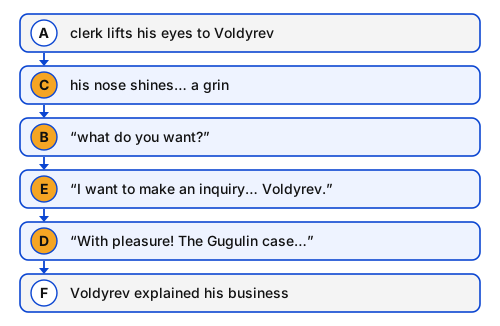
- A ends with the clerk lifting his eyes to Voldyrev; C describes his face reacting at once — 'His nose began to shine… in a grin'.
- Then the clerk speaks: B 'Ah... what do you want?' he asked.
- E is Voldyrev's reply to that question: 'I want to make an inquiry… My name is Voldyrev.'
- D is the clerk's response to the name: 'With pleasure! The Gugulin case…', which leads to F 'Voldyrev explained his business.'
Trick: A question (B) must come before its answer (E); a reply that asks 'What is it exactly?' (D) leads into the explanation (F).
Answer: (B) CBED
अवधारणा: कहानी में क्रम स्वाभाविक होता है: देखना → चेहरे की प्रतिक्रिया → प्रश्न → उत्तर → जवाब।
- A में clerk Voldyrev की ओर आँखें उठाता है; तुरंत C में उसके चेहरे की प्रतिक्रिया है — 'His nose began to shine… in a grin'।
- फिर clerk पूछता है: B 'Ah... what do you want?'
- E इस प्रश्न का उत्तर है: 'I want to make an inquiry… My name is Voldyrev.'
- D नाम सुनकर clerk की प्रतिक्रिया है ('The Gugulin case… What is it then exactly?'), जिसके बाद F 'Voldyrev explained his business' आता है।
ट्रिक: प्रश्न (B) हमेशा उत्तर (E) से पहले; 'What is it exactly?' (D) के बाद ही explanation (F)।
उत्तर: (B) CBED
SSC CPO Paper IIEnglish Language and ComprehensionPara JumblesSSC CPO Paper II 2025 · 30 Apr Shift 3
Q52.Sentences of a paragraph are given below. While the first and the last sentences (A and F) are in the correct order, the sentences in between are jumbled up. Arrange the sentences in the correct order to form a meaningful and coherent paragraph.
A. Through the window of the compartment, I watched the countryside slip past. B. From a distance, the men in the fields in their white dhotis and turbans and the womenfolk in
bright splashes of colour against the green background of paddy fields seemed to inhabit some beautiful painting.
C. Almost everywhere, people were engaged in some activity which had a rhythm and tranquillity about it—men driving cattle, women fetching water from streams.
D. It is astonishing how the landscape changes as one moves northwards. E. Occasionally, a child would appear and wave at the train. F. The rich and fertile plains of the river Ganga and its numerous tributaries have invited invasion, turmoil and change.
- AECDB
- BBDEC
- CCBDE
- DBCED
Show answer
Concept: Descriptive passages move from what is seen nearby to a general comment, and then to the wider theme.
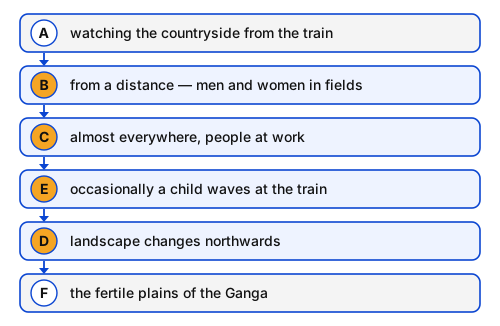
- A: the writer watches the countryside from the train window — B gives the first view 'From a distance… the men in the fields…'.
- C widens it: 'Almost everywhere, people were engaged in some activity…'.
- E adds a small detail of the same scene: 'Occasionally, a child would appear and wave at the train.'
- D shifts to a general remark — 'the landscape changes as one moves northwards' — which leads to F about the Ganga plains.
Trick: The general statement (D) is the bridge to the closing sentence (F) about the northern plains.
Answer: (D) BCED
अवधारणा: वर्णनात्मक अनुच्छेद पहले दिखने वाले दृश्य, फिर सामान्य टिप्पणी और अंत में बड़े विषय की ओर बढ़ता है।
- A: लेखक ट्रेन की खिड़की से देहात देख रहा है — B पहला दृश्य देता है 'From a distance… the men in the fields…'।
- C दृश्य को फैलाता है: 'Almost everywhere, people were engaged in some activity…'।
- E उसी दृश्य का छोटा विवरण है: 'Occasionally, a child would appear and wave at the train.'
- D सामान्य टिप्पणी है — 'the landscape changes as one moves northwards' — जो F (गंगा के मैदान) तक ले जाती है।
ट्रिक: Last sentence से ठीक पहले वाला वाक्य (D) उसका bridge होता है।
उत्तर: (D) BCED
SSC CPO Paper IIEnglish Language and ComprehensionPara JumblesSSC CPO Paper II 2025 · 30 Apr Shift 3
Q53.The following sentence has been split into four segments. Identify the segment that contains a grammatical error.
The Calcutta High Court ordered / the formation of a special investigation team / probing the attack on / Enforcement Directorate officials in West Bengal.
- Athe formation of a special investigation team
- BThe Calcutta High Court ordered
- CEnforcement Directorate officials in West Bengal
- Dprobing the attack on
Show answer
Concept: Verbs like 'order' take 'the formation of a team to + verb' to show purpose; a participle ('probing') does not fit here.
- The court ordered a team to be formed for a purpose — to probe the attack.
- Purpose is expressed by the to-infinitive: 'a special investigation team to probe the attack on…'.
- 'probing' wrongly suggests the team was already probing; so the segment 'probing the attack on' has the error.
- The other segments are correct.
Trick: Purpose of a newly formed body → 'to + V1' (a team to probe, a committee to study).
Answer: (D) probing the attack on
अवधारणा: 'order the formation of a team' के बाद उद्देश्य (purpose) बताने के लिए 'to + verb' आता है; 'probing' यहाँ ठीक नहीं।
- Court ने एक team बनाने का आदेश दिया — एक उद्देश्य से: हमले की जाँच करने के लिए।
- उद्देश्य to-infinitive से बताया जाता है: 'a special investigation team to probe the attack on…'।
- 'probing' से लगता है कि team पहले से जाँच कर रही है; इसलिए 'probing the attack on' में त्रुटि है।
- बाकी भाग सही हैं।
ट्रिक: नई बनी संस्था का उद्देश्य → 'to + V1' (a team to probe)।
उत्तर: (D) probing the attack on
SSC CPO Paper IIEnglish Language and ComprehensionError SpottingSSC CPO Paper II 2025 · 30 Apr Shift 3
Q54.Select the option that will improve the underlined part of the given sentence. In case no improvement is needed, select ‘No improvement required’. The cat lied on the cosy blanket, purring softly.
- ANo improvement required
- BThe cat lied in
- CThe cat lay on
- DThe cat laid at
Show answer
Concept: 'Lie' (to rest in a flat position) is an intransitive verb: lie – lay – lain. 'Lie' (to tell a lie) is lie – lied – lied. 'Lay' (to put something down) is transitive: lay – laid – laid.
- The cat was resting on the blanket, so we need the past of 'lie' (rest) = lay.
- 'lied' means 'told a lie' — wrong meaning.
- 'laid' needs an object (laid the book) and 'at the blanket' is a wrong preposition.
- So: 'The cat lay on the cosy blanket, purring softly.'
Yaad rakhein: Rest → lie/lay/lain; Put → lay/laid/laid; Untruth → lie/lied/lied.
Answer: (C) The cat lay on
अवधारणा: 'Lie' (लेटना) intransitive है: lie – lay – lain। 'Lie' (झूठ बोलना): lie – lied – lied। 'Lay' (कुछ रखना) transitive है: lay – laid – laid।
- बिल्ली कंबल पर लेटी थी, इसलिए 'lie' (लेटना) का past = lay चाहिए।
- 'lied' का अर्थ 'झूठ बोला' है — गलत।
- 'laid' को object चाहिए (laid the book) और 'at the blanket' गलत preposition है।
- सही: 'The cat lay on the cosy blanket, purring softly.'
याद रखें: लेटना → lie/lay/lain; रखना → lay/laid/laid; झूठ → lie/lied/lied।
उत्तर: (C) The cat lay on
SSC CPO Paper IIEnglish Language and ComprehensionVerb forms: lie / laySSC CPO Paper II 2025 · 30 Apr Shift 3
Q55.Select the option that can be used as a one-word substitute for the given group of words.
An optical instrument designed to make distant objects appear nearer
- AKaleidoscope
- BTelescope
- CMagnifying glass
- DMicroscope
Show answer
Concept: Optical instruments are named by what they do: 'tele' = far, 'micro' = small, 'kaleido' = beautiful forms.
- A telescope makes distant objects (stars, planets) appear nearer and larger.
- Microscope — makes very small, near objects visible.
- Magnifying glass — a single lens that enlarges nearby objects.
- Kaleidoscope — a tube of mirrors producing changing coloured patterns.
Trick: Tele = far (telephone, television, telescope).
Answer: (B) Telescope
अवधारणा: प्रकाशीय यंत्रों के नाम उनके काम से बनते हैं: 'tele' = दूर, 'micro' = छोटा।
- Telescope (दूरबीन) दूर की वस्तुओं (तारे, ग्रह) को पास और बड़ा दिखाता है।
- Microscope (सूक्ष्मदर्शी) — बहुत छोटी वस्तुएँ दिखाता है।
- Magnifying glass — पास की वस्तु को बड़ा दिखाने वाला लेंस।
- Kaleidoscope — दर्पणों वाली नली जिसमें रंगीन बदलते पैटर्न दिखते हैं।
ट्रिक: Tele = दूर (telephone, television, telescope)।
उत्तर: (B) Telescope
SSC CPO Paper IIEnglish Language and ComprehensionOne Word SubstitutionSSC CPO Paper II 2025 · 30 Apr Shift 3
Q56.Sentences of a paragraph are given below. While the first and the last sentences (A and F) are in the correct order, the sentences in between are jumbled up. Arrange the sentences in the correct order to form a meaningful and coherent paragraph.
A. Day after day we wandered on with the caravans and pitched our little mountaineer’s tent alongside theirs.
B. The only thing that disturbed us was the extreme slowness of our progress. C. We thought ourselves very lucky to be allowed to join the caravans. D. Compared with our previous marches, we seemed to be gently strolling along. E. The nomads start early, and after covering three or four miles, pitch their tents again and send their animals out to graze.
F. Before nightfall they bring them in and fold them near the tents, where they are safe from wolves and can ruminate in peace.
- ACBED
- BECDB
- CCBDE
- DBDEC
Show answer
Concept: Follow the writer's feelings and then the reason for them, before describing the nomads' routine that F completes.
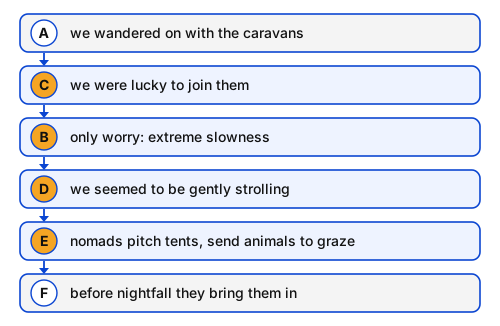
- A: they travel with the caravans — C gives their feeling: 'We thought ourselves very lucky to be allowed to join'.
- B adds the one drawback: 'The only thing that disturbed us was the extreme slowness'.
- D explains the slowness by comparison: 'we seemed to be gently strolling along'.
- E describes why the caravan is slow — the nomads pitch tents again after three or four miles and send animals to graze; F continues: 'Before nightfall they bring them in…'.
Trick: Pronoun link: 'them' in F = the animals in E, so E must sit just before F.
Answer: (C) CBDE
अवधारणा: पहले लेखक की भावना, फिर उसकी कमी और कारण, और अंत में खानाबदोशों की दिनचर्या जिसे F पूरा करता है।
- A: वे caravans के साथ चलते हैं — C उनकी भावना: 'We thought ourselves very lucky…'।
- B एकमात्र परेशानी बताता है: 'the extreme slowness of our progress'।
- D धीमेपन की तुलना करता है: 'we seemed to be gently strolling along'।
- E कारण है — nomads तीन-चार मील बाद फिर तंबू लगाते हैं और जानवर चराने भेजते हैं; F: 'Before nightfall they bring them in…'।
ट्रिक: F का 'them' = E के animals, इसलिए E ठीक F से पहले आएगा।
उत्तर: (C) CBDE
SSC CPO Paper IIEnglish Language and ComprehensionPara JumblesSSC CPO Paper II 2025 · 30 Apr Shift 3
Q57.Select the most appropriate option to fill in the blank and complete the given idiom.
Cost an arm and a __________
- Afoot
- Bnose
- Chand
- Dleg
Show answer
Concept: The idiom 'cost an arm and a leg' means to be very expensive.
- Arm and leg are both precious parts of the body; paying 'an arm and a leg' means paying a huge price.
- Example: That designer watch cost him an arm and a leg.
- 'foot', 'nose' and 'hand' do not complete this fixed expression.
Yaad rakhein: Pair of limbs: arm + leg = very costly.
Answer: (D) leg
अवधारणा: मुहावरा 'cost an arm and a leg' का अर्थ है — बहुत महँगा होना।
- हाथ और पैर दोनों कीमती अंग हैं; 'an arm and a leg' देना = बहुत बड़ी कीमत चुकाना।
- उदाहरण: That designer watch cost him an arm and a leg.
- 'foot', 'nose', 'hand' इस fixed मुहावरे में नहीं आते।
याद रखें: Arm + leg = बहुत महँगा।
उत्तर: (D) leg
SSC CPO Paper IIEnglish Language and ComprehensionIdioms and PhrasesSSC CPO Paper II 2025 · 30 Apr Shift 3
Q58.Select the option that will improve the underlined part of the given sentence. In case no improvement is needed, select ‘No improvement required’. She can speak fluently in French, German and Italian; her linguistic skills are impressing.
- ANo improvement required
- Bher linguistic skills are impressed
- Cher linguistic skills are impressive
- Dher linguistical skills are impressing
Show answer
Concept: '-ing' participial adjectives describe the thing that causes a feeling; '-ive'/'-ed' forms have other uses. The adjective from 'impress' that means 'causing admiration' is 'impressive'.
- 'Impressing' is the participle of the verb (He is impressing the judges), not an adjective for skills.
- 'Impressed' describes a person who feels admiration (I am impressed).
- Skills that cause admiration are impressive.
- 'linguistical' is not a standard word; the adjective is 'linguistic'.
Trick: Thing that wins admiration → impressive; person who feels it → impressed.
Answer: (C) her linguistic skills are impressive
अवधारणा: प्रशंसा पैदा करने वाली चीज़ के लिए 'impress' का विशेषण 'impressive' है।
- 'Impressing' क्रिया का participle है (He is impressing the judges), skills का विशेषण नहीं।
- 'Impressed' उस व्यक्ति के लिए है जो प्रभावित होता है (I am impressed)।
- जो skills प्रभावित करें वे impressive हैं।
- 'linguistical' मानक शब्द नहीं; सही विशेषण 'linguistic' है।
ट्रिक: प्रभावित करने वाली चीज़ → impressive; प्रभावित व्यक्ति → impressed।
उत्तर: (C) her linguistic skills are impressive
SSC CPO Paper IIEnglish Language and ComprehensionParticipial adjectivesSSC CPO Paper II 2025 · 30 Apr Shift 3
Q59.Select the most appropriate option to fill in the blanks. At the party last night, I found her engrossed in __________ conversation with _______ renowned scientist.
- Aa; no word
- Bthe; a
- Cthe; the
- Da; a
Show answer
Concept: Use 'a/an' before a singular countable noun mentioned for the first time or in a general sense; 'the' for something specific already known.
- 'conversation' here is one unspecified conversation → a conversation ('engrossed in a conversation').
- 'renowned scientist' starts with a consonant sound /r/ and is not identified earlier → a renowned scientist.
- 'the' would wrongly suggest that the listener already knows which conversation and which scientist.
Trick: First mention + singular countable + consonant sound → 'a'.
Answer: (D) a; a
अवधारणा: किसी singular countable noun का पहली बार या सामान्य रूप में उल्लेख हो तो 'a/an'; पहले से ज्ञात विशेष वस्तु के लिए 'the'।
- 'conversation' कोई अनिर्दिष्ट बातचीत है → a conversation।
- 'renowned scientist' consonant ध्वनि /r/ से शुरू होता है और पहले से ज्ञात नहीं → a renowned scientist।
- 'the' लगाने से लगेगा कि सुनने वाला पहले से जानता है कौन-सी बातचीत/कौन-सा वैज्ञानिक — गलत।
ट्रिक: पहला उल्लेख + singular countable + consonant ध्वनि → 'a'।
उत्तर: (D) a; a
SSC CPO Paper IIEnglish Language and ComprehensionFill in the BlanksSSC CPO Paper II 2025 · 30 Apr Shift 3
Q60.Select the most appropriate option to fill in the blanks. When I met Sarah at a café, _____ learnt that ______ had visited Japan last month.
- AI; she
- Bshe; she
- CI; we
- Dyou; I
Show answer
Concept: Pronouns must agree with who is speaking and who is being talked about.
- The speaker says 'When I met Sarah', so the person who learnt the news is the speaker → I learnt.
- The one who visited Japan is Sarah, a female third person → she had visited Japan.
- 'she; she' changes the speaker; 'I; we' and 'you; I' do not fit the meaning.
Trick: Keep the pronoun of the main clause same as 'I met' → 'I learnt'.
Answer: (A) I; she
अवधारणा: सर्वनाम (pronoun) बोलने वाले और जिसके बारे में बात हो रही है, उसके अनुसार होने चाहिए।
- वक्ता कहता है 'When I met Sarah', इसलिए जानकारी पाने वाला वही है → I learnt।
- Japan गई थी Sarah (स्त्रीलिंग, third person) → she had visited Japan।
- 'she; she' से वक्ता बदल जाता है; 'I; we' और 'you; I' अर्थ में फिट नहीं।
ट्रिक: 'I met' वाला ही 'I learnt' करेगा।
उत्तर: (A) I; she
SSC CPO Paper IIEnglish Language and ComprehensionFill in the BlanksSSC CPO Paper II 2025 · 30 Apr Shift 3

