Q61.Select the option that expresses the given sentence in direct speech. Avika requested Kavya not to make noise as it disturbed her sleep.
- AAvika said to Kavya,” Do not make noise. It disturbs my sleep.”
- BAvika said to Kavya, “Can you stop making noise? It disturbs my sleep.”
- CAvika said to Kavya, “Please do not make noise. It disturbs my sleep.”
- DAvika told Kavya, “Please do not make noise. It disturbs her sleep.”
Show answer
Concept: 'Requested' in indirect speech becomes a polite imperative with 'Please' in direct speech; pronouns and tense return to the speaker's actual words.
- Reporting verb: 'requested' → 'said to'; add Please.
- 'not to make noise' → 'Please do not make noise.'
- 'it disturbed her sleep' → 'It disturbs my sleep.' (past → present; her → my, since Avika speaks).
- (A) lacks 'Please'; (B) is a question; (D) keeps 'her' and uses 'told' wrongly.
Trick: requested → Please; ordered → plain imperative; advised → You should.
Answer: (C) Avika said to Kavya, “Please do not make noise. It disturbs my sleep.”
अवधारणा: Indirect में 'requested' हो तो direct में 'Please' वाला विनम्र imperative बनता है; pronoun और tense वक्ता के मूल शब्दों में लौटते हैं।
- Reporting verb: 'requested' → 'said to'; Please जोड़ें।
- 'not to make noise' → 'Please do not make noise.'
- 'it disturbed her sleep' → 'It disturbs my sleep.' (past → present; her → my)।
- (A) में 'Please' नहीं; (B) प्रश्न है; (D) में 'her' और 'told' गलत हैं।
ट्रिक: requested → Please; ordered → सीधा आदेश; advised → You should।
उत्तर: (C) Avika said to Kavya, “Please do not make noise. It disturbs my sleep.”
SSC CPO Paper IIEnglish Language and ComprehensionDirect and Indirect SpeechSSC CPO Paper II 2025 · 30 Apr Shift 3
Q62.Select the option that will improve the underlined part of the given sentence. In case no improvement is needed, select ‘No improvement required’. People with Alzheimer are such forgetting as they are not able to carry out a conversation for long.
- Aso forgetful that
- BNo improvement required
- Cso forgetting that
- Dsuch forgetful as
Show answer
Concept: With an adjective, the result structure is 'so + adjective + that'; with a noun phrase it is 'such + (a) adjective + noun + that'.
- The adjective meaning 'tending to forget' is forgetful, not 'forgetting'.
- There is no noun after it, so we need 'so' (not 'such').
- A result clause follows, so 'that', not 'as' → 'so forgetful that they are not able to carry out a conversation for long.'
- 'such forgetful as' and 'so forgetting that' are both wrong.
Yaad rakhein: so + adj + that; such + (a) adj + noun + that.
Answer: (A) so forgetful that
अवधारणा: विशेषण के साथ परिणाम बताने की संरचना 'so + adjective + that' है; noun हो तो 'such + adjective + noun + that'।
- 'भूलने की आदत वाला' का विशेषण forgetful है, 'forgetting' नहीं।
- इसके बाद कोई noun नहीं, इसलिए 'so' (not 'such')।
- परिणाम-उपवाक्य के साथ 'that' आता है, 'as' नहीं → 'so forgetful that they are not able…'।
- 'such forgetful as' और 'so forgetting that' दोनों गलत हैं।
याद रखें: so + adj + that; such + adj + noun + that।
उत्तर: (A) so forgetful that
SSC CPO Paper IIEnglish Language and Comprehensionso … that structureSSC CPO Paper II 2025 · 30 Apr Shift 3
Q63.Sentences of a paragraph are given below in jumbled order. Arrange the sentences in the correct order to form a meaningful and coherent paragraph. A. One day, I was travelling by train from Bangalore to Belgaum. B. I was travelling by second class as that’s where one can meet lots of people who are eager to talk.
C. It is an overnight train and the only rail link between Bangalore and north Karnataka.
D. I have noticed, the more expensive the ticket, the lesser the co-travellers speak.
- ADBAC
- BADBC
- CCBAD
- DACBD
Show answer
Concept: A story opens with the event (time + journey), then details of the train, the class chosen, and finally the writer's general observation.
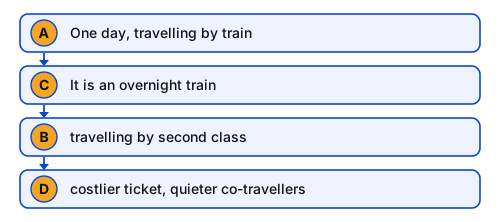
- A opens the story: 'One day, I was travelling by train from Bangalore to Belgaum.'
- C describes that train: 'It is an overnight train… the only rail link…'.
- B tells which class he chose and why: 'second class… people who are eager to talk'.
- D explains the reason further with an observation about expensive tickets, completing the idea of B.
Trick: 'One day…' is a classic opening; the pronoun 'It' in C refers to the train in A.
Answer: (D) ACBD
अवधारणा: कहानी घटना (समय + यात्रा) से शुरू होती है, फिर ट्रेन का विवरण, चुनी गई class और अंत में लेखक का सामान्य अवलोकन।
- A शुरुआत है: 'One day, I was travelling by train from Bangalore to Belgaum.'
- C उसी ट्रेन का विवरण है: 'It is an overnight train…'।
- B बताता है कौन-सी class और क्यों: 'second class… people who are eager to talk'।
- D महँगे टिकट वाली टिप्पणी से B के कारण को आगे बढ़ाता है।
ट्रिक: 'One day…' से शुरुआत; C का 'It' = A की train।
उत्तर: (D) ACBD
SSC CPO Paper IIEnglish Language and ComprehensionPara JumblesSSC CPO Paper II 2025 · 30 Apr Shift 3
Q64.Sentences of a paragraph are given below in jumbled order. Arrange the sentences in the correct order to form a meaningful and coherent paragraph. A. By day, he slept in the servants’ kitchen or made jokes with the cooks. B. At night, wrapped in an ample sheepskin, he walked round the grounds and tapped with his little mallet.
C. Vanka raised his eyes to the dark picture on which the light of his candle was reflected and vividly recalled his grandfather, Konstantin Makaritch, who was a night watchman to a family called Zhivarev.
D. He was a thin but extraordinarily nimble and lively little old man of sixty-five, with an everlastingly laughing face and drunken eyes.
- ABDAC
- BCADB
- CACBD
- DCDAB
Show answer
Concept: Introduce a person first, then describe him, then his routine (by day → at night).
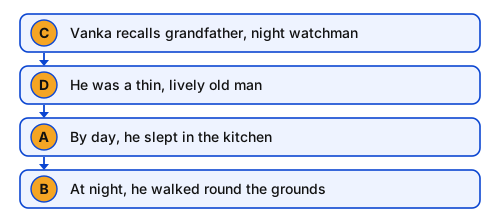
- C introduces the grandfather, Konstantin Makaritch, a night watchman — the only sentence that names him.
- D describes him: 'He was a thin but… nimble… little old man of sixty-five'.
- A gives his daytime routine: 'By day, he slept in the servants' kitchen…'.
- B follows with his night duty: 'At night… he walked round the grounds…', which suits a night watchman.
Trick: Name first (C), then 'He' sentences; 'By day' comes before 'At night'.
Answer: (D) CDAB
अवधारणा: पहले व्यक्ति का परिचय, फिर उसका वर्णन, फिर दिनचर्या (दिन → रात)।
- C दादा Konstantin Makaritch (night watchman) का परिचय देता है — उनका नाम केवल इसी में है।
- D उनका वर्णन: 'He was a thin but… nimble… little old man of sixty-five'।
- A दिन की दिनचर्या: 'By day, he slept in the servants' kitchen…'।
- B रात का काम: 'At night… he walked round the grounds…' — night watchman के अनुरूप।
ट्रिक: नाम पहले (C), फिर 'He' वाले वाक्य; 'By day' के बाद 'At night'।
उत्तर: (D) CDAB
SSC CPO Paper IIEnglish Language and ComprehensionPara JumblesSSC CPO Paper II 2025 · 30 Apr Shift 3
Q65.Select the most appropriate meaning of the given idiom. Turn a blind eye
- AIrritate
- BIgnore
- CInsult
- DAbuse
Show answer
Concept: 'Turn a blind eye (to something)' means to pretend not to notice something, usually something wrong.
- A 'blind eye' sees nothing — so you deliberately ignore what is happening.
- Example: The guard turned a blind eye to the late-comers.
- Irritate, Insult and Abuse describe annoying or hurting someone, not ignoring.
Yaad rakhein: Blind eye = choose not to see = ignore.
Answer: (B) Ignore
अवधारणा: 'Turn a blind eye (to something)' का अर्थ है — जानबूझकर अनदेखा करना, प्रायः किसी गलत बात को।
- 'Blind eye' कुछ नहीं देखती — यानी जानबूझकर नज़रअंदाज़ करना।
- उदाहरण: The guard turned a blind eye to the late-comers.
- Irritate, Insult, Abuse का अर्थ परेशान करना/अपमान करना है, अनदेखा करना नहीं।
याद रखें: Blind eye = देखना ही नहीं = Ignore।
उत्तर: (B) Ignore
SSC CPO Paper IIEnglish Language and ComprehensionIdioms and PhrasesSSC CPO Paper II 2025 · 30 Apr Shift 3
Q66.Sentences of a paragraph are given below in jumbled order. Arrange the sentences in the correct order to form a meaningful and coherent paragraph. A. He spoke very good English, 'Exactly like a "European"', which meant that few in the school could understand what he said.
B. Many of his classmates could not trust themselves to speak to him, their fund of broken English being small.
C. There were vague rumours in the school that Rajam had come from some English boys’ school somewhere in Madras.
D. Only Sankar, the genius of the class, had the courage to face him, though his English sounded halting and weak before that of Rajam.
- AACBD
- BCABD
- CCDBA
- DBDAC
Show answer
Concept: Introduce the new boy by name, describe his English, then show its effect on most classmates and finally the exception.
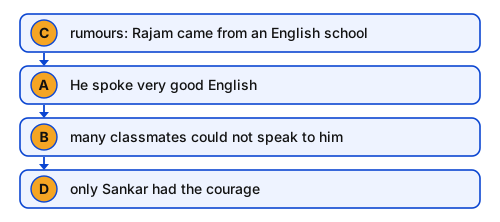
- C introduces Rajam and the rumour that he came from an English boys' school — the only sentence naming him.
- A follows naturally: 'He spoke very good English…', so few could understand him.
- B gives the effect: many classmates could not trust themselves to speak to him.
- D gives the exception: 'Only Sankar… had the courage to face him'.
Trick: 'Many could not…' (B) comes before 'Only Sankar…' (D) — the general group before the exception.
Answer: (B) CABD
अवधारणा: नए लड़के का नाम लेकर परिचय, फिर उसकी अंग्रेज़ी, फिर सहपाठियों पर असर और अंत में अपवाद।
- C Rajam और अफ़वाह का परिचय देता है कि वह English boys' school से आया — नाम केवल इसमें है।
- A: 'He spoke very good English…' — कम लोग समझ पाते थे।
- B असर: कई सहपाठी उससे बात करने का साहस नहीं कर पाते थे।
- D अपवाद: 'Only Sankar… had the courage to face him'।
ट्रिक: 'Many…' (B) पहले, 'Only Sankar…' (D) बाद में — पहले समूह, फिर अपवाद।
उत्तर: (B) CABD
SSC CPO Paper IIEnglish Language and ComprehensionPara JumblesSSC CPO Paper II 2025 · 30 Apr Shift 3
Q67.Sentences of a paragraph are given below in jumbled order. Arrange the sentences in the correct order to form a meaningful and coherent paragraph. A. Back home, Bipin Babu rang up Dr. Chanda and asked him to come over. B. Just then, the servant brought him a letter which someone had left in the letter box.
C. Then, after a shower, he got into bed with an ice bag clamped on his head. D. It was a greenish envelope with his name in red ink on it.
- AACBD
- BCBAD
- CADBC
- DDBAC
Show answer
Concept: Follow the time sequence of actions: coming home → calling the doctor → resting → an interruption.
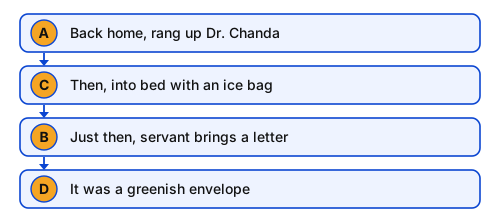
- A starts: 'Back home, Bipin Babu rang up Dr. Chanda…'.
- C continues with 'Then, after a shower, he got into bed with an ice bag…'.
- B: 'Just then, the servant brought him a letter…' — interrupts him while in bed.
- D describes that letter: 'It was a greenish envelope…'.
Trick: Time words guide the order: Back home → Then → Just then; 'It' in D = the letter in B.
Answer: (A) ACBD
अवधारणा: क्रियाओं का समय-क्रम: घर आना → डॉक्टर को फ़ोन → आराम → बीच में व्यवधान।
- A शुरुआत: 'Back home, Bipin Babu rang up Dr. Chanda…'।
- C: 'Then, after a shower, he got into bed with an ice bag…'।
- B: 'Just then, the servant brought him a letter…' — बिस्तर पर रहते समय।
- D उसी पत्र का वर्णन: 'It was a greenish envelope…'।
ट्रिक: समय-सूचक शब्द: Back home → Then → Just then; D का 'It' = B का letter।
उत्तर: (A) ACBD
SSC CPO Paper IIEnglish Language and ComprehensionPara JumblesSSC CPO Paper II 2025 · 30 Apr Shift 3
Q68.Sentences of a paragraph are given below. While the first and the last sentences (A and F) are in the correct order, the sentences in between are jumbled up. Arrange the sentences in the correct order to form a meaningful and coherent paragraph.
A. Till a few years back, I did not have a driver, and used to drive everywhere myself.
B. Some Saturdays I would take my car to that service station and stay there until it was serviced.
C. The petrol pump where I filled petrol from had a service station beside it. D. There were two boys, perhaps fourteen years of age, who worked there. E. They were identical twins.
F. One was called Ram and the other one was Gopal.
- AECDB
- BBDEC
- CCBED
- DCBDE
Show answer
Concept: Move from the place to the people in it, then add details about them that lead to their names in F.
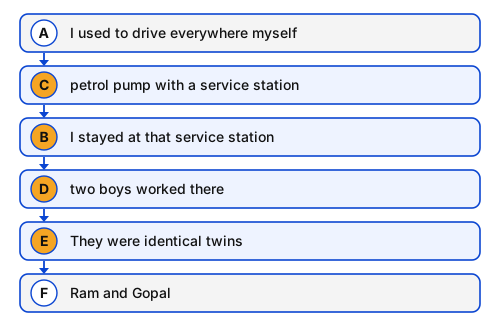
- A: he drove everywhere himself → C introduces the petrol pump with a service station.
- B: he would take his car to 'that service station' and stay there — 'that' points back to C.
- D introduces the two boys who worked there.
- E: 'They were identical twins', followed by F giving their names, Ram and Gopal.
Trick: Demonstrative link: 'that service station' (B) needs C before it; 'They' (E) needs 'two boys' (D).
Answer: (D) CBDE
अवधारणा: पहले स्थान, फिर वहाँ के लोग, फिर उनके बारे में विवरण जो F में उनके नाम तक ले जाता है।
- A: वह स्वयं गाड़ी चलाते थे → C petrol pump और उसके पास service station बताता है।
- B: 'that service station' — 'that' C की ओर इशारा करता है।
- D वहाँ काम करने वाले दो लड़कों का परिचय देता है।
- E: 'They were identical twins', फिर F में उनके नाम Ram और Gopal।
ट्रिक: 'that service station' (B) से पहले C; 'They' (E) से पहले 'two boys' (D)।
उत्तर: (D) CBDE
SSC CPO Paper IIEnglish Language and ComprehensionPara JumblesSSC CPO Paper II 2025 · 30 Apr Shift 3
Q69.Select the option that expresses the given sentence in passive voice. Why didn’t your mother pick you up today?
- AWhy haven’t you been picked up by your mother today?
- BWhy didn’t you be picked up by your mother today?
- CWhy wasn’t your mother picked up by you today?
- DWhy weren’t you picked up by your mother today?
Show answer
Concept: Passive of a simple-past question: (Wh-word) + was/were + (not) + subject + V3 + by + agent? 'Why didn't…' becomes 'Why wasn't/weren't…'.
- Object 'you' becomes the subject → takes 'were' → 'Why weren't you…'.
- Verb 'pick up' → past participle 'picked up'.
- Agent: 'by your mother'; time 'today' stays at the end.
- (A) changes the tense; (B) 'didn't you be' is ungrammatical; (C) reverses the meaning.
Trick: did/didn't (active) → was/were (+ not) + V3 (passive).
Answer: (D) Why weren’t you picked up by your mother today?
अवधारणा: Simple past प्रश्न का passive: (Wh-word) + was/were + (not) + subject + V3 + by + agent? 'Why didn't…' → 'Why wasn't/weren't…'।
- Object 'you' subject बनता है → 'were' लेता है → 'Why weren't you…'।
- Verb 'pick up' → V3 'picked up'।
- Agent: 'by your mother'; 'today' अंत में।
- (A) tense बदलता है; (B) 'didn't you be' अशुद्ध; (C) अर्थ उलट देता है।
ट्रिक: did/didn't (active) → was/were (+ not) + V3 (passive)।
उत्तर: (D) Why weren’t you picked up by your mother today?
SSC CPO Paper IIEnglish Language and ComprehensionActive and Passive VoiceSSC CPO Paper II 2025 · 30 Apr Shift 3
Q70.Select the option that can be used as a one-word substitute for the given group of words.
Make smaller or less in amount, degree, or size
- AReclaim
- BRefine
- CReduce
- DRecoup
Show answer
Concept: Words with the prefix 're-' have different meanings; choose the one meaning 'to make less'.
- Reduce = to make smaller or less in amount, degree or size (reduce the price, reduce speed).
- Reclaim = to get back something lost or taken.
- Refine = to remove impurities or improve.
- Recoup = to regain money or losses.
Trick: Reduce ↔ increase: the pair of opposites for 'less / more'.
Answer: (C) Reduce
अवधारणा: 're-' वाले शब्दों के अर्थ अलग-अलग हैं; 'कम करना' वाला शब्द चुनें।
- Reduce = मात्रा, स्तर या आकार में कम करना (reduce the price)।
- Reclaim = खोई हुई चीज़ वापस लेना।
- Refine = शुद्ध करना या सुधारना।
- Recoup = पैसा/नुकसान वापस पाना।
ट्रिक: Reduce ↔ increase (कम ↔ अधिक)।
उत्तर: (C) Reduce
SSC CPO Paper IIEnglish Language and ComprehensionOne Word SubstitutionSSC CPO Paper II 2025 · 30 Apr Shift 3
Q71.Select the option that will improve the underlined part of the given sentence. In case no improvement is needed, select ‘No improvement required’. By the end of the last year, he would have completed the design of his multipurpose agri-machine.
- Ahas completed
- Bhad completed
- CNo improvement required
- Dwould complete
Show answer
Concept: 'By + a past time' (by the end of last year) shows an action completed before that past point → past perfect (had + V3).
- 'last year' is already in the past.
- The design was finished before the end of that year → had completed.
- 'would have completed' is used for unreal/conditional ideas; 'has completed' (present perfect) cannot go with a past time; 'would complete' shows future-in-past.
- Correct: 'By the end of the last year, he had completed the design…'.
Trick: By + past time → had + V3; By + future time → will have + V3.
Answer: (B) had completed
अवधारणा: 'By + भूतकाल का समय' (by the end of last year) — उस समय से पहले पूरी हुई क्रिया → past perfect (had + V3)।
- 'last year' पहले ही बीत चुका है।
- Design उस वर्ष के अंत से पहले पूरा हो गया → had completed।
- 'would have completed' शर्त/काल्पनिक के लिए; 'has completed' भूतकाल के समय के साथ नहीं आता; 'would complete' future-in-past है।
- सही: 'By the end of the last year, he had completed the design…'।
ट्रिक: By + past time → had + V3; By + future time → will have + V3।
उत्तर: (B) had completed
SSC CPO Paper IIEnglish Language and ComprehensionPast perfect tenseSSC CPO Paper II 2025 · 30 Apr Shift 3
Q72.Sentences of a paragraph are given below in jumbled order. Arrange the sentences in the correct order to form a meaningful and coherent paragraph. A. I was struck by the objectivity and clarity of his thinking. B. The next day, Dr. Mediratta brought a visitor to our hovercraft—a tall, handsome, bearded man.
C. “Can you give me a ride in the machine?” he finally enquired. D. He asked me several questions about the machine.
- ABDAC
- BBCAD
- CACDB
- DCBAD
Show answer
Concept: Introduce the visitor, then his questions, the writer's impression, and finally his request.
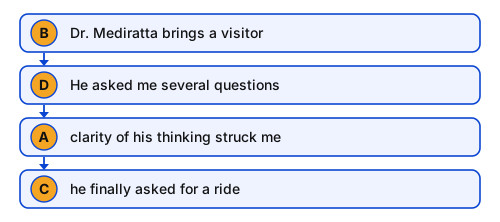
- B introduces the visitor — 'a tall, handsome, bearded man' — so it must come first.
- D: 'He asked me several questions about the machine.'
- A: the writer's impression of those questions — 'the objectivity and clarity of his thinking'.
- C: 'he finally enquired' about a ride — the last step.
Trick: 'finally' marks the closing sentence; 'He' in D needs the man introduced in B.
Answer: (A) BDAC
अवधारणा: पहले मेहमान का परिचय, फिर उसके प्रश्न, लेखक की राय और अंत में उसका अनुरोध।
- B मेहमान का परिचय देता है — 'a tall, handsome, bearded man' — इसलिए पहले।
- D: 'He asked me several questions about the machine.'
- A: उन प्रश्नों पर लेखक की राय — 'the objectivity and clarity of his thinking'।
- C: 'he finally enquired' — अंतिम वाक्य।
ट्रिक: 'finally' अंतिम वाक्य का संकेत; D का 'He' = B का व्यक्ति।
उत्तर: (A) BDAC
SSC CPO Paper IIEnglish Language and ComprehensionPara JumblesSSC CPO Paper II 2025 · 30 Apr Shift 3
Q73.Select the option that expresses the given sentence in reported speech. Kavya said to her mother, “Do you know that we got our school magazine today?”
- AKavya asked her mother that do you know that we got our school magazine today.
- BKavya asked her mother if she would be knowing that they had got their school magazine that day.
- CKavya asked her mother if she had known that they got their school magazine today.
- DKavya asked her mother if she knew that they had got their school magazine that day.
Show answer
Concept: Reporting a yes/no question: said to → asked; join with 'if/whether'; question becomes a statement; tenses go back; time words change.
- 'said to' → 'asked'; 'Do you know' → 'if she knew' (present → past).
- 'we got' → 'they had got' (past → past perfect); 'we/our' → 'they/their'.
- 'today' → 'that day'.
- (A) keeps the question form; (B) adds 'would be knowing'; (C) keeps 'today'.
Trick: Do you know → if she knew; got → had got; today → that day.
Answer: (D) Kavya asked her mother if she knew that they had got their school magazine that day.
अवधारणा: Yes/no प्रश्न का indirect: said to → asked; 'if/whether' से जोड़ें; प्रश्न को कथन बनाएँ; tense पीछे जाता है; समय-सूचक शब्द बदलते हैं।
- 'said to' → 'asked'; 'Do you know' → 'if she knew'।
- 'we got' → 'they had got'; 'we/our' → 'they/their'।
- 'today' → 'that day'।
- (A) प्रश्न रूप ही रखता है; (B) 'would be knowing' गलत; (C) में 'today' बचा है।
ट्रिक: Do you know → if she knew; got → had got; today → that day।
उत्तर: (D) Kavya asked her mother if she knew that they had got their school magazine that day.
SSC CPO Paper IIEnglish Language and ComprehensionDirect and Indirect SpeechSSC CPO Paper II 2025 · 30 Apr Shift 3
Q74.Select the option that expresses the given sentence in passive voice. The gardener is going to plant some tulips in the garden this year.
- ASome tulips are being planted in the garden this year.
- BSome tulips have been planted in the garden this year.
- CSome tulips will be planted in the garden this year.
- DSome tulips are going to be planted in the garden this year.
Show answer
Concept: 'be going to + V1' in the active becomes 'be going to be + V3' in the passive; the tense of 'be' stays the same.
- Object 'some tulips' (plural) → subject → 'Some tulips are going to be planted'.
- 'in the garden this year' stays; the agent 'by the gardener' may be dropped as it is obvious.
- (A) is present continuous, (B) present perfect, (C) simple future — they change the tense form.
Trick: is/are going to + V1 → is/are going to be + V3.
Answer: (D) Some tulips are going to be planted in the garden this year.
अवधारणा: Active में 'be going to + V1' हो तो passive में 'be going to be + V3'; 'be' का tense वही रहता है।
- Object 'some tulips' (plural) → subject → 'Some tulips are going to be planted'।
- 'in the garden this year' वैसे ही रहता है; 'by the gardener' स्पष्ट होने से छोड़ा जा सकता है।
- (A) present continuous, (B) present perfect, (C) simple future — tense बदल देते हैं।
ट्रिक: is/are going to + V1 → is/are going to be + V3।
उत्तर: (D) Some tulips are going to be planted in the garden this year.
SSC CPO Paper IIEnglish Language and ComprehensionActive and Passive VoiceSSC CPO Paper II 2025 · 30 Apr Shift 3
Q75.Select the option that expresses the given sentence in direct speech. Isha told Nitya that she could get her suit stitched at her shop and that it would be convenient for her.
- AIsha said to Nitya, “She could get her suit stitched at her shop and that it would be convenient for her.”
- BIsha said to Nitya, “You can get her suit stitched at my shop. It would be convenient for you.”
- CIsha said to Nitya, “You can get your suit stitched at my shop. It will be convenient for you.”
- DIsha said to Nitya, “You could get your suit stitched at her shop. It will be convenient for her.”
Show answer
Concept: Converting indirect to direct: use inverted commas, restore the speaker's pronouns (I/my, you/your), and change past forms back to present (could → can, would → will).
- Isha speaks to Nitya: 'her suit' (Nitya's) → your suit; 'her shop' (Isha's) → my shop.
- 'could get' → 'can get'; 'would be convenient' → 'will be convenient'.
- 'for her' (Nitya) → 'for you'; the two clauses become two sentences.
- (A) keeps indirect pronouns; (B) keeps 'her suit'; (D) keeps 'her shop' and 'for her'.
Trick: Listener's things → your; speaker's things → my.
Answer: (C) Isha said to Nitya, “You can get your suit stitched at my shop. It will be convenient for you.”
अवधारणा: Indirect से direct: inverted commas लगाएँ, वक्ता के pronoun (I/my, you/your) लौटाएँ, और past रूप को present करें (could → can, would → will)।
- Isha, Nitya से कहती है: 'her suit' (Nitya का) → your suit; 'her shop' (Isha की) → my shop।
- 'could get' → 'can get'; 'would be' → 'will be'।
- 'for her' (Nitya) → 'for you'।
- (A) में indirect pronoun; (B) में 'her suit'; (D) में 'her shop' और 'for her' गलत।
ट्रिक: सुनने वाले की चीज़ → your; बोलने वाले की → my।
उत्तर: (C) Isha said to Nitya, “You can get your suit stitched at my shop. It will be convenient for you.”
SSC CPO Paper IIEnglish Language and ComprehensionDirect and Indirect SpeechSSC CPO Paper II 2025 · 30 Apr Shift 3
Q76.The following sentence has been divided into parts. One of them may contain an error. Select the part that contains the error from the given options. If you don’t find any error, mark ‘No error’ as your answer.
My flight is scheduled / to take off / on 6:30 p.m.
- AMy flight is scheduled
- Bto take off
- Con 6:30 p.m.
- DNo error
Show answer
Concept: Preposition of time: 'at' for clock times, 'on' for days and dates, 'in' for months, years and parts of the day.
- 6:30 p.m. is a clock time → at 6:30 p.m.
- 'on 6:30 p.m.' is wrong; 'on' is for days/dates (on Monday, on 6 May).
- Correct: 'My flight is scheduled to take off at 6:30 p.m.'
Trick: AT time, ON day, IN month/year.
Answer: (C) on 6:30 p.m.
अवधारणा: समय के preposition: घड़ी के समय के लिए 'at', दिन/तारीख के लिए 'on', महीना/वर्ष/दिन के हिस्से के लिए 'in'।
- 6:30 p.m. घड़ी का समय है → at 6:30 p.m.
- 'on 6:30 p.m.' गलत; 'on' दिन/तारीख के लिए है (on Monday)।
- सही: 'My flight is scheduled to take off at 6:30 p.m.'
ट्रिक: AT समय, ON दिन, IN महीना/वर्ष।
उत्तर: (C) on 6:30 p.m.
SSC CPO Paper IIEnglish Language and ComprehensionError SpottingSSC CPO Paper II 2025 · 30 Apr Shift 3
Q77.Select the option that expresses the given sentence in direct speech. Anshuman exclaimed that he had lost his coat again.
- AAnshuman said, “Alas! I had lost my coat again!”
- BAnshuman said, “O God! How can I have lost my coat again!”
- CAnshuman said, “O God, I have lost my coat again!”
- DAnshuman said, “O God, he had lost his coat again!”
Show answer
Concept: 'exclaimed that' in indirect speech signals an exclamation (O God!/Alas!) in direct speech; the past perfect goes back to present perfect and pronouns return to the first person.
- Add an exclamation like 'O God,' and end with '!'.
- 'he had lost' → 'I have lost' (past perfect → present perfect); 'his coat' → 'my coat'.
- (A) keeps 'had lost'; (B) changes the meaning into a question-like 'How can I have…'; (D) keeps 'he… his'.
Trick: had + V3 (indirect) → have/has + V3 (direct) when the original was present perfect.
Answer: (C) Anshuman said, “O God, I have lost my coat again!”
अवधारणा: Indirect में 'exclaimed that' हो तो direct में विस्मयादिबोधक (O God!/Alas!) आता है; past perfect वापस present perfect बनता है और pronoun first person में लौटते हैं।
- 'O God,' जैसा exclamation जोड़ें और अंत में '!'।
- 'he had lost' → 'I have lost'; 'his coat' → 'my coat'।
- (A) में 'had lost' बचा है; (B) अर्थ बदलता है; (D) में 'he… his' बचा है।
ट्रिक: Indirect का had + V3 → direct में have/has + V3।
उत्तर: (C) Anshuman said, “O God, I have lost my coat again!”
SSC CPO Paper IIEnglish Language and ComprehensionDirect and Indirect SpeechSSC CPO Paper II 2025 · 30 Apr Shift 3
Q78.Select the option that expresses the given sentence in passive voice. Sunita watered the plants and made my bed.
- AThe plants were watered and my bed was made by Sunita.
- BThe plants were watered and my bed will be made by Sunita.
- CThe plants has been watered and my bed has been made by Sunita.
- DThe plants had been watered and my bed made by Sunita.
Show answer
Concept: Two simple-past verbs joined by 'and': each object becomes a subject with was/were + V3; the agent comes once at the end.
- 'watered the plants' → 'The plants were watered' (plural).
- 'made my bed' → 'my bed was made' (singular).
- Agent: 'by Sunita' at the end.
- (B) changes the second verb to future; (C) uses 'has been' (wrong tense and number); (D) uses past perfect.
Trick: Simple past active → was/were + V3; match was/were with each new subject.
Answer: (A) The plants were watered and my bed was made by Sunita.
अवधारणा: 'and' से जुड़ी दो simple-past क्रियाएँ: हर object subject बनकर was/were + V3 लेता है; agent अंत में एक बार।
- 'watered the plants' → 'The plants were watered' (plural)।
- 'made my bed' → 'my bed was made' (singular)।
- Agent: 'by Sunita' अंत में।
- (B) दूसरी क्रिया को future करता है; (C) 'has been' गलत; (D) past perfect गलत।
ट्रिक: Simple past active → was/were + V3; हर subject के अनुसार was/were।
उत्तर: (A) The plants were watered and my bed was made by Sunita.
SSC CPO Paper IIEnglish Language and ComprehensionActive and Passive VoiceSSC CPO Paper II 2025 · 30 Apr Shift 3
Q79.Select the option that expresses the given sentence in passive voice. Paul Goldstein, a wildlife photographer, took this photo in Kenya's Masai Mara National Park.
- AThis photo was taken by Paul Goldstein, a wildlife photographer, in Kenya's Masai Mara National Park.
- BKenya’s Masai Mara National Park was taken in this photo by Paul Goldstein, a wildlife photographer.
- CPaul Goldstein, a wildlife photographer was taken by Masai Mara National Park in this photo in Kenya.
- DThis photo has taken Paul Goldstein, a wildlife photographer, in Kenya's Masai Mara National Park.
Show answer
Concept: Simple past active (subject + V2 + object) → passive (object + was/were + V3 + by + subject).
- Object 'this photo' becomes the subject → 'This photo was taken'.
- Agent with its appositive: 'by Paul Goldstein, a wildlife photographer'.
- Place phrase stays: 'in Kenya's Masai Mara National Park'.
- (B) and (C) make the park or the photographer the thing 'taken' — absurd; (D) 'has taken' is active and wrong tense.
Trick: took → was taken; the doer moves after 'by'.
Answer: (A) This photo was taken by Paul Goldstein, a wildlife photographer, in Kenya's Masai Mara National Park.
अवधारणा: Simple past active (subject + V2 + object) → passive (object + was/were + V3 + by + subject)।
- Object 'this photo' subject बनता है → 'This photo was taken'।
- Agent: 'by Paul Goldstein, a wildlife photographer'।
- स्थान वाला भाग वैसे ही: 'in Kenya's Masai Mara National Park'।
- (B), (C) पार्क या फोटोग्राफर को 'taken' बना देते हैं — बेतुका; (D) 'has taken' active है और tense गलत।
ट्रिक: took → was taken; कर्ता 'by' के बाद।
उत्तर: (A) This photo was taken by Paul Goldstein, a wildlife photographer, in Kenya's Masai Mara National Park.
SSC CPO Paper IIEnglish Language and ComprehensionActive and Passive VoiceSSC CPO Paper II 2025 · 30 Apr Shift 3
Q80.Parts of the following sentence have been given as options. One of them may contain an error. Select the part that contains the error from the given options. If you don’t find any error, mark ‘No error’ as your answer. Everything happened such quickly that I felt dazed.
- Asuch quickly that
- BEverything happened
- CNo error
- DI felt dazed
Show answer
Concept: An adverb is modified by 'so', not 'such'. 'Such' goes before a noun (such a quick response); 'so' goes before an adjective or adverb (so quickly).
- 'quickly' is an adverb modifying 'happened'.
- Hence 'such quickly' is wrong → so quickly that.
- Correct: 'Everything happened so quickly that I felt dazed.'
Trick: so + adj/adverb + that; such + (a) + noun + that.
Answer: (A) such quickly that
अवधारणा: Adverb से पहले 'so' आता है, 'such' नहीं। 'Such' noun से पहले (such a quick response); 'so' adjective/adverb से पहले (so quickly)।
- 'quickly' adverb है जो 'happened' को बताता है।
- इसलिए 'such quickly' गलत → so quickly that।
- सही: 'Everything happened so quickly that I felt dazed.'
ट्रिक: so + adj/adverb + that; such + (a) + noun + that।
उत्तर: (A) such quickly that
SSC CPO Paper IIEnglish Language and ComprehensionError SpottingSSC CPO Paper II 2025 · 30 Apr Shift 3

