Q81.Select the option that expresses the given sentence in active voice. Was the novel read by her?
- ADoes she read the novel?
- BDid she read the novel?
- CHas she read the novel?
- DHad she read the novel?
Show answer
Concept: Passive 'Was/Were + subject + V3 + by…?' is simple past, so the active is 'Did + subject + V1 + object?'.
- Agent 'her' → subject 'she'.
- 'Was … read' (simple past passive) → 'Did … read' (simple past active).
- Subject 'the novel' → object: 'Did she read the novel?'
- 'Does' is present, 'Has' present perfect, 'Had' past perfect — wrong tenses.
Trick: Was/Were + V3 ↔ Did + V1.
Answer: (B) Did she read the novel?
अवधारणा: Passive 'Was/Were + subject + V3 + by…?' simple past है, अतः active 'Did + subject + V1 + object?' होगा।
- Agent 'her' → subject 'she'।
- 'Was … read' → 'Did … read'।
- 'the novel' object बनता है: 'Did she read the novel?'
- 'Does' present, 'Has' present perfect, 'Had' past perfect — गलत tense।
ट्रिक: Was/Were + V3 ↔ Did + V1।
उत्तर: (B) Did she read the novel?
SSC CPO Paper IIEnglish Language and ComprehensionActive and Passive VoiceSSC CPO Paper II 2025 · 30 Apr Shift 3
Q82.Sentences of a paragraph are given below in jumbled order. Arrange the sentences in the correct order to form a meaningful and coherent paragraph. A. I was often invited to colleges and universities to deliver lectures. B. After it was over, students gathered to ask some questions. C. Once, I went to a university to deliver a lecture.
D. Though it was getting late for my next programme, since I love talking to students, I remained there answering their questions.
- AACBD
- BADBC
- CDBAC
- DCBAD
Show answer
Concept: General habit first, then one particular occasion, what happened after it, and the writer's response.
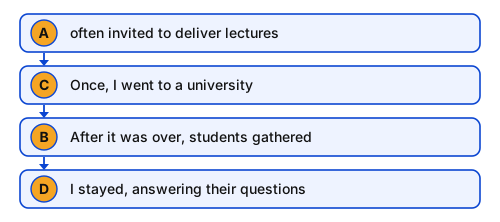
- A states the general fact: 'I was often invited… to deliver lectures.'
- C narrows to one instance: 'Once, I went to a university…'.
- B: 'After it was over, students gathered…' — 'it' = the lecture in C.
- D: he stayed back answering their questions.
Trick: General (often) → Specific (once) → After it → Result.
Answer: (A) ACBD
अवधारणा: पहले सामान्य आदत, फिर एक विशेष अवसर, उसके बाद क्या हुआ और लेखक की प्रतिक्रिया।
- A सामान्य बात: 'I was often invited… to deliver lectures.'
- C एक घटना: 'Once, I went to a university…'।
- B: 'After it was over, students gathered…' — 'it' = C का lecture।
- D: वह रुककर उनके प्रश्नों के उत्तर देते रहे।
ट्रिक: General (often) → Specific (once) → After it → परिणाम।
उत्तर: (A) ACBD
SSC CPO Paper IIEnglish Language and ComprehensionPara JumblesSSC CPO Paper II 2025 · 30 Apr Shift 3
Q83.Select the option that expresses the given sentence in direct speech. The teacher said that Ashoka had converted to Buddhism after the Kalinga War.
- AThe teacher said, “Ashoka had converted to Buddhism after the Kalinga War.”
- BThe teacher said, “Ashoka converted to Buddhism after the Kalinga War.”
- CThe teacher says, “Ashoka converted to Buddhism after the Kalinga War.”
- DThe teacher said, “Ashoka was converted to Buddhism after the Kalinga War.”
Show answer
Concept: When the reporting verb is past, a simple-past statement in direct speech is shifted to past perfect in indirect speech. So 'had converted' (indirect) comes from 'converted' (direct).
- Change 'said that' to 'said,' with inverted commas.
- Reverse the backshift: 'had converted' → 'converted'.
- The reporting verb stays 'said' — so (C) with 'says' is wrong.
- (A) keeps the past perfect; (D) changes the verb into passive 'was converted'.
Trick: Indirect had + V3 → Direct V2 (when the original was simple past).
Answer: (B) The teacher said, “Ashoka converted to Buddhism after the Kalinga War.”
अवधारणा: Reporting verb past हो तो direct का simple past indirect में past perfect बन जाता है। इसलिए indirect का 'had converted' direct में 'converted' था।
- 'said that' → 'said,' और inverted commas।
- Backshift उलटें: 'had converted' → 'converted'।
- Reporting verb 'said' ही रहेगा — (C) का 'says' गलत।
- (A) में past perfect बचा है; (D) 'was converted' passive बना देता है।
ट्रिक: Indirect had + V3 → Direct V2।
उत्तर: (B) The teacher said, “Ashoka converted to Buddhism after the Kalinga War.”
SSC CPO Paper IIEnglish Language and ComprehensionDirect and Indirect SpeechSSC CPO Paper II 2025 · 30 Apr Shift 3
Q84.Select the option that expresses the given sentence in direct speech. Mr. Prakash asked Rajesh if he wanted to work as an accountant for his company.
- AMr. Prakash said to Rajesh, “Do you want to work as an accountant for my company?”
- BMr. Prakash said to Rajesh, “Would you want to work as an accountant for my company?”
- CMr. Prakash said to Rajesh, “Does he want to work as an accountant for his company?”
- DMr. Prakash said to Rajesh, “Why don’t you work as an accountant for my company?”
Show answer
Concept: 'asked if' shows a yes/no question; in direct speech start with the auxiliary (Do/Does), use the second person for the listener and the first person for the speaker.
- 'asked Rajesh if he wanted' → 'said to Rajesh, “Do you want…?”' (wanted → want).
- 'his company' (Mr. Prakash's) → 'my company'.
- End with a question mark.
- (B) adds 'Would'; (C) keeps 'he… his'; (D) turns it into a suggestion.
Trick: asked if + he wanted → “Do you want…?”
Answer: (A) Mr. Prakash said to Rajesh, “Do you want to work as an accountant for my company?”
अवधारणा: 'asked if' = yes/no प्रश्न; direct में auxiliary (Do/Does) से शुरू करें, सुनने वाले के लिए you और वक्ता के लिए my।
- 'asked Rajesh if he wanted' → 'said to Rajesh, “Do you want…?”'।
- 'his company' (Mr. Prakash की) → 'my company'।
- अंत में प्रश्नचिह्न।
- (B) 'Would' जोड़ता है; (C) 'he… his' रखता है; (D) सुझाव बना देता है।
ट्रिक: asked if + he wanted → “Do you want…?”
उत्तर: (A) Mr. Prakash said to Rajesh, “Do you want to work as an accountant for my company?”
SSC CPO Paper IIEnglish Language and ComprehensionDirect and Indirect SpeechSSC CPO Paper II 2025 · 30 Apr Shift 3
Q85.Select the option that can be used as a one word substitute for the given group of words.
Science of life
- APhytology
- BPhonology
- CPhilology
- DBiology
Show answer
Concept: 'Bio' = life and '-logy' = study/science; other options are sciences of different subjects.
- Biology = the science of living organisms (life).
- Phytology = study of plants (botany).
- Phonology = study of speech sounds.
- Philology = study of language in historical texts.
Yaad rakhein: bio = life, phyto = plant, phono = sound, philo = love (of words).
Answer: (D) Biology
अवधारणा: 'Bio' = जीवन और '-logy' = अध्ययन/विज्ञान; बाकी विकल्प अन्य विषयों के अध्ययन हैं।
- Biology = जीवों (जीवन) का विज्ञान।
- Phytology = पौधों का अध्ययन (botany)।
- Phonology = वाक्-ध्वनियों का अध्ययन।
- Philology = ऐतिहासिक भाषा/ग्रंथों का अध्ययन।
याद रखें: bio = जीवन, phyto = पौधा, phono = ध्वनि।
उत्तर: (D) Biology
SSC CPO Paper IIEnglish Language and ComprehensionOne Word SubstitutionSSC CPO Paper II 2025 · 30 Apr Shift 3
Q86.Select the option that expresses the given sentence in indirect speech. The manager said, "I will give you a raise next month."
- AThe manager said that he would give me a raise the next month.
- BThe manager said that I would have gotten a raise the next month.
- CThe manager said that he would have given me a raise the next month.
- DThe manager said that I would get a raise the next month.
Show answer
Concept: Statement with a past reporting verb: will → would, pronouns change, and 'next month' → 'the next month / the following month'.
- 'I will give' → 'he would give' (I = the manager → he).
- 'you' (the listener, here the narrator) → 'me'.
- 'next month' → 'the next month'.
- (B) and (D) change the subject and meaning; (C) 'would have given' is a wrong tense.
Trick: will → would; next month → the next/following month.
Answer: (A) The manager said that he would give me a raise the next month.
अवधारणा: Past reporting verb वाला कथन: will → would, pronoun बदलते हैं, और 'next month' → 'the next month / the following month'।
- 'I will give' → 'he would give' (I = manager → he)।
- 'you' (सुनने वाला, यहाँ वर्णनकर्ता) → 'me'।
- 'next month' → 'the next month'।
- (B), (D) subject और अर्थ बदलते हैं; (C) 'would have given' गलत tense।
ट्रिक: will → would; next month → the next/following month।
उत्तर: (A) The manager said that he would give me a raise the next month.
SSC CPO Paper IIEnglish Language and ComprehensionDirect and Indirect SpeechSSC CPO Paper II 2025 · 30 Apr Shift 3
Q87.Select the most appropriate option to fill in the blanks. The swimming pool is about five kilometres ____ our house. So we go there _____ car.
- Ato; by
- Bfrom; in
- Cfrom; by
- Dto; in
Show answer
Concept: Distance is measured 'from' a place (five km from our house); means of transport takes 'by' without an article (by car, by bus).
- 'about five kilometres from our house' — the starting point takes 'from'.
- 'we go there by car' — 'by' + vehicle shows the mode of travel.
- 'in' is used only with an article/possessive: 'in a car', 'in our car'.
Trick: Distance → from; mode of travel → by + vehicle.
Answer: (C) from; by
अवधारणा: दूरी किसी स्थान 'से' नापी जाती है (five km from our house); यातायात का साधन बिना article 'by' के साथ (by car)।
- 'about five kilometres from our house' — आरंभ बिंदु के साथ 'from'।
- 'we go there by car' — 'by' + वाहन = यात्रा का साधन।
- 'in' केवल article/possessive के साथ: 'in a car', 'in our car'।
ट्रिक: दूरी → from; साधन → by + वाहन।
उत्तर: (C) from; by
SSC CPO Paper IIEnglish Language and ComprehensionFill in the BlanksSSC CPO Paper II 2025 · 30 Apr Shift 3
Q88.Sentences of a paragraph are given below. While the first and the last sentences (A and F) are in the correct order, the sentences in between are jumbled up. Arrange the sentences in the correct order to form a meaningful and coherent paragraph.
A. The child stood dreamily gazing.
B. After a while, a little dark-brown dog came trotting down the sidewalk. C. The child put out his hand and called him.
D. He stopped opposite the child, and the two regarded each other. E. The dog hesitated for a moment, but presently he made little advances with his tail.
F. In an apologetic manner the dog came close, and the two had an interchange of friendly patting and waggles.
- ABDEC
- BDBCE
- CECDB
- DCBED
Show answer
Concept: Track the entry of the dog and the stages of the meeting: arrival → stopping → child's call → dog's hesitation → coming close.
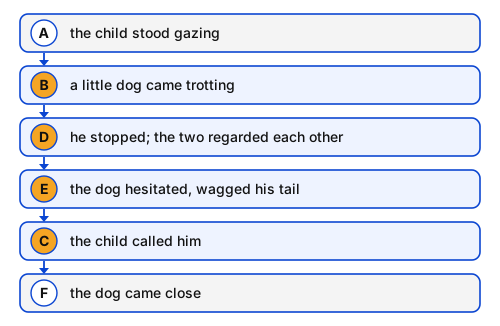
- A: the child is gazing → B: 'a little dark-brown dog came trotting down the sidewalk.'
- D: 'He stopped opposite the child, and the two regarded each other.'
- E: 'The dog hesitated… made little advances with his tail.'
- C: the child puts out his hand and calls him → F: the dog comes close and they pat and wag.
Trick: The child's call (C) must come just before the dog 'came close' (F).
Answer: (A) BDEC
अवधारणा: कुत्ते का आना और मुलाकात के चरण देखें: आना → रुकना → झिझक → बच्चे का बुलाना → पास आना।
- A: बच्चा देख रहा है → B: 'a little dark-brown dog came trotting…'।
- D: 'He stopped opposite the child… regarded each other.'
- E: 'The dog hesitated… made little advances with his tail.'
- C: बच्चा हाथ बढ़ाकर बुलाता है → F: कुत्ता पास आता है।
ट्रिक: बच्चे का बुलाना (C) ठीक 'came close' (F) से पहले।
उत्तर: (A) BDEC
SSC CPO Paper IIEnglish Language and ComprehensionPara JumblesSSC CPO Paper II 2025 · 30 Apr Shift 3
Q89.The following sentence has been divided into parts. One of them may contain an error. Select the part that contains the error from the given options. If you don’t find any error, mark ‘No error’ as your answer.
The police had lot evidence / against him to take him / into their custody.
- Aagainst him to take him
- Binto their custody
- CNo error
- DThe police had lot evidence
Show answer
Concept: 'Evidence' is an uncountable noun; it takes 'a lot of / much / some', not a bare 'lot'.
- 'lot' cannot directly modify a noun: we need 'a lot of evidence'.
- 'evidence' is uncountable — never 'evidences' or 'an evidence'.
- Correct: 'The police had a lot of evidence against him to take him into their custody.'
Yaad rakhein: a lot of + noun; uncountable: evidence, advice, information, furniture.
Answer: (D) The police had lot evidence
अवधारणा: 'Evidence' uncountable noun है; इसके साथ 'a lot of / much / some' आता है, केवल 'lot' नहीं।
- 'lot' सीधे noun के साथ नहीं आता: 'a lot of evidence' चाहिए।
- 'evidence' uncountable है — 'evidences' या 'an evidence' नहीं।
- सही: 'The police had a lot of evidence against him…'।
याद रखें: a lot of + noun; uncountable: evidence, advice, information।
उत्तर: (D) The police had lot evidence
SSC CPO Paper IIEnglish Language and ComprehensionError SpottingSSC CPO Paper II 2025 · 30 Apr Shift 3
Q90.Parts of the following sentence have been given as options. Select the option that contains an error.
The stain on your shirt can be removed from lime juice.
- AThe stain
- Bfrom lime juice
- Ccan be removed
- Don your shirt
Show answer
Concept: The instrument or means used to do something takes 'with' (or 'by using'); 'from' shows the source or the thing removed from.
- The stain is removed from your shirt, but with lime juice.
- Lime juice is the agent/tool → 'with lime juice'.
- So the error is in 'from lime juice'.
- Correct: 'The stain on your shirt can be removed with lime juice.'
Trick: Remove something FROM a place WITH a tool/substance.
Answer: (B) from lime juice
अवधारणा: जिस साधन/वस्तु से कोई काम किया जाए उसके लिए 'with' आता है; 'from' स्रोत या जिससे हटाया जाए उसके लिए।
- दाग shirt से (from) हटता है, पर lime juice के द्वारा (with)।
- Lime juice साधन है → 'with lime juice'।
- इसलिए त्रुटि 'from lime juice' में है।
- सही: 'The stain on your shirt can be removed with lime juice.'
ट्रिक: किसी जगह FROM हटाना, साधन WITH से।
उत्तर: (B) from lime juice
SSC CPO Paper IIEnglish Language and ComprehensionError SpottingSSC CPO Paper II 2025 · 30 Apr Shift 3
Q91.Select the option that expresses the given sentence in indirect speech. “I finished my homework early,” she said happily.
- AShe said happily that I have finished my homework early.
- BShe said happily that she has finished her homework early.
- CShe said happily that I finished her homework early.
- DShe said happily that she had finished her homework early.
Show answer
Concept: Statement with a past reporting verb: simple past → past perfect; the first person changes according to the subject of the reporting verb.
- 'I finished' → 'she had finished' (past → past perfect).
- 'I/my' → 'she/her' because the speaker is 'she'.
- 'happily' stays with 'said'.
- (A) and (C) keep 'I'; (B) uses present perfect 'has finished'.
Trick: V2 → had + V3 when the reporting verb is past.
Answer: (D) She said happily that she had finished her homework early.
अवधारणा: Past reporting verb वाले कथन में simple past → past perfect; first person reporting subject के अनुसार बदलता है।
- 'I finished' → 'she had finished'।
- 'I/my' → 'she/her', क्योंकि बोलने वाली 'she' है।
- 'happily' 'said' के साथ रहता है।
- (A), (C) में 'I' बचा है; (B) 'has finished' गलत।
ट्रिक: Reporting verb past हो तो V2 → had + V3।
उत्तर: (D) She said happily that she had finished her homework early.
SSC CPO Paper IIEnglish Language and ComprehensionDirect and Indirect SpeechSSC CPO Paper II 2025 · 30 Apr Shift 3
Q92.Parts of the following sentence have been given as options. One of them may contain an error. Select the part that contains the error from the given options. If you don’t find any error, mark ‘No error’ as your answer. The government has declared a public holiday at Monday.
- Aholiday at Monday
- BThe government has
- CNo error
- Ddeclared a public
Show answer
Concept: Days of the week take the preposition 'on' (on Monday); 'at' is for clock times.
- 'Monday' is a day → on Monday.
- 'at Monday' is wrong, so the error is in 'holiday at Monday'.
- Correct: 'The government has declared a public holiday on Monday.'
Trick: AT time, ON day/date, IN month/year.
Answer: (A) holiday at Monday
अवधारणा: सप्ताह के दिनों के साथ 'on' आता है (on Monday); 'at' घड़ी के समय के लिए है।
- 'Monday' दिन है → on Monday।
- 'at Monday' गलत, इसलिए त्रुटि 'holiday at Monday' में है।
- सही: 'The government has declared a public holiday on Monday.'
ट्रिक: AT समय, ON दिन/तारीख, IN महीना/वर्ष।
उत्तर: (A) holiday at Monday
SSC CPO Paper IIEnglish Language and ComprehensionError SpottingSSC CPO Paper II 2025 · 30 Apr Shift 3
Q93.Select the option that will improve the underlined part of the given sentence. In case no improvement is needed, select ‘No improvement required’. There is a new restaurant opening downtown who sells exotic Chinese cuisine.
- Awho is selling exotic Chinese cuisine
- BNo improvement required
- Cwho sell exotic Chinese cuisine
- Dwhich sells exotic Chinese cuisine
Show answer
Concept: Relative pronoun: 'who' for persons, 'which/that' for things and places.
- The antecedent is 'a new restaurant' — a thing, not a person.
- So 'who' must become 'which' (or 'that').
- 'restaurant' is singular → 'sells'.
- (A) and (C) keep 'who'; (C) also has the wrong verb 'sell'.
Trick: Person → who; thing/animal → which; both → that.
Answer: (D) which sells exotic Chinese cuisine
अवधारणा: Relative pronoun: व्यक्ति के लिए 'who', वस्तु/स्थान के लिए 'which/that'।
- Antecedent 'a new restaurant' है — वस्तु, व्यक्ति नहीं।
- इसलिए 'who' → 'which' (या 'that')।
- 'restaurant' singular → 'sells'।
- (A), (C) में 'who' बचा है; (C) में 'sell' भी गलत।
ट्रिक: व्यक्ति → who; वस्तु/पशु → which; दोनों → that।
उत्तर: (D) which sells exotic Chinese cuisine
SSC CPO Paper IIEnglish Language and ComprehensionRelative pronounsSSC CPO Paper II 2025 · 30 Apr Shift 3
Q94.Select the option that can be used as a one-word substitute for the given group of words.
The branch of medicine that deals with the study and treatment of nervous system disorders.
- ANeurology
- BDermatology
- CCardiology
- DUrology
Show answer
Concept: Branches of medicine are named from Greek roots for the organ: neuro = nerve, derma = skin, cardio = heart, uro = urinary tract.
- Neurology deals with disorders of the brain, spinal cord and nerves (nervous system).
- Dermatology — skin; Cardiology — heart.
- Urology — urinary tract.
Trick: Neuro = nerve → Neurology / Neurologist.
Answer: (A) Neurology
अवधारणा: चिकित्सा की शाखाओं के नाम अंग की यूनानी जड़ से बनते हैं: neuro = तंत्रिका, derma = त्वचा, cardio = हृदय, uro = मूत्र-मार्ग।
- Neurology — मस्तिष्क, रीढ़ और तंत्रिकाओं (nervous system) के रोगों का अध्ययन/उपचार।
- Dermatology — त्वचा; Cardiology — हृदय।
- Urology — मूत्र-मार्ग।
ट्रिक: Neuro = तंत्रिका → Neurology।
उत्तर: (A) Neurology
SSC CPO Paper IIEnglish Language and ComprehensionOne Word SubstitutionSSC CPO Paper II 2025 · 30 Apr Shift 3
Q95.Select the most appropriate ANTONYM of the given word. Discernible
- ASensational
- BImperceptible
- CNoticeable
- DApparent
Show answer
Concept: 'Discernible' means able to be seen, noticed or recognised.
- Its opposite is Imperceptible — so slight that it cannot be noticed.
- Noticeable and Apparent are synonyms of 'discernible'.
- Sensational means causing great excitement — unrelated.
Trick: discern = perceive → discernible ↔ imperceptible.
Answer: (B) Imperceptible
अवधारणा: 'Discernible' का अर्थ है — जिसे देखा, पहचाना या महसूस किया जा सके (स्पष्ट)।
- इसका विलोम Imperceptible है — इतना सूक्ष्म कि महसूस न हो (अगोचर)।
- Noticeable और Apparent 'discernible' के समानार्थी हैं।
- Sensational = सनसनीखेज़ — असंबंधित।
ट्रिक: discern = perceive → discernible ↔ imperceptible।
उत्तर: (B) Imperceptible
SSC CPO Paper IIEnglish Language and ComprehensionAntonymsSSC CPO Paper II 2025 · 30 Apr Shift 3
Q96.Select the option that expresses the given sentence in direct speech. Neha requested her mother to let her rest as she was very tired.
- ANeha said to her mother, “Can you let me rest? I am very tired.”
- BNeha said to her mother, “Please let me rest. I was very tired.”
- CNeha said to her mother, “Please let me rest. I am very tired.”
- DNeha told her mother, “Please let her rest. I am very tired.”
Show answer
Concept: 'requested… to let her rest' → a polite imperative with 'Please'; the reason clause 'as she was very tired' returns to the present 'I am very tired'.
- 'requested her mother' → 'said to her mother, “Please let me rest.”' (her → me).
- 'she was very tired' → 'I am very tired.' (past → present).
- (A) is a question; (B) keeps 'was'; (D) keeps 'her' and uses 'told'.
Trick: requested → Please + V1; was → am in the reason clause.
Answer: (C) Neha said to her mother, “Please let me rest. I am very tired.”
अवधारणा: 'requested… to let her rest' → 'Please' वाला विनम्र आदेश; कारण 'as she was very tired' → present 'I am very tired'।
- 'requested her mother' → 'said to her mother, “Please let me rest.”'।
- 'she was very tired' → 'I am very tired.'
- (A) प्रश्न है; (B) में 'was' बचा है; (D) में 'her' और 'told' गलत।
ट्रिक: requested → Please + V1; was → am।
उत्तर: (C) Neha said to her mother, “Please let me rest. I am very tired.”
SSC CPO Paper IIEnglish Language and ComprehensionDirect and Indirect SpeechSSC CPO Paper II 2025 · 30 Apr Shift 3
Q97.Select the option that expresses the given sentence in active voice. The construction of the tunnel has been completed by the Public Works Department.
- AThe construction of the tunnel has completed the Public Works Department.
- BThe Public Works Department has completed the construction of the tunnel.
- CThe Public Works Department is completing the construction of the tunnel.
- DThe Public Works Department completed the construction of the tunnel.
Show answer
Concept: Present perfect passive 'has/have been + V3' becomes present perfect active 'has/have + V3'.
- Agent 'the Public Works Department' becomes the subject.
- 'has been completed' → 'has completed'.
- Subject 'the construction of the tunnel' becomes the object.
- (A) mixes subject and object; (C) is present continuous; (D) is simple past.
Trick: has been + V3 ↔ has + V3.
Answer: (B) The Public Works Department has completed the construction of the tunnel.
अवधारणा: Present perfect passive 'has/have been + V3' → present perfect active 'has/have + V3'।
- Agent 'the Public Works Department' subject बनता है।
- 'has been completed' → 'has completed'।
- 'the construction of the tunnel' object बनता है।
- (A) subject-object उलट देता है; (C) present continuous; (D) simple past।
ट्रिक: has been + V3 ↔ has + V3।
उत्तर: (B) The Public Works Department has completed the construction of the tunnel.
SSC CPO Paper IIEnglish Language and ComprehensionActive and Passive VoiceSSC CPO Paper II 2025 · 30 Apr Shift 3
Q98.The following sentence has been split into four segments. Identify the segment that contains a grammatical error.
Professor Gupta is an authority / on income tax because / he cannot exercise / any authority over his family.
- Ahe cannot exercise
- Bany authority over his family
- Con income tax because
- DProfessor Gupta is an authority
Show answer
Concept: Conjunctions must show the correct logical relation. Two contrasting ideas need 'but/though', not 'because' (which shows cause).
- Being an authority on income tax is not the reason why he cannot control his family.
- The two clauses contrast with each other → 'on income tax, but he cannot exercise…'.
- So the error is in the segment 'on income tax because'.
- The play on the word 'authority' (expert vs power) makes the contrast clear.
Trick: Contrast → but/though/yet; Cause → because/since/as.
Answer: (C) on income tax because
अवधारणा: Conjunction सही तार्किक संबंध दिखाए। विरोधी विचारों के लिए 'but/though' आता है, 'because' (कारण) नहीं।
- Income tax का विशेषज्ञ होना परिवार पर नियंत्रण न रख पाने का कारण नहीं है।
- दोनों उपवाक्य विरोधी हैं → 'on income tax, but he cannot exercise…'।
- इसलिए त्रुटि 'on income tax because' में है।
- 'authority' (विशेषज्ञ बनाम अधिकार) का खेल विरोध स्पष्ट करता है।
ट्रिक: विरोध → but/though/yet; कारण → because/since/as।
उत्तर: (C) on income tax because
SSC CPO Paper IIEnglish Language and ComprehensionError SpottingSSC CPO Paper II 2025 · 30 Apr Shift 3
Q99.Select the option that expresses the given sentence in direct speech. The doctor told the patient that she needed to rest and avoid stress.
- AThe doctor said to the patient, "You would have needed to rest and avoid stress."
- BThe doctor said to the patient, "You need to rest and avoid stress."
- CThe doctor said to the patient, "You needed to rest and avoid stress."
- DThe doctor said to the patient, "You will need to rest and avoid stress."
Show answer
Concept: In 'told… that she needed', the past 'needed' is only a backshift; a general present advice in direct speech uses the present tense.
- 'told the patient' → 'said to the patient,' with inverted commas.
- 'she needed' → 'You need' (the patient is addressed; past → present).
- 'to rest and avoid stress' stays the same.
- (A) 'would have needed', (C) 'needed' and (D) 'will need' are wrong tenses.
Trick: Indirect V2 → Direct V1 (present) when it was a present fact/advice.
Answer: (B) The doctor said to the patient, “You need to rest and avoid stress.”
अवधारणा: 'told… that she needed' में 'needed' केवल backshift है; direct में वर्तमान सलाह present tense में होगी।
- 'told the patient' → 'said to the patient,' और inverted commas।
- 'she needed' → 'You need' (सुनने वाला patient; past → present)।
- 'to rest and avoid stress' वैसा ही।
- (A) 'would have needed', (C) 'needed', (D) 'will need' — गलत tense।
ट्रिक: Indirect V2 → Direct V1 (present)।
उत्तर: (B) The doctor said to the patient, “You need to rest and avoid stress.”
SSC CPO Paper IIEnglish Language and ComprehensionDirect and Indirect SpeechSSC CPO Paper II 2025 · 30 Apr Shift 3
Q100.Select the option that will improve the underlined part of the given sentence. In case no improvement is needed, select ‘No improvement required’. Me and my friends planning a road trip to the beach this weekend.
- AMe and my friends have plan
- BNo improvement required
- CI and my friends are planned
- DMy friends and I are planning
Show answer
Concept: In a compound subject, the nominative 'I' (not 'me') is used and placed last out of courtesy; a present continuous plan needs 'are + V-ing'.
- 'Me and my friends' is the subject → use 'I' → 'My friends and I'.
- The sentence has no helping verb; a plan for this weekend → present continuous 'are planning'.
- (A) 'have plan' is ungrammatical; (C) 'are planned' is passive and keeps 'I' first.
Yaad rakhein: Courtesy order 231: second person, third person, then first person (I) last.
Answer: (D) My friends and I are planning
अवधारणा: Compound subject में 'me' नहीं, nominative 'I' आता है और शिष्टाचार में अंत में रखा जाता है; योजना के लिए present continuous 'are + V-ing'।
- 'Me and my friends' subject है → 'I' → 'My friends and I'।
- वाक्य में helping verb नहीं; सप्ताहांत की योजना → 'are planning'।
- (A) 'have plan' अशुद्ध; (C) 'are planned' passive है और 'I' पहले रखा है।
याद रखें: शिष्टाचार क्रम 231: second, third, फिर first person (I) अंत में।
उत्तर: (D) My friends and I are planning
SSC CPO Paper IIEnglish Language and ComprehensionSubject–verb & pronoun caseSSC CPO Paper II 2025 · 30 Apr Shift 3

