Q101.Select the option that can be used as a one-word substitute for the given group of words.
Pleasing to the sense of taste or smell especially by reason of effective seasoning
- ASavoury
- BSweet
- CStale
- DSmelly
Show answer
Concept: 'Savoury' describes food that is pleasing in taste or smell, especially because it is well seasoned (salty or spicy rather than sweet).
- Key words: pleasing taste/smell + effective seasoning → savoury.
- 'Sweet' refers only to sugar taste, not seasoning.
- 'Stale' (not fresh) and 'smelly' (bad odour) are unpleasant – opposite in sense.
Trick: Seasoning (salt, spices) → savoury food, e.g. samosa, pakora.
Answer: (A) Savoury
अवधारणा: 'Savoury' उस भोजन के लिए है जो अच्छी seasoning (नमक-मसाले) के कारण स्वाद या सुगंध में अच्छा लगे।
- मुख्य शब्द: स्वाद/सुगंध में अच्छा + seasoning → savoury।
- 'Sweet' केवल मीठे स्वाद के लिए है, seasoning के लिए नहीं।
- 'Stale' (बासी) और 'smelly' (बदबूदार) तो अप्रिय अर्थ देते हैं।
ट्रिक: नमक-मसाले वाला स्वादिष्ट भोजन → savoury (जैसे समोसा)।
उत्तर: (A) Savoury
SSC CPO Paper IIEnglish Language and ComprehensionOne-word SubstitutionSSC CPO Paper II 2025 · 30 Apr Shift 3
Q102.Select the most appropriate meaning of the given idiom. A new broom sweeps clean
- ANew tools work effectively
- BNew things are more attractive than the older ones
- CPeople tend to forget old things when new ones come
- DNew management makes far-reaching changes
Show answer
Concept: 'A new broom sweeps clean' means a newly appointed person or management makes sweeping (far-reaching) changes at first.
- A new broom = a new boss/management; sweeps clean = removes old ways completely.
- Example: The new principal changed every rule – a new broom sweeps clean.
- Option (A) takes the idiom literally; (B) and (C) talk about attraction/forgetting, not change.
Trick: New broom = new boss → big changes.
Answer: (D) New management makes far-reaching changes
अवधारणा: 'A new broom sweeps clean' का अर्थ है – नया अधिकारी या नई management आते ही बड़े बदलाव करती है।
- New broom = नया boss; sweeps clean = पुराने तरीके पूरी तरह हटाना।
- उदाहरण: नए principal ने सारे नियम बदल दिए।
- (A) शाब्दिक अर्थ है; (B) व (C) आकर्षण/भूलने की बात करते हैं, बदलाव की नहीं।
ट्रिक: नई झाड़ू = नया boss → बड़े बदलाव।
उत्तर: (D) New management makes far-reaching changes
SSC CPO Paper IIEnglish Language and ComprehensionIdioms and PhrasesSSC CPO Paper II 2025 · 30 Apr Shift 3
Q103.Select the option that expresses the given sentence in active voice. Is the news watched by you every day?
- AHave you watched the news every day?
- BWill you be watching the news everyday?
- CDo you watch the news every day?
- DAre you watching the news every day?
Show answer
Concept: A passive question in the simple present ('Is/Am/Are + V3') becomes 'Do/Does + subject + V1' in the active voice.
- 'Is the news watched by you' → tense: simple present passive.
- Agent 'by you' becomes subject 'you'; 'you' takes 'Do'.
- Active: 'Do you watch the news every day?'
- (A) present perfect, (B) future continuous, (D) present continuous – tense changed.
Trick: Is/Are + V3 (passive) ↔ Do/Does + V1 (active).
Answer: (C) Do you watch the news every day?
अवधारणा: Simple present का passive प्रश्न 'Is/Are + V3' active में 'Do/Does + subject + V1' बनता है।
- 'Is the news watched by you' → simple present passive।
- 'by you' subject 'you' बनेगा; 'you' के साथ 'Do'।
- Active: 'Do you watch the news every day?'
- (A) present perfect, (B) future continuous, (D) present continuous – tense बदल गया।
ट्रिक: Is/Are + V3 ↔ Do/Does + V1
उत्तर: (C) Do you watch the news every day?
SSC CPO Paper IIEnglish Language and ComprehensionActive and Passive VoiceSSC CPO Paper II 2025 · 30 Apr Shift 3
Q104.Parts of the following sentence have been given as options. One of them may contain an error. Select the part that contains the error from the given options. If you don’t find any error, mark ‘No error’ as your answer. Nobody in the office is satisfied with your work.
- ANobody in the office
- Bis satisfied
- CNo error
- Dwith your work
Show answer
Concept: Indefinite pronouns like 'nobody', 'everyone', 'somebody' are singular and take a singular verb.
- 'Nobody' is singular → 'is satisfied' is correct.
- 'satisfied with' is the correct preposition.
- 'your work' is fine. The sentence has no error.
Trick: Nobody / everybody / each / every → singular verb.
Answer: (C) No error
अवधारणा: 'Nobody', 'everyone', 'somebody' जैसे indefinite pronouns singular होते हैं और singular verb लेते हैं।
- 'Nobody' singular है → 'is satisfied' सही है।
- 'satisfied with' सही preposition है।
- 'your work' भी सही है। वाक्य में कोई त्रुटि नहीं।
ट्रिक: Nobody / everybody / each → singular verb
उत्तर: (C) No error
SSC CPO Paper IIEnglish Language and ComprehensionError SpottingSSC CPO Paper II 2025 · 30 Apr Shift 3
Q105.Select the option that expresses the given sentence in passive voice. Submit the report by Friday.
- ALet the report be submitted by Friday.
- BThe report can be submitted by Friday.
- CThe report has to be submitted by Friday.
- DLet the report submit by Friday.
Show answer
Concept: An imperative sentence (order/request) becomes passive with 'Let + object + be + V3'.
- 'Submit the report by Friday' is an order.
- Pattern: Let + the report + be + submitted.
- Passive: 'Let the report be submitted by Friday.'
- (B) and (C) change the sense (possibility/necessity); (D) misses 'be'.
Trick: Order → Let + object + be + V3.
Answer: (A) Let the report be submitted by Friday.
अवधारणा: आज्ञार्थक (imperative) वाक्य का passive 'Let + object + be + V3' से बनता है।
- 'Submit the report by Friday' एक आदेश है।
- ढांचा: Let + the report + be + submitted।
- Passive: 'Let the report be submitted by Friday.'
- (B), (C) अर्थ बदलते हैं (संभावना/आवश्यकता); (D) में 'be' नहीं है।
ट्रिक: आदेश → Let + object + be + V3
उत्तर: (A) Let the report be submitted by Friday.
SSC CPO Paper IIEnglish Language and ComprehensionActive and Passive VoiceSSC CPO Paper II 2025 · 30 Apr Shift 3
Q106.Select the option that will improve the underlined part of the given sentence. In case no improvement is needed, select ‘No improvement required’. In Brazil, the economy has started recovering, but unemployment is on its lowest from 2015.
- Ais at its lowest since
- BNo improvement required
- Chas been on its low from
- Dis at its lowest from
Show answer
Concept: Idiomatic expression: 'at its lowest' (not 'on its lowest'); a point of time in the past with the present situation takes 'since', not 'from'.
- The underlined part is 'is on its lowest from'.
- Correct phrase: 'is at its lowest since 2015' – lowest level since that year.
- (C) and (D) keep the wrong 'from'; (C) also uses 'on its low'.
Trick: at its lowest / at its highest + since + year.
Answer: (A) is at its lowest since
अवधारणा: सही मुहावरेदार प्रयोग 'at its lowest' है ('on' नहीं); अतीत के किसी समय-बिंदु से अब तक के लिए 'since' आता है, 'from' नहीं।
- रेखांकित भाग: 'is on its lowest from'।
- सही: 'is at its lowest since 2015' – 2015 के बाद से सबसे कम स्तर।
- (C) और (D) में गलत 'from' बना रहता है।
ट्रिक: at its lowest + since + वर्ष
उत्तर: (A) is at its lowest since
SSC CPO Paper IIEnglish Language and ComprehensionIdioms & since/forSSC CPO Paper II 2025 · 30 Apr Shift 3
Q107.Select the option that will improve the underlined part of the given sentence. In case no improvement is needed, select ‘No improvement required’. We can go on a vacation if everyone is agreeing.
- Aeveryone is agree
- Beveryone will agreeing
- CNo improvement required
- Deveryone agrees
Show answer
Concept: In a first conditional sentence, the 'if' clause takes the simple present; 'agree' is a stative verb and is not used in the continuous form.
- Underlined: 'everyone is agreeing'.
- 'Everyone' is singular → 'agrees'.
- Correct: 'We can go on a vacation if everyone agrees.'
- 'is agree' and 'will agreeing' are ungrammatical.
Trick: If + simple present; stative verbs (agree, know, like) – no -ing.
Answer: (D) everyone agrees
अवधारणा: First conditional में 'if' clause simple present लेता है; 'agree' stative verb है, इसका continuous रूप नहीं बनता।
- रेखांकित: 'everyone is agreeing'।
- 'Everyone' singular → 'agrees'।
- सही: 'We can go on a vacation if everyone agrees.'
- 'is agree' और 'will agreeing' व्याकरण की दृष्टि से गलत हैं।
ट्रिक: If + simple present; agree/know/like का -ing नहीं
उत्तर: (D) everyone agrees
SSC CPO Paper IIEnglish Language and ComprehensionConditional sentencesSSC CPO Paper II 2025 · 30 Apr Shift 3
Q108.The following sentence has been divided into parts. One of them may contain an error. Select the part that contains the error from the given options. If you don’t find any error, mark ‘No error’ as your answer.
The Pench Tiger Reserve is / one of India's premier tiger reserve / and the first to span two states.
- AThe Pench Tiger Reserve is
- Bone of India's premier tiger reserve
- CNo error
- Dand the first to span two states
Show answer
Concept: 'One of + plural noun' – the noun after 'one of the/India's' must be plural.
- 'one of India's premier tiger reserve' → noun should be plural.
- Correct: 'one of India's premier tiger reserves'.
- Other parts are fine: 'The Pench Tiger Reserve is' and 'the first to span two states'.
Trick: One of + plural noun + singular verb.
Answer: (B) one of India's premier tiger reserve
अवधारणा: 'One of + plural noun' – 'one of' के बाद noun हमेशा plural होता है।
- 'one of India's premier tiger reserve' → noun plural होना चाहिए।
- सही: 'one of India's premier tiger reserves'।
- बाकी भाग सही हैं।
ट्रिक: One of + plural noun
उत्तर: (B) one of India's premier tiger reserve
SSC CPO Paper IIEnglish Language and ComprehensionError SpottingSSC CPO Paper II 2025 · 30 Apr Shift 3
Q109.Sentences of a paragraph are given below. While the first and the last sentences (A and F) are in the correct order, the sentences in between are jumbled up. Arrange the sentences in the correct order to form a meaningful and coherent paragraph.
A. As soon as I returned from NASA, India’s first rocket launch took place on 21 November, 1963.
B. The assembled rocket was to be shifted from the church building to the launch pad.
C. The rocket was assembled in the local church building. D. The only equipment available to transport the rocket was a truck and a manually operated hydraulic crane.
E. It was a sounding rocket, called NikeApache, made at NASA. F. When the rocket was lifted by the crane and was about to be placed on the launcher, it started tilting, indicating a leak in the hydraulic system of the crane.
- ABDEC
- BECBD
- CEDBC
- DCBDE
Show answer
Concept: Find the logical chain: introduce the rocket → where it was assembled → moving it → the equipment used, which leads to F (the crane).
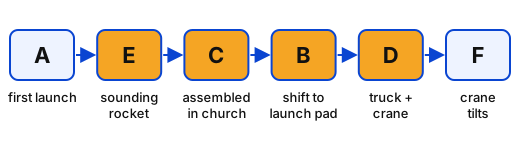
- A ends with India's first rocket launch; E names that rocket ('It was a sounding rocket…').
- C tells where it was assembled – the church building.
- B: it had to be shifted from the church to the launch pad.
- D: the only equipment was a truck and a crane → F: the crane began tilting.
Trick: 'It' in E refers to the rocket in A; 'crane' in D links to the crane in F.
Answer: (B) ECBD
अवधारणा: तार्किक क्रम खोजें: rocket का परिचय → कहाँ assemble हुआ → उसे ले जाना → कौन-सा उपकरण, जो F (crane) से जुड़ता है।
- A में पहले rocket launch की बात; E उसी rocket का नाम बताता है ('It was a sounding rocket…')।
- C: rocket church building में assemble हुआ।
- B: उसे church से launch pad पर ले जाना था।
- D: केवल truck और crane उपलब्ध थे → F: crane झुकने लगी।
ट्रिक: E का 'It' = A का rocket; D का 'crane' F से जुड़ता है।
उत्तर: (B) ECBD
SSC CPO Paper IIEnglish Language and ComprehensionPara JumblesSSC CPO Paper II 2025 · 30 Apr Shift 3
Q110.Select the option that will improve the underlined part of the given sentence. In case no improvement is needed, select ‘No improvement required’. He was too exhausted to continue, but he refused to admit defeat and decides to keep going.
- Ais deciding to keep going
- Bdecided to keep going
- CNo improvement required
- Dhas decide to keep going
Show answer
Concept: Parallel verbs joined by 'and' should be in the same tense; the sentence is in the past ('was', 'refused').
- Underlined: 'decides to keep going' (present).
- 'refused … and decided' – both past.
- Correct: '…he refused to admit defeat and decided to keep going.'
- (A) and (D) are wrong forms ('has decide' is ungrammatical).
Trick: Verbs joined by 'and' → same tense.
Answer: (B) decided to keep going
अवधारणा: 'and' से जुड़ी क्रियाएँ एक ही tense में होनी चाहिए; वाक्य past में है ('was', 'refused')।
- रेखांकित: 'decides to keep going' (present)।
- 'refused … and decided' – दोनों past।
- सही: '…refused to admit defeat and decided to keep going.'
- (A) व (D) गलत रूप हैं ('has decide' अशुद्ध)।
ट्रिक: 'and' से जुड़ी क्रियाएँ → एक ही tense
उत्तर: (B) decided to keep going
SSC CPO Paper IIEnglish Language and ComprehensionParallel tenseSSC CPO Paper II 2025 · 30 Apr Shift 3
Q111.Select the option that expresses the given sentence in direct speech. The teacher told the children to draw the diagram of water cycle after they had finished writing.
- AThe teacher said to the children, “Draw the diagram of water cycle after they had finished writing.”
- BThe teacher said, “Children, draw the diagram of water cycle after you have finished writing.”
- CThe teacher said to the children, “Now draw the diagram of water cycle after finishing writing.”
- DThe teacher said, “Children, you may draw the diagram of water cycle after you have finished writing.”
Show answer
Concept: Indirect 'told … to + V1' becomes an imperative in direct speech; pronouns become second person and 'had finished' becomes 'have finished'.
- 'told the children to draw' → said, "Children, draw …"
- 'they had finished' → 'you have finished' (addressed to the children).
- (A) keeps 'they had finished'; (C) adds 'Now' and changes wording; (D) changes the order into permission ('may').
Trick: told + to V1 (indirect) ↔ imperative (direct); past perfect → present perfect.
Answer: (B) The teacher said, “Children, draw the diagram of water cycle after you have finished writing.”
अवधारणा: Indirect में 'told … to + V1' direct में आज्ञार्थक वाक्य बनता है; pronoun second person में और 'had finished' → 'have finished'।
- 'told the children to draw' → said, "Children, draw …"
- 'they had finished' → 'you have finished'।
- (A) में 'they had finished' रह गया; (C) में 'Now' जोड़ा; (D) आदेश को अनुमति ('may') बना देता है।
ट्रिक: told + to V1 ↔ imperative; had + V3 → have + V3
उत्तर: (B) The teacher said, “Children, draw the diagram of water cycle after you have finished writing.”
SSC CPO Paper IIEnglish Language and ComprehensionDirect and Indirect SpeechSSC CPO Paper II 2025 · 30 Apr Shift 3
Q112.Select the option that will improve the underlined part of the given sentence. In case no improvement is needed, select ‘No improvement required’. We should always wash our hands during having food.
- Awhile
- Bbefore
- Cas soon as
- DNo improvement required
Show answer
Concept: Use the correct time preposition/conjunction for sense: hands are washed before eating, not during it.
- Underlined: 'during' – 'during having food' is unidiomatic, and washing hands during the meal gives the wrong sense.
- Hygiene sense: wash hands before having food.
- 'while' and 'as soon as' also give the wrong time sense.
Trick: Wash hands before (and after) meals.
Answer: (B) before
अवधारणा: अर्थ के अनुसार सही समय-सूचक शब्द चुनें: हाथ खाने से पहले धोए जाते हैं, खाने के दौरान नहीं।
- रेखांकित: 'during' – अर्थ गलत है।
- स्वच्छता के अनुसार: wash hands before having food।
- 'while' और 'as soon as' भी गलत समय-अर्थ देते हैं।
ट्रिक: खाने से पहले हाथ धोना → before
उत्तर: (B) before
SSC CPO Paper IIEnglish Language and ComprehensionConjunctions of timeSSC CPO Paper II 2025 · 30 Apr Shift 3
Q113.Select the option that will improve the underlined part of the given sentence. In case no improvement is needed, select ‘No improvement required’. October has four consecutive holidays but we are planning a trip to Andaman Islands
- Aso we are planning
- Bsince we have planned
- CNo improvement required
- Dbecause we are planning
Show answer
Concept: Choose the conjunction by the logical relation: four holidays (cause) → planning a trip (result) needs 'so'.
- Underlined: 'but we are planning' – 'but' shows contrast, which does not exist.
- Holidays are the reason; the trip is the result → 'so'.
- 'since/because' would wrongly make the trip the cause of the holidays.
Trick: Cause, so result; result because cause.
Answer: (A) so we are planning
अवधारणा: तार्किक संबंध के अनुसार conjunction चुनें: चार छुट्टियाँ (कारण) → trip की योजना (परिणाम) → 'so'।
- रेखांकित: 'but we are planning' – 'but' विरोध दिखाता है, जो यहाँ नहीं है।
- छुट्टियाँ कारण हैं, trip परिणाम → 'so'।
- 'since/because' उल्टा अर्थ देंगे (trip छुट्टियों का कारण)।
ट्रिक: कारण, so परिणाम
उत्तर: (A) so we are planning
SSC CPO Paper IIEnglish Language and ComprehensionConjunctionsSSC CPO Paper II 2025 · 30 Apr Shift 3
Q114.Select the most appropriate ANTONYM of the given word. Stringent
- AExacting
- BSatiated
- CFlexible
- DAffordable
Show answer
Concept: 'Stringent' means strict, rigid, demanding firm obedience to rules.
- Opposite of strict/rigid = flexible (easily adjusted).
- 'Exacting' is a synonym (demanding).
- 'Satiated' (fully satisfied) and 'affordable' (cheap enough) are unrelated.
Trick: Stringent rules ↔ flexible rules.
Answer: (C) Flexible
अवधारणा: 'Stringent' का अर्थ है – कठोर, सख्त (strict, rigid)।
- सख्त का विलोम = flexible (लचीला)।
- 'Exacting' समानार्थी है (कठोर माँग वाला)।
- 'Satiated' (तृप्त) और 'affordable' (सस्ता) असंबंधित हैं।
ट्रिक: Stringent (सख्त) ↔ Flexible (लचीला)
उत्तर: (C) Flexible
SSC CPO Paper IIEnglish Language and ComprehensionAntonymsSSC CPO Paper II 2025 · 30 Apr Shift 3
Q115.Select the option that expresses the given sentence in direct speech. Alex expressed uncertainty regarding his ability to meet the complex requirements of the project.
- AAlex said, “The requirements of the project are complex enough to be handled.”
- BAlex said, “I am uncertain to meet the complex requirements of the project.”
- CAlex said, “I’m sure I won’t be able to meet the complex requirements of the project.”
- DAlex said, “I’m not sure if I can meet the complex requirements of the project.”
Show answer
Concept: 'Expressed uncertainty regarding his ability' must become a direct statement in which the speaker says he is not sure he can do it.
- Reporting verb 'expressed uncertainty' → 'I'm not sure if …'.
- 'his ability to meet' → 'I can meet' (first person).
- (C) shows certainty of failure; (A) changes meaning; (B) 'uncertain to meet' is unidiomatic.
Trick: Uncertainty = 'not sure if/whether'.
Answer: (D) Alex said, “I’m not sure if I can meet the complex requirements of the project.”
अवधारणा: 'Expressed uncertainty regarding his ability' का direct रूप वह कथन है जिसमें बोलने वाला कहे कि उसे यकीन नहीं कि वह कर पाएगा।
- 'expressed uncertainty' → 'I'm not sure if …'।
- 'his ability to meet' → 'I can meet' (first person)।
- (C) असफलता की निश्चितता दिखाता है; (A) अर्थ बदलता है; (B) 'uncertain to meet' अशुद्ध प्रयोग है।
ट्रिक: Uncertainty = 'not sure if'
उत्तर: (D) Alex said, “I’m not sure if I can meet the complex requirements of the project.”
SSC CPO Paper IIEnglish Language and ComprehensionDirect and Indirect SpeechSSC CPO Paper II 2025 · 30 Apr Shift 3
Q116.Select the option that expresses the given sentence in direct speech. Grandmother asked the little girl if she was hungry.
- AGrandmother said to the little girl, “Was she hungry?”
- BGrandmother said to the little girl, “Are you hungry?”
- CGrandmother said to the little girl, “Is she hungry?”
- DGrandmother said to the little girl, “If she was hungry.”
Show answer
Concept: 'asked if' (indirect yes/no question) becomes a direct question with inverted order; 'she was' → 'you are' when addressing the girl.
- 'asked the little girl' → said to the little girl.
- 'if she was hungry' → "Are you hungry?"
- (A) and (C) keep third person 'she'; (D) keeps 'if', which is not used in direct speech.
Trick: asked if + S + V ↔ "Aux + S …?"
Answer: (B) Grandmother said to the little girl, “Are you hungry?”
अवधारणा: 'asked if' (हाँ/ना प्रश्न) direct में उल्टे क्रम वाला प्रश्न बनता है; लड़की से बात करते हुए 'she was' → 'you are'।
- 'asked the little girl' → said to the little girl।
- 'if she was hungry' → "Are you hungry?"
- (A), (C) में third person 'she' रह गया; (D) में 'if' है, जो direct में नहीं आता।
ट्रिक: asked if ↔ "Aux + S …?"
उत्तर: (B) Grandmother said to the little girl, “Are you hungry?”
SSC CPO Paper IIEnglish Language and ComprehensionDirect and Indirect SpeechSSC CPO Paper II 2025 · 30 Apr Shift 3
Q117.Select the most appropriate option to fill in the blank and complete the given idiom.
Break the _________
- Asnow
- Bice
- Cfog
- Dchill
Show answer
Concept: The idiom 'break the ice' means to start a conversation and remove awkwardness or shyness among people.
- Example: He told a joke to break the ice at the meeting.
- Only 'ice' forms this fixed idiom; snow, fog and chill do not.
Yaad rakhein: Ice = coldness/awkwardness; breaking it starts friendliness.
Answer: (B) ice
अवधारणा: 'Break the ice' मुहावरे का अर्थ है – बातचीत शुरू करके झिझक या अजनबीपन दूर करना।
- उदाहरण: He told a joke to break the ice at the meeting।
- केवल 'ice' से यह निश्चित मुहावरा बनता है।
याद रखें: Ice = झिझक; break the ice = झिझक तोड़ना
उत्तर: (B) ice
SSC CPO Paper IIEnglish Language and ComprehensionIdioms and PhrasesSSC CPO Paper II 2025 · 30 Apr Shift 3
Q118.Select the option that expresses the given sentence in passive voice. Visitors can scale the massive rock by climbing the 708-step path up to the top.
- AThe massive rock be scaled by visitors by climbing the 708-step path up to the top.
- BThe massive rock can scaled by visitors by climbing the 708-step path up to the top.
- CThe massive rock scaled visitors by climbing the 708-step path up to the top.
- DThe massive rock can be scaled by visitors by climbing the 708-step path up to the top.
Show answer
Concept: With a modal, the passive is 'modal + be + V3'.
- 'can scale' → 'can be scaled'.
- Object 'the massive rock' becomes subject; 'by visitors' follows.
- (A) misses 'can'; (B) misses 'be'; (C) changes the meaning completely.
Trick: can/may/must + be + V3.
Answer: (D) The massive rock can be scaled by visitors by climbing the 708-step path up to the top.
अवधारणा: Modal वाले वाक्य का passive 'modal + be + V3' से बनता है।
- 'can scale' → 'can be scaled'।
- Object 'the massive rock' subject बनेगा; 'by visitors' बाद में।
- (A) में 'can' नहीं; (B) में 'be' नहीं; (C) का अर्थ ही बदल गया।
ट्रिक: Modal + be + V3
उत्तर: (D) The massive rock can be scaled by visitors by climbing the 708-step path up to the top.
SSC CPO Paper IIEnglish Language and ComprehensionActive and Passive VoiceSSC CPO Paper II 2025 · 30 Apr Shift 3
Q119.Select the most appropriate option to fill in the blank. She meticulously arranged the meeting agenda _____ every intricate detail of the project could be thoroughly discussed and analysed by the team.
- Aeven so
- Bas if
- Csuch as
- Dso that
Show answer
Concept: 'So that' introduces a clause of purpose – it tells why something was done.
- She arranged the agenda carefully – purpose: every detail could be discussed.
- 'so that … could' is the standard purpose structure.
- 'even so' (despite this), 'as if' (comparison) and 'such as' (examples) do not show purpose.
Trick: Purpose clause → so that + can/could/may/might.
Answer: (D) so that
अवधारणा: 'So that' उद्देश्य (purpose) वाला clause शुरू करता है – कोई काम क्यों किया गया।
- उसने agenda ध्यान से बनाया – उद्देश्य: हर detail पर चर्चा हो सके।
- 'so that … could' उद्देश्य की मानक संरचना है।
- 'even so', 'as if', 'such as' उद्देश्य नहीं दिखाते।
ट्रिक: उद्देश्य → so that + could/may
उत्तर: (D) so that
SSC CPO Paper IIEnglish Language and ComprehensionFill in the BlanksSSC CPO Paper II 2025 · 30 Apr Shift 3
Q120.Select the option that will improve the underlined part of the given sentence. In case no improvement is needed, select ‘No improvement required’. Despite of the heavy rain, we decided to go for a hike in the mountains.
- ADespite of a heavy rain
- BNo improvement required
- CDespite the heavy rain
- DIn spite the heavy rain
Show answer
Concept: 'Despite' is never followed by 'of'; use 'despite + noun' or 'in spite of + noun'.
- Underlined: 'Despite of the heavy rain'.
- Correct: 'Despite the heavy rain'.
- (A) keeps 'of'; (D) 'In spite the' misses 'of'.
Trick: Despite = In spite of (never 'despite of').
Answer: (C) Despite the heavy rain
अवधारणा: 'Despite' के बाद कभी 'of' नहीं आता; 'despite + noun' या 'in spite of + noun' प्रयोग करें।
- रेखांकित: 'Despite of the heavy rain'।
- सही: 'Despite the heavy rain'।
- (A) में 'of' बना है; (D) 'In spite the' में 'of' नहीं है।
ट्रिक: Despite = In spite of
उत्तर: (C) Despite the heavy rain
SSC CPO Paper IIEnglish Language and ComprehensionDespite / In spite ofSSC CPO Paper II 2025 · 30 Apr Shift 3

