Q121.Select the option that will improve the underlined part of the given sentence. In case no improvement is needed, select ‘No improvement required’. I prefer coffee than tea in the morning.
- ANo improvement required
- Bprefer coffee than to tea
- Cprefer coffee to tea
- Dpreferred coffee than tea
Show answer
Concept: 'Prefer' is followed by 'to', not 'than': prefer A to B.
- Underlined: 'prefer coffee than tea'.
- Correct: 'I prefer coffee to tea in the morning.'
- (B) 'than to' and (D) 'preferred … than' are both wrong.
Yaad rakhein: Prefer / superior / inferior / senior / junior + to.
Answer: (C) prefer coffee to tea
अवधारणा: 'Prefer' के बाद 'than' नहीं, 'to' आता है: prefer A to B।
- रेखांकित: 'prefer coffee than tea'।
- सही: 'I prefer coffee to tea in the morning.'
- (B) 'than to' और (D) 'preferred … than' दोनों गलत।
याद रखें: Prefer / superior / senior + to
उत्तर: (C) prefer coffee to tea
SSC CPO Paper IIEnglish Language and ComprehensionPrefer … toSSC CPO Paper II 2025 · 30 Apr Shift 3
Q122.Select the option that expresses the given sentence in active voice. The selection of these books for the library has been made by a committee.
- AA committee has made the selection of these books for the library.
- BA committee is making the selection of these books for the library.
- CA committee will make the selection of these books for the library.
- DA committee has been making the selection of these books for the library.
Show answer
Concept: Present perfect passive 'has/have been + V3' becomes 'has/have + V3' in the active voice.
- 'has been made by a committee' → present perfect.
- Agent 'a committee' becomes subject: 'A committee has made …'.
- (B) present continuous, (C) future, (D) present perfect continuous – tense changed.
Trick: has been + V3 ↔ has + V3.
Answer: (A) A committee has made the selection of these books for the library.
अवधारणा: Present perfect passive 'has/have been + V3' active में 'has/have + V3' बनता है।
- 'has been made by a committee' → present perfect।
- 'a committee' subject बनेगा: 'A committee has made …'।
- (B), (C), (D) में tense बदल गया।
ट्रिक: has been + V3 ↔ has + V3
उत्तर: (A) A committee has made the selection of these books for the library.
SSC CPO Paper IIEnglish Language and ComprehensionActive and Passive VoiceSSC CPO Paper II 2025 · 30 Apr Shift 3
Q123.Select the option that expresses the given sentence in active voice. The work of laying the optical fibre will have been completed by the time you reach back home tonight.
- AThe labourers have completed the work of laying the optical fibre by the time you reach back home tonight.
- BThe labourers will complete the work of laying the optical fibre by the time you reach back home tonight
- CThe labourers will have completed the work of laying the optical fibre by the time you reach back home tonight.
- DThe labourers will be completing the work of laying the optical fibre by the time you reach back home tonight
Show answer
Concept: Future perfect passive 'will have been + V3' becomes 'will have + V3' in the active voice (an agent like 'the labourers' is supplied).
- 'will have been completed' → future perfect.
- Active: 'The labourers will have completed the work …'.
- (A) present perfect, (B) simple future, (D) future continuous – tense changed.
Trick: will have been + V3 ↔ will have + V3.
Answer: (C) The labourers will have completed the work of laying the optical fibre by the time you reach back home tonight.
अवधारणा: Future perfect passive 'will have been + V3' active में 'will have + V3' बनता है।
- 'will have been completed' → future perfect।
- Active: 'The labourers will have completed the work …'।
- (A), (B), (D) में tense बदल गया।
ट्रिक: will have been + V3 ↔ will have + V3
उत्तर: (C) The labourers will have completed the work of laying the optical fibre by the time you reach back home tonight.
SSC CPO Paper IIEnglish Language and ComprehensionActive and Passive VoiceSSC CPO Paper II 2025 · 30 Apr Shift 3
Q124.Select the option that expresses the given sentence in direct speech. Kavya said that she was going to have a nap in the afternoon.
- AKavya said, “I am having a nap in the afternoon.”
- BKavya says, “She is going to have a nap in the afternoon.”
- CKavya said, “She was going to have a nap in the afternoon.”
- DKavya said, “I am going to have a nap in the afternoon.”
Show answer
Concept: Indirect to direct: 'said that she was going to' → said, "I am going to …"; pronoun becomes first person and past becomes present.
- 'she' (Kavya herself) → 'I'.
- 'was going to have' → 'am going to have'.
- (A) changes 'going to' into 'having'; (B) and (C) keep 'she'.
Trick: Reverse the backshift: was → am/is, she → I.
Answer: (D) Kavya said, “I am going to have a nap in the afternoon.”
अवधारणा: Indirect से direct: 'said that she was going to' → said, "I am going to …"; pronoun first person और past → present।
- 'she' (स्वयं Kavya) → 'I'।
- 'was going to have' → 'am going to have'।
- (A) 'going to' को 'having' बनाता है; (B), (C) में 'she' रह गया।
ट्रिक: उल्टा backshift: was → am, she → I
उत्तर: (D) Kavya said, “I am going to have a nap in the afternoon.”
SSC CPO Paper IIEnglish Language and ComprehensionDirect and Indirect SpeechSSC CPO Paper II 2025 · 30 Apr Shift 3
Q125.Select the INCORRECTLY spelt word.
- AIllestrious
- BIllusion
- CIlliterate
- DIllegible
Show answer
Concept: The correct spelling is 'Illustrious' (famous and admired), with 'u' after 'll'.
- 'Illestrious' ✗ → 'Illustrious' ✓.
- Illusion, Illiterate and Illegible are spelt correctly.
Trick: Ill-u-strious – like 'illustrate'.
Answer: (A) Illestrious
अवधारणा: सही वर्तनी 'Illustrious' (प्रसिद्ध, यशस्वी) है – 'll' के बाद 'u'।
- 'Illestrious' ✗ → 'Illustrious' ✓।
- Illusion, Illiterate, Illegible सही हैं।
ट्रिक: Ill-u-strious – 'illustrate' जैसा
उत्तर: (A) Illestrious
SSC CPO Paper IIEnglish Language and ComprehensionSpellingSSC CPO Paper II 2025 · 30 Apr Shift 3
Q126.Select the most appropriate meaning of the given idiom. Swim with sharks
- ATo be an excellent swimmer
- BTo spend money recklessly
- CTo operate among dangerous people
- DTo work with experts
Show answer
Concept: 'Swim with sharks' means to be among or deal with dangerous, ruthless or untrustworthy people.
- Sharks = dangerous people; swimming with them = operating among them.
- Example: In this cut-throat business, you swim with sharks every day.
- (A) is literal; (B) and (D) have no link with danger.
Trick: Sharks = dangerous, ruthless people.
Answer: (C) To operate among dangerous people
अवधारणा: 'Swim with sharks' का अर्थ है – खतरनाक, निर्दयी या अविश्वसनीय लोगों के बीच काम करना।
- Sharks = खतरनाक लोग; उनके साथ तैरना = उनके बीच काम करना।
- उदाहरण: इस cut-throat business में रोज़ sharks के साथ तैरना पड़ता है।
- (A) शाब्दिक अर्थ है; (B), (D) का खतरे से संबंध नहीं।
ट्रिक: Sharks = खतरनाक लोग
उत्तर: (C) To operate among dangerous people
SSC CPO Paper IIEnglish Language and ComprehensionIdioms and PhrasesSSC CPO Paper II 2025 · 30 Apr Shift 3
Q127.Sentences of a paragraph are given below. While the first and the last sentences (A and F) are in the correct order, the sentences in between are jumbled up. Arrange the sentences in the correct order to form a meaningful and coherent paragraph.
A. I met Swami Sivananda—a man who looked like the Buddha, wearing a snow- white dhoti and wooden slippers.
B. Before I could speak any further, he inquired about the source of my sorrow. C. I introduced myself to the Swamiji.
D. My Muslim name aroused no reaction in him.
E. I was struck by his irresistible, almost childlike smile and gracious manner. F. He offered no explanation of how he knew that I was sad and I did not ask.
- ABDEC
- BCBDE
- CEDBC
- DECDB
Show answer
Concept: Follow the meeting step by step: first impression → introduction → his reaction → his question, which leads to F.
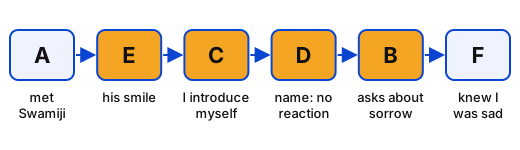
- A: I met the Swami → E: I was struck by his smile (first impression).
- C: I introduced myself → D: my Muslim name aroused no reaction.
- B: before I could speak further, he asked about my sorrow → F: he did not explain how he knew I was sad.
Trick: 'my sorrow' in B links directly to 'I was sad' in F.
Answer: (D) ECDB
अवधारणा: मुलाक़ात का क्रम देखें: पहली छाप → परिचय → उनकी प्रतिक्रिया → उनका प्रश्न, जो F से जुड़ता है।
- A: Swami से मिला → E: उनकी मुस्कान से प्रभावित हुआ।
- C: मैंने परिचय दिया → D: मेरे Muslim नाम पर कोई प्रतिक्रिया नहीं।
- B: आगे बोलने से पहले उन्होंने मेरे दुख के बारे में पूछा → F: उन्हें कैसे पता चला कि मैं दुखी हूँ।
ट्रिक: B का 'my sorrow' F के 'I was sad' से जुड़ता है।
उत्तर: (D) ECDB
SSC CPO Paper IIEnglish Language and ComprehensionPara JumblesSSC CPO Paper II 2025 · 30 Apr Shift 3
Q128.Select the option that expresses the given sentence in active voice. The students were scolded for not completing the homework.
- AThe teacher was scolding the students for not completing the homework.
- BThe teacher has been scolding the students for not completing the homework.
- CThe teacher scolded the students for not completing the homework.
- DThe teacher has scolded the students for not completing the homework.
Show answer
Concept: Simple past passive 'was/were + V3' becomes simple past 'V2' in the active voice; a doer (the teacher) is supplied.
- 'were scolded' → simple past.
- Active: 'The teacher scolded the students …'.
- (A) past continuous, (B) present perfect continuous, (D) present perfect – tense changed.
Trick: was/were + V3 ↔ V2.
Answer: (C) The teacher scolded the students for not completing the homework.
अवधारणा: Simple past passive 'was/were + V3' active में V2 बनता है; कर्ता (the teacher) जोड़ा जाता है।
- 'were scolded' → simple past।
- Active: 'The teacher scolded the students …'।
- (A), (B), (D) में tense बदल गया।
ट्रिक: was/were + V3 ↔ V2
उत्तर: (C) The teacher scolded the students for not completing the homework.
SSC CPO Paper IIEnglish Language and ComprehensionActive and Passive VoiceSSC CPO Paper II 2025 · 30 Apr Shift 3
Q129.Select the option that expresses the given sentence in indirect speech. “I love the smell of fresh flowers in the morning,” she said.
- AShe said that I love the smell of fresh flowers in the morning.
- BShe said that she loves the smell of fresh flowers in the morning.
- CShe says that she loved the smell of fresh flowers in the morning.
- DShe said that she loved the smell of fresh flowers in the morning.
Show answer
Concept: With a past reporting verb ('said'), simple present changes to simple past and 'I' changes to the subject's pronoun.
- 'I love' → 'she loved'.
- Reporting verb 'said' stays; 'that' is added.
- (A) keeps 'I love'; (B) keeps 'loves' (no backshift); (C) changes 'said' to 'says'.
Trick: said + present → past (love → loved).
Answer: (D) She said that she loved the smell of fresh flowers in the morning.
अवधारणा: Reporting verb past ('said') हो तो simple present → simple past और 'I' → कर्ता का pronoun।
- 'I love' → 'she loved'।
- 'said' वही रहेगा; 'that' जुड़ेगा।
- (A) में 'I love' रह गया; (B) में 'loves' (backshift नहीं); (C) में 'says' कर दिया।
ट्रिक: said + present → past
उत्तर: (D) She said that she loved the smell of fresh flowers in the morning.
SSC CPO Paper IIEnglish Language and ComprehensionDirect and Indirect SpeechSSC CPO Paper II 2025 · 30 Apr Shift 3
Q130.Select the option that expresses the given sentence in passive voice. Under Alauddin Khalji, the state brought the collection of land revenue under its own control.
- AUnder Alauddin Khalji, the collection of land revenue was brought under its own control by the state.
- BUnder Alauddin Khalji, the collection of land revenue was being brought under its own control by the state.
- CUnder Alauddin Khalji, the collection of land revenue was to be brought under its own control by the state.
- DUnder Alauddin Khalji, the collection of land revenue had been brought under its own control by the state.
Show answer
Concept: Simple past active (V2) becomes 'was/were + V3' in the passive voice.
- 'brought' (simple past) → 'was brought'.
- Object 'the collection of land revenue' becomes subject; 'by the state' at the end.
- (B) past continuous, (C) 'was to be' (future in past), (D) past perfect – tense changed.
Trick: V2 ↔ was/were + V3.
Answer: (A) Under Alauddin Khalji, the collection of land revenue was brought under its own control by the state.
अवधारणा: Simple past active (V2) passive में 'was/were + V3' बनता है।
- 'brought' (simple past) → 'was brought'।
- Object 'the collection of land revenue' subject बनेगा; 'by the state' अंत में।
- (B), (C), (D) में tense बदल गया।
ट्रिक: V2 ↔ was/were + V3
उत्तर: (A) Under Alauddin Khalji, the collection of land revenue was brought under its own control by the state.
SSC CPO Paper IIEnglish Language and ComprehensionActive and Passive VoiceSSC CPO Paper II 2025 · 30 Apr Shift 3
Q131.Select the option that expresses the given sentence in direct speech. She told me that she had loved the outing with me the previous evening.
- AShe said to me, “I love the outing with me last evening.”
- BShe said to me, “She had loved the outing with me the previous evening.”
- CShe said to me, “I loved the outing with you last evening.”
- DShe said to me, “She has loved the outing with you the previous evening.”
Show answer
Concept: Indirect to direct: 'told me' → said to me; 'she had loved' → 'I loved'; 'with me' → 'with you'; 'the previous evening' → 'last evening'.
- Speaker 'she' → 'I'; listener 'me' → 'you'.
- Past perfect 'had loved' → simple past 'loved' (outing was earlier).
- 'the previous evening' → 'last evening'.
- (A) keeps 'with me'; (B) and (D) keep 'she'.
Trick: Reverse: previous evening → last evening; had V3 → V2.
Answer: (C) She said to me, “I loved the outing with you last evening.”
अवधारणा: Indirect से direct: 'told me' → said to me; 'she had loved' → 'I loved'; 'with me' → 'with you'; 'the previous evening' → 'last evening'।
- बोलने वाली 'she' → 'I'; सुनने वाला 'me' → 'you'।
- 'had loved' → 'loved'।
- 'the previous evening' → 'last evening'।
- (A) में 'with me'; (B), (D) में 'she' रह गया।
ट्रिक: previous evening → last evening; had V3 → V2
उत्तर: (C) She said to me, “I loved the outing with you last evening.”
SSC CPO Paper IIEnglish Language and ComprehensionDirect and Indirect SpeechSSC CPO Paper II 2025 · 30 Apr Shift 3
Q132.Select the option that expresses the given sentence in reported speech. He said, "I visited Paris last summer."
- AHe said that he had visited Paris the previous summer.
- BHe said that I visited Paris last summer.
- CHe said that he was visiting Paris last summer.
- DHe said that he had been visiting Paris the previous summer.
Show answer
Concept: Simple past in direct speech becomes past perfect in indirect speech; 'last summer' becomes 'the previous summer'.
- 'I visited' → 'he had visited'.
- 'last summer' → 'the previous summer'.
- (B) keeps 'I'; (C) and (D) use continuous forms that change the meaning.
Trick: V2 → had + V3; last → previous.
Answer: (A) He said that he had visited Paris the previous summer.
अवधारणा: Direct का simple past indirect में past perfect बनता है; 'last summer' → 'the previous summer'।
- 'I visited' → 'he had visited'।
- 'last summer' → 'the previous summer'।
- (B) में 'I' रह गया; (C), (D) continuous रूप से अर्थ बदलते हैं।
ट्रिक: V2 → had + V3; last → previous
उत्तर: (A) He said that he had visited Paris the previous summer.
SSC CPO Paper IIEnglish Language and ComprehensionDirect and Indirect SpeechSSC CPO Paper II 2025 · 30 Apr Shift 3
Q133.Select the option that expresses the given sentence in passive voice. Does the teacher explain the lesson every day?
- AIs the lesson explained by the teacher every day?
- BHas the lesson been explained by the teacher every day?
- CIs the teacher explaining the lesson every day?
- DIs the lesson being explained by the teacher every day?
Show answer
Concept: Simple present question 'Does + S + V1 + O?' becomes 'Is/Are + O + V3 + by + S?'.
- 'Does the teacher explain' → simple present.
- Object 'the lesson' (singular) → 'Is the lesson explained'.
- (B) present perfect, (C) is still active, (D) present continuous.
Trick: Do/Does + V1 ↔ Is/Are + V3.
Answer: (A) Is the lesson explained by the teacher every day?
अवधारणा: Simple present प्रश्न 'Does + S + V1 + O?' passive में 'Is/Are + O + V3 + by + S?' बनता है।
- 'Does the teacher explain' → simple present।
- Object 'the lesson' (singular) → 'Is the lesson explained'।
- (B) present perfect, (C) active ही है, (D) present continuous।
ट्रिक: Does + V1 ↔ Is + V3
उत्तर: (A) Is the lesson explained by the teacher every day?
SSC CPO Paper IIEnglish Language and ComprehensionActive and Passive VoiceSSC CPO Paper II 2025 · 30 Apr Shift 3
Q134.Parts of the following sentence have been given as options. Select the option that contains an error.
A war was waging all around and the whole village was at panic.
- Athe whole village
- BA war was waging
- Cwas at panic
- Dall around and
Show answer
Concept: The correct prepositional phrase is 'in panic' / 'in a panic', not 'at panic'.
- 'the whole village was at panic' ✗.
- Correct: '… the whole village was in panic.'
- 'in' is used for states/conditions: in panic, in trouble, in danger.
Trick: State of mind → in: in panic, in love, in fear.
Answer: (C) was at panic
अवधारणा: सही prepositional phrase 'in panic' / 'in a panic' है, 'at panic' नहीं।
- 'the whole village was at panic' ✗।
- सही: '… the whole village was in panic.'
- अवस्था/स्थिति के लिए 'in': in panic, in trouble, in danger।
ट्रिक: मन की अवस्था → in: in panic, in fear
उत्तर: (C) was at panic
SSC CPO Paper IIEnglish Language and ComprehensionError SpottingSSC CPO Paper II 2025 · 30 Apr Shift 3
Q135.Select the option that expresses the given sentence in passive voice. The secretary does not answer the phone after office hours.
- AThe phone is not answered by the secretary after office hours.
- BThe phone is not been answered by the secretary after office hours.
- CThe phone will not be answered by the secretary after office hours.
- DThe phone has not been answered by the secretary after office hours.
Show answer
Concept: Negative simple present 'does not + V1' becomes 'is/are not + V3' in the passive voice.
- 'does not answer' → 'is not answered'.
- Object 'the phone' becomes subject; 'by the secretary'.
- (B) 'is not been' is ungrammatical; (C) future; (D) present perfect.
Trick: does not + V1 ↔ is not + V3.
Answer: (A) The phone is not answered by the secretary after office hours.
अवधारणा: Negative simple present 'does not + V1' passive में 'is/are not + V3' बनता है।
- 'does not answer' → 'is not answered'।
- Object 'the phone' subject बनेगा; 'by the secretary'।
- (B) 'is not been' अशुद्ध; (C) future; (D) present perfect।
ट्रिक: does not + V1 ↔ is not + V3
उत्तर: (A) The phone is not answered by the secretary after office hours.
SSC CPO Paper IIEnglish Language and ComprehensionActive and Passive VoiceSSC CPO Paper II 2025 · 30 Apr Shift 3
Q136.Select the option that will improve the underlined part of the given sentence. In case no improvement is needed, select ‘No improvement required’. Your application has been accepted if you fulfil all the conditions.
- Awill be accepted
- BNo improvement required
- Chad been accepted
- Dwas being accepted
Show answer
Concept: In a first conditional, the 'if' clause is in the simple present and the main clause is in the simple future.
- 'if you fulfil all the conditions' – simple present, a future possibility.
- Main clause: 'will be accepted' (future passive).
- Underlined 'has been accepted' wrongly says it has already happened; (C) and (D) are past.
Trick: If + present, will + V1 (or will be + V3).
Answer: (A) will be accepted
अवधारणा: First conditional में 'if' clause simple present और main clause simple future में होता है।
- 'if you fulfil all the conditions' – simple present, भविष्य की संभावना।
- Main clause: 'will be accepted' (future passive)।
- रेखांकित 'has been accepted' दर्शाता है कि काम हो चुका; (C), (D) past हैं।
ट्रिक: If + present, will + V1
उत्तर: (A) will be accepted
SSC CPO Paper IIEnglish Language and ComprehensionConditional sentencesSSC CPO Paper II 2025 · 30 Apr Shift 3
Q137.Select the option that expresses the given sentence in direct speech. The guard said that his family had gone to his village the previous week.
- AThe guard said, “My family had gone to my village the previous week.”
- BThe guard said, “His family went to his village the previous week.”
- CThe guard said, “My family went to my village last week.”
- DThe guard said, “My family was going to my village last week.”
Show answer
Concept: Indirect to direct: 'his family had gone' → 'My family went'; 'his village' → 'my village'; 'the previous week' → 'last week'.
- Pronouns: his → my (the guard is speaking).
- 'had gone' → 'went' (reverse backshift).
- 'the previous week' → 'last week'.
- (A) keeps 'had gone' and 'previous'; (B) keeps 'his'; (D) changes the tense to continuous.
Trick: previous week → last week; had V3 → V2.
Answer: (C) The guard said, “My family went to my village last week.”
अवधारणा: Indirect से direct: 'his family had gone' → 'My family went'; 'his village' → 'my village'; 'the previous week' → 'last week'।
- Pronoun: his → my (guard बोल रहा है)।
- 'had gone' → 'went'।
- 'the previous week' → 'last week'।
- (A) में 'had gone', 'previous' रह गए; (B) में 'his'; (D) continuous कर देता है।
ट्रिक: previous week → last week; had V3 → V2
उत्तर: (C) The guard said, “My family went to my village last week.”
SSC CPO Paper IIEnglish Language and ComprehensionDirect and Indirect SpeechSSC CPO Paper II 2025 · 30 Apr Shift 3
Q138.Select the most appropriate option to fill in the blank. The puzzle was so intricately designed ______ even the most seasoned cryptographers found themselves perplexed.
- Aas
- Bsince
- Cthat
- Dwhen
Show answer
Concept: The correlative pattern 'so + adjective/adverb + that' shows a result.
- 'so intricately designed … that even the most seasoned cryptographers found themselves perplexed'.
- 'so' in the sentence demands 'that'.
- 'as', 'since' and 'when' do not complete the so … that structure.
Trick: so … that / such … that → result.
Answer: (C) that
अवधारणा: Correlative ढांचा 'so + adjective/adverb + that' परिणाम (result) दिखाता है।
- 'so intricately designed … that even the most seasoned cryptographers…'।
- वाक्य में 'so' है, इसलिए 'that' आएगा।
- 'as', 'since', 'when' so … that ढांचा पूरा नहीं करते।
ट्रिक: so … that → परिणाम
उत्तर: (C) that
SSC CPO Paper IIEnglish Language and ComprehensionFill in the BlanksSSC CPO Paper II 2025 · 30 Apr Shift 3
Q139.Select the INCORRECTLY spelt word.
- AMariner
- BMartyre
- CMartial
- DMarriage
Show answer
Concept: The correct spelling is 'Martyr' (one who dies for a cause); there is no final 'e'.
- 'Martyre' ✗ → 'Martyr' ✓.
- Mariner (sailor), Martial (related to war) and Marriage are correct.
Trick: Martyr ends in -yr, like 'satyr'.
Answer: (B) Martyre
अवधारणा: सही वर्तनी 'Martyr' (शहीद) है; अंत में 'e' नहीं आता।
- 'Martyre' ✗ → 'Martyr' ✓।
- Mariner (नाविक), Martial (युद्ध संबंधी), Marriage सही हैं।
ट्रिक: Martyr – अंत में -yr
उत्तर: (B) Martyre
SSC CPO Paper IIEnglish Language and ComprehensionSpellingSSC CPO Paper II 2025 · 30 Apr Shift 3
Q140.Select the option that expresses the given sentence in direct speech. She said that she was going to the store to buy some groceries.
- AShe said, “She was going to the store to buy some groceries.”
- BShe said, “She will be going to the store to buy some groceries.”
- CShe told, “I am going to the store to buy some groceries.”
- DShe said, “I am going to the store to buy some groceries.”
Show answer
Concept: Indirect to direct: 'said that she was going' → said, "I am going …"; with no listener, use 'said', not 'told'.
- 'she' (the speaker herself) → 'I'.
- 'was going' → 'am going'.
- (A) and (B) keep 'she'; (C) uses 'told' without an object, which is wrong.
Trick: 'told' always needs an object (told me/him); otherwise use 'said'.
Answer: (D) She said, “I am going to the store to buy some groceries.”
अवधारणा: Indirect से direct: 'said that she was going' → said, "I am going …"; सुनने वाला न हो तो 'told' नहीं, 'said'।
- 'she' (स्वयं वक्ता) → 'I'।
- 'was going' → 'am going'।
- (A), (B) में 'she' रह गया; (C) में object के बिना 'told' गलत है।
ट्रिक: 'told' के साथ object ज़रूरी; वरना 'said'
उत्तर: (D) She said, “I am going to the store to buy some groceries.”
SSC CPO Paper IIEnglish Language and ComprehensionDirect and Indirect SpeechSSC CPO Paper II 2025 · 30 Apr Shift 3

