Q141.Select the option that will improve the underlined part of the given sentence. In case no improvement is needed, select ‘No improvement required’. You ought cut out your consumption of fats if you want to reduce your weight.
- Aought to cut down
- BNo improvement required
- Cought cut down
- Dmust cut out
Show answer
Concept: 'Ought' is always followed by 'to + V1'; to reduce something gradually is 'cut down (on)', while 'cut out' means remove completely.
- Underlined: 'ought cut out' – 'to' is missing.
- Reducing fat intake to lose weight → 'cut down'.
- Correct: 'You ought to cut down your consumption of fats …'.
- (C) still misses 'to'; (D) changes the sense.
Trick: ought to + V1; cut down = reduce.
Answer: (A) ought to cut down
अवधारणा: 'Ought' के बाद हमेशा 'to + V1' आता है; धीरे-धीरे कम करना = 'cut down', जबकि 'cut out' = पूरी तरह हटाना।
- रेखांकित: 'ought cut out' – 'to' नहीं है।
- वजन घटाने हेतु वसा कम करना → 'cut down'।
- सही: 'You ought to cut down your consumption of fats …'।
- (C) में अब भी 'to' नहीं; (D) अर्थ बदलता है।
ट्रिक: ought to + V1; cut down = कम करना
उत्तर: (A) ought to cut down
SSC CPO Paper IIEnglish Language and ComprehensionModals & phrasal verbsSSC CPO Paper II 2025 · 30 Apr Shift 3
Q142.Select the option that will improve the underlined part of the given sentence. In case no improvement is needed, select ‘No improvement required’. Mr Sharma has been working since five years in this company as Senior Accountant.
- ANo improvement required
- Bworks for
- Chas worked since
- Dhas been working for
Show answer
Concept: For a period of time use 'for'; for a starting point use 'since'. An action continuing till now takes the present perfect continuous.
- Underlined: 'has been working since' – 'five years' is a period.
- Correct: 'has been working for five years'.
- (B) simple present and (C) 'since' are wrong.
Trick: for + period (five years); since + point (2020, Monday).
Answer: (D) has been working for
अवधारणा: समय-अवधि के लिए 'for' और आरंभ-बिंदु के लिए 'since'। अब तक जारी काम के लिए present perfect continuous।
- रेखांकित: 'has been working since' – 'five years' अवधि है।
- सही: 'has been working for five years'।
- (B) simple present और (C) 'since' गलत हैं।
ट्रिक: for + अवधि; since + समय-बिंदु
उत्तर: (D) has been working for
SSC CPO Paper IIEnglish Language and ComprehensionSince / For with tensesSSC CPO Paper II 2025 · 30 Apr Shift 3
Q143.Select the most appropriate option to fill in the blanks. The detective carefully examined the crime scene, searching ____ clues hidden ____ the shadows.
- Afrom; beyond
- Bfor; in
- Cto; under
- Dover; in
Show answer
Concept: Fixed prepositions: 'search for' something; hidden 'in' the shadows.
- 'searching for clues' – search for = look for.
- 'hidden in the shadows' – in = inside an area/darkness.
- 'searching from/to/over' are not idiomatic here.
Trick: search for, look for, hidden in.
Answer: (B) for; in
अवधारणा: निश्चित preposition: 'search for' कुछ खोजना; 'in' the shadows छिपा।
- 'searching for clues' – search for = खोजना।
- 'hidden in the shadows' – in = अंधेरे/क्षेत्र के अंदर।
- 'searching from/to/over' यहाँ सही नहीं।
ट्रिक: search for, hidden in
उत्तर: (B) for; in
SSC CPO Paper IIEnglish Language and ComprehensionFill in the BlanksSSC CPO Paper II 2025 · 30 Apr Shift 3
Q144.Select the option that expresses the given sentence in reported speech. She said to him, “I will call you tomorrow.”
- AShe said to him that she will call him tomorrow.
- BShe said to him that I will call you tomorrow.
- CShe said to him that she would call him the next day.
- DShe said to him that she would call you the next day.
Show answer
Concept: With 'said' (past), 'will' becomes 'would', pronouns change to suit the speaker and listener, and 'tomorrow' becomes 'the next day'.
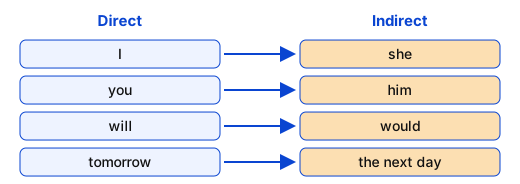
- 'I' → 'she'; 'you' → 'him'.
- 'will call' → 'would call'.
- 'tomorrow' → 'the next day'.
- (A) keeps 'will' and 'tomorrow'; (B) keeps 'I/you'; (D) keeps 'you'.
Trick: will → would; tomorrow → the next day.
Answer: (C) She said to him that she would call him the next day.
अवधारणा: Reporting verb 'said' (past) हो तो 'will' → 'would', pronoun वक्ता/श्रोता के अनुसार और 'tomorrow' → 'the next day'।
- 'I' → 'she'; 'you' → 'him'।
- 'will call' → 'would call'।
- 'tomorrow' → 'the next day'।
- (A) में 'will', 'tomorrow' रह गए; (B) में 'I/you'; (D) में 'you'।
ट्रिक: will → would; tomorrow → the next day
उत्तर: (C) She said to him that she would call him the next day.
SSC CPO Paper IIEnglish Language and ComprehensionDirect and Indirect SpeechSSC CPO Paper II 2025 · 30 Apr Shift 3
Q145.The following sentence has been split into four segments. Identify the segment that contains a grammatical error.
He entered the room / such quietly that / none of us / noticed him.
- Anoticed him
- Bsuch quietly that
- Cnone of us
- DHe entered the room
Show answer
Concept: 'So' is used before an adjective/adverb alone; 'such' is used before a noun phrase (such a quiet man).
- 'quietly' is an adverb → 'so quietly that'.
- Correct: 'He entered the room so quietly that none of us noticed him.'
- Other segments are correct.
Trick: so + adj/adverb + that; such + (a) + adj + noun + that.
Answer: (B) such quietly that
अवधारणा: अकेले adjective/adverb से पहले 'so' और noun phrase से पहले 'such' आता है (such a quiet man)।
- 'quietly' adverb है → 'so quietly that'।
- सही: 'He entered the room so quietly that none of us noticed him.'
- बाकी भाग सही हैं।
ट्रिक: so + adverb; such + noun
उत्तर: (B) such quietly that
SSC CPO Paper IIEnglish Language and ComprehensionError SpottingSSC CPO Paper II 2025 · 30 Apr Shift 3
Q146.Select the option that expresses the given sentence in passive voice. The chef prepares a special dish every evening.
- AA special dish is prepared by the chef every evening.
- BA special dish has been prepared by the chef every evening.
- CA special dish is being prepared by the chef everyday.
- DA special dish will be prepared by the chef every evening.
Show answer
Concept: Simple present active (V1/V1+s) becomes 'is/are + V3' in the passive voice.
- 'prepares' → 'is prepared'.
- Object 'a special dish' becomes subject; 'by the chef'.
- (B) present perfect, (C) present continuous, (D) future – tense changed.
Trick: V1/V1+s ↔ is/am/are + V3.
Answer: (A) A special dish is prepared by the chef every evening.
अवधारणा: Simple present active (V1/V1+s) passive में 'is/are + V3' बनता है।
- 'prepares' → 'is prepared'।
- Object 'a special dish' subject बनेगा; 'by the chef'।
- (B), (C), (D) में tense बदल गया।
ट्रिक: V1+s ↔ is + V3
उत्तर: (A) A special dish is prepared by the chef every evening.
SSC CPO Paper IIEnglish Language and ComprehensionActive and Passive VoiceSSC CPO Paper II 2025 · 30 Apr Shift 3
Q147.Sentences of a paragraph are given below in jumbled order. Arrange the sentences in the correct order to form a meaningful and coherent paragraph. A. Gryabov, a large stout man, with a very big head, was sitting on the sand, angling, with his legs tucked under him like a Turk.
B. Otsov thought a little, and then went to the river to look for Gryabov. C. His hat was on the back of his head, and his cravat had slipped on one side. D. Going down to the river, he found him a mile and a half from the house.
- AACDB
- BCBAD
- CBDAC
- DBCAD
Show answer
Concept: Find the opening sentence (it introduces both characters and the action), then follow the movement and description.
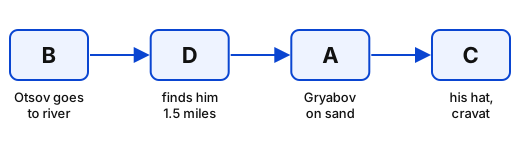
- B opens: Otsov goes to the river to look for Gryabov.
- D: going down to the river, he found him (Gryabov).
- A describes Gryabov sitting on the sand, angling → C: 'His hat … his cravat' continues the description.
Trick: Action (B, D) → description of the person found (A, C).
Answer: (C) BDAC
अवधारणा: शुरुआती वाक्य खोजें (जो पात्र और क्रिया बताता है), फिर गति और वर्णन का क्रम अपनाएँ।
- B शुरुआत: Otsov, Gryabov को खोजने नदी पर जाता है।
- D: नदी पर जाकर उसने उसे पाया।
- A: Gryabov रेत पर बैठा मछली पकड़ रहा था → C: 'His hat … his cravat' – वर्णन जारी।
ट्रिक: क्रिया (B, D) → मिले व्यक्ति का वर्णन (A, C)।
उत्तर: (C) BDAC
SSC CPO Paper IIEnglish Language and ComprehensionPara JumblesSSC CPO Paper II 2025 · 30 Apr Shift 3
Q148.Select the most appropriate option to complete the given idiom. __________ lies in the eyes of beholder.
- ALove
- BBeauty
- CHappiness
- DNature
Show answer
Concept: The proverb 'Beauty lies in the eyes of the beholder' means that beauty is subjective – different people find different things beautiful.
- Beholder = the person who looks.
- Only 'Beauty' completes this well-known saying.
- Love, happiness and nature do not form the proverb.
Yaad rakhein: Beauty is subjective → lies in the eyes of the beholder.
Answer: (B) Beauty
अवधारणा: 'Beauty lies in the eyes of the beholder' का अर्थ है – सुंदरता व्यक्तिपरक है; हर व्यक्ति को अलग चीज़ें सुंदर लगती हैं।
- Beholder = देखने वाला।
- केवल 'Beauty' से यह प्रसिद्ध कहावत पूरी होती है।
- Love, happiness, nature से कहावत नहीं बनती।
याद रखें: सुंदरता देखने वाले की आँखों में होती है।
उत्तर: (B) Beauty
SSC CPO Paper IIEnglish Language and ComprehensionIdioms and PhrasesSSC CPO Paper II 2025 · 30 Apr Shift 3
Q149.Select the option that can be used as a one-word substitute for the given group of words.
Fear of being in closed spaces
- AClaustrophobia
- BAcrophobia
- CCacophobia
- DHydrophobia
Show answer
Concept: Phobia words: 'claustro' (closed space) + 'phobia' (fear) = fear of being in closed spaces.
- Claustrophobia – fear of confined spaces (lifts, tunnels).
- Acrophobia – fear of heights.
- Cacophobia – fear of ugliness; Hydrophobia – fear of water.
Yaad rakhein: Claustro = closed (like 'cloister'); Acro = height; Hydro = water.
Answer: (A) Claustrophobia
अवधारणा: Phobia शब्द: 'claustro' (बंद स्थान) + 'phobia' (डर) = बंद जगहों का डर।
- Claustrophobia – बंद जगहों (lift, सुरंग) का डर।
- Acrophobia – ऊँचाई का डर।
- Cacophobia – कुरूपता का डर; Hydrophobia – पानी का डर।
याद रखें: Claustro = बंद; Acro = ऊँचाई; Hydro = पानी
उत्तर: (A) Claustrophobia
SSC CPO Paper IIEnglish Language and ComprehensionOne-word SubstitutionSSC CPO Paper II 2025 · 30 Apr Shift 3
Q150.Select the option that expresses the given sentence in active voice. Our team has been invited by the National High School to play hockey with them.
- AThe National High School is inviting our team to play hockey with them.
- BThe National High School has invited our team to play hockey with them.
- CThe National High School invited our team to play hockey with them.
- DOur team has invited the National High School to play hockey with them.
Show answer
Concept: Present perfect passive 'has been + V3' becomes 'has/have + V3' in the active voice; the agent becomes the subject.
- 'has been invited by the National High School' → present perfect.
- Active: 'The National High School has invited our team …'.
- (A) present continuous, (C) simple past; (D) reverses who invited whom.
Trick: has been + V3 ↔ has + V3.
Answer: (B) The National High School has invited our team to play hockey with them.
अवधारणा: Present perfect passive 'has been + V3' active में 'has/have + V3' बनता है; agent subject बनता है।
- 'has been invited by the National High School' → present perfect।
- Active: 'The National High School has invited our team …'।
- (A) present continuous, (C) simple past; (D) कर्ता-कर्म उलट देता है।
ट्रिक: has been + V3 ↔ has + V3
उत्तर: (B) The National High School has invited our team to play hockey with them.
SSC CPO Paper IIEnglish Language and ComprehensionActive and Passive VoiceSSC CPO Paper II 2025 · 30 Apr Shift 3
Q151.Select the option that expresses the following sentence in direct speech. She told me that she had visited Paris last summer.
- A“I have been visiting Paris last summer,” she told me.
- B“I will visit Paris next summer,” she told me.
- C“I am visiting Paris next summer,” she told me.
- D“I visited Paris last summer,” she told me.
Show answer
Concept: While changing indirect speech to direct speech, the past perfect of the reported clause usually goes back to the simple past, and pronouns change back to the speaker's point of view.
- Reporting verb 'told me' → 'she told me' with inverted commas.
- 'she had visited' → 'I visited' (past perfect → simple past; she → I).
- 'last summer' stays as it is because it already belongs to the speaker's time frame.
- Options with 'will visit', 'am visiting' or 'next summer' change the meaning; 'have been visiting last summer' is ungrammatical.
Trick: Indirect → Direct: had + V3 → V2, and the third-person subject becomes 'I'.
Answer: (D) “I visited Paris last summer,” she told me.
अवधारणा: Indirect speech को direct speech में बदलते समय reported clause का past perfect सामान्यतः simple past बन जाता है और pronouns वक्ता के अनुसार वापस बदलते हैं।
- 'She told me that' → “...,” she told me.
- 'she had visited' → 'I visited' (past perfect → simple past; she → I)।
- 'last summer' वैसा ही रहता है।
- 'will visit', 'am visiting', 'next summer' अर्थ बदल देते हैं; 'have been visiting last summer' व्याकरण की दृष्टि से गलत है।
ट्रिक: Indirect → Direct में had + V3 → V2 और she/he → I।
उत्तर: (D) “I visited Paris last summer,” she told me.
SSC CPO Paper IIEnglish Language and ComprehensionDirect and Indirect SpeechSSC CPO Paper II 2025 · 30 Apr Shift 3
Q152.Select the option that expresses the given sentence in active voice. By whom was this painting made?
- AWho made this painting?
- BWhom made this painting?
- CWho has made this painting?
- DWho was making this painting?
Show answer
Concept: An interrogative passive 'By whom + was/were + subject + V3?' becomes an active question 'Who + V2 + object?' with the same tense.
- 'By whom' → 'Who' (subject of the active sentence).
- 'was ... made' is simple past passive → active verb 'made'.
- Object: 'this painting' → 'Who made this painting?'
- 'Whom' cannot be a subject; 'has made' and 'was making' change the tense.
Trick: By whom ... was + V3? → Who + V2 ...?
Answer: (A) Who made this painting?
अवधारणा: Passive प्रश्न 'By whom + was/were + subject + V3?' को active में 'Who + V2 + object?' बनाते हैं, tense वही रहता है।
- 'By whom' → 'Who' (active का कर्ता)।
- 'was ... made' = simple past passive → active में 'made'।
- Object 'this painting' → 'Who made this painting?'
- 'Whom' कर्ता नहीं बन सकता; 'has made', 'was making' से tense बदल जाता है।
ट्रिक: By whom ... was + V3? → Who + V2 ...?
उत्तर: (A) Who made this painting?
SSC CPO Paper IIEnglish Language and ComprehensionActive and Passive VoiceSSC CPO Paper II 2025 · 30 Apr Shift 3
Q153.Select the option that can be used as a one-word substitute for the given group of words.
Able to withstand or recover quickly from difficult conditions
- ARemnant
- BReliant
- CRelevant
- DResilient
Show answer
Concept: 'Resilient' means able to withstand or recover quickly from difficult conditions.
- The given phrase exactly describes 'Resilient'.
- Remnant = a small remaining part.
- Reliant = dependent on someone or something.
- Relevant = connected with the matter in hand.
Yaad rakhein: Resilient = one who bounces back; noun: resilience.
Answer: (D) Resilient
अवधारणा: 'Resilient' का अर्थ है कठिन परिस्थितियों को सह लेने वाला या उनसे जल्दी उबरने वाला (लचीला/सहनशील)।
- दिया गया वाक्यांश ठीक 'Resilient' का ही वर्णन करता है।
- Remnant = बचा हुआ छोटा भाग।
- Reliant = किसी पर निर्भर।
- Relevant = प्रासंगिक, विषय से जुड़ा।
याद रखें: Resilient = bounce back करने वाला; resilience = लचीलापन।
उत्तर: (D) Resilient
SSC CPO Paper IIEnglish Language and ComprehensionOne Word SubstitutionSSC CPO Paper II 2025 · 30 Apr Shift 3
Q154.Select the option that can be used as a one-word substitute for the given group of words.
Intense sadness especially caused by somebody’s death
- AGrief
- BAche
- CTorture
- DWorry
Show answer
Concept: 'Grief' means intense sorrow, especially caused by someone's death.
- The given phrase exactly describes 'Grief'.
- Ache = a continuous dull physical pain.
- Torture = causing severe pain deliberately.
- Worry = anxiety about possible problems.
Yaad rakhein: Grief → grieve (verb); 'grief-stricken' = shocked by death.
Answer: (A) Grief
अवधारणा: 'Grief' का अर्थ है गहरा दुःख, विशेषकर किसी की मृत्यु के कारण (शोक)।
- दिया गया वाक्यांश ठीक 'Grief' का ही वर्णन करता है।
- Ache = लगातार हल्का शारीरिक दर्द।
- Torture = जानबूझकर दी गई यातना।
- Worry = चिंता।
याद रखें: Grief = शोक; grieve = शोक मनाना; grief-stricken = शोक में डूबा।
उत्तर: (A) Grief
SSC CPO Paper IIEnglish Language and ComprehensionOne Word SubstitutionSSC CPO Paper II 2025 · 30 Apr Shift 3
Q155.Select the most appropriate meaning of the given idiom. Tall talk
- APresenting illogical arguments
- BExaggerating things
- CTalking sorrowfully
- DExchanging heated words
Show answer
Concept: The idiom 'tall talk' means boastful or exaggerated talk.
- 'Tall' here means unbelievable or exaggerated (as in 'a tall story').
- So 'tall talk' = exaggerating things, bragging.
- It has nothing to do with illogical arguments, sorrow or heated quarrels.
- Example: His claims of meeting the President were just tall talk.
Yaad rakhein: Tall talk / tall claims / tall story — all point to exaggeration.
Answer: (B) Exaggerating things
अवधारणा: 'Tall talk' मुहावरे का अर्थ है डींग मारना या बढ़ा-चढ़ाकर बात करना।
- यहाँ 'tall' का अर्थ है अविश्वसनीय/बढ़ा-चढ़ाकर ('a tall story' की तरह)।
- इसलिए 'tall talk' = Exaggerating things।
- इसका तर्कहीन बहस, दुःख या झगड़े से कोई संबंध नहीं।
- उदाहरण: His claims of meeting the President were just tall talk.
याद रखें: Tall talk / tall claims / tall story = अतिशयोक्ति।
उत्तर: (B) Exaggerating things
SSC CPO Paper IIEnglish Language and ComprehensionIdioms and PhrasesSSC CPO Paper II 2025 · 30 Apr Shift 3
Q156.Parts of the following sentence have been given as options. Select the option that contains an error.
Those people which do not get sufficient sleep at night suffer from a disease called insomnia.
- Asuffer from a disease
- BThose people which do not get
- Csufficient sleep at night
- Dcalled insomnia
Show answer
Concept: 'Who' is used as a relative pronoun for persons; 'which' is used for animals and things.
- The antecedent is 'Those people' — persons.
- So 'which' must be replaced by 'who': 'Those people who do not get sufficient sleep...'.
- The other parts ('sufficient sleep at night', 'suffer from a disease', 'called insomnia') are correct.
Trick: Persons → who/whom/whose; things/animals → which.
Answer: (B) Those people which do not get
अवधारणा: व्यक्तियों के लिए relative pronoun 'who' और वस्तुओं/जानवरों के लिए 'which' प्रयोग होता है।
- Antecedent 'Those people' व्यक्ति हैं।
- अतः 'which' की जगह 'who' होगा: 'Those people who do not get sufficient sleep...'।
- बाकी भाग ('sufficient sleep at night', 'suffer from a disease', 'called insomnia') सही हैं।
ट्रिक: व्यक्ति → who/whom/whose; वस्तु/जानवर → which।
उत्तर: (B) Those people which do not get
SSC CPO Paper IIEnglish Language and ComprehensionSpotting Errors – Relative PronounSSC CPO Paper II 2025 · 30 Apr Shift 3
Q157.Parts of the following sentence have been given as options. Select the option that contains an error.
The Survey showed that across most tasks that test the ability to apply basic numeracy and reading skills, Primary school boys did best than girls.
- Abasic numeracy and reading skills
- Bthat test the ability to apply
- CPrimary school boys did best than girls
- DThe Survey showed that across most tasks
Show answer
Concept: When two persons/groups are compared with 'than', the comparative degree is used, not the superlative.
- Two groups are compared: boys and girls, with 'than'.
- 'best' is superlative and cannot go with 'than'.
- Correct: 'Primary school boys did better than girls.'
- The other parts are grammatically fine.
Trick: 'than' always needs a comparative: good → better → best.
Answer: (C) Primary school boys did best than girls
अवधारणा: दो व्यक्तियों/समूहों की 'than' के साथ तुलना में comparative degree आती है, superlative नहीं।
- यहाँ boys और girls दो समूहों की 'than' से तुलना है।
- 'best' superlative है, 'than' के साथ नहीं आ सकता।
- सही: 'Primary school boys did better than girls.'
- अन्य भाग सही हैं।
ट्रिक: 'than' के साथ हमेशा comparative: good → better → best।
उत्तर: (C) Primary school boys did best than girls
SSC CPO Paper IIEnglish Language and ComprehensionSpotting Errors – Degrees of ComparisonSSC CPO Paper II 2025 · 30 Apr Shift 3
Q158.Choose the correct option to convert the following active voice sentence into passive voice.
He gathered the men and brought the priest to witness the death.
- AThe men were gathered and the priest was brought by him to witness the death.
- BHe had the death witnessed by gathering and bringing the priest.
- CHe has the death witnessed by gathering and bringing the priest.
- DThe priest was brought by the men and witnessed the death.
Show answer
Concept: In a compound sentence each clause is changed into passive separately: object becomes subject, verb becomes 'was/were + V3', and the doer goes after 'by'.
- Clause 1: 'He gathered the men' → 'The men were gathered'.
- Clause 2: 'brought the priest' → 'the priest was brought by him'.
- Purpose phrase 'to witness the death' stays unchanged.
- Options B and C change the meaning; D wrongly makes the men the doers.
Trick: Simple past: V2 → was/were + V3; keep the purpose phrase as it is.
Answer: (A) The men were gathered and the priest was brought by him to witness the death.
अवधारणा: Compound sentence में हर clause को अलग-अलग passive में बदलते हैं: object कर्ता बनता है, verb 'was/were + V3' और कर्ता 'by' के बाद।
- Clause 1: 'He gathered the men' → 'The men were gathered'।
- Clause 2: 'brought the priest' → 'the priest was brought by him'।
- 'to witness the death' वैसा ही रहता है।
- B और C अर्थ बदल देते हैं; D में men को कर्ता बना दिया गया है।
ट्रिक: Simple past: V2 → was/were + V3; purpose phrase वैसा ही रहता है।
उत्तर: (A) The men were gathered and the priest was brought by him to witness the death.
SSC CPO Paper IIEnglish Language and ComprehensionActive and Passive VoiceSSC CPO Paper II 2025 · 30 Apr Shift 3
Q159.Select the option that expresses the given sentence in active voice. Will the Lohri function be organised in your lawns this year?
- AWill you be organising the Lohri function in your lawns this year?
- BWill you have organised the Lohri function in your lawns this year?
- CWill you organise your lawns in the Lohri function this year?
- DWill you organise the Lohri function in your lawns this year?
Show answer
Concept: Simple future passive 'Will + subject + be + V3?' becomes active 'Will + doer + V1 + object?'.
- The doer is not stated; from 'your lawns' it is 'you'.
- 'Will ... be organised' → 'Will you organise'.
- Object: 'the Lohri function' → 'Will you organise the Lohri function in your lawns this year?'
- A (continuous) and B (perfect) change the tense; C reverses the meaning.
Trick: will be + V3 → will + V1 (simple future).
Answer: (D) Will you organise the Lohri function in your lawns this year?
अवधारणा: Simple future passive 'Will + subject + be + V3?' का active 'Will + कर्ता + V1 + object?' होता है।
- कर्ता नहीं दिया; 'your lawns' से कर्ता 'you' है।
- 'Will ... be organised' → 'Will you organise'।
- 'Will you organise the Lohri function in your lawns this year?'
- A (continuous) और B (perfect) tense बदलते हैं; C का अर्थ उल्टा है।
ट्रिक: will be + V3 → will + V1।
उत्तर: (D) Will you organise the Lohri function in your lawns this year?
SSC CPO Paper IIEnglish Language and ComprehensionActive and Passive VoiceSSC CPO Paper II 2025 · 30 Apr Shift 3
Q160.Select the option that will improve the underlined part of the given sentence. In case no improvement is needed, select ‘No improvement required’. It had been a serious offence, but he was let out with a warning.
- Ais let out
- Bhad been let off
- Cwas let off
- DNo improvement required
Show answer
Concept: 'Let off' means to release someone without punishment or with only a light punishment; 'let out' means to release from a place or to reveal.
- The sentence says the offence was serious, yet he escaped with only a warning.
- So the correct phrasal verb is 'let off': 'he was let off with a warning'.
- Simple past 'was' matches the narrative; 'had been let off' and 'is let out' break the tense sequence.
Trick: 'Let off with a warning/fine' = escape full punishment; 'let out' = release from a place or reveal.
Answer: (C) was let off
अवधारणा: 'Let off' = बिना सज़ा या हल्की सज़ा देकर छोड़ देना; 'let out' = किसी जगह से बाहर निकालना या रहस्य खोलना।
- वाक्य कहता है अपराध गंभीर था, फिर भी उसे केवल चेतावनी देकर छोड़ा गया।
- इसलिए सही phrasal verb 'let off' है: 'he was let off with a warning'।
- Simple past 'was' सही है; 'had been let off' और 'is let out' tense क्रम तोड़ते हैं।
ट्रिक: let off with a warning = चेतावनी देकर छोड़ देना।
उत्तर: (C) was let off
SSC CPO Paper IIEnglish Language and ComprehensionPhrasal verbsSSC CPO Paper II 2025 · 30 Apr Shift 3

