Q181.Find the value of .
का मान ज्ञात कीजिए।
- A1
- B
- C
- D2
Show answer
Concept: Do ÷ and × from left to right before + and −, separately in numerator and denominator.
- Numerator: , →
- Denominator: →
- Value
Trick: Left to right: , not .
Answer: (A) 1
अवधारणा: अंश और हर में अलग-अलग पहले ÷ और × (बाएँ से दाएँ), फिर + और −।
- अंश: , →
- हर: →
- मान
ट्रिक: बाएँ से दाएँ: ।
उत्तर: (A) 1
SSC CPO Paper IQuantitative AptitudeSimplification (BODMAS)SSC CPO Paper I 2024 · 28 Jun Shift 3
Q182.Simplify
सरल कीजिए
- A
- B
- C
- D
Show answer
Concept: Use and .
- Divide by :
Trick: Check : expression , and ✓.
Answer: (C)
अवधारणा: और का प्रयोग करें।
- से भाग:
ट्रिक: रखें: व्यंजक और ✓।
उत्तर: (C)
SSC CPO Paper IQuantitative AptitudeTrigonometric identitiesSSC CPO Paper I 2024 · 28 Jun Shift 3
Q183.The marked price of a table is ₹5,980. If the shopkeeper offers a discount of 18%, what is its selling price (in ₹, to the nearest rupee)?
एक मेज़ का अंकित मूल्य ₹5,980 है। यदि दुकानदार 18% की छूट देता है, तो इसका विक्रय मूल्य (₹ में, निकटतम रुपये तक) क्या है?
- A4,940
- B4,490
- C4,094
- D4,904
Show answer
Concept: Selling price .
- SP
- To the nearest rupee: ₹4,904
Trick: of ; .
Answer: (D) 4,904
अवधारणा: विक्रय मूल्य ।
- SP
- निकटतम रुपये तक: ₹4,904
ट्रिक: का ; ।
उत्तर: (D) 4,904
SSC CPO Paper IQuantitative AptitudeDiscountSSC CPO Paper I 2024 · 28 Jun Shift 3
Q184.A vessel contains 18 litres mixture of milk and water in the ratio 5 : 1. If 3 litres of milk is added to the vessel, then how much water (in litres) should be added to the vessel to have milk and water in the ratio 9 : 2?
एक बर्तन में दूध और पानी का 18 लीटर मिश्रण 5 : 1 के अनुपात में है। यदि बर्तन में 3 लीटर दूध मिलाया जाता है, तो दूध और पानी का अनुपात 9 : 2 करने के लिए बर्तन में कितना पानी (लीटर में) मिलाया जाना चाहिए?
- A2
- B1.5
- C1
- D0.5
Show answer
Concept: Split the mixture into milk and water, add the new quantities, and match the target ratio.
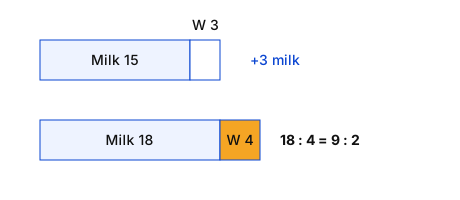
- Milk L, water L
- After adding 3 L milk: milk L
- For : water L
- Water to add L
Trick: Milk 18 = 9 parts → 1 part = 2 L → water 2 parts = 4 L.
Answer: (C) 1
अवधारणा: मिश्रण को दूध और पानी में बाँटें, नई मात्राएँ जोड़ें और लक्ष्य अनुपात से मिलाएँ।
- दूध L, पानी L
- 3 L दूध मिलाने पर: दूध L
- के लिए पानी L
- मिलाना है L पानी
ट्रिक: दूध 18 = 9 भाग → 1 भाग = 2 L → पानी 2 भाग = 4 L।
उत्तर: (C) 1
SSC CPO Paper IQuantitative AptitudeMixture and alligationSSC CPO Paper I 2024 · 28 Jun Shift 3
Q185.Two trains are moving in the same direction at 60 km/h and 42 km/h. The faster train crosses a man in the slower train in 36 seconds. Find the length of the faster train.
दो रेलगाड़ियाँ एक ही दिशा में 60 km/h और 42 km/h की चाल से चल रही हैं। तेज़ रेलगाड़ी, धीमी रेलगाड़ी में बैठे एक व्यक्ति को 36 सेकंड में पार करती है। तेज़ रेलगाड़ी की लंबाई ज्ञात कीजिए।
- A185 m
- B195 m
- C180 m
- D175 m
Show answer
Concept: Crossing a man (a point) in a train moving the same way: length = relative speed × time, relative speed = difference.
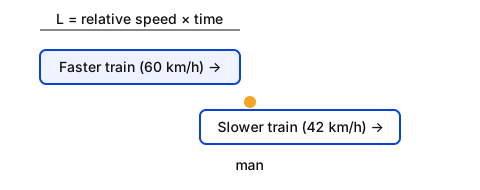
- Relative speed
- Length m
Yaad rakhein: Same direction → subtract speeds; opposite → add.
Answer: (C) 180 m
अवधारणा: एक ही दिशा में चलती ट्रेन में बैठे व्यक्ति (बिंदु) को पार करना: लंबाई = सापेक्ष चाल × समय, सापेक्ष चाल = अंतर।
- सापेक्ष चाल
- लंबाई m
याद रखें: एक ही दिशा → चालें घटाएँ; विपरीत दिशा → जोड़ें।
उत्तर: (C) 180 m
SSC CPO Paper IQuantitative AptitudeTrains – relative speedSSC CPO Paper I 2024 · 28 Jun Shift 3
Q186.Study the given table and answer the question that follows.
The table shows the yearly production (in thousands) of scooters in five different factories (P, Q, R, S and T) from 1985 to 1989.
Yearly production (in thousands) of scooters in different factories.
| Factory | 1985 | 1986 | 1987 | 1988 | 1989 |
|---|
| P | 20 | 15 | 24 | 13 | 17 |
| Q | 16 | 23 | 41 | 20 | 15 |
| R | 14 | 21 | 30 | 16 | 12 |
| S | 25 | 17 | 15 | 12 | 22 |
| T | 40 | 32 | 39 | 41 | 35 |
| Total | 115 | 108 | 149 | 102 | 101 |
In which year was the total production of scooters of all factories 20% of the total production of scooters from 1985 to 1989?
दी गई तालिका का अध्ययन कीजिए और उसके बाद दिए गए प्रश्न का उत्तर दीजिए।
तालिका 1985 से 1989 तक पाँच अलग-अलग कारखानों (P, Q, R, S और T) में स्कूटरों का वार्षिक उत्पादन (हज़ार में) दर्शाती है।
विभिन्न कारखानों में स्कूटरों का वार्षिक उत्पादन (हज़ार में)।
| कारखाना | 1985 | 1986 | 1987 | 1988 | 1989 |
|---|
| P | 20 | 15 | 24 | 13 | 17 |
| Q | 16 | 23 | 41 | 20 | 15 |
| R | 14 | 21 | 30 | 16 | 12 |
| S | 25 | 17 | 15 | 12 | 22 |
| T | 40 | 32 | 39 | 41 | 35 |
| कुल | 115 | 108 | 149 | 102 | 101 |
किस वर्ष सभी कारखानों के स्कूटरों का कुल उत्पादन, 1985 से 1989 तक स्कूटरों के कुल उत्पादन का 20% था?
- A1985
- B1986
- C1988
- D1989
Show answer
Concept: Find the grand total over five years and compare of it with each yearly total.
- Grand total thousand
- of thousand
- Year with total 115 thousand = 1985
Trick: , so look for the year equal to the average of the five totals ().
Answer: (A) 1985
अवधारणा: पाँच वर्षों का कुल योग निकालें और उसके की तुलना हर वर्ष के कुल से करें।
- कुल योग हज़ार
- का हज़ार
- 115 हज़ार वाला वर्ष = 1985
ट्रिक: , यानी पाँच वर्षों का औसत () वाला वर्ष।
उत्तर: (A) 1985
SSC CPO Paper IQuantitative AptitudeData Interpretation – tableSSC CPO Paper I 2024 · 28 Jun Shift 3
Q187.A vegetable vendor bought 100 kg of potatoes at the rate of ₹19 per kg and spent ₹100 as cartage. He sold 60 kg of potatoes with a 50% profit and half of the remaining stock with a 40% profit. He sold half of the still remaining potatoes with a 25% profit. What profit percentage should he aim for when selling the ultimate remaining potatoes to achieve an overall profit of 42%?
एक सब्ज़ी विक्रेता ने ₹19 प्रति kg की दर से 100 kg आलू खरीदे और ढुलाई पर ₹100 खर्च किए। उसने 60 kg आलू 50% लाभ पर और शेष स्टॉक का आधा भाग 40% लाभ पर बेचा। उसने अब भी शेष बचे आलुओं का आधा भाग 25% लाभ पर बेचा। 42% का समग्र लाभ प्राप्त करने के लिए, अंत में शेष बचे आलुओं को बेचते समय उसे कितने लाभ प्रतिशत का लक्ष्य रखना चाहिए?
- A0.1
- B0.15
- C0.12
- D0.16
Show answer
Concept: Effective CP includes cartage. Target SP = CP × 1.42; the last lot must cover what is still missing.
- Total CP , i.e. ₹20 per kg; target SP
- 60 kg at : ; 20 kg at :
- 10 kg at : ; total so far ₹2610
- Last 10 kg must fetch → ₹23 per kg
- Profit , i.e.
Trick: Weighted-profit check: .
Answer: (B) 0.15 (i.e. 15%)
अवधारणा: प्रभावी क्रय मूल्य में ढुलाई (cartage) शामिल है। लक्ष्य SP = CP × 1.42; अंतिम हिस्से से बाकी कमी पूरी करनी है।
- कुल CP , यानी ₹20 प्रति kg; लक्ष्य SP
- 60 kg पर : ; 20 kg पर :
- 10 kg पर : ; अब तक ₹2610
- अंतिम 10 kg से → ₹23 प्रति kg
- लाभ , यानी
ट्रिक: भारित लाभ: ।
उत्तर: (B) 0.15 (i.e. 15%)
SSC CPO Paper IQuantitative AptitudeProfit and lossSSC CPO Paper I 2024 · 28 Jun Shift 3
Q188.Simplify the following.
निम्नलिखित को सरल कीजिए।
- A
- B
- C
- D
Show answer
Concept: Apply BODMAS from the innermost bracket outwards; simplify the denominator separately.
- ; ;
- ; numerator
- Denominator
- Value
Trick: first — makes the division instant.
Answer: (C)
अवधारणा: सबसे अंदर के कोष्ठक से बाहर की ओर BODMAS लगाएँ; हर को अलग से सरल करें।
- ; ;
- ; अंश
- हर
- मान
ट्रिक: पहले कर लें — भाग तुरंत हो जाता है।
उत्तर: (C)
SSC CPO Paper IQuantitative AptitudeSimplification (fractions)SSC CPO Paper I 2024 · 28 Jun Shift 3
Q189.A trader sells pulses at a 32% profit and uses weights 20% less than the actual
measure. Find his gain percentage.
एक व्यापारी दालों को 32% लाभ पर बेचता है और वास्तविक माप से 20% कम भार वाले बाटों का उपयोग करता है।
उसका लाभ प्रतिशत ज्ञात कीजिए।
- A72%
- B62%
- C58%
- D65%
Show answer
Concept: With a false weight, the trader gives less goods for the same price: SP of 1 unit of goods × CP.
- Take CP of 1 kg = ₹100; he sells at profit, i.e. charges ₹132
- But he gives only kg (CP ₹80)
- Gain
Trick: → gain .
Answer: (D) 65%
अवधारणा: कम तौल में व्यापारी उसी कीमत पर कम माल देता है: वास्तविक लाभ से।
- 1 kg का CP = ₹100 मानें; लाभ पर वह ₹132 लेता है
- पर देता है केवल kg (CP ₹80)
- लाभ
ट्रिक: → लाभ ।
उत्तर: (D) 65%
SSC CPO Paper IQuantitative AptitudeProfit – false weightsSSC CPO Paper I 2024 · 28 Jun Shift 3
Q190.Consider the data of a certain number of activities of type P, Q, and R in the percentage of the total activities of the cities B, C, D, and K in the table below.
| Activity ↓ / City → | B | C | D | K |
|---|
| P | 45 | 30 | 25 | 35 |
| Q | 25 | 30 | 35 | 30 |
| R | 30 | 40 | 40 | 35 |
If the total activities of B and C are 500 and 400, respectively, then what is the difference in activity R of B and C?
नीचे दी गई तालिका में शहरों B, C, D और K की कुल गतिविधियों के प्रतिशत के रूप में P, Q और R प्रकार की गतिविधियों की एक निश्चित संख्या के आँकड़ों पर विचार कीजिए।
| गतिविधि ↓ / शहर → | B | C | D | K |
|---|
| P | 45 | 30 | 25 | 35 |
| Q | 25 | 30 | 35 | 30 |
| R | 30 | 40 | 40 | 35 |
यदि B और C की कुल गतिविधियाँ क्रमशः 500 और 400 हैं, तो B और C की गतिविधि R में कितना अंतर है?
- A15
- B10
- C30
- D20
Show answer
Concept: Actual activity = percentage × total activities of that city.
- R in B
- R in C
- Difference
Yaad rakhein: Percentages of different totals can't be compared directly — convert to actual numbers first.
Answer: (B) 10
अवधारणा: वास्तविक गतिविधि = प्रतिशत × उस शहर की कुल गतिविधियाँ।
- B में R
- C में R
- अंतर
याद रखें: अलग-अलग कुल के प्रतिशत सीधे नहीं तुलते — पहले वास्तविक संख्या निकालें।
उत्तर: (B) 10
SSC CPO Paper IQuantitative AptitudeData Interpretation – percentage tableSSC CPO Paper I 2024 · 28 Jun Shift 3
Q191.A shopkeeper kept the marked price of an item at ₹500. He sold it at a scheme
discount of 10% and 20% and got a profit of 25%. What was the cost price of the item?
एक दुकानदार ने एक वस्तु का अंकित मूल्य ₹500 रखा। उसने इसे 10% और 20% की योजनागत
छूट पर बेचा और 25% का लाभ प्राप्त किया। वस्तु का क्रय मूल्य क्या था?
- A₹188
- B₹482
- C₹288
- D₹384
Show answer
Concept: Successive discounts multiply; then CP .
- SP
- CP
- CP
Trick: and successive = single discount ().
Answer: (C) ₹288
अवधारणा: क्रमागत बट्टे गुणा होते हैं; फिर CP ।
- SP
- CP
- CP
ट्रिक: और क्रमागत = एकल बट्टा ()।
उत्तर: (C) ₹288
SSC CPO Paper IQuantitative AptitudeSuccessive discountsSSC CPO Paper I 2024 · 28 Jun Shift 3
Q192.The value of 72 ÷ 8 − 210 ÷ 15 − 5 + 2 × 5 is:
72 ÷ 8 − 210 ÷ 15 − 5 + 2 × 5 का मान है:
- A3
- B0
- C1
- D2
Show answer
Concept: BODMAS: divisions and multiplications first, then additions and subtractions left to right.
- , ,
Trick: Group positives and negatives: .
Answer: (B) 0
अवधारणा: BODMAS: पहले भाग और गुणा, फिर जोड़-घटाव बाएँ से दाएँ।
- , ,
ट्रिक: धनात्मक और ऋणात्मक अलग जोड़ें: ।
उत्तर: (B) 0
SSC CPO Paper IQuantitative AptitudeSimplification (BODMAS)SSC CPO Paper I 2024 · 28 Jun Shift 3
Q193.If A, B and C are the interior angles of , then what is the value of ?
यदि A, B और C, के आंतरिक कोण हैं, तो का मान क्या है?
- A–1
- B2
- C–2
- D1
Show answer
Concept: In a triangle , so and .
- Expression
- (since )
Yaad rakhein: with .
Answer: (A) −1
अवधारणा: त्रिभुज में , अतः और ।
- व्यंजक
- (क्योंकि )
याद रखें: तथा ।
उत्तर: (A) −1
SSC CPO Paper IQuantitative AptitudeTrigonometry – angles of a triangleSSC CPO Paper I 2024 · 28 Jun Shift 3
Q194.The following table shows the number of new employees added to different categories of employees in a university and also the number of employees from these categories who left the university every year:
| Professor | Assistant Professor | Associate Professor | Peon |
|---|
| New | Left | New | Left | New | Left | New | Left |
|---|
| 2018 | 80 | - | 100 | - | 90 | - | 60 | - |
| 2019 | 100 | 60 | 150 | 40 | 110 | 30 | 80 | 10 |
| 2020 | 150 | 40 | 160 | 30 | 140 | 40 | 70 | 20 |
| 2021 | 180 | 60 | 200 | 50 | 190 | 50 | 80 | 30 |
| 2022 | 200 | 80 | 220 | 60 | 220 | 60 | 90 | 40 |
What is the difference between the total number of professors added to the university and the total number of associate professors added to the university during the years 2019 to 2022?
निम्नलिखित तालिका एक विश्वविद्यालय में कर्मचारियों की विभिन्न श्रेणियों में प्रतिवर्ष जोड़े गए नए कर्मचारियों की संख्या और इन श्रेणियों के उन कर्मचारियों की संख्या को भी दर्शाती है, जिन्होंने विश्वविद्यालय छोड़ दिया:
| प्रोफ़ेसर | असिस्टेंट प्रोफ़ेसर | एसोसिएट प्रोफ़ेसर | चपरासी |
|---|
| नए | छोड़ा | नए | छोड़ा | नए | छोड़ा | नए | छोड़ा |
|---|
| 2018 | 80 | - | 100 | - | 90 | - | 60 | - |
| 2019 | 100 | 60 | 150 | 40 | 110 | 30 | 80 | 10 |
| 2020 | 150 | 40 | 160 | 30 | 140 | 40 | 70 | 20 |
| 2021 | 180 | 60 | 200 | 50 | 190 | 50 | 80 | 30 |
| 2022 | 200 | 80 | 220 | 60 | 220 | 60 | 90 | 40 |
वर्ष 2019 से 2022 के दौरान विश्वविद्यालय में जोड़े गए प्रोफ़ेसरों की कुल संख्या और जोड़े गए एसोसिएट प्रोफ़ेसरों की कुल संख्या के बीच कितना अंतर है?
- A30
- B40
- C50
- D120
Show answer
Concept: 'Added' means the 'New' column; sum it for 2019–2022 for both categories.
- Professors added
- Associate professors added
- Difference
Trick: Subtract year-wise: — no need for full totals.
Answer: (A) 30
अवधारणा: 'Added' यानी 'New' कॉलम; 2019–2022 के लिए दोनों श्रेणियों का योग करें।
- जोड़े गए Professors
- जोड़े गए Associate Professors
- अंतर
ट्रिक: वर्षवार अंतर जोड़ें: ।
उत्तर: (A) 30
SSC CPO Paper IQuantitative AptitudeData Interpretation – tableSSC CPO Paper I 2024 · 28 Jun Shift 3
Q195.What is the ratio between S and T if S is 75% of T?
यदि S, T का 75% है, तो S और T के बीच अनुपात क्या है?
- A2 : 3
- B4 : 3
- C75 : 1
- D3 : 4
Show answer
Concept: Write the percentage as a fraction: .
Yaad rakhein: — memorise common percentage-fraction pairs.
Answer: (D) 3 : 4
अवधारणा: प्रतिशत को भिन्न में लिखें: ।
याद रखें: — सामान्य प्रतिशत-भिन्न याद रखें।
उत्तर: (D) 3 : 4
SSC CPO Paper IQuantitative AptitudeRatio from percentageSSC CPO Paper I 2024 · 28 Jun Shift 3
Q196.Simplify.
22.0625 – [15 + 0.25 × (4.78 – 1.5 × 3.02)]
सरल कीजिए।
22.0625 – [15 + 0.25 × (4.78 – 1.5 × 3.02)]
- A7.1
- B7.3
- C7.2
- D7.0
Show answer
Concept: Solve the innermost bracket first (multiplication before subtraction).
- ;
- ;
Trick: Notice the matching decimal tails — they cancel to give a whole number.
Answer: (D) 7.0
अवधारणा: सबसे अंदर का कोष्ठक पहले (घटाने से पहले गुणा)।
- ;
- ;
ट्रिक: वाले दशमलव आपस में कटकर पूर्ण संख्या देते हैं।
उत्तर: (D) 7.0
SSC CPO Paper IQuantitative AptitudeSimplification (decimals)SSC CPO Paper I 2024 · 28 Jun Shift 3
Q197.A gear 15 cm in diameter is turning a gear 21 cm in diameter. When the smaller gear has 105 revolutions, how many has the larger one made?
15 cm व्यास वाला एक गियर, 21 cm व्यास वाले एक गियर को घुमा रहा है। जब छोटा गियर 105 चक्कर लगा लेता है, तो बड़ा गियर कितने चक्कर लगाएगा?
- A100
- B75
- C85
- D90
Show answer
Concept: Meshing gears move the same arc length (teeth) at the contact point, so diameter × revolutions is equal.
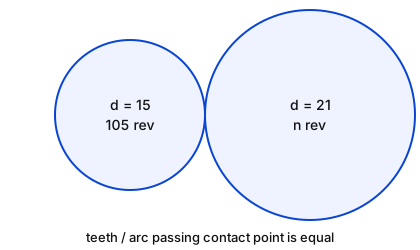
Trick: Revolutions are inversely proportional to diameter: .
Answer: (B) 75
अवधारणा: आपस में जुड़े गियर संपर्क बिंदु पर समान चाप-लंबाई चलते हैं, अतः व्यास × चक्कर बराबर।
ट्रिक: चक्कर व्यास के व्युत्क्रमानुपाती: ।
उत्तर: (B) 75
SSC CPO Paper IQuantitative AptitudeGears – circumferenceSSC CPO Paper I 2024 · 28 Jun Shift 3
Q198.Simplify
सरल कीजिए
- A5
- B7
- C6
- D8
Show answer
Concept: Innermost bracket first, then multiplication, then the outer subtraction.
- ;
Trick: Inside the bracket, multiply before subtracting: , not .
Answer: (B) 7
अवधारणा: सबसे अंदर का कोष्ठक, फिर गुणा, फिर बाहर का घटाव।
- ;
ट्रिक: कोष्ठक में पहले गुणा फिर घटाव: ।
उत्तर: (B) 7
SSC CPO Paper IQuantitative AptitudeSimplification (BODMAS)SSC CPO Paper I 2024 · 28 Jun Shift 3
Q199.The area of the canvas cloth needed to erect a right conical tent of height 20ft. and circular base of circumference 30π ft. is:
20 ft ऊँचाई और 30π ft परिधि वाले वृत्ताकार आधार वाले एक लंब शंक्वाकार तंबू को खड़ा करने के लिए आवश्यक कैनवास कपड़े का क्षेत्रफल है:
- A375π sq.ft.
- B589π sq.ft.
- C470π sq.ft.
- D455π sq.ft.
Show answer
Concept: Canvas for a tent = curved surface area , with .
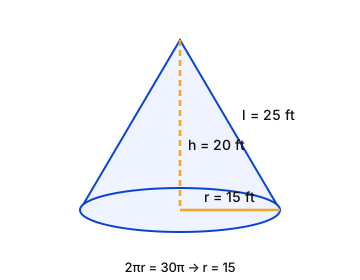
- ft
- ft
- CSA sq. ft.
Trick: 15–20–25 is the 3–4–5 triplet scaled by 5.
Answer: (A) sq. ft.
अवधारणा: तंबू का कपड़ा = वक्र पृष्ठीय क्षेत्रफल , जहाँ ।
- ft
- ft
- CSA sq. ft.
ट्रिक: 15–20–25, 3–4–5 त्रिक का 5 गुना है।
उत्तर: (A) sq. ft.
SSC CPO Paper IQuantitative AptitudeCone – curved surface areaSSC CPO Paper I 2024 · 28 Jun Shift 3
Q200.Tarun is twice as good as Tripti in doing a work. Together, they can complete the work in 16 days. In how many days can Tripti alone complete the same work?
किसी काम को करने में तरुण, तृप्ति से दोगुना कुशल है। साथ मिलकर, वे काम को 16 दिनों में पूरा कर सकते हैं। तृप्ति अकेले उसी काम को कितने दिनों में पूरा कर सकती है?
- A48
- B24
- C50
- D25
Show answer
Concept: 'Twice as good' means double efficiency. Total work = combined efficiency × days.
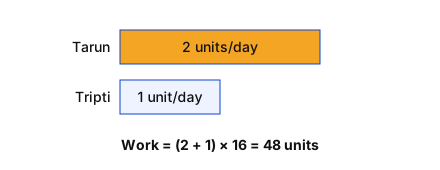
- Tarun units/day, Tripti unit/day
- Work units
- Tripti alone days
Trick: Tripti's share is of combined rate → she takes days.
Answer: (A) 48
अवधारणा: 'दोगुना कुशल' = दोगुनी क्षमता। कुल कार्य = संयुक्त क्षमता × दिन।
- Tarun इकाई/दिन, Tripti इकाई/दिन
- कार्य इकाई
- Tripti अकेले दिन
ट्रिक: Tripti संयुक्त दर का → उसे दिन।
उत्तर: (A) 48
SSC CPO Paper IQuantitative AptitudeTime and work – efficiencySSC CPO Paper I 2024 · 28 Jun Shift 3

