Q2121.Find the value of sin (50 ° + A) - cos (40 ° - A).
sin (50 ° + A) - cos (40 ° - A) का मान ज्ञात कीजिए।
- A2
- B0
- C−1
- D1
Show answer
Concept: .
- – the angles are complementary.
- So .
- Difference
Trick: Put : .
Answer: (B) 0
अवधारणा: ।
- – कोण पूरक हैं।
- अतः ।
- अंतर
ट्रिक: रखें: ।
उत्तर: (B) 0
SSC CPO Paper IQuantitative AptitudeTrigonometry – Complementary AnglesSSC CPO Paper I 2023 · 5 Oct Shift 2
Q2122.A sum amounts to ₹7,656 in 4 years and to ₹8,120 in 5 years at a certain simple interest rate per cent per annum. The rate of interest is:
एक निश्चित वार्षिक साधारण ब्याज दर पर कोई राशि 4 वर्षों में ₹7,656 और 5 वर्षों में ₹8,120 हो जाती है। ब्याज की दर है:
- A4%
- B3%
- C7%
- D8%
Show answer
Concept: In simple interest, interest is the same every year; the difference of amounts of consecutive years = one year's interest.
- 1 year SI ₹464.
- 4 years SI ⇒ Principal ₹5,800.
Trick: ; check: 8% of 5800 = 464.
Answer: (D) 8%
अवधारणा: साधारण ब्याज हर वर्ष समान होता है; लगातार दो वर्षों की राशियों का अंतर = एक वर्ष का ब्याज।
- 1 वर्ष का SI ₹464।
- 4 वर्ष का SI ⇒ मूलधन ₹5,800।
ट्रिक: जाँच: 5800 का 8% = 464।
उत्तर: (D) 8%
SSC CPO Paper IQuantitative AptitudeSimple InterestSSC CPO Paper I 2023 · 5 Oct Shift 2
Q2123.If , then the value of is:
यदि है, तो का मान है:
- A
- B
- C
- D
Show answer
Concept: .
Trick: "minus" known ⇒ add 4 after squaring; "plus" known ⇒ subtract 4.
Answer: (C)
अवधारणा: ।
ट्रिक: "माइनस" ज्ञात हो ⇒ वर्ग करके 4 जोड़ें; "प्लस" ज्ञात हो ⇒ 4 घटाएँ।
उत्तर: (C)
SSC CPO Paper IQuantitative AptitudeAlgebraic IdentitiesSSC CPO Paper I 2023 · 5 Oct Shift 2
Q2124.Vipin can do a piece of work in 2 days; Vaibhav can do the same work in 3 days and Chirag can do the same work in 6 days. If they start working together, how many days will they take to complete the work?
Vipin किसी कार्य को 2 दिनों में कर सकता है; Vaibhav उसी कार्य को 3 दिनों में कर सकता है और Chirag उसी कार्य को 6 दिनों में कर सकता है। यदि वे एक साथ कार्य करना आरंभ करते हैं, तो उन्हें कार्य पूरा करने में कितने दिन लगेंगे?
- A3
- B1
- C5
- D4
Show answer
Concept: Add one-day work of all persons; time .
- One-day work
- Time day
Trick: Total work = LCM(2, 3, 6) = 6 units; rates 3 + 2 + 1 = 6 units/day ⇒ 1 day.
Answer: (B) 1
अवधारणा: सबके एक दिन के कार्य जोड़ें; समय ।
- एक दिन का कार्य
- समय दिन
ट्रिक: कुल कार्य = LCM(2, 3, 6) = 6 इकाई; दरें 3 + 2 + 1 = 6 इकाई/दिन ⇒ 1 दिन।
उत्तर: (B) 1
SSC CPO Paper IQuantitative AptitudeTime and WorkSSC CPO Paper I 2023 · 5 Oct Shift 2
Q2125.Two successive discounts of 30% and 20% are equivalent to a single discount of:
30% और 20% की दो क्रमिक छूटें किस एकल छूट के समतुल्य हैं?
- A44%
- B52%
- C45%
- D50%
Show answer
Concept: Equivalent single discount .
Trick: On ₹100: after 30% → 70; after 20% → 56; total discount .
Answer: (A) 44%
अवधारणा: समतुल्य एकल छूट ।
ट्रिक: ₹100 पर: 30% के बाद 70; 20% के बाद 56; कुल छूट ।
उत्तर: (A) 44%
SSC CPO Paper IQuantitative AptitudeSuccessive DiscountSSC CPO Paper I 2023 · 5 Oct Shift 2
Q2126.The LCM of and is:
और का लघुत्तम समापवर्त्य (LCM) है:
- A
- B
- C
- D
Show answer
Concept: Factorise each polynomial; LCM = product of all factors with highest powers.
Trick: Common factor is taken only once – so option A with is wrong.
Answer: (D)
अवधारणा: हर बहुपद का गुणनखंड करें; LCM = सभी गुणनखंड उनकी अधिकतम घात के साथ।
ट्रिक: उभयनिष्ठ गुणनखंड केवल एक बार लिया जाता है – विकल्प A गलत।
उत्तर: (D)
SSC CPO Paper IQuantitative AptitudeLCM of PolynomialsSSC CPO Paper I 2023 · 5 Oct Shift 2
Q2127.The average of 45 numbers was found to be 39. Later on, it was detected that a
number 65 was misread as 56. Find the correct average of the given numbers.
45 संख्याओं का औसत 39 पाया गया। बाद में यह पता चला कि एक
संख्या 65 को गलती से 56 पढ़ लिया गया था। दी गई संख्याओं का सही औसत ज्ञात कीजिए।
- A39.2
- B37.2
- C38.2
- D36.2
Show answer
Concept: Correct average = old average .
- Error (sum was 9 less).
- Change in average
- Correct average
Trick: Sum was under-counted, so the average must go UP – only 39.2 is more than 39.
Answer: (A) 39.2
अवधारणा: सही औसत = पुराना औसत ।
- त्रुटि (योग 9 कम था)।
- औसत में परिवर्तन
- सही औसत
ट्रिक: योग कम गिना गया, अतः औसत बढ़ेगा – केवल 39.2 ही 39 से अधिक है।
उत्तर: (A) 39.2
SSC CPO Paper IQuantitative AptitudeAverage – CorrectionSSC CPO Paper I 2023 · 5 Oct Shift 2
Q2128.Robert takes twice as much time as Tom and thrice as much time as George to
complete a work. If working together, they can complete it in 23 hours, then find the time that Tom will take to complete the work.
Robert किसी कार्य को पूरा करने में Tom से दोगुना और George से तिगुना समय
लेता है। यदि एक साथ कार्य करते हुए वे इसे 23 घंटों में पूरा कर सकते हैं, तो Tom द्वारा कार्य पूरा करने में लिया जाने वाला समय ज्ञात कीजिए।
- A46 hours46 घंटे
- B69 hours69 घंटे
- C11 hours11 घंटे
- D39 hours39 घंटे
Show answer
Concept: Time and efficiency are inversely proportional.
- Let Robert take hours ⇒ Tom , George .
- Efficiencies (per hour) Robert : Tom : George , total 6 units/hr.
- Work units; Robert alone hours ⇒ .
- Tom hours
Trick: Tom does 2 of the 6 units each hour, i.e. of the team ⇒ Tom alone takes hours.
Answer: (B) 69 hours
अवधारणा: समय और कार्यक्षमता व्युत्क्रमानुपाती होते हैं।
- माना रॉबर्ट घंटे ⇒ टॉम , जॉर्ज ।
- क्षमता रॉबर्ट : टॉम : जॉर्ज , कुल 6 इकाई/घंटा।
- कुल कार्य इकाई ⇒ , ।
- टॉम घंटे
ट्रिक: टॉम टीम का कार्य करता है ⇒ अकेले घंटे।
उत्तर: (B) 69 घंटे
SSC CPO Paper IQuantitative AptitudeTime and WorkSSC CPO Paper I 2023 · 5 Oct Shift 2
Q2129.Two metallic balls P and Q are such that the diameter of P is four times the diameter of Q. What is the ratio between the volumes of P and Q?
दो धात्विक गेंदें P और Q इस प्रकार हैं कि P का व्यास, Q के व्यास का चार गुना है। P और Q के आयतनों के बीच का अनुपात क्या है?
- A32:1
- B16:1
- C8:1
- D64:1
Show answer
Concept: Volume of a sphere (or ).
Trick: Length ratio ⇒ area ratio ⇒ volume ratio ; 16 : 1 would be the surface-area ratio.
Answer: (D) 64 : 1
अवधारणा: गोले का आयतन (या )।
ट्रिक: लंबाई अनुपात ⇒ क्षेत्रफल ⇒ आयतन ; 16 : 1 पृष्ठ क्षेत्रफल का अनुपात होता।
उत्तर: (D) 64 : 1
SSC CPO Paper IQuantitative AptitudeMensuration – Sphere Volume RatioSSC CPO Paper I 2023 · 5 Oct Shift 2
Q2130.A runner runs a 750-metre race in 54 seconds. Find the runner’s speed (in km/h).
एक धावक 750 मीटर की दौड़ 54 सेकंड में पूरी करता है। धावक की चाल (km/h में) ज्ञात कीजिए।
- A40
- B30
- C14
- D50
Show answer
Concept: Speed = distance ÷ time; m/s × = km/h.
- Speed
Trick: .
Answer: (D) 50
अवधारणा: चाल = दूरी ÷ समय; m/s × = km/h।
- चाल
ट्रिक: ।
उत्तर: (D) 50
SSC CPO Paper IQuantitative AptitudeSpeed ConversionSSC CPO Paper I 2023 · 5 Oct Shift 2
Q2131.Out of two concentric circles, the radius of the outer circle is 6 cm and the chord PQ of the length 10 cm is a tangent to the inner circle. Find the radius (in cm) of the inner circle.
दो संकेंद्रीय वृत्तों में से, बाहरी वृत्त की त्रिज्या 6 cm है और 10 cm लंबाई की जीवा PQ आंतरिक वृत्त की स्पर्श रेखा है। आंतरिक वृत्त की त्रिज्या (cm में) ज्ञात कीजिए।
- A4
- B
- C
- D
Show answer
Concept: The radius to the point of contact is perpendicular to the tangent, and the perpendicular from the centre bisects a chord.
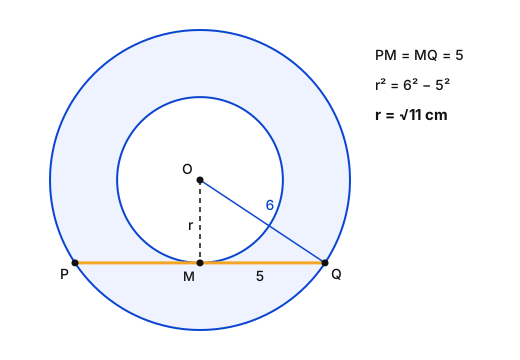
- OM ⊥ PQ, so .
- In right : (outer radius).
Trick: for a chord of the outer circle touching the inner one.
Answer: (D)
अवधारणा: स्पर्श बिंदु पर त्रिज्या, स्पर्शरेखा पर लंब होती है और केंद्र से जीवा पर लंब उसे समद्विभाजित करता है।
- OM ⊥ PQ, अतः ।
- समकोण में (बाहरी त्रिज्या)।
ट्रिक: ।
उत्तर: (D)
SSC CPO Paper IQuantitative AptitudeCircles – Concentric CirclesSSC CPO Paper I 2023 · 5 Oct Shift 2
Q2132.Simplify the following.
9 × 2 ÷ 3 of 24 - 3 ÷ 2 × (6 - 7) × 2 + 3 ÷ 3 of 5
निम्नलिखित को सरल कीजिए।
9 × 2 ÷ 3 of 24 - 3 ÷ 2 × (6 - 7) × 2 + 3 ÷ 3 of 5
- A3
- B
- C4
- D
Show answer
Concept: Order: Brackets → "of" → Division → Multiplication → Addition → Subtraction.
- Bracket: ; "of": , .
- ;
Trick: "of" is solved before ÷ – treat "3 of 24" as one number, 72.
Answer: (D)
अवधारणा: क्रम: कोष्ठक → "of" (का) → भाग → गुणा → जोड़ → घटाव।
- कोष्ठक: ; "of": , ।
- ;
ट्रिक: "of" भाग से पहले हल होता है – "3 of 24" को एक संख्या 72 मानें।
उत्तर: (D)
SSC CPO Paper IQuantitative AptitudeSimplification (BODMAS)SSC CPO Paper I 2023 · 5 Oct Shift 2
Q2133.What will be the area of a plot of quadrilateral shape, one of whose diagonals is 20 m and lengths of the perpendiculars from the opposite vertices on it are 12 m and 18 m, respectively?
चतुर्भुज आकार के एक भूखंड का क्षेत्रफल कितना होगा, जिसका एक विकर्ण 20 m है और सम्मुख शीर्षों से उस पर डाले गए लंबों की लंबाइयाँ क्रमशः 12 m और 18 m हैं?
- A400 m2
- B250 m2
- C200 m2
- D300 m2
Show answer
Concept: Area of a quadrilateral , where are the perpendiculars from the opposite vertices on that diagonal.
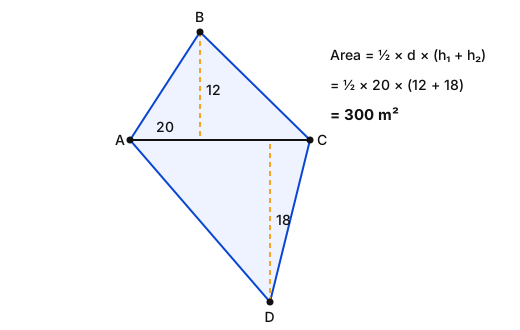
- Diagonal , , .
- Area
Trick: The diagonal splits it into two triangles: .
Answer: (D) 300 m2
अवधारणा: चतुर्भुज का क्षेत्रफल , जहाँ सम्मुख शीर्षों से विकर्ण पर लंब हैं।
- विकर्ण , , ।
- क्षेत्रफल
ट्रिक: विकर्ण दो त्रिभुज बनाता है: ।
उत्तर: (D) 300 m2
SSC CPO Paper IQuantitative AptitudeMensuration – Area of QuadrilateralSSC CPO Paper I 2023 · 5 Oct Shift 2
Q2134.In a survey, 200 respondents were asked whether they owned a vehicle or not. Their responses are tabulated below. What percentage of respondents do NOT own a car?
| Men | Women |
|---|
| Own Vehicle | Scooter | 30 | 20 |
| Car | 25 | 10 |
| Both | 15 | 5 |
| Do not own vehicle | 50 | 45 |
एक सर्वेक्षण में, 200 उत्तरदाताओं से पूछा गया कि उनके पास वाहन है या नहीं। उनकी प्रतिक्रियाएँ नीचे सारणीबद्ध की गई हैं। कितने प्रतिशत उत्तरदाताओं के पास कार नहीं है?
| पुरुष | महिलाएँ |
|---|
| वाहन है | स्कूटर | 30 | 20 |
| कार | 25 | 10 |
| दोनों | 15 | 5 |
| वाहन नहीं है | 50 | 45 |
- A68.5%
- B75%
- C65%
- D72.5%
Show answer
Concept: People owning a car = "Car" only + "Both"; the rest do not own a car.
- Own a car
- Do not own a car
Trick: Do not forget the "Both" row – it also owns a car. Ignoring it gives 82.5% (not an option) and counting only "no vehicle" gives 47.5%.
Answer: (D) 72.5%
अवधारणा: कार रखने वाले = केवल "Car" + "Both"; बाकी सबके पास कार नहीं है।
- कार वाले
- कार नहीं
ट्रिक: "Both" पंक्ति को न भूलें – उनके पास भी कार है।
उत्तर: (D) 72.5%
SSC CPO Paper IQuantitative AptitudeData Interpretation – TableSSC CPO Paper I 2023 · 5 Oct Shift 2
Q2135.Study the given table and answer the question that follows.
The table shows the number of students studying in six different classes of six different schools.
| School | Class V | Class VI | Class VII | Class VIII | Class IX | Class X |
|---|
| P | 152 | 160 | 145 | 156 | 147 | 144 |
| Q | 148 | 166 | 150 | 155 | 157 | 143 |
| R | 161 | 152 | 140 | 145 | 143 | 165 |
| S | 159 | 142 | 149 | 140 | 142 | 168 |
| T | 147 | 144 | 158 | 163 | 154 | 150 |
| U | 150 | 160 | 162 | 160 | 161 | 140 |
| Total | 917 | 924 | 904 | 919 | 904 | 910 |
The number of students studying in class VII from school U is what percentage of the total number of students from all the classes together from that school (rounded off to 2 digits after decimal)?
दी गई तालिका का अध्ययन कीजिए और उसके बाद दिए गए प्रश्न का उत्तर दीजिए।
तालिका छह अलग-अलग विद्यालयों की छह अलग-अलग कक्षाओं में पढ़ने वाले विद्यार्थियों की संख्या दर्शाती है।
| विद्यालय | कक्षा V | कक्षा VI | कक्षा VII | कक्षा VIII | कक्षा IX | कक्षा X |
|---|
| P | 152 | 160 | 145 | 156 | 147 | 144 |
| Q | 148 | 166 | 150 | 155 | 157 | 143 |
| R | 161 | 152 | 140 | 145 | 143 | 165 |
| S | 159 | 142 | 149 | 140 | 142 | 168 |
| T | 147 | 144 | 158 | 163 | 154 | 150 |
| U | 150 | 160 | 162 | 160 | 161 | 140 |
| कुल | 917 | 924 | 904 | 919 | 904 | 910 |
विद्यालय U से कक्षा VII में पढ़ने वाले विद्यार्थियों की संख्या, उस विद्यालय की सभी कक्षाओं के कुल मिलाकर विद्यार्थियों की संख्या का कितना प्रतिशत है (दशमलव के बाद 2 अंकों तक पूर्णांकित)?
- A16.48%
- B18.25%
- C15.63%
- D17.36%
Show answer
Concept: Required % .
- School U total
- Class VII of U
Trick: 162 is a little more than one-sixth of 933 (155.5), so the answer must be a little above 16.67% – only 17.36% fits.
Answer: (D) 17.36%
अवधारणा: अभीष्ट % ।
- स्कूल U का कुल
- U की कक्षा VII
ट्रिक: 162, 933 के छठे भाग (155.5) से थोड़ा अधिक है, अतः उत्तर 16.67% से थोड़ा ऊपर – केवल 17.36%।
उत्तर: (D) 17.36%
SSC CPO Paper IQuantitative AptitudeData Interpretation – TableSSC CPO Paper I 2023 · 5 Oct Shift 2
Q2136.Study the following table carefully and answer the questions based on it.
The following table shows the domestic sales of vehicles of four manufacturers from 2010 to 2015.
| Manufacturer | 2010 | 2011 | 2012 | 2013 | 2014 | 2015 |
|---|
| A | 560000 | 580000 | 600000 | 620000 | 650000 | 680000 |
| B | 540000 | 590000 | 570000 | 630000 | 710000 | 550000 |
| C | 610000 | 580000 | 620000 | 680000 | 690000 | 630000 |
| D | 630000 | 570000 | 700000 | 690000 | 700000 | 640000 |
With respect to which of the following combinations, is the sales of vehicles lowest over the given period?
निम्नलिखित तालिका का ध्यानपूर्वक अध्ययन कीजिए और उस पर आधारित प्रश्नों के उत्तर दीजिए।
निम्नलिखित तालिका 2010 से 2015 तक चार विनिर्माताओं के वाहनों की घरेलू बिक्री दर्शाती है।
| विनिर्माता | 2010 | 2011 | 2012 | 2013 | 2014 | 2015 |
|---|
| A | 560000 | 580000 | 600000 | 620000 | 650000 | 680000 |
| B | 540000 | 590000 | 570000 | 630000 | 710000 | 550000 |
| C | 610000 | 580000 | 620000 | 680000 | 690000 | 630000 |
| D | 630000 | 570000 | 700000 | 690000 | 700000 | 640000 |
दी गई अवधि में निम्नलिखित में से किस संयोजन के संबंध में वाहनों की बिक्री सबसे कम है?
- AA, 2010
- BB, 2015
- CB, 2010
- DA, 2011
Show answer
Concept: Scan the whole table for the smallest entry.
- Options: A-2010 = 560000, B-2015 = 550000, B-2010 = 540000, A-2011 = 580000.
- The smallest value in the entire table is 540000 (B in 2010).
Trick: Compare only the first three digits: 540 is the least.
Answer: (C) B, 2010
अवधारणा: पूरी तालिका में सबसे छोटा मान खोजें।
- विकल्प: A-2010 = 560000, B-2015 = 550000, B-2010 = 540000, A-2011 = 580000।
- पूरी तालिका का सबसे छोटा मान 540000 (B, 2010) है।
ट्रिक: केवल पहले तीन अंकों की तुलना करें: 540 सबसे कम।
उत्तर: (C) B, 2010
SSC CPO Paper IQuantitative AptitudeData Interpretation – TableSSC CPO Paper I 2023 · 5 Oct Shift 2
Q2137.If , then what is ?
यदि है, तो क्या है?
- A
- B
- C
- D
Show answer
Concept: .
Trick: Numerators of the two squares add to : ⇒ .
Answer: (B)
अवधारणा: ।
ट्रिक: दोनों वर्गों के अंशों का योग : ⇒ ।
उत्तर: (B)
SSC CPO Paper IQuantitative AptitudeTrigonometric IdentitiesSSC CPO Paper I 2023 · 5 Oct Shift 2
Q2138.The following table shows the marks obtained out of 100, by 5 students in 5 different subjects.
| Students | Hindi | English | Maths | Science | Social |
|---|
| Ravi | 78 | 84 | 88 | 75 | 79 |
| Abhishek | 84 | 86 | 78 | 89 | 80 |
| Ayush | 88 | 80 | 90 | 82 | 85 |
| Rohit | 72 | 85 | 88 | 89 | 78 |
| Aryan | 86 | 88 | 77 | 79 | 89 |
What are the total marks scored by Ayush in all the subjects?
निम्नलिखित तालिका 5 विद्यार्थियों द्वारा 5 अलग-अलग विषयों में 100 में से प्राप्त अंक दर्शाती है।
| विद्यार्थी | हिंदी | अंग्रेज़ी | गणित | विज्ञान | सामाजिक विज्ञान |
|---|
| Ravi | 78 | 84 | 88 | 75 | 79 |
| Abhishek | 84 | 86 | 78 | 89 | 80 |
| Ayush | 88 | 80 | 90 | 82 | 85 |
| Rohit | 72 | 85 | 88 | 89 | 78 |
| Aryan | 86 | 88 | 77 | 79 | 89 |
Ayush द्वारा सभी विषयों में प्राप्त कुल अंक कितने हैं?
- A435
- B465
- C445
- D425
Show answer
Concept: Add the row of the required student.
- Ayush:
Trick: Take 85 as base: ⇒ total .
Answer: (D) 425
अवधारणा: संबंधित छात्र की पंक्ति का योग करें।
- आयुष:
ट्रिक: 85 को आधार लें: ⇒ कुल ।
उत्तर: (D) 425
SSC CPO Paper IQuantitative AptitudeData Interpretation – TableSSC CPO Paper I 2023 · 5 Oct Shift 2
Q2139.A family earns ₹75,000, out of which 10% is saved. 30% of the expenditure is incurred on education, while ₹30,375 is spent on health and the remaining amount is spent on food. What is the percentage of food expenditure to the total income?
एक परिवार ₹75,000 कमाता है, जिसमें से 10% की बचत की जाती है। व्यय का 30% शिक्षा पर किया जाता है, जबकि ₹30,375 स्वास्थ्य पर खर्च किए जाते हैं और शेष राशि भोजन पर खर्च की जाती है। कुल आय में भोजन पर व्यय का प्रतिशत कितना है?
- A32.5%
- B22.5%
- C20%
- D21.5%
Show answer
Concept: Expenditure = Income − Savings; split the expenditure step by step.
- Savings of 75000 = ₹7,500 ⇒ expenditure = ₹67,500.
- Education of 67500 = ₹20,250.
- Food ₹16,875.
Trick: Education is 30% of expenditure, not of income – using income gives a wrong value.
Answer: (B) 22.5%
अवधारणा: व्यय = आय − बचत; फिर व्यय को चरणबद्ध बाँटें।
- बचत × 75000 = ₹7,500 ⇒ व्यय = ₹67,500।
- शिक्षा × 67500 = ₹20,250।
- भोजन ₹16,875।
ट्रिक: शिक्षा, व्यय का 30% है, आय का नहीं।
उत्तर: (B) 22.5%
SSC CPO Paper IQuantitative AptitudePercentage – Income and ExpenditureSSC CPO Paper I 2023 · 5 Oct Shift 2
Q2140.Study the given table and answer the question that follows.
The table shows the number of employees in five different organisations A, B, C, D and E in different departments.
| Dept ↓ / Org → | A | B | C | D | E |
|---|
| HR | 1050 | 1015 | 976 | 888 | 1004 |
| Finance | 1017 | 960 | 786 | 1025 | 963 |
| Marketing | 1382 | 1384 | 1275 | 1300 | 1290 |
| Production | 1542 | 1545 | 4550 | 1570 | 1580 |
| Accounts | 786 | 745 | 801 | 800 | 735 |
| Legal | 48 | 54 | 36 | 30 | 53 |
| Total | 5825 | 5703 | 5424 | 5613 | 5625 |
Which organisation has maximum number of employees?
दी गई तालिका का अध्ययन कीजिए और उसके बाद दिए गए प्रश्न का उत्तर दीजिए।
तालिका पाँच अलग-अलग संगठनों A, B, C, D और E में विभिन्न विभागों में कर्मचारियों की संख्या दर्शाती है।
| विभाग ↓ / संगठन → | A | B | C | D | E |
|---|
| मानव संसाधन (HR) | 1050 | 1015 | 976 | 888 | 1004 |
| वित्त | 1017 | 960 | 786 | 1025 | 963 |
| विपणन | 1382 | 1384 | 1275 | 1300 | 1290 |
| उत्पादन | 1542 | 1545 | 4550 | 1570 | 1580 |
| लेखा | 786 | 745 | 801 | 800 | 735 |
| विधि | 48 | 54 | 36 | 30 | 53 |
| कुल | 5825 | 5703 | 5424 | 5613 | 5625 |
किस संगठन में कर्मचारियों की संख्या अधिकतम है?
- AA
- BB
- CD
- DE
Show answer
Concept: Compare the column totals of the organisations given in the options.
- A
- B = 5703, D = 5613, E = 5625.
- Among the options, A has the maximum (5825).
Trick: Read the "Total" row directly – 5825 is the largest among A, B, D, E.
Answer: (A) A
अवधारणा: विकल्पों में दिए संगठनों के कॉलम योग की तुलना करें।
- A
- B = 5703, D = 5613, E = 5625।
- विकल्पों में A सबसे अधिक (5825)।
ट्रिक: सीधे "Total" पंक्ति पढ़ें – A, B, D, E में 5825 सबसे बड़ा।
उत्तर: (A) A
SSC CPO Paper IQuantitative AptitudeData Interpretation – TableSSC CPO Paper I 2023 · 5 Oct Shift 2

