Q241.A spherical box has surface area 528 cm2. Find the radius of the spherical box.
एक गोलाकार डिब्बे का पृष्ठीय क्षेत्रफल 528 cm2 है। गोलाकार डिब्बे की त्रिज्या ज्ञात कीजिए।
- A cm
- B cm
- C cm
- D cm
Show answer
Concept: Surface area of sphere .
- .
- .
Trick: , then .
Answer: (B)
अवधारणा: गोले का पृष्ठीय क्षेत्रफल ।
- ।
- ।
ट्रिक: , ।
उत्तर: (B)
SSC CPO Paper IQuantitative AptitudeSphere – surface areaSSC CPO Paper I 2024 · 28 Jun Shift 2
Q242.What is the length (in cm) of chord PQ in a circle with a radius of 7 cm, where a
diameter AB and non-diameter chord PQ intersect perpendicularly at point C, and the ratio of AC to BC is 4 : 3?
7 cm त्रिज्या वाले एक वृत्त में, जहाँ एक व्यास AB और एक गैर-व्यास जीवा PQ बिंदु C पर लंबवत प्रतिच्छेद करते हैं, और AC तथा BC का अनुपात 4 : 3 है, जीवा PQ की लंबाई (cm में) क्या है?
- A
- B
- C
- D
Show answer
Concept: A diameter perpendicular to a chord bisects it; also .
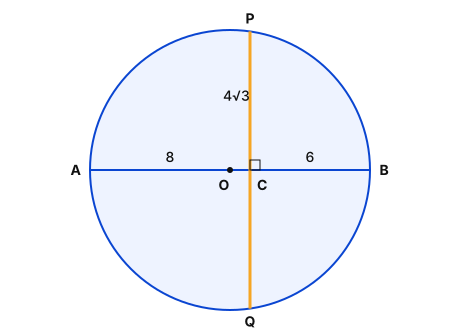
- , , .
- .
- .
Trick: Intersecting chords: with .
Answer: (D)
अवधारणा: जीवा पर लंब व्यास उसे समद्विभाजित करता है; ।
- , , ।
- ।
- ।
ट्रिक: प्रतिच्छेदी जीवाएँ: , ।
उत्तर: (D)
SSC CPO Paper IQuantitative AptitudeCircle – intersecting chordsSSC CPO Paper I 2024 · 28 Jun Shift 2
Q243.A man travels 1200 km by train at 80 km/h, 1600 km by ship at 40 km/h, 1000 km by plane at 400 km/h, and 200 km by car at 50 km/h. What is the average speed for the entire distance? (rounded off to 2 decimal places)
एक व्यक्ति 1200 km की यात्रा रेलगाड़ी से 80 km/h की चाल से, 1600 km की यात्रा जहाज़ से 40 km/h की चाल से, 1000 km की यात्रा हवाई जहाज़ से 400 km/h की चाल से, और 200 km की यात्रा कार से 50 km/h की चाल से करता है। पूरी दूरी के लिए औसत चाल क्या है? (2 दशमलव स्थानों तक पूर्णांकित)
- A65.04 km/h
- B72.40 km/h
- C68.14 km/h
- D75.40 km/h
Show answer
Concept: Average speed .
- Times: , , , ; total h.
- Distance km.
- Average .
Trick: The slow ship leg (40 h) dominates, pulling the average down.
Answer: (A)
अवधारणा: औसत चाल ।
- समय: h।
- दूरी km।
- औसत ।
ट्रिक: धीमी जहाज यात्रा (40 h) औसत को नीचे खींचती है।
उत्तर: (A)
SSC CPO Paper IQuantitative AptitudeAverage speedSSC CPO Paper I 2024 · 28 Jun Shift 2
Q244.Simplify the given expression.
दिए गए व्यंजक को सरल कीजिए।
- A1
- B–1
- C–2
- D2
Show answer
Concept: Brackets first, then divide.
- , → .
- .
- ; .
Trick: Numerator , denominator – neat round numbers.
Answer: (D)
अवधारणा: पहले कोष्ठक, फिर भाग।
- ।
- ।
- ; ।
ट्रिक: अंश 1000, हर 500।
उत्तर: (D)
SSC CPO Paper IQuantitative AptitudeSimplificationSSC CPO Paper I 2024 · 28 Jun Shift 2
Q245.Study the given table and answer the question that follows.
The table below shows the number of people who responded to a survey about their favourite style of music.
| Age | 25-30 | 31-50 | 51+ |
|---|
| Classical | 2 | 9 | 16 |
| Pop | 10 | 16 | 8 |
| Hip-Hop | 4 | 7 | 6 |
| Rock | 14 | 17 | 14 |
| Ambient | 7 | 13 | 20 |
| Total | 37 | 62 | 64 |
What percentage of respondents aged 31-50 indicated a favourite style other than Pop music (rounded off to 2 decimal places)?
दी गई तालिका का अध्ययन कीजिए और उसके बाद पूछे गए प्रश्न का उत्तर दीजिए।
नीचे दी गई तालिका उन लोगों की संख्या दर्शाती है जिन्होंने अपनी पसंदीदा संगीत शैली के बारे में एक सर्वेक्षण में उत्तर दिया।
| आयु | 25-30 | 31-50 | 51+ |
|---|
| शास्त्रीय | 2 | 9 | 16 |
| पॉप | 10 | 16 | 8 |
| हिप-हॉप | 4 | 7 | 6 |
| रॉक | 14 | 17 | 14 |
| एम्बिएंट | 7 | 13 | 20 |
| कुल | 37 | 62 | 64 |
31-50 आयु वर्ग के कितने प्रतिशत उत्तरदाताओं ने पॉप संगीत के अतिरिक्त किसी अन्य शैली को अपनी पसंदीदा शैली बताया (2 दशमलव स्थानों तक पूर्णांकित)?
- A82.39%
- B76.25%
- C74.19%
- D78.20%
Show answer
Concept: Required for age 31-50.
- Total , Pop → others .
- .
Trick: .
Answer: (C) 74.19%
अवधारणा: 31-50 आयु वर्ग में अभीष्ट ।
- कुल , Pop → अन्य ।
- ।
ट्रिक: ।
उत्तर: (C) 74.19%
SSC CPO Paper IQuantitative AptitudeData interpretationSSC CPO Paper I 2024 · 28 Jun Shift 2
Q246.Manish, Nakul and Pintoo alone can complete a certain work in 21days, 28 days and 15 days, respectively. Manish and Pintoo started the work together while Nakul joined them after 5 days and worked with them till the completion of the work. For how many days did Nakul work?
मनीष, नकुल और पिंटू अकेले किसी निश्चित कार्य को क्रमशः 21 दिन, 28 दिन और 15 दिन में पूरा कर सकते हैं। मनीष और पिंटू ने एक साथ कार्य शुरू किया जबकि नकुल 5 दिन बाद उनके साथ जुड़ा और कार्य पूरा होने तक उनके साथ कार्य किया। नकुल ने कितने दिनों तक कार्य किया?
- A
- B
- C
- D
Show answer
Concept: Total work = LCM units.
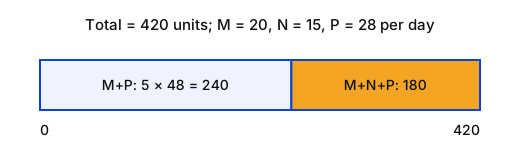
- Efficiencies: Manish , Nakul , Pintoo units/day.
- First 5 days (M + P): ; left .
- All three: /day → days.
Trick: Nakul works only for the remaining part – divide remainder by combined rate.
Answer: (B)
अवधारणा: कुल कार्य = LCM इकाई।
- क्षमता: Manish , Nakul , Pintoo ।
- पहले 5 दिन: ; शेष ।
- तीनों: /दिन → दिन।
ट्रिक: Nakul केवल शेष कार्य में – शेष ÷ संयुक्त दर।
उत्तर: (B)
SSC CPO Paper IQuantitative AptitudeTime and workSSC CPO Paper I 2024 · 28 Jun Shift 2
Q247.If tan θ + cot θ = 6, then the value of tan2θ + cot2θ is ____ .
यदि tan θ + cot θ = 6 है, तो tan2θ + cot2θ का मान ____ है।
- A20
- B24
- C34
- D22
Show answer
Concept: , so .
- .
- .
Trick: If then .
Answer: (C)
अवधारणा: , अतः ।
- ।
- ।
ट्रिक: तो ।
उत्तर: (C)
SSC CPO Paper IQuantitative AptitudeTrigonometric identitiesSSC CPO Paper I 2024 · 28 Jun Shift 2
Q248.If the sides of a triangle are 7, 12 and x, and x is an integer, then find the number of possible values of x.
यदि किसी त्रिभुज की भुजाएँ 7, 12 और x हैं, और x एक पूर्णांक है, तो x के संभावित मानों की संख्या ज्ञात कीजिए।
- A13
- B14
- C12
- D15
Show answer
Concept: .
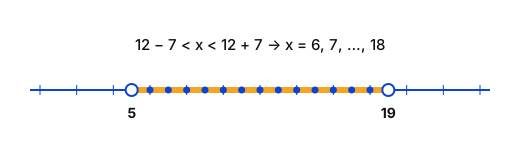
- .
- Integers: → values.
Yaad rakhein: Count (b = smaller side).
Answer: (A)
अवधारणा: ।
- ।
- पूर्णांक से → मान।
याद रखें: संख्या (b = छोटी भुजा)।
उत्तर: (A)
SSC CPO Paper IQuantitative AptitudeTriangle inequalitySSC CPO Paper I 2024 · 28 Jun Shift 2
Q249.Ramnarayan's salary was reduced by , and then, the reduced salary was increased by . By what percentage (rounded off to two decimal places) is his new salary more/less as compared to his original salary?
रामनारायण के वेतन में की कमी की गई, और फिर घटे हुए वेतन में की वृद्धि की गई। उसका नया वेतन उसके मूल वेतन की तुलना में कितने प्रतिशत (दो दशमलव स्थानों तक पूर्णांकित) अधिक/कम है?
- A4.04% less4.04% कम
- B4.04% more4.04% अधिक
- C3.03% less3.03% कम
- D3.03% more3.03% अधिक
Show answer
Concept: Net change (decrease negative).
- , .
- .
- ≈ more.
Trick: Multiplier: .
Answer: (B) 4.04% more
अवधारणा: शुद्ध परिवर्तन (कमी ऋणात्मक)।
- , ।
- ।
- ≈ अधिक।
ट्रिक: गुणक: ।
उत्तर: (B) 4.04% more
SSC CPO Paper IQuantitative AptitudeSuccessive percentage changeSSC CPO Paper I 2024 · 28 Jun Shift 2
Q250.On the tag price, a seller offers a 10% discount and a cashback of ₹250. He still earns 10% profit. If the cost price is ₹1,200, then the tag price (rounded off to 2 decimal
places) is ₹______.
एक विक्रेता टैग मूल्य पर 10% की छूट और ₹250 का कैशबैक प्रदान करता है। फिर भी वह 10% लाभ अर्जित करता है। यदि क्रय मूल्य ₹1,200 है, तो टैग मूल्य (2 दशमलव
स्थानों तक पूर्णांकित) ₹______ है।
- A1774.44
- B1777.44
- C1744.44
- D1447.44
Show answer
Concept: Final SP tag price after discount cashback CP .
- SP .
- .
- .
Trick: Add the cashback back before dividing by .
Answer: (C) 1744.44
अवधारणा: अंतिम SP छूट के बाद मूल्य कैशबैक CP ।
- SP ।
- ।
- ।
ट्रिक: पहले कैशबैक जोड़ें, फिर से भाग।
उत्तर: (C) 1744.44
SSC CPO Paper IQuantitative AptitudeDiscount, cashback and profitSSC CPO Paper I 2024 · 28 Jun Shift 2
Q251.Find the natural number obtained when the number 13 is subtracted from the mean proportional of 75 and 12.
75 और 12 के मध्यानुपाती में से संख्या 13 घटाने पर प्राप्त प्राकृत संख्या ज्ञात कीजिए।
- A14
- B27
- C17
- D30
Show answer
Concept: Mean proportional of and is .
Trick: is a perfect square, so the root is instantly.
Answer: (C)
अवधारणा: और का मध्यानुपाती (mean proportional) होता है।
ट्रिक: पूर्ण वर्ग है, अतः मूल सीधे ।
उत्तर: (C)
SSC CPO Paper IQuantitative AptitudeMean ProportionalSSC CPO Paper I 2024 · 28 Jun Shift 1
Q252.The value of is equal to:
का मान किसके बराबर है?
- A15
- B16
- C18
- D12
Show answer
Concept: BODMAS: brackets first, then “of”, then and left to right, then and .
- , so
Trick: Treat “of” as multiplication done before .
Answer: (B)
अवधारणा: BODMAS: पहले कोष्ठक, फिर “of”, फिर बाएँ से दाएँ व , फिर व ।
- , अतः
ट्रिक: “of” को गुणा मानें, जो से पहले होता है।
उत्तर: (B)
SSC CPO Paper IQuantitative AptitudeSimplification (BODMAS)SSC CPO Paper I 2024 · 28 Jun Shift 1
Q253.The value of is:
का मान है:
- A
- B
- C
- D
Show answer
Concept: Solve the innermost bracket first; convert mixed fractions to improper fractions with LCM .
Trick: Use one common denominator () for all steps to avoid repeated LCMs.
Answer: (A)
अवधारणा: सबसे भीतरी कोष्ठक पहले हल करें; मिश्र भिन्न को विषम भिन्न बनाकर LCM लें।
ट्रिक: सभी चरणों में एक ही हर () रखें।
उत्तर: (A)
SSC CPO Paper IQuantitative AptitudeSimplification of FractionsSSC CPO Paper I 2024 · 28 Jun Shift 1
Q254.The following table shows the classification of 100 students based on the marks
obtained by them in Maths and Science in an examination.
| Subjects | Marks out of 100 |
|---|
| 80 and above | 60 and above | 40 and above | 20 and above | 0 and above |
|---|
| Maths | 12 | 35 | 80 | 94 | 100 |
| Science | 16 | 43 | 76 | 88 | 100 |
| Average (Aggregate) | 14 | 39 | 78 | 91 | 100 |
Find the number of students scoring less than 40% marks in aggregates.
निम्नलिखित तालिका एक परीक्षा में गणित और विज्ञान में 100 विद्यार्थियों द्वारा प्राप्त अंकों
के आधार पर उनके वर्गीकरण को दर्शाती है।
| विषय | 100 में से प्राप्त अंक |
|---|
| 80 और उससे अधिक | 60 और उससे अधिक | 40 और उससे अधिक | 20 और उससे अधिक | 0 और उससे अधिक |
|---|
| गणित | 12 | 35 | 80 | 94 | 100 |
| विज्ञान | 16 | 43 | 76 | 88 | 100 |
| औसत (कुल) | 14 | 39 | 78 | 91 | 100 |
कुल योग में 40% से कम अंक प्राप्त करने वाले विद्यार्थियों की संख्या ज्ञात कीजिए।
- A28
- B26
- C24
- D22
Show answer
Concept: The table is cumulative (“and above”). Students below a mark = total − students at or above it.
- Aggregate “ and above” students
- Total students
- Below
Trick: “Less than ” total “ and above” — read only the Aggregate row.
Answer: (D)
अवधारणा: तालिका संचयी (cumulative, “और अधिक”) है। किसी अंक से कम वाले कुल उससे अधिक या बराबर वाले।
- Aggregate में “ और अधिक” छात्र
- कुल छात्र
- से कम
ट्रिक: “ से कम” कुल “ और अधिक” — केवल Aggregate पंक्ति देखें।
उत्तर: (D)
SSC CPO Paper IQuantitative AptitudeData Interpretation (Table)SSC CPO Paper I 2024 · 28 Jun Shift 1
Q255.S drives his car and covers 37 km and 500 m in 90 minutes. What is his average speed (in km/h)?
S अपनी कार चलाता है और 90 मिनट में 37 km 500 m की दूरी तय करता है। उसकी औसत चाल (km/h में) क्या है?
- A25
- B20
- C40
- D22.5
Show answer
Concept: Average speed , with distance in km and time in hours.
- Distance
- Time
- Speed
Trick: min is h, so speed .
Answer: (A)
अवधारणा: औसत चाल ; दूरी km में और समय घंटे में लें।
- दूरी
- समय
- चाल
ट्रिक: मिनट घंटा, अतः चाल ।
उत्तर: (A)
SSC CPO Paper IQuantitative AptitudeSpeed, Distance and TimeSSC CPO Paper I 2024 · 28 Jun Shift 1
Q256.Which of the following statements is/are correct?
A. A triangle can have all angles less than 60°.
B. A triangle can have one obtuse angle.
C. A triangle can have two right angles.
D. A triangle can have two acute angles.
निम्नलिखित में से कौन-सा/से कथन सही है/हैं?
A. एक त्रिभुज के सभी कोण 60° से कम हो सकते हैं।
B. एक त्रिभुज में एक अधिक कोण हो सकता है।
C. एक त्रिभुज में दो समकोण हो सकते हैं।
D. एक त्रिभुज में दो न्यून कोण हो सकते हैं।
- AA
- BB and DB और D
- CB
- DA and CA और C
Show answer
Concept: Angle sum of a triangle is ; at most one angle can be .
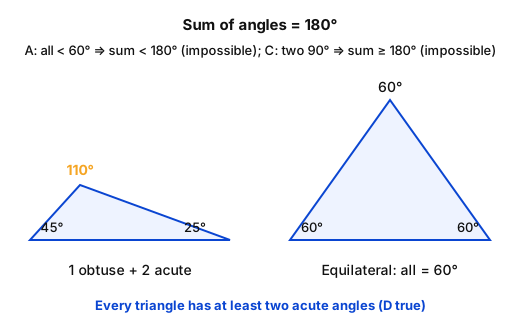
- A: all angles gives sum — false.
- B: one obtuse angle (e.g. ) with two small acute angles — true.
- C: two right angles already make , third angle — false.
- D: every triangle has at least two acute angles — true.
Yaad rakhein: Equilateral triangle ( each) shows angles can never all be below .
Answer: (B) B and D
अवधारणा: त्रिभुज के कोणों का योग है; अधिकतम एक कोण हो सकता है।
- A: सभी कोण हों तो योग — असत्य।
- B: एक अधिक कोण (obtuse, जैसे ) संभव — सत्य।
- C: दो समकोण से ही हो जाता है — असत्य।
- D: हर त्रिभुज में कम से कम दो न्यून कोण (acute) होते हैं — सत्य।
याद रखें: समबाहु त्रिभुज ( प्रत्येक) बताता है कि सभी कोण से कम नहीं हो सकते।
उत्तर: (B) B और D
SSC CPO Paper IQuantitative AptitudeTriangle – Angle PropertiesSSC CPO Paper I 2024 · 28 Jun Shift 1
Q257.If x [ - 5 { - 4 ( - a ) } ] + 6 [ - 3 { -3 ( - a ) } ] = 6a, then the value of x is:
यदि x [ - 5 { - 4 ( - a ) } ] + 6 [ - 3 { -3 ( - a ) } ] = 6a है, तो x का मान है:
- A−3
- B−1
- C2
- D0
Show answer
Concept: Open brackets from inside out; product of two negatives is positive.
- , so
- , so
Trick: Count minus signs: even count gives , odd gives .
Answer: (A)
अवधारणा: कोष्ठक अंदर से बाहर खोलें; दो ऋणात्मक का गुणनफल धनात्मक होता है।
- , अतः
- , अतः
ट्रिक: ऋण चिह्न गिनें: सम संख्या , विषम ।
उत्तर: (A)
SSC CPO Paper IQuantitative AptitudeLinear Equation with BracketsSSC CPO Paper I 2024 · 28 Jun Shift 1
Q258.If a + 2b + 3c = 0, then what is the value of (a3 + 8b3 + 27c3)?
यदि a + 2b + 3c = 0 है, तो (a3 + 8b3 + 27c3) का मान क्या है?
- A18 abc
- B12 abc
- C6 abc
- D0
Show answer
Concept: If , then .
- Let , , ; then
Trick: Multiply by all the coefficients: .
Answer: (A)
अवधारणा: यदि , तो ।
- , , लें;
ट्रिक: गुणांकों का गुणा से करें: ।
उत्तर: (A)
SSC CPO Paper IQuantitative AptitudeAlgebraic Identity (Cubes)SSC CPO Paper I 2024 · 28 Jun Shift 1
Q259.The following bar graph shows the sales (in thousands) of magazines from six branches (A, B, C, D, E and F) of a publishing company during two consecutive years 2021 and 2022.
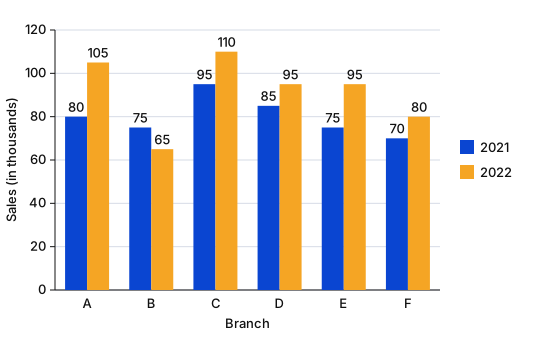
What percentage of the total sales of branch C for both years is the total sales of branch F for both years? (round your answer up to two decimal places)
निम्नलिखित दंड आलेख लगातार दो वर्षों 2021 और 2022 के दौरान एक प्रकाशन कंपनी की छह शाखाओं (A, B, C, D, E और F) से पत्रिकाओं की बिक्री (हज़ार में) को दर्शाता है।
दोनों वर्षों में शाखा F की कुल बिक्री, दोनों वर्षों में शाखा C की कुल बिक्री का कितना प्रतिशत है? (अपना उत्तर दशमलव के दो स्थानों तक पूर्णांकित कीजिए)
- A53.25%
- B85.25%
- C73.17%
- D65.21%
Show answer
Concept: Required .
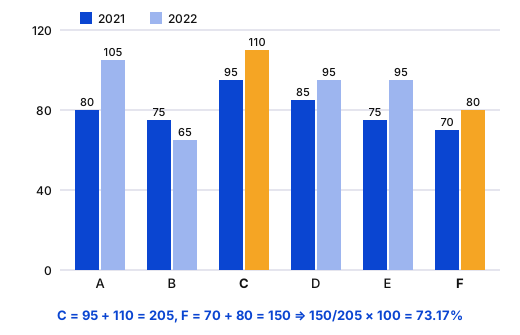
- C: thousand
- F: thousand
Trick: ; .
Answer: (C)
अवधारणा: अभीष्ट ।
- C: हजार
- F: हजार
ट्रिक: ।
उत्तर: (C)
SSC CPO Paper IQuantitative AptitudeData Interpretation (Bar Graph)SSC CPO Paper I 2024 · 28 Jun Shift 1
Q260.A and B together can complete a piece of work in 25 days, B and C together can
complete the same piece of work in 36 days, while C and A together can complete it in 30 days. If A, B, C, and D together can complete this piece of work in 18 days, then in how many days can D alone complete this piece of work?
A और B मिलकर किसी कार्य को 25 दिनों में पूरा कर सकते हैं, B और C मिलकर उसी कार्य को
36 दिनों में पूरा कर सकते हैं, जबकि C और A मिलकर इसे 30 दिनों में पूरा कर सकते हैं। यदि A, B, C और D मिलकर इस कार्य को 18 दिनों में पूरा कर सकते हैं, तो D अकेले इस कार्य को कितने दिनों में पूरा कर सकता है?
- A210
- B180
- C200
- D225
Show answer
Concept: Add the pair rates: = sum of pair rates. Then .
- D alone takes days
Trick: Total work units: A+B+C do units/day, all four do units/day, so D does units/day days.
Answer: (C)
अवधारणा: जोड़ी की दरें जोड़ें: = सब जोड़ी दरों का योग। फिर ।
- D अकेला दिन लेगा
ट्रिक: कुल कार्य इकाई: A+B+C इकाई/दिन, चारों इकाई/दिन, D इकाई/दिन दिन।
उत्तर: (C)
SSC CPO Paper IQuantitative AptitudeTime and WorkSSC CPO Paper I 2024 · 28 Jun Shift 1

