Q261.In the given number-pairs, the second number is obtained by applying certain
mathematical operations to the first number. Select the number-pair in which the
numbers are related in the same way as are the numbers of the given number-pairs. (NOTE: Operations should be performed on the whole numbers, without breaking
down the numbers into its constituent digits. E.g., 13 – Operations on 13 such as
adding/subtracting/multiplying etc. to 13 can be performed. Breaking down 13 into 1 and 3 and then performing mathematical operations on 1 and 3 is not allowed.)
(19, 200)
(15, 160)
दिए गए संख्या-युग्मों में, पहली संख्या पर कुछ निश्चित
गणितीय संक्रियाएँ करके दूसरी संख्या प्राप्त की जाती है। उस संख्या-युग्म का चयन कीजिए, जिसकी
संख्याएँ आपस में उसी प्रकार संबंधित हैं, जिस प्रकार दिए गए संख्या-युग्मों की संख्याएँ संबंधित हैं। (ध्यान दें: संक्रियाएँ संख्याओं को उनके घटक अंकों में विभाजित किए बिना, पूर्ण संख्याओं पर की जानी चाहिए। उदाहरण 13 – 13 पर संक्रियाएँ जैसे 13 में जोड़ना/घटाना/गुणा करना आदि किया जा सकता है। 13 को 1 और 3 में विभाजित करना और फिर 1 और 3 पर गणितीय संक्रियाएँ करना वर्जित है।)
(19, 200)
(15, 160)
- A(23, 300)
- B(22, 230)
- C(25, 250)
- D(18, 200)
Show answer
Concept: Find one rule that changes the first number into the second for both given pairs.
- : , i.e. .
- : ✓. Rule: .
- Check options: ✓; ; ; .
Trick: Second number ends in 0 and is about 10 times the first → try .
Answer: (B) (22, 230)
अवधारणा: दोनों दिए गए युग्मों में पहली संख्या को दूसरी में बदलने वाला एक नियम खोजें।
- : , यानी ।
- : ✓। नियम: ।
- विकल्प जाँचें: ✓; ; ; ।
ट्रिक: दूसरी संख्या 0 पर खत्म और पहली की लगभग 10 गुनी हो → आज़माएँ।
उत्तर: (B) (22, 230)
SSC CPO Paper IGeneral Intelligence and ReasoningNumber Pair RelationSSC CPO Paper I 2024 · 28 Jun Shift 1
Q262.In a certain code language, ‘FLY’ is written as ‘38’ and ‘NUT’ is written as ‘26’. How will ‘GOD’ be written in that language?
एक निश्चित कूट भाषा में, ‘FLY’ को ‘38’ लिखा जाता है और ‘NUT’ को ‘26’ लिखा जाता है। उस भाषा में ‘GOD’ को किस प्रकार लिखा जाएगा?
- A55
- B34
- C28
- D46
Show answer
Concept: Use reverse alphabetical positions (Z = 1, Y = 2, …, A = 26), i.e. reverse value , and add them.
- FLY: F = 21, L = 15, Y = 2 → ✓.
- NUT: N = 13, U = 6, T = 7 → ✓.
- GOD: G = 20, O = 12, D = 23 → .
Trick: If forward position sums do not match, try reverse positions () before anything else.
Answer: (A) 55
अवधारणा: उल्टे वर्णक्रम के स्थान (Z = 1, Y = 2, …, A = 26), यानी उल्टा मान , लेकर जोड़ें।
- FLY: F = 21, L = 15, Y = 2 → ✓।
- NUT: N = 13, U = 6, T = 7 → ✓।
- GOD: G = 20, O = 12, D = 23 → ।
ट्रिक: सीधे स्थानों का योग न मिले तो उल्टे स्थान () आज़माएँ।
उत्तर: (A) 55
SSC CPO Paper IGeneral Intelligence and ReasoningCoding-DecodingSSC CPO Paper I 2024 · 28 Jun Shift 1
Q263.In a code language, 'PEN' is coded as ‘70’ and 'NEST' is coded as ‘116’. How will
'PEON' be coded in the same language?
एक कूट भाषा में, ‘PEN’ को ‘70’ के रूप में कूटबद्ध किया जाता है और ‘NEST’ को ‘116’ के रूप में कूटबद्ध किया जाता है। उसी भाषा में
‘PEON’ को किस प्रकार कूटबद्ध किया जाएगा?
- A162
- B46
- C100
- D99
Show answer
Concept: Code = (sum of alphabetical positions of the letters).
- PEN: , ✓.
- NEST: , ✓.
- PEON: , .
Trick: If the code is even and about double the letter-sum, test "sum × 2" first.
Answer: (C) 100
अवधारणा: कोड (अक्षरों के वर्णक्रम स्थानों का योग)।
- PEN: , ✓।
- NEST: , ✓।
- PEON: , ।
ट्रिक: कोड सम हो और अक्षर-योग का लगभग दुगुना हो तो पहले "योग × 2" जाँचें।
उत्तर: (C) 100
SSC CPO Paper IGeneral Intelligence and ReasoningCoding-DecodingSSC CPO Paper I 2024 · 28 Jun Shift 1
Q264.If ‘P’ stands for ‘÷’, ‘Q’ stands for ‘×’, ‘R’ stands for ‘+’ and ‘S’ stands for ‘−’, what will come in place of the question mark (?) in the following equation?
174 P 2 S 45 R (16 P 4) Q 5 S 26 = ?
यदि ‘P’ का अर्थ ‘÷’ है, ‘Q’ का अर्थ ‘×’ है, ‘R’ का अर्थ ‘+’ है और ‘S’ का अर्थ ‘−’ है, तो निम्नलिखित समीकरण में प्रश्न चिह्न (?) के स्थान पर क्या आएगा?
174 P 2 S 45 R (16 P 4) Q 5 S 26 = ?
- A32
- B48
- C36
- D44
Show answer
Concept: Replace the letters by signs and solve with BODMAS.
- P = , Q = , R = , S = : .
- Bracket and division/multiplication: , .
- .
Trick: Solve the bracket first, then all ÷ and ×, and only then + and − from left to right.
Answer: (C) 36
अवधारणा: अक्षरों को चिह्नों से बदलें और BODMAS से हल करें।
- P = , Q = , R = , S = : ।
- कोष्ठक व भाग/गुणा: , ।
- ।
ट्रिक: पहले कोष्ठक, फिर सारे ÷ और ×, अंत में बाएँ से दाएँ + और −।
उत्तर: (C) 36
SSC CPO Paper IGeneral Intelligence and ReasoningMathematical OperationsSSC CPO Paper I 2024 · 28 Jun Shift 1
Q265.Find the two signs to be interchanged for making the following equation correct.
9 + 6 × 3 − 9 ÷ 1 = 10
निम्नलिखित समीकरण को सही बनाने के लिए आपस में बदले जाने वाले दो चिह्न ज्ञात कीजिए।
9 + 6 × 3 − 9 ÷ 1 = 10
- A× and ÷× और ÷
- B÷ and −÷ और −
- C− and +− और +
- D÷ and +÷ और +
Show answer
Concept: Interchange the two signs given in each option and test with BODMAS.
- Option (B), swap ÷ and −: .
- , so ✓.
- Others fail, e.g. (A) ; (C) .
Trick: Look for a swap that makes a big product shrink (here ) — the RHS 10 is small.
Answer: (B) ÷ and −
अवधारणा: हर विकल्प के दोनों चिह्न आपस में बदलकर BODMAS से जाँचें।
- विकल्प (B), ÷ और − बदलें: ।
- , अतः ✓।
- बाकी गलत, जैसे (A) ; (C) ।
ट्रिक: दायाँ पक्ष 10 छोटा है, इसलिए ऐसा बदलाव खोजें जिससे बड़ा गुणनफल घटे (यहाँ )।
उत्तर: (B) ÷ and −
SSC CPO Paper IGeneral Intelligence and ReasoningSign InterchangeSSC CPO Paper I 2024 · 28 Jun Shift 1
Q266.Based on the English alphabetical order, three of the following four letter-clusters are alike in a certain way and thus form a group. Which letter-cluster does not belong to that group?
(Note: The odd letter-cluster is not based on the number of consonants/vowels or their position in the letter-cluster.)
अंग्रेज़ी वर्णमाला क्रम के आधार पर, निम्नलिखित चार अक्षर-समूहों में से तीन किसी निश्चित प्रकार से एकसमान हैं और इस प्रकार एक समूह बनाते हैं। कौन-सा अक्षर-समूह उस समूह से संबंधित नहीं है?
(ध्यान दें: असंगत अक्षर-समूह, उस अक्षर-समूह में व्यंजनों/स्वरों की संख्या या उनके स्थान पर आधारित नहीं है।)
- AOVS
- BLSP
- CJQM
- DNUR
Show answer
Concept: Write the alphabetical positions and check the gaps between letters.
- OVS: = . LSP: = . NUR: = .
- JQM: = .
- So JQM breaks the pattern.
Trick: Equivalently, the 1st and 3rd letters differ by 4 in the group (O–S, L–P, N–R), but by 3 in J–M.
Answer: (C) JQM
अवधारणा: अक्षरों के वर्णक्रम स्थान लिखकर अंतर देखें।
- OVS: = । LSP: = । NUR: = ।
- JQM: = ।
- अतः JQM, पैटर्न को तोड़ता है।
ट्रिक: समूह में पहले और तीसरे अक्षर का अंतर 4 है (O–S, L–P, N–R), पर J–M में 3।
उत्तर: (C) JQM
SSC CPO Paper IGeneral Intelligence and ReasoningOdd One Out (Letters)SSC CPO Paper I 2024 · 28 Jun Shift 1
Q267.Six friends - A,B, C, D, E and F - are sitting around a circular table, facing towards the centre of the table.
D and C are immediate neighbours of A. B is second to the right of A. F is an
immediate neighbour of E , and fourth to the left of D. What is the position of E?
छह मित्र - A, B, C, D, E और F - एक वृत्ताकार मेज़ के चारों ओर मेज़ के केंद्र की ओर मुख करके बैठे हैं।
D और C, A के निकटतम पड़ोसी हैं। B, A के दाएँ से दूसरे स्थान पर है। F, E का
निकटतम पड़ोसी है, और D के बाएँ से चौथे स्थान पर है। E का स्थान क्या है?
- AThird to the left of AA के बाएँ से तीसरा
- BImmediate left of CC के ठीक बाएँ
- CSecond to the right of AA के दाएँ से दूसरा
- DImmediate neighbour of D and FD और F का निकटतम पड़ोसी
Show answer
Concept: Facing the centre, a person's right is the anticlockwise direction and left is clockwise.
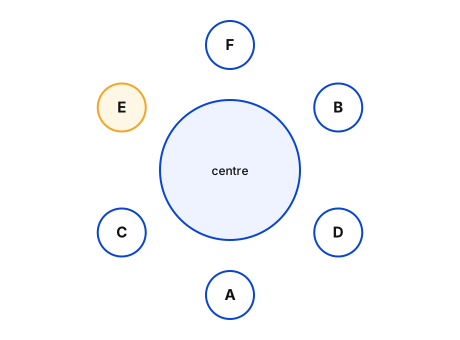
- Fix A. B is second to the right of A. D and C sit on either side of A.
- F is fourth to the left of D. If D were on A's left, F would land on C's seat, so D is immediately right of A; then F is opposite A.
- E is a neighbour of F; B already sits on one side of F, so E takes the seat between F and C.
- Order (going right from A): A, D, B, F, E, C. E is immediately to the left of C.
Trick: With 6 people, "fourth to the left" equals "second to the right" — saves counting.
Answer: (B) Immediate left of C
अवधारणा: केंद्र की ओर मुख होने पर व्यक्ति का दायाँ = वामावर्त (anticlockwise) और बायाँ = दक्षिणावर्त (clockwise)।
- A को स्थिर करें। B, A के दाएँ दूसरे स्थान पर है। D और C, A के दोनों ओर हैं।
- F, D के बाएँ चौथा है। यदि D, A के बाएँ होता तो F, C की सीट पर आता; अतः D, A के ठीक दाएँ है और F, A के सामने।
- E, F का पड़ोसी है; F के एक ओर B है, इसलिए E, F और C के बीच बैठता है।
- क्रम (A से दाएँ): A, D, B, F, E, C। E, C के ठीक बाएँ है।
ट्रिक: 6 लोगों में "बाएँ चौथा" = "दाएँ दूसरा" — गिनती बचती है।
उत्तर: (B) Immediate left of C
SSC CPO Paper IGeneral Intelligence and ReasoningCircular Seating ArrangementSSC CPO Paper I 2024 · 28 Jun Shift 1
Q268.Select the set in which the numbers are related in the same way as are the numbers of the following sets.
(NOTE: Operations should be performed on the whole numbers, without breaking
down the numbers into its constituent digits. E.g. 13 – Operations on 13 such as
adding /deleting /multiplying etc. to 13 can be performed. Breaking down 13 into 1 and 3 and then performing mathematical operations on 1 and 3 is not allowed)
(21, 105, 35)
(27, 135, 45)
उस समुच्चय का चयन कीजिए, जिसकी संख्याएँ आपस में उसी प्रकार संबंधित हैं, जिस प्रकार निम्नलिखित समुच्चयों की संख्याएँ आपस में संबंधित हैं।
(ध्यान दें: संक्रियाएँ संख्याओं को उनके घटक अंकों में विभाजित किए बिना, पूर्ण संख्याओं पर की जानी चाहिए। उदाहरण 13 – 13 पर संक्रियाएँ जैसे 13 में जोड़ना/घटाना/गुणा करना आदि किया जा सकता है। 13 को 1 और 3 में विभाजित करना और फिर 1 और 3 पर गणितीय संक्रियाएँ करना वर्जित है।)
(21, 105, 35)
(27, 135, 45)
- A(39, 195, 65)
- B(39, 195, 55)
- C(39, 185, 65)
- D(37, 195, 65)
Show answer
Concept: Find the rule linking the three numbers in each given set.
- : and .
- : , ✓.
- : , ✓. In (B) , in (C) , in (D) .
Trick: Third number first: .
Answer: (A) (39, 195, 65)
अवधारणा: हर दिए गए समूह की तीनों संख्याओं को जोड़ने वाला नियम खोजें।
- : और ।
- : , ✓।
- : , ✓। (B) में , (C) में , (D) में ।
ट्रिक: तीसरी संख्या पहली: ।
उत्तर: (A) (39, 195, 65)
SSC CPO Paper IGeneral Intelligence and ReasoningNumber Set RelationSSC CPO Paper I 2024 · 28 Jun Shift 1
Q269.If ‘A’ stands for ‘÷’, ‘B’ stands for ‘×’, ‘C’ stands for ‘+’ and ‘D’ stands for ‘−’, what will come in place of the question mark (?) in the following equation?
455 A 5 D 17 C 36 B 4 = ?
यदि ‘A’ का अर्थ ‘÷’ है, ‘B’ का अर्थ ‘×’ है, ‘C’ का अर्थ ‘+’ है और ‘D’ का अर्थ ‘−’ है, तो निम्नलिखित समीकरण में प्रश्न चिह्न (?) के स्थान पर क्या आएगा?
455 A 5 D 17 C 36 B 4 = ?
- A214
- B216
- C220
- D218
Show answer
Concept: Replace the letters by signs and solve with BODMAS.
- A = , B = , C = , D = : .
- , .
- .
Trick: Do ÷ and × first, then add/subtract from left to right.
Answer: (D) 218
अवधारणा: अक्षरों को चिह्नों से बदलें और BODMAS से हल करें।
- A = , B = , C = , D = : ।
- , ।
- ।
ट्रिक: पहले ÷ और ×, फिर बाएँ से दाएँ जोड़-घटाव।
उत्तर: (D) 218
SSC CPO Paper IGeneral Intelligence and ReasoningMathematical OperationsSSC CPO Paper I 2024 · 28 Jun Shift 1
Q270.If ‘A’ stands for ‘+’, ‘B’ stands for ‘−’, ‘C’ stands for ‘×’ and ‘D’ stands for ‘÷’, what will come in place of the question mark (?) in the following equation?
29 A 37 B 14 C 3 A (84 D 4) A 46 = ?
यदि ‘A’ का अर्थ ‘+’ है, ‘B’ का अर्थ ‘−’ है, ‘C’ का अर्थ ‘×’ है और ‘D’ का अर्थ ‘÷’ है, तो निम्नलिखित समीकरण में प्रश्न चिह्न (?) के स्थान पर क्या आएगा?
29 A 37 B 14 C 3 A (84 D 4) A 46 = ?
- A78
- B91
- C83
- D97
Show answer
Concept: Replace the letters by signs and solve with BODMAS.
- A = , B = , C = , D = : .
- , .
- .
Trick: Group all positives and subtract the negatives once: .
Answer: (B) 91
अवधारणा: अक्षरों को चिह्नों से बदलें और BODMAS से हल करें।
- A = , B = , C = , D = : ।
- , ।
- ।
ट्रिक: सारे धनात्मक जोड़कर एक बार घटाएँ: ।
उत्तर: (B) 91
SSC CPO Paper IGeneral Intelligence and ReasoningMathematical OperationsSSC CPO Paper I 2024 · 28 Jun Shift 1
Q271.Three different positions of the same dice are given. Find the number on the face
opposite to the face showing ‘6’.
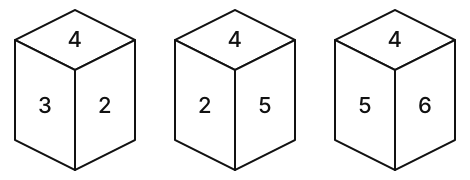
एक ही पासे की तीन भिन्न स्थितियाँ दी गई हैं। ‘6’ दर्शाने वाले फलक के
विपरीत फलक पर कौन-सी संख्या है, ज्ञात कीजिए।
- A3
- B4
- C2
- D1
Show answer
Concept: Faces that appear together with a face are adjacent to it; the one face never seen with it is opposite.
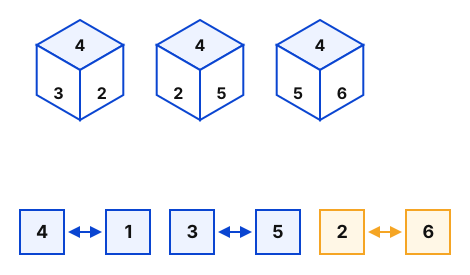
- 4 is on top in all three views and its neighbours are 3, 2, 5 and 6, so 1 is opposite 4.
- Turning the dice about the 4–1 axis, the side faces come round in the order 3, 2, 5, 6.
- In this ring of four, alternate faces are opposite: 3 ↔ 5 and 2 ↔ 6.
Trick: With a common top face, the four side faces form a ring — the 1st and 3rd of the ring are opposite, as are the 2nd and 4th.
Answer: (C) 2
अवधारणा: किसी फलक के साथ दिखने वाले फलक उसके आसन्न (adjacent) होते हैं; जो कभी साथ न दिखे वह विपरीत होता है।
- तीनों स्थितियों में 4 ऊपर है और उसके पड़ोसी 3, 2, 5, 6 हैं, इसलिए 1, 4 के विपरीत है।
- 4–1 अक्ष पर घुमाने पर बगल के फलक क्रम 3, 2, 5, 6 में आते हैं।
- चार के इस चक्र में एकांतर फलक विपरीत हैं: 3 ↔ 5 और 2 ↔ 6।
ट्रिक: ऊपर का फलक समान हो तो चारों बगल वाले फलक एक चक्र बनाते हैं — पहला-तीसरा और दूसरा-चौथा विपरीत होते हैं।
उत्तर: (C) 2
SSC CPO Paper IGeneral Intelligence and ReasoningDiceSSC CPO Paper I 2024 · 28 Jun Shift 1
Q272.Vani starts from point A and drives 6 km towards West. She then takes a left turn,
drives 8 km. She then turns left and drives 6 km to reach point B. In which direction is point B with respect to point A?
Vani बिंदु A से शुरू करती है और पश्चिम की ओर 6 km गाड़ी चलाती है। फिर वह बाएँ मुड़ती है,
8 km गाड़ी चलाती है। फिर वह बाएँ मुड़ती है और बिंदु B पर पहुँचने के लिए 6 km गाड़ी चलाती है। बिंदु A के सापेक्ष बिंदु B किस दिशा में है?
- ANorthउत्तर
- BSouthदक्षिण
- CSouth-westदक्षिण-पश्चिम
- DSouth-eastदक्षिण-पूर्व
Show answer
Concept: Trace the path step by step; a left turn while going West means facing South, and a left turn while going South means facing East.
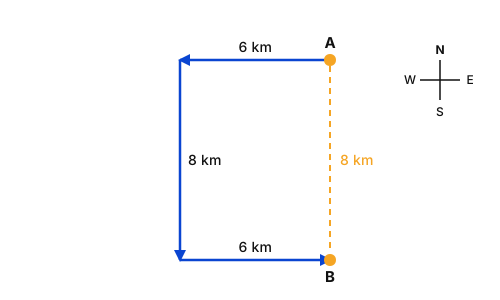
- From A, 6 km West.
- Left turn → South, 8 km.
- Left turn → East, 6 km to B. The 6 km West and 6 km East cancel.
- So B is 8 km directly South of A.
Trick: Equal and opposite moves cancel; only the unpaired 8 km South remains.
Answer: (B) South
अवधारणा: पथ को चरण-दर-चरण बनाएँ; पश्चिम जाते समय बायाँ मोड़ = दक्षिण, दक्षिण जाते समय बायाँ मोड़ = पूर्व।
- A से 6 km पश्चिम।
- बाएँ मुड़कर दक्षिण, 8 km।
- बाएँ मुड़कर पूर्व, 6 km चलकर B। 6 km पश्चिम और 6 km पूर्व एक-दूसरे को काट देते हैं।
- अतः B, A से ठीक 8 km दक्षिण में है।
ट्रिक: बराबर और विपरीत चालें कट जाती हैं; केवल 8 km दक्षिण बचता है।
उत्तर: (B) South
SSC CPO Paper IGeneral Intelligence and ReasoningDirection and DistanceSSC CPO Paper I 2024 · 28 Jun Shift 1
Q273.3 is related to 2 following a certain logic. Following the same logic, 9 is related to 6. Which of the following numbers is related to 12 using the same logic?
एक निश्चित तर्क के अनुसार 3 का संबंध 2 से है। उसी तर्क के अनुसार 9 का संबंध 6 से है। उसी तर्क का प्रयोग करते हुए, निम्नलिखित में से कौन-सी संख्या 12 से संबंधित है?
- A16
- B18
- C20
- D14
Show answer
Concept: Read the direction of the relation carefully: the first number is related to the second.
- and : the second number is of the first.
- We need the number that is related to 12, i.e. .
- . Check: ✓.
Trick: Here 12 plays the role of 2 and 6, so reverse the rule: multiply by .
Answer: (B) 18
अवधारणा: संबंध की दिशा ध्यान से पढ़ें: पहली संख्या दूसरी से संबंधित है।
- और : दूसरी संख्या पहली की है।
- ऐसी संख्या चाहिए जो 12 से संबंधित हो, यानी ।
- । जाँच: ✓।
ट्रिक: यहाँ 12 की भूमिका 2 और 6 जैसी है, इसलिए नियम उल्टा करें: से गुणा।
उत्तर: (B) 18
SSC CPO Paper IGeneral Intelligence and ReasoningNumber AnalogySSC CPO Paper I 2024 · 28 Jun Shift 1
Q274.Identify the figure given in the options which when put in place of ‘?’ will logically
complete the series.

विकल्पों में दी गई उस आकृति की पहचान कीजिए, जिसे ‘?’ के स्थान पर रखने पर
श्रृंखला तार्किक रूप से पूर्ण हो जाएगी।
- A

- B

- C

- D

Show answer
Concept: Note what is added at each step; here an element is added every step, alternating between curved arcs inside the circle and vertical lines beside it.
- Fig 1: plain circle. Fig 2: two arcs added inside.
- Fig 3: a vertical line added on the left. Fig 4: a third arc added inside.
- Next step should add a vertical line again, on the right, keeping the left line and all three arcs.
- Option (D) has both lines and three arcs; (C) has only two arcs, (A) and (B) have extra lines.
Trick: Alternating additions: arc, line, arc, line — count both elements in the options.
Answer: (D)
अवधारणा: हर चरण में क्या जुड़ता है, देखें; यहाँ बारी-बारी से वृत्त के अंदर चाप (arc) और बगल में खड़ी रेखा जुड़ती है।
- चित्र 1: केवल वृत्त। चित्र 2: अंदर दो चाप जुड़े।
- चित्र 3: बाईं ओर एक खड़ी रेखा जुड़ी। चित्र 4: अंदर तीसरा चाप जुड़ा।
- अगले चरण में फिर एक खड़ी रेखा, दाईं ओर, जुड़नी चाहिए; बाईं रेखा और तीनों चाप बने रहें।
- विकल्प (D) में दोनों रेखाएँ और तीन चाप हैं; (C) में केवल दो चाप, (A) व (B) में अतिरिक्त रेखाएँ हैं।
ट्रिक: बारी-बारी जोड़: चाप, रेखा, चाप, रेखा — विकल्पों में दोनों तत्व गिनें।
उत्तर: (D)
SSC CPO Paper IGeneral Intelligence and ReasoningFigure SeriesSSC CPO Paper I 2024 · 28 Jun Shift 1
Q275.Which of the following terms will replace the question mark (?) in the given series? HMW, INX, JOY,?
दी गई श्रृंखला में प्रश्न चिह्न (?) के स्थान पर निम्नलिखित में से कौन-सा पद आएगा? HMW, INX, JOY,?
- AKPZ
- BEHM
- CDHM
- DDJB
Show answer
Concept: Check each letter position separately.
- 1st letters: H, I, J → next K ().
- 2nd letters: M, N, O → next P ().
- 3rd letters: W, X, Y → next Z ().
Trick: Every letter moves one step forward, so the next cluster is simply each letter .
Answer: (A) KPZ
अवधारणा: हर स्थान के अक्षर अलग-अलग जाँचें।
- पहले अक्षर: H, I, J → अगला K ()।
- दूसरे अक्षर: M, N, O → अगला P ()।
- तीसरे अक्षर: W, X, Y → अगला Z ()।
ट्रिक: हर अक्षर एक कदम आगे बढ़ता है, इसलिए अगला समूह हर अक्षर है।
उत्तर: (A) KPZ
SSC CPO Paper IGeneral Intelligence and ReasoningLetter SeriesSSC CPO Paper I 2024 · 28 Jun Shift 1
Q276.In a certain code language, ‘JAM’ is written as ‘24’ and ‘GEL’ is written as ‘24’. How will ‘LAW’ be written in that language?
एक निश्चित कूट भाषा में, ‘JAM’ को ‘24’ लिखा जाता है और ‘GEL’ को ‘24’ लिखा जाता है। उस भाषा में ‘LAW’ को किस प्रकार लिखा जाएगा?
- A32
- B24
- C36
- D28
Show answer
Concept: Code = sum of alphabetical positions of the letters.
- JAM: ✓.
- GEL: ✓.
- LAW: .
Trick: Remember EJOTY: E = 5, J = 10, O = 15, T = 20, Y = 25 — W = 23 is two after U = 21.
Answer: (C) 36
अवधारणा: कोड = अक्षरों के वर्णक्रम स्थानों का योग।
- JAM: ✓।
- GEL: ✓।
- LAW: ।
ट्रिक: EJOTY याद रखें: E = 5, J = 10, O = 15, T = 20, Y = 25।
उत्तर: (C) 36
SSC CPO Paper IGeneral Intelligence and ReasoningCoding-DecodingSSC CPO Paper I 2024 · 28 Jun Shift 1
Q277.Select the set in which the numbers are related in the same way as are the numbers of the given sets.
(NOTE: Operations should be performed on the whole numbers, without breaking
down the numbers into its constituent digits. E.g. 13 – Operations on 13 such as
adding/deleting/multiplying, etc. to 13 can be performed. Breaking down 13 into 1 and 3 and then performing mathematical operations on 1 and 3 is not allowed.)
(4, 12, 48)
(9, 27, 108)
उस समुच्चय का चयन कीजिए, जिसकी संख्याएँ आपस में उसी प्रकार संबंधित हैं, जिस प्रकार दिए गए समुच्चयों की संख्याएँ आपस में संबंधित हैं।
(ध्यान दें: संक्रियाएँ संख्याओं को उनके घटक अंकों में विभाजित किए बिना, पूर्ण संख्याओं पर की जानी चाहिए। उदाहरण 13 – 13 पर संक्रियाएँ जैसे 13 में जोड़ना/घटाना/गुणा करना आदि किया जा सकता है। 13 को 1 और 3 में विभाजित करना और फिर 1 और 3 पर गणितीय संक्रियाएँ करना वर्जित है।)
(4, 12, 48)
(9, 27, 108)
- A(13, 39, 146)
- B(13, 36, 146)
- C(13, 39, 156)
- D(13, 36, 156)
Show answer
Concept: Find the rule linking the three numbers of each given set.
- : , .
- : , ✓.
- : , ✓. (A) has 146, (B) and (D) have 36.
Trick: Third number first: .
Answer: (C) (13, 39, 156)
अवधारणा: हर दिए गए समूह की तीनों संख्याओं का नियम खोजें।
- : , ।
- : , ✓।
- : , ✓। (A) में 146, (B) व (D) में 36 है।
ट्रिक: तीसरी संख्या पहली: ।
उत्तर: (C) (13, 39, 156)
SSC CPO Paper IGeneral Intelligence and ReasoningNumber Set RelationSSC CPO Paper I 2024 · 28 Jun Shift 1
Q278.Select the Venn diagram that best illustrates the relationship between the following classes.
Mother, Women, Husband
उस वेन आरेख का चयन कीजिए, जो निम्नलिखित वर्गों के बीच के संबंध को सर्वोत्तम रूप से दर्शाता है।
माता, महिलाएँ, पति
- A

- B

- C

- D

Show answer
Concept: Decide for each pair of classes whether one lies inside the other, they overlap, or they are separate.
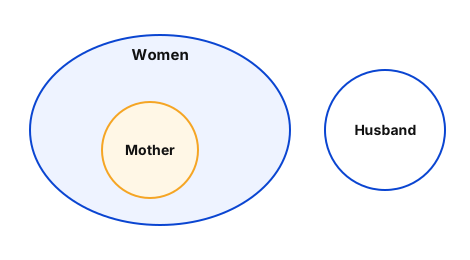
- Every mother is a woman, so Mother lies completely inside Women.
- A husband is a man, so Husband has nothing in common with Women or Mother — a separate circle.
- Option (A) shows one circle inside a bigger one and a third separate circle.
Trick: Gender-based classes (husband vs woman) are always disjoint.
Answer: (A)
अवधारणा: हर दो वर्गों के लिए तय करें: एक दूसरे के अंदर है, आंशिक रूप से मिलते हैं, या पूरी तरह अलग हैं।
- हर mother एक woman है, इसलिए Mother पूरी तरह Women के अंदर है।
- Husband पुरुष होता है, इसलिए Husband का Women या Mother से कोई संबंध नहीं — अलग वृत्त।
- विकल्प (A) में एक वृत्त बड़े वृत्त के अंदर और तीसरा अलग है।
ट्रिक: लिंग पर आधारित वर्ग (husband और woman) हमेशा अलग होते हैं।
उत्तर: (A)
SSC CPO Paper IGeneral Intelligence and ReasoningVenn DiagramSSC CPO Paper I 2024 · 28 Jun Shift 1
Q279.Two statements are given, followed by two conclusions numbered I and II. Assuming the statements to be true, even if they seem to be at variance with commonly known facts, decide which of the conclusions logically follow(s) from the statements.
Statements:
All roads are routes.
All routes are bridges.
Conclusions:
I.Some routes are roads.
II.All roads are bridges.
दो कथन दिए गए हैं, जिनके बाद I और II से क्रमांकित दो निष्कर्ष दिए गए हैं। कथनों को सत्य मानते हुए, भले ही वे सामान्य रूप से ज्ञात तथ्यों से भिन्न प्रतीत होते हों, निर्णय कीजिए कि कौन-सा/से निष्कर्ष कथनों का तार्किक रूप से अनुसरण करता है/करते हैं।
कथन:
सभी सड़कें, मार्ग हैं।
सभी मार्ग, पुल हैं।
निष्कर्ष:
I. कुछ मार्ग, सड़कें हैं।
II. सभी सड़कें, पुल हैं।
- AOnly conclusion II followsकेवल निष्कर्ष II अनुसरण करता है
- BOnly conclusion I followsकेवल निष्कर्ष I अनुसरण करता है
- CBoth conclusions I and II followनिष्कर्ष I और II दोनों अनुसरण करते हैं
- DNeither conclusion I nor II followsन तो निष्कर्ष I और न ही II अनुसरण करता है
Show answer
Concept: Two "All" statements in a chain give Roads ⊂ Routes ⊂ Bridges.
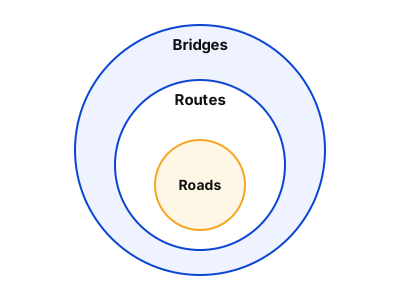
- I: "Some routes are roads" — since all roads are routes, the reverse "some" is always true (conversion).
- II: "All roads are bridges" — all roads are routes and all routes are bridges, so all roads are bridges.
- Both conclusions are certain.
Trick: All A are B + All B are C ⇒ All A are C; and All A are B ⇒ Some B are A.
Answer: (C) Both conclusions I and II follow
अवधारणा: दो "All" कथनों की श्रृंखला से Roads ⊂ Routes ⊂ Bridges बनता है।
- I: "Some routes are roads" — सभी roads, routes हैं, इसलिए उल्टा "some" हमेशा सत्य (conversion)।
- II: "All roads are bridges" — सभी roads, routes हैं और सभी routes, bridges, अतः सभी roads, bridges हैं।
- दोनों निष्कर्ष निश्चित हैं।
ट्रिक: All A are B + All B are C ⇒ All A are C; तथा All A are B ⇒ Some B are A।
उत्तर: (C) Both conclusions I and II follow
SSC CPO Paper IGeneral Intelligence and ReasoningSyllogismSSC CPO Paper I 2024 · 28 Jun Shift 1
Q280.In a certain code language, ‘CITY’ is written as ‘241872’, and ‘DRUG’ is written as
‘239620’. How will ‘GOLF’ be written in that language?
एक निश्चित कूट भाषा में, ‘CITY’ को ‘241872’ लिखा जाता है, और ‘DRUG’ को
‘239620’ लिखा जाता है। उस भाषा में ‘GOLF’ को किस प्रकार लिखा जाएगा?
- A7121521
- B20121521
- C7151212
- D18151215
Show answer
Concept: Each letter is written as its reverse alphabetical position ().
- CITY: C = 24, I = 18, T = 7, Y = 2 → 241872 ✓.
- DRUG: D = 23, R = 9, U = 6, G = 20 → 239620 ✓.
- GOLF: G = 20, O = 12, L = 15, F = 21 → 20121521.
Trick: Reverse position: A ↔ 26, M ↔ 14, N ↔ 13; pairs of letters always add to 27.
Answer: (B) 20121521
अवधारणा: हर अक्षर को उसके उल्टे वर्णक्रम स्थान () से लिखा गया है।
- CITY: C = 24, I = 18, T = 7, Y = 2 → 241872 ✓।
- DRUG: D = 23, R = 9, U = 6, G = 20 → 239620 ✓।
- GOLF: G = 20, O = 12, L = 15, F = 21 → 20121521।
ट्रिक: सीधा + उल्टा स्थान = 27 (जैसे A = 1 ↔ 26)।
उत्तर: (B) 20121521
SSC CPO Paper IGeneral Intelligence and ReasoningCoding-DecodingSSC CPO Paper I 2024 · 28 Jun Shift 1

