Q301.Select the figure from among the given options that can logically replace the question mark (?) in the following series.

दिए गए विकल्पों में से उस आकृति का चयन कीजिए जो निम्नलिखित श्रृंखला में प्रश्न चिह्न (?) के स्थान पर तार्किक रूप से आ सकती है।
- A
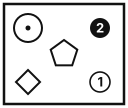
- B
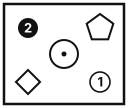
- C
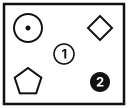
- D
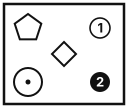
Show answer
Concept: In this series, every symbol moves one step along a fixed path of the five positions.
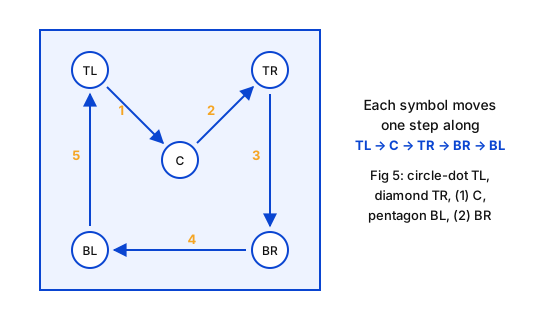
- Track the pentagon: TL → centre → TR → BR, so next it goes to BL.
- Every symbol follows the same path: TL → C → TR → BR → BL → TL.
- From figure 4: (1) TL → C, diamond C → TR, (2) TR → BR, pentagon BR → BL, circle-dot BL → TL.
- Figure 5: circle-dot TL, diamond TR, (1) centre, pentagon BL, (2) BR, which matches option (C).
Trick: Follow one symbol for 3–4 figures to find the path, then move all symbols together.
Answer: (C)
अवधारणा: इस श्रृंखला में हर चिह्न पाँच स्थानों के एक निश्चित रास्ते पर हर बार एक कदम आगे बढ़ता है।
- पंचभुज (pentagon) को देखें: TL → केंद्र → TR → BR, अब अगला स्थान BL है।
- सभी चिह्न एक ही रास्ते पर चलते हैं: TL → C → TR → BR → BL → TL।
- आकृति 4 से: (1) TL → C, diamond C → TR, (2) TR → BR, pentagon BR → BL, circle-dot BL → TL।
- आकृति 5: circle-dot TL, diamond TR, (1) केंद्र, pentagon BL, (2) BR, जो विकल्प (C) से मेल खाती है।
ट्रिक: एक चिह्न को 3–4 आकृतियों तक ट्रैक करें, रास्ता मिलते ही सभी को साथ खिसकाएँ।
उत्तर: (C)
SSC CPO Paper IGeneral Intelligence and ReasoningFigure SeriesSSC CPO Paper I 2024 · 27 Jun Shift 3
Q302.Select the correct mirror image of the given figure when the mirror is placed at MN as shown below.
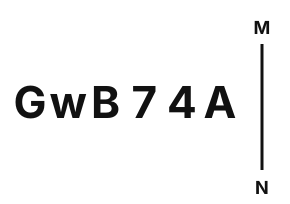
जब दर्पण को नीचे दर्शाए अनुसार MN पर रखा जाता है, तो दी गई आकृति के सही दर्पण प्रतिबिंब का चयन कीजिए।
- A
- B

- C
- D

Show answer
Concept: With a vertical mirror (MN) on the right side, left and right are interchanged; top and bottom stay the same.
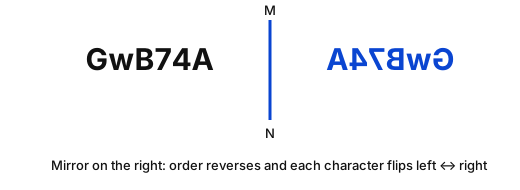
- The last character A comes first and G comes last: order becomes A 4 7 B w G.
- Every character is also laterally reversed (4, 7, B, G look back-to-front; A and w look the same).
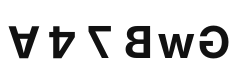
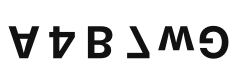
- Only option (D) shows this order with each character flipped left–right; the others are upside-down (water image) or not reversed properly.
Trick: Vertical mirror: read the word from the mirror side and flip each letter horizontally, never upside-down.
Answer: (D)
अवधारणा: दाईं ओर ऊर्ध्वाधर दर्पण (MN) होने पर बायाँ-दायाँ आपस में बदल जाते हैं; ऊपर-नीचे वैसे ही रहते हैं।
- अंतिम अक्षर A सबसे पहले और G सबसे अंत में आएगा: क्रम A 4 7 B w G।
- हर अक्षर भी पार्श्व रूप से उलटा होगा (4, 7, B, G उलटे दिखेंगे; A और w समान दिखते हैं)।
- केवल विकल्प (D) में यही क्रम और हर अक्षर बायें-दायें उलटा है; बाकी उल्टे-सीधे (जल प्रतिबिंब) या ग़लत हैं।
ट्रिक: ऊर्ध्वाधर दर्पण में शब्द दर्पण की ओर से पढ़ें और हर अक्षर को केवल क्षैतिज रूप से पलटें।
उत्तर: (D)
SSC CPO Paper IGeneral Intelligence and ReasoningMirror ImageSSC CPO Paper I 2024 · 27 Jun Shift 3
Q303.Select the set in which the numbers are related in the same way as are the numbers of the following sets.
(NOTE: Operations should be performed on the whole numbers, without breaking
down the numbers into its constituent digits. E.g. 13 – Operations on 13 such as
adding /deleting /multiplying etc. to 13 can be performed. Breaking down 13 into 1 and 3 and then performing mathematical operations on 1 and 3 is not allowed)
(288, 144, 24)
(432, 216, 36)
उस समुच्चय का चयन कीजिए जिसमें संख्याएँ ठीक उसी प्रकार संबंधित हैं, जिस प्रकार निम्नलिखित समुच्चयों की संख्याएँ संबंधित हैं।
(ध्यान दें: संक्रियाएँ संख्याओं को उनके घटक अंकों में विभक्त किए बिना, पूर्ण संख्याओं पर की जानी चाहिए। उदाहरण के लिए 13 – 13 पर की जाने वाली संक्रियाएँ, जैसे 13 में जोड़ना/घटाना/गुणा करना आदि की जा सकती हैं। 13 को 1 और 3 में विभक्त करना और फिर 1 और 3 पर गणितीय संक्रियाएँ करना वर्जित है।)
(288, 144, 24)
(432, 216, 36)
- A(504, 252, 42)
- B(506, 252, 42)
- C(504, 252, 44)
- D(504, 250, 42)
Show answer
Concept: Find the operations linking the three numbers of each set and apply them to the options.
- and .
- and .
- Option (A): and ✓.
- (B) ; (C) ; (D) .
Trick: Rule: 2nd , 3rd ; check both links for every option.
Answer: (A) (504, 252, 42)
अवधारणा: हर समूह की तीनों संख्याओं के बीच संक्रियाएँ खोजें और विकल्पों पर लगाएँ।
- और ।
- और ।
- विकल्प (A): और ✓।
- (B) ; (C) ; (D) ।
ट्रिक: नियम: दूसरी , तीसरी ।
उत्तर: (A) (504, 252, 42)
SSC CPO Paper IGeneral Intelligence and ReasoningNumber Set AnalogySSC CPO Paper I 2024 · 27 Jun Shift 3
Q304.Based on the English alphabetical order, three of the following four letter-clusters are alike in a certain way and thus form a group. Which letter-cluster does not belong to that group?
(Note: The odd letter-cluster is not based on the number of consonants/vowels or their position in the letter-cluster.)
अंग्रेज़ी वर्णमाला क्रम के आधार पर, निम्नलिखित चार अक्षर-समूहों में से तीन किसी निश्चित प्रकार से समान हैं और इस प्रकार एक समूह बनाते हैं। कौन-सा अक्षर-समूह उस समूह से संबंधित नहीं है?
(ध्यान दें: असंगत अक्षर-समूह, उस अक्षर-समूह में व्यंजनों/स्वरों की संख्या या उनके स्थान पर आधारित नहीं है।)
- AFIK
- BJMP
- CORT
- DDGI
Show answer
Concept: Compare the gaps between consecutive letters using their alphabet positions.
- FIK: F(6) → I(9) → K(11).
- ORT: O(15) → R(18) → T(20); DGI: D(4) → G(7) → I(9).
- JMP: J(10) → M(13) → P(16) – the gaps are .
- So JMP is the odd one.
Trick: Write the positions and the gaps (+3, +2); the cluster with a different gap pattern is odd.
Answer: (B) JMP
अवधारणा: वर्णमाला स्थान लेकर लगातार अक्षरों के अंतर की तुलना करें।
- FIK: F(6) → I(9) → K(11)।
- ORT: O(15) → R(18) → T(20); DGI: D(4) → G(7) → I(9)।
- JMP: J(10) → M(13) → P(16) – अंतर है।
- अतः JMP अलग है।
ट्रिक: स्थान लिखकर अंतर (+3, +2) देखें; जिसका पैटर्न अलग हो वही विषम।
उत्तर: (B) JMP
SSC CPO Paper IGeneral Intelligence and ReasoningOdd One Out (Letters)SSC CPO Paper I 2024 · 27 Jun Shift 3
Q305.In a code language, 'BASIC' is coded as 101 and 'MAGIC' is coded as 102. How will 'LIGHT' be coded in the same language?
एक कूट भाषा में, 'BASIC' को 101 के रूप में कूटबद्ध किया जाता है और 'MAGIC' को 102 के रूप में कूटबद्ध किया जाता है। उसी भाषा में 'LIGHT' को किस प्रकार कूटबद्ध किया जाएगा?
- A85
- B79
- C82
- D86
Show answer
Concept: Code = sum of reverse alphabet positions of the letters (A = 26, B = 25, …, Z = 1); reverse value .
- BASIC: ✓.
- MAGIC: ✓.
- LIGHT: L = 15, I = 18, G = 20, H = 19, T = 7.
- Sum .
Trick: If the forward sum does not fit, try the reverse values ().
Answer: (B) 79
अवधारणा: कोड = अक्षरों के उल्टे वर्णमाला स्थानों का योग (A = 26, B = 25, …, Z = 1); उल्टा मान ।
- BASIC: ✓।
- MAGIC: ✓।
- LIGHT: L = 15, I = 18, G = 20, H = 19, T = 7।
- योग ।
ट्रिक: सीधा योग न मिले तो उल्टे मान () से जाँचें।
उत्तर: (B) 79
SSC CPO Paper IGeneral Intelligence and ReasoningCoding–DecodingSSC CPO Paper I 2024 · 27 Jun Shift 3
Q306.Select the set in which the numbers are related in the same way as are the numbers of the given sets.
(NOTE: Operations should be performed on the whole numbers, without breaking
down the numbers into its constituent digits. E.g. 13 – Operations on 13 such as
adding/deleting/multiplying, etc. to 13 can be performed. Breaking down 13 into 1 and 3 and then performing mathematical operations on 1 and 3 is not allowed.)
(16, 4, 20)
(28, 7, 35)
उस समुच्चय का चयन कीजिए जिसमें संख्याएँ ठीक उसी प्रकार संबंधित हैं, जिस प्रकार निम्नलिखित समुच्चयों की संख्याएँ संबंधित हैं।
(ध्यान दें: संक्रियाएँ संख्याओं को उनके घटक अंकों में विभक्त किए बिना, पूर्ण संख्याओं पर की जानी चाहिए। उदाहरण के लिए 13 – 13 पर की जाने वाली संक्रियाएँ, जैसे 13 में जोड़ना/घटाना/गुणा करना आदि की जा सकती हैं। 13 को 1 और 3 में विभक्त करना और फिर 1 और 3 पर गणितीय संक्रियाएँ करना वर्जित है।)
(16, 4, 20)
(28, 7, 35)
- A(52, 13, 65)
- B(52, 13, 60)
- C(50, 13, 65)
- D(50, 13, 60)
Show answer
Concept: Look for the relation between the first number and the other two.
- and .
- and .
- Option (A): and ✓.
- (B) and (D) fail because the third number should be 65; (C) is not 13.
Trick: Third number = first : , , .
Answer: (A) (52, 13, 65)
अवधारणा: पहली संख्या और बाकी दो संख्याओं के बीच संबंध खोजें।
- और ।
- और ।
- विकल्प (A): और ✓।
- (B), (D) में तीसरी संख्या 65 होनी चाहिए; (C) में 13 नहीं है।
ट्रिक: तीसरी संख्या = पहली : , , ।
उत्तर: (A) (52, 13, 65)
SSC CPO Paper IGeneral Intelligence and ReasoningNumber Set AnalogySSC CPO Paper I 2024 · 27 Jun Shift 3
Q307.What will come in place of the question mark (?) when + and − are interchanged and 8 and 6 are also interchanged?
8 − 6 + 10 =?
यदि + और − को आपस में बदल दिया जाए तथा 8 और 6 को भी आपस में बदल दिया जाए, तो प्रश्न चिह्न (?) के स्थान पर क्या आएगा?
8 − 6 + 10 =?
- A7
- B4
- C6
- D5
Show answer
Concept: Make both interchanges first, then solve.
- Given: .
- Swap + and −: .
- Swap 8 and 6: .
- .
Trick: Do the swaps on paper before calculating – mixing the order is the usual mistake.
Answer: (B) 4
अवधारणा: पहले दोनों अदला-बदली करें, फिर हल करें।
- दिया है: ।
- + और − बदलें: ।
- 8 और 6 बदलें: ।
- ।
ट्रिक: गणना से पहले बदला हुआ व्यंजक लिख लें।
उत्तर: (B) 4
SSC CPO Paper IGeneral Intelligence and ReasoningMathematical OperationsSSC CPO Paper I 2024 · 27 Jun Shift 3
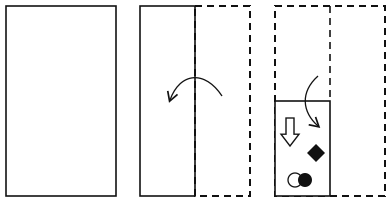
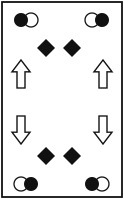
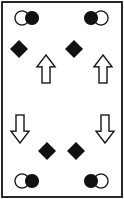
Q308.The sequence of folding a paper and the manner in which the folded paper is cut is shown in the following figures. How would this paper look when unfolded?
निम्नलिखित आकृतियों में एक कागज़ को मोड़ने का क्रम और मोड़े गए कागज़ को काटने का तरीका दर्शाया गया है। खोलने पर यह कागज़ कैसा दिखाई देगा?
- A
- B
- C
- D
Show answer
Concept: Unfold in reverse order; each cut is reflected across the fold line it is opened about.
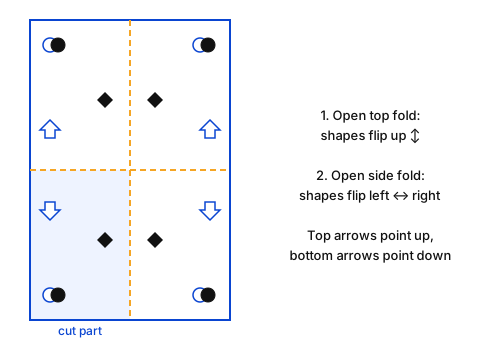
- The paper was folded right-to-left, then top-to-bottom, so the cut part is the bottom-left quarter.
- Opening the top fold reflects the down-arrow, diamond and circle-pair into the top half – the arrows there point up.
- Opening the side fold copies everything to the right half as a mirror image.
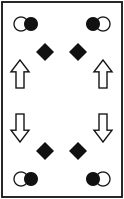
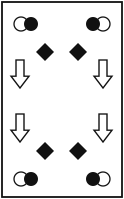
- Result: 4 circle-pairs at the corners, 4 diamonds near the centre, up-arrows in the top half and down-arrows in the bottom half – option (A).
Trick: Across a horizontal fold arrows flip up/down; across a vertical fold they flip left/right.
Answer: (A)
अवधारणा: उल्टे क्रम में खोलें; हर कट उस मोड़-रेखा के सापेक्ष प्रतिबिंबित होता है जिससे कागज़ खोला जाता है।
- कागज़ पहले दाएँ से बाएँ, फिर ऊपर से नीचे मोड़ा गया, अतः कटा भाग नीचे-बायाँ चौथाई है।
- ऊपरी मोड़ खोलने पर नीचे वाला तीर ऊपर के आधे भाग में ऊपर की ओर दिखेगा; diamond और गोले भी प्रतिबिंबित होंगे।
- साइड मोड़ खोलने पर सब कुछ दाएँ आधे में दर्पण-प्रतिबिंब बनकर आएगा।
- परिणाम: कोनों पर 4 गोले-जोड़े, केंद्र के पास 4 diamond, ऊपर तीर ऊपर की ओर और नीचे तीर नीचे की ओर – विकल्प (A)।
ट्रिक: क्षैतिज मोड़ पर आकृति ऊपर-नीचे पलटती है; ऊर्ध्वाधर मोड़ पर बायें-दायें।
उत्तर: (A)
SSC CPO Paper IGeneral Intelligence and ReasoningPaper Folding and CuttingSSC CPO Paper I 2024 · 27 Jun Shift 3
Q309.Select the option that is related to the fifth letter-cluster in the same way as the second letter-cluster is related to the first letter-cluster and the fourth letter-cluster is related to the third letter-cluster.
ISLAND : ANDISL :: EITHER : HEREIT :: IMPACT : ?
उस विकल्प का चयन कीजिए जो पाँचवें अक्षर-समूह से उसी प्रकार संबंधित है, जिस प्रकार दूसरा अक्षर-समूह पहले अक्षर-समूह से संबंधित है और चौथा अक्षर-समूह तीसरे अक्षर-समूह से संबंधित है।
ISLAND : ANDISL :: EITHER : HEREIT :: IMPACT : ?
- AICAPMT
- BTCAPMI
- CIPMCTA
- DACTIMP
Show answer
Concept: Split the six-letter word into two halves of three letters and swap the halves.
- ISL | AND → AND + ISL = ANDISL.
- EIT | HER → HER + EIT = HEREIT.
- IMP | ACT → ACT + IMP = ACTIMP.
Trick: Two blocks of 3 letters exchanged – check whether the last 3 letters of the word start the answer.
Answer: (D) ACTIMP
अवधारणा: छह अक्षरों के शब्द को तीन-तीन अक्षरों के दो भागों में बाँटकर उनकी जगह बदलें।
- ISL | AND → AND + ISL = ANDISL।
- EIT | HER → HER + EIT = HEREIT।
- IMP | ACT → ACT + IMP = ACTIMP।
ट्रिक: शब्द के अंतिम 3 अक्षर उत्तर की शुरुआत में हैं या नहीं, देखें।
उत्तर: (D) ACTIMP
SSC CPO Paper IGeneral Intelligence and ReasoningLetter AnalogySSC CPO Paper I 2024 · 27 Jun Shift 3
Q310.If ‘P’ stands for ‘÷’, ‘Q’ stands for ‘×’, ‘R’ stands for ‘+’ and ‘S’ stands for ‘−’, what will come in place of the question mark (?) in the following equation?
[(18 S 5) Q 4] P 2 R 22 Q 3 S 24 R 9 = ?
यदि ‘P’ का अर्थ ‘÷’, ‘Q’ का अर्थ ‘×’, ‘R’ का अर्थ ‘+’ और ‘S’ का अर्थ ‘−’ है, तो निम्नलिखित समीकरण में प्रश्न चिह्न (?) के स्थान पर क्या आएगा?
[(18 S 5) Q 4] P 2 R 22 Q 3 S 24 R 9 = ?
- A89
- B77
- C82
- D63
Show answer
Concept: Replace the letters by signs and solve using BODMAS.
- Expression: .
- Brackets: , then .
- .
- .
Trick: Solve the bracket first, then ÷ and ×, and only then + and −.
Answer: (B) 77
अवधारणा: अक्षरों की जगह चिह्न रखकर BODMAS से हल करें।
- व्यंजक: ।
- कोष्ठक: , फिर ।
- ।
- ।
ट्रिक: पहले कोष्ठक, फिर ÷ और ×, अंत में + और −।
उत्तर: (B) 77
SSC CPO Paper IGeneral Intelligence and ReasoningMathematical OperationsSSC CPO Paper I 2024 · 27 Jun Shift 3
Q311.Select the Venn diagram that best illustrates the relationship between the following classes.
Mechanic, Peon, Lawyer
उस वेन आरेख का चयन कीजिए जो निम्नलिखित वर्गों के बीच के संबंध को सर्वोत्तम रूप से दर्शाता है।
मैकेनिक, चपरासी, वकील
- A

- B
- C

- D

Show answer
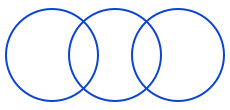
Concept: Classes that have nothing in common are shown as separate, non-touching circles.
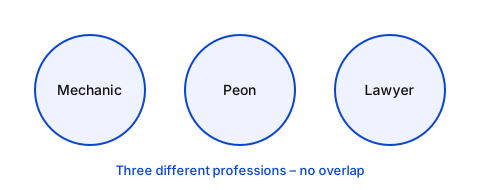
- A mechanic, a peon and a lawyer are three different occupations.
- A person is classified in one of these jobs, so no class lies inside another and there is no common region.
- Hence three separate circles – option (D).
Yaad rakhein: Three different professions/categories of the same level → three disjoint circles.
Answer: (D)
अवधारणा: जिन वर्गों में कुछ भी समान नहीं होता, उन्हें अलग-अलग (न छूने वाले) वृत्तों से दिखाते हैं।
- Mechanic, Peon और Lawyer तीन अलग-अलग व्यवसाय हैं।
- कोई वर्ग दूसरे के अंदर नहीं है और कोई साझा भाग नहीं है।
- अतः तीन अलग वृत्त – विकल्प (D)।
याद रखें: एक ही स्तर के तीन अलग व्यवसाय → तीन अलग वृत्त।
उत्तर: (D)
SSC CPO Paper IGeneral Intelligence and ReasoningVenn DiagramSSC CPO Paper I 2024 · 27 Jun Shift 3
Q312.What will come in the place of ‘?’ in the following equation, if ‘+’ and ‘–’ are
interchanged and also ‘×’ and ‘÷’ are interchanged?
154 × 11 − 24 ÷ 3 + 19 = ?
यदि ‘+’ और ‘–’ को आपस में बदल दिया जाए तथा ‘×’ और ‘÷’ को भी आपस में बदल दिया जाए, तो निम्नलिखित समीकरण में ‘?’ के स्थान पर क्या आएगा?
154 × 11 − 24 ÷ 3 + 19 = ?
- A62
- B67
- C71
- D54
Show answer
Concept: Interchange the signs as told, then apply BODMAS.
- Given: .
- After swapping (+ ↔ −, × ↔ ÷): .
- , .
- .
Trick: Rewrite the full expression with new signs before calculating.
Answer: (B) 67
अवधारणा: बताए अनुसार चिह्न बदलें, फिर BODMAS लगाएँ।
- दिया है: ।
- बदलने के बाद (+ ↔ −, × ↔ ÷): ।
- , ।
- ।
ट्रिक: गणना से पहले नए चिह्नों वाला पूरा व्यंजक लिखें।
उत्तर: (B) 67
SSC CPO Paper IGeneral Intelligence and ReasoningMathematical OperationsSSC CPO Paper I 2024 · 27 Jun Shift 3
Q313.Select the figure from among the given options that can logically replace the question mark (?) in the following series.

दिए गए विकल्पों में से उस आकृति का चयन कीजिए जो निम्नलिखित श्रृंखला में प्रश्न चिह्न (?) के स्थान पर तार्किक रूप से आ सकती है।
- A
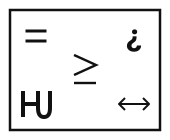
- B
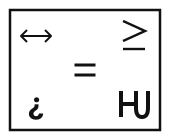
- C
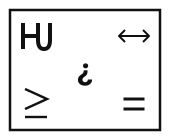
- D
Show answer
Concept: In each step, the three symbols on one diagonal (two corners and the centre) rotate; the diagonals alternate.
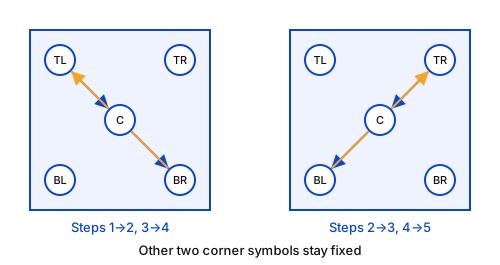
- Fig 1 → 2: on the TL–BR diagonal, TL → C → BR → TL; TR and BL stay.
- Fig 2 → 3: on the TR–BL diagonal, TR → C → BL → TR; Fig 3 → 4: TL–BR diagonal again.
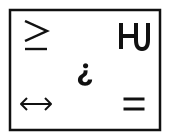
- Fig 4 → 5: TR–BL diagonal moves: TR (¿) → C, C (↔) → BL, BL (Hu) → TR; TL (≥) and BR (=) stay.
- Fig 5: ≥ TL, Hu TR, ¿ centre, ↔ BL, = BR – option (D).
Trick: Spot which two symbols stay fixed in each step; the moving three always share a diagonal.
Answer: (D)
अवधारणा: हर चरण में एक विकर्ण (दो कोने और केंद्र) के तीन चिह्न घूमते हैं; विकर्ण बारी-बारी से बदलते हैं।
- आकृति 1 → 2: TL–BR विकर्ण पर TL → C → BR → TL; TR और BL स्थिर।
- आकृति 2 → 3: TR–BL विकर्ण पर TR → C → BL → TR; 3 → 4 में फिर TL–BR।
- 4 → 5: TR (¿) → C, C (↔) → BL, BL (Hu) → TR; TL (≥) और BR (=) स्थिर।
- आकृति 5: ≥ TL, Hu TR, ¿ केंद्र, ↔ BL, = BR – विकल्प (D)।
ट्रिक: हर चरण में कौन-से दो चिह्न स्थिर हैं, पहले वह देखें।
उत्तर: (D)
SSC CPO Paper IGeneral Intelligence and ReasoningFigure SeriesSSC CPO Paper I 2024 · 27 Jun Shift 3
Q314.Which letter cluster will replace the question mark (?) to complete the given series? TDQR, SFNV, ?, QJHD, PLEH
दी गई श्रृंखला को पूरा करने के लिए कौन-सा अक्षर-समूह प्रश्न चिह्न (?) का स्थान लेगा? TDQR, SFNV, ?, QJHD, PLEH
- ARHKZ
- BRGJZ
- CFJCQ
- DIDBZ
Show answer
Concept: Treat each of the four letter positions as a separate series.
- 1st letters: T, S, ?, Q, P () → R.
- 2nd letters: D, F, ?, J, L () → H.
- 3rd letters: Q, N, ?, H, E () → K.
- 4th letters: R, V, ?, D, H (, cyclic) → Z. Missing term: RHKZ.
Trick: Column-wise reading: , , , .
Answer: (A) RHKZ
अवधारणा: चारों अक्षर-स्थानों को अलग-अलग श्रृंखला मानें।
- पहले अक्षर: T, S, ?, Q, P () → R।
- दूसरे अक्षर: D, F, ?, J, L () → H।
- तीसरे अक्षर: Q, N, ?, H, E () → K।
- चौथे अक्षर: R, V, ?, D, H (, चक्रीय) → Z। उत्तर: RHKZ।
ट्रिक: स्तंभवार पढ़ें: , , , ।
उत्तर: (A) RHKZ
SSC CPO Paper IGeneral Intelligence and ReasoningLetter SeriesSSC CPO Paper I 2024 · 27 Jun Shift 3
Q315.Which of the following numbers will replace the question mark (?) in the given series? 324, 722, 1200, ?, 2420
दी गई श्रृंखला में प्रश्न चिह्न (?) के स्थान पर निम्नलिखित में से कौन-सी संख्या आएगी? 324, 722, 1200, ?, 2420
- A1764
- B1632
- C1634
- D1736
Show answer
Concept: Each term is for
- , .
- .
- Next: .
- Check: ✓.
Trick: 324 is a perfect square () – try multipliers 1, 2, 3 with consecutive squares.
Answer: (A) 1764
अवधारणा: हर पद है, जहाँ
- , ।
- ।
- अगला: ।
- जाँच: ✓।
ट्रिक: 324 पूर्ण वर्ग () है – गुणक 1, 2, 3 और क्रमागत वर्ग आज़माएँ।
उत्तर: (A) 1764
SSC CPO Paper IGeneral Intelligence and ReasoningNumber SeriesSSC CPO Paper I 2024 · 27 Jun Shift 3
Q316.Two statements are given, followed by two conclusions numbered I and II. Assuming the statements to be true, even if they seem to be at variance with commonly known facts, decide which of the conclusions logically follow(s) from the statements.
Statements:
All wings are whites.
No whites are wands.
Conclusions:
I. Some wings are wands.
II. No wand is a white.
दो कथन दिए गए हैं, जिनके बाद I और II से संख्यांकित दो निष्कर्ष दिए गए हैं। कथनों को सत्य मानते हुए, भले ही वे सामान्यतः ज्ञात तथ्यों से भिन्न प्रतीत होते हों, निर्णय लीजिए कि कौन-सा/कौन-से निष्कर्ष तार्किक रूप से कथनों का अनुसरण करता है/करते हैं।
कथन:
सभी पंख, सफ़ेद हैं।
कोई सफ़ेद, छड़ी नहीं है।
निष्कर्ष:
I. कुछ पंख, छड़ियाँ हैं।
II. कोई छड़ी, सफ़ेद नहीं है।
- AOnly conclusion II followsकेवल निष्कर्ष II अनुसरण करता है
- BBoth conclusions I and II followनिष्कर्ष I और II दोनों अनुसरण करते हैं
- CNeither conclusion I nor II followsन तो निष्कर्ष I और न ही II अनुसरण करता है
- DOnly conclusion I followsकेवल निष्कर्ष I अनुसरण करता है
Show answer
Concept: Draw the least-overlap Venn diagram and test each conclusion.
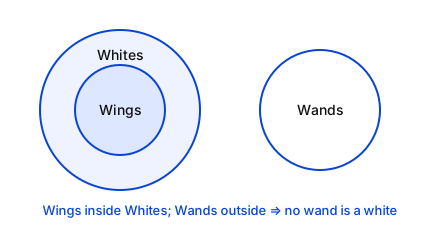
- All wings are whites: Wings circle lies inside Whites.
- No whites are wands: Wands circle is fully outside Whites, so it is outside Wings too.
- I. Some wings are wands – false (no wing can be a wand).
- II. No wand is a white – the converse of "No whites are wands", always true. Only II follows.
Trick: "No A is B" is always convertible to "No B is A".
Answer: (A) Only conclusion II follows
अवधारणा: न्यूनतम संभव Venn आरेख बनाकर हर निष्कर्ष जाँचें।
- All wings are whites: Wings वृत्त Whites के अंदर।
- No whites are wands: Wands वृत्त Whites से पूरी तरह बाहर, अतः Wings से भी बाहर।
- I. Some wings are wands – असत्य।
- II. No wand is a white – "No whites are wands" का विलोम (converse), सदैव सत्य। केवल II अनुसरण करता है।
ट्रिक: "No A is B" का विलोम "No B is A" सदैव सत्य होता है।
उत्तर: (A) केवल निष्कर्ष II अनुसरण करता है
SSC CPO Paper IGeneral Intelligence and ReasoningSyllogismSSC CPO Paper I 2024 · 27 Jun Shift 3
Q317.If ‘P’ stands for ‘÷’, ‘Q’ stands for ‘×’, ‘R’ stands for ‘+’ and ‘S’ stands for ‘−’, what will come in place of the question mark (?) in the following equation?
45 R (26 Q 2) P 4 R 19 S 32 = ?
यदि ‘P’ का अर्थ ‘÷’, ‘Q’ का अर्थ ‘×’, ‘R’ का अर्थ ‘+’ और ‘S’ का अर्थ ‘−’ है, तो निम्नलिखित समीकरण में प्रश्न चिह्न (?) के स्थान पर क्या आएगा?
45 R (26 Q 2) P 4 R 19 S 32 = ?
- A50
- B35
- C45
- D40
Show answer
Concept: Replace letters with signs and apply BODMAS.
- Expression: .
- , .
- .
Trick: Do the bracket and division first; then add/subtract left to right.
Answer: (C) 45
अवधारणा: अक्षरों की जगह चिह्न रखकर BODMAS लगाएँ।
- व्यंजक: ।
- , ।
- ।
ट्रिक: पहले कोष्ठक और भाग, फिर जोड़-घटाव।
उत्तर: (C) 45
SSC CPO Paper IGeneral Intelligence and ReasoningMathematical OperationsSSC CPO Paper I 2024 · 27 Jun Shift 3
Q318.Select the set in which the numbers are related in the same way as are the numbers of the following sets.
(NOTE: Operations should be performed on the whole numbers, without breaking
down the numbers into its constituent digits. E.g. 13 – Operations on 13 such as
adding /deleting /multiplying etc. to 13 can be performed. Breaking down 13 into 1 and 3 and then performing mathematical operations on 1 and 3 is not allowed)
(21, 3 , 15)
(49, 7, 35)
उस समुच्चय का चयन कीजिए जिसमें संख्याएँ ठीक उसी प्रकार संबंधित हैं, जिस प्रकार निम्नलिखित समुच्चयों की संख्याएँ संबंधित हैं।
(ध्यान दें: संक्रियाएँ संख्याओं को उनके घटक अंकों में विभक्त किए बिना, पूर्ण संख्याओं पर की जानी चाहिए। उदाहरण के लिए 13 – 13 पर की जाने वाली संक्रियाएँ, जैसे 13 में जोड़ना/घटाना/गुणा करना आदि की जा सकती हैं। 13 को 1 और 3 में विभक्त करना और फिर 1 और 3 पर गणितीय संक्रियाएँ करना वर्जित है।)
(21, 3 , 15)
(49, 7, 35)
- A(84, 12, 60)
- B(85, 12, 60)
- C(84, 12, 62)
- D(85, 13, 60)
Show answer
Concept: Find how the 2nd and 3rd numbers come from the 1st.
- and .
- and .
- Option (A): and ✓.
- (B) 85 is not divisible by 7; (C) ; (D) .
Trick: Third number of the first: , , .
Answer: (A) (84, 12, 60)
अवधारणा: दूसरी और तीसरी संख्या पहली से कैसे बनती है, खोजें।
- और ।
- और ।
- विकल्प (A): और ✓।
- (B) 85, 7 से विभाज्य नहीं; (C) ; (D) ।
ट्रिक: तीसरी संख्या = पहली का ।
उत्तर: (A) (84, 12, 60)
SSC CPO Paper IGeneral Intelligence and ReasoningNumber Set AnalogySSC CPO Paper I 2024 · 27 Jun Shift 3
Q319.Select the Venn diagram that best illustrates the relationship between the following classes.
Humans, Painters, Men
उस वेन आरेख का चयन कीजिए जो निम्नलिखित वर्गों के बीच के संबंध को सर्वोत्तम रूप से दर्शाता है।
मनुष्य, चित्रकार, पुरुष
- A

- B

- C
- D

Show answer
Concept: Show the bigger class as the outer circle and check whether the smaller classes overlap.
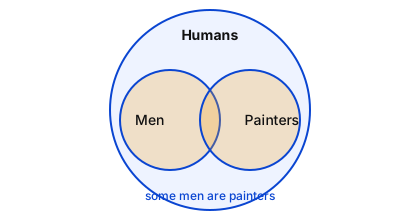
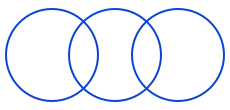
- All men are humans and all painters are humans – both lie inside Humans.
- Some men are painters (and some painters are women), so Men and Painters overlap.
- So: one big circle containing two intersecting circles – option (D).
Yaad rakhein: Two sub-groups that can share members → two overlapping circles inside the big one.
Answer: (D)
अवधारणा: बड़े वर्ग को बाहरी वृत्त बनाएँ और देखें कि छोटे वर्ग आपस में मिलते हैं या नहीं।
- सभी Men और सभी Painters, Humans हैं – दोनों Humans के अंदर।
- कुछ पुरुष चित्रकार हैं (और कुछ चित्रकार महिलाएँ), अतः Men और Painters परस्पर काटते हैं।
- अतः एक बड़े वृत्त के अंदर दो प्रतिच्छेदी वृत्त – विकल्प (D)।
याद रखें: साझा सदस्य वाले दो उपवर्ग → बड़े वृत्त के अंदर दो कटते वृत्त।
उत्तर: (D)
SSC CPO Paper IGeneral Intelligence and ReasoningVenn DiagramSSC CPO Paper I 2024 · 27 Jun Shift 3
Q320.In a certain code language,
‘A+ B’ means ‘A is the mother of B’
‘A – B’ means ‘A is the husband of B’
‘A x B’ means ‘B is the sister of A’
‘A ÷ B’ means ‘A is the father of B’
Based on the above, how is B related to E if ‘D ÷ E – C + A x B ’?
एक निश्चित कूट भाषा में,
‘A+ B’ का अर्थ है ‘A, B की माता है’
‘A – B’ का अर्थ है ‘A, B का पति है’
‘A x B’ का अर्थ है ‘B, A की बहन है’
‘A ÷ B’ का अर्थ है ‘A, B का पिता है’
उपर्युक्त के आधार पर, यदि ‘D ÷ E – C + A x B ’ है, तो B का E से क्या संबंध है?
- AWifeपत्नी
- BSonपुत्र
- CMotherमाता
- DDaughterपुत्री
Show answer
Concept: Decode the expression one symbol at a time and build the family tree.
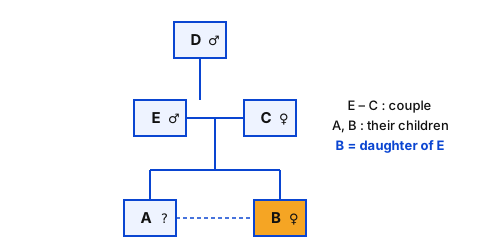
- D ÷ E: D is the father of E.
- E – C: E is the husband of C.
- C + A: C is the mother of A, so A is a child of E and C.
- A × B: B is the sister of A, so B is a female child of E – B is the daughter of E.
Trick: A sister of E's child is E's daughter (female + same parents).
Answer: (D) Daughter
अवधारणा: हर चिह्न को क्रम से डिकोड कर परिवार वृक्ष बनाएँ।
- D ÷ E: D, E का पिता है।
- E – C: E, C का पति है।
- C + A: C, A की माता है, अतः A, E और C की संतान है।
- A × B: B, A की बहन है, अतः B, E की बेटी (Daughter) है।
ट्रिक: E की संतान की बहन = E की बेटी।
उत्तर: (D) Daughter (बेटी)
SSC CPO Paper IGeneral Intelligence and ReasoningCoded Blood RelationSSC CPO Paper I 2024 · 27 Jun Shift 3

