Q6181.Fill in the blank with the most appropriate word.
______ of living life on his own terms, he made few compromises.
- ADesirous
- BDesire
- CDesired
- DDesiring
Show answer
Concept: An adjective phrase can open a sentence to describe the subject: desirous of + -ing = wishing to.
- “Desirous of living life on his own terms, he made few compromises.” – ‘desirous’ describes ‘he’.
- The fixed pattern is ‘desirous of’; ‘Desiring’ takes a direct object (desiring to live), not ‘of’.
- ‘Desire’ (noun/verb) and ‘Desired’ (past) do not fit the structure.
Yaad rakhein: Desirous of, fond of, capable of – adjective + of.
Answer: (A) Desirous
अवधारणा: वाक्य की शुरुआत में विशेषण-वाक्यांश subject का वर्णन कर सकता है: desirous of + -ing = की इच्छा रखने वाला।
- “Desirous of living life on his own terms, he made few compromises.” – ‘desirous’ ‘he’ का वर्णन करता है।
- मानक प्रयोग ‘desirous of’ है; ‘Desiring’ के साथ ‘of’ नहीं, सीधा object आता है।
- ‘Desire’ और ‘Desired’ इस संरचना में नहीं बैठते।
याद रखें: Desirous of, fond of, capable of – adjective + of।
उत्तर: (A) Desirous
SSC CPO Paper IEnglish ComprehensionFill in the BlanksSSC CPO Paper I 2020 · 24 Nov Shift 1
Q6182.Select the most appropriate ANTONYM of the given word.
DISTRACT
- Adivert
- Bbeguile
- Cperplex
- Dclarify
Show answer
Concept: Distract = to divert attention; to confuse or bewilder.
- The opposite of confusing someone is making things clear – clarify.
- ‘divert’, ‘beguile’ and ‘perplex’ are all similar to distract – synonyms.
Yaad rakhein: Distract (dhyaan bhatkana) ↔ Clarify / Focus.
Answer: (D) clarify
अवधारणा: Distract = ध्यान भटकाना; उलझन में डालना।
- उलझाने का विलोम है स्पष्ट करना – clarify।
- ‘divert’, ‘beguile’, ‘perplex’ – सभी distract के समान अर्थ वाले हैं।
याद रखें: Distract (ध्यान भटकाना) ↔ Clarify (स्पष्ट करना)।
उत्तर: (D) clarify
SSC CPO Paper IEnglish ComprehensionAntonymsSSC CPO Paper I 2020 · 24 Nov Shift 1
Q6183.Select the most appropriate synonym of the given word.
GAUDY
- Aplain
- Bproper
- Cflashy
- Dsimple
Show answer
Concept: Gaudy = extravagantly bright or showy, often tasteless.
- Flashy = showy, ostentatious – same meaning.
- ‘plain’ and ‘simple’ are opposites; ‘proper’ is unrelated.
Yaad rakhein: Gaudy = Flashy = Garish = Showy (bhadkila).
Answer: (C) flashy
अवधारणा: Gaudy = भड़कीला, दिखावटी।
- Flashy = चमक-दमक वाला, दिखावटी – समान अर्थ।
- ‘plain’, ‘simple’ विलोम हैं; ‘proper’ असंबंधित।
याद रखें: Gaudy = Flashy = Garish (भड़कीला)।
उत्तर: (C) flashy
SSC CPO Paper IEnglish ComprehensionSynonymsSSC CPO Paper I 2020 · 24 Nov Shift 1
Q6184.Select the most appropriate option to substitute the underlined segment in the given sentence. If there is no need to substitute it, select ‘No substitution required’
Have either of you been to the planetarium before?
- AHave everyone
- BNo substitution required
- CHas both
- DHas either
Show answer
Concept: Either (and ‘either of’) is singular and takes a singular verb.
- ‘Have either of you…’ uses plural ‘have’ – wrong.
- Correct: “Has either of you been to the planetarium before?”
- ‘Has both’ (both is plural) and ‘Have everyone’ (everyone is singular) are wrong agreements.
Yaad rakhein: Either, neither, each, everyone + singular verb.
Answer: (D) Has either
अवधारणा: Either (और ‘either of’) एकवचन है, अतः एकवचन verb लेता है।
- ‘Have either of you…’ में बहुवचन ‘have’ है – गलत।
- सही: “Has either of you been to the planetarium before?”
- ‘Has both’ (both बहुवचन) और ‘Have everyone’ (everyone एकवचन) में agreement गलत है।
याद रखें: Either, neither, each, everyone + एकवचन verb।
उत्तर: (D) Has either
SSC CPO Paper IEnglish ComprehensionSentence ImprovementSSC CPO Paper I 2020 · 24 Nov Shift 1
Q6185.Select the most appropriate one-word substitution for the given group of words.
The dates when days and nights are of equal length
- Asolstice
- Beclipse
- Cequinox
- Dstellar
Show answer
Concept: The two dates in a year when day and night are nearly equal are the equinoxes (about 21 March and 23 September).
- equinox: ‘equi’ (equal) + ‘nox’ (night).
- ‘solstice’ = longest or shortest day (21 June, 22 December); ‘eclipse’ = one body hiding another; ‘stellar’ = related to stars.
Yaad rakhein: Equinox = equal night; Solstice = sun ‘stands still’ (longest/shortest day).
Answer: (C) equinox
अवधारणा: वर्ष की वे तिथियाँ जब दिन-रात लगभग बराबर होते हैं = equinox (विषुव) – लगभग 21 मार्च व 23 सितंबर।
- equinox: ‘equi’ (बराबर) + ‘nox’ (रात)।
- ‘solstice’ = सबसे लंबा/छोटा दिन (21 जून, 22 दिसंबर); ‘eclipse’ = ग्रहण; ‘stellar’ = तारों से संबंधित।
याद रखें: Equinox = बराबर रात (विषुव); Solstice = संक्रांति।
उत्तर: (C) equinox
SSC CPO Paper IEnglish ComprehensionOne Word SubstitutionSSC CPO Paper I 2020 · 24 Nov Shift 1
Q6186.Select the most appropriate ANTONYM of the given word.
MENACE
- Abalance
- Bthreat
- Ccomfort
- Dperil
Show answer
Concept: Menace = a threat or danger.
- Its opposite is a state of safety and ease – comfort.
- ‘threat’ and ‘peril’ are synonyms; ‘balance’ is unrelated.
Yaad rakhein: Menace (khatra) ↔ Comfort / Safety.
Answer: (C) comfort
अवधारणा: Menace = ख़तरा, धमकी।
- इसका विलोम सुरक्षा व आराम की स्थिति – comfort।
- ‘threat’, ‘peril’ पर्यायवाची हैं; ‘balance’ असंबंधित।
याद रखें: Menace (ख़तरा) ↔ Comfort (आराम/सुरक्षा)।
उत्तर: (C) comfort
SSC CPO Paper IEnglish ComprehensionAntonymsSSC CPO Paper I 2020 · 24 Nov Shift 1
Q6187.Select the most appropriate synonym of the given word.
FASTEN
- Aallow
- Bhurry
- Caffix
- Dhalt
Show answer
Concept: Fasten = to fix or attach firmly.
- Affix = to stick or attach – same meaning.
- ‘hurry’ is the trap (‘fast’ = quick), but fasten has nothing to do with speed; ‘allow’, ‘halt’ are unrelated.
Yaad rakhein: Fasten your seat belt = attach it firmly → affix.
Answer: (C) affix
अवधारणा: Fasten = कसकर बाँधना, जोड़ना।
- Affix = चिपकाना, जोड़ना – समान अर्थ।
- ‘hurry’ जाल है (‘fast’ = तेज़), पर fasten का गति से संबंध नहीं; ‘allow’, ‘halt’ असंबंधित।
याद रखें: Fasten your seat belt = बेल्ट बाँधो → affix।
उत्तर: (C) affix
SSC CPO Paper IEnglish ComprehensionSynonymsSSC CPO Paper I 2020 · 24 Nov Shift 1
Q6188.Identify the segment in the sentence which contains a grammatical error.
One of the proposals received by us seem very interesting.
- Athe proposals
- Breceived by us
- COne of
- Dseem very interesting
Show answer
Concept: In ‘One of + plural noun’, the subject is ‘One’, so the verb is singular.
- Subject = ‘One (of the proposals)’ → singular.
- ‘seem’ must be seems: “One of the proposals received by us seems very interesting.”
- ‘the proposals’ (plural after ‘one of’) is correct.
Yaad rakhein: One of + plural noun + singular verb.
Answer: (D) seem very interesting
अवधारणा: ‘One of + बहुवचन संज्ञा’ में subject ‘One’ होता है, अतः verb एकवचन।
- Subject = ‘One (of the proposals)’ → एकवचन।
- ‘seem’ की जगह seems: “One of the proposals received by us seems very interesting.”
- ‘one of’ के बाद ‘the proposals’ (बहुवचन) सही है।
याद रखें: One of + बहुवचन संज्ञा + एकवचन verb।
उत्तर: (D) seem very interesting
SSC CPO Paper IEnglish ComprehensionError SpottingSSC CPO Paper I 2020 · 24 Nov Shift 1
Q6189.Select the most appropriate meaning of the given idiom.
Rise to the occasion
- Achallenge an opponent who is strong
- Bshow you can deal with a situation successfully
- Ctake a big risk in order to succeed
- Dassess a critical situation carefully
Show answer
Concept: Rise to the occasion = to perform well and handle a difficult or unexpected situation successfully.
- E.g. “The young captain rose to the occasion in the final.”
- So the meaning is show you can deal with a situation successfully.
- The other options (challenge an opponent, take a risk, assess carefully) are not the meaning.
Yaad rakhein: Rise to the occasion = mauke par khara utarna.
Answer: (B) show you can deal with a situation successfully
अवधारणा: Rise to the occasion = कठिन परिस्थिति में सफलतापूर्वक काम करके दिखाना; मौके पर खरा उतरना।
- उदाहरण: “The young captain rose to the occasion in the final.”
- अतः अर्थ है show you can deal with a situation successfully।
- अन्य विकल्प (मज़बूत विरोधी को चुनौती, जोखिम लेना, सावधानी से आकलन) इसका अर्थ नहीं।
याद रखें: Rise to the occasion = मौके पर खरा उतरना।
उत्तर: (B) show you can deal with a situation successfully
SSC CPO Paper IEnglish ComprehensionIdioms and PhrasesSSC CPO Paper I 2020 · 24 Nov Shift 1
Q6190.Select the most appropriate option to substitute the underlined segment in the given sentence. If there is no need to substitute it, select ‘No substitution required’.
A large swarm of dogs was blocking the way.
- Aschool of
- Bpack of
- Cherd of
- DNo substitution required
Show answer
Concept: Collective nouns are fixed: a pack of dogs / wolves.
- “A large pack of dogs was blocking the way.”
- ‘swarm’ is for insects (bees), ‘school’ for fish, ‘herd’ for cattle/elephants.
Yaad rakhein: Pack – dogs, wolves; Swarm – bees; School – fish; Herd – cattle.
Answer: (B) pack of
अवधारणा: समूहवाचक संज्ञाएँ निश्चित होती हैं: a pack of dogs / wolves।
- “A large pack of dogs was blocking the way.”
- ‘swarm’ कीटों (मधुमक्खी) के लिए, ‘school’ मछलियों के लिए, ‘herd’ मवेशियों/हाथियों के लिए।
याद रखें: Pack – कुत्ते, भेड़िये; Swarm – मधुमक्खी; School – मछली; Herd – मवेशी।
उत्तर: (B) pack of
SSC CPO Paper IEnglish ComprehensionSentence ImprovementSSC CPO Paper I 2020 · 24 Nov Shift 1
Q6191.Select the misspelt word.
- Apursue
- Btyrrany
- Cvicious
- Dresistance
Show answer
Concept: The correct spelling is tyranny – single ‘r’, double ‘n’.
- tyrant → ty-r-a-nn-y.
- ‘tyrrany’ doubles the ‘r’ and has a single ‘n’ – misspelt.
- ‘pursue’, ‘vicious’ and ‘resistance’ are correct.
Yaad rakhein: tyrant + ny = tyranny (one r, two n).
Answer: (B) tyrrany
अवधारणा: सही वर्तनी tyranny है – एक ‘r’, दो ‘n’।
- tyrant → ty-r-a-nn-y।
- ‘tyrrany’ में ‘r’ दो बार और ‘n’ एक बार है – गलत।
- ‘pursue’, ‘vicious’, ‘resistance’ सही हैं।
याद रखें: tyranny = एक r, दो n।
उत्तर: (B) tyrrany
SSC CPO Paper IEnglish ComprehensionSpellingSSC CPO Paper I 2020 · 24 Nov Shift 1
Q6192.Select the most appropriate synonym of the given word.
DESPISE
- Aapprove
- Babhor
- Cadmire
- Dadore
Show answer
Concept: Despise = to feel contempt or deep dislike for.
- Abhor = to hate intensely – same meaning.
- ‘approve’, ‘admire’ and ‘adore’ express liking – opposites.
Yaad rakhein: Despise = Abhor = Loathe = Detest (ghrina karna).
Answer: (B) abhor
अवधारणा: Despise = घृणा करना, तिरस्कार करना।
- Abhor = अत्यधिक घृणा करना – समान अर्थ।
- ‘approve’, ‘admire’, ‘adore’ पसंद दर्शाते हैं – विलोम।
याद रखें: Despise = Abhor = Loathe (घृणा करना)।
उत्तर: (B) abhor
SSC CPO Paper IEnglish ComprehensionSynonymsSSC CPO Paper I 2020 · 24 Nov Shift 1
Q6193.Select the most appropriate meaning of the given idiom.
Kith and kin
- Acolleagues
- Bneighbours
- Cfamily relations
- Ddistant enemies
Show answer
Concept: Kith and kin = friends and relatives; one’s own family and people.
- ‘kin’ means blood relatives, ‘kith’ means friends/acquaintances.
- Of the options, the phrase’s meaning is best given by family relations.
- ‘colleagues’, ‘neighbours’ and ‘distant enemies’ do not fit.
Yaad rakhein: Kith and kin = sage-sambandhi (friends and relatives).
Answer: (C) family relations
अवधारणा: Kith and kin = मित्र और सगे-संबंधी; अपने लोग।
- ‘kin’ = रक्त-संबंधी, ‘kith’ = मित्र/परिचित।
- विकल्पों में सबसे उपयुक्त अर्थ family relations है।
- ‘colleagues’, ‘neighbours’, ‘distant enemies’ मेल नहीं खाते।
याद रखें: Kith and kin = सगे-संबंधी।
उत्तर: (C) family relations
SSC CPO Paper IEnglish ComprehensionIdioms and PhrasesSSC CPO Paper I 2020 · 24 Nov Shift 1
Q6194.Select the most appropriate option to substitute the underlined segment in the given sentence. If there is no need to substitute it, select ‘No substitution required’.
The mare hurt its hooves when running to the forest.
- Awith running across
- Bwhile running through
- CNo substitution required
- Dwhen running into
Show answer
Concept: For an action happening at the same time as another, use while + -ing; for movement inside an area like a forest, use through.
- ‘running to the forest’ means on the way towards it, but the hooves were hurt in the forest terrain.
- Correct: “The mare hurt its hooves while running through the forest.”
- ‘with running across’ is unidiomatic; ‘running into’ means entering/colliding.
Yaad rakhein: Through = from one side to the other inside (through the forest, through the tunnel).
Answer: (B) while running through
अवधारणा: एक साथ चल रही क्रिया के लिए while + -ing; जंगल जैसे क्षेत्र के भीतर से गति के लिए through।
- ‘running to the forest’ = जंगल की ओर जाना, पर खुर जंगल के रास्ते में घायल हुए।
- सही: “The mare hurt its hooves while running through the forest.”
- ‘with running across’ अस्वाभाविक है; ‘running into’ = अंदर घुसना/टकराना।
याद रखें: Through = भीतर से होकर (through the forest)।
उत्तर: (B) while running through
SSC CPO Paper IEnglish ComprehensionSentence ImprovementSSC CPO Paper I 2020 · 24 Nov Shift 1
Q6195.Select the most appropriate one-word substitution for the given group of words.
A large bedroom for a number of people in an institution
- Aauditorium
- Bapartment
- Cdormitory
- Dchamber
Show answer
Concept: A large room with many beds, as in a hostel or school, is a dormitory.
- dormitory: Latin ‘dormire’ = to sleep.
- ‘auditorium’ = hall for an audience; ‘apartment’ = a flat; ‘chamber’ = a room in general.
Yaad rakhein: Dorm = sleep (dormant, dormitory).
Answer: (C) dormitory
अवधारणा: किसी संस्था (हॉस्टल, स्कूल) में अनेक लोगों के सोने का बड़ा कमरा = dormitory (शयनागार)।
- dormitory: Latin ‘dormire’ = सोना।
- ‘auditorium’ = सभागार; ‘apartment’ = फ्लैट; ‘chamber’ = कक्ष (सामान्य)।
याद रखें: Dorm = नींद (dormant, dormitory)।
उत्तर: (C) dormitory
SSC CPO Paper IEnglish ComprehensionOne Word SubstitutionSSC CPO Paper I 2020 · 24 Nov Shift 1
Read the passage and answer the questions that follow.
Greek religious traditions encompassed a large pantheon of gods, complex mythologies,
rituals and cult practices. Greece was a polytheistic society, and looked to its gods and
mythology to explain natural mysteries as well as current events. Religious festivals and
ceremonies were held throughout the year, and animal sacrifice and votive offerings were popular ways to appease and worship the gods. Religious life, rituals and practices were one of the unifying aspects of Greece across regions and poleis (cities, or city-states, such as Athens and Sparta).
Greek gods were immortal beings who possessed human-like qualities and were represented as completely human in visual art. They were moral and immoral, petty and just, and often vain. The gods were invoked to intervene and assist in all matters large, small, private and public.
City-states claimed individual gods and goddesses as their patrons. Temples and sanctuaries to the gods were built in every city. Many cities became cult sites due to their connection with a god or goddess and specific myths. For instance, the city of Delphi was known for its oracle and sanctuary of Apollo, because Apollo was believed to have killed a dragon that inhabited Delphi.
The history of the Greek pantheon begins with the primordial deities Gaia (Mother Earth) and Uranus (Father Sky), who were the parents of the first of twelve giants known as Titans.
Among these Titans were six males and six females. The males were named Oceanus,
Hyperion, Coeus, Crius, Iapetus, and Kronos. The females were named Themis, Mnemosyne, Tethys, Theia, Phoebe, and Rhea.
Kronos eventually overthrew Uranus and ruled during a mythological Golden Age. Over time, he and Rhea had twelve children who would become the Olympian gods. However, Kronos heard a prophecy that his son would overthrow him, as he did to Uranus. In an effort to avert fate, he ordered Rhea to allow him to devour each of the children upon their birth.
Best known among the pantheon are the twelve Olympian gods and goddesses who resided on Mt. Olympus in northern Greece. Zeus, the youngest son of Rhea and Kronos, was hidden from his father, instead of being swallowed. Once he became a man, he challenged his
father’s rule, forcing Kronos to regurgitate the rest of his swallowed children. These children were Zeus’s siblings, and together they overthrew Kronos, making Zeus the father of gods and men.
Q6196.Animal sacrifices were made to Gods to:
- Aunderstand nature’s mysteries
- Bpacify and worship them
- Cknow about future events
- Denrage and challenge them
Show answer
Concept: Find the line about sacrifice in paragraph 1.
- The passage: “animal sacrifice and votive offerings were popular ways to appease and worship the gods.”
- ‘appease’ = pacify, so the answer is pacify and worship them.
- Understanding nature’s mysteries is why they looked to mythology, not why they sacrificed.
Yaad rakhein: Appease = pacify = calm/please someone.
Answer: (B) pacify and worship them
अवधारणा: पहले अनुच्छेद में बलि वाली पंक्ति देखें।
- गद्यांश: “animal sacrifice and votive offerings were popular ways to appease and worship the gods.”
- ‘appease’ = pacify (प्रसन्न/शांत करना), अतः उत्तर pacify and worship them।
- प्रकृति के रहस्य समझने के लिए वे पौराणिक कथाओं को देखते थे, बलि का कारण यह नहीं था।
याद रखें: Appease = pacify = शांत/प्रसन्न करना।
उत्तर: (B) pacify and worship them
SSC CPO Paper IEnglish ComprehensionReading ComprehensionSSC CPO Paper I 2020 · 24 Nov Shift 1
Read the passage and answer the questions that follow.
Greek religious traditions encompassed a large pantheon of gods, complex mythologies,
rituals and cult practices. Greece was a polytheistic society, and looked to its gods and
mythology to explain natural mysteries as well as current events. Religious festivals and
ceremonies were held throughout the year, and animal sacrifice and votive offerings were popular ways to appease and worship the gods. Religious life, rituals and practices were one of the unifying aspects of Greece across regions and poleis (cities, or city-states, such as Athens and Sparta).
Greek gods were immortal beings who possessed human-like qualities and were represented as completely human in visual art. They were moral and immoral, petty and just, and often vain. The gods were invoked to intervene and assist in all matters large, small, private and public.
City-states claimed individual gods and goddesses as their patrons. Temples and sanctuaries to the gods were built in every city. Many cities became cult sites due to their connection with a god or goddess and specific myths. For instance, the city of Delphi was known for its oracle and sanctuary of Apollo, because Apollo was believed to have killed a dragon that inhabited Delphi.
The history of the Greek pantheon begins with the primordial deities Gaia (Mother Earth) and Uranus (Father Sky), who were the parents of the first of twelve giants known as Titans.
Among these Titans were six males and six females. The males were named Oceanus,
Hyperion, Coeus, Crius, Iapetus, and Kronos. The females were named Themis, Mnemosyne, Tethys, Theia, Phoebe, and Rhea.
Kronos eventually overthrew Uranus and ruled during a mythological Golden Age. Over time, he and Rhea had twelve children who would become the Olympian gods. However, Kronos heard a prophecy that his son would overthrow him, as he did to Uranus. In an effort to avert fate, he ordered Rhea to allow him to devour each of the children upon their birth.
Best known among the pantheon are the twelve Olympian gods and goddesses who resided on Mt. Olympus in northern Greece. Zeus, the youngest son of Rhea and Kronos, was hidden from his father, instead of being swallowed. Once he became a man, he challenged his
father’s rule, forcing Kronos to regurgitate the rest of his swallowed children. These children were Zeus’s siblings, and together they overthrew Kronos, making Zeus the father of gods and men.
Q6197.Kronos devoured his children at birth because:
- Ahis son was predicted to overthrow him
- Bhe did not have faith in his wife
- Che was a titan who hated children
- Dit was a cult practice to please the gods
Show answer
Concept: Look at the paragraph on Kronos and the prophecy.
- “Kronos heard a prophecy that his son would overthrow him, as he did to Uranus.”
- “In an effort to avert fate, he ordered Rhea to allow him to devour each of the children.”
- So he devoured them because his son was predicted to overthrow him.
Yaad rakhein: Prophecy = prediction → fear of being overthrown → devouring children.
Answer: (A) his son was predicted to overthrow him
अवधारणा: Kronos और भविष्यवाणी वाला अनुच्छेद देखें।
- “Kronos heard a prophecy that his son would overthrow him, as he did to Uranus.”
- “In an effort to avert fate, he ordered Rhea to allow him to devour each of the children.”
- अतः उसने बच्चों को निगला क्योंकि his son was predicted to overthrow him।
याद रखें: Prophecy = भविष्यवाणी → सत्ता छिनने का डर → बच्चों को निगलना।
उत्तर: (A) his son was predicted to overthrow him
SSC CPO Paper IEnglish ComprehensionReading ComprehensionSSC CPO Paper I 2020 · 24 Nov Shift 1
Read the passage and answer the questions that follow.
Greek religious traditions encompassed a large pantheon of gods, complex mythologies,
rituals and cult practices. Greece was a polytheistic society, and looked to its gods and
mythology to explain natural mysteries as well as current events. Religious festivals and
ceremonies were held throughout the year, and animal sacrifice and votive offerings were popular ways to appease and worship the gods. Religious life, rituals and practices were one of the unifying aspects of Greece across regions and poleis (cities, or city-states, such as Athens and Sparta).
Greek gods were immortal beings who possessed human-like qualities and were represented as completely human in visual art. They were moral and immoral, petty and just, and often vain. The gods were invoked to intervene and assist in all matters large, small, private and public.
City-states claimed individual gods and goddesses as their patrons. Temples and sanctuaries to the gods were built in every city. Many cities became cult sites due to their connection with a god or goddess and specific myths. For instance, the city of Delphi was known for its oracle and sanctuary of Apollo, because Apollo was believed to have killed a dragon that inhabited Delphi.
The history of the Greek pantheon begins with the primordial deities Gaia (Mother Earth) and Uranus (Father Sky), who were the parents of the first of twelve giants known as Titans.
Among these Titans were six males and six females. The males were named Oceanus,
Hyperion, Coeus, Crius, Iapetus, and Kronos. The females were named Themis, Mnemosyne, Tethys, Theia, Phoebe, and Rhea.
Kronos eventually overthrew Uranus and ruled during a mythological Golden Age. Over time, he and Rhea had twelve children who would become the Olympian gods. However, Kronos heard a prophecy that his son would overthrow him, as he did to Uranus. In an effort to avert fate, he ordered Rhea to allow him to devour each of the children upon their birth.
Best known among the pantheon are the twelve Olympian gods and goddesses who resided on Mt. Olympus in northern Greece. Zeus, the youngest son of Rhea and Kronos, was hidden from his father, instead of being swallowed. Once he became a man, he challenged his
father’s rule, forcing Kronos to regurgitate the rest of his swallowed children. These children were Zeus’s siblings, and together they overthrew Kronos, making Zeus the father of gods and men.
Q6198.The twelve Olympian Gods and Goddesses were the children of:
- AGaia and Uranus
- BKronos and Rhea
- CHyperion and Theia
- DZeus and Phoebe
Show answer
Concept: Trace the family line given in the passage.
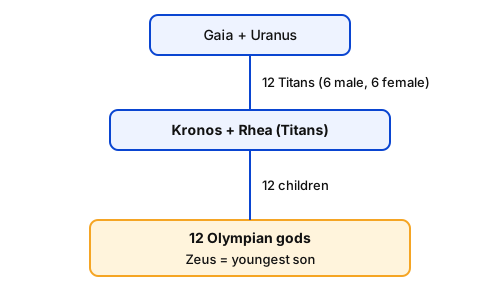
- Gaia and Uranus were the parents of the twelve Titans, including Kronos and Rhea.
- “He (Kronos) and Rhea had twelve children who would become the Olympian gods.”
- So the Olympians were children of Kronos and Rhea; Zeus was one of them, not their parent.
Yaad rakhein: Gaia + Uranus → Titans; Kronos + Rhea → Olympians (Zeus youngest).
Answer: (B) Kronos and Rhea
अवधारणा: गद्यांश में दी गई वंश-परंपरा देखें।
- Gaia और Uranus बारह Titans के माता-पिता थे, जिनमें Kronos और Rhea भी थे।
- “He (Kronos) and Rhea had twelve children who would become the Olympian gods.”
- अतः Olympian देवता Kronos और Rhea की संतान थे; Zeus उनमें से एक था, माता-पिता नहीं।
याद रखें: Gaia + Uranus → Titans; Kronos + Rhea → Olympians (Zeus सबसे छोटा)।
उत्तर: (B) Kronos and Rhea
SSC CPO Paper IEnglish ComprehensionReading ComprehensionSSC CPO Paper I 2020 · 24 Nov Shift 1
Read the passage and answer the questions that follow.
Greek religious traditions encompassed a large pantheon of gods, complex mythologies,
rituals and cult practices. Greece was a polytheistic society, and looked to its gods and
mythology to explain natural mysteries as well as current events. Religious festivals and
ceremonies were held throughout the year, and animal sacrifice and votive offerings were popular ways to appease and worship the gods. Religious life, rituals and practices were one of the unifying aspects of Greece across regions and poleis (cities, or city-states, such as Athens and Sparta).
Greek gods were immortal beings who possessed human-like qualities and were represented as completely human in visual art. They were moral and immoral, petty and just, and often vain. The gods were invoked to intervene and assist in all matters large, small, private and public.
City-states claimed individual gods and goddesses as their patrons. Temples and sanctuaries to the gods were built in every city. Many cities became cult sites due to their connection with a god or goddess and specific myths. For instance, the city of Delphi was known for its oracle and sanctuary of Apollo, because Apollo was believed to have killed a dragon that inhabited Delphi.
The history of the Greek pantheon begins with the primordial deities Gaia (Mother Earth) and Uranus (Father Sky), who were the parents of the first of twelve giants known as Titans.
Among these Titans were six males and six females. The males were named Oceanus,
Hyperion, Coeus, Crius, Iapetus, and Kronos. The females were named Themis, Mnemosyne, Tethys, Theia, Phoebe, and Rhea.
Kronos eventually overthrew Uranus and ruled during a mythological Golden Age. Over time, he and Rhea had twelve children who would become the Olympian gods. However, Kronos heard a prophecy that his son would overthrow him, as he did to Uranus. In an effort to avert fate, he ordered Rhea to allow him to devour each of the children upon their birth.
Best known among the pantheon are the twelve Olympian gods and goddesses who resided on Mt. Olympus in northern Greece. Zeus, the youngest son of Rhea and Kronos, was hidden from his father, instead of being swallowed. Once he became a man, he challenged his
father’s rule, forcing Kronos to regurgitate the rest of his swallowed children. These children were Zeus’s siblings, and together they overthrew Kronos, making Zeus the father of gods and men.
Q6199.How did Zeus bring back his siblings?
- Aby challenging and slaying Crius
- Bby reviving them with an elixir
- Cby making Kronos vomit the swallowed children
- Dby worshipping the sanctuary of Apollo
Show answer
Concept: See the last paragraph about Zeus.
- Zeus, hidden from his father, grew up and “challenged his father’s rule, forcing Kronos to regurgitate the rest of his swallowed children”.
- ‘regurgitate’ = bring swallowed food back up = vomit.
- So he brought them back by making Kronos vomit the swallowed children.
Yaad rakhein: Regurgitate = vomit / bring back up.
Answer: (C) by making Kronos vomit the swallowed children
अवधारणा: Zeus के बारे में अंतिम अनुच्छेद देखें।
- Zeus बड़ा होकर “challenged his father’s rule, forcing Kronos to regurgitate the rest of his swallowed children”।
- ‘regurgitate’ = निगली हुई चीज़ को बाहर उगलना = vomit।
- अतः उसने भाई-बहनों को Kronos से उल्टी करवाकर (vomit) वापस लाया।
याद रखें: Regurgitate = उगलना / उल्टी करना।
उत्तर: (C) by making Kronos vomit the swallowed children
SSC CPO Paper IEnglish ComprehensionReading ComprehensionSSC CPO Paper I 2020 · 24 Nov Shift 1
Read the passage and answer the questions that follow.
Greek religious traditions encompassed a large pantheon of gods, complex mythologies,
rituals and cult practices. Greece was a polytheistic society, and looked to its gods and
mythology to explain natural mysteries as well as current events. Religious festivals and
ceremonies were held throughout the year, and animal sacrifice and votive offerings were popular ways to appease and worship the gods. Religious life, rituals and practices were one of the unifying aspects of Greece across regions and poleis (cities, or city-states, such as Athens and Sparta).
Greek gods were immortal beings who possessed human-like qualities and were represented as completely human in visual art. They were moral and immoral, petty and just, and often vain. The gods were invoked to intervene and assist in all matters large, small, private and public.
City-states claimed individual gods and goddesses as their patrons. Temples and sanctuaries to the gods were built in every city. Many cities became cult sites due to their connection with a god or goddess and specific myths. For instance, the city of Delphi was known for its oracle and sanctuary of Apollo, because Apollo was believed to have killed a dragon that inhabited Delphi.
The history of the Greek pantheon begins with the primordial deities Gaia (Mother Earth) and Uranus (Father Sky), who were the parents of the first of twelve giants known as Titans.
Among these Titans were six males and six females. The males were named Oceanus,
Hyperion, Coeus, Crius, Iapetus, and Kronos. The females were named Themis, Mnemosyne, Tethys, Theia, Phoebe, and Rhea.
Kronos eventually overthrew Uranus and ruled during a mythological Golden Age. Over time, he and Rhea had twelve children who would become the Olympian gods. However, Kronos heard a prophecy that his son would overthrow him, as he did to Uranus. In an effort to avert fate, he ordered Rhea to allow him to devour each of the children upon their birth.
Best known among the pantheon are the twelve Olympian gods and goddesses who resided on Mt. Olympus in northern Greece. Zeus, the youngest son of Rhea and Kronos, was hidden from his father, instead of being swallowed. Once he became a man, he challenged his
father’s rule, forcing Kronos to regurgitate the rest of his swallowed children. These children were Zeus’s siblings, and together they overthrew Kronos, making Zeus the father of gods and men.
Q6200.Which of the following statements about Greek Gods is NOT true?
- AGreek Gods were mortals.
- BThey possessed human qualities.
- CSome of them were immoral, petty and vain.
- DThey were invoked to aid in all matters.
Show answer
Concept: Check each statement against paragraph 2.
- The passage says “Greek gods were immortal beings” – so ‘Greek Gods were mortals’ is NOT true.
- They “possessed human-like qualities”, were “moral and immoral, petty and just, and often vain”, and “were invoked to intervene and assist in all matters” – options (B), (C), (D) are true.
Yaad rakhein: Immortal = never dies; Mortal = must die.
Answer: (A) Greek Gods were mortals.
अवधारणा: हर कथन को दूसरे अनुच्छेद से मिलाएँ।
- गद्यांश: “Greek gods were immortal beings” – अतः ‘Greek Gods were mortals’ सत्य नहीं है।
- वे “possessed human-like qualities”, “moral and immoral, petty and just, and often vain” थे और “invoked … in all matters” – विकल्प (B), (C), (D) सत्य हैं।
याद रखें: Immortal = अमर; Mortal = नश्वर।
उत्तर: (A) Greek Gods were mortals.
SSC CPO Paper IEnglish ComprehensionReading ComprehensionSSC CPO Paper I 2020 · 24 Nov Shift 1

