Q681.Tom can do a piece of work in 7 days, whereas Jay can do the same work in 14 days. How long will they take to finish the work if both work together?
टॉम किसी कार्य को 7 दिनों में पूरा कर सकता है, जबकि जय उसी कार्य को 14 दिनों में पूरा कर सकता है। यदि दोनों एक साथ मिलकर कार्य करें, तो उन्हें कार्य पूरा करने में कितना समय लगेगा?
- A days दिन
- B days दिन
- C days दिन
- D days दिन
Show answer
Concept: Together time .
- days
- days
Trick: Total work = 14 units: Tom 2/day, Jay 1/day → days.
Answer: (B) days
अवधारणा: साथ में समय ।
- दिन
- दिन
ट्रिक: कुल कार्य 14 इकाई: Tom 2/दिन, Jay 1/दिन → दिन।
उत्तर: (B) days
SSC CPO Paper IQuantitative AptitudeTime and WorkSSC CPO Paper I 2023 · 4 Oct Shift 2
Q682.Two trains of lengths 200 m and 250 m are running on parallel rail tracks at speeds of 68 km/h and 50 km/h, respectively. In how much time (in seconds) will they cross each other if they are running in the same direction?
200 m और 250 m लंबाई वाली दो रेलगाड़ियाँ समानांतर रेल पटरियों पर क्रमशः 68 km/h और 50 km/h की चाल से चल रही हैं। यदि वे समान दिशा में चल रही हैं, तो वे कितने समय (सेकंड में) में एक-दूसरे को पार करेंगी?
- A90
- B85
- C80
- D75
Show answer
Concept: Same direction: relative speed difference; distance sum of lengths.
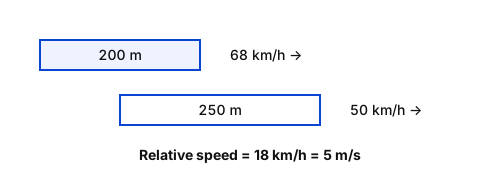
- Relative speed
- Distance
- Time
Trick: – a pair worth remembering.
Answer: (A) 90
अवधारणा: एक ही दिशा: सापेक्ष चाल अंतर; दूरी लंबाइयों का योग।
- सापेक्ष चाल
- दूरी
- समय
ट्रिक: याद रखें।
उत्तर: (A) 90
SSC CPO Paper IQuantitative AptitudeTrains – Relative speedSSC CPO Paper I 2023 · 4 Oct Shift 2
Q683.Travelling a distance of 1000 km, a train slowed down due to repairs of the tracks. Its average speed for the trip reduced by 75 km/h and the time of travel increased by 3 hours. The original duration of the travel is:
1000 km की दूरी तय करते समय, एक रेलगाड़ी पटरियों की मरम्मत के कारण धीमी हो गई। यात्रा के लिए उसकी औसत चाल 75 km/h कम हो गई और यात्रा का समय 3 घंटे बढ़ गया। यात्रा की मूल अवधि है:
- A6 hours6 घंटे
- B5 hours5 घंटे
- C5.5 hours5.5 घंटे
- D6.5 hours6.5 घंटे
Show answer
Concept: Speed ; form an equation in original time .
Trick: Option check: → speeds 200 and ; difference 75 ✓.
Answer: (B) 5 hours
अवधारणा: चाल ; मूल समय में समीकरण बनाएँ।
ट्रिक: विकल्प जाँच: → चाल 200 और 125; अंतर 75 ✓।
उत्तर: (B) 5 hours
SSC CPO Paper IQuantitative AptitudeSpeed, Time and DistanceSSC CPO Paper I 2023 · 4 Oct Shift 2
Q684.If , then find :
यदि है, तो ज्ञात कीजिए:
- A
- B
- C
- D
Show answer
Concept: Use to reduce to one ratio.
Trick: Split the bigger coefficient: , so only remains.
Answer: (A)
अवधारणा: से एक ही अनुपात में बदलें।
ट्रिक: बड़े गुणांक को तोड़ें: , बचता है ।
उत्तर: (A)
SSC CPO Paper IQuantitative AptitudeTrigonometrySSC CPO Paper I 2023 · 4 Oct Shift 2
Q685.If , then find the value of .
यदि है, तो का मान ज्ञात कीजिए।
- A
- B
- C
- D
Show answer
Concept: .
- Add:
Trick: Add the two equations for sec, subtract them for tan .
Answer: (D)
अवधारणा: ।
- जोड़ें:
ट्रिक: sec के लिए दोनों समीकरण जोड़ें, tan के लिए घटाएँ।
उत्तर: (D)
SSC CPO Paper IQuantitative AptitudeTrigonometric identitiesSSC CPO Paper I 2023 · 4 Oct Shift 2
Q686.2(sin 1° × sec 89° ) + 3 (cos 11° × cosec 79°) + 5 (tan 21° × tan 69°) = ?
मान ज्ञात कीजिए:
2(sin 1° × sec 89° ) + 3 (cos 11° × cosec 79°) + 5 (tan 21° × tan 69°) = ?
- A11
- B12
- C20
- D10
Show answer
Concept: , , .
- Sum
Trick: Angles adding to with "co" partners give 1 – just add the coefficients.
Answer: (D) 10
अवधारणा: , , ।
- योग
ट्रिक: जिन कोणों का योग हो और "co" जोड़ी बने, गुणनफल 1 – बस गुणांक जोड़ें।
उत्तर: (D) 10
SSC CPO Paper IQuantitative AptitudeTrigonometry – Complementary anglesSSC CPO Paper I 2023 · 4 Oct Shift 2
Q687.A person has three iron bars whose lengths are 20, 30 and 40 metres, respectively. He wants to cut pieces of the same length from each of the three bars. What is the least number of total pieces if he cuts without any wastage?
एक व्यक्ति के पास लोहे की तीन छड़ें हैं जिनकी लंबाई क्रमशः 20, 30 और 40 मीटर है। वह तीनों छड़ों में से प्रत्येक से समान लंबाई के टुकड़े काटना चाहता है। यदि वह बिना किसी बर्बादी के काटता है, तो टुकड़ों की कुल न्यूनतम संख्या कितनी होगी?
- A8
- B10
- C9
- D11
Show answer
Concept: Largest equal piece length = HCF of the lengths → least number of pieces.
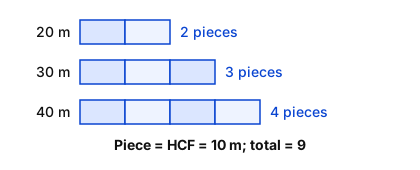
- HCF(20, 30, 40)
- Pieces
Yaad rakhein: Least pieces ↔ longest piece ↔ HCF.
Answer: (C) 9
अवधारणा: सबसे लंबा समान टुकड़ा = लंबाइयों का HCF → न्यूनतम टुकड़े।
- HCF(20, 30, 40)
- टुकड़े
याद रखें: न्यूनतम टुकड़े ↔ सबसे लंबा टुकड़ा ↔ HCF।
उत्तर: (C) 9
SSC CPO Paper IQuantitative AptitudeHCF – ApplicationSSC CPO Paper I 2023 · 4 Oct Shift 2
Q688.In a ΔPQR,∠P:∠Q:∠R=3∶4∶8. The shortest side and the longest side of the triangle, respectively, are:
एक ΔPQR में, ∠P:∠Q:∠R=3∶4∶8 है। त्रिभुज की सबसे छोटी भुजा और सबसे लंबी भुजा क्रमशः हैं:
- APQ and PRPQ और PR
- BQR and PRQR और PR
- CPQ and QRPQ और QR
- DQR and PQQR और PQ
Show answer
Concept: In a triangle, the side opposite the smallest angle is shortest and opposite the largest angle is longest.
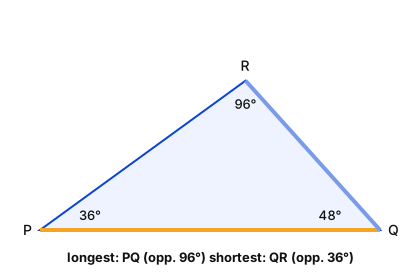
- : , ,
- Smallest angle P → opposite side QR (shortest)
- Largest angle R → opposite side PQ (longest)
Trick: Side opposite a vertex = the two other letters: opposite P is QR, opposite R is PQ.
Answer: (D) QR and PQ
अवधारणा: त्रिभुज में सबसे छोटे कोण के सामने की भुजा सबसे छोटी और सबसे बड़े कोण के सामने सबसे लंबी।
- : , ,
- सबसे छोटा कोण P → सामने QR (सबसे छोटी)
- सबसे बड़ा कोण R → सामने PQ (सबसे लंबी)
ट्रिक: शीर्ष के सामने की भुजा = बाकी दो अक्षर: P के सामने QR, R के सामने PQ।
उत्तर: (D) QR and PQ
SSC CPO Paper IQuantitative AptitudeTriangles – Angle-side relationSSC CPO Paper I 2023 · 4 Oct Shift 2
Q689.In a triangle ABC, if , and AC = 4 cm, then the value of BC is:
एक त्रिभुज ABC में, यदि , और AC = 4 cm है, तो BC का मान है:
- A cm
- B4 cm
- C cm
- D cm
Show answer
Concept: With , AC is the hypotenuse; makes the triangle isosceles.
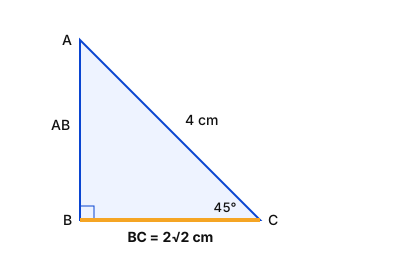
Yaad rakhein: In a -- triangle each leg .
Answer: (C)
अवधारणा: होने से AC कर्ण है; से त्रिभुज समद्विबाहु।
याद रखें: -- त्रिभुज में प्रत्येक भुजा ।
उत्तर: (C)
SSC CPO Paper IQuantitative AptitudeTrigonometry – Right triangleSSC CPO Paper I 2023 · 4 Oct Shift 2
Q690.Study the given pie-chart and answer the question that follows.
The pie-chart shows the number of boys studying in play group of various schools (A, B, C).
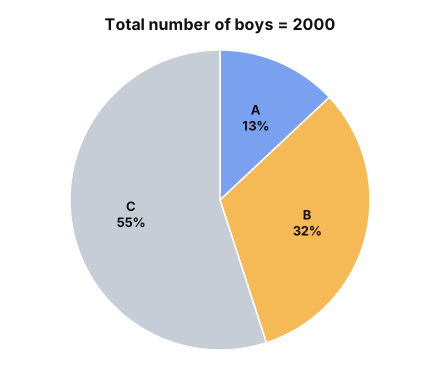
What is the average number of boys studying in schools A and C?
दिए गए पाई-चार्ट का अध्ययन कीजिए और उसके बाद आने वाले प्रश्न का उत्तर दीजिए।
पाई-चार्ट विभिन्न स्कूलों (A, B, C) के प्ले ग्रुप में पढ़ने वाले लड़कों की संख्या को दर्शाता है।
स्कूल A और C में पढ़ने वाले लड़कों की औसत संख्या कितनी है?
- A740
- B920
- C560
- D680
Show answer
Concept: Number in a school its percentage of 2000.
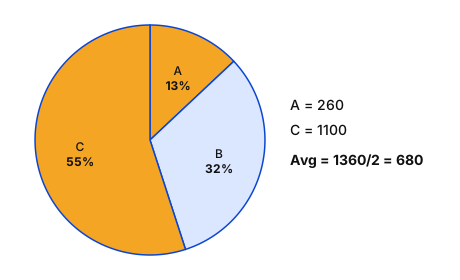
- A of 2000
- C of 2000
- Average
Trick: Average of percentages first: of 2000 .
Answer: (D) 680
अवधारणा: किसी विद्यालय में संख्या का उसका प्रतिशत।
- A का
- C का
- औसत
ट्रिक: पहले प्रतिशतों का औसत: , 2000 का ।
उत्तर: (D) 680
SSC CPO Paper IQuantitative AptitudeData Interpretation – Pie chartSSC CPO Paper I 2023 · 4 Oct Shift 2
Q691.In an office, 75 employees can finish a project in 60 days. After few days, 15
employees left the job and the project was completed in 65 days. After how many days did the 15 employees leave?
एक कार्यालय में, 75 कर्मचारी किसी परियोजना को 60 दिनों में पूरा कर सकते हैं। कुछ दिनों के बाद, 15
कर्मचारियों ने काम छोड़ दिया और परियोजना 65 दिनों में पूरी हुई। 15 कर्मचारियों ने कितने दिनों के बाद काम छोड़ा था?
- A50
- B45
- C30
- D40
Show answer
Concept: Total work in man-days stays constant: .
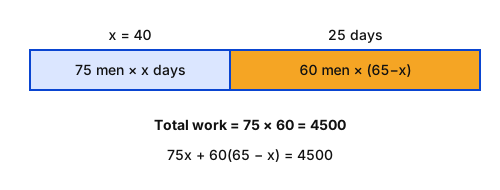
- Let 15 leave after days:
Trick: Extra 5 days by 60 men man-days work lost by 15 men in days: .
Answer: (D) 40
अवधारणा: कुल कार्य (मानव-दिवस) स्थिर: ।
- माना 15 कर्मचारी दिन बाद गए:
ट्रिक: अतिरिक्त 5 दिन × 60 = 15 कर्मचारियों का दिन का काम: ।
उत्तर: (D) 40
SSC CPO Paper IQuantitative AptitudeTime and Work – Man-daysSSC CPO Paper I 2023 · 4 Oct Shift 2
Q692.Ramesh borrowed ₹15,000 at a certain rate of simple interest from a bank. He repaid (the principal but not interest) ₹6,000 after 5 years, and after 5 more years he paid
₹18,600 and settled his account. Find the rate of simple interest per annum.
रमेश ने एक बैंक से साधारण ब्याज की एक निश्चित दर पर ₹15,000 उधार लिए। उसने 5 वर्ष बाद ₹6,000 (मूलधन, ब्याज नहीं) चुकाए, और 5 वर्ष और बीतने के बाद उसने
₹18,600 का भुगतान करके अपना खाता निपटा दिया। साधारण ब्याज की वार्षिक दर ज्ञात कीजिए।
- A12%
- B10%
- C8%
- D6%
Show answer
Concept: SI is charged on the outstanding principal for each period: .
- First 5 years on ₹15,000:
- Next 5 years on ₹9,000:
- Final payment
Trick: Interest paid on "principal-years" : .
Answer: (C) 8%
अवधारणा: हर अवधि में बकाया मूलधन पर SI: ।
- पहले 5 वर्ष ₹15,000 पर:
- अगले 5 वर्ष ₹9,000 पर:
- अंतिम भुगतान
ट्रिक: कुल ब्याज , मूलधन-वर्ष : ।
उत्तर: (C) 8%
SSC CPO Paper IQuantitative AptitudeSimple InterestSSC CPO Paper I 2023 · 4 Oct Shift 2
Q693.Let ABC, PQR be two congruent triangles such that ∠A = ∠P = 90 °. If BC = 17 cm, PR = 8 cm, find AB (in cm).
मान लीजिए ABC, PQR दो सर्वांगसम त्रिभुज इस प्रकार हैं कि ∠A = ∠P = 90 ° है। यदि BC = 17 cm, PR = 8 cm है, तो AB (cm में) ज्ञात कीजिए।
- A12
- B15
- C14
- D9
Show answer
Concept: In congruent triangles ABC ≅ PQR, corresponding sides are equal: AC = PR.
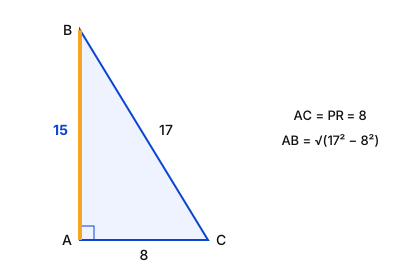
- , so BC is the hypotenuse
- AC PR
Yaad rakhein: 8, 15, 17 is a Pythagorean triplet.
Answer: (B) 15
अवधारणा: सर्वांगसम ABC ≅ PQR में संगत भुजाएँ बराबर: AC = PR।
- , अतः BC कर्ण है
- AC PR
याद रखें: 8, 15, 17 पाइथागोरस त्रिक है।
उत्तर: (B) 15
SSC CPO Paper IQuantitative AptitudeCongruent triangles – PythagorasSSC CPO Paper I 2023 · 4 Oct Shift 2
Q694.Study the pie-chart given below, and answer the question that follows.
Percentage-wise break up of students in terms of specialisation in BTech
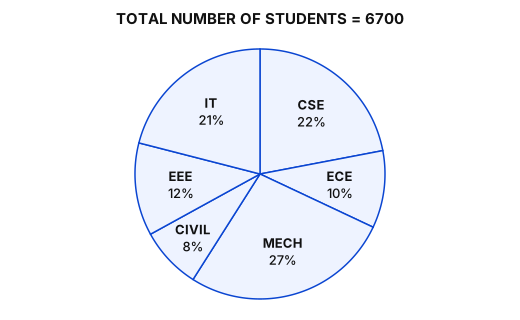
What is the total number of students having specialisation in CSE, ECE and CIVIL?
नीचे दिए गए पाई-चार्ट का अध्ययन कीजिए और उसके बाद आने वाले प्रश्न का उत्तर दीजिए।
BTech में विशेषज्ञता के आधार पर विद्यार्थियों का प्रतिशत-वार विभाजन
CSE, ECE और CIVIL में विशेषज्ञता रखने वाले विद्यार्थियों की कुल संख्या कितनी है?
- A2680
- B2840
- C2860
- D2480
Show answer
Concept: Add the required percentages, then take that percentage of the total.
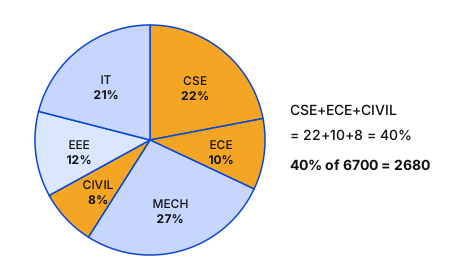
- CSE + ECE + CIVIL
- of 6700
Trick: 1% of 6700 = 67, so 40% .
Answer: (A) 2680
अवधारणा: आवश्यक प्रतिशत जोड़ें, फिर कुल का वह प्रतिशत लें।
- CSE + ECE + CIVIL
- 6700 का
ट्रिक: 6700 का 1% = 67, अतः 40% ।
उत्तर: (A) 2680
SSC CPO Paper IQuantitative AptitudeData Interpretation – Pie chartSSC CPO Paper I 2023 · 4 Oct Shift 2
Q695.The LCM and HCF of two numbers are 1105 and 5. If the LCM is 17 times the first
number, then find the two numbers.
दो संख्याओं का LCM और HCF क्रमशः 1105 और 5 है। यदि LCM पहली
संख्या का 17 गुना है, तो दोनों संख्याएँ ज्ञात कीजिए।
- A65 and 8565 और 85
- B55 and 8555 और 85
- C65 and 7565 और 75
- D60 and 8060 और 80
Show answer
Concept: Product of two numbers = HCF × LCM.
- First number
- Second
- Check: HCF(65, 85) = 5 ✓
Trick: Both numbers must be multiples of the HCF 5 and the first must be – only (A) fits.
Answer: (A) 65 and 85
अवधारणा: दो संख्याओं का गुणनफल = HCF × LCM।
- पहली संख्या
- दूसरी
- जाँच: HCF(65, 85) = 5 ✓
ट्रिक: पहली संख्या 65 वाला केवल एक विकल्प (65 और 85) सही बैठता है।
उत्तर: (A) 65 and 85
SSC CPO Paper IQuantitative AptitudeHCF and LCMSSC CPO Paper I 2023 · 4 Oct Shift 2
Q696.Akshita and Raina are typing a book, but have only one laptop to work upon. They
decided that they will work on alternate basis such that Akshita works for the first day, Raina works for the second day, Akshita for the third day and so on. Akshita alone can finish the typing work in 16 days, while Raina will take 24 days if she works alone on the entire book. How many days will they take to finish the typing work if they work on alternate basis?
अक्षिता और रैना एक पुस्तक टाइप कर रही हैं, लेकिन उनके पास काम करने के लिए केवल एक लैपटॉप है। उन्होंने
निर्णय लिया कि वे बारी-बारी से इस प्रकार काम करेंगी कि पहले दिन अक्षिता काम करेगी, दूसरे दिन रैना, तीसरे दिन अक्षिता और इसी प्रकार आगे। अक्षिता अकेले टाइपिंग का कार्य 16 दिनों में पूरा कर सकती है, जबकि रैना अकेले पूरी पुस्तक पर काम करने पर 24 दिन लेगी। यदि वे बारी-बारी से काम करें, तो उन्हें टाइपिंग का कार्य पूरा करने में कितने दिन लगेंगे?
- A15
- B18
- C19
- D17
Show answer
Concept: Take total work = LCM(16, 24) = 48 units; Akshita 3 units/day, Raina 2 units/day.
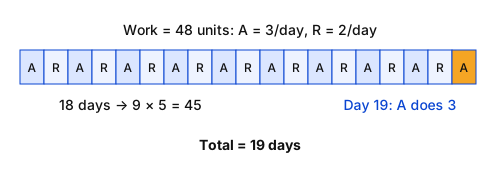
- Every 2-day cycle: units
- 9 cycles (18 days): units; left units
- Day 19 is Akshita’s turn: she does 3 units → work done
Trick: Stop the cycles before the total and check who works next – here it is exactly 1 day of Akshita.
Answer: (C) 19
अवधारणा: कुल कार्य = LCM(16, 24) = 48 इकाई; अक्षिता 3/दिन, रैना 2/दिन।
- हर 2 दिन का चक्र: इकाई
- 9 चक्र (18 दिन): इकाई; शेष
- 19वाँ दिन अक्षिता का: 3 इकाई → कार्य पूरा
ट्रिक: कुल से पहले चक्र रोकें और देखें अगली बारी किसकी है – यहाँ अक्षिता का ठीक 1 दिन।
उत्तर: (C) 19
SSC CPO Paper IQuantitative AptitudeTime and Work – Alternate daysSSC CPO Paper I 2023 · 4 Oct Shift 2
Q697.A train covers a distance of 540 km between two stations in 240 minutes. It travels at a speed of 90 km/h to another station in 5 hours. What is the average speed of the train (in km/h)?
एक रेलगाड़ी दो स्टेशनों के बीच 540 km की दूरी 240 मिनट में तय करती है। वह 90 km/h की चाल से 5 घंटे में दूसरे स्टेशन तक यात्रा करती है। रेलगाड़ी की औसत चाल (km/h में) कितनी है?
- A112
- B110
- C100
- D120
Show answer
Concept: Average speed .
- Part 1: 540 km in 240 min h
- Part 2: km in 5 h
- Average
Trick: Never average the speeds (135 and 90) directly – times differ.
Answer: (B) 110
अवधारणा: औसत चाल ।
- भाग 1: 540 km, 240 मिनट घंटे
- भाग 2: km, 5 घंटे
- औसत
ट्रिक: चालों (135 और 90) का सीधा औसत न लें – समय अलग हैं।
उत्तर: (B) 110
SSC CPO Paper IQuantitative AptitudeSpeed – Average speedSSC CPO Paper I 2023 · 4 Oct Shift 2
Q698.The heights of two cones are in the ratio 7:5 and their diameters are in the ratio 10:21. What is the ratio of their volumes? (Where )
दो शंकुओं की ऊँचाइयों का अनुपात 7:5 है और उनके व्यासों का अनुपात 10:21 है। उनके आयतनों का अनुपात क्या है? (जहाँ )
- A26:47
- B14:19
- C20:63
- D17:21
Show answer
Concept: , so .
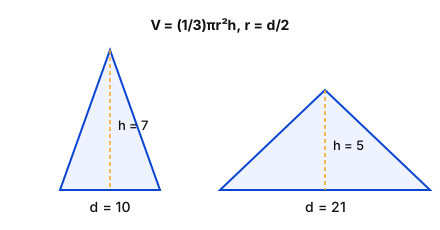
- Divide by 35:
Trick: Cancel early: .
Answer: (C) 20 : 63
अवधारणा: , अतः ।
- 35 से भाग:
ट्रिक: पहले काटें: ।
उत्तर: (C) 20 : 63
SSC CPO Paper IQuantitative AptitudeMensuration – ConeSSC CPO Paper I 2023 · 4 Oct Shift 2
Q699.What is the difference between a single discount of 35% on ₹700 and two successive discounts of 18% and 12% on the same amount (correct to two places of decimals)?
₹700 पर 35% की एकल छूट तथा उसी राशि पर 18% और 12% की दो क्रमिक छूटों के बीच का अंतर (दशमलव के दो स्थानों तक सही) कितना है?
- A₹51.20
- B₹50.12
- C₹52.10
- D₹49.80
Show answer
Concept: Two successive discounts and equal one discount of .
- Difference of discounts
- of 700
Trick: Directly: vs → gap ₹50.12.
Answer: (B) ₹50.12
अवधारणा: क्रमिक बट्टे व = एकल बट्टा ।
- अंतर
- 700 का
ट्रिक: सीधे: बनाम → अंतर ₹50.12।
उत्तर: (B) ₹50.12
SSC CPO Paper IQuantitative AptitudeDiscount – Successive discountsSSC CPO Paper I 2023 · 4 Oct Shift 2
Q700.Study the given pie-chart and answer the question that follows.
The pie-chart shows the sale of different fruits in a shop in a day.
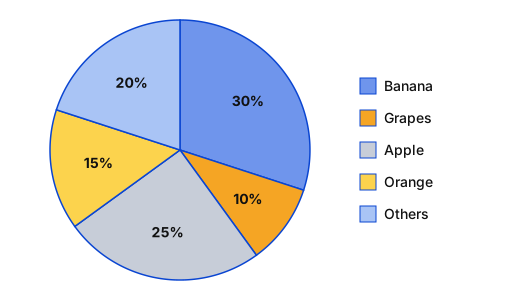
If a total of 1200 kg of fruits were sold in a day, calculate the amount of bananas sold (in kg).
दिए गए पाई-चार्ट का अध्ययन कीजिए और उसके बाद आने वाले प्रश्न का उत्तर दीजिए।
पाई-चार्ट एक दिन में एक दुकान में विभिन्न फलों की बिक्री दर्शाता है।
यदि एक दिन में कुल 1200 kg फल बेचे गए, तो बेचे गए केलों की मात्रा (kg में) की गणना कीजिए।
- A360
- B290
- C330
- D260
Show answer
Concept: Amount of a fruit its percentage of the total sale.
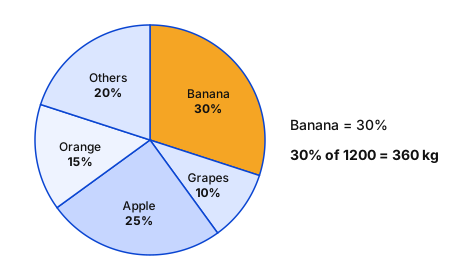
- Banana
- of 1200 kg kg
Trick: 10% of 1200 = 120, so 30% .
Answer: (A) 360
अवधारणा: किसी फल की मात्रा कुल बिक्री का उसका प्रतिशत।
- केला
- 1200 kg का kg
ट्रिक: 1200 का 10% = 120, अतः 30% ।
उत्तर: (A) 360
SSC CPO Paper IQuantitative AptitudeData Interpretation – Pie chartSSC CPO Paper I 2023 · 4 Oct Shift 2

