Q721.Study the following table chart carefully and answer the question that follows.
The table given below shows the number of registered voters and the percentage of the people who voted among them in different voting centres.
| Centres | Total number of Registered Voters | Percentage of people who voted |
|---|
| Centre 1 | 26000 | 70% |
| Centre 2 | 28000 | 60% |
| Centre 3 | 25000 | 80% |
| Centre 4 | 30000 | 76% |
According to the table given above, which centre has the maximum number of voting?
निम्नलिखित तालिका का ध्यानपूर्वक अध्ययन कीजिए और उसके बाद दिए गए प्रश्न का उत्तर दीजिए।
नीचे दी गई तालिका विभिन्न मतदान केंद्रों में पंजीकृत मतदाताओं की संख्या और उनमें से मतदान करने वाले लोगों का प्रतिशत दर्शाती है।
| केंद्र | पंजीकृत मतदाताओं की कुल संख्या | मतदान करने वाले लोगों का प्रतिशत |
|---|
| केंद्र 1 | 26000 | 70% |
| केंद्र 2 | 28000 | 60% |
| केंद्र 3 | 25000 | 80% |
| केंद्र 4 | 30000 | 76% |
ऊपर दी गई तालिका के अनुसार, किस केंद्र में मतदान की संख्या अधिकतम है?
- ACentre 1केंद्र 1
- BCentre 3केंद्र 3
- CCentre 2केंद्र 2
- DCentre 4केंद्र 4
Show answer
Concept: Number of votes cast = registered voters × percentage who voted.
- Centre 1: ; Centre 2:
- Centre 3: ; Centre 4:
- Maximum = Centre 4 (22800)
Trick: Centre 4 has both the most voters and a high — check it against Centre 3 only.
Answer: (D) Centre 4
अवधारणा: डाले गए मत = पंजीकृत मतदाता × मतदान प्रतिशत।
- Centre 1: ; Centre 2:
- Centre 3: ; Centre 4:
- अधिकतम = Centre 4 (22800)
ट्रिक: Centre 4 में मतदाता सबसे अधिक और भी ऊँचा — केवल Centre 3 से तुलना काफी।
उत्तर: (D) Centre 4
SSC CPO Paper IQuantitative AptitudeData Interpretation – tableSSC CPO Paper I 2024 · 28 Jun Shift 3
Q722.Arrange the following ratios in ascending order.
3 : 4, 3 : 5, 2 : 11, 7 : 2
निम्नलिखित अनुपातों को आरोही क्रम में व्यवस्थित कीजिए।
3 : 4, 3 : 5, 2 : 11, 7 : 2
- A3 : 5 < 2 : 11 < 3 : 4 < 7 : 2
- B2:11 < 3: 5 < 3 : 4 < 7 : 2
- C7 : 2 < 3 : 4 < 3 : 5 < 2 : 11
- D3 : 4 < 3 : 5 < 2:11 < 7: 2
Show answer
Concept: Convert each ratio to a decimal (or fraction) and compare.
- ,
- ,
- Ascending:
Trick: Any ratio with first term bigger than second () exceeds 1 — it is the largest here.
Answer: (B) 2 : 11 < 3 : 5 < 3 : 4 < 7 : 2
अवधारणा: हर अनुपात को दशमलव (या भिन्न) में बदलकर तुलना करें।
- ,
- ,
- आरोही क्रम:
ट्रिक: पहला पद बड़ा हो () तो अनुपात 1 से अधिक — यही सबसे बड़ा।
उत्तर: (B) 2 : 11 < 3 : 5 < 3 : 4 < 7 : 2
SSC CPO Paper IQuantitative AptitudeComparison of ratiosSSC CPO Paper I 2024 · 28 Jun Shift 3
Q723.P can do a piece of work in 30 days and Q in 40 days. They work together for 4 days and then Q leaves. The number of days taken by P to finish the remaining work is:
P किसी काम को 30 दिनों में और Q उसे 40 दिनों में कर सकता है। वे 4 दिनों तक एक साथ काम करते हैं और फिर Q काम छोड़ देता है। शेष काम को पूरा करने में P द्वारा लिए गए दिनों की संख्या है:
- A28 days28 दिन
- B23 days23 दिन
- C30 days30 दिन
- D7 days7 दिन
Show answer
Concept: Take total work = LCM of days and use per-day efficiencies.
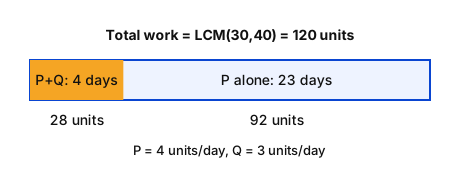
- Work units; P , Q units/day
- In 4 days together: units
- Remaining units
- P alone: days
Trick: Fraction method: done, left → P needs 23 days.
Answer: (B) 23 days
अवधारणा: कुल कार्य = दिनों का LCM मानें और प्रतिदिन की क्षमता लें।
- कार्य इकाई; P , Q इकाई/दिन
- 4 दिन साथ में: इकाई
- शेष इकाई
- P अकेला: दिन
ट्रिक: भिन्न विधि: , शेष → P को 23 दिन।
उत्तर: (B) 23 days
SSC CPO Paper IQuantitative AptitudeTime and workSSC CPO Paper I 2024 · 28 Jun Shift 3
Q724.Ashish covers 72 km at a speed of 45 km/h by bike, 28 km at a speed of 4 km/h by
bicycle, and another 160 km at a speed of 20 km/h by car. Find his average speed (in km/h) for the whole journey. (Rounded off to two decimal places)
आशीष 72 km की दूरी 45 km/h की चाल से बाइक द्वारा, 28 km की दूरी 4 km/h की चाल से
साइकिल द्वारा, और अन्य 160 km की दूरी 20 km/h की चाल से कार द्वारा तय करता है। पूरी यात्रा के लिए उसकी औसत चाल (km/h में) ज्ञात कीजिए। (दो दशमलव स्थानों तक पूर्णांकित)
- A15.66
- B28.33
- C25.25
- D27.65
Show answer
Concept: Average speed .
- Times: h, h, h
- Total time h; total distance
- Average
Trick: The slow 7-hour bicycle leg drags the average far below the bike/car speeds.
Answer: (A) 15.66
अवधारणा: औसत चाल ।
- समय: h, h, h
- कुल समय h; कुल दूरी
- औसत
ट्रिक: साइकिल के धीमे 7 घंटे औसत को बहुत नीचे ले आते हैं।
उत्तर: (A) 15.66
SSC CPO Paper IQuantitative AptitudeAverage speedSSC CPO Paper I 2024 · 28 Jun Shift 3
Q725.If 56 ÷ 4 + p × 3 – 24 ÷ 12 + 4 = 21 ÷ 3 + 3, then the value of p is:
यदि 56 ÷ 4 + p × 3 – 24 ÷ 12 + 4 = 21 ÷ 3 + 3 है, तो p का मान है:
- A2
- B1
- C−1
- D−2
Show answer
Concept: Apply BODMAS on both sides, then solve the linear equation.
- LHS:
- RHS:
Trick: Substitute options: gives ✓.
Answer: (D) −2
अवधारणा: दोनों पक्षों पर BODMAS लगाकर रैखिक समीकरण हल करें।
- बायाँ पक्ष:
- दायाँ पक्ष:
ट्रिक: विकल्प रखें: से ✓।
उत्तर: (D) −2
SSC CPO Paper IQuantitative AptitudeSimplification – find the unknownSSC CPO Paper I 2024 · 28 Jun Shift 3
Q726.The volume of a right circular cone is and its height is 18 cm. Find its slant height (in cm) (correct to 2 decimal places).
एक लंब वृत्तीय शंकु का आयतन है और उसकी ऊँचाई 18 cm है। इसकी तिर्यक ऊँचाई (cm में) ज्ञात कीजिए (2 दशमलव स्थानों तक सही)।
- A28.68
- B25.35
- C15.25
- D18.68
Show answer
Concept: Volume of cone and slant height .
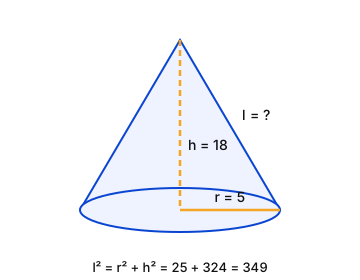
- cm
- cm
Trick: is just above — only 18.68 fits.
Answer: (D) 18.68
अवधारणा: शंकु का आयतन और तिर्यक ऊँचाई ।
- cm
- cm
ट्रिक: , से थोड़ा अधिक — केवल 18.68 उपयुक्त।
उत्तर: (D) 18.68
SSC CPO Paper IQuantitative AptitudeCone – slant heightSSC CPO Paper I 2024 · 28 Jun Shift 3
Q727.The curved surface area of a cone is , and its slant height is 28 cm. Find the radius of its base. (Use )
एक शंकु का वक्र पृष्ठीय क्षेत्रफल है, और उसकी तिर्यक ऊँचाई 28 cm है। इसके आधार की त्रिज्या ज्ञात कीजिए। ( का प्रयोग कीजिए)
- A3.5 cm
- B2.8 cm
- C3.0 cm
- D2.5 cm
Show answer
Concept: Curved surface area of a cone .
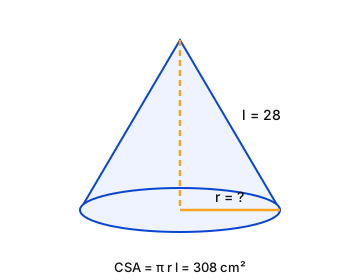
- cm
Yaad rakhein: ; then .
Answer: (A) 3.5 cm
अवधारणा: शंकु का वक्र पृष्ठीय क्षेत्रफल ।
- cm
याद रखें: ; फिर ।
उत्तर: (A) 3.5 cm
SSC CPO Paper IQuantitative AptitudeCone – curved surface areaSSC CPO Paper I 2024 · 28 Jun Shift 3
Q728.A school has four sections A, B, C, D of class X students. The results of half yearly and annual examinations are shown in the table given below:
| Result | Number of students |
|---|
| Section A | Section B | Section C | Section D |
|---|
| Students failed in both exams | 25 | 22 | 18 | 20 |
| Students failed in half yearly but passed in Annual exam | 20 | 25 | 24 | 12 |
| Students passed in half yearly but failed in Annual exam | 12 | 15 | 8 | 10 |
| Students passed in both exams | 15 | 20 | 22 | 18 |
How many students are there in class X in the school?
एक विद्यालय में कक्षा X के विद्यार्थियों के चार वर्ग A, B, C, D हैं। अर्धवार्षिक और वार्षिक परीक्षाओं के परिणाम नीचे दी गई तालिका में दर्शाए गए हैं:
| परिणाम | विद्यार्थियों की संख्या |
|---|
| वर्ग A | वर्ग B | वर्ग C | वर्ग D |
|---|
| दोनों परीक्षाओं में अनुत्तीर्ण विद्यार्थी | 25 | 22 | 18 | 20 |
| अर्धवार्षिक परीक्षा में अनुत्तीर्ण किंतु वार्षिक परीक्षा में उत्तीर्ण विद्यार्थी | 20 | 25 | 24 | 12 |
| अर्धवार्षिक परीक्षा में उत्तीर्ण किंतु वार्षिक परीक्षा में अनुत्तीर्ण विद्यार्थी | 12 | 15 | 8 | 10 |
| दोनों परीक्षाओं में उत्तीर्ण विद्यार्थी | 15 | 20 | 22 | 18 |
विद्यालय में कक्षा X में कितने विद्यार्थी हैं?
- A286
- B256
- C206
- D226
Show answer
Concept: The four result categories are mutually exclusive and cover every student, so total = sum of all entries.
- Section A:
- Section B:
- Section C: ; Section D:
- Total
Yaad rakhein: Fail-fail, fail-pass, pass-fail, pass-pass = all possibilities; no overlap, so just add.
Answer: (A) 286
अवधारणा: चारों परिणाम-श्रेणियाँ अलग-अलग हैं और हर छात्र किसी एक में है, अतः कुल = सभी संख्याओं का योग।
- Section A:
- Section B:
- Section C: ; Section D:
- कुल
याद रखें: फेल-फेल, फेल-पास, पास-फेल, पास-पास = सभी संभावनाएँ; कोई दोहराव नहीं।
उत्तर: (A) 286
SSC CPO Paper IQuantitative AptitudeData Interpretation – tableSSC CPO Paper I 2024 · 28 Jun Shift 3
Q729.A train covers a distance of 72 km in 40 minutes. Travelling at the same speed, how many metres will the train cover in 6 seconds?
एक रेलगाड़ी 72 km की दूरी 40 मिनट में तय करती है। समान चाल से चलते हुए, रेलगाड़ी 6 सेकंड में कितने मीटर की दूरी तय करेगी?
- A210
- B174
- C192
- D180
Show answer
Concept: Convert speed to m/s: .
- Speed
- Distance in 6 s m
Trick: 72 km in 2400 s → m per second directly.
Answer: (D) 180
अवधारणा: चाल को m/s में बदलें: ।
- चाल
- 6 सेकंड में दूरी m
ट्रिक: 72 km, 2400 सेकंड में → m प्रति सेकंड।
उत्तर: (D) 180
SSC CPO Paper IQuantitative AptitudeSpeed, distance and timeSSC CPO Paper I 2024 · 28 Jun Shift 3
Q730.If the number of school going children in a town is 64000 and it is increasing annually by 10%, then what will be the number of school going children in the town at the end of 3 years?
यदि किसी कस्बे में विद्यालय जाने वाले बच्चों की संख्या 64000 है और यह प्रतिवर्ष 10% की दर से बढ़ रही है, तो 3 वर्ष के अंत में कस्बे में विद्यालय जाने वाले बच्चों की संख्या कितनी होगी?
- A85000
- B85100
- C85184
- D80000
Show answer
Concept: Growth at per year: .
Trick: Year by year: .
Answer: (C) 85184
अवधारणा: वार्षिक वृद्धि: ।
ट्रिक: वर्षवार: ।
उत्तर: (C) 85184
SSC CPO Paper IQuantitative AptitudePopulation growthSSC CPO Paper I 2024 · 28 Jun Shift 3
Q731.Find the value of .
का मान ज्ञात कीजिए।
- A1
- B
- C
- D2
Show answer
Concept: Do ÷ and × from left to right before + and −, separately in numerator and denominator.
- Numerator: , →
- Denominator: →
- Value
Trick: Left to right: , not .
Answer: (A) 1
अवधारणा: अंश और हर में अलग-अलग पहले ÷ और × (बाएँ से दाएँ), फिर + और −।
- अंश: , →
- हर: →
- मान
ट्रिक: बाएँ से दाएँ: ।
उत्तर: (A) 1
SSC CPO Paper IQuantitative AptitudeSimplification (BODMAS)SSC CPO Paper I 2024 · 28 Jun Shift 3
Q732.Simplify
सरल कीजिए
- A
- B
- C
- D
Show answer
Concept: Use and .
- Divide by :
Trick: Check : expression , and ✓.
Answer: (C)
अवधारणा: और का प्रयोग करें।
- से भाग:
ट्रिक: रखें: व्यंजक और ✓।
उत्तर: (C)
SSC CPO Paper IQuantitative AptitudeTrigonometric identitiesSSC CPO Paper I 2024 · 28 Jun Shift 3
Q733.The marked price of a table is ₹5,980. If the shopkeeper offers a discount of 18%, what is its selling price (in ₹, to the nearest rupee)?
एक मेज़ का अंकित मूल्य ₹5,980 है। यदि दुकानदार 18% की छूट देता है, तो इसका विक्रय मूल्य (₹ में, निकटतम रुपये तक) क्या है?
- A4,940
- B4,490
- C4,094
- D4,904
Show answer
Concept: Selling price .
- SP
- To the nearest rupee: ₹4,904
Trick: of ; .
Answer: (D) 4,904
अवधारणा: विक्रय मूल्य ।
- SP
- निकटतम रुपये तक: ₹4,904
ट्रिक: का ; ।
उत्तर: (D) 4,904
SSC CPO Paper IQuantitative AptitudeDiscountSSC CPO Paper I 2024 · 28 Jun Shift 3
Q734.A vessel contains 18 litres mixture of milk and water in the ratio 5 : 1. If 3 litres of milk is added to the vessel, then how much water (in litres) should be added to the vessel to have milk and water in the ratio 9 : 2?
एक बर्तन में दूध और पानी का 18 लीटर मिश्रण 5 : 1 के अनुपात में है। यदि बर्तन में 3 लीटर दूध मिलाया जाता है, तो दूध और पानी का अनुपात 9 : 2 करने के लिए बर्तन में कितना पानी (लीटर में) मिलाया जाना चाहिए?
- A2
- B1.5
- C1
- D0.5
Show answer
Concept: Split the mixture into milk and water, add the new quantities, and match the target ratio.
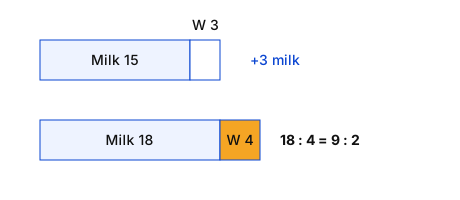
- Milk L, water L
- After adding 3 L milk: milk L
- For : water L
- Water to add L
Trick: Milk 18 = 9 parts → 1 part = 2 L → water 2 parts = 4 L.
Answer: (C) 1
अवधारणा: मिश्रण को दूध और पानी में बाँटें, नई मात्राएँ जोड़ें और लक्ष्य अनुपात से मिलाएँ।
- दूध L, पानी L
- 3 L दूध मिलाने पर: दूध L
- के लिए पानी L
- मिलाना है L पानी
ट्रिक: दूध 18 = 9 भाग → 1 भाग = 2 L → पानी 2 भाग = 4 L।
उत्तर: (C) 1
SSC CPO Paper IQuantitative AptitudeMixture and alligationSSC CPO Paper I 2024 · 28 Jun Shift 3
Q735.Two trains are moving in the same direction at 60 km/h and 42 km/h. The faster train crosses a man in the slower train in 36 seconds. Find the length of the faster train.
दो रेलगाड़ियाँ एक ही दिशा में 60 km/h और 42 km/h की चाल से चल रही हैं। तेज़ रेलगाड़ी, धीमी रेलगाड़ी में बैठे एक व्यक्ति को 36 सेकंड में पार करती है। तेज़ रेलगाड़ी की लंबाई ज्ञात कीजिए।
- A185 m
- B195 m
- C180 m
- D175 m
Show answer
Concept: Crossing a man (a point) in a train moving the same way: length = relative speed × time, relative speed = difference.
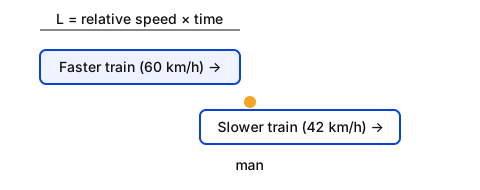
- Relative speed
- Length m
Yaad rakhein: Same direction → subtract speeds; opposite → add.
Answer: (C) 180 m
अवधारणा: एक ही दिशा में चलती ट्रेन में बैठे व्यक्ति (बिंदु) को पार करना: लंबाई = सापेक्ष चाल × समय, सापेक्ष चाल = अंतर।
- सापेक्ष चाल
- लंबाई m
याद रखें: एक ही दिशा → चालें घटाएँ; विपरीत दिशा → जोड़ें।
उत्तर: (C) 180 m
SSC CPO Paper IQuantitative AptitudeTrains – relative speedSSC CPO Paper I 2024 · 28 Jun Shift 3
Q736.Study the given table and answer the question that follows.
The table shows the yearly production (in thousands) of scooters in five different factories (P, Q, R, S and T) from 1985 to 1989.
Yearly production (in thousands) of scooters in different factories.
| Factory | 1985 | 1986 | 1987 | 1988 | 1989 |
|---|
| P | 20 | 15 | 24 | 13 | 17 |
| Q | 16 | 23 | 41 | 20 | 15 |
| R | 14 | 21 | 30 | 16 | 12 |
| S | 25 | 17 | 15 | 12 | 22 |
| T | 40 | 32 | 39 | 41 | 35 |
| Total | 115 | 108 | 149 | 102 | 101 |
In which year was the total production of scooters of all factories 20% of the total production of scooters from 1985 to 1989?
दी गई तालिका का अध्ययन कीजिए और उसके बाद दिए गए प्रश्न का उत्तर दीजिए।
तालिका 1985 से 1989 तक पाँच अलग-अलग कारखानों (P, Q, R, S और T) में स्कूटरों का वार्षिक उत्पादन (हज़ार में) दर्शाती है।
विभिन्न कारखानों में स्कूटरों का वार्षिक उत्पादन (हज़ार में)।
| कारखाना | 1985 | 1986 | 1987 | 1988 | 1989 |
|---|
| P | 20 | 15 | 24 | 13 | 17 |
| Q | 16 | 23 | 41 | 20 | 15 |
| R | 14 | 21 | 30 | 16 | 12 |
| S | 25 | 17 | 15 | 12 | 22 |
| T | 40 | 32 | 39 | 41 | 35 |
| कुल | 115 | 108 | 149 | 102 | 101 |
किस वर्ष सभी कारखानों के स्कूटरों का कुल उत्पादन, 1985 से 1989 तक स्कूटरों के कुल उत्पादन का 20% था?
- A1985
- B1986
- C1988
- D1989
Show answer
Concept: Find the grand total over five years and compare of it with each yearly total.
- Grand total thousand
- of thousand
- Year with total 115 thousand = 1985
Trick: , so look for the year equal to the average of the five totals ().
Answer: (A) 1985
अवधारणा: पाँच वर्षों का कुल योग निकालें और उसके की तुलना हर वर्ष के कुल से करें।
- कुल योग हज़ार
- का हज़ार
- 115 हज़ार वाला वर्ष = 1985
ट्रिक: , यानी पाँच वर्षों का औसत () वाला वर्ष।
उत्तर: (A) 1985
SSC CPO Paper IQuantitative AptitudeData Interpretation – tableSSC CPO Paper I 2024 · 28 Jun Shift 3
Q737.A vegetable vendor bought 100 kg of potatoes at the rate of ₹19 per kg and spent ₹100 as cartage. He sold 60 kg of potatoes with a 50% profit and half of the remaining stock with a 40% profit. He sold half of the still remaining potatoes with a 25% profit. What profit percentage should he aim for when selling the ultimate remaining potatoes to achieve an overall profit of 42%?
एक सब्ज़ी विक्रेता ने ₹19 प्रति kg की दर से 100 kg आलू खरीदे और ढुलाई पर ₹100 खर्च किए। उसने 60 kg आलू 50% लाभ पर और शेष स्टॉक का आधा भाग 40% लाभ पर बेचा। उसने अब भी शेष बचे आलुओं का आधा भाग 25% लाभ पर बेचा। 42% का समग्र लाभ प्राप्त करने के लिए, अंत में शेष बचे आलुओं को बेचते समय उसे कितने लाभ प्रतिशत का लक्ष्य रखना चाहिए?
- A0.1
- B0.15
- C0.12
- D0.16
Show answer
Concept: Effective CP includes cartage. Target SP = CP × 1.42; the last lot must cover what is still missing.
- Total CP , i.e. ₹20 per kg; target SP
- 60 kg at : ; 20 kg at :
- 10 kg at : ; total so far ₹2610
- Last 10 kg must fetch → ₹23 per kg
- Profit , i.e.
Trick: Weighted-profit check: .
Answer: (B) 0.15 (i.e. 15%)
अवधारणा: प्रभावी क्रय मूल्य में ढुलाई (cartage) शामिल है। लक्ष्य SP = CP × 1.42; अंतिम हिस्से से बाकी कमी पूरी करनी है।
- कुल CP , यानी ₹20 प्रति kg; लक्ष्य SP
- 60 kg पर : ; 20 kg पर :
- 10 kg पर : ; अब तक ₹2610
- अंतिम 10 kg से → ₹23 प्रति kg
- लाभ , यानी
ट्रिक: भारित लाभ: ।
उत्तर: (B) 0.15 (i.e. 15%)
SSC CPO Paper IQuantitative AptitudeProfit and lossSSC CPO Paper I 2024 · 28 Jun Shift 3
Q738.Simplify the following.
निम्नलिखित को सरल कीजिए।
- A
- B
- C
- D
Show answer
Concept: Apply BODMAS from the innermost bracket outwards; simplify the denominator separately.
- ; ;
- ; numerator
- Denominator
- Value
Trick: first — makes the division instant.
Answer: (C)
अवधारणा: सबसे अंदर के कोष्ठक से बाहर की ओर BODMAS लगाएँ; हर को अलग से सरल करें।
- ; ;
- ; अंश
- हर
- मान
ट्रिक: पहले कर लें — भाग तुरंत हो जाता है।
उत्तर: (C)
SSC CPO Paper IQuantitative AptitudeSimplification (fractions)SSC CPO Paper I 2024 · 28 Jun Shift 3
Q739.A trader sells pulses at a 32% profit and uses weights 20% less than the actual
measure. Find his gain percentage.
एक व्यापारी दालों को 32% लाभ पर बेचता है और वास्तविक माप से 20% कम भार वाले बाटों का उपयोग करता है।
उसका लाभ प्रतिशत ज्ञात कीजिए।
- A72%
- B62%
- C58%
- D65%
Show answer
Concept: With a false weight, the trader gives less goods for the same price: SP of 1 unit of goods × CP.
- Take CP of 1 kg = ₹100; he sells at profit, i.e. charges ₹132
- But he gives only kg (CP ₹80)
- Gain
Trick: → gain .
Answer: (D) 65%
अवधारणा: कम तौल में व्यापारी उसी कीमत पर कम माल देता है: वास्तविक लाभ से।
- 1 kg का CP = ₹100 मानें; लाभ पर वह ₹132 लेता है
- पर देता है केवल kg (CP ₹80)
- लाभ
ट्रिक: → लाभ ।
उत्तर: (D) 65%
SSC CPO Paper IQuantitative AptitudeProfit – false weightsSSC CPO Paper I 2024 · 28 Jun Shift 3
Q740.Consider the data of a certain number of activities of type P, Q, and R in the percentage of the total activities of the cities B, C, D, and K in the table below.
| Activity ↓ / City → | B | C | D | K |
|---|
| P | 45 | 30 | 25 | 35 |
| Q | 25 | 30 | 35 | 30 |
| R | 30 | 40 | 40 | 35 |
If the total activities of B and C are 500 and 400, respectively, then what is the difference in activity R of B and C?
नीचे दी गई तालिका में शहरों B, C, D और K की कुल गतिविधियों के प्रतिशत के रूप में P, Q और R प्रकार की गतिविधियों की एक निश्चित संख्या के आँकड़ों पर विचार कीजिए।
| गतिविधि ↓ / शहर → | B | C | D | K |
|---|
| P | 45 | 30 | 25 | 35 |
| Q | 25 | 30 | 35 | 30 |
| R | 30 | 40 | 40 | 35 |
यदि B और C की कुल गतिविधियाँ क्रमशः 500 और 400 हैं, तो B और C की गतिविधि R में कितना अंतर है?
- A15
- B10
- C30
- D20
Show answer
Concept: Actual activity = percentage × total activities of that city.
- R in B
- R in C
- Difference
Yaad rakhein: Percentages of different totals can't be compared directly — convert to actual numbers first.
Answer: (B) 10
अवधारणा: वास्तविक गतिविधि = प्रतिशत × उस शहर की कुल गतिविधियाँ।
- B में R
- C में R
- अंतर
याद रखें: अलग-अलग कुल के प्रतिशत सीधे नहीं तुलते — पहले वास्तविक संख्या निकालें।
उत्तर: (B) 10
SSC CPO Paper IQuantitative AptitudeData Interpretation – percentage tableSSC CPO Paper I 2024 · 28 Jun Shift 3

