SSC CPO Paper I · 6,600 questions

SSC CPO Paper I 2020, 2022, 2023, 2024 PYQs

Real previous year questions, subject-wise. Try the question, then open the answer and the explanation in Hindi & English – free, no login.

Courses – airGurukul

1,650 questions in General Intelligence and Reasoning.

Q941.
If A denotes ‘+’, B denotes ‘×’, C denotes ‘−’, and D denotes ‘÷’, then what will be the value of the following expression?
2 B 12 D 4 A 16 C 7
यदि A का अर्थ ‘+’, B का अर्थ ‘×’, C का अर्थ ‘−’ और D का अर्थ ‘÷’ है, तो निम्नलिखित व्यंजक का मान क्या होगा?
2 B 12 D 4 A 16 C 7
  1. A15
  2. B12
  3. C13
  4. D14
Show answer

Concept: Substitute the signs and apply BODMAS.

  1. Expression: 2×12÷4+16−7.
  2. 2×12=24, 24÷4=6.
  3. 6+16−7=15.

Trick: × and ÷ have equal priority — do them left to right.

Answer: (A) 15

अवधारणा: चिह्न बदलें और BODMAS लगाएँ।

  1. व्यंजक: 2×12÷4+16−7।
  2. 2×12=24, 24÷4=6।
  3. 6+16−7=15।

ट्रिक: × और ÷ की प्राथमिकता बराबर — बाएँ से दाएँ करें।

उत्तर: (A) 15
SSC CPO Paper IGeneral Intelligence and ReasoningMathematical operations (symbol substitution)SSC CPO Paper I 2022 · 11 Nov Shift 3
Q942.
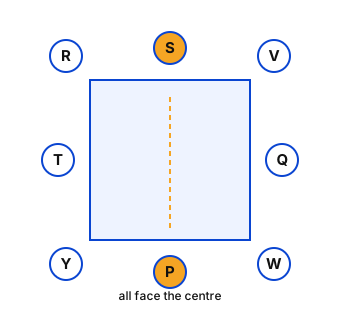
Eight relatives, P, Q, R, S, T, V, W and Y are sitting around a square table in such a way that four of them sit at four corners of the square while four sit in the middle of each of four sides, all of them facing the centre of the square.
P sits third to the left of V. R is not an immediate neighbour of V. Only one person sits between V and W. S sits second to the right of Q. R is not an immediate neighbour of P. T sits second left of P.
Who sits fourth to the right of P?
आठ संबंधी P, Q, R, S, T, V, W और Y एक वर्गाकार मेज़ के चारों ओर इस प्रकार बैठे हैं कि उनमें से चार वर्ग के चारों कोनों पर बैठे हैं, जबकि चार प्रत्येक भुजा के मध्य में बैठे हैं, और सभी का मुख वर्ग के केंद्र की ओर है।
P, V के बाएँ से तीसरे स्थान पर बैठा है। R, V का निकटतम पड़ोसी नहीं है। V और W के बीच केवल एक व्यक्ति बैठा है। S, Q के दाएँ से दूसरे स्थान पर बैठा है। R, P का निकटतम पड़ोसी नहीं है। T, P के बाएँ से दूसरे स्थान पर बैठा है।
P के दाएँ से चौथे स्थान पर कौन बैठा है?
  1. AV
  2. BT
  3. CS
  4. DR
Show answer

Concept: All face the centre, so 'left' means clockwise and 'right' means anticlockwise (seen from above).

  1. Put P at a seat. T is 2nd to the left of P; V is 3rd to the right of P (P is 3rd left of V).
  2. W is 2 seats from V: either T's side seat (then R would have no valid seat) or the seat just right of P — so W sits immediately right of P.
  3. R avoids the neighbours of V and P, so R sits between T and the seat beside V. S is 2nd right of Q ⇒ Q sits between V and W, S between R and V; Y takes the last seat (left of P).
  4. Clockwise: P, Y, T, R, S, V, Q, W ⇒ 4th to the right of P (directly opposite) is S.

Trick: In an 8-seat arrangement, 4th to the left or right is simply the person opposite.

Answer: (C) S

अवधारणा: सभी का मुख केंद्र की ओर है, अतः 'बाएँ' = दक्षिणावर्त (clockwise) और 'दाएँ' = वामावर्त (ऊपर से देखने पर)।

  1. P को रखें। T, P के बाएँ दूसरे स्थान पर; V, P के दाएँ तीसरे स्थान पर (P, V के बाएँ तीसरा)।
  2. W, V से 2 स्थान दूर है: दूसरी संभावित सीट लेने पर R के लिए कोई सीट नहीं बचती, अतः W, P के ठीक दाएँ बैठता है।
  3. R, V और P का पड़ोसी नहीं, अतः R, T के बगल में P के बाएँ तीसरे स्थान पर। S, Q के दाएँ दूसरा ⇒ Q, V और W के बीच, S, R और V के बीच; Y बची सीट (P के बाएँ) पर।
  4. दक्षिणावर्त: P, Y, T, R, S, V, Q, W ⇒ P के दाएँ चौथा (ठीक सामने) S है।

ट्रिक: 8 सीटों में बाएँ या दाएँ चौथा व्यक्ति ठीक सामने बैठा होता है।

उत्तर: (C) S

SSC CPO Paper IGeneral Intelligence and ReasoningSquare table seating arrangementSSC CPO Paper I 2022 · 11 Nov Shift 3
Q943.
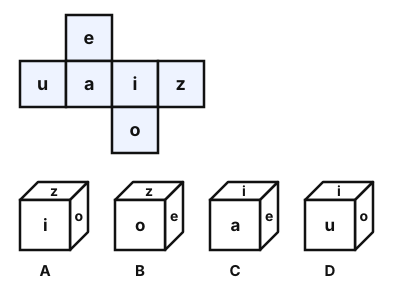
If the given sheet is folded to form a cube, which of the given figures are possible?
(The letters are shown to indicate the sides only.)
यदि दी गई शीट को मोड़कर एक घन बनाया जाए, तो दी गई आकृतियों में से कौन-सी संभव हैं?
(अक्षर केवल फलकों को इंगित करने के लिए दर्शाए गए हैं।)
  1. AOnly A and Cकेवल A और C
  2. BOnly B and Cकेवल B और C
  3. COnly A, C and Dकेवल A, C और D
  4. DOnly C and Dकेवल C और D
Show answer

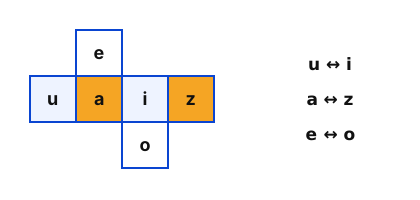
Concept: In a net, faces separated by one face in a straight line are opposite; two opposite faces can never be seen together on a cube.

  1. Row u–a–i–z: u ↔ i and a ↔ z are opposite.
  2. e (above a) and o (below i) end up as top and bottom ⇒ e ↔ o.
  3. B shows o and e together and D shows u and i together — impossible. A (z, i, o) and C (i, a, e) contain no opposite pair ⇒ possible.

Trick: First find the three opposite pairs; then reject any cube showing a pair together.

Answer: (A) Only A and C

अवधारणा: जाल (net) में एक सीधी पंक्ति में एक फलक छोड़कर आने वाले फलक विपरीत होते हैं; विपरीत फलक घन पर कभी एक साथ नहीं दिखते।

  1. पंक्ति u–a–i–z: u ↔ i और a ↔ z विपरीत।
  2. e (a के ऊपर) और o (i के नीचे) ऊपर-नीचे के फलक बनते हैं ⇒ e ↔ o।
  3. B में o और e साथ, D में u और i साथ — असंभव। A (z, i, o) और C (i, a, e) में कोई विपरीत जोड़ा नहीं ⇒ संभव।

ट्रिक: पहले तीनों विपरीत जोड़े निकालें; फिर जिस घन में जोड़ा साथ दिखे उसे हटा दें।

उत्तर: (A) केवल A और C

SSC CPO Paper IGeneral Intelligence and ReasoningCube from a netSSC CPO Paper I 2022 · 11 Nov Shift 3
Q944.
In a certain code language, ‘GRANTED’ is written as ‘HPBLUCE’ and ‘FRAGMENT’ is written as ‘GPBENCOR’. How will ‘IGNORE’ be written in that language?
एक निश्चित कूट भाषा में, ‘GRANTED’ को ‘HPBLUCE’ लिखा जाता है और ‘FRAGMENT’ को ‘GPBENCOR’ लिखा जाता है। उसी भाषा में ‘IGNORE’ को कैसे लिखा जाएगा?
  1. AJFMPSC
  2. BJIOQTG
  3. CKHLNPC
  4. DJEOMSC
Show answer

Concept: Letters in odd positions move +1, letters in even positions move −2.

  1. GRANTED: G+1=H, R−2=P, A+1=B, N−2=L, T+1=U, E−2=C, D+1=E ✓.
  2. IGNORE: I+1=J, G−2=E, N+1=O, O−2=M, R+1=S, E−2=C.
  3. Code: JEOMSC.

Trick: Check the first two letters of the options: only (D) starts with 'JE'.

Answer: (D) JEOMSC

अवधारणा: विषम स्थानों के अक्षर +1, सम स्थानों के अक्षर −2।

  1. GRANTED: G+1=H, R−2=P, A+1=B, N−2=L, T+1=U, E−2=C, D+1=E ✓।
  2. IGNORE: I+1=J, G−2=E, N+1=O, O−2=M, R+1=S, E−2=C।
  3. कोड: JEOMSC।

ट्रिक: विकल्पों के पहले दो अक्षर देखें: केवल (D) 'JE' से शुरू होता है।

उत्तर: (D) JEOMSC

SSC CPO Paper IGeneral Intelligence and ReasoningCoding-decoding (alternate shifts)SSC CPO Paper I 2022 · 11 Nov Shift 3
Q945.
Which two signs should be interchanged to make the given equation correct?
551 ÷ 19 - 16 × 12 + 121 = 100
दिए गए समीकरण को सही बनाने के लिए किन दो चिह्नों को आपस में बदला जाना चाहिए?
551 ÷ 19 - 16 × 12 + 121 = 100
  1. A- and ×- और ×
  2. B+ and ×+ और ×
  3. C÷ and ×÷ और ×
  4. D+ and -+ और -
Show answer

Concept: Swap the given pair of signs in each option and evaluate with BODMAS.

  1. Swap + and −: 551÷19+16×12−121.
  2. 551÷19=29, 16×12=192.
  3. 29+192−121=100 ✓.

Trick: 551÷19=29 is a clean division — keep ÷ where it is and try swaps among the other signs.

Answer: (D) + and −

अवधारणा: हर विकल्प के चिह्न आपस में बदलकर BODMAS से हल करें।

  1. + और − बदलें: 551÷19+16×12−121।
  2. 551÷19=29, 16×12=192।
  3. 29+192−121=100 ✓।

ट्रिक: 551÷19=29 पूरा भाग है — ÷ को वहीं रखें और बाकी चिह्नों की अदला-बदली आज़माएँ।

उत्तर: (D) + और −

SSC CPO Paper IGeneral Intelligence and ReasoningInterchanging signsSSC CPO Paper I 2022 · 11 Nov Shift 3
Q946.
Select the number from among the given options that can replace the question mark (?) in the following series.
53, 69, 86, 104, 120, ?, 155
दिए गए विकल्पों में से उस संख्या का चयन कीजिए जो निम्नलिखित श्रृंखला में प्रश्न चिह्न (?) के स्थान पर आ सकती है।
53, 69, 86, 104, 120, ?, 155
  1. A140
  2. B131
  3. C132
  4. D137
Show answer

Concept: The differences repeat in the cycle 16,17,18.

  1. 69−53=16,86−69=17,104−86=18.
  2. 120−104=16, next difference 17: 120+17=137.
  3. Check: 155−137=18 ✓.

Trick: Always verify the answer with the term after the blank.

Answer: (D) 137

अवधारणा: अंतर 16,17,18 के चक्र में दोहराते हैं।

  1. 69−53=16,86−69=17,104−86=18।
  2. 120−104=16, अगला अंतर 17: 120+17=137।
  3. जाँच: 155−137=18 ✓।

ट्रिक: उत्तर को रिक्त स्थान के बाद वाले पद से ज़रूर जाँचें।

उत्तर: (D) 137

SSC CPO Paper IGeneral Intelligence and ReasoningNumber seriesSSC CPO Paper I 2022 · 11 Nov Shift 3
Q947.
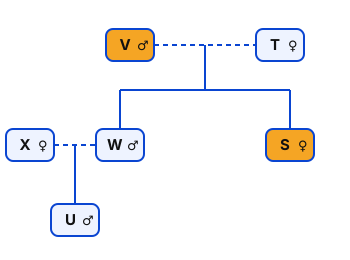
‘A & Z’ means ‘A is the father of Z’.
‘A × Z’ means ‘A is the sister of Z’.
‘A # Z’ means ‘A is the mother of Z’.
‘A $ Z’ means ‘A is the daughter of Z’.
‘A % Z’ means ‘A is the son of Z’.
‘A @ Z’ means ‘A is the daughter-in-law of Z’.
How is V related to S in the following expression?
S $ T # W & U % X @ V
‘A & Z’ का अर्थ है ‘A, Z का पिता है’।
‘A × Z’ का अर्थ है ‘A, Z की बहन है’।
‘A # Z’ का अर्थ है ‘A, Z की माता है’।
‘A $ Z’ का अर्थ है ‘A, Z की पुत्री है’।
‘A % Z’ का अर्थ है ‘A, Z का पुत्र है’।
‘A @ Z’ का अर्थ है ‘A, Z की पुत्रवधू है’।
निम्नलिखित व्यंजक में V का S से क्या संबंध है?
S $ T # W & U % X @ V
  1. ABrotherभाई
  2. BSonपुत्र
  3. CUncleचाचा/मामा
  4. DFatherपिता
Show answer

Concept: Decode the chain S $ T # W & U % X @ V, where X is a person.

  1. S $ T: S is T's daughter. T # W: T is W's mother ⇒ S and W are siblings, T is their mother.
  2. W & U: W is U's father. U % X: U is X's son ⇒ X is W's wife.
  3. X @ V: X is V's daughter-in-law ⇒ V is W's parent; W's mother is T, so V is male, T's husband — the father of S.

Trick: Daughter-in-law of V = wife of V's son; then V is the parent of that son.

Answer: (D) Father

अवधारणा: श्रृंखला S $ T # W & U % X @ V को खोलें, जहाँ X एक व्यक्ति है।

  1. S $ T: S, T की बेटी। T # W: T, W की माँ ⇒ S और W भाई-बहन, T उनकी माँ।
  2. W & U: W, U का पिता। U % X: U, X का बेटा ⇒ X, W की पत्नी।
  3. X @ V: X, V की बहू ⇒ V, W का माता/पिता; माँ T है, अतः V पुरुष (T का पति) — S का पिता।

ट्रिक: V की बहू = V के बेटे की पत्नी; तब V उस बेटे का माता/पिता है।

उत्तर: (D) Father (पिता)

SSC CPO Paper IGeneral Intelligence and ReasoningBlood relation (coded)SSC CPO Paper I 2022 · 11 Nov Shift 3
Q948.
Select the option that is related to the fifth term in the same way as the second term is related to the first term and the fourth term is related to the third term.
E25I : A5E : : Z49T : V7P : : P144K : ?
उस विकल्प का चयन कीजिए जो पाँचवें पद से उसी प्रकार संबंधित है, जिस प्रकार दूसरा पद पहले पद से संबंधित है और चौथा पद तीसरे पद से संबंधित है।
E25I : A5E : : Z49T : V7P : : P144K : ?
  1. AL12H
  2. BL12G
  3. CL14G
  4. DL13G
Show answer

Concept: Each letter moves back by 4 and the number becomes its square root.

  1. E25I → A5E: E−4=A, 25=5, I−4=E ✓. Z49T → V7P ✓.
  2. P144K: P−4=L, 144=12, K−4=G.
  3. Result: L12G.

Trick: Spot perfect squares (25, 49, 144) — the square root is the usual link.

Answer: (B) L12G

अवधारणा: हर अक्षर 4 पीछे जाता है और संख्या का वर्गमूल लिया जाता है।

  1. E25I → A5E: E−4=A, 25=5, I−4=E ✓। Z49T → V7P ✓।
  2. P144K: P−4=L, 144=12, K−4=G।
  3. परिणाम: L12G।

ट्रिक: पूर्ण वर्ग (25, 49, 144) दिखें तो वर्गमूल का संबंध देखें।

उत्तर: (B) L12G

SSC CPO Paper IGeneral Intelligence and ReasoningAlphanumeric analogySSC CPO Paper I 2022 · 11 Nov Shift 3
Q949.
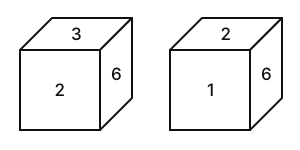
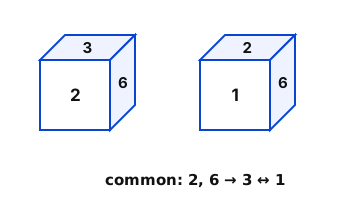
Two different positions of the same dice are shown, the six faces of which are numbered from 1 to 6. Select the number that will be on the face opposite to the one showing 1.
एक ही पासे की दो अलग-अलग स्थितियाँ दर्शाई गई हैं, जिसके छह फलकों पर 1 से 6 तक की संख्याएँ अंकित हैं। उस संख्या का चयन कीजिए जो 1 दर्शाने वाले फलक के विपरीत फलक पर होगी।
  1. A5
  2. B4
  3. C6
  4. D3
Show answer

Concept: If two faces are common to both views, the remaining faces in the matching position are opposite to each other.

  1. Common faces in both dice: 2 and 6.
  2. Read each corner clockwise: view 1 gives 2 → 6 → 3, view 2 gives 6 → 2 → 1 — the same edge 2–6 seen from its two ends.
  3. The faces 3 and 1 lie at the two ends of the common edge 2–6, so they are opposite: 1 ↔ 3.

Trick: Two common faces ⇒ the two uncommon faces are opposite (standard dice rule).

Answer: (D) 3

अवधारणा: यदि दोनों स्थितियों में दो फलक समान हों, तो बचे हुए दोनों फलक एक-दूसरे के विपरीत होते हैं।

  1. दोनों पासों में समान फलक: 2 और 6।
  2. हर कोने को दक्षिणावर्त पढ़ें: पहला पासा 2 → 6 → 3, दूसरा 6 → 2 → 1 — यह उसी किनारे 2–6 को दोनों सिरों से देखना है।
  3. 3 और 1 साझा किनारे 2–6 के दोनों सिरों पर हैं, अतः विपरीत: 1 ↔ 3।

ट्रिक: दो फलक समान ⇒ बचे दो असमान फलक विपरीत (पासे का मानक नियम)।

उत्तर: (D) 3

SSC CPO Paper IGeneral Intelligence and ReasoningDice (opposite faces)SSC CPO Paper I 2022 · 11 Nov Shift 3
Q950.
If × means +, + means −, − means ÷, ÷ means ×, what will come in place of the question mark (?)?
15 ÷ 5 × 36 – 6 + 14 = ?
यदि × का अर्थ +, + का अर्थ −, − का अर्थ ÷ और ÷ का अर्थ × है, तो प्रश्न चिह्न (?) के स्थान पर क्या आएगा?
15 ÷ 5 × 36 – 6 + 14 = ?
  1. A116
  2. B108
  3. C84
  4. D67
Show answer

Concept: Replace each sign by its meaning, then use BODMAS.

  1. 15÷5×36−6+14 becomes 15×5+36÷6−14.
  2. 15×5=75, 36÷6=6.
  3. 75+6−14=67.

Trick: Rewrite the whole expression with the new signs before calculating.

Answer: (D) 67

अवधारणा: हर चिह्न को उसके अर्थ से बदलें, फिर BODMAS लगाएँ।

  1. 15÷5×36−6+14 बनता है 15×5+36÷6−14।
  2. 15×5=75, 36÷6=6।
  3. 75+6−14=67।

ट्रिक: गणना से पहले पूरा व्यंजक नए चिह्नों के साथ दोबारा लिखें।

उत्तर: (D) 67

SSC CPO Paper IGeneral Intelligence and ReasoningMathematical operations (sign interchange)SSC CPO Paper I 2022 · 11 Nov Shift 3
Q951.
If + means −, − means ×, × means ÷, and ÷ means +, what will be the value of the
following expression?
65 ÷ 35 + 72 × 8 − 5
यदि + का अर्थ −, − का अर्थ ×, × का अर्थ ÷ और ÷ का अर्थ + है, तो निम्नलिखित व्यंजक का मान क्या होगा?
65 ÷ 35 + 72 × 8 − 5
  1. A195
  2. B45
  3. C455
  4. D55
Show answer

Concept: Replace each symbol by its meaning, then apply BODMAS.

  1. Given: 65÷35+72×8−5
  2. After replacing: 65+35−72÷8×5
  3. 72÷8=9, 9×5=45
  4. 65+35−45=55

Trick: Write the new expression fully before solving; do division and multiplication first.

Answer: (D) 55

अवधारणा: प्रत्येक चिह्न को उसके अर्थ से बदलें, फिर BODMAS लगाएँ।

  1. दिया है: 65÷35+72×8−5
  2. बदलने पर: 65+35−72÷8×5
  3. 72÷8=9, 9×5=45
  4. 65+35−45=55

ट्रिक: पहले पूरा नया व्यंजक लिखें, फिर भाग और गुणा पहले करें।

उत्तर: (D) 55

SSC CPO Paper IGeneral Intelligence and ReasoningMathematical OperationsSSC CPO Paper I 2022 · 11 Nov Shift 2
Q952.
In a certain code language, 'CHART' is written as 'GDASS' and 'EMPTY' is written as 'LFPXU'. How will 'INDEX' be written in that language?
एक निश्चित कूट भाषा में, 'CHART' को 'GDASS' लिखा जाता है और 'EMPTY' को 'LFPXU' लिखा जाता है। उसी भाषा में 'INDEX' को कैसे लिखा जाएगा?
  1. AMIDWF
  2. BMJDWF
  3. CMDJWF
  4. DMWDJF
Show answer

Concept: The letters are taken in pairs: 1st and 2nd letters swap with shifts, middle letter stays, 4th and 5th swap with shifts.

  1. CHART: (C, H) → (H−1, C+1) = (G, D); A stays; (R, T) → (T−1, R+1) = (S, S) → GDASS
  2. EMPTY: (E, M) → (L, F); P stays; (T, Y) → (X, U) → LFPXU
  3. INDEX: (I, N) → (N−1, I+1) = (M, J); D stays; (E, X) → (X−1, E+1) = (W, F)
  4. Code = MJDWF

Trick: Whenever the middle letter is unchanged, check pair-wise reversal with ±1.

Answer: (B) MJDWF

अवधारणा: अक्षरों को जोड़ों में लिया गया है: पहले दो अक्षर उलटकर ±1 होते हैं, बीच का अक्षर वही रहता है, अंतिम दो अक्षर भी उलटकर ±1 होते हैं।

  1. CHART: (C, H) → (H−1, C+1) = (G, D); A वही; (R, T) → (S, S) → GDASS
  2. EMPTY: (E, M) → (L, F); P वही; (T, Y) → (X, U) → LFPXU
  3. INDEX: (I, N) → (M, J); D वही; (E, X) → (W, F)
  4. कोड = MJDWF

ट्रिक: बीच का अक्षर न बदले तो जोड़ों का उलटना और ±1 जाँचें।

उत्तर: (B) MJDWF

SSC CPO Paper IGeneral Intelligence and ReasoningCoding-DecodingSSC CPO Paper I 2022 · 11 Nov Shift 2
Q953.
Two statements are given, followed by two conclusions numbered I and II. Assuming the statements to be true, even if they seem to be at variance with commonly known facts, decide which of the conclusions logically follow(s) from the statements.
Statements:
All phones are gadgets.
All gadgets are machines.
Conclusions:
I. All phones are machines.
II. All machines are gadgets.
दो कथन दिए गए हैं, जिनके बाद दो निष्कर्ष I और II दिए गए हैं। कथनों को सत्य मानते हुए, भले ही वे सामान्य रूप से ज्ञात तथ्यों से भिन्न प्रतीत होते हों, निर्णय कीजिए कि कौन-सा/कौन-से निष्कर्ष तार्किक रूप से कथनों का अनुसरण करता है/करते हैं।
कथन:
सभी फ़ोन, गैजेट हैं।
सभी गैजेट, मशीनें हैं।
निष्कर्ष:
I. सभी फ़ोन, मशीनें हैं।
II. सभी मशीनें, गैजेट हैं।
  1. ABoth conclusions I and II followनिष्कर्ष I और II दोनों अनुसरण करते हैं
  2. BOnly conclusion II followsकेवल निष्कर्ष II अनुसरण करता है
  3. CNeither conclusion I nor II followsन तो निष्कर्ष I और न ही II अनुसरण करता है
  4. DOnly conclusion I followsकेवल निष्कर्ष I अनुसरण करता है
Show answer

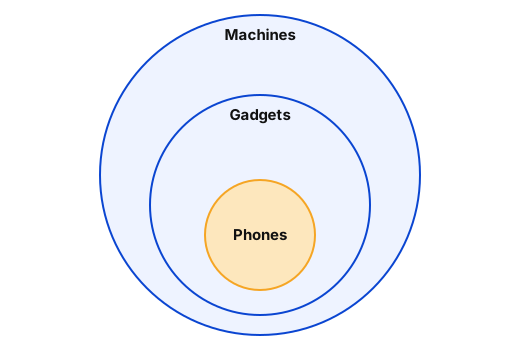
Concept: Draw the smallest set inside the bigger sets (Venn method).

  1. All phones are gadgets, all gadgets are machines → Phones inside Gadgets inside Machines.
  2. I: All phones are machines — true, since the Phones circle lies wholly inside Machines.
  3. II: All machines are gadgets — not certain; the Machines circle is bigger than Gadgets.

Trick: All A are B + All B are C ⇒ All A are C; but the reverse (All C are B) never follows.

Answer: (D) Only conclusion I follows

अवधारणा: वेन आरेख में छोटे समूह को बड़े समूह के अंदर बनाइए।

  1. सभी phones, gadgets हैं और सभी gadgets, machines हैं → Phones, Gadgets के अंदर और Gadgets, Machines के अंदर।
  2. I: All phones are machines — सही, Phones का वृत्त पूरी तरह Machines के अंदर है।
  3. II: All machines are gadgets — निश्चित नहीं; Machines का वृत्त बड़ा है।

ट्रिक: All A are B + All B are C ⇒ All A are C; उल्टा (All C are B) कभी नहीं निकलता।

उत्तर: (D) केवल निष्कर्ष I अनुसरण करता है

SSC CPO Paper IGeneral Intelligence and ReasoningSyllogismSSC CPO Paper I 2022 · 11 Nov Shift 2
Q954.
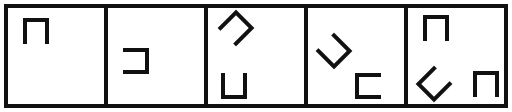
Select the figure that will come next in the following figure series.
उस आकृति का चयन कीजिए जो निम्नलिखित आकृति श्रृंखला में आगे आएगी।
  1. A
  2. B
  3. C
  4. D
Show answer

Concept: Track each element separately: every existing bracket rotates 90∘ clockwise in the next figure and a new element is added.

  1. The bracket ⊓ (open downward) becomes ⊐ (open left), then ⊔ (open up), then ⊏ (open right), then ⊓ again — each step 90∘ clockwise.
  2. The chevron (added in figure 3) also turns 90∘ clockwise in each step.
  3. In figure 5 there are two ⊓ brackets and a chevron; in figure 6 both ⊓ become ⊐ and the chevron turns once more.
  4. Only option (C) shows both brackets as ⊐ with the chevron in the correct new orientation.

Trick: In figure series, follow one element at a time — rotation direction first, then position.

Answer: (C) Option (C)

अवधारणा: प्रत्येक तत्व को अलग से देखें: हर ब्रैकेट अगली आकृति में 90∘ दक्षिणावर्त (clockwise) घूमता है और एक नया तत्व जुड़ता है।

  1. ब्रैकेट ⊓ (नीचे खुला) → ⊐ (बाएँ खुला) → ⊔ (ऊपर खुला) → ⊏ (दाएँ खुला) → ⊓; हर चरण में 90∘ clockwise।
  2. शेवरॉन (आकृति 3 में जुड़ा) भी हर चरण में 90∘ clockwise घूमता है।
  3. आकृति 5 में दो ⊓ और एक शेवरॉन हैं; अगली आकृति में दोनों ⊓ → ⊐ और शेवरॉन एक बार और घूमेगा।
  4. केवल विकल्प (C) में दोनों ब्रैकेट ⊐ हैं और शेवरॉन सही दिशा में है।

ट्रिक: आकृति श्रृंखला में एक-एक तत्व को देखें — पहले घूमने की दिशा, फिर स्थान।

उत्तर: (C) विकल्प (C)

SSC CPO Paper IGeneral Intelligence and ReasoningFigure SeriesSSC CPO Paper I 2022 · 11 Nov Shift 2
Q955.
Based on the position in the English alphabetical order, three of the following letter- clusters are alike in some manner and one is different. Select the odd letter-cluster.
अंग्रेज़ी वर्णमाला क्रम में स्थिति के आधार पर, निम्नलिखित चार अक्षर-समूहों में से तीन किसी प्रकार से एकसमान हैं और एक उनसे भिन्न है। उस असंगत अक्षर-समूह का चयन कीजिए।
  1. AQUXZ
  2. BGKOQ
  3. CAEIK
  4. DKOSU
Show answer

Concept: Find the gaps between consecutive letters of each cluster.

  1. GKOQ: G(7) → K(11) → O(15) → Q(17): +4, +4, +2
  2. AEIK: +4, +4, +2; KOSU: +4, +4, +2
  3. QUXZ: Q(17) → U(21) → X(24) → Z(26): +4, +3, +2 — different

Trick: Write the alphabet positions under the letters; the pattern of gaps reveals the odd one quickly.

Answer: (A) QUXZ

अवधारणा: प्रत्येक समूह के लगातार अक्षरों का अंतर निकालें।

  1. GKOQ: G(7) → K(11) → O(15) → Q(17): +4, +4, +2
  2. AEIK: +4, +4, +2; KOSU: +4, +4, +2
  3. QUXZ: Q(17) → U(21) → X(24) → Z(26): +4, +3, +2 — अलग

ट्रिक: अक्षरों के नीचे उनकी स्थिति-संख्या लिखें; अंतर का पैटर्न तुरंत विषम बता देता है।

उत्तर: (A) QUXZ

SSC CPO Paper IGeneral Intelligence and ReasoningOdd One Out (Letters)SSC CPO Paper I 2022 · 11 Nov Shift 2
Q956.
In a code language, ‘you are tall’ is coded as 'la da ma', 'you workout daily' is coded as 'la pa ka', and 'daily workout makes you tall' is coded as 'ka pa ja la ma'. What is the code for the word 'makes'?
एक कूट भाषा में, 'you are tall' को 'la da ma' के रूप में कूटबद्ध किया जाता है, 'you workout daily' को 'la pa ka' के रूप में कूटबद्ध किया जाता है, और 'daily workout makes you tall' को 'ka pa ja la ma' के रूप में कूटबद्ध किया जाता है। शब्द 'makes' का कूट क्या है?
  1. Ama
  2. Bja
  3. Cla
  4. Dpa
Show answer

Concept: Compare common words and common codes between sentences.

  1. 'you are tall' and 'daily workout makes you tall' share 'you, tall' → codes 'la, ma'.
  2. 'you workout daily' and 'daily workout makes you tall' share 'you, workout, daily' → 'la, pa, ka'.
  3. In the third sentence, the codes left after removing la, ma, pa, ka are 'ja'.
  4. So 'makes' = ja.

Trick: The only word that appears in just one sentence gets the only code that also appears just once there.

Answer: (B) ja

अवधारणा: वाक्यों के सामान्य शब्दों और सामान्य कोडों की तुलना करें।

  1. 'you are tall' और 'daily workout makes you tall' में 'you, tall' सामान्य → कोड 'la, ma'।
  2. 'you workout daily' और तीसरे वाक्य में 'you, workout, daily' सामान्य → 'la, pa, ka'।
  3. तीसरे वाक्य में la, ma, pa, ka हटाने पर 'ja' बचता है।
  4. अतः 'makes' = ja।

ट्रिक: जो शब्द केवल एक वाक्य में है, उसका कोड वही होगा जो वहाँ अकेला बचे।

उत्तर: (B) ja

SSC CPO Paper IGeneral Intelligence and ReasoningCoding-Decoding (Words)SSC CPO Paper I 2022 · 11 Nov Shift 2
Q957.
Which of the following letter-clusters will replace the question mark (?) in the given series to make it logically complete?
AZX, CBZ, EDB, GFD, ?
निम्नलिखित में से कौन-सा अक्षर-समूह दी गई शृंखला को तार्किक रूप से पूर्ण करने के लिए प्रश्न चिह्न (?) के स्थान पर आएगा?
AZX, CBZ, EDB, GFD, ?
  1. AIHF
  2. BIFH
  3. CFHI
  4. DJHF
Show answer

Concept: Check each position of the clusters separately.

  1. 1st letters: A, C, E, G, I (+2)
  2. 2nd letters: Z, B, D, F, H (+2)
  3. 3rd letters: X, Z, B, D, F (+2)
  4. Next cluster = IHF

Trick: Position-wise series: each column moves +2 with wrap-around after Z.

Answer: (A) IHF

अवधारणा: प्रत्येक स्थान के अक्षरों को अलग-अलग देखें।

  1. पहले अक्षर: A, C, E, G, I (+2)
  2. दूसरे अक्षर: Z, B, D, F, H (+2)
  3. तीसरे अक्षर: X, Z, B, D, F (+2)
  4. अगला समूह = IHF

ट्रिक: हर कॉलम +2 बढ़ता है; Z के बाद फिर A से शुरू।

उत्तर: (A) IHF

SSC CPO Paper IGeneral Intelligence and ReasoningLetter SeriesSSC CPO Paper I 2022 · 11 Nov Shift 2
Q958.
Two statements are given, followed by two conclusions numbered I and II. Assuming the statements to be true, even if they seem to be at variance with commonly known facts, decide which of the conclusions logically follow(s) from the statements.
Statements:
Some classes are theories.
Some theories are lessons.
Conclusions:
I. All classes can never be lessons.
II. All theories being classes is a possibility.
दो कथन दिए गए हैं, जिनके बाद दो निष्कर्ष I और II दिए गए हैं। कथनों को सत्य मानते हुए, भले ही वे सामान्य रूप से ज्ञात तथ्यों से भिन्न प्रतीत होते हों, निर्णय कीजिए कि कौन-सा/कौन-से निष्कर्ष तार्किक रूप से कथनों का अनुसरण करता है/करते हैं।
कथन:
कुछ कक्षाएँ, सिद्धांत हैं।
कुछ सिद्धांत, पाठ हैं।
निष्कर्ष:
I. सभी कक्षाएँ कभी भी पाठ नहीं हो सकतीं।
II. सभी सिद्धांतों के कक्षाएँ होने की संभावना है।
  1. AOnly conclusion I followsकेवल निष्कर्ष I अनुसरण करता है
  2. BBoth conclusions I and II followनिष्कर्ष I और II दोनों अनुसरण करते हैं
  3. COnly conclusion II followsकेवल निष्कर्ष II अनुसरण करता है
  4. DNeither conclusion I nor II followsन तो निष्कर्ष I और न ही II अनुसरण करता है
Show answer

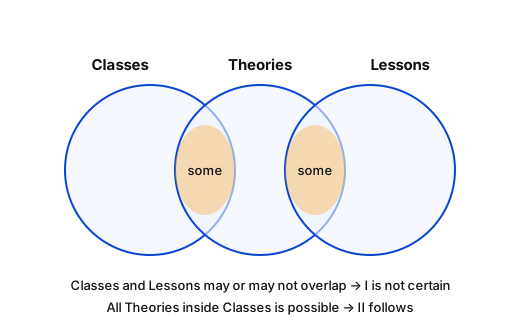
Concept: With 'some' statements, a definite conclusion must be true in every diagram; a possibility needs only one valid diagram.

  1. Classes–Theories overlap and Theories–Lessons overlap; Classes and Lessons have no direct relation.
  2. I: 'All classes can never be lessons' means no class is a lesson — not certain (they may overlap). I does not follow.
  3. II: Theories may lie completely inside Classes without breaking any statement, so the possibility is true. II follows.

Trick: No direct link between two terms → both 'some' and 'no' are only possibilities, never certainties.

Answer: (C) Only conclusion II follows

अवधारणा: 'Some' कथनों में निश्चित निष्कर्ष हर आरेख में सत्य होना चाहिए; संभावना के लिए एक वैध आरेख पर्याप्त है।

  1. Classes–Theories और Theories–Lessons में आंशिक संबंध है; Classes और Lessons में कोई सीधा संबंध नहीं।
  2. I: 'All classes can never be lessons' अर्थात् कोई class, lesson नहीं — निश्चित नहीं। I अनुसरण नहीं करता।
  3. II: सभी Theories, Classes के अंदर हो सकती हैं — कोई कथन नहीं टूटता, अतः संभावना सत्य। II अनुसरण करता है।

ट्रिक: दो पदों में सीधा संबंध न हो तो 'some' और 'no' दोनों केवल संभावना हैं।

उत्तर: (C) केवल निष्कर्ष II अनुसरण करता है

SSC CPO Paper IGeneral Intelligence and ReasoningSyllogism (Possibility)SSC CPO Paper I 2022 · 11 Nov Shift 2
Q959.
Which letter-cluster will replace the question mark (?) to complete the given series? PYWB, MVYD, ?, GPCH, DMEJ
दी गई शृंखला को पूर्ण करने के लिए कौन-सा अक्षर-समूह प्रश्न चिह्न (?) के स्थान पर आएगा? PYWB, MVYD, ?, GPCH, DMEJ
  1. AJSBF
  2. BJTBF
  3. CJTBG
  4. DJSAF
Show answer

Concept: Analyse each letter position separately.

  1. 1st: P, M, J, G, D (−3)
  2. 2nd: Y, V, S, P, M (−3)
  3. 3rd: W, Y, A, C, E (+2)
  4. 4th: B, D, F, H, J (+2)
  5. Missing term = J S A F

Trick: Two columns go −3 and two go +2 — check the 3rd column across Z → A.

Answer: (D) JSAF

अवधारणा: प्रत्येक स्थान के अक्षर अलग-अलग देखें।

  1. पहला: P, M, J, G, D (−3)
  2. दूसरा: Y, V, S, P, M (−3)
  3. तीसरा: W, Y, A, C, E (+2)
  4. चौथा: B, D, F, H, J (+2)
  5. लुप्त पद = J S A F

ट्रिक: दो कॉलम −3 और दो +2 चलते हैं; तीसरे कॉलम में Z के बाद A आता है।

उत्तर: (D) JSAF

SSC CPO Paper IGeneral Intelligence and ReasoningLetter SeriesSSC CPO Paper I 2022 · 11 Nov Shift 2
Q960.
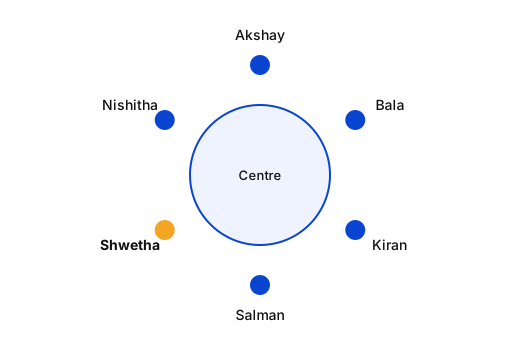
Six students are sitting around a circular table facing the centre. Salman is an
immediate neighbour of both Kiran and Shwetha. Bala is sitting second right to
Salman. Shwetha is sitting third to the left of Bala. Akshay is an immediate neighbour of both Bala and Nishitha. Who is the immediate neighbour of Nishitha and Salman?
छह विद्यार्थी एक वृत्ताकार मेज़ के चारों ओर केंद्र की ओर मुख करके बैठे हैं। सलमान, किरण और श्वेता दोनों का निकटतम पड़ोसी है।
बाला, सलमान के दाएँ से दूसरे स्थान पर बैठा है। श्वेता, बाला के बाएँ से तीसरे स्थान पर बैठी है।
अक्षय, बाला और निशिता दोनों का निकटतम पड़ोसी है। निशिता और सलमान का निकटतम पड़ोसी कौन है?
  1. ABalaबाला
  2. BKiranकिरण
  3. CShwethaश्वेता
  4. DAkshayअक्षय
Show answer

Concept: Facing the centre: right = anticlockwise, left = clockwise.

  1. Place Salman; Bala is 2nd to his right.
  2. Shwetha is 3rd to the left of Bala → she sits next to Salman on the other side.
  3. Salman's neighbours are Kiran and Shwetha → Kiran sits between Salman and Bala.
  4. Akshay sits next to Bala and Nishitha → order: Bala, Akshay, Nishitha, Shwetha.
  5. Shwetha is the neighbour of both Nishitha and Salman.

Trick: Fix the person mentioned most often first, then place others relative to him.

Answer: (C) Shwetha

अवधारणा: केंद्र की ओर मुख होने पर: दायाँ = वामावर्त (anticlockwise), बायाँ = दक्षिणावर्त (clockwise)।

  1. Salman को रखें; Bala उसके दाएँ से दूसरे स्थान पर।
  2. Shwetha, Bala के बाएँ से तीसरे स्थान पर → Salman के दूसरी ओर।
  3. Salman के पड़ोसी Kiran और Shwetha → Kiran, Salman और Bala के बीच।
  4. Akshay, Bala और Nishitha के बीच → क्रम: Bala, Akshay, Nishitha, Shwetha।
  5. Nishitha और Salman दोनों की पड़ोसी Shwetha है।

ट्रिक: जिस व्यक्ति का नाम सबसे अधिक आए, उसे पहले स्थिर करें।

उत्तर: (C) Shwetha

SSC CPO Paper IGeneral Intelligence and ReasoningCircular ArrangementSSC CPO Paper I 2022 · 11 Nov Shift 2