Q1101.Six students are sitting around a circular table facing the centre. Sonal is sitting
second to the right of Lavanya. Rana is sitting second to the right of Sonal. Karishma is sitting third to the right of Rana. Mary is an immediate neighbour of both Rana and Sonal. Who is sitting immediate right of Kumari?
छह विद्यार्थी एक वृत्ताकार मेज़ के चारों ओर केंद्र की ओर मुख करके बैठे हैं। Sonal, Lavanya के दाईं ओर दूसरे स्थान पर
बैठी है। Rana, Sonal के दाईं ओर दूसरे स्थान पर बैठा है। Karishma, Rana के दाईं ओर तीसरे स्थान पर बैठी है। Mary, Rana और Sonal दोनों की निकटतम पड़ोसी है। Kumari के ठीक दाईं ओर कौन बैठा है?
- AMary
- BKarishma
- CRana
- DLavanya
Show answer
Concept: When people sit around a table facing the centre, their right is the anticlockwise direction.
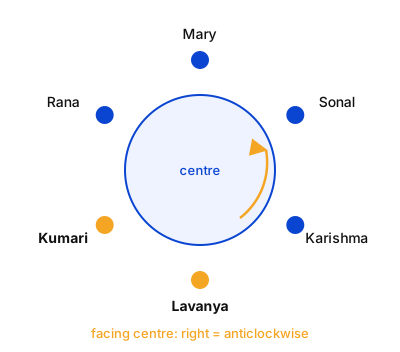
- Fix Lavanya. Sonal is 2nd to her right, Rana is 2nd to the right of Sonal.
- Karishma is 3rd to the right of Rana, i.e. exactly opposite him — she sits between Lavanya and Sonal.
- Mary is between Rana and Sonal; the only empty seat (between Rana and Lavanya) goes to Kumari.
- Moving one seat to the right (anticlockwise) from Kumari we reach Lavanya.
Trick: In a 6-seat circle, '3rd to the right' always means the person directly opposite.
Answer: (D) Lavanya
अवधारणा: केंद्र की ओर मुख करके बैठे लोगों के लिए दायाँ = वामावर्त (anticlockwise) दिशा।
- Lavanya को स्थिर करें। Sonal उसके दाएँ दूसरे स्थान पर, Rana, Sonal के दाएँ दूसरे स्थान पर।
- Karishma, Rana के दाएँ तीसरे स्थान पर = ठीक सामने, यानी Lavanya और Sonal के बीच।
- Mary, Rana और Sonal के बीच; बची हुई सीट (Rana और Lavanya के बीच) Kumari की।
- Kumari से एक सीट दाएँ (वामावर्त) जाने पर Lavanya मिलती है।
ट्रिक: 6 लोगों के वृत्त में 'दाएँ तीसरा' हमेशा ठीक सामने वाला व्यक्ति होता है।
उत्तर: (D) Lavanya
SSC CPO Paper IGeneral Intelligence and ReasoningCircular Seating ArrangementSSC CPO Paper I 2022 · 10 Nov Shift 2
Q1102.From its nest, a bird flew 25 m towards the north-east. It then took a right turn and flew 7 m. Again, it took a right turn and flew 75 m. In which direction is the bird now from its nest?
अपने घोंसले से, एक पक्षी उत्तर-पूर्व की ओर 25 m उड़ा। फिर उसने दाएँ मुड़कर 7 m उड़ान भरी। फिर से, उसने दाएँ मुड़कर 75 m उड़ान भरी। पक्षी अब अपने घोंसले से किस दिशा में है?
- ANorth-Eastउत्तर-पूर्व
- BEastपूर्व
- CSouth-Westदक्षिण-पश्चिम
- DNorth-Westउत्तर-पश्चिम
Show answer
Concept: Turning right from North-East points South-East; turning right again points South-West. Compare the net movement along the NE–SW line.
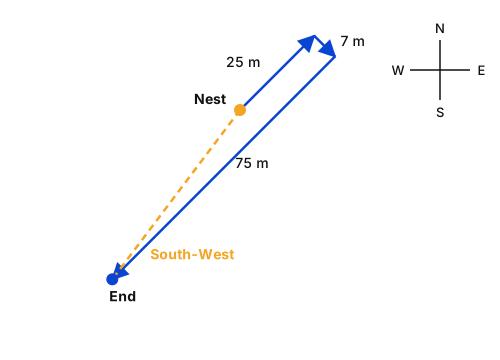
- 25 m towards NE, then 7 m towards SE, then 75 m towards SW.
- Along the NE–SW line: m, i.e. 50 m towards SW.
- Along the SE line the bird is only 7 m — small compared with 50 m.
- So the final point lies in the South-West direction from the nest.
Trick: Each right turn = rotate the direction by clockwise: NE → SE → SW.
Answer: (C) South-West
अवधारणा: North-East से दाएँ मुड़ने पर South-East, फिर दाएँ मुड़ने पर South-West दिशा मिलती है। NE–SW रेखा पर कुल दूरी देखें।
- 25 m NE, फिर 7 m SE, फिर 75 m SW।
- NE–SW रेखा पर: m, यानी 50 m SW की ओर।
- SE दिशा में केवल 7 m — 50 m की तुलना में बहुत कम।
- इसलिए पक्षी घोंसले से South-West दिशा में है।
ट्रिक: हर दायाँ मोड़ = दिशा घड़ी की दिशा में: NE → SE → SW।
उत्तर: (C) South-West
SSC CPO Paper IGeneral Intelligence and ReasoningDirection SenseSSC CPO Paper I 2022 · 10 Nov Shift 2
Q1103.Which of the following numbers will replace the question mark (?) in the given series? 13, 26, 23, 115, 108, ?
दी गई श्रृंखला में प्रश्न चिह्न (?) के स्थान पर निम्नलिखित में से कौन-सी संख्या आएगी? 13, 26, 23, 115, 108, ?
- A1118
- B1818
- C1881
- D1188
Show answer
Concept: The terms alternately multiply and subtract by consecutive prime numbers.
- ,
- ,
- Next:
Trick: Operators used: ×2, −3, ×5, −7, ×11 — primes 2, 3, 5, 7, 11 in order.
Answer: (D) 1188
अवधारणा: पद बारी-बारी से क्रमागत अभाज्य संख्याओं (prime numbers) से गुणा और घटाए गए हैं।
- ,
- ,
- अगला:
ट्रिक: प्रयुक्त संख्याएँ: 2, 3, 5, 7, 11 — क्रम से अभाज्य संख्याएँ।
उत्तर: (D) 1188
SSC CPO Paper IGeneral Intelligence and ReasoningNumber SeriesSSC CPO Paper I 2022 · 10 Nov Shift 2
Q1104.Select the option that represents the correct order of the given words as they would appear in an English dictionary.
1.Tattoo
2.Tatters
3.Tatting
4.Tattle
5.Taut
उस विकल्प का चयन कीजिए जो दिए गए शब्दों के उस सही क्रम को दर्शाता है, जिस क्रम में वे अंग्रेज़ी शब्दकोश में आते हैं।
1.Tattoo
2.Tatters
3.Tatting
4.Tattle
5.Taut
- A2, 3, 4, 1, 5
- B2, 4, 5, 3, 1
- C5, 4, 3, 2, 1
- D4, 5, 1, 2, 3
Show answer
Concept: Compare words letter by letter; the first differing letter decides the order.
- Tatters, Tatting, Tattle, Tattoo all start with 'Tatt'; the 5th letters are e, i, l, o → Tatters, Tatting, Tattle, Tattoo.
- Taut: 3rd letter 'u' comes after 't', so Taut is last.
- Order: Tatters (2), Tatting (3), Tattle (4), Tattoo (1), Taut (5).
Trick: Group words with a common prefix first, then sort only by the next letter.
Answer: (A) 2, 3, 4, 1, 5
अवधारणा: शब्दों की अक्षर-दर-अक्षर तुलना करें; पहला अलग अक्षर क्रम तय करता है।
- Tatters, Tatting, Tattle, Tattoo सब 'Tatt' से शुरू; 5वें अक्षर e, i, l, o → Tatters, Tatting, Tattle, Tattoo।
- Taut: तीसरा अक्षर 'u', जो 't' के बाद आता है, इसलिए Taut अंतिम।
- क्रम: Tatters (2), Tatting (3), Tattle (4), Tattoo (1), Taut (5)।
ट्रिक: पहले समान prefix वाले शब्द समूह बनाएँ, फिर केवल अगले अक्षर से क्रम लगाएँ।
उत्तर: (A) 2, 3, 4, 1, 5
SSC CPO Paper IGeneral Intelligence and ReasoningDictionary OrderSSC CPO Paper I 2022 · 10 Nov Shift 2
Q1105.Select the set in which the numbers are related in the same way as are the numbers of the given sets.
(NOTE : Operations should be performed on the whole numbers, without breaking
down the numbers into its constituent digits. E.g. 13 – Operations on 13 such as
adding /subtracting /multiplying etc. to 13 can be performed. Breaking down 13 into 1 and 3 and then performing mathematical operations on 1 and 3 is not allowed.)
(16, 22, 28)
(14, 19, 23)
उस समुच्चय का चयन कीजिए जिसमें संख्याएँ उसी प्रकार संबंधित हैं, जिस प्रकार दिए गए समुच्चयों की संख्याएँ संबंधित हैं।
(नोट: संक्रियाएँ संख्याओं को उनके घटक अंकों में विभाजित किए बिना, पूर्ण संख्याओं पर की जानी चाहिए। उदाहरण के लिए 13 – 13 पर संक्रियाएँ, जैसे 13 में जोड़ना/घटाना/गुणा करना आदि की जा सकती हैं। 13 को 1 और 3 में विभाजित करना और फिर 1 और 3 पर गणितीय संक्रियाएँ करना वर्जित है।)
(16, 22, 28)
(14, 19, 23)
- A(12, 18, 25)
- B(13, 21, 27)
- C(15, 26, 31)
- D(17, 24, 41)
Show answer
Concept: Find one rule that links the three numbers in both given sets.
- Rule: first + second − third = 10.
- Check options: (15, 26, 31) → ✓; others give 5, 7 and 0.
Trick: When the gaps differ between sets, try (a + b − c) or (a + c − b) — a constant result is the key.
Answer: (C) (15, 26, 31)
अवधारणा: दोनों दिए गए समुच्चयों की तीनों संख्याओं को जोड़ने वाला एक नियम खोजें।
- नियम: पहली + दूसरी − तीसरी = 10।
- विकल्प जाँचें: (15, 26, 31) → ✓; बाकी 5, 7 और 0 देते हैं।
ट्रिक: अंतर अलग-अलग हों तो (a + b − c) जैसा नियम आज़माएँ — परिणाम स्थिर मिले तो वही नियम है।
उत्तर: (C) (15, 26, 31)
SSC CPO Paper IGeneral Intelligence and ReasoningNumber Set RelationSSC CPO Paper I 2022 · 10 Nov Shift 2
Q1106.Two statements are given followed by Three conclusions numbered I, II and III.
Assuming the statements to be true, even if they seem to be at variance with
commonly known facts, decide which of the conclusions logically follow(s) from the statements.
Statements:
All bags are pens
All pencils are pens
Conclusions:
I. Some pens are bags.
II. All bags are pencils.
III. Some pens are pencils
दो कथन दिए गए हैं, जिनके बाद I, II और III से संख्यांकित तीन निष्कर्ष दिए गए हैं।
कथनों को सत्य मानते हुए, भले ही वे सामान्य रूप से ज्ञात तथ्यों से भिन्न प्रतीत होते हों, निर्णय लीजिए कि कौन-सा/से निष्कर्ष तार्किक रूप से कथनों का अनुसरण करता है/करते हैं।
कथन:
सभी बैग, पेन हैं
सभी पेंसिल, पेन हैं
निष्कर्ष:
I. कुछ पेन, बैग हैं।
II. सभी बैग, पेंसिल हैं।
III. कुछ पेन, पेंसिल हैं
- ABoth conclusions II and III follow.निष्कर्ष II और III दोनों अनुसरण करते हैं।
- BConclusions I, II and III follow.निष्कर्ष I, II और III अनुसरण करते हैं।
- CBoth conclusions I and II follow.निष्कर्ष I और II दोनों अनुसरण करते हैं।
- DBoth conclusions I and III follow.निष्कर्ष I और III दोनों अनुसरण करते हैं।
Show answer
Concept: 'All A are B' can be converted to 'Some B are A'. Two groups lying inside the same circle need not overlap.
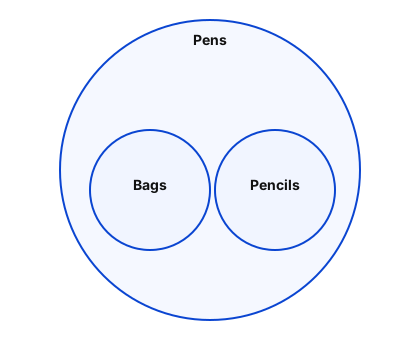
- All bags are pens → Some pens are bags. I follows.
- Bags and pencils are both inside pens but no link between them is given → II (All bags are pencils) does not follow.
- All pencils are pens → Some pens are pencils. III follows.
Trick: All A are B ⇒ Some B are A (always true). Two 'All … are X' statements never connect the two subjects.
Answer: (D) Both conclusions I and III follow.
अवधारणा: 'All A are B' को 'Some B are A' में बदला जा सकता है। एक ही बड़े वृत्त के अंदर के दो समूह आपस में मिलें, यह ज़रूरी नहीं।
- All bags are pens → Some pens are bags। I सही।
- Bags और pencils दोनों pens के अंदर हैं, पर उनमें कोई संबंध नहीं दिया → II (All bags are pencils) गलत।
- All pencils are pens → Some pens are pencils। III सही।
ट्रिक: All A are B ⇒ Some B are A हमेशा सही। दो 'All … are X' कथन दोनों subjects को नहीं जोड़ते।
उत्तर: (D) Both conclusions I and III follow.
SSC CPO Paper IGeneral Intelligence and ReasoningSyllogismSSC CPO Paper I 2022 · 10 Nov Shift 2
Q1107.Select the set in which the numbers are related in the same way as are the numbers of the given sets.
(NOTE : Operations should be performed on the whole numbers, without breaking
down the numbers into its constituent digits. E.g. 13 – Operations on 13 such as
adding /subtracting /multiplying etc. to 13 can be performed. Breaking down 13 into 1 and 3 and then performing mathematical operations on 1 and 3 is not allowed.)
(2, 28, 4)
(3, 22, 2)
उस समुच्चय का चयन कीजिए जिसमें संख्याएँ उसी प्रकार संबंधित हैं, जिस प्रकार दिए गए समुच्चयों की संख्याएँ संबंधित हैं।
(नोट: संक्रियाएँ संख्याओं को उनके घटक अंकों में विभाजित किए बिना, पूर्ण संख्याओं पर की जानी चाहिए। उदाहरण के लिए 13 – 13 पर संक्रियाएँ, जैसे 13 में जोड़ना/घटाना/गुणा करना आदि की जा सकती हैं। 13 को 1 और 3 में विभाजित करना और फिर 1 और 3 पर गणितीय संक्रियाएँ करना वर्जित है।)
(2, 28, 4)
(3, 22, 2)
- A(6, 29, 3)
- B(1, 10, 5)
- C(7, 32, 2 )
- D(4, 31, 3)
Show answer
Concept: Look for a rule giving the middle number from the outer numbers.
- :
- :
- Rule: middle .
- : ✓; (6, 29, 3) → 39, (1, 10, 5) → 29, (7, 32, 2) → 38.
Trick: If middle numbers are big, test weighted sums like of the outer numbers.
Answer: (D) (4, 31, 3)
अवधारणा: बाहरी दो संख्याओं से बीच की संख्या बनाने वाला नियम खोजें।
- :
- :
- नियम: बीच की संख्या ।
- : ✓; (6, 29, 3) → 39, (1, 10, 5) → 29, (7, 32, 2) → 38।
ट्रिक: बीच की संख्या बड़ी हो तो बाहरी संख्याओं का जैसा भारित योग आज़माएँ।
उत्तर: (D) (4, 31, 3)
SSC CPO Paper IGeneral Intelligence and ReasoningNumber Set RelationSSC CPO Paper I 2022 · 10 Nov Shift 2
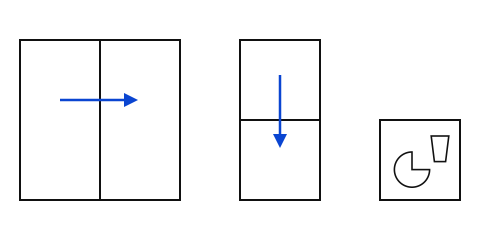
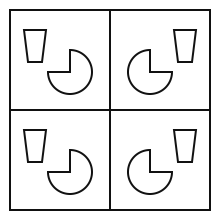
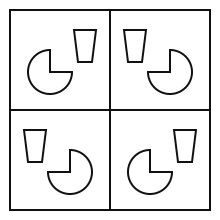
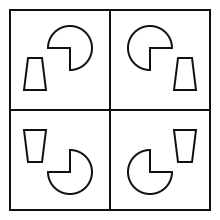
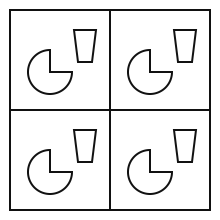
Q1108.A paper is folded and cut as shown below. How will it appear when unfolded?
एक कागज़ को नीचे दर्शाए अनुसार मोड़ा और काटा जाता है। खोलने पर यह कैसा दिखाई देगा?
- A
- B
- C
- D
Show answer
Concept: Every fold acts like a mirror: on unfolding, the cut appears again as a mirror image across each fold line.
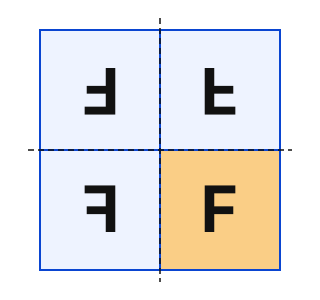
- The paper is folded left onto right, then top onto bottom, so the cut lies in the bottom-right quarter.
- Opening the second fold: the top-right quarter gets the cut flipped upside down.
- Opening the first fold: the left half gets a left–right mirror image of the right half.
- So each quarter shows the design reflected across the fold lines, exactly as in option (C).
Trick: Check one quarter at a time: neighbours across a fold line must be mirror images of each other.
Answer: (C) the third figure
अवधारणा: हर मोड़ (fold) दर्पण की तरह काम करता है: खोलने पर कट उसी मोड़-रेखा के पार दर्पण-प्रतिबिंब के रूप में दोबारा दिखता है।
- कागज़ पहले बाएँ से दाएँ, फिर ऊपर से नीचे मोड़ा गया, इसलिए कट नीचे-दाएँ चौथाई में है।
- दूसरा मोड़ खोलने पर ऊपर-दाएँ चौथाई में वही कट उल्टा (ऊपर-नीचे पलटा) दिखेगा।
- पहला मोड़ खोलने पर बायाँ आधा, दाएँ आधे का बाएँ-दाएँ दर्पण-प्रतिबिंब होगा।
- चारों भागों में डिज़ाइन fold-रेखाओं के पार प्रतिबिंबित है — विकल्प (C) जैसा।
ट्रिक: एक-एक चौथाई जाँचें: fold-रेखा के आर-पार के भाग एक-दूसरे के दर्पण-प्रतिबिंब होने चाहिए।
उत्तर: (C) तीसरी आकृति
SSC CPO Paper IGeneral Intelligence and ReasoningPaper Folding and CuttingSSC CPO Paper I 2022 · 10 Nov Shift 2
Q1109.Three Statements are given followed by four conclusions numbered 1, 2, 3,and 4.
Assuming the statements to be true, even if they seem to be at variance with
commonly known facts, decide which of the conclusions logically does NOT follow(s) from the statements.
Statements:
All K are S.
No S is a B.
Some B are T.
Conclusions:
1) No K are B.
2) Some T are not S.
3) Some T are B.
4) All B being K is a possibility.
तीन कथन दिए गए हैं, जिनके बाद 1, 2, 3 और 4 से संख्यांकित चार निष्कर्ष दिए गए हैं।
कथनों को सत्य मानते हुए, भले ही वे सामान्य रूप से ज्ञात तथ्यों से भिन्न प्रतीत होते हों, निर्णय लीजिए कि कौन-सा निष्कर्ष तार्किक रूप से कथनों का अनुसरण नहीं करता है।
कथन:
सभी K, S हैं।
कोई S, B नहीं है।
कुछ B, T हैं।
निष्कर्ष:
1) कोई K, B नहीं है।
2) कुछ T, S नहीं हैं।
3) कुछ T, B हैं।
4) सभी B के K होने की संभावना है।
- AOnly 2 does not follow.केवल 2 अनुसरण नहीं करता है।
- BOnly 1 does not follow.केवल 1 अनुसरण नहीं करता है।
- COnly 3 does not follow.केवल 3 अनुसरण नहीं करता है।
- DOnly 4 does not follow.केवल 4 अनुसरण नहीं करता है।
Show answer
Concept: A definite 'No' relation between two groups rules out every possibility of them overlapping.
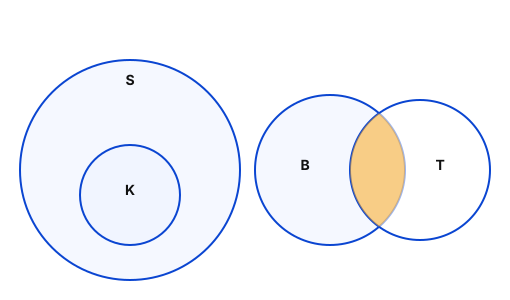
- All K are S and No S is B ⇒ No K is B. So 1 follows.
- Some B are T, and no B is S ⇒ those T which are B are not S ⇒ Some T are not S. 2 follows.
- Some B are T ⇒ Some T are B. 3 follows.
- Since No K is B, 'All B being K' is impossible. 4 does NOT follow.
Trick: A 'possibility' conclusion fails whenever it contradicts a definite 'No' already derived.
Answer: (D) Only 4 does not follow.
अवधारणा: दो समूहों में निश्चित 'No' संबंध हो तो उनके overlap की कोई संभावना नहीं रहती।
- All K are S और No S is B ⇒ No K is B। अतः 1 सही।
- Some B are T, और कोई B, S नहीं ⇒ जो T, B हैं वे S नहीं ⇒ Some T are not S। 2 सही।
- Some B are T ⇒ Some T are B। 3 सही।
- No K is B है, इसलिए 'All B being K' असंभव। 4 सही नहीं।
ट्रिक: Possibility वाला निष्कर्ष तब गलत होता है जब वह किसी निश्चित 'No' संबंध के विरुद्ध हो।
उत्तर: (D) Only 4 does not follow.
SSC CPO Paper IGeneral Intelligence and ReasoningSyllogismSSC CPO Paper I 2022 · 10 Nov Shift 2
Q1110.‘B & D’ means ‘B is the brother of D’.
'B × D’ means ‘B is the mother of D’.
‘B # D’ means ‘B is the wife of D’.
‘B $ D’ means ‘B is the son of D’.
‘B @ D’ means ‘B is the mother of D’.
How is B related to G in the following expression?
A × B # F $ C @ E # G
‘B & D’ का अर्थ है ‘B, D का भाई है’।
‘B × D’ का अर्थ है ‘B, D की माँ है’।
‘B # D’ का अर्थ है ‘B, D की पत्नी है’।
‘B $ D’ का अर्थ है ‘B, D का पुत्र है’।
‘B @ D’ का अर्थ है ‘B, D की माँ है’।
निम्नलिखित व्यंजक में B, G से किस प्रकार संबंधित है?
A × B # F $ C @ E # G
- AWife’s brother’s wifeपत्नी के भाई की पत्नी
- BSiblingसहोदर
- CAuntचाची/मौसी
- DMotherमाँ
Show answer
Concept: Decode each symbol one link at a time and build a family tree.
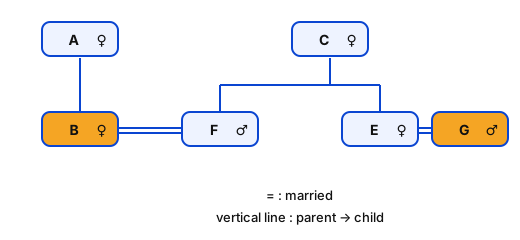
- A × B: A is the mother of B. B # F: B is the wife of F.
- F $ C: F is the son of C. C @ E: C is the mother of E — so E and F are siblings.
- E # G: E is the wife of G. E is a female, so she is F's sister.
- G's wife is E, E's brother is F, and F's wife is B.
Trick: Read the chain from G back to B: wife → brother → wife.
Answer: (A) Wife’s brother’s wife
अवधारणा: हर चिह्न को एक-एक करके डिकोड करें और वंश-वृक्ष (family tree) बनाएँ।
- A × B: A, B की माँ है। B # F: B, F की पत्नी है।
- F $ C: F, C का पुत्र है। C @ E: C, E की माँ है — अतः E और F भाई-बहन।
- E # G: E, G की पत्नी है; E स्त्री है, यानी F की बहन।
- G की पत्नी E, E का भाई F, और F की पत्नी B।
ट्रिक: G से B तक श्रृंखला पढ़ें: पत्नी → भाई → पत्नी।
उत्तर: (A) Wife’s brother’s wife
SSC CPO Paper IGeneral Intelligence and ReasoningCoded Blood RelationSSC CPO Paper I 2022 · 10 Nov Shift 2
Q1111.Select the set in which the numbers are related in the same way as are the numbers of the given sets.
(NOTE : Operations should be performed on the whole numbers, without breaking
down the numbers into its constituent digits. E.g. 13 – Operations on 13 such as
adding /subtracting /multiplying etc. to 13 can be performed. Breaking down 13 into 1 and 3 and then performing mathematical operations on 1 and 3 is not allowed.)
(7, 12, 25)
(6, 9, 21)
उस समुच्चय का चयन कीजिए जिसमें संख्याएँ उसी प्रकार संबंधित हैं, जिस प्रकार दिए गए समुच्चयों की संख्याएँ संबंधित हैं।
(नोट: संक्रियाएँ संख्याओं को उनके घटक अंकों में विभाजित किए बिना, पूर्ण संख्याओं पर की जानी चाहिए। उदाहरण के लिए 13 – 13 पर संक्रियाएँ, जैसे 13 में जोड़ना/घटाना/गुणा करना आदि की जा सकती हैं। 13 को 1 और 3 में विभाजित करना और फिर 1 और 3 पर गणितीय संक्रियाएँ करना वर्जित है।)
(7, 12, 25)
(6, 9, 21)
- A(9, 13, 24)
- B(5, 8, 19)
- C(8, 14, 24)
- D(4, 11, 20)
Show answer
Concept: Find a rule linking the third number to the first two.
- Rule: third = first + second + 6.
- : ✓; (9, 13, 24) needs 28, (8, 14, 24) needs 28, (4, 11, 20) needs 21.
Trick: Subtract the sum of the first two from the third: 25 − 19 = 6 and 21 − 15 = 6 — a constant gap.
Answer: (B) (5, 8, 19)
अवधारणा: तीसरी संख्या को पहली दो से जोड़ने वाला नियम खोजें।
- नियम: तीसरी = पहली + दूसरी + 6।
- : ✓; (9, 13, 24) में 28, (8, 14, 24) में 28, (4, 11, 20) में 21 चाहिए।
ट्रिक: तीसरी संख्या में से पहली दो का योग घटाएँ: 25 − 19 = 6, 21 − 15 = 6 — स्थिर अंतर।
उत्तर: (B) (5, 8, 19)
SSC CPO Paper IGeneral Intelligence and ReasoningNumber Set RelationSSC CPO Paper I 2022 · 10 Nov Shift 2
Q1112.Which option represents the correct order of the given words as they would appear in the English dictionary?
1 Pelvic
2 Pentagon
3 Permanent
4 Persistent
5 Perceive
कौन-सा विकल्प दिए गए शब्दों के उस सही क्रम को दर्शाता है, जिस क्रम में वे अंग्रेज़ी शब्दकोश में आते हैं?
1 Pelvic
2 Pentagon
3 Permanent
4 Persistent
5 Perceive
- A1,2,4,3,5
- B1,3,2,4,5
- C1,2,3,4,5
- D1,2,5,3,4
Show answer
Concept: Arrange by the first letter that differs.
- Pel- < Pen- < Per-: Pelvic (1), Pentagon (2), then the 'Per' words.
- Among Perceive, Permanent, Persistent the 4th letters are c, m, s → Perceive (5), Permanent (3), Persistent (4).
- Order: 1, 2, 5, 3, 4.
Trick: All five start with 'Pe' — sort by 3rd letter (l, n, r), then break the 'Per' tie with the 4th letter.
Answer: (D) 1, 2, 5, 3, 4
अवधारणा: पहले अलग अक्षर के आधार पर क्रम लगाएँ।
- Pel- < Pen- < Per-: Pelvic (1), Pentagon (2), फिर 'Per' वाले शब्द।
- Perceive, Permanent, Persistent में चौथे अक्षर c, m, s → Perceive (5), Permanent (3), Persistent (4)।
- क्रम: 1, 2, 5, 3, 4।
ट्रिक: सभी 'Pe' से शुरू — तीसरे अक्षर (l, n, r) से क्रम, फिर 'Per' वालों में चौथे अक्षर से।
उत्तर: (D) 1, 2, 5, 3, 4
SSC CPO Paper IGeneral Intelligence and ReasoningDictionary OrderSSC CPO Paper I 2022 · 10 Nov Shift 2
Q1113.There are six children playing ludo, namely 1, 2, 3, 4, 5, and 6. 1 and 5 are brothers. 6 is the sister of 5. 3 is the only son of 1's father’s brother. 2 and 4 are the daughters of the only brother of 3's father. How is 4 related to 1?
छह बच्चे लूडो खेल रहे हैं, जिनके नाम 1, 2, 3, 4, 5 और 6 हैं। 1 और 5 भाई हैं। 6, 5 की बहन है। 3, 1 के पिता के भाई का इकलौता पुत्र है। 2 और 4, 3 के पिता के इकलौते भाई की पुत्रियाँ हैं। 4, 1 से किस प्रकार संबंधित है?
- ASisterबहन
- BUncleचाचा
- CNieceभतीजी
- DCousinचचेरी बहन (Cousin)
Show answer
Concept: Identify the two brothers (the fathers) first; then place the children under them.
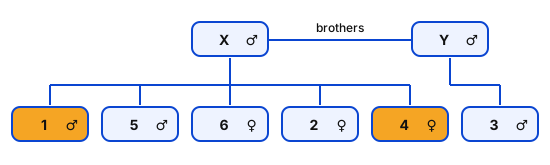
- 1 and 5 are brothers; 6 is their sister.
- 3 is the only son of 1's father's brother — so 3's father is the brother of 1's father.
- The only brother of 3's father is therefore 1's father. His daughters are 2 and 4.
- So 4 is a daughter of 1's father, i.e. 4 is 1's sister.
Trick: 'Father's brother's son' = cousin, but 'the brother of my cousin's father' = my own father.
Answer: (A) Sister
अवधारणा: पहले दोनों भाइयों (पिताओं) को पहचानें, फिर बच्चों को उनके नीचे रखें।
- 1 और 5 भाई हैं; 6 उनकी बहन है।
- 3, 1 के पिता के भाई का इकलौता पुत्र है — यानी 3 के पिता, 1 के पिता के भाई हैं।
- 3 के पिता का इकलौता भाई = 1 के पिता। 2 और 4 उनकी पुत्रियाँ हैं।
- इसलिए 4, 1 के पिता की पुत्री = 1 की बहन।
ट्रिक: 'पिता के भाई का पुत्र' = cousin, पर 'cousin के पिता का भाई' = अपने ही पिता।
उत्तर: (A) Sister (बहन)
SSC CPO Paper IGeneral Intelligence and ReasoningBlood RelationSSC CPO Paper I 2022 · 10 Nov Shift 2
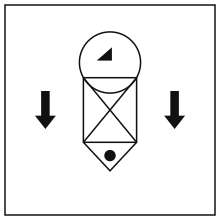
Q1114.Select the figure that will replace the question mark (?) in the following figure series.
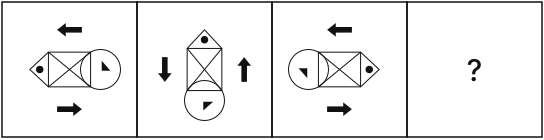
निम्नलिखित आकृति श्रृंखला में प्रश्न चिह्न (?) के स्थान पर आने वाली आकृति का चयन कीजिए।
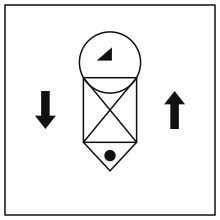
- A
- B
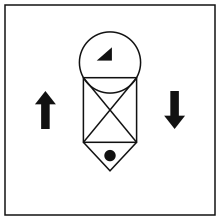
- C
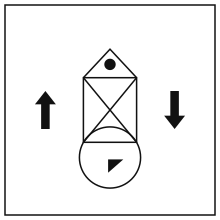
- D
Show answer
Concept: Track the rotation of the main shape and the direction of the arrows separately.
- The shape (pointed end with a dot, round end with a small triangle) rotates 90° clockwise each step: dot-end at left → top → right → next at the bottom.
- So in the 4th figure the pointed end with the dot is at the bottom and the round end is at the top.
- The two arrows always circulate anticlockwise: in a vertical figure the left arrow points down and the right arrow points up (as in figure 2).
- Option (A) satisfies both.
Trick: Figures 1 and 3 are opposite positions of the same rotation — so figure 4 must be the opposite of figure 2.
Answer: (A) the first figure
अवधारणा: मुख्य आकृति का घूमना और तीरों की दिशा अलग-अलग देखें।
- आकृति (बिंदु वाला नुकीला सिरा, छोटे त्रिभुज वाला गोल सिरा) हर चरण में 90° दक्षिणावर्त घूमती है: बिंदु वाला सिरा बाएँ → ऊपर → दाएँ → अगला नीचे।
- चौथी आकृति में बिंदु वाला नुकीला सिरा नीचे और गोल सिरा ऊपर होगा।
- दोनों तीर हमेशा वामावर्त घूमते हैं: खड़ी आकृति में बायाँ तीर नीचे और दायाँ तीर ऊपर (आकृति 2 जैसा)।
- विकल्प (A) दोनों शर्तें पूरी करता है।
ट्रिक: आकृति 1 और 3 एक ही घूर्णन की विपरीत स्थितियाँ हैं — इसलिए आकृति 4, आकृति 2 की उलटी होगी।
उत्तर: (A) पहली आकृति
SSC CPO Paper IGeneral Intelligence and ReasoningFigure SeriesSSC CPO Paper I 2022 · 10 Nov Shift 2
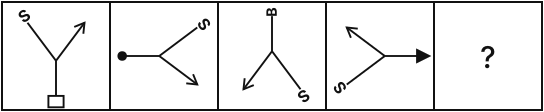
Q1115.Select the figure from among the given options that can replace the question mark (?) in the following series.
दिए गए विकल्पों में से उस आकृति का चयन कीजिए जो निम्नलिखित श्रृंखला में प्रश्न चिह्न (?) को प्रतिस्थापित कर सकती है।
- A
- B
- C
- D
Show answer
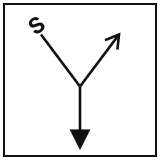
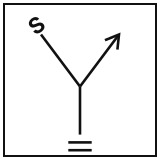
Concept: The three-armed figure rotates 90° clockwise every step, while the symbol at the end of the stem changes each time.
- Stem direction: down → left → up → right → next down again.
- The wavy 'S' arm moves clockwise with the figure: upper-left → upper-right → lower-right → lower-left → next upper-left; the open arrow arm takes the other side (upper-right in figure 5).
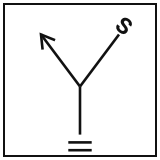
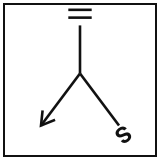
- The stem end gets a new mark each time (square, dot, B, filled arrow) — option (D) shows a new mark ‘=’, while (C) repeats the filled arrow.
- Option (D): stem down, S arm upper-left, arrow upper-right.
Trick: In rotation series, follow one distinctive part (here the 'S' arm) — it alone fixes the answer quickly.
Answer: (D) the fourth figure
अवधारणा: तीन भुजाओं वाली आकृति हर चरण में 90° दक्षिणावर्त घूमती है, और तने (stem) के सिरे का चिह्न हर बार बदलता है।
- तने की दिशा: नीचे → बाएँ → ऊपर → दाएँ → अगली फिर नीचे।
- लहरदार 'S' भुजा भी दक्षिणावर्त चलती है: ऊपर-बाएँ → ऊपर-दाएँ → नीचे-दाएँ → नीचे-बाएँ → अगली ऊपर-बाएँ; खुले तीर वाली भुजा दूसरी ओर (ऊपर-दाएँ)।
- तने के सिरे पर हर बार नया चिह्न (वर्ग, बिंदु, B, भरा तीर) — विकल्प (D) में नया चिह्न ‘=’ है, जबकि (C) भरा तीर दोहराता है।
- विकल्प (D): तना नीचे, S भुजा ऊपर-बाएँ, तीर ऊपर-दाएँ।
ट्रिक: घूर्णन श्रृंखला में एक विशेष भाग (यहाँ 'S' भुजा) का पीछा करें — उत्तर जल्दी मिलता है।
उत्तर: (D) चौथी आकृति
SSC CPO Paper IGeneral Intelligence and ReasoningFigure SeriesSSC CPO Paper I 2022 · 10 Nov Shift 2
Q1116.Seven people, A, B, C, D, E, F and G, are sitting in a straight row facing the north. Only two people sit to the left of C. Only two people sit between A and B. B sits to the left of A. E is an immediate neighbour of A to the right. Only one person sits to the right of D. F is not an immediate neighbour of B. Who sits at the centre?
सात व्यक्ति, A, B, C, D, E, F और G, उत्तर की ओर मुख करके एक सीधी पंक्ति में बैठे हैं। C के बाईं ओर केवल दो व्यक्ति बैठे हैं। A और B के बीच केवल दो व्यक्ति बैठे हैं। B, A के बाईं ओर बैठा है। E, A का दाईं ओर निकटतम पड़ोसी है। D के दाईं ओर केवल एक व्यक्ति बैठा है। F, B का निकटतम पड़ोसी नहीं है। मध्य में कौन बैठा है?
- AC
- BE
- CD
- DA
Show answer
Concept: Number the seats 1 to 7 from left to right (all face north) and place the fixed persons first.
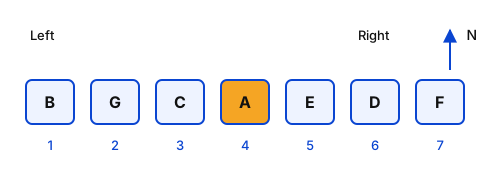
- Two people to the left of C → C at 3. Only one person to the right of D → D at 6.
- B and A have two people between them, B on the left, and E is immediately right of A. B = 1, A = 4, E = 5 is the only fit (B = 2 would put E at 6).
- Seats 2 and 7 remain for F and G; F is not next to B → F = 7, G = 2.
- Row: B G C A E D F. The centre seat 4 is A.
Trick: In a row of 7 the centre is seat 4 — place the 'fixed-count' clues (C, D) first.
Answer: (D) A
अवधारणा: सीटों को बाएँ से दाएँ 1 से 7 क्रमांक दें (सभी उत्तर की ओर मुख) और पहले निश्चित व्यक्तियों को रखें।
- C के बाएँ दो व्यक्ति → C सीट 3 पर। D के दाएँ केवल एक → D सीट 6 पर।
- B और A के बीच दो व्यक्ति, B बाएँ, और E, A के ठीक दाएँ। केवल B = 1, A = 4, E = 5 संभव (B = 2 से E सीट 6 पर जाएगा)।
- सीट 2 और 7 पर F, G; F, B का पड़ोसी नहीं → F = 7, G = 2।
- पंक्ति: B G C A E D F। बीच की सीट 4 पर A।
ट्रिक: 7 की पंक्ति में बीच = सीट 4; पहले संख्या वाले संकेत (C, D) रखें।
उत्तर: (D) A
SSC CPO Paper IGeneral Intelligence and ReasoningLinear Seating ArrangementSSC CPO Paper I 2022 · 10 Nov Shift 2
Q1117.Select the set in which the numbers are related in the same way as are the numbers of the following sets.
(NOTE : Operations should be performed on the whole numbers, without breaking
down the numbers into its constituent digits. E.g. 13- Operations on 13 such as adding /subtracting /multiplying etc. to 13 can be performed. Breaking down 13 into 1 and 3 and then performing mathematical operations on 1 and 3 is not allowed.)
(14, 25, 38)
(8, 19, 32)
उस समुच्चय का चयन कीजिए जिसमें संख्याएँ उसी प्रकार संबंधित हैं, जिस प्रकार निम्नलिखित समुच्चयों की संख्याएँ संबंधित हैं।
(नोट: संक्रियाएँ संख्याओं को उनके घटक अंकों में विभाजित किए बिना, पूर्ण संख्याओं पर की जानी चाहिए। उदाहरण के लिए 13 – 13 पर संक्रियाएँ, जैसे 13 में जोड़ना/घटाना/गुणा करना आदि की जा सकती हैं। 13 को 1 और 3 में विभाजित करना और फिर 1 और 3 पर गणितीय संक्रियाएँ करना वर्जित है।)
(14, 25, 38)
(8, 19, 32)
- A(24, 35, 46)
- B(6, 17, 30)
- C(15, 28, 41)
- D(13, 26, 37)
Show answer
Concept: Check the differences between consecutive numbers of each set.
- : ,
- : ,
- : , ✓
- Others: (24, 35, 46) → 11, 11; (15, 28, 41) → 13, 13; (13, 26, 37) → 13, 11.
Trick: Same pair of gaps (+11, +13) in both sets ⇒ just test gaps in the options.
Answer: (B) (6, 17, 30)
अवधारणा: हर समुच्चय में क्रमागत संख्याओं का अंतर देखें।
- : ,
- : ,
- : , ✓
- बाकी: (24, 35, 46) → 11, 11; (15, 28, 41) → 13, 13; (13, 26, 37) → 13, 11।
ट्रिक: दोनों समुच्चयों में अंतर (+11, +13) समान ⇒ विकल्पों में केवल अंतर जाँचें।
उत्तर: (B) (6, 17, 30)
SSC CPO Paper IGeneral Intelligence and ReasoningNumber Set RelationSSC CPO Paper I 2022 · 10 Nov Shift 2
Q1118.Based on the position in the English alphabetical order, three of the following letter- clusters are alike in some manner and one is different. Select the odd letter-cluster.
अंग्रेज़ी वर्णमाला क्रम में स्थिति के आधार पर, निम्नलिखित में से तीन अक्षर-समूह किसी प्रकार से एकसमान हैं और एक असंगत है। असंगत अक्षर-समूह का चयन कीजिए।
- ABEIL
- BLOSV
- CFIMP
- DJMPT
Show answer
Concept: Write alphabet positions and check the gaps.
- BEIL: B(2) E(5) I(9) L(12) → +3, +4, +3
- LOSV: L(12) O(15) S(19) V(22) → +3, +4, +3
- FIMP: F(6) I(9) M(13) P(16) → +3, +4, +3
- JMPT: J(10) M(13) P(16) T(20) → +3, +3, +4 — different.
Trick: Learn E(5), J(10), O(15), T(20), Y(25) to find positions instantly.
Answer: (D) JMPT
अवधारणा: अक्षरों की वर्णमाला स्थिति लिखकर अंतर देखें।
- BEIL: B(2) E(5) I(9) L(12) → +3, +4, +3
- LOSV: L(12) O(15) S(19) V(22) → +3, +4, +3
- FIMP: F(6) I(9) M(13) P(16) → +3, +4, +3
- JMPT: J(10) M(13) P(16) T(20) → +3, +3, +4 — अलग।
ट्रिक: EJOTY (5, 10, 15, 20, 25) याद रखें — स्थिति तुरंत मिलती है।
उत्तर: (D) JMPT
SSC CPO Paper IGeneral Intelligence and ReasoningOdd One Out (Letters)SSC CPO Paper I 2022 · 10 Nov Shift 2
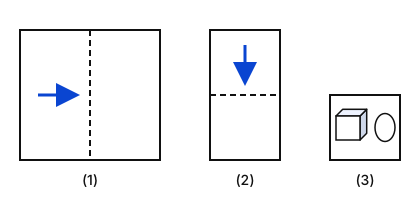
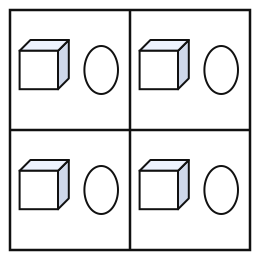
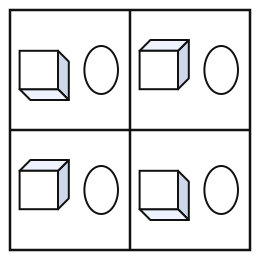
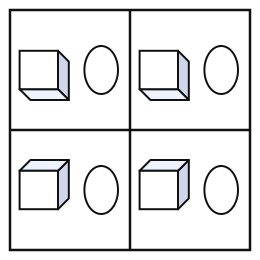
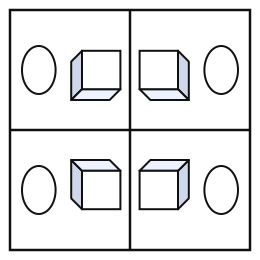
Q1119.The sequence of folding a piece of paper and the manner in which the folded paper has been cut is shown in the following figures. How would this paper look when unfolded?
एक कागज़ के टुकड़े को मोड़ने का क्रम और मोड़े गए कागज़ को काटने का तरीका निम्नलिखित आकृतियों में दर्शाया गया है। खोलने पर यह कागज़ कैसा दिखाई देगा?
- A
- B
- C
- D
Show answer
Concept: Every fold acts like a mirror: on unfolding, the cut appears again as a mirror image across each fold line.
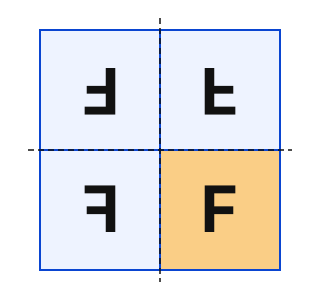
- The paper is folded left onto right and then top onto bottom, so the cut is in the bottom-right quarter.
- Unfolding the second fold: the top-right quarter shows the cube-and-oval cut flipped upside down.
- Unfolding the first fold: the left half is the left–right mirror image of the right half (oval on the outer side, cube near the middle line).
- This pattern matches option (D).
Trick: Shapes touching a fold line meet their own mirror image at that line.
Answer: (D) the fourth figure
अवधारणा: हर मोड़ (fold) दर्पण की तरह काम करता है: खोलने पर कट उसी मोड़-रेखा के पार दर्पण-प्रतिबिंब के रूप में दोबारा दिखता है।
- कागज़ पहले बाएँ से दाएँ और फिर ऊपर से नीचे मोड़ा गया, अतः कट नीचे-दाएँ चौथाई में है।
- दूसरा मोड़ खोलने पर ऊपर-दाएँ चौथाई में घन (cube) और अंडाकार कट ऊपर-नीचे पलटे दिखेंगे।
- पहला मोड़ खोलने पर बायाँ आधा, दाएँ आधे का बाएँ-दाएँ दर्पण-प्रतिबिंब होगा (अंडाकार बाहर की ओर, घन बीच की रेखा के पास)।
- यह विकल्प (D) से मेल खाता है।
ट्रिक: Fold-रेखा के पास की आकृति उसी रेखा पर अपने प्रतिबिंब से मिलती है।
उत्तर: (D) चौथी आकृति
SSC CPO Paper IGeneral Intelligence and ReasoningPaper Folding and CuttingSSC CPO Paper I 2022 · 10 Nov Shift 2
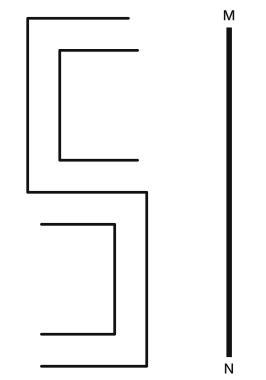
Q1120.Select the correct mirror image of the given figure when the mirror is placed at line MN as shown.
जब दर्पण को दर्शाए गए अनुसार रेखा MN पर रखा जाता है, तो दी गई आकृति के सही दर्पण प्रतिबिंब का चयन कीजिए।
- A

- B

- C

- D

Show answer
Concept: A vertical mirror (line MN) reverses left and right but keeps top and bottom unchanged.
- The mirror is on the right side of the figure, so every part keeps its height.
- The upper bracket opening towards the right will open towards the left in the image, and vice versa for the lower bracket.
- Parts nearer the mirror stay nearer the mirror in the image.
- Only option (C) shows this left–right reversal with the same up–down order.
Trick: Vertical mirror: only left ↔ right swaps; top stays top.
Answer: (C) the third figure
अवधारणा: खड़ा दर्पण (रेखा MN) बाएँ-दाएँ उलट देता है, ऊपर-नीचे वैसा ही रहता है।
- दर्पण आकृति के दाईं ओर है, इसलिए हर भाग की ऊँचाई वही रहती है।
- ऊपर वाला कोष्ठक जो दाईं ओर खुलता है, प्रतिबिंब में बाईं ओर खुलेगा; नीचे वाले के लिए उल्टा।
- जो भाग दर्पण के पास है, वह प्रतिबिंब में भी दर्पण के पास रहेगा।
- केवल विकल्प (C) में यही बाएँ-दाएँ उलटाव और वही ऊपर-नीचे क्रम है।
ट्रिक: खड़ा दर्पण: केवल बाएँ ↔ दाएँ बदलता है; ऊपर वाला ऊपर ही रहता है।
उत्तर: (C) तीसरी आकृति
SSC CPO Paper IGeneral Intelligence and ReasoningMirror ImageSSC CPO Paper I 2022 · 10 Nov Shift 2

