Q1301.Two trains - A and B- having the lengths 195 m and 165 m, respectively, are running in the same direction on parallel lines. If the speed of A and B be 77 km/h and 85 km/h, respectively, what will be the time (in seconds) taken by them to cross each other?
क्रमशः 195 m और 165 m लंबाई वाली दो रेलगाड़ियाँ - A और B - समानांतर पटरियों पर एक ही दिशा में चल रही हैं। यदि A और B की चाल क्रमशः 77 km/h और 85 km/h है, तो उनके द्वारा एक-दूसरे को पार करने में लिया गया समय (सेकंड में) कितना होगा?
- A162
- B164
- C160
- D166
Show answer
Concept: When two trains move in the same direction, relative speed = difference of speeds, and to cross each other they must cover the sum of their lengths.
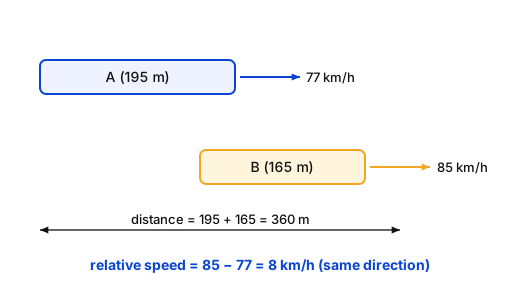
- Distance .
- Relative speed .
- Time .
Trick: Time (s) .
Answer: (A) seconds
अवधारणा: एक ही दिशा में चलने पर सापेक्ष चाल (relative speed) = चालों का अंतर; एक-दूसरे को पार करने के लिए दोनों की लंबाइयों का योग तय करना होता है।
- दूरी ।
- सापेक्ष चाल ।
- समय ।
ट्रिक: समय (सेकंड) — सीधे km/h से।
उत्तर: (A) सेकंड
SSC CPO Paper IQuantitative AptitudeTrains – same directionSSC CPO Paper I 2022 · 9 Nov Shift 1
Q1302.If , then the value of is:
यदि है, तो का मान है:
- A140
- B70
- C100
- D120
Show answer
Concept: If , then .
- .
- Put : .
- .
Trick: Subtract 5 from both sides first so that the same bracket appears everywhere.
Answer: (A)
अवधारणा: यदि हो, तो ।
- ।
- रखें: ।
- ।
ट्रिक: दोनों ओर से 5 घटाकर एक ही ब्रैकेट बना लें, फिर सूत्र लगाएँ।
उत्तर: (A)
SSC CPO Paper IQuantitative AptitudeAlgebraic identitiesSSC CPO Paper I 2022 · 9 Nov Shift 1
Q1303.A field is in the shape of a rectangle of length 90 m and breadth 75 m. In one corner of the field, a pit, which is 18 m long 15 m broad and 6 m deep, has been dug out. The earth taken out of it is evenly spread over the remaining part of the field. Find the rise in the level of the field?
एक खेत 90 m लंबाई और 75 m चौड़ाई वाले आयत के आकार का है। खेत के एक कोने में, 18 m लंबा, 15 m चौड़ा और 6 m गहरा एक गड्ढा खोदा गया है। इससे निकाली गई मिट्टी को खेत के शेष भाग पर समान रूप से फैला दिया जाता है। खेत के तल में हुई वृद्धि ज्ञात कीजिए।
- A27 cm
- B25 cm
- C28 cm
- D24 cm
Show answer
Concept: Volume of earth dug out = (area of remaining field) × (rise in level).
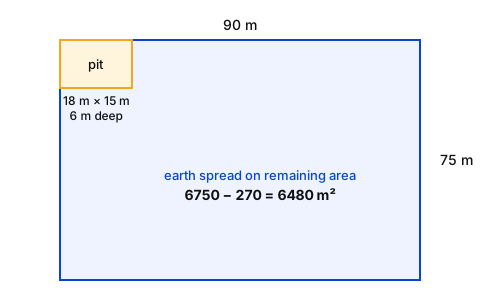
- Volume of pit .
- Field area ; pit area ; remaining .
- Rise .
Yaad rakhein: The earth is not spread on the pit itself, so always subtract the pit's area.
Answer: (B) cm
अवधारणा: निकाली गई मिट्टी का आयतन = (शेष खेत का क्षेत्रफल) × (स्तर में वृद्धि)।
- गड्ढे का आयतन ।
- खेत , गड्ढे का क्षेत्रफल , शेष ।
- वृद्धि ।
याद रखें: मिट्टी गड्ढे पर नहीं फैलाई जाती, इसलिए गड्ढे का क्षेत्रफल घटाना न भूलें।
उत्तर: (B) cm
SSC CPO Paper IQuantitative AptitudeMensuration – earth spreadSSC CPO Paper I 2022 · 9 Nov Shift 1
Q1304.A seller uses faulty weight in place of a 2 kg weight and earns a 25% profit. He claims that he is selling on the cost price in front of the customers but uses a faulty weight. How much error is there in the 2 kg weight to gain 25%?
एक विक्रेता 2 kg के बाट के स्थान पर दोषपूर्ण बाट का उपयोग करता है और 25% लाभ अर्जित करता है। वह ग्राहकों के सामने दावा करता है कि वह क्रय मूल्य पर बेच रहा है, परंतु दोषपूर्ण बाट का उपयोग करता है। 25% लाभ प्राप्त करने के लिए 2 kg के बाट में कितनी त्रुटि है?
- A250 g
- B400 g
- C500 g
- D300 g
Show answer
Concept: When goods are sold at cost price using a false weight, .
- Let actual weight given be kg while charging for kg.
- .
- Error .
Trick: 25% profit : error : true weight , so splits as .
Answer: (B) g
अवधारणा: क्रय मूल्य पर बेचकर झूठे बाट से लाभ: ।
- माना kg के पैसे लेकर वास्तव में kg दिया।
- ।
- त्रुटि ।
ट्रिक: 25% , अतः त्रुटि : वास्तविक भार ; kg ।
उत्तर: (B) g
SSC CPO Paper IQuantitative AptitudeFalse weightSSC CPO Paper I 2022 · 9 Nov Shift 1
Q1305.In the given figure (a circle with centre O and radius r, sector OAB shaded), the length of arc AB is equal to twice the length of radius r of the circle. Find the area of sector OAB in terms of the radius r.
दी गई आकृति (केंद्र O और त्रिज्या r वाला एक वृत्त, त्रिज्यखंड OAB छायांकित) में, चाप AB की लंबाई वृत्त की त्रिज्या r की लंबाई के दोगुने के बराबर है। त्रिज्या r के पदों में त्रिज्यखंड OAB का क्षेत्रफल ज्ञात कीजिए।
- A3r
- B2r
- Cπr2
- Dr2
Show answer
Concept: Area of a sector , where is the arc length.
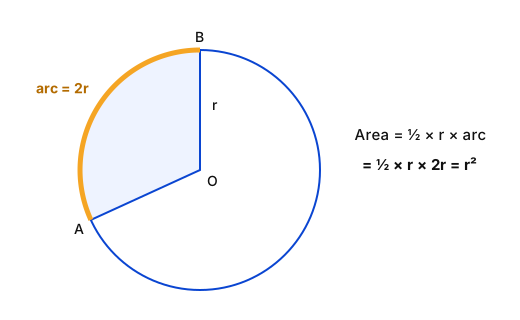
- Arc AB .
- Area of sector OAB .
Trick: With arc , the angle is radians and area .
Answer: (D)
अवधारणा: त्रिज्यखंड का क्षेत्रफल , जहाँ चाप की लंबाई है।
- चाप AB ।
- क्षेत्रफल ।
ट्रिक: चाप हो तो कोण रेडियन, क्षेत्रफल ।
उत्तर: (D)
SSC CPO Paper IQuantitative AptitudeArea of a sectorSSC CPO Paper I 2022 · 9 Nov Shift 1
Q1306.The angles of a triangle are in the ratio 1 : 1 : 2. What percentage of the total internal angle is the greatest angle?
एक त्रिभुज के कोण 1 : 1 : 2 के अनुपात में हैं। सबसे बड़ा कोण कुल आंतरिक कोण का कितना प्रतिशत है?
- A50%
- B65%
- C45%
- D40%
Show answer
Concept: Sum of the angles of a triangle is .
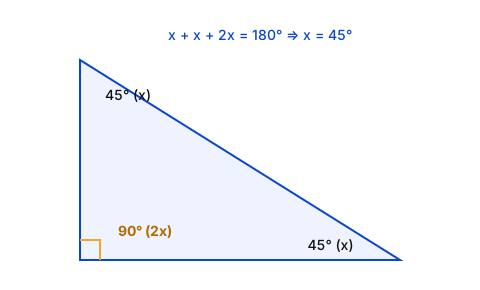
- Angles ; .
- Greatest angle .
- Percentage .
Trick: No need to find angles: greatest share .
Answer: (A)
अवधारणा: त्रिभुज के कोणों का योग होता है।
- कोण ; ।
- सबसे बड़ा कोण ।
- प्रतिशत ।
ट्रिक: सीधे अनुपात से: ।
उत्तर: (A)
SSC CPO Paper IQuantitative AptitudeAngles of a triangleSSC CPO Paper I 2022 · 9 Nov Shift 1
Q1307.The average salary of all the employees in a company is Rs.14,000. The average salary of 5 technicians is Rs.18,000 and the average salary of the rest is Rs.13,200. The total number of employees in the company is:
एक कंपनी के सभी कर्मचारियों का औसत वेतन Rs.14,000 है। 5 तकनीशियनों का औसत वेतन Rs.18,000 है और शेष कर्मचारियों का औसत वेतन Rs.13,200 है। कंपनी में कर्मचारियों की कुल संख्या है:
- A28
- B30
- C29
- D27
Show answer
Concept: Total deviation above the average must equal total deviation below it.
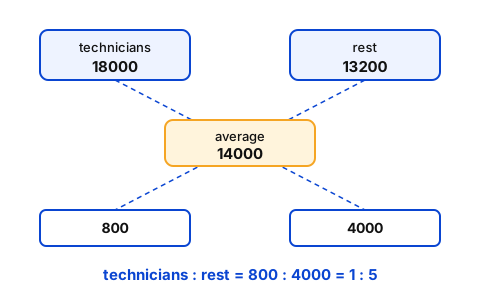
- Technicians are above the average by each: total .
- Others are below by each.
- Number of others ; total .
Trick: Alligation gives technicians : rest ; part , so total parts .
Answer: (B)
अवधारणा: औसत से ऊपर का कुल विचलन = औसत से नीचे का कुल विचलन।
- प्रत्येक technician औसत से अधिक: कुल ।
- शेष प्रत्येक कम।
- शेष ; कुल ।
ट्रिक: एलिगेशन: technicians : शेष ; भाग ⇒ कुल भाग ।
उत्तर: (B)
SSC CPO Paper IQuantitative AptitudeAverage – alligationSSC CPO Paper I 2022 · 9 Nov Shift 1
Q1308.Solve the following.
निम्नलिखित को हल कीजिए।
- A
- B
- C
- D
Show answer
Concept: Order: vinculum (bar) → brackets → 'of' → , → , .
- ; ; ; .
- ; ; bracket .
- Numerator .
- Denominator: ; , ; total .
- Value .
Trick: 'of' is done before : , not .
Answer: (C)
अवधारणा: क्रम: रेखा-कोष्ठक (vinculum) → कोष्ठक → 'of' → , → , ।
- ; ; ; ।
- ; ; कोष्ठक ।
- अंश ।
- हर: ; ; कुल ।
- मान ।
ट्रिक: 'of' को से पहले हल करें: ।
उत्तर: (C)
SSC CPO Paper IQuantitative AptitudeSimplification – BODMASSSC CPO Paper I 2022 · 9 Nov Shift 1
Q1309.A faulty weighing machine reads 1 kg when 900 gm is actually weighted on it. The
shopkeeper marked the price of his goods by 10%, but unfortunately he was caught by the metrology department and then they ordered him to repair his weighing machine and gave punishment to sell the goods at 10% discount on cost price for a month. If each customer is now paying ₹20 for 1 kg, then before the raid _______ amount they have paid for the same quantity. (Rounded off to two places of decimal)
एक दोषपूर्ण तौल मशीन पर वास्तव में 900 gm तौलने पर वह 1 kg दर्शाती है।
दुकानदार ने अपने माल का मूल्य 10% अधिक अंकित किया, परंतु दुर्भाग्यवश वह विधिक माप-विज्ञान विभाग द्वारा पकड़ा गया और फिर उन्होंने उसे अपनी तौल मशीन ठीक कराने का आदेश दिया तथा एक माह तक क्रय मूल्य पर 10% छूट पर माल बेचने का दंड दिया। यदि अब प्रत्येक ग्राहक 1 kg के लिए ₹20 का भुगतान कर रहा है, तो छापे से पहले उन्होंने उतनी ही मात्रा के लिए _______ राशि का भुगतान किया था। (दशमलव के दो स्थानों तक पूर्णांकित)
- A₹27.16
- B₹27.04
- C₹28.05
- D₹28.15
Show answer
Concept: Find the cost price per kg from the present selling price, then find what the customer paid earlier for a true 1 kg.
- Now: SP of CP ₹ ⇒ CP ₹ per kg.
- Before: price per 'kg' of CP ₹, but this bought only g.
- For a true kg: ₹.
Trick: In one line: .
Answer: (A) ₹
अवधारणा: वर्तमान विक्रय मूल्य से प्रति kg क्रय मूल्य निकालें, फिर पहले असली 1 kg के लिए ग्राहक ने कितना दिया, यह निकालें।
- अब: SP CP का ₹ ⇒ CP ₹ प्रति kg।
- पहले: 'kg' का मूल्य ₹, पर मिलता केवल g था।
- असली kg के लिए: ₹।
ट्रिक: एक पंक्ति में: ।
उत्तर: (A) ₹
SSC CPO Paper IQuantitative AptitudeFaulty weighing machine & discountSSC CPO Paper I 2022 · 9 Nov Shift 1
Q1310.In a school, the ratio of the number of boys and girls is 3 : 4, respectively. If the number of boys increases by 10% and the number of girls increases by 15%, then what will be the new ratio of the number of boys and the number of girls?
एक विद्यालय में, लड़कों और लड़कियों की संख्या का अनुपात क्रमशः 3 : 4 है। यदि लड़कों की संख्या में 10% की वृद्धि होती है और लड़कियों की संख्या में 15% की वृद्धि होती है, तो लड़कों की संख्या और लड़कियों की संख्या का नया अनुपात क्या होगा?
- A
- B
- C
- D
Show answer
Concept: Multiply each term of the ratio by its own growth factor.
- Boys .
- Girls .
- New ratio .
Trick: Write and : .
Answer: (C)
अवधारणा: अनुपात के हर पद को उसकी अपनी वृद्धि-गुणक से गुणा करें।
- लड़के ।
- लड़कियाँ ।
- नया अनुपात ।
ट्रिक: दशमलव हटाने के लिए दोनों को 10 से गुणा करें: ।
उत्तर: (C)
SSC CPO Paper IQuantitative AptitudeRatio – percentage changeSSC CPO Paper I 2022 · 9 Nov Shift 1
Q1311.∆ABC and ∆DEF are two triangles such that ∆ABC ≅ ∆FDE. If AB = 5 cm, ∠B = 40° and ∠A = 80°, then which of the following options is true?
∆ABC और ∆DEF दो त्रिभुज इस प्रकार हैं कि ∆ABC ≅ ∆FDE है। यदि AB = 5 cm, ∠B = 40° और ∠A = 80° है, तो निम्नलिखित में से कौन-सा विकल्प सत्य है?
- ADF = 5 cm, ∠E = 60°
- BDE = 5 cm, ∠F = 60°
- CDE = 5 cm, ∠D = 60°
- DDE = 5 cm, ∠E = 60°
Show answer
Concept: In the order of letters gives the correspondence: , , .
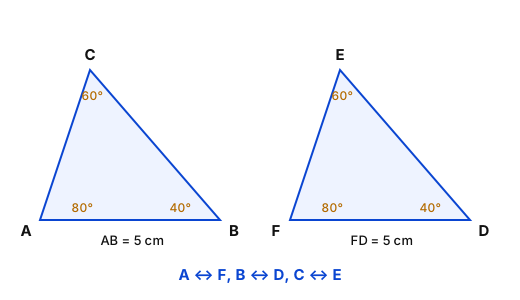
- corresponds to , so .
- and , so .
- corresponds to (not ), so options with are wrong.
Yaad rakhein: Match letters by position, not by alphabet.
Answer: (A) ,
अवधारणा: में अक्षरों का क्रम संगति बताता है: , , ।
- की संगत भुजा है, अतः ।
- और , अतः ।
- की संगत भुजा है, इसलिए वाले विकल्प गलत हैं।
याद रखें: अक्षरों को उनकी स्थिति (position) से मिलाएँ, वर्णमाला से नहीं।
उत्तर: (A) ,
SSC CPO Paper IQuantitative AptitudeCongruent trianglesSSC CPO Paper I 2022 · 9 Nov Shift 1
Q1312.There are three papers in an examination. Marks obtained by four students have been tabulated below:
Who are the students who got the highest marks in P1, P2 and P3 respectively?
| Student | P1 | P2 | P3 |
|---|
| Mohit | 79 | 78 | 77 |
| Shivam | 73 | 87 | 80 |
| Vishal | 82 | 74 | 83 |
| Viraj | 77 | 89 | 86 |
एक परीक्षा में तीन प्रश्न-पत्र हैं। चार विद्यार्थियों द्वारा प्राप्त अंकों को नीचे सारणीबद्ध किया गया है:
वे कौन-से विद्यार्थी हैं जिन्होंने क्रमशः P1, P2 और P3 में सर्वाधिक अंक प्राप्त किए?
| विद्यार्थी | P1 | P2 | P3 |
|---|
| मोहित | 79 | 78 | 77 |
| शिवम | 73 | 87 | 80 |
| विशाल | 82 | 74 | 83 |
| विराज | 77 | 89 | 86 |
- AViraj, Vishal, Mohitविराज, विशाल, मोहित
- BVishal, Viraj, Virajविशाल, विराज, विराज
- CShivam, Viraj, Vishalशिवम, विराज, विशाल
- DMohit, Viraj, Vishalमोहित, विराज, विशाल
Show answer
Concept: Scan each column separately and pick its largest entry.
- P1: → highest (Vishal).
- P2: → highest (Viraj).
- P3: → highest (Viraj).
Yaad rakhein: A student can top more than one paper — here Viraj tops both P2 and P3.
Answer: (B) Vishal, Viraj, Viraj
अवधारणा: हर कॉलम को अलग-अलग देखकर उसका सबसे बड़ा मान चुनें।
- P1: सबसे अधिक (Vishal)।
- P2: सबसे अधिक (Viraj)।
- P3: सबसे अधिक (Viraj)।
याद रखें: एक ही छात्र एक से अधिक पेपर में सबसे आगे हो सकता है — यहाँ Viraj।
उत्तर: (B) Vishal, Viraj, Viraj
SSC CPO Paper IQuantitative AptitudeData interpretation – tableSSC CPO Paper I 2022 · 9 Nov Shift 1
Q1313.To do a certain task X would take 3 times as long as Y and Z together; and Z would takes 4 times as long as Y and X together. Three of them together can complete the task in 10 days. How much time is taken by X and Z to complete the task?
किसी निश्चित कार्य को करने में X को, Y और Z द्वारा एक साथ लिए गए समय का 3 गुना समय लगेगा; और Z को, Y और X द्वारा एक साथ लिए गए समय का 4 गुना समय लगेगा। तीनों मिलकर उस कार्य को 10 दिनों में पूरा कर सकते हैं। X और Z द्वारा कार्य पूरा करने में कितना समय लिया जाता है?
- A days दिन
- B days दिन
- C days दिन
- D days दिन
Show answer
Concept: Convert the 'times as long' statements into rates: if X takes 3 times as long as (Y+Z), then .
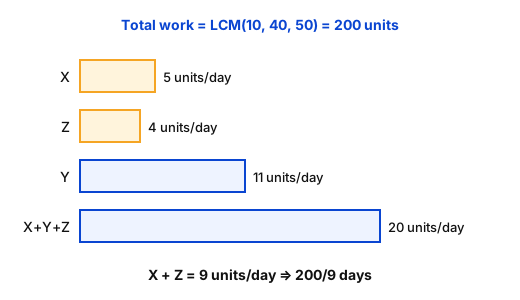
- Let total rate .
- .
- .
- ⇒ time days.
Trick: With total work units: all /day, X , Z ⇒ days.
Answer: (D) days
अवधारणा: 'X को (Y+Z) से 3 गुना समय लगता है' का अर्थ है (दक्षता में)।
- माना ।
- ।
- ।
- ⇒ समय दिन।
ट्रिक: कुल कार्य इकाई: सब मिलकर /दिन, X , Z ⇒ दिन।
उत्तर: (D) दिन
SSC CPO Paper IQuantitative AptitudeTime and workSSC CPO Paper I 2022 · 9 Nov Shift 1
Q1314.On a certain sum, the difference between compound interest and simple interest at 10% per annum for 2 years is Rs.250. The sum is _________.
किसी निश्चित धनराशि पर, 10% वार्षिक दर से 2 वर्षों के लिए चक्रवृद्धि ब्याज और साधारण ब्याज के बीच का अंतर Rs.250 है। धनराशि _________ है।
- ARs.25,450
- BRs.26,550
- CRs.25,000
- DRs.26,000
Show answer
Concept: For 2 years, .
- .
- .
Trick: At 10%, the 2-year difference is of the sum: sum .
Answer: (C) Rs.
अवधारणा: 2 वर्ष के लिए ।
- ।
- ।
ट्रिक: 10% पर 2 वर्ष का अंतर मूलधन का होता है।
उत्तर: (C) Rs.
SSC CPO Paper IQuantitative AptitudeCI – SI differenceSSC CPO Paper I 2022 · 9 Nov Shift 1
Q1315.If A is greater than B by 7, B is greater than C by 16, and A + B + C is 255, then the value of 3A + C – 4B is:
यदि A, B से 7 अधिक है, B, C से 16 अधिक है, और A + B + C = 255 है, तो 3A + C – 4B का मान है:
- A5
- B10
- C8
- D4
Show answer
Concept: Express all variables in terms of one and use the sum.
- , .
- ; , .
- .
Trick: — the sum is not even needed!
Answer: (A)
अवधारणा: सभी चरों को एक चर में लिखकर योग का प्रयोग करें।
- , ।
- ; , ।
- ।
ट्रिक: — योग की ज़रूरत ही नहीं!
उत्तर: (A)
SSC CPO Paper IQuantitative AptitudeLinear equationsSSC CPO Paper I 2022 · 9 Nov Shift 1
Q1316.Which of the following is a prime number?
निम्नलिखित में से कौन-सी एक अभाज्य संख्या है?
- A54
- B39
- C68
- D89
Show answer
Concept: A prime has no divisor other than 1 and itself; test primes up to .
- and are even; .
- : , and is not divisible by ⇒ prime.
Yaad rakhein: Check divisibility only by primes up to the square root.
Answer: (D)
अवधारणा: अभाज्य संख्या के केवल दो गुणनखंड होते हैं: 1 और स्वयं; तक के अभाज्यों से जाँचें।
- , सम हैं; ।
- किसी भी से विभाज्य नहीं ⇒ अभाज्य।
याद रखें: केवल वर्गमूल तक के अभाज्यों से भाग जाँचें।
उत्तर: (D)
SSC CPO Paper IQuantitative AptitudePrime numbersSSC CPO Paper I 2022 · 9 Nov Shift 1
Q1317.In an election between 2 parties A and B, A gets 37% of total votes cast and thus lost by 338 votes. The total number of casted votes is (assume none of the votes was
declared invalid):
2 दलों A और B के बीच एक चुनाव में, A को डाले गए कुल मतों का 37% प्राप्त होता है और इस प्रकार वह 338 मतों से हार जाता है। डाले गए मतों की कुल संख्या है (मान लीजिए कि कोई भी मत
अवैध घोषित नहीं किया गया था):
- A1300
- B1500
- C1200
- D1800
Show answer
Concept: Two candidates, no invalid votes: winner's share loser's share.
- B gets .
- Margin of total .
- Total .
Trick: Margin .
Answer: (A)
अवधारणा: दो उम्मीदवार, कोई अवैध मत नहीं: विजेता का हिस्सा हारने वाले का।
- B को मत।
- अंतर ।
- कुल ।
ट्रिक: अंतर ।
उत्तर: (A)
SSC CPO Paper IQuantitative AptitudePercentage – electionsSSC CPO Paper I 2022 · 9 Nov Shift 1
Q1318.Study the given graph and answer the question that follows.
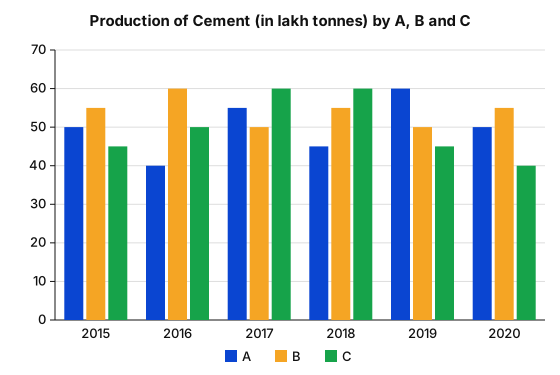
What is the difference between the production of Company C in 2015 and the production of Company B in 2018?
दिए गए ग्राफ़ का अध्ययन कीजिए और उसके बाद आने वाले प्रश्न का उत्तर दीजिए।
2015 में कंपनी C के उत्पादन और 2018 में कंपनी B के उत्पादन के बीच कितना अंतर है?
- A15,00,000 tonnes15,00,000 टन
- B1,00,000 tonnes1,00,000 टन
- C10,000 tonnes10,000 टन
- D10,00,000 tonnes10,00,000 टन
Show answer
Concept: Read both bars from the graph and convert lakh tonnes into tonnes ( lakh ).
- Company C in 2015 lakh tonnes.
- Company B in 2018 lakh tonnes.
- Difference lakh tonnes tonnes.
Yaad rakhein: Watch the unit — the axis is in lakh tonnes, so means .
Answer: (D) tonnes
अवधारणा: दोनों दंड पढ़कर लाख टन को टन में बदलें ( लाख )।
- 2015 में C लाख टन।
- 2018 में B लाख टन।
- अंतर लाख टन टन।
याद रखें: इकाई पर ध्यान दें — अक्ष लाख टन में है।
उत्तर: (D) टन
SSC CPO Paper IQuantitative AptitudeBar graphSSC CPO Paper I 2022 · 9 Nov Shift 1
Q1319.The least common multiple of a and b is 42. The LCM of 5a and 11b is :
a और b का लघुत्तम समापवर्त्य 42 है। 5a और 11b का LCM है:
- A2310
- B4620
- C210
- D462
Show answer
Concept: When and are not factors of or , .
- — no factor or .
- .
Yaad rakhein: New prime factors simply multiply into the LCM.
Answer: (A)
अवधारणा: यदि व , या के गुणनखंड नहीं हैं, तो ।
- — इसमें या नहीं।
- ।
याद रखें: नए अभाज्य गुणनखंड LCM में सीधे गुणा हो जाते हैं।
उत्तर: (A)
SSC CPO Paper IQuantitative AptitudeLCMSSC CPO Paper I 2022 · 9 Nov Shift 1
Q1320.A thief is spotted by a policeman from a distance of 250m. When the policeman starts the chase, the thief also starts running. Assuming that the speed of the thief is 10 km/h and that of the policeman is 12 km/h, how far would the thief have run before he is
caught?
एक पुलिसकर्मी 250m की दूरी से एक चोर को देखता है। जब पुलिसकर्मी पीछा करना शुरू करता है, तो चोर भी दौड़ना शुरू कर देता है। यह मानते हुए कि चोर की चाल 10 km/h और पुलिसकर्मी की चाल 12 km/h है, पकड़े जाने से पहले चोर कितनी दूरी तक
दौड़ चुका होगा?
- A4 km
- B1.25 km
- C3 km
- D2 km
Show answer
Concept: In a chase, the gap closes at the difference of speeds.
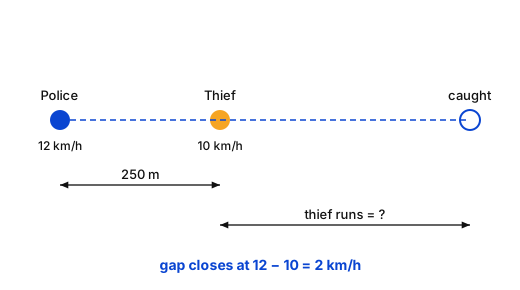
- Gap ; relative speed .
- Time to catch .
- Thief's distance .
Trick: Thief's run .
Answer: (B) km
अवधारणा: पीछा करने में दूरी चालों के अंतर से घटती है।
- दूरी ; सापेक्ष चाल ।
- पकड़ने का समय ।
- चोर की दूरी ।
ट्रिक: चोर की दूरी ।
उत्तर: (B) km
SSC CPO Paper IQuantitative AptitudeRelative speed – chaseSSC CPO Paper I 2022 · 9 Nov Shift 1

