Q1341.The following bar graph shows the production of various models of mobiles in the year 2019 and 2020. The total production is 40 lakhs during 2019 and 65 lakhs in 2020.
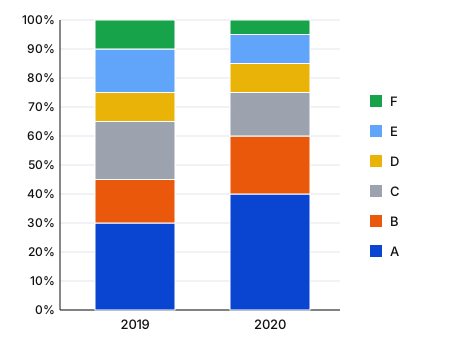
What is the total production of model A mobiles in 2020 and model E mobiles in 2019?
निम्नलिखित बार ग्राफ़ वर्ष 2019 और 2020 में मोबाइल के विभिन्न मॉडलों के उत्पादन को दर्शाता है। 2019 के दौरान कुल उत्पादन 40 लाख और 2020 में 65 लाख है।
2020 में मॉडल A के मोबाइलों और 2019 में मॉडल E के मोबाइलों का कुल उत्पादन कितना है?
- A39,00,000
- B32,00,000
- C36,00,000
- D21,00,000
Show answer
Concept: In a 100% stacked bar, each model's share upper edge lower edge of its segment.
- 2020, model A: to ⇒ of lakh lakh.
- 2019, model E: to ⇒ of lakh lakh.
- Total lakh .
Yaad rakhein: Read segment heights, not the top edge of the segment.
Answer: (B)
अवधारणा: 100% स्टैक्ड दंड में किसी मॉडल का हिस्सा खंड का ऊपरी किनारा निचला किनारा।
- 2020 में A: of लाख लाख।
- 2019 में E: of लाख लाख।
- कुल लाख ।
याद रखें: खंड की ऊँचाई पढ़ें, उसका ऊपरी किनारा नहीं।
उत्तर: (B)
SSC CPO Paper IQuantitative AptitudeStacked percentage bar graphSSC CPO Paper I 2022 · 9 Nov Shift 1
Q1342.The given graph shows the number (in hundreds) of trees axed in four cities during the period 2016-2020.
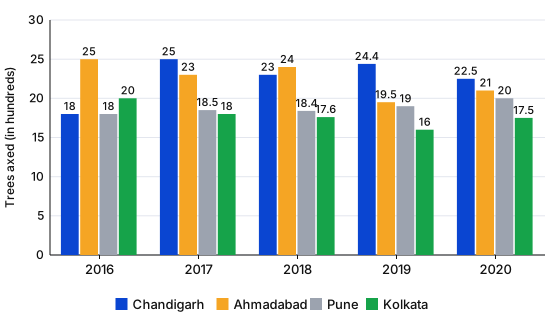
Find the year in which the least number of trees are axed.
दिया गया ग्राफ़ 2016-2020 की अवधि के दौरान चार शहरों में काटे गए पेड़ों की संख्या (सैकड़ों में) दर्शाता है।
वह वर्ष ज्ञात कीजिए जिसमें सबसे कम पेड़ काटे गए।
- A2016
- B2020
- C2019
- D2017
Show answer
Concept: Add the four cities for each year and pick the smallest total.
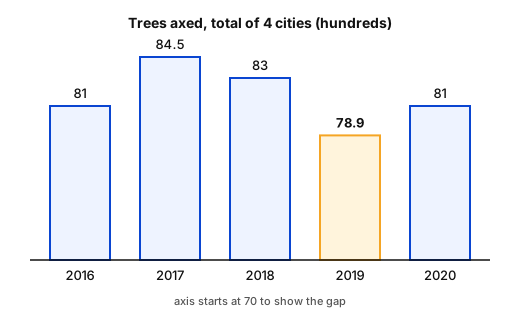
- 2016: ; 2017: .
- 2018: ; 2019: .
- 2020: . Least in 2019.
Yaad rakhein: 2019 has the lowest Kolkata bar () and no year makes it up elsewhere.
Answer: (C) 2019
अवधारणा: हर वर्ष चारों शहरों का योग करके सबसे कम चुनें।
- 2016: ; 2017: ।
- 2018: ; 2019: ।
- 2020: । न्यूनतम (2019)।
याद रखें: 2019 में Kolkata का दंड सबसे छोटा () है।
उत्तर: (C) 2019
SSC CPO Paper IQuantitative AptitudeBar graph – totalsSSC CPO Paper I 2022 · 9 Nov Shift 1
Q1343.A tradesman marks his goods at 26% above the cost price. He allows his customer a discount of 12% on the marked price. His profit per cent is:
एक व्यापारी अपने माल पर क्रय मूल्य से 26% अधिक मूल्य अंकित करता है। वह अपने ग्राहक को अंकित मूल्य पर 12% की छूट देता है। उसका लाभ प्रतिशत है:
- A10.88%
- B11.08%
- C10.50%
- D10%
Show answer
Concept: Net effect of then : .
- .
- Check: CP → MP → SP .
Trick: Successive change formula saves time.
Answer: (A)
अवधारणा: फिर का शुद्ध प्रभाव ।
- ।
- जाँच: ।
ट्रिक: क्रमिक परिवर्तन सूत्र से समय बचता है।
उत्तर: (A)
SSC CPO Paper IQuantitative AptitudeMarked price & discountSSC CPO Paper I 2022 · 9 Nov Shift 1
Q1344.If , , then what is the value of ?
यदि , है, तो का मान क्या है?
- A1
- B0
- C5
- D3
Show answer
Concept: and .
- .
- (as ).
- .
Trick: Add and take the root: .
Answer: (A)
अवधारणा: तथा ।
- ।
- ।
- ।
ट्रिक: जोड़ें और वर्गमूल लें: ।
उत्तर: (A)
SSC CPO Paper IQuantitative AptitudeAlgebraic identitiesSSC CPO Paper I 2022 · 9 Nov Shift 1
Q1345.If , then ?
यदि है, तो ?
- A1
- B0.5
- C−1
- D−0.5
Show answer
Concept: .
- Multiply numerator and denominator by : .
- So .
- .
Trick: : LHS for any , so try : .
Answer: (B)
अवधारणा: ।
- अंश-हर को से गुणा: ।
- अतः बायाँ पक्ष ।
- ।
ट्रिक: रखें: ।
उत्तर: (B)
SSC CPO Paper IQuantitative AptitudeTrigonometric identitiesSSC CPO Paper I 2022 · 9 Nov Shift 1
Q1346.In ΔABC, DE ∥ BC in such a way that A-D-B and A-E-C. If m⎿ACB = 40°, then m⎿DAE + m⎿ADE =_________.
ΔABC में, DE ∥ BC इस प्रकार है कि A-D-B और A-E-C हैं। यदि m⎿ACB = 40° है, तो m⎿DAE + m⎿ADE =_________ है।
- A240°
- B120°
- C140°
- D230°
Show answer
Concept: If , corresponding angles are equal: .
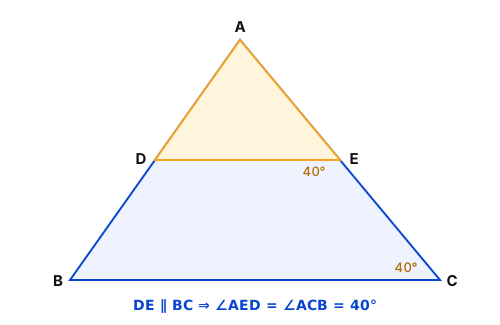
- .
- In : .
Trick: It equals of the big triangle .
Answer: (C)
अवधारणा: हो तो संगत कोण बराबर: ।
- ।
- में: ।
ट्रिक: यह बड़े त्रिभुज के के बराबर है।
उत्तर: (C)
SSC CPO Paper IQuantitative AptitudeBasic proportionality – anglesSSC CPO Paper I 2022 · 9 Nov Shift 1
Q1347.What is the volume of a cube whose surface area is 54 cm2?
उस घन का आयतन क्या है जिसका पृष्ठीय क्षेत्रफल 54 cm2 है?
- A28 cm3
- B3 cm3
- C27 cm3
- D9 cm3
Show answer
Concept: Surface area of a cube , volume .
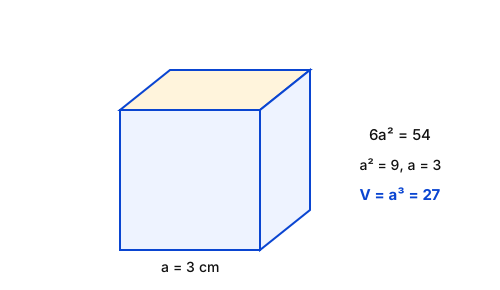
- .
- Volume .
Trick: .
Answer: (C)
अवधारणा: घन का पृष्ठीय क्षेत्रफल , आयतन ।
- ।
- आयतन ।
ट्रिक: ।
उत्तर: (C)
SSC CPO Paper IQuantitative AptitudeCube – volumeSSC CPO Paper I 2022 · 9 Nov Shift 1
Q1348. _______.
_______ है।
- A9
- B0
- C16
- D1
Show answer
Concept: .
- .
- .
Yaad rakhein: Take the common factor out first.
Answer: (C)
अवधारणा: ।
- ।
- ।
याद रखें: पहले उभयनिष्ठ गुणनखंड बाहर निकालें।
उत्तर: (C)
SSC CPO Paper IQuantitative AptitudeTrigonometric identitiesSSC CPO Paper I 2022 · 9 Nov Shift 1
Q1349.The cost of two varieties of tea is ₹300 and ₹375 respectively. If both the varieties of tea are mixed together in the ratio 3 : 2, then what should be the price of mixed variety of tea per kg?
दो किस्मों की चाय का मूल्य क्रमशः ₹300 और ₹375 है। यदि चाय की दोनों किस्मों को 3 : 2 के अनुपात में एक साथ मिलाया जाता है, तो मिश्रित किस्म की चाय का प्रति kg मूल्य क्या होना चाहिए?
- A₹340
- B₹330
- C₹350
- D₹360
Show answer
Concept: Price of mixture .
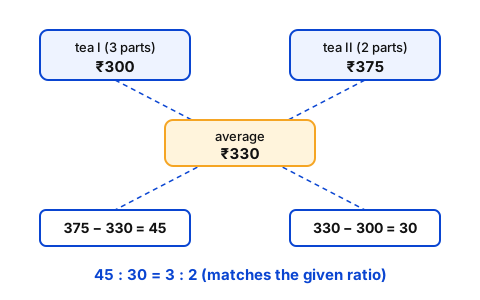
- .
- per kg.
Trick: .
Answer: (B) ₹
अवधारणा: मिश्रण का मूल्य ।
- ।
- प्रति kg।
ट्रिक: ।
उत्तर: (B) ₹
SSC CPO Paper IQuantitative AptitudeMixture – weighted averageSSC CPO Paper I 2022 · 9 Nov Shift 1
Q1350.The value of is:
का मान है:
- A2
- B0
- C
- D1
Show answer
Concept: , and .
- with .
- .
- Value .
Trick: Put : .
Answer: (A)
अवधारणा: तथा ।
- ।
- ।
- मान ।
ट्रिक: रखें: ।
उत्तर: (A)
SSC CPO Paper IQuantitative AptitudeTrigonometric identitiesSSC CPO Paper I 2022 · 9 Nov Shift 1
Q1351.Study the given histogram that shows the marks obtained by students in an examination and answer the question that follows.
(Histogram data: marks on the horizontal axis, number of students on the vertical axis)
| Marks | Number of Students |
|---|
| 150 – 200 | 30 |
| 200 – 250 | 45 |
| 250 – 300 | 60 |
| 300 – 350 | 35 |
| 350 – 400 | 40 |
| 400 – 450 | 35 |
The number of students who obtained less than 250 marks is what per cent more than the number of students who obtained 400 or more marks? (correct to one decimal place)
दिए गए आयतचित्र (histogram) का अध्ययन कीजिए, जो किसी परीक्षा में छात्रों द्वारा प्राप्त अंकों को दर्शाता है, और उसके बाद दिए गए प्रश्न का उत्तर दीजिए।
(आयतचित्र के आँकड़े: क्षैतिज अक्ष पर अंक, ऊर्ध्वाधर अक्ष पर छात्रों की संख्या)
| अंक | छात्रों की संख्या |
|---|
| 150 – 200 | 30 |
| 200 – 250 | 45 |
| 250 – 300 | 60 |
| 300 – 350 | 35 |
| 350 – 400 | 40 |
| 400 – 450 | 35 |
250 से कम अंक प्राप्त करने वाले छात्रों की संख्या, 400 या उससे अधिक अंक प्राप्त करने वाले छात्रों की संख्या से कितने प्रतिशत अधिक है? (दशमलव के एक स्थान तक सही)
- A150%
- B175.8%
- C114.3%
- D100%
Show answer
Concept: Read the class frequencies from the histogram and use .
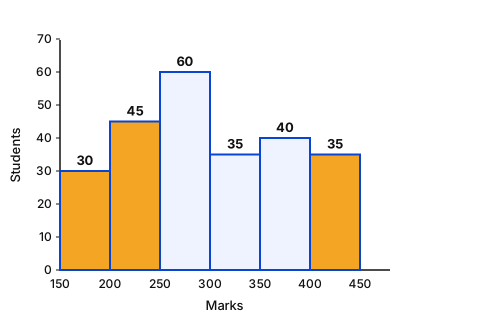
- Less than 250 marks: classes 150–200 and 200–250 .
- 400 or more marks: only class 400–450 .
- .
Trick: Base is the number after 'than' (here 35), so divide the difference by 35.
Answer: (C)
अवधारणा: हिस्टोग्राम से class की frequency पढ़ें और लगाएँ।
- 250 से कम अंक: 150–200 और 200–250 ।
- 400 या अधिक अंक: केवल 400–450 ।
- ।
ट्रिक: 'than' के बाद वाली संख्या (35) आधार होती है — अंतर को 35 से भाग दें।
उत्तर: (C)
SSC CPO Paper IQuantitative AptitudeHistogram (DI)SSC CPO Paper I 2020 · 25 Nov Shift 3
Q1352.The internal length, breadth and height of a cuboidal room are 12 m, 8 m and 10 m, respectively. The total cost (in ₹) of whitewashing only all four walls of the room at the cost of ₹25 per m2, is:
एक घनाभाकार कमरे की आंतरिक लंबाई, चौड़ाई और ऊँचाई क्रमशः 12 m, 8 m और 10 m है। ₹25 प्रति m2 की दर से कमरे की केवल चारों दीवारों पर सफेदी कराने की कुल लागत (₹ में) है:
- A12,600
- B10,000
- C11,400
- D18,000
Show answer
Concept: Area of four walls of a room .
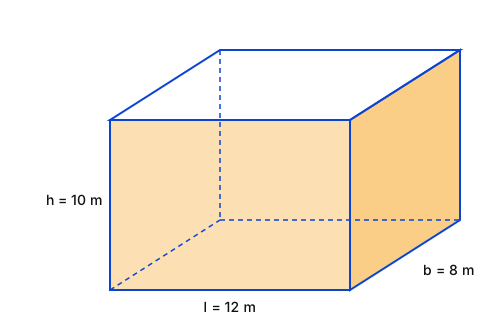
- Area .
- Cost rupees.
Trick: Four walls = perimeter of floor × height: .
Answer: (B) ₹10,000
अवधारणा: कमरे की चार दीवारों का क्षेत्रफल ।
- क्षेत्रफल ।
- खर्च रुपये।
ट्रिक: चार दीवारें = फर्श का परिमाप × ऊँचाई: ।
उत्तर: (B) ₹10,000
SSC CPO Paper IQuantitative AptitudeMensuration – Cuboid (4 walls)SSC CPO Paper I 2020 · 25 Nov Shift 3
Q1353.If the numerator of a fraction is increased by 60% and the denominator is increased by 40%, then the resultant fraction is . The original fraction is:
यदि किसी भिन्न के अंश में 60% की वृद्धि की जाए और हर में 40% की वृद्धि की जाए, तो परिणामी भिन्न है। मूल भिन्न है:
- A
- B
- C
- D
Show answer
Concept: New fraction ; equate to the given value.
- , i.e. .
- .
Trick: Check: ✓.
Answer: (B)
अवधारणा: नई भिन्न ; इसे दिए मान के बराबर रखें।
- ।
- ।
ट्रिक: जाँच: ✓।
उत्तर: (B)
SSC CPO Paper IQuantitative AptitudeFractions & PercentageSSC CPO Paper I 2020 · 25 Nov Shift 3
Q1354.Five bells ring together at the intervals of 3, 5, 8, 9 and 10 seconds. All the bells ring simultaneously at the same time. They will again ring simultaneously after:
पाँच घंटियाँ 3, 5, 8, 9 और 10 सेकंड के अंतराल पर बजती हैं। सभी घंटियाँ एक ही समय पर एक साथ बजती हैं। वे पुनः एक साथ कितने समय बाद बजेंगी:
- A6 minutes6 मिनट
- B8 minutes8 मिनट
- C9 minutes9 मिनट
- D4 minutes4 मिनट
Show answer
Concept: Bells ring together again after the LCM of their intervals.
- seconds.
- minutes.
Trick: Take highest powers: 8 gives , 9 gives , and 5.
Answer: (A) 6 minutes
अवधारणा: घंटियाँ फिर एक साथ उनके अंतरालों के LCM के बाद बजती हैं।
- सेकंड।
- मिनट।
ट्रिक: सबसे बड़ी घातें लें: 8 से , 9 से , और 5।
उत्तर: (A) 6 मिनट
SSC CPO Paper IQuantitative AptitudeLCM – BellsSSC CPO Paper I 2020 · 25 Nov Shift 3
Q1355.The average age of 40 students of a class is 16 years. After admission of 10 new students to the class, the average becomes 15 years. If the average age of 5 of the new students is 11 years, then the average age (in years) of the remaining 5 new students is:
किसी कक्षा के 40 छात्रों की औसत आयु 16 वर्ष है। कक्षा में 10 नए छात्रों के प्रवेश के बाद, औसत 15 वर्ष हो जाता है। यदि नए छात्रों में से 5 की औसत आयु 11 वर्ष है, तो शेष 5 नए छात्रों की औसत आयु (वर्षों में) है:
- A10
- B15
- C16
- D11
Show answer
Concept: Total = average × number.
- Old total ; new total .
- 10 new students' total .
- 5 of them ; remaining 5 , average .
Trick: Sum of new 10 = 110, so their average is also 11.
Answer: (D) 11
अवधारणा: कुल योग = औसत × संख्या।
- पुराना योग ; नया योग ।
- 10 नए छात्रों का योग ।
- 5 छात्रों का योग ; शेष 5 का योग , औसत ।
ट्रिक: नए 10 का योग 110 है, अतः उनका औसत 11 ही है।
उत्तर: (D) 11
SSC CPO Paper IQuantitative AptitudeAverageSSC CPO Paper I 2020 · 25 Nov Shift 3
Q1356.The following pie chart shows percentage expenditure of a country on different heads. The total expenditure is ₹1,680 (in billions). Study the chart and answer the question.
(Pie chart data)
| Head | Expenditure (%) |
|---|
| Subsidy | 21 |
| Interest Payment | 15 |
| Health | 4 |
| Education | 6 |
| Proceeds to states | 34 |
| Defence | 12 |
| Employee | 7 |
| Misc | 1 |
The central angle of the sector representing expenditure on Interest payment is:
निम्नलिखित पाई चार्ट विभिन्न मदों पर किसी देश के प्रतिशत व्यय को दर्शाता है। कुल व्यय ₹1,680 (अरब में) है। चार्ट का अध्ययन कीजिए और प्रश्न का उत्तर दीजिए।
(पाई चार्ट के आँकड़े)
| मद | व्यय (%) |
|---|
| सब्सिडी | 21 |
| ब्याज भुगतान | 15 |
| स्वास्थ्य | 4 |
| शिक्षा | 6 |
| राज्यों को अंतरण | 34 |
| रक्षा | 12 |
| कर्मचारी | 7 |
| विविध | 1 |
ब्याज भुगतान पर व्यय को दर्शाने वाले त्रिज्यखंड का केंद्रीय कोण है:
- A
- B
- C
- D
Show answer
Concept: Central angle .
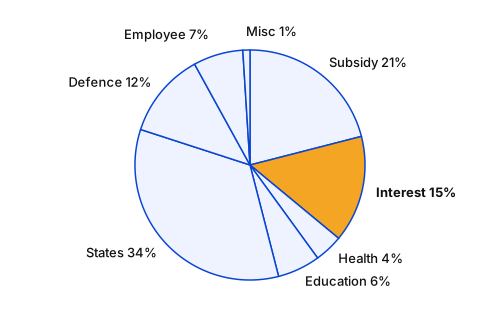
- Interest payment .
- Angle .
Trick: , so .
Answer: (C)
अवधारणा: केंद्रीय कोण ।
- ब्याज भुगतान (Interest payment) ।
- कोण ।
ट्रिक: , अतः ।
उत्तर: (C)
SSC CPO Paper IQuantitative AptitudePie Chart (DI)SSC CPO Paper I 2020 · 25 Nov Shift 3
Q1357.A’s salary is 35% more than B’s salary. How much per cent is B’s salary less than that of A’s? (correct to the nearest integer)
A का वेतन, B के वेतन से 35% अधिक है। B का वेतन, A के वेतन से कितने प्रतिशत कम है? (निकटतम पूर्णांक तक सही)
- A17.5%
- B20%
- C35%
- D26%
Show answer
Concept: If A is more than B, B is less than A.
- Let B = 100, then A = 135.
- .
Trick: ; B less than A by .
Answer: (D)
अवधारणा: यदि A, B से अधिक है तो B, A से कम है।
- B = 100 मानें, तो A = 135।
- ।
ट्रिक: ; B कम है ।
उत्तर: (D)
SSC CPO Paper IQuantitative AptitudePercentageSSC CPO Paper I 2020 · 25 Nov Shift 3
Q1358.A sum of ₹36,000 is divided into two parts, A and B, such that the simple interest at the rate of 15% p.a. on A and B after two years and four years, respectively, is equal. The total interest (in ₹) received from A is:
₹36,000 की राशि को दो भागों, A और B, में इस प्रकार विभाजित किया जाता है कि 15% वार्षिक दर से A पर दो वर्ष बाद और B पर चार वर्ष बाद प्राप्त साधारण ब्याज बराबर है। A से प्राप्त कुल ब्याज (₹ में) है:
- A1,800
- B3,600
- C7,200
- D5,400
Show answer
Concept: ; equal interest means .
- .
- .
- Interest from A .
Trick: Same rate: principal ratio = inverse of time ratio .
Answer: (C) ₹7,200
अवधारणा: ; ब्याज बराबर हो तो ।
- ।
- ।
- A से ब्याज ।
ट्रिक: दर समान हो तो मूलधन का अनुपात = समय का उल्टा अनुपात ।
उत्तर: (C) ₹7,200
SSC CPO Paper IQuantitative AptitudeSimple InterestSSC CPO Paper I 2020 · 25 Nov Shift 3
Q1359.P and Q together can do a work in 12 days. P alone can do the same work in 36 days. In how many days can Q alone complete two-third part of the same work?
P और Q मिलकर किसी कार्य को 12 दिनों में कर सकते हैं। P अकेले उसी कार्य को 36 दिनों में कर सकता है। Q अकेले उसी कार्य के दो-तिहाई भाग को कितने दिनों में पूरा कर सकता है?
- A12
- B15
- C18
- D21
Show answer
Concept: Use the LCM of days as total work.
- Total work units; P+Q = 3/day, P = 1/day.
- Q units/day.
- of work units days.
Trick: Q alone does whole work in 18 days; .
Answer: (A) 12
अवधारणा: दिनों का LCM कुल कार्य मानें।
- कुल कार्य इकाई; P+Q = 3 प्रति दिन, P = 1 प्रति दिन।
- Q इकाई प्रति दिन।
- कार्य इकाई दिन।
ट्रिक: Q अकेला 18 दिन में पूरा करता है; ।
उत्तर: (A) 12
SSC CPO Paper IQuantitative AptitudeTime and WorkSSC CPO Paper I 2020 · 25 Nov Shift 3
Q1360.In an entrance examination at different centres, a total of 25, 30, 40, 45, 60 and 100 students appeared. The pass percentages of the different centres are 20%, 30%, 35%, 40%, 50% and 75%, respectively. The pass percentage of the entrance examination is: (correct to the nearest integer)
विभिन्न केंद्रों पर आयोजित एक प्रवेश परीक्षा में कुल 25, 30, 40, 45, 60 और 100 छात्र उपस्थित हुए। विभिन्न केंद्रों का उत्तीर्ण प्रतिशत क्रमशः 20%, 30%, 35%, 40%, 50% और 75% है। प्रवेश परीक्षा का उत्तीर्ण प्रतिशत है: (निकटतम पूर्णांक तक सही)
- A59%
- B43%
- C53%
- D50%
Show answer
Concept: Overall pass % .
- Passed: .
- Appeared: .
- Pass % .
Trick: Never average the percentages directly — weight them by students.
Answer: (D)
अवधारणा: कुल उत्तीर्ण % ।
- उत्तीर्ण: ।
- कुल: ।
- उत्तीर्ण % ।
ट्रिक: प्रतिशतों का सीधा औसत न लें — छात्र संख्या से भारित करें।
उत्तर: (D)
SSC CPO Paper IQuantitative AptitudePercentage – WeightedSSC CPO Paper I 2020 · 25 Nov Shift 3

