Q1361.Select the most appropriate option to substitute the underlined segment in the given sentence. If there is no need to substitute it, select ‘No substitution required’.
I looked anywhere for my puppy but could not find it.
- Asomewhere
- BNo substitution required
- Cnowhere
- Deverywhere
Show answer
Concept: Everywhere = in all places. Anywhere is used in negatives/questions, not in a positive sentence like 'I looked …'.
- The sense: searched in all places, yet could not find it.
- somewhere is too limited; nowhere contradicts 'looked'.
- Correct: I looked everywhere for my puppy.
Trick: Searched all places → everywhere.
Answer: (D) everywhere
अवधारणा: Everywhere = हर जगह। Anywhere नकारात्मक/प्रश्नवाचक वाक्यों में आता है, 'I looked …' जैसे सकारात्मक वाक्य में नहीं।
- भाव: हर जगह ढूँढा, फिर भी नहीं मिला।
- somewhere सीमित है; nowhere 'looked' के विपरीत है।
- सही: I looked everywhere for my puppy.
ट्रिक: हर जगह ढूँढा → everywhere।
उत्तर: (D) everywhere
SSC CPO Paper IEnglish ComprehensionSentence Improvement – AdverbsSSC CPO Paper I 2020 · 25 Nov Shift 3
Q1362.Select the most appropriate ANTONYM of the given word.
IGNOBLE
- Acorrupt
- Bcraven
- Cabject
- Ddignified
Show answer
Concept: Ignoble = dishonourable, mean, not respectable.
- Its opposite is dignified = honourable, respectable.
- corrupt, craven (cowardly), abject (wretched) are close to 'ignoble' itself.
Trick: in + noble = not noble ↔ dignified.
Answer: (D) dignified
अवधारणा: Ignoble = नीच, अपमानजनक, असम्मानित।
- विलोम dignified = गरिमापूर्ण, सम्मानित।
- corrupt, craven (डरपोक), abject (दयनीय) – ये ignoble के समान अर्थ वाले हैं।
ट्रिक: ig + noble = not noble ↔ dignified।
उत्तर: (D) dignified
SSC CPO Paper IEnglish ComprehensionAntonymsSSC CPO Paper I 2020 · 25 Nov Shift 3
Q1363.Fill in the blank with the most appropriate word.
You have memorised your speech, ______ you?
- Ahasn’t
- Bcouldn’t
- Cdidn’t
- Dhaven’t
Show answer
Concept: A question tag repeats the same auxiliary as the statement, in the opposite polarity, with a pronoun subject.
- Statement: 'You have memorised…' → auxiliary = have, positive.
- Tag = negative + have + you → haven't you?
- 'hasn't' disagrees with 'you'; 'didn't', 'couldn't' use the wrong auxiliary.
Trick: Copy the helping verb, flip the sign.
Answer: (D) haven't
अवधारणा: Question tag में वाक्य वाला वही सहायक क्रिया उलटे भाव (positive/negative) में और सर्वनाम के साथ आती है।
- वाक्य: 'You have memorised…' → सहायक क्रिया have, सकारात्मक।
- Tag = negative + have + you → haven't you?
- 'hasn't' you से मेल नहीं खाता; 'didn't', 'couldn't' गलत सहायक क्रिया।
ट्रिक: सहायक क्रिया वही, भाव उल्टा।
उत्तर: (D) haven't
SSC CPO Paper IEnglish ComprehensionQuestion TagsSSC CPO Paper I 2020 · 25 Nov Shift 3
Q1364.Select the most appropriate one-word substitution for the given group of words.
Travelling under a name other than one’s own
- Aimpromptu
- Bincognito
- Cincredible
- Dinvisible
Show answer
Concept: Incognito = having one's true identity concealed; travelling under an assumed name.
- impromptu = done without preparation.
- incredible = unbelievable; invisible = cannot be seen.
- So the answer is incognito.
Yaad rakhein: Incognito = in + cognitus (not known).
Answer: (B) incognito
अवधारणा: Incognito = अपनी असली पहचान छिपाकर, किसी दूसरे नाम से यात्रा करना।
- impromptu = बिना तैयारी के।
- incredible = अविश्वसनीय; invisible = अदृश्य।
- अतः उत्तर incognito।
याद रखें: Incognito = in + cognitus (अज्ञात)।
उत्तर: (B) incognito
SSC CPO Paper IEnglish ComprehensionOne Word SubstitutionSSC CPO Paper I 2020 · 25 Nov Shift 3
Q1365.Fill in the blank with the most appropriate word.
The fan was directly ______ my head.
- Aat
- Bon
- Cbelow
- Dover
Show answer
Concept: Over = directly above something, usually without touching it. On = in contact with a surface.
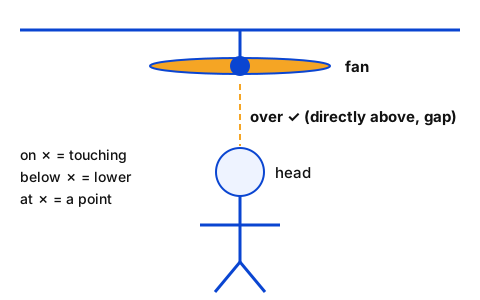
- A ceiling fan hangs above the head without touching it → over.
- on would mean the fan is resting on the head; below means lower.
- at shows a point, not position above.
Trick: Above + not touching → over; touching → on.
Answer: (D) over
अवधारणा: Over = किसी चीज़ के ठीक ऊपर, बिना छुए। On = सतह को छूते हुए।
- पंखा सिर के ऊपर लटका है, छूता नहीं → over।
- on का अर्थ होगा पंखा सिर पर रखा है; below = नीचे।
- at एक बिंदु बताता है, ऊपर की स्थिति नहीं।
ट्रिक: ऊपर + बिना छुए → over; छूते हुए → on।
उत्तर: (D) over
SSC CPO Paper IEnglish ComprehensionPrepositionsSSC CPO Paper I 2020 · 25 Nov Shift 3
In the following passage some words have been deleted. Fill in the blanks with the help of the alternatives given. Select the most appropriate option for each number.
Malti had to wait long to see her son, Abhik. She had worked hard to (1)______ her husband’s last wish that Abhik should (2)______ his higher education at Cambridge. Abhik (3)______ to be meritorious and hardworking and had secured a seat. Making ends meet was (4)______ and a trip back home in the vacation, (5)______ for the mother and son.
Q1366.Select the most appropriate option to fill in blank no. 1.
- Aproduce
- Bfulfil
- Cperform
- Dfinish
Show answer
Concept: A wish, promise or dream collocates with fulfil (make it come true).
- 'to fulfil her husband's last wish' is the natural collocation.
- produce, perform, finish do not go with 'wish'.
Trick: fulfil a wish/dream/promise.
Answer: (B) fulfil
अवधारणा: Wish, promise या dream के साथ fulfil (पूरा करना) आता है।
- 'to fulfil her husband's last wish' – स्वाभाविक collocation।
- produce, perform, finish 'wish' के साथ प्रयोग नहीं होते।
ट्रिक: fulfil a wish/dream/promise।
उत्तर: (B) fulfil
SSC CPO Paper IEnglish ComprehensionCloze TestSSC CPO Paper I 2020 · 25 Nov Shift 3
In the following passage some words have been deleted. Fill in the blanks with the help of the alternatives given. Select the most appropriate option for each number.
Malti had to wait long to see her son, Abhik. She had worked hard to (1)______ her husband’s last wish that Abhik should (2)______ his higher education at Cambridge. Abhik (3)______ to be meritorious and hardworking and had secured a seat. Making ends meet was (4)______ and a trip back home in the vacation, (5)______ for the mother and son.
Q1367.Select the most appropriate option to fill in blank no. 2.
- Aprovide
- Bapproach
- Cdelete
- Dpursue
Show answer
Concept: Studies, a career or a goal collocate with pursue (to follow/carry on).
- 'Abhik should pursue his higher education at Cambridge' – correct collocation.
- provide, approach, delete make no sense with education here.
Trick: pursue studies/a course/a career.
Answer: (D) pursue
अवधारणा: पढ़ाई, करियर या लक्ष्य के साथ pursue (आगे बढ़ाना/करना) आता है।
- 'Abhik should pursue his higher education at Cambridge' – सही collocation।
- provide, approach, delete यहाँ अर्थहीन हैं।
ट्रिक: pursue studies/a course/a career।
उत्तर: (D) pursue
SSC CPO Paper IEnglish ComprehensionCloze TestSSC CPO Paper I 2020 · 25 Nov Shift 3
In the following passage some words have been deleted. Fill in the blanks with the help of the alternatives given. Select the most appropriate option for each number.
Malti had to wait long to see her son, Abhik. She had worked hard to (1)______ her husband’s last wish that Abhik should (2)______ his higher education at Cambridge. Abhik (3)______ to be meritorious and hardworking and had secured a seat. Making ends meet was (4)______ and a trip back home in the vacation, (5)______ for the mother and son.
Q1368.Select the most appropriate option to fill in blank no. 3.
- Ahad proved
- Bis proving
- Cwill prove
- Dprove
Show answer
Concept: An action completed before another past action takes the past perfect (had + V3).
- The passage is in the past ('had worked', 'had secured').
- Abhik's proving himself meritorious happened before he secured the seat → had proved.
- is proving, will prove, prove break the past narration.
Trick: Earlier of two past actions → had + V3.
Answer: (A) had proved
अवधारणा: किसी दूसरे भूतकालीन कार्य से पहले पूरा हुआ कार्य past perfect (had + V3) में आता है।
- गद्यांश भूतकाल में है ('had worked', 'had secured')।
- सीट मिलने से पहले Abhik मेधावी सिद्ध हो चुका था → had proved।
- is proving, will prove, prove भूतकालीन वर्णन से मेल नहीं खाते।
ट्रिक: दो भूत कार्यों में पहला → had + V3।
उत्तर: (A) had proved
SSC CPO Paper IEnglish ComprehensionCloze Test – TensesSSC CPO Paper I 2020 · 25 Nov Shift 3
In the following passage some words have been deleted. Fill in the blanks with the help of the alternatives given. Select the most appropriate option for each number.
Malti had to wait long to see her son, Abhik. She had worked hard to (1)______ her husband’s last wish that Abhik should (2)______ his higher education at Cambridge. Abhik (3)______ to be meritorious and hardworking and had secured a seat. Making ends meet was (4)______ and a trip back home in the vacation, (5)______ for the mother and son.
Q1369.Select the most appropriate option to fill in blank no. 4.
- Ainspiring
- Bdifficult
- Csevere
- Dworthy
Show answer
Concept: Making ends meet = managing with limited money; it is naturally described as difficult.
- The mother worked hard with limited means → making ends meet was difficult.
- inspiring, worthy are positive and unsuitable; severe does not collocate with this idiom.
Trick: Making ends meet was difficult/hard.
Answer: (B) difficult
अवधारणा: Making ends meet = सीमित पैसों में गुज़ारा करना; इसके साथ difficult स्वाभाविक है।
- माँ ने सीमित साधनों में मेहनत की → गुज़ारा करना कठिन था।
- inspiring, worthy सकारात्मक व अनुपयुक्त; severe इस मुहावरे के साथ नहीं आता।
ट्रिक: Making ends meet was difficult/hard।
उत्तर: (B) difficult
SSC CPO Paper IEnglish ComprehensionCloze TestSSC CPO Paper I 2020 · 25 Nov Shift 3
In the following passage some words have been deleted. Fill in the blanks with the help of the alternatives given. Select the most appropriate option for each number.
Malti had to wait long to see her son, Abhik. She had worked hard to (1)______ her husband’s last wish that Abhik should (2)______ his higher education at Cambridge. Abhik (3)______ to be meritorious and hardworking and had secured a seat. Making ends meet was (4)______ and a trip back home in the vacation, (5)______ for the mother and son.
Q1370.Select the most appropriate option to fill in blank no. 5.
- Auncouth
- Bunbearable
- Cunaffordable
- Duncomfortable
Show answer
Concept: The context is money shortage, so the trip home was something they could not pay for → unaffordable.
- Money was tight (making ends meet was difficult).
- Hence a vacation trip back home was unaffordable for mother and son.
- uncouth (rude), unbearable, uncomfortable do not relate to cost.
Trick: Money problem → unaffordable.
Answer: (C) unaffordable
अवधारणा: संदर्भ पैसों की कमी का है, अतः घर आने की यात्रा का खर्च वे नहीं उठा सकते थे → unaffordable।
- पैसे की तंगी थी (गुज़ारा कठिन था)।
- इसलिए छुट्टियों में घर आना माँ-बेटे के लिए unaffordable था।
- uncouth (असभ्य), unbearable, uncomfortable खर्च से संबंधित नहीं।
ट्रिक: पैसे की समस्या → unaffordable।
उत्तर: (C) unaffordable
SSC CPO Paper IEnglish ComprehensionCloze TestSSC CPO Paper I 2020 · 25 Nov Shift 3
Q1371.Select the misspelt word.
- Airritible
- Bgallery
- Cenmity
- Dearnest
Show answer
Concept: The correct spelling is irritable (irritate → irritable, -able).
- 'irritible' wrongly uses -ible.
- gallery, enmity, earnest are spelt correctly.
Trick: Root ending in -ate usually takes -able: irritate → irritable.
Answer: (A) irritible
अवधारणा: सही वर्तनी irritable है (irritate → irritable, -able)।
- 'irritible' में गलत -ible लगा है।
- gallery, enmity, earnest सही हैं।
ट्रिक: -ate वाले मूल से -able: irritate → irritable।
उत्तर: (A) irritible
SSC CPO Paper IEnglish ComprehensionSpellingSSC CPO Paper I 2020 · 25 Nov Shift 3
Q1372.Select the most appropriate synonym of the given word.
FLABBERGASTED
- Adisturbed
- Bmotivated
- Castonished
- Dterrified
Show answer
Concept: Flabbergasted = extremely surprised or shocked.
- astonished = greatly surprised → synonym.
- disturbed, motivated, terrified express other feelings.
Trick: Flabbergasted ≈ astonished ≈ stunned.
Answer: (C) astonished
अवधारणा: Flabbergasted = अत्यंत चकित/हैरान।
- astonished = बहुत आश्चर्यचकित → पर्याय।
- disturbed, motivated, terrified अन्य भाव हैं।
ट्रिक: Flabbergasted ≈ astonished ≈ stunned।
उत्तर: (C) astonished
SSC CPO Paper IEnglish ComprehensionSynonymsSSC CPO Paper I 2020 · 25 Nov Shift 3
Q1373.Select the misspelt word.
- Amillionaire
- Bmagnificient
- Cmediocre
- Dmiraculous
Show answer
Concept: The correct spelling is magnificent – there is no 'i' before '-cent'.
- 'magnificient' adds an extra i.
- millionaire, mediocre, miraculous are correct.
Trick: magni + fi + cent.
Answer: (B) magnificient
अवधारणा: सही वर्तनी magnificent है – '-cent' से पहले 'i' नहीं आता।
- 'magnificient' में एक अतिरिक्त i है।
- millionaire, mediocre, miraculous सही हैं।
ट्रिक: magni + fi + cent।
उत्तर: (B) magnificient
SSC CPO Paper IEnglish ComprehensionSpellingSSC CPO Paper I 2020 · 25 Nov Shift 3
Q1374.Select the most appropriate synonym of the given word.
AUSPICIOUS
- Afavourable
- Bsuspicious
- Chapless
- Dplayful
Show answer
Concept: Auspicious = promising success; favourable, lucky.
- favourable matches the meaning.
- suspicious only sounds similar; hapless (unlucky) is opposite; playful is unrelated.
Trick: Auspicious = shubh = favourable.
Answer: (A) favourable
अवधारणा: Auspicious = शुभ, अनुकूल।
- favourable समान अर्थ है।
- suspicious केवल सुनने में मिलता है; hapless (अभागा) विपरीत; playful असंबंधित।
ट्रिक: Auspicious = शुभ = favourable।
उत्तर: (A) favourable
SSC CPO Paper IEnglish ComprehensionSynonymsSSC CPO Paper I 2020 · 25 Nov Shift 3
Q1375.Select the most appropriate ANTONYM of the given word.
INDUSTRIOUS
- Aassiduous
- Bdiligent
- Cindolent
- Dproductive
Show answer
Concept: Industrious = hard-working. Its opposite is indolent = lazy.
- assiduous, diligent are synonyms of industrious.
- productive is also close in sense.
- So the antonym is indolent.
Trick: Industrious ↔ indolent (both start with 'ind' – a classic pair).
Answer: (C) indolent
अवधारणा: Industrious = परिश्रमी। विलोम indolent = आलसी।
- assiduous, diligent industrious के पर्याय हैं।
- productive भी समान भाव वाला है।
- अतः विलोम indolent।
ट्रिक: Industrious ↔ indolent (दोनों 'ind' से – प्रसिद्ध जोड़ी)।
उत्तर: (C) indolent
SSC CPO Paper IEnglish ComprehensionAntonymsSSC CPO Paper I 2020 · 25 Nov Shift 3
Q1376.Select the most appropriate ANTONYM of the given word.
FLEXIBLE
- Aelastic
- Bductile
- Cpliable
- Drigid
Show answer
Concept: Flexible = able to bend easily. Its opposite is rigid = stiff, not bending.
- elastic, ductile, pliable are all synonyms.
- Only rigid is opposite.
Trick: Odd one out among synonyms = antonym.
Answer: (D) rigid
अवधारणा: Flexible = आसानी से मुड़ने वाला। विलोम rigid = कठोर, न मुड़ने वाला।
- elastic, ductile, pliable सब पर्याय हैं।
- केवल rigid विपरीत है।
ट्रिक: पर्यायों में अलग शब्द = विलोम।
उत्तर: (D) rigid
SSC CPO Paper IEnglish ComprehensionAntonymsSSC CPO Paper I 2020 · 25 Nov Shift 3
Q1377.Fill in the blank with the most appropriate word.
The man ______ book you are reading is my father.
- Athat
- Bwho
- Cwhose
- Dwhom
Show answer
Concept: Whose shows possession: the man whose book = the man's book.
- The blank stands before a noun 'book' and shows ownership.
- who (subject) and whom (object) cannot be followed directly by a noun.
- that cannot show possession.
Trick: Relative pronoun + noun showing ownership → whose.
Answer: (C) whose
अवधारणा: Whose स्वामित्व बताता है: the man whose book = उस आदमी की किताब।
- रिक्त स्थान संज्ञा 'book' से पहले है और स्वामित्व दिखाता है।
- who (कर्ता) और whom (कर्म) के तुरंत बाद संज्ञा नहीं आती।
- that स्वामित्व नहीं दिखाता।
ट्रिक: Relative pronoun + noun (स्वामित्व) → whose।
उत्तर: (C) whose
SSC CPO Paper IEnglish ComprehensionRelative PronounsSSC CPO Paper I 2020 · 25 Nov Shift 3
Q1378.Select the most appropriate one-word substitution for the given group of words.
To separate husk from the grain
- Awillow
- Bwhisk
- Cwinnow
- Dwhip
Show answer
Concept: Winnow = to blow air through grain to separate the husk (chaff) from it.
- willow is a tree; whisk = beat eggs/move quickly; whip = strike with a lash.
- Only winnow fits.
Yaad rakhein: Winnow – wind blows away the husk.
Answer: (C) winnow
अवधारणा: Winnow = अनाज को हवा में उड़ाकर भूसा अलग करना (ओसाई)।
- willow एक पेड़; whisk = फेंटना; whip = कोड़ा मारना।
- केवल winnow उपयुक्त है।
याद रखें: Winnow – हवा (wind) से भूसा उड़ाना।
उत्तर: (C) winnow
SSC CPO Paper IEnglish ComprehensionOne Word SubstitutionSSC CPO Paper I 2020 · 25 Nov Shift 3
Q1379.Select the misspelt word.
- Apierce
- Brelieve
- Cdeceive
- Driegn
Show answer
Concept: The correct spelling is reign (rule of a king) – 'e' before 'i' here.
- 'riegn' is wrong.
- pierce, relieve, deceive are correct (i before e, except after c: deceive).
Trick: 'i before e, except after c, or when sounded as ay' – reign, weigh.
Answer: (D) riegn
अवधारणा: सही वर्तनी reign (शासन) है – यहाँ 'e' पहले, फिर 'i'।
- 'riegn' गलत है।
- pierce, relieve, deceive सही हैं (c के बाद ei: deceive)।
ट्रिक: 'i before e, except after c, or when sounded as ay' – reign, weigh।
उत्तर: (D) riegn
SSC CPO Paper IEnglish ComprehensionSpellingSSC CPO Paper I 2020 · 25 Nov Shift 3
Q1380.Select the most appropriate option to substitute the underlined segment in the given sentence. If there is no need to substitute it, select ‘No substitution required’.
Have taken permission , Shivam went horse riding.
- ANo substitution required
- BHave took permission
- CHaving taken permission
- DHaving taking permission
Show answer
Concept: A completed earlier action of the same subject is shown by the perfect participle: having + V3.
- Shivam first took permission, then went riding.
- So: Having taken permission, Shivam went horse riding.
- 'Have taken/Have took' are finite verbs without a subject; 'Having taking' wrongly uses V-ing.
Trick: Having + V3 = 'after doing'.
Answer: (C) Having taken permission
अवधारणा: एक ही कर्ता का पहले पूरा हुआ कार्य perfect participle: having + V3 से दिखाते हैं।
- Shivam ने पहले अनुमति ली, फिर घुड़सवारी की।
- अतः: Having taken permission, Shivam went horse riding.
- 'Have taken/Have took' बिना कर्ता की क्रिया हैं; 'Having taking' में V-ing गलत है।
ट्रिक: Having + V3 = 'करके'।
उत्तर: (C) Having taken permission
SSC CPO Paper IEnglish ComprehensionParticiplesSSC CPO Paper I 2020 · 25 Nov Shift 3

