Q1381.Select the most appropriate synonym of the given word.
AUTHENTIC
- Aincredible
- Bgenuine
- Cdubious
- Dcounterfeit
Show answer
Concept: Authentic = real, genuine, of undisputed origin.
- genuine = real → synonym.
- dubious, counterfeit (fake) are opposites; incredible = unbelievable.
Trick: Authentic ≈ genuine ≈ original.
Answer: (B) genuine
अवधारणा: Authentic = असली, प्रामाणिक।
- genuine = असली → पर्याय।
- dubious, counterfeit (नकली) विपरीत हैं; incredible = अविश्वसनीय।
ट्रिक: Authentic ≈ genuine ≈ original।
उत्तर: (B) genuine
SSC CPO Paper IEnglish ComprehensionSynonymsSSC CPO Paper I 2020 · 25 Nov Shift 3
Q1382.Identify the segment in the sentence which contains a grammatical error.
Either Ramesh or Reema have the keys to the cupboard.
- Aor Reema have
- Bthe keys
- CEither Ramesh
- Dto the cupboard
Show answer
Concept: With either … or / neither … nor, the verb agrees with the nearer subject.
- Nearer subject = Reema (singular).
- So verb must be singular: has, not have.
- Correct: Either Ramesh or Reema has the keys…
Trick: Either/or → look at the subject closest to the verb.
Answer: (A) or Reema have
अवधारणा: either … or / neither … nor में क्रिया निकटतम कर्ता के अनुसार होती है।
- निकटतम कर्ता = Reema (एकवचन)।
- अतः क्रिया एकवचन: has, न कि have।
- सही: Either Ramesh or Reema has the keys…
ट्रिक: Either/or → क्रिया के सबसे पास वाला कर्ता देखें।
उत्तर: (A) or Reema have
SSC CPO Paper IEnglish ComprehensionSubject–Verb AgreementSSC CPO Paper I 2020 · 25 Nov Shift 3
Q1383.Select the most appropriate meaning of the given idiom.
Make up one’s mind
- Ato achieve
- Bto lie
- Cto decide
- Dto pretend
Show answer
Concept: Make up one's mind = to decide.
- e.g. She made up her mind to study law.
- Not to be confused with make up (invent a story = lie) – a trap option.
Trick: Make up your mind = decide.
Answer: (C) to decide
अवधारणा: Make up one's mind = निश्चय करना, तय करना।
- जैसे She made up her mind to study law.
- केवल make up (कहानी गढ़ना = झूठ) से भ्रमित न हों – जाल विकल्प।
ट्रिक: Make up your mind = फ़ैसला करना।
उत्तर: (C) to decide
SSC CPO Paper IEnglish ComprehensionIdiomsSSC CPO Paper I 2020 · 25 Nov Shift 3
Q1384.Identify the segment in the sentence which contains a grammatical error.
The information you are asking for is quite irrelevance.
- AThe information
- Byou are
- Casking for
- Dis quite irrelevance
Show answer
Concept: After a linking verb (is) with an adverb (quite), we need an adjective as complement, not a noun.
- irrelevance is a noun.
- The adjective form is irrelevant: …is quite irrelevant.
- Other segments are correct.
Trick: is + quite + adjective.
Answer: (D) is quite irrelevance
अवधारणा: Linking verb (is) तथा adverb (quite) के बाद पूरक के रूप में adjective चाहिए, noun नहीं।
- irrelevance संज्ञा है।
- विशेषण रूप irrelevant: …is quite irrelevant।
- बाकी भाग सही हैं।
ट्रिक: is + quite + adjective।
उत्तर: (D) is quite irrelevance
SSC CPO Paper IEnglish ComprehensionError Spotting – Parts of SpeechSSC CPO Paper I 2020 · 25 Nov Shift 3
Q1385.Identify the segment in the sentence which contains a grammatical error.
She will come to work though it doesn’t rain tomorrow.
- Athough it doesn’t
- Bto work
- Crain tomorrow
- DShe will come
Show answer
Concept: A condition is introduced by if/unless; though shows contrast.
- Her coming depends on the weather → a condition.
- Correct: She will come to work if it doesn't rain (or unless it rains) tomorrow.
- The error is in 'though it doesn't'.
Trick: Condition → if/unless; contrast → though.
Answer: (A) though it doesn't
अवधारणा: शर्त if/unless से लगती है; though विरोध (contrast) बताता है।
- उसका आना मौसम पर निर्भर है → शर्त।
- सही: She will come to work if it doesn't rain (या unless it rains) tomorrow।
- त्रुटि 'though it doesn't' में है।
ट्रिक: शर्त → if/unless; विरोध → though।
उत्तर: (A) though it doesn't
SSC CPO Paper IEnglish ComprehensionError Spotting – ConjunctionsSSC CPO Paper I 2020 · 25 Nov Shift 3
Q1386.Select the most appropriate ANTONYM of the given word.
FEROCIOUS
- Aruthless
- Bfearless
- Cgentle
- Dbrutal
Show answer
Concept: Ferocious = savagely fierce, violent. Opposite: gentle = mild, kind.
- ruthless, brutal are synonyms.
- fearless means brave – not an opposite.
- So gentle.
Trick: Ferocious tiger ↔ gentle lamb.
Answer: (C) gentle
अवधारणा: Ferocious = भयंकर, हिंसक। विलोम: gentle = सौम्य, कोमल।
- ruthless, brutal पर्याय हैं।
- fearless = निडर – विलोम नहीं।
- अतः gentle।
ट्रिक: Ferocious tiger ↔ gentle lamb।
उत्तर: (C) gentle
SSC CPO Paper IEnglish ComprehensionAntonymsSSC CPO Paper I 2020 · 25 Nov Shift 3
Q1387.Select the most appropriate one-word substitution for the given group of words.
Irresistible impulse to steal
- Akleptomania
- Bplunder
- Csabotage
- Dmegalomania
Show answer
Concept: Kleptomania = an irresistible urge to steal (klepto = steal, mania = madness).
- plunder = loot by force; sabotage = deliberate damage.
- megalomania = obsession with power/greatness.
Yaad rakhein: Klepto = thief (Greek).
Answer: (A) kleptomania
अवधारणा: Kleptomania = चोरी करने की अनियंत्रित इच्छा (klepto = चोरी, mania = उन्माद)।
- plunder = लूटना; sabotage = जानबूझकर नुकसान।
- megalomania = सत्ता/महानता का उन्माद।
याद रखें: Klepto = चोर (यूनानी)।
उत्तर: (A) kleptomania
SSC CPO Paper IEnglish ComprehensionOne Word SubstitutionSSC CPO Paper I 2020 · 25 Nov Shift 3
Q1388.Select the most appropriate option to substitute the underlined segment in the given sentence. If there is no need to substitute it, select ‘No substitution required’.
I am certain Ashok has finished his work by tomorrow.
- Awould have finish
- BNo substitution required
- Cwill have finished
- Dhad finished
Show answer
Concept: An action that will be completed before a future time ('by tomorrow') takes the future perfect: will have + V3.
- 'by tomorrow' marks a future deadline.
- So: Ashok will have finished his work by tomorrow.
- 'has finished' (present) and 'had finished' (past) clash with tomorrow; 'would have finish' uses a wrong verb form.
Trick: By + future time → will have + V3.
Answer: (C) will have finished
अवधारणा: भविष्य के किसी समय ('by tomorrow') तक पूरा होने वाला कार्य future perfect: will have + V3 में आता है।
- 'by tomorrow' भविष्य की समय-सीमा है।
- अतः: Ashok will have finished his work by tomorrow।
- 'has finished' और 'had finished' tomorrow से मेल नहीं खाते; 'would have finish' में क्रिया रूप गलत है।
ट्रिक: By + भविष्य समय → will have + V3।
उत्तर: (C) will have finished
SSC CPO Paper IEnglish ComprehensionTenses – Future PerfectSSC CPO Paper I 2020 · 25 Nov Shift 3
Q1389.Select the misspelt word.
- Aexplotion
- Bcarriage
- Cdescent
- Dcautious
Show answer
Concept: The correct spelling is explosion (explode → explosion, -sion).
- 'explotion' wrongly uses -tion.
- carriage, descent, cautious are correct.
Trick: Verbs ending in -de → -sion: explode → explosion, decide → decision.
Answer: (A) explotion
अवधारणा: सही वर्तनी explosion है (explode → explosion, -sion)।
- 'explotion' में गलत -tion है।
- carriage, descent, cautious सही हैं।
ट्रिक: -de वाली क्रिया → -sion: explode → explosion, decide → decision।
उत्तर: (A) explotion
SSC CPO Paper IEnglish ComprehensionSpellingSSC CPO Paper I 2020 · 25 Nov Shift 3
Q1390.Select the misspelt word.
- Aaccommodate
- Boccurred
- Coppressed
- Dommission
Show answer
Concept: The correct spelling is omission – one m, double s (omit → omission).
- 'ommission' wrongly doubles the m.
- accommodate (double c, double m), occurred, oppressed are correct.
Trick: omit has one m → omission has one m.
Answer: (D) ommission
अवधारणा: सही वर्तनी omission है – एक m, दो s (omit → omission)।
- 'ommission' में m दो बार गलत है।
- accommodate (दो c, दो m), occurred, oppressed सही हैं।
ट्रिक: omit में एक m → omission में भी एक m।
उत्तर: (D) ommission
SSC CPO Paper IEnglish ComprehensionSpellingSSC CPO Paper I 2020 · 25 Nov Shift 3
Q1391.Select the most appropriate synonym of the given word.
GRADUAL
- Aabrupt
- Bhasty
- Cuneven
- Dcontinuous
Show answer
Concept: Gradual = happening slowly and steadily, step by step, without sudden breaks.
- Among options, continuous (steady, unbroken) is closest.
- abrupt, hasty are opposites; uneven suggests irregularity.
Trick: Gradual change = slow, continuous change.
Answer: (D) continuous
अवधारणा: Gradual = धीरे-धीरे और लगातार होने वाला, बिना अचानक बदलाव के।
- विकल्पों में continuous (निरंतर) सबसे निकट है।
- abrupt, hasty विपरीत हैं; uneven = असमान।
ट्रिक: Gradual change = धीमा, निरंतर बदलाव।
उत्तर: (D) continuous
SSC CPO Paper IEnglish ComprehensionSynonymsSSC CPO Paper I 2020 · 25 Nov Shift 3
Q1392.Fill in the blank with the most appropriate word.
We cannot delay the project ______ it is urgent.
- Aas if
- Bthan
- Cbecause
- Dalthough
Show answer
Concept: Because introduces a reason.
- Why can't the project be delayed? – it is urgent → reason → because.
- although shows contrast; as if shows manner/comparison; than is for comparison.
Trick: Answer to 'why?' → because.
Answer: (C) because
अवधारणा: Because कारण बताता है।
- प्रोजेक्ट में देरी क्यों नहीं? – क्योंकि यह ज़रूरी है → कारण → because।
- although विरोध; as if ढंग/तुलना; than तुलना के लिए।
ट्रिक: 'क्यों?' का उत्तर → because।
उत्तर: (C) because
SSC CPO Paper IEnglish ComprehensionConjunctionsSSC CPO Paper I 2020 · 25 Nov Shift 3
Q1393.Select the most appropriate ANTONYM of the given word.
HUMILITY
- Atimidity
- Bservility
- Cvanity
- Dmodesty
Show answer
Concept: Humility = modesty, a low view of one's own importance. Opposite: vanity = excessive pride in oneself.
- modesty is a synonym.
- timidity (shyness) and servility (excessive submissiveness) are not opposites of humility.
- So vanity.
Trick: Humble ↔ vain.
Answer: (C) vanity
अवधारणा: Humility = विनम्रता। विलोम: vanity = घमंड, अहंकार।
- modesty पर्याय है।
- timidity (संकोच) और servility (दासता) विलोम नहीं।
- अतः vanity।
ट्रिक: Humble ↔ vain।
उत्तर: (C) vanity
SSC CPO Paper IEnglish ComprehensionAntonymsSSC CPO Paper I 2020 · 25 Nov Shift 3
Q1394.Fill in the blank with the most appropriate word.
It is not easy to distinguish a loyal friend ______ a flatterer.
- Afrom
- Band
- Camong
- Dbetween
Show answer
Concept: The verb distinguish takes from (distinguish A from B) or between (distinguish between A and B).
- Here the pattern is 'distinguish a loyal friend ___ a flatterer' → A from B.
- 'between' would need 'and'; 'and', 'among' do not fit.
Trick: distinguish/differ/separate + from.
Answer: (A) from
अवधारणा: क्रिया distinguish के साथ from (distinguish A from B) या between (between A and B) आता है।
- यहाँ 'distinguish a loyal friend ___ a flatterer' → A from B।
- 'between' के साथ 'and' चाहिए; 'and', 'among' उपयुक्त नहीं।
ट्रिक: distinguish/differ/separate + from।
उत्तर: (A) from
SSC CPO Paper IEnglish ComprehensionPrepositionsSSC CPO Paper I 2020 · 25 Nov Shift 3
Q1395.Select the most appropriate meaning of the given idiom.
Sitting on a gold mine
- Ato own something potentially valuable
- Bsecretly hunting for something precious
- Cnot availing of an opportunity
- Dwasting a vast treasure
Show answer
Concept: Sitting on a gold mine = owning something very valuable (often without realising its full worth).
- e.g. With that land near the highway, he is sitting on a gold mine.
- It does not mean hunting secretly, wasting, or missing an opportunity.
Trick: Gold mine = source of great value you already have.
Answer: (A) to own something potentially valuable
अवधारणा: Sitting on a gold mine = किसी बहुत मूल्यवान चीज़ का मालिक होना (अक्सर उसकी कीमत जाने बिना)।
- जैसे With that land near the highway, he is sitting on a gold mine.
- इसका अर्थ छिपकर खोजना, बर्बाद करना या अवसर खोना नहीं है।
ट्रिक: Gold mine = पास में रखा अनमोल स्रोत।
उत्तर: (A) to own something potentially valuable
SSC CPO Paper IEnglish ComprehensionIdiomsSSC CPO Paper I 2020 · 25 Nov Shift 3
Read the given passage and answer the questions that follow.
Early written symbols were based on pictographs (pictures which resemble what they signify) and ideograms (symbols which represent ideas). Ancient Sumerian, Egyptian, and Chinese civilizations began to adapt such symbols to represent concepts, developing them into logographic writing systems. Pictographs are still in use as the main medium of written communication in some non-literate cultures in Africa, the Americas, and Oceania.
Pictographs are often used as simple, pictorial, representational symbols by most
contemporary cultures.
Pictographs can be considered an art form, or can be considered a written language and are designated as such in Pre-Columbian art, Native American art, Ancient Mesopotamia and Painting in the Americas before Colonization. One example of many is the Rock art of the Chumash people, part of the Native American history of California.
An early modern example of the extensive use of pictographs may be seen in the map in the London suburban timetables of the London and North Eastern Railway, 1936-1947, designed by George Dow, in which a variety of pictographs was used to indicate facilities available near each station. Pictographs remain in common use today, serving as pictorial, representational signs, instructions, or statistical diagrams. Because of their graphical nature and fairly realistic style, they are widely used to indicate public toilets, or places such as airports and train stations. Because they are a concise way to communicate a concept to people who speak many different languages, pictograms have also been used extensively at the Olympics since 1964 Summer Olympics, and are redesigned for each set of games.
Pictographs can often transcend languages in that they can communicate to speakers of a number of tongues and language families equally effectively, even if the languages and cultures are completely different. This is why road signs and similar pictographic material are often applied as global standards expected to be understood by nearly all.
A standard set of pictographs was defined in the international standard ISO 7001: Public Information Symbols. Other common sets of pictographs are the laundry symbols used on clothing tags and the chemical hazard symbols as standardised by the GHS system.
Pictograms have been popularised in use on the web and in software, better known as ‘icons’ displayed on a computer screen in order to help users navigate a computer system or mobile device.
Q1396.Early civilisations used symbols to represent:
- Aart
- Bfacilities
- Cconcepts
- Dculture
Show answer
Concept: Answer from the first paragraph about early civilisations.
- 'Ancient Sumerian, Egyptian, and Chinese civilizations began to adapt such symbols to represent concepts…'
- Art, facilities, culture are mentioned elsewhere in other contexts.
Trick: Match the key word 'represent' in the passage.
Answer: (C) concepts
अवधारणा: प्रथम अनुच्छेद (प्राचीन सभ्यताएँ) से उत्तर मिलता है।
- 'Ancient Sumerian, Egyptian, and Chinese civilizations began to adapt such symbols to represent concepts…'
- Art, facilities, culture अन्य संदर्भों में आए हैं।
ट्रिक: गद्यांश में 'represent' शब्द से मिलान करें।
उत्तर: (C) concepts
SSC CPO Paper IEnglish ComprehensionReading ComprehensionSSC CPO Paper I 2020 · 25 Nov Shift 3
Read the given passage and answer the questions that follow.
Early written symbols were based on pictographs (pictures which resemble what they signify) and ideograms (symbols which represent ideas). Ancient Sumerian, Egyptian, and Chinese civilizations began to adapt such symbols to represent concepts, developing them into logographic writing systems. Pictographs are still in use as the main medium of written communication in some non-literate cultures in Africa, the Americas, and Oceania.
Pictographs are often used as simple, pictorial, representational symbols by most
contemporary cultures.
Pictographs can be considered an art form, or can be considered a written language and are designated as such in Pre-Columbian art, Native American art, Ancient Mesopotamia and Painting in the Americas before Colonization. One example of many is the Rock art of the Chumash people, part of the Native American history of California.
An early modern example of the extensive use of pictographs may be seen in the map in the London suburban timetables of the London and North Eastern Railway, 1936-1947, designed by George Dow, in which a variety of pictographs was used to indicate facilities available near each station. Pictographs remain in common use today, serving as pictorial, representational signs, instructions, or statistical diagrams. Because of their graphical nature and fairly realistic style, they are widely used to indicate public toilets, or places such as airports and train stations. Because they are a concise way to communicate a concept to people who speak many different languages, pictograms have also been used extensively at the Olympics since 1964 Summer Olympics, and are redesigned for each set of games.
Pictographs can often transcend languages in that they can communicate to speakers of a number of tongues and language families equally effectively, even if the languages and cultures are completely different. This is why road signs and similar pictographic material are often applied as global standards expected to be understood by nearly all.
A standard set of pictographs was defined in the international standard ISO 7001: Public Information Symbols. Other common sets of pictographs are the laundry symbols used on clothing tags and the chemical hazard symbols as standardised by the GHS system.
Pictograms have been popularised in use on the web and in software, better known as ‘icons’ displayed on a computer screen in order to help users navigate a computer system or mobile device.
Q1397.Pictographs are used in Olympic games because:
- Athey are the main medium of written communication
- Bthey can transcend languages and convey information effectively
- Cthey can help to navigate computer systems
- Dthey can be redesigned for each set of games
Show answer
Concept: The passage gives the reason for Olympic use directly.
- '…they are a concise way to communicate a concept to people who speak many different languages, pictograms have also been used extensively at the Olympics…'
- Thus they transcend languages and convey information effectively.
- 'Redesigned for each set of games' is a fact, not the reason.
Trick: Look for 'Because …' before 'Olympics'.
Answer: (B) they can transcend languages and convey information effectively
अवधारणा: गद्यांश ओलंपिक में प्रयोग का कारण सीधे बताता है।
- '…they are a concise way to communicate a concept to people who speak many different languages, pictograms have also been used extensively at the Olympics…'
- अर्थात वे भाषा की सीमा पार कर जानकारी प्रभावी ढंग से देते हैं।
- 'Redesigned for each set of games' एक तथ्य है, कारण नहीं।
ट्रिक: 'Olympics' से पहले 'Because …' देखें।
उत्तर: (B) they can transcend languages and convey information effectively
SSC CPO Paper IEnglish ComprehensionReading ComprehensionSSC CPO Paper I 2020 · 25 Nov Shift 3
Read the given passage and answer the questions that follow.
Early written symbols were based on pictographs (pictures which resemble what they signify) and ideograms (symbols which represent ideas). Ancient Sumerian, Egyptian, and Chinese civilizations began to adapt such symbols to represent concepts, developing them into logographic writing systems. Pictographs are still in use as the main medium of written communication in some non-literate cultures in Africa, the Americas, and Oceania.
Pictographs are often used as simple, pictorial, representational symbols by most
contemporary cultures.
Pictographs can be considered an art form, or can be considered a written language and are designated as such in Pre-Columbian art, Native American art, Ancient Mesopotamia and Painting in the Americas before Colonization. One example of many is the Rock art of the Chumash people, part of the Native American history of California.
An early modern example of the extensive use of pictographs may be seen in the map in the London suburban timetables of the London and North Eastern Railway, 1936-1947, designed by George Dow, in which a variety of pictographs was used to indicate facilities available near each station. Pictographs remain in common use today, serving as pictorial, representational signs, instructions, or statistical diagrams. Because of their graphical nature and fairly realistic style, they are widely used to indicate public toilets, or places such as airports and train stations. Because they are a concise way to communicate a concept to people who speak many different languages, pictograms have also been used extensively at the Olympics since 1964 Summer Olympics, and are redesigned for each set of games.
Pictographs can often transcend languages in that they can communicate to speakers of a number of tongues and language families equally effectively, even if the languages and cultures are completely different. This is why road signs and similar pictographic material are often applied as global standards expected to be understood by nearly all.
A standard set of pictographs was defined in the international standard ISO 7001: Public Information Symbols. Other common sets of pictographs are the laundry symbols used on clothing tags and the chemical hazard symbols as standardised by the GHS system.
Pictograms have been popularised in use on the web and in software, better known as ‘icons’ displayed on a computer screen in order to help users navigate a computer system or mobile device.
Q1398.What is the passage mainly about?
- AUse of pictographs in ancient and modern times
- BPictographs as an art form
- CLimitations of pictographs
- DThe origin of pictographs
Show answer
Concept: The main idea must cover the whole passage, not one paragraph.
- The passage moves from ancient pictographs (Sumerian, Egyptian, Chinese) to modern uses (railway map, Olympics, road signs, ISO 7001, computer icons).
- 'Art form' and 'origin' cover only parts; limitations are not discussed.
Trick: Choose the option that spans beginning to end.
Answer: (A) Use of pictographs in ancient and modern times
अवधारणा: मुख्य विचार पूरे गद्यांश को समेटे, केवल एक अनुच्छेद को नहीं।
- गद्यांश प्राचीन चित्रलिपि (Sumerian, Egyptian, Chinese) से आधुनिक प्रयोग (railway map, Olympics, road signs, ISO 7001, computer icons) तक जाता है।
- 'Art form' व 'origin' केवल अंश हैं; limitations की चर्चा ही नहीं है।
ट्रिक: शुरू से अंत तक को समेटने वाला विकल्प चुनें।
उत्तर: (A) Use of pictographs in ancient and modern times
SSC CPO Paper IEnglish ComprehensionReading Comprehension – Main IdeaSSC CPO Paper I 2020 · 25 Nov Shift 3
Read the given passage and answer the questions that follow.
Early written symbols were based on pictographs (pictures which resemble what they signify) and ideograms (symbols which represent ideas). Ancient Sumerian, Egyptian, and Chinese civilizations began to adapt such symbols to represent concepts, developing them into logographic writing systems. Pictographs are still in use as the main medium of written communication in some non-literate cultures in Africa, the Americas, and Oceania.
Pictographs are often used as simple, pictorial, representational symbols by most
contemporary cultures.
Pictographs can be considered an art form, or can be considered a written language and are designated as such in Pre-Columbian art, Native American art, Ancient Mesopotamia and Painting in the Americas before Colonization. One example of many is the Rock art of the Chumash people, part of the Native American history of California.
An early modern example of the extensive use of pictographs may be seen in the map in the London suburban timetables of the London and North Eastern Railway, 1936-1947, designed by George Dow, in which a variety of pictographs was used to indicate facilities available near each station. Pictographs remain in common use today, serving as pictorial, representational signs, instructions, or statistical diagrams. Because of their graphical nature and fairly realistic style, they are widely used to indicate public toilets, or places such as airports and train stations. Because they are a concise way to communicate a concept to people who speak many different languages, pictograms have also been used extensively at the Olympics since 1964 Summer Olympics, and are redesigned for each set of games.
Pictographs can often transcend languages in that they can communicate to speakers of a number of tongues and language families equally effectively, even if the languages and cultures are completely different. This is why road signs and similar pictographic material are often applied as global standards expected to be understood by nearly all.
A standard set of pictographs was defined in the international standard ISO 7001: Public Information Symbols. Other common sets of pictographs are the laundry symbols used on clothing tags and the chemical hazard symbols as standardised by the GHS system.
Pictograms have been popularised in use on the web and in software, better known as ‘icons’ displayed on a computer screen in order to help users navigate a computer system or mobile device.
Q1399.Which of the following is an early example of use of pictographs in modern times?
- ALogographic writing system
- BIcons on a computer screen
- CLondon railway timetable
- DChemical hazard symbols
Show answer
Concept: The passage explicitly calls one use an 'early modern example'.
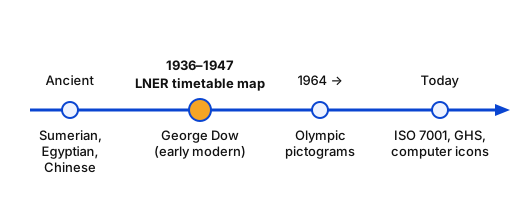
- 'An early modern example… may be seen in the map in the London suburban timetables of the London and North Eastern Railway, 1936–1947, designed by George Dow.'
- Logographic writing is ancient; icons and chemical hazard symbols are present-day uses.
Trick: Keyword match: 'early modern example'.
Answer: (C) London railway timetable
अवधारणा: गद्यांश में एक प्रयोग को स्पष्ट रूप से 'early modern example' कहा गया है।
- 'An early modern example… may be seen in the map in the London suburban timetables of the London and North Eastern Railway, 1936–1947, designed by George Dow.'
- Logographic writing प्राचीन है; icons व chemical hazard symbols आज के प्रयोग हैं।
ट्रिक: Keyword मिलान: 'early modern example'।
उत्तर: (C) London railway timetable
SSC CPO Paper IEnglish ComprehensionReading ComprehensionSSC CPO Paper I 2020 · 25 Nov Shift 3
Read the given passage and answer the questions that follow.
Early written symbols were based on pictographs (pictures which resemble what they signify) and ideograms (symbols which represent ideas). Ancient Sumerian, Egyptian, and Chinese civilizations began to adapt such symbols to represent concepts, developing them into logographic writing systems. Pictographs are still in use as the main medium of written communication in some non-literate cultures in Africa, the Americas, and Oceania.
Pictographs are often used as simple, pictorial, representational symbols by most
contemporary cultures.
Pictographs can be considered an art form, or can be considered a written language and are designated as such in Pre-Columbian art, Native American art, Ancient Mesopotamia and Painting in the Americas before Colonization. One example of many is the Rock art of the Chumash people, part of the Native American history of California.
An early modern example of the extensive use of pictographs may be seen in the map in the London suburban timetables of the London and North Eastern Railway, 1936-1947, designed by George Dow, in which a variety of pictographs was used to indicate facilities available near each station. Pictographs remain in common use today, serving as pictorial, representational signs, instructions, or statistical diagrams. Because of their graphical nature and fairly realistic style, they are widely used to indicate public toilets, or places such as airports and train stations. Because they are a concise way to communicate a concept to people who speak many different languages, pictograms have also been used extensively at the Olympics since 1964 Summer Olympics, and are redesigned for each set of games.
Pictographs can often transcend languages in that they can communicate to speakers of a number of tongues and language families equally effectively, even if the languages and cultures are completely different. This is why road signs and similar pictographic material are often applied as global standards expected to be understood by nearly all.
A standard set of pictographs was defined in the international standard ISO 7001: Public Information Symbols. Other common sets of pictographs are the laundry symbols used on clothing tags and the chemical hazard symbols as standardised by the GHS system.
Pictograms have been popularised in use on the web and in software, better known as ‘icons’ displayed on a computer screen in order to help users navigate a computer system or mobile device.
Q1400.Which of the following statements is NOT true?
- AIdeograms are symbols which represent ideas.
- BRock art of Chumash people is part of Mesopotamian history.
- CGeorge Dow used pictographs to represent facilities near each train station.
- DPictographs are widely used to depict road signs.
Show answer
Concept: Check each statement against the passage.
- (A) True – ideograms are 'symbols which represent ideas'. (C) True – George Dow's map. (D) True – road signs use pictographs.
- (B) False – the Rock art of the Chumash people is part of the Native American history of California, not Mesopotamian history.
Trick: In NOT-true questions, look for a mixed-up pairing of names.
Answer: (B) Rock art of Chumash people is part of Mesopotamian history.
अवधारणा: हर कथन को गद्यांश से मिलाएँ।
- (A) सत्य – ideograms 'symbols which represent ideas' हैं। (C) सत्य – George Dow का map। (D) सत्य – road signs में pictographs।
- (B) असत्य – Chumash लोगों की Rock art Native American history of California का भाग है, Mesopotamia का नहीं।
ट्रिक: असत्य कथन में अक्सर नामों का गलत जोड़ होता है।
उत्तर: (B) Rock art of Chumash people is part of Mesopotamian history.
SSC CPO Paper IEnglish ComprehensionReading Comprehension – NOT trueSSC CPO Paper I 2020 · 25 Nov Shift 3

