Q1381.When a number is successively divided by 3, 4 and 7, the remainder obtained is 2, 3 and 5, respectively. What will be the remainder when 42 divides the same number?
जब किसी संख्या को क्रमिक रूप से 3, 4 और 7 से विभाजित किया जाता है, तो प्राप्त शेषफल क्रमशः 2, 3 और 5 है। उसी संख्या को 42 से विभाजित करने पर शेषफल क्या होगा?
- A41
- B30
- C29
- D31
Show answer
Concept: Build the smallest number backwards from the last quotient.
- Last quotient 0: ; ; .
- General number (since ).
- is a multiple of 42, so remainder .
Trick: Remainder by a factor of 84 is just the remainder of 71.
Answer: (C) 29
अवधारणा: अंतिम भागफल से उल्टा चलकर सबसे छोटी संख्या बनाएँ।
- ; ; ।
- सामान्य संख्या ।
- 84, 42 का गुणज है, शेषफल ।
ट्रिक: 84 के गुणनखंड से भाग देने पर 71 का शेषफल ही उत्तर है।
उत्तर: (C) 29
SSC CPO Paper IQuantitative AptitudeNumber System – Successive DivisionSSC CPO Paper I 2020 · 25 Nov Shift 3
Q1382.An article was sold at a loss of 13.5%. If it was sold for ₹1,104 more, then there would have been a profit of 9.5%. The cost price of the article was:
एक वस्तु को 13.5% की हानि पर बेचा गया। यदि इसे ₹1,104 अधिक में बेचा जाता, तो 9.5% का लाभ होता। वस्तु का क्रय मूल्य था:
- A₹4,600
- B₹4,800
- C₹4,400
- D₹4,200
Show answer
Concept: Change from loss to profit is a percentage of CP.
- Difference of CP.
- .
Trick: , so CP = 4800.
Answer: (B) ₹4,800
अवधारणा: हानि से लाभ तक का बदलाव CP का प्रतिशत है।
- अंतर ।
- ।
ट्रिक: , अतः CP = 4800।
उत्तर: (B) ₹4,800
SSC CPO Paper IQuantitative AptitudeProfit and LossSSC CPO Paper I 2020 · 25 Nov Shift 3
Q1383.How many numbers between 300 and 700 are divisible by 5, 6 and 8?
300 और 700 के बीच कितनी संख्याएँ 5, 6 और 8 से विभाज्य हैं?
- A3
- B2
- C5
- D20
Show answer
Concept: A number divisible by 5, 6 and 8 is a multiple of their LCM.
- .
- Multiples between 300 and 700: 360, 480, 600.
- Count = 3.
Trick: .
Answer: (A) 3
अवधारणा: 5, 6 और 8 से विभाज्य संख्या उनके LCM का गुणज होती है।
- ।
- 300 और 700 के बीच: 360, 480, 600।
- संख्या = 3।
ट्रिक: (700 और 300 में 120 के गुणजों की गिनती)।
उत्तर: (A) 3
SSC CPO Paper IQuantitative AptitudeLCM – DivisibilitySSC CPO Paper I 2020 · 25 Nov Shift 3
Q1384.The simple interest on a sum of money at 10% per annum for 2 years is ₹8,100. What would be the compound interest (in ₹) on the same sum for the same period at 15% p.a, when the interest is compounded yearly? (nearest to ₹1)
किसी धनराशि पर 10% वार्षिक दर से 2 वर्षों का साधारण ब्याज ₹8,100 है। उसी धनराशि पर उसी अवधि के लिए 15% वार्षिक दर से, ब्याज वार्षिक रूप से संयोजित होने पर, चक्रवृद्धि ब्याज (₹ में) कितना होगा? (निकटतम ₹1 तक)
- A8,100
- B12,751
- C14,671
- D13,061
Show answer
Concept: ; .
- .
- .
- Nearest rupee: 13,061.
Trick: Two-year CI rate at 15% .
Answer: (D) ₹13,061
अवधारणा: ; ।
- ।
- ।
- निकटतम रुपया: 13,061।
ट्रिक: 15% पर 2 वर्ष की CI दर ।
उत्तर: (D) ₹13,061
SSC CPO Paper IQuantitative AptitudeSimple & Compound InterestSSC CPO Paper I 2020 · 25 Nov Shift 3
Q1385.On a marked price, the difference of selling prices with a discount of 35% and two successive discounts of 20% and 15%, is ₹504. The marked price of the article (in ₹) is:
किसी अंकित मूल्य पर, 35% की एकल छूट और 20% तथा 15% की दो क्रमिक छूटों के साथ विक्रय मूल्यों का अंतर ₹504 है। वस्तु का अंकित मूल्य (₹ में) है:
- A16,000
- B16,800
- C15,500
- D18,000
Show answer
Concept: Compare the single equivalent discounts.
- Successive 20% and 15%: .
- Difference of MP .
- MP .
Trick: Equivalent discount: .
Answer: (B) ₹16,800
अवधारणा: समतुल्य एकल छूट की तुलना करें।
- 20% और 15% क्रमिक: ।
- अंतर MP ।
- MP ।
ट्रिक: समतुल्य छूट: ।
उत्तर: (B) ₹16,800
SSC CPO Paper IQuantitative AptitudeDiscountSSC CPO Paper I 2020 · 25 Nov Shift 3
Q1386.The sides PQ and PR of are produced to points S and T, respectively. The bisectors of and meet at U. If , then the measure of is:
की भुजाओं PQ और PR को क्रमशः बिंदुओं S और T तक बढ़ाया गया है। और के समद्विभाजक U पर मिलते हैं। यदि है, तो का माप है:
- A
- B
- C
- D
Show answer
Concept: Exterior angle bisectors at Q and R meet at the excentre U: .
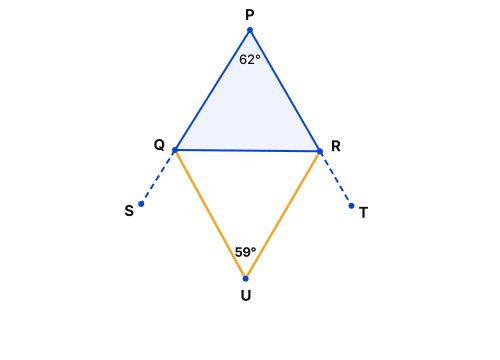
- .
- .
Yaad rakhein: Two external bisectors: ; two internal: .
Answer: (B)
अवधारणा: Q और R के बाह्य कोण समद्विभाजक बाह्यकेंद्र U पर मिलते हैं: ।
- ।
- ।
याद रखें: दो बाह्य समद्विभाजक: ; दो आंतरिक: ।
उत्तर: (B)
SSC CPO Paper IQuantitative AptitudeGeometry – ExcentreSSC CPO Paper I 2020 · 25 Nov Shift 3
Q1387.The number of students in Class XI in Science, Arts and Commerce streams of a school over a period of 4 years (2011 – 2014) has been depicted through the bar chart given below.
(Bar chart data)
| Year | Science | Arts | Commerce |
|---|
| 2011 | 20 | 30 | 40 |
| 2012 | 30 | 50 | 30 |
| 2013 | 40 | 20 | 20 |
| 2014 | 10 | 20 | 30 |
What is the average of the number of Arts students in the given class over the given period of 4 years?
नीचे दिए गए दंड आलेख (bar chart) के माध्यम से 4 वर्षों (2011 – 2014) की अवधि में एक स्कूल की कक्षा XI में विज्ञान, कला और वाणिज्य संकायों के छात्रों की संख्या दर्शाई गई है।
(दंड आलेख के आँकड़े)
| वर्ष | विज्ञान | कला | वाणिज्य |
|---|
| 2011 | 20 | 30 | 40 |
| 2012 | 30 | 50 | 30 |
| 2013 | 40 | 20 | 20 |
| 2014 | 10 | 20 | 30 |
4 वर्षों की दी गई अवधि में दी गई कक्षा में कला के छात्रों की संख्या का औसत क्या है?
- A25
- B30
- C35
- D32
Show answer
Concept: Average = sum of Arts students ÷ 4.
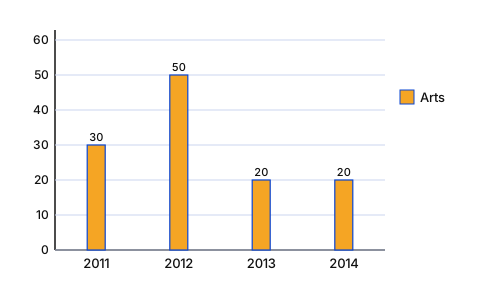
- Arts: .
- Average .
Trick: Read only the Arts bars (orange in the chart).
Answer: (B) 30
अवधारणा: औसत = Arts छात्रों का योग ÷ 4।
- Arts: ।
- औसत ।
ट्रिक: केवल Arts के बार पढ़ें।
उत्तर: (B) 30
SSC CPO Paper IQuantitative AptitudeBar Graph (DI)SSC CPO Paper I 2020 · 25 Nov Shift 3
Q1388.If , then the value of is:
यदि है, तो का मान है:
- A1
- B3
- C−1
- D0
Show answer
Concept: If then .
- .
- .
Trick: Check with a = 1, b = 1, c = −2: .
Answer: (B) 3
अवधारणा: यदि तो ।
- व्यंजक ।
- ।
ट्रिक: a = 1, b = 1, c = −2 रखकर: ।
उत्तर: (B) 3
SSC CPO Paper IQuantitative AptitudeAlgebraic IdentitiesSSC CPO Paper I 2020 · 25 Nov Shift 3
Q1389.In a school, of the number of students are girls and the rest are boys. of the number of boys are below 14 years of age, and of the number of girls are 14 years or above 14 years of age. If the number of students below 14 years of age is 1120, then the total number of students in the school is:
एक स्कूल में छात्रों की संख्या का भाग लड़कियाँ हैं और शेष लड़के हैं। लड़कों की संख्या का भाग 14 वर्ष से कम आयु का है, और लड़कियों की संख्या का भाग 14 वर्ष या 14 वर्ष से अधिक आयु का है। यदि 14 वर्ष से कम आयु के छात्रों की संख्या 1120 है, तो स्कूल में छात्रों की कुल संख्या है:
- A1820
- B1290
- C1900
- D1920
Show answer
Concept: Express both groups below 14 years as fractions of total N.
- Boys ; below 14: .
- Girls ; below 14: .
- .
Trick: Girls below 14 is of girls — don't use .
Answer: (D) 1920
अवधारणा: 14 वर्ष से कम दोनों समूहों को कुल N की भिन्न में लिखें।
- लड़के ; 14 से कम: ।
- लड़कियाँ ; 14 से कम: ।
- ।
ट्रिक: 14 से कम लड़कियाँ हैं, नहीं।
उत्तर: (D) 1920
SSC CPO Paper IQuantitative AptitudeFractions – Word ProblemSSC CPO Paper I 2020 · 25 Nov Shift 3
Q1390.The base of a triangle is equal to the perimeter of a square whose diagonal is cm, and its height is equal to the side of a square whose area is 144 cm2. The area of the triangle (in cm2) is:
एक त्रिभुज का आधार उस वर्ग के परिमाप के बराबर है जिसका विकर्ण cm है, और इसकी ऊँचाई उस वर्ग की भुजा के बराबर है जिसका क्षेत्रफल 144 cm2 है। त्रिभुज का क्षेत्रफल (cm2 में) है:
- A216
- B72
- C144
- D288
Show answer
Concept: Square side ; triangle area .
- Side ⇒ perimeter (base) cm.
- Height cm.
- Area .
Trick: Diagonal ⇒ side a directly.
Answer: (A) 216
अवधारणा: वर्ग की भुजा ; त्रिभुज क्षेत्रफल ।
- भुजा ⇒ परिमाप (आधार) cm।
- ऊँचाई cm।
- क्षेत्रफल ।
ट्रिक: विकर्ण ⇒ भुजा a सीधे।
उत्तर: (A) 216
SSC CPO Paper IQuantitative AptitudeMensuration – Triangle & SquareSSC CPO Paper I 2020 · 25 Nov Shift 3
Q1391.A ladder is resting against a wall. The angle between the foot of the ladder and the wall is 45° and the foot of the ladder is 6.6 m away from the wall. The length of the ladder (in m) is:
एक सीढ़ी दीवार के सहारे टिकी हुई है। सीढ़ी के पाद और दीवार के बीच का कोण 45° है और सीढ़ी का पाद दीवार से 6.6 m दूर है। सीढ़ी की लंबाई (m में) है:
- A
- B
- C
- D
Show answer
Concept: Ladder, wall and ground form a right triangle; at 45° it is isosceles.
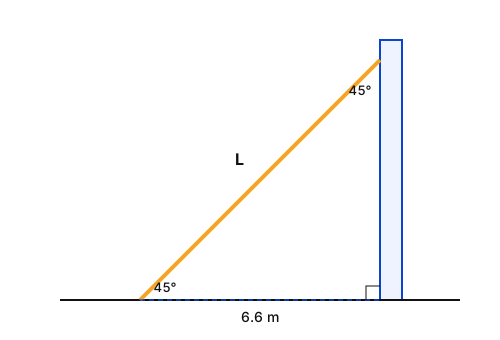
- Angle with the wall , so angle with the ground is also .
- m.
Trick: 45-45-90 triangle: hypotenuse = leg .
Answer: (A)
अवधारणा: सीढ़ी, दीवार और ज़मीन समकोण त्रिभुज बनाते हैं; 45° पर यह समद्विबाहु है।
- दीवार से कोण , अतः ज़मीन से भी ।
- m।
ट्रिक: 45-45-90 त्रिभुज: कर्ण = भुजा ।
उत्तर: (A)
SSC CPO Paper IQuantitative AptitudeHeights and DistancesSSC CPO Paper I 2020 · 25 Nov Shift 3
Q1392.The HCF of two numbers is 29, and the other two factors of their LCM are 15 and 13. The smaller of the two numbers is:
दो संख्याओं का महत्तम समापवर्तक (HCF) 29 है, और उनके लघुत्तम समापवर्त्य (LCM) के अन्य दो गुणनखंड 15 और 13 हैं। दोनों संख्याओं में से छोटी संख्या है:
- A377
- B406
- C435
- D464
Show answer
Concept: Numbers = HCF × each co-prime factor of the LCM.
- Numbers and .
- Smaller number = 377.
Trick: Multiply HCF by the smaller other factor.
Answer: (A) 377
अवधारणा: संख्याएँ = HCF × LCM के सह-अभाज्य गुणनखंड।
- संख्याएँ और ।
- छोटी संख्या = 377।
ट्रिक: HCF को छोटे गुणनखंड से गुणा करें।
उत्तर: (A) 377
SSC CPO Paper IQuantitative AptitudeHCF and LCMSSC CPO Paper I 2020 · 25 Nov Shift 3
Q1393.Solve for : , .
के लिए हल कीजिए: , ।
- A
- B
- C
- D
Show answer
Concept: .
- .
- .
Trick: Check: ✓ at .
Answer: (C)
अवधारणा: ।
- ।
- ।
ट्रिक: जाँच: पर ✓।
उत्तर: (C)
SSC CPO Paper IQuantitative AptitudeTrigonometrySSC CPO Paper I 2020 · 25 Nov Shift 3
Q1394.On the marked price of ₹1,250 of an article, three successive discounts of 5%, 15% and 20% were offered. The amount (in ₹) of discount received by a customer is:
किसी वस्तु के ₹1,250 के अंकित मूल्य पर 5%, 15% और 20% की तीन क्रमिक छूटें दी गईं। एक ग्राहक को प्राप्त छूट की राशि (₹ में) है:
- A442.50
- B950.25
- C450
- D807.50
Show answer
Concept: Apply each discount on the reduced price.
- SP .
- Discount .
Trick: 807.50 is the selling price — a trap option; the question asks for the discount.
Answer: (A) ₹442.50
अवधारणा: हर छूट घटे हुए मूल्य पर लगती है।
- SP ।
- छूट ।
ट्रिक: 807.50 विक्रय मूल्य है — प्रश्न छूट पूछ रहा है।
उत्तर: (A) ₹442.50
SSC CPO Paper IQuantitative AptitudeSuccessive DiscountsSSC CPO Paper I 2020 · 25 Nov Shift 3
Q1395.If , , then the value of is:
यदि , है, तो का मान है:
- A0
- B2
- C5
- D1
Show answer
Concept: .
- , : .
- , .
- Value .
Trick: Note .
Answer: (D) 1
अवधारणा: ।
- ।
- , ।
- मान ।
ट्रिक: ।
उत्तर: (D) 1
SSC CPO Paper IQuantitative AptitudeTrigonometrySSC CPO Paper I 2020 · 25 Nov Shift 3
Q1396.Two circles of radii 15 cm and 10 cm intersect each other and the length of their common chord is 16 cm. What is the distance (in cm) between their centres?
15 cm और 10 cm त्रिज्या वाले दो वृत्त एक-दूसरे को प्रतिच्छेद करते हैं और उनकी उभयनिष्ठ जीवा की लंबाई 16 cm है। उनके केंद्रों के बीच की दूरी (cm में) कितनी है?
- A
- B
- C
- D
Show answer
Concept: The line of centres is the perpendicular bisector of the common chord.
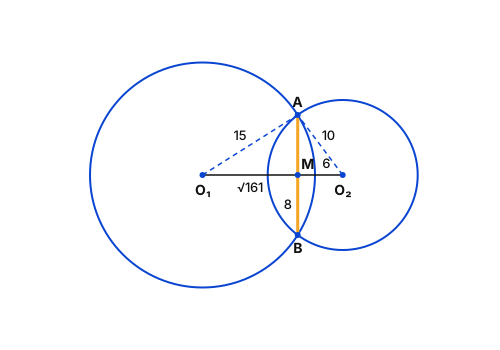
- Half chord AM cm.
- ; .
- cm.
Trick: Use Pythagoras in each circle separately with the half chord.
Answer: (D)
अवधारणा: केंद्रों को मिलाने वाली रेखा उभयनिष्ठ जीवा (common chord) का लंब समद्विभाजक है।
- आधी जीवा AM cm।
- ; ।
- cm।
ट्रिक: हर वृत्त में आधी जीवा से पाइथागोरस लगाएँ।
उत्तर: (D)
SSC CPO Paper IQuantitative AptitudeGeometry – Intersecting CirclesSSC CPO Paper I 2020 · 25 Nov Shift 3
Q1397.The fasting blood sugar level (F) and the post prandial blood sugar level (PP) of a patient was monitored for four weeks W1, W2, W3, W4, and the readings (in mg/dl) for the four weeks are as follows:
F/PP: 170/220, 150/180, 120/150, 90/120.
These have been presented through a bar graph. The normal range is considered to be:
F/PP: 70 – 100/100 – 130.
(Bar graph data)
| Week | F | PP |
|---|
| W1 | 170 | 220 |
| W2 | 150 | 180 |
| W3 | 120 | 150 |
| W4 | 90 | 120 |
During which week was the fasting blood sugar level of the patient approximately 115.4% above the upper limit of normal PP blood sugar level?
चार सप्ताहों W1, W2, W3, W4 तक एक रोगी के उपवास (fasting) रक्त शर्करा स्तर (F) और भोजन के पश्चात (post prandial) रक्त शर्करा स्तर (PP) की निगरानी की गई, और चार सप्ताहों की रीडिंग (mg/dl में) इस प्रकार हैं:
F/PP: 170/220, 150/180, 120/150, 90/120.
इन्हें एक दंड आलेख के माध्यम से प्रस्तुत किया गया है। सामान्य सीमा इस प्रकार मानी जाती है:
F/PP: 70 – 100/100 – 130.
(दंड आलेख के आँकड़े)
| सप्ताह | F | PP |
|---|
| W1 | 170 | 220 |
| W2 | 150 | 180 |
| W3 | 120 | 150 |
| W4 | 90 | 120 |
किस सप्ताह के दौरान रोगी का उपवास रक्त शर्करा स्तर, सामान्य PP रक्त शर्करा स्तर की ऊपरी सीमा से लगभग 115.4% अधिक था?
- AW3
- BW1
- CW2
- DW4
Show answer
Concept: Upper limit of normal PP = 130; compare each week's F value with 130 as a percentage.
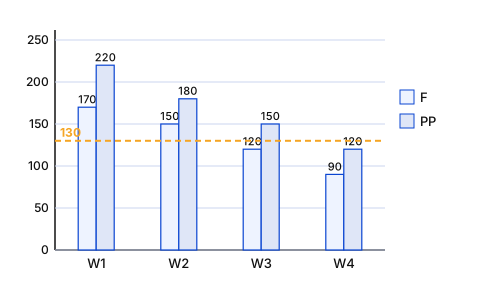
- W2: — F equals 115.4% of 130 (15.4% higher).
- Others: W1 , W3 , W4 .
- Only W2 gives the 115.4% figure.
Trick: — recognise the fraction behind 115.4%.
Answer: (C) W2
अवधारणा: सामान्य PP की ऊपरी सीमा = 130; हर सप्ताह के F मान को 130 के प्रतिशत में देखें।
- W2: — F, 130 का 115.4% है (15.4% अधिक)।
- W1 , W3 , W4 ।
- केवल W2 से 115.4% आता है।
ट्रिक: — 115.4% के पीछे की भिन्न पहचानें।
उत्तर: (C) W2
SSC CPO Paper IQuantitative AptitudeBar Graph (DI)SSC CPO Paper I 2020 · 25 Nov Shift 3
Q1398.Study the given histogram that shows the marks obtained by students in an examination and answer the question that follows.
(Histogram data: marks on the horizontal axis, number of students on the vertical axis)
| Marks | Number of Students |
|---|
| 150 – 200 | 30 |
| 200 – 250 | 45 |
| 250 – 300 | 60 |
| 300 – 350 | 35 |
| 350 – 400 | 40 |
| 400 – 450 | 35 |
The number of students who obtained less than 200 marks is:
दिए गए आयतचित्र (histogram) का अध्ययन कीजिए, जो किसी परीक्षा में छात्रों द्वारा प्राप्त अंकों को दर्शाता है, और उसके बाद दिए गए प्रश्न का उत्तर दीजिए।
(आयतचित्र के आँकड़े: क्षैतिज अक्ष पर अंक, ऊर्ध्वाधर अक्ष पर छात्रों की संख्या)
| अंक | छात्रों की संख्या |
|---|
| 150 – 200 | 30 |
| 200 – 250 | 45 |
| 250 – 300 | 60 |
| 300 – 350 | 35 |
| 350 – 400 | 40 |
| 400 – 450 | 35 |
200 से कम अंक प्राप्त करने वाले छात्रों की संख्या है:
- A75
- B30
- C45
- D135
Show answer
Concept: Less than 200 marks means only the class 150–200.
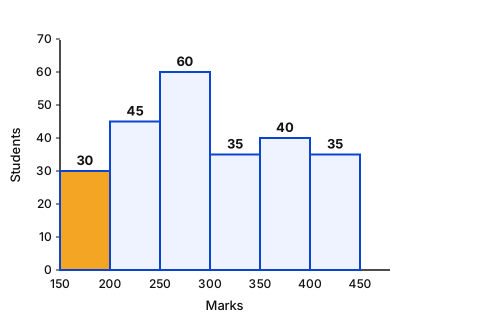
- Class 150–200 has 30 students.
- No class starts below 150, so the answer is 30.
Trick: 75 (= 30 + 45) is the count below 250, a trap.
Answer: (B) 30
अवधारणा: 200 से कम अंक = केवल 150–200 वाली class।
- 150–200 में 30 छात्र।
- 150 से नीचे कोई class नहीं, अतः उत्तर 30।
ट्रिक: 75 (= 30 + 45) 250 से कम वालों की संख्या है — जाल विकल्प।
उत्तर: (B) 30
SSC CPO Paper IQuantitative AptitudeHistogram (DI)SSC CPO Paper I 2020 · 25 Nov Shift 3
Q1399.The value of is:
का मान है:
- A7
- B
- C−7
- D
Show answer
Concept: Solve innermost brackets first; 'of' before ÷.
- ; .
- Curly bracket: .
- Square bracket: .
- .
Trick: '5 ÷ 5 of 2' is , not .
Answer: (C)
अवधारणा: पहले अंदर के कोष्ठक; 'of' को ÷ से पहले।
- ; ।
- मझला कोष्ठक: ।
- बड़ा कोष्ठक: ।
- ।
ट्रिक: '5 ÷ 5 of 2' होता है।
उत्तर: (C)
SSC CPO Paper IQuantitative AptitudeSimplification – BODMASSSC CPO Paper I 2020 · 25 Nov Shift 3
Q1400.Two pipes A and B can fill a cistern in hours and 25 hours, respectively. The pipes are opened simultaneously and it is found that due to a leakage in the bottom, it took 1 hour 40 minutes more to fill the cistern. When the cistern is full, in how much time will the leak empty the cistern?
दो पाइप A और B किसी टंकी को क्रमशः घंटे और 25 घंटे में भर सकते हैं। पाइपों को एक साथ खोला जाता है और यह पाया जाता है कि तल में एक रिसाव के कारण टंकी को भरने में 1 घंटा 40 मिनट अधिक लगे। टंकी के पूरी भरी होने पर, रिसाव उसे कितने समय में खाली कर देगा?
- A45 hours45 घंटे
- B42 hours42 घंटे
- C48 hours48 घंटे
- D50 hours50 घंटे
Show answer
Concept: Leak rate = combined filling rate − actual net rate.
- A + B per hour ⇒ time h = 8 h 20 min.
- With leak: 8 h 20 min + 1 h 40 min = 10 h ⇒ net rate .
- Leak rate ⇒ 50 hours.
Trick: Leak time .
Answer: (D) 50 hours
अवधारणा: रिसाव दर = संयुक्त भरने की दर − वास्तविक शुद्ध दर।
- A + B प्रति घंटा ⇒ समय h = 8 h 20 min।
- रिसाव के साथ 10 h ⇒ शुद्ध दर ।
- रिसाव दर ⇒ 50 घंटे।
ट्रिक: रिसाव समय ।
उत्तर: (D) 50 घंटे
SSC CPO Paper IQuantitative AptitudePipes and CisternsSSC CPO Paper I 2020 · 25 Nov Shift 3

