Q1421.Select the most appropriate option to fill in the blank.
When I solved the sum ______ I was very happy.
- Amyself
- Bitself
- Coneself
- Dherself
Show answer
Concept: Emphatic reflexive pronoun agrees with the subject: I → myself.
- Subject is I, so the reflexive form is myself (I did it without help).
- itself (it), oneself (one), herself (she) do not match I.
- When I solved the sum myself I was very happy.
Yaad rakhein: I–myself, we–ourselves, you–yourself, he–himself.
Answer: (A) myself
अवधारणा: Emphatic reflexive pronoun subject के अनुसार: I → myself।
- Subject I है, अतः myself (मैंने स्वयं हल किया)।
- itself (it), oneself (one), herself (she) – I से मेल नहीं।
- When I solved the sum myself I was very happy.
याद रखें: I–myself, we–ourselves, you–yourself, he–himself।
उत्तर: (A) myself
SSC CPO Paper IEnglish ComprehensionFill in the BlanksSSC CPO Paper I 2020 · 25 Nov Shift 1
Q1422.Select the most appropriate meaning of the given idiom.
A bird’s eye view
- Aa cursory look
- Ba detailed study
- Ca prejudiced view
- Da personal view
Show answer
Concept: A bird's eye view = a general view from above; a broad, quick overall look without details.
- A bird flying high sees everything broadly, not in detail.
- So it means a general / cursory look (overview).
- a detailed study is the opposite; prejudiced or personal view are unrelated.
Yaad rakhein: Bird's eye view = overview; opposite = close / detailed study.
Answer: (A) a cursory look
अवधारणा: A bird's eye view = ऊपर से देखा गया सामान्य दृश्य; विस्तार में गए बिना सरसरी, समग्र दृष्टि।
- ऊँचाई पर उड़ता पक्षी सब कुछ मोटे तौर पर देखता है, विस्तार में नहीं।
- अतः अर्थ है सरसरी नज़र (a cursory look)।
- a detailed study उल्टा अर्थ है; prejudiced/personal view असंबंधित।
याद रखें: Bird's eye view = सरसरी/समग्र दृष्टि; उल्टा = detailed study।
उत्तर: (A) a cursory look
SSC CPO Paper IEnglish ComprehensionIdioms and PhrasesSSC CPO Paper I 2020 · 25 Nov Shift 1
Q1423.Select the most appropriate option to substitute the underlined segment in the given sentence. If there is no need to substitute it, select ‘No substitution required’.
I cannot tell you now whether I will be able to come or not.
- Aunless
- Bbecause
- Cin case
- DNo substitution required
Show answer
Concept: whether ... or not is the correct correlative to express two alternatives (uncertainty).
- I cannot tell you now whether I will be able to come or not. – correct as it is.
- unless (= if not), because (reason), in case (precaution) cannot pair with 'or not'.
- So no substitution is required.
Trick: 'or not' at the end → 'whether' is the partner.
Answer: (D) No substitution required
अवधारणा: दो विकल्पों/अनिश्चितता के लिए सही correlative whether ... or not है।
- I cannot tell you now whether I will be able to come or not. – वाक्य सही है।
- unless (= यदि नहीं), because (कारण), in case (सावधानी) 'or not' के साथ नहीं आते।
- अतः कोई बदलाव आवश्यक नहीं।
ट्रिक: अंत में 'or not' → साथी 'whether'।
उत्तर: (D) No substitution required
SSC CPO Paper IEnglish ComprehensionSentence ImprovementSSC CPO Paper I 2020 · 25 Nov Shift 1
Q1424.Select the most appropriate option to substitute the underlined segment in the given sentence. If there is no need to substitute it, select ‘No substitution required’.
That tree fell down yesterday narrowly miss my car.
- Anarrowly missing
- BNo substitution required
- Cnarrowed missing
- Dnarrowly missed
Show answer
Concept: A present participle (-ing) phrase shows an action happening at the same time as the main verb.
- Main verb: fell down; the tree, while falling, almost hit the car.
- That tree fell down yesterday, narrowly missing my car. (adverb narrowly + participle missing)
- narrowly miss/missed add a second finite verb without a conjunction; narrowed is a verb, not an adverb.
Trick: Two simultaneous actions, one subject → second verb in -ing.
Answer: (A) narrowly missing
अवधारणा: Present participle (-ing) phrase मुख्य क्रिया के साथ-साथ होने वाली क्रिया दर्शाता है।
- मुख्य क्रिया: fell down; गिरते समय पेड़ कार से बाल-बाल चूका।
- That tree fell down yesterday, narrowly missing my car. (adverb narrowly + participle missing)
- narrowly miss/missed बिना conjunction दूसरी finite verb देते हैं; narrowed verb है, adverb नहीं।
ट्रिक: एक subject, दो साथ-साथ क्रियाएँ → दूसरी क्रिया -ing में।
उत्तर: (A) narrowly missing
SSC CPO Paper IEnglish ComprehensionSentence ImprovementSSC CPO Paper I 2020 · 25 Nov Shift 1
Q1425.Select the most appropriate word for the given group of words.
A young person tending to commit crime, particularly minor crime.
- Aconvict
- Bderelict
- Ccriminal
- Ddelinquent
Show answer
Concept: A young person who tends to commit (minor) crimes is a delinquent (juvenile delinquent).
- convict = a person found guilty and in prison.
- derelict = abandoned / a homeless vagrant; criminal = any law-breaker, not specifically young.
- So the word is delinquent.
Yaad rakhein: Juvenile delinquent = young offender.
Answer: (D) delinquent
अवधारणा: छोटे-मोटे अपराधों की प्रवृत्ति वाला युवा = delinquent (बाल अपराधी / juvenile delinquent)।
- convict = दोषसिद्ध कैदी।
- derelict = परित्यक्त / आवारा; criminal = कोई भी अपराधी, विशेषकर युवा नहीं।
- अतः शब्द delinquent है।
याद रखें: Juvenile delinquent = बाल अपराधी।
उत्तर: (D) delinquent
SSC CPO Paper IEnglish ComprehensionOne-word SubstitutionSSC CPO Paper I 2020 · 25 Nov Shift 1
Q1426.Select the most appropriate option to substitute the underlined segment in the given sentence. If there is no need to substitute it, select ‘No substitution required’.
She will have to go to another school when she moves from here, has she ?
- ANo substitution required
- Bhasn’t she
- Cwill she
- Dwon’t she
Show answer
Concept: Question tag uses the same auxiliary as the main clause, with opposite polarity.
- Main clause: She will have to go ... – positive, auxiliary will.
- So the tag is negative with will: won't she?
- has she / hasn't she use the wrong auxiliary; will she is not negative.
Trick: will → won't; has → hasn't; is → isn't (after a positive statement).
Answer: (D) won’t she
अवधारणा: Question tag में main clause वाला वही auxiliary, उल्टी polarity के साथ।
- Main clause: She will have to go ... – positive, auxiliary will।
- अतः tag negative: won't she?
- has she / hasn't she में गलत auxiliary; will she negative नहीं।
ट्रिक: positive वाक्य के बाद: will → won't; has → hasn't; is → isn't।
उत्तर: (D) won’t she
SSC CPO Paper IEnglish ComprehensionSentence ImprovementSSC CPO Paper I 2020 · 25 Nov Shift 1
Q1427.Select the most appropriate word for the given group of word.
A factual written account of important or historical events in the order of their occurrence.
- Ajournal
- Bchronicle
- Cregister
- Dchronology
Show answer
Concept: A factual written record of (historical) events in the order they happened is a chronicle.
- chronology = the arrangement/order of events in time, not the written account itself.
- journal = personal daily record or periodical; register = official list of names/entries.
- So the word is chronicle.
Yaad rakhein: Chronicle = written account; chronology = the time-order.
Answer: (B) chronicle
अवधारणा: ऐतिहासिक घटनाओं का उनके घटने के क्रम में लिखित तथ्यात्मक विवरण = chronicle (इतिवृत्त)।
- chronology = घटनाओं का कालक्रम (व्यवस्था), लिखित विवरण नहीं।
- journal = दैनिकी/पत्रिका; register = नामों/प्रविष्टियों की सूची।
- अतः शब्द chronicle।
याद रखें: Chronicle = लिखित विवरण; chronology = समय-क्रम।
उत्तर: (B) chronicle
SSC CPO Paper IEnglish ComprehensionOne-word SubstitutionSSC CPO Paper I 2020 · 25 Nov Shift 1
Q1428.Select the most appropriate word for the given group of words.
Government run by a small group of people
- Aaristocracy
- Bmonarchy
- Coligarchy
- Dplutocracy
Show answer
Concept: Government by a small group of people = oligarchy (Greek oligos = few).
- aristocracy = rule by the nobility (privileged class by birth).
- monarchy = rule by one king/queen; plutocracy = rule by the wealthy.
- Small group (few) → oligarchy.
Yaad rakhein: Oligo = few, mono = one, pluto = wealth, aristo = best/noble.
Answer: (C) oligarchy
अवधारणा: थोड़े से लोगों के छोटे समूह का शासन = oligarchy (अल्पतंत्र; Greek oligos = कुछ)।
- aristocracy = कुलीन वर्ग का शासन।
- monarchy = राजा/रानी का शासन; plutocracy = धनिकों का शासन।
- छोटा समूह → oligarchy।
याद रखें: Oligo = कुछ, mono = एक, pluto = धन, aristo = कुलीन।
उत्तर: (C) oligarchy
SSC CPO Paper IEnglish ComprehensionOne-word SubstitutionSSC CPO Paper I 2020 · 25 Nov Shift 1
Q1429.Select the most appropriate synonym of the given word.
BENIGN
- Amalignant
- Bsevere
- Cfavourable
- Dharsh
Show answer
Concept: Benign = kindly, gentle, favourable; (of a tumour) not harmful.
- favourable = positive, beneficial – closest meaning (a benign climate = favourable climate).
- malignant is the direct antonym; severe and harsh are also opposite in sense.
- So the synonym is favourable.
Yaad rakhein: Benign tumour (harmless) vs malignant tumour (harmful).
Answer: (C) favourable
अवधारणा: Benign = दयालु, सौम्य, अनुकूल; (ट्यूमर) हानिरहित।
- favourable = अनुकूल, हितकारी – निकटतम अर्थ (benign climate = अनुकूल जलवायु)।
- malignant सीधा विलोम है; severe, harsh भी विपरीत भाव।
- अतः समानार्थी favourable।
याद रखें: Benign tumour (हानिरहित) vs malignant tumour (घातक)।
उत्तर: (C) favourable
SSC CPO Paper IEnglish ComprehensionSynonymsSSC CPO Paper I 2020 · 25 Nov Shift 1
Q1430.Select the wrongly spelt word.
- Afashion
- Bfascination
- Cfastedious
- Dfascism
Show answer
Concept: Spelling check of each option.
- fashion, fascination, fascism – correct.
- The correct spelling is fastidious (f-a-s-t-i-d-i-o-u-s) = very particular about details.
- So fastedious is wrongly spelt.
Trick: fast-i-d-i-ous: two i's, no e.
Answer: (C) fastedious
अवधारणा: हर विकल्प की वर्तनी जाँचें।
- fashion, fascination, fascism – सही।
- सही वर्तनी fastidious (f-a-s-t-i-d-i-o-u-s) = बहुत नुक्ताचीन/सूक्ष्मदर्शी।
- अतः fastedious गलत।
ट्रिक: fast-i-d-i-ous: दो i, कोई e नहीं।
उत्तर: (C) fastedious
SSC CPO Paper IEnglish ComprehensionSpellingSSC CPO Paper I 2020 · 25 Nov Shift 1
Q1431.Select the most appropriate option to substitute the underlined segment in the given sentence. If there is no need to substitute it, select ‘No substitution required’.
One morning I went out with my cousin which is the lawyer.
- Awho is the
- BNo substitution required
- Cwhich is a
- Dwho is a
Show answer
Concept: Relative pronoun who for persons; indefinite article a before a profession mentioned for the first time.
- cousin is a person → who, not which.
- Profession as complement → a lawyer (he is one of many lawyers).
- One morning I went out with my cousin who is a lawyer.
Yaad rakhein: He is a doctor / an engineer – profession takes a/an.
Answer: (D) who is a
अवधारणा: व्यक्ति के लिए relative pronoun who; पेशे से पहले indefinite article a।
- cousin व्यक्ति है → who, which नहीं।
- पेशा बताने पर → a lawyer (अनेक वकीलों में से एक)।
- One morning I went out with my cousin who is a lawyer.
याद रखें: He is a doctor / an engineer – पेशे के साथ a/an।
उत्तर: (D) who is a
SSC CPO Paper IEnglish ComprehensionSentence ImprovementSSC CPO Paper I 2020 · 25 Nov Shift 1
Q1432.Select the most appropriate ANTONYM of the given word.
EXONERATE
- Aabsolve
- Bvindicate
- Cacquit
- Dsentence
Show answer
Concept: Exonerate = to declare someone free from blame or guilt.
- absolve, vindicate, acquit all mean to clear of blame – synonyms.
- The opposite is to declare guilty and punish = sentence.
- So the antonym is sentence.
Trick: Court: acquit/exonerate ↔ convict/sentence.
Answer: (D) sentence
अवधारणा: Exonerate = दोषमुक्त करना, आरोप से मुक्त करना।
- absolve, vindicate, acquit – सभी का अर्थ दोषमुक्त करना (समानार्थी)।
- विपरीत = दोषी ठहराकर सज़ा सुनाना = sentence।
- अतः विलोम sentence।
ट्रिक: अदालत: acquit/exonerate ↔ convict/sentence।
उत्तर: (D) sentence
SSC CPO Paper IEnglish ComprehensionAntonymsSSC CPO Paper I 2020 · 25 Nov Shift 1
Q1433.Select the most appropriate word for the given group of words.
A particular form of a language which is peculiar to a specific region
- Aslang
- Bdialect
- Clingo
- Djargon
Show answer
Concept: A form of a language peculiar to a particular region = dialect (बोली).
- slang = very informal words used by a group, not tied to a region.
- jargon = technical words of a profession; lingo = informal word for a language or jargon.
- Regional variety of a language → dialect.
Yaad rakhein: Bhojpuri, Awadhi are dialects of Hindi – regional forms.
Answer: (B) dialect
अवधारणा: किसी क्षेत्र विशेष में बोला जाने वाला भाषा का रूप = dialect (बोली)।
- slang = किसी समूह के अनौपचारिक शब्द, क्षेत्र से बंधे नहीं।
- jargon = किसी पेशे की तकनीकी शब्दावली; lingo = भाषा/jargon का अनौपचारिक शब्द।
- क्षेत्रीय रूप → dialect।
याद रखें: भोजपुरी, अवधी – हिंदी की बोलियाँ (dialects)।
उत्तर: (B) dialect
SSC CPO Paper IEnglish ComprehensionOne-word SubstitutionSSC CPO Paper I 2020 · 25 Nov Shift 1
Q1434.Select the most appropriate option to fill in the blank.
I ______ for forty minutes to see the doctor before my name was announced.
- Aam waiting
- Bwere waiting
- Chad been waiting
- Dhave been waiting
Show answer
Concept: Past perfect continuous (had been + V-ing) shows an action that continued for a period before another past action.
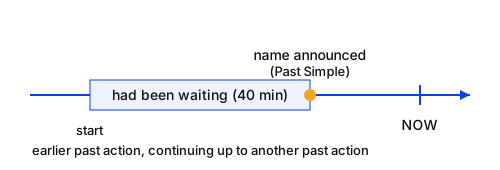
- The waiting (for forty minutes) went on before the past event my name was announced.
- 'for + period' + earlier past action → had been waiting.
- am/have been waiting are present forms; were does not agree with I.
Trick: Duration + 'before' + simple past → had been + V-ing.
Answer: (C) had been waiting
अवधारणा: Past perfect continuous (had been + V-ing) – किसी दूसरी भूतकालिक क्रिया से पहले कुछ समय तक चलती रही क्रिया।
- प्रतीक्षा (चालीस मिनट) भूतकालिक घटना my name was announced से पहले चलती रही।
- 'for + अवधि' + पहले की past क्रिया → had been waiting।
- am/have been waiting present रूप हैं; were, I से मेल नहीं खाता।
ट्रिक: अवधि + 'before' + simple past → had been + V-ing।
उत्तर: (C) had been waiting
SSC CPO Paper IEnglish ComprehensionFill in the BlanksSSC CPO Paper I 2020 · 25 Nov Shift 1
Q1435.Select the most appropriate option to substitute the underlined segment in the given sentence. If there is no need to substitute it, select ‘No substitution required’.
Everybody who know him agree that he rarely loses his temper.
- Awhom know him agrees that
- BNo substitution required
- Cwho knows him agrees that
- Dwho knows him agrees if
Show answer
Concept: Indefinite pronouns like everybody are singular and take singular verbs.
- Everybody → singular verb agrees; in the relative clause who refers to everybody → knows.
- whom cannot be the subject of know; agrees if changes the meaning – agree that introduces the statement.
- Everybody who knows him agrees that he rarely loses his temper.
Yaad rakhein: Everybody / everyone / each → singular verb, even in the 'who' clause.
Answer: (C) who knows him agrees that
अवधारणा: Everybody जैसे indefinite pronouns singular होते हैं, verb भी singular।
- Everybody → singular verb agrees; relative clause में who = everybody → knows।
- whom verb know का subject नहीं हो सकता; agrees if से अर्थ बदलता है – कथन के लिए agree that।
- Everybody who knows him agrees that he rarely loses his temper.
याद रखें: Everybody / everyone / each → singular verb, 'who' clause में भी।
उत्तर: (C) who knows him agrees that
SSC CPO Paper IEnglish ComprehensionSentence ImprovementSSC CPO Paper I 2020 · 25 Nov Shift 1
Q1436.Select the wrongly spelt word.
- Amidget
- Bmilitant
- Cmigrent
- Dmigraine
Show answer
Concept: Spelling check of each option.
- midget, militant, migraine – correct.
- The correct spelling is migrant (one who migrates) – ending -ant, not -ent.
- So migrent is wrongly spelt.
Trick: migrate → migrant (like immigrant).
Answer: (C) migrent
अवधारणा: हर विकल्प की वर्तनी जाँचें।
- midget, militant, migraine – सही।
- सही वर्तनी migrant (प्रवासी) है – अंत -ant, -ent नहीं।
- अतः migrent गलत।
ट्रिक: migrate → migrant (जैसे immigrant)।
उत्तर: (C) migrent
SSC CPO Paper IEnglish ComprehensionSpellingSSC CPO Paper I 2020 · 25 Nov Shift 1
Q1437.Select the most appropriate synonym of the given word.
CHASTE
- Adivine
- Bpure
- Cliberated
- Ddefiled
Show answer
Concept: Chaste = pure, virtuous; simple and undecorated in style.
- pure = morally clean – same sense.
- defiled (made impure) is the antonym; divine = godly, liberated = set free – different meanings.
- So the synonym is pure.
Yaad rakhein: Chaste ≈ pure; chastity = purity.
Answer: (B) pure
अवधारणा: Chaste = पवित्र, शुद्ध, सदाचारी; (शैली) सादा।
- pure = पवित्र, शुद्ध – समान अर्थ।
- defiled (अपवित्र किया हुआ) विलोम है; divine = दैवी, liberated = मुक्त – भिन्न अर्थ।
- अतः समानार्थी pure।
याद रखें: Chaste ≈ pure; chastity = पवित्रता।
उत्तर: (B) pure
SSC CPO Paper IEnglish ComprehensionSynonymsSSC CPO Paper I 2020 · 25 Nov Shift 1
Q1438.Identify the segment in the sentence which contains a grammatical error.
Anybody who does not stop at the red light will fined.
- Awill fined
- Bat the red light
- CAnybody who
- Ddoes not stop
Show answer
Concept: Passive voice with a modal: modal + be + V3.
- The person does not fine himself; he receives the action → passive.
- Correct: Anybody who does not stop at the red light will be fined.
- will fined misses be, so the error is in that segment.
Trick: will/can/must/should + be + V3 in passive.
Answer: (A) will fined
अवधारणा: Modal के साथ passive voice: modal + be + V3।
- व्यक्ति स्वयं जुर्माना नहीं करता, उस पर जुर्माना होता है → passive।
- सही: Anybody who does not stop at the red light will be fined.
- will fined में be छूटा है, अतः त्रुटि इसी भाग में।
ट्रिक: will/can/must/should + be + V3 (passive)।
उत्तर: (A) will fined
SSC CPO Paper IEnglish ComprehensionError SpottingSSC CPO Paper I 2020 · 25 Nov Shift 1
Q1439.Select the most appropriate ANTONYM of the given word.
IRRELEVANT
- Aconsequential
- Btrivial
- Cimmaterial
- Dpointless
Show answer
Concept: Irrelevant = not connected with the matter; unimportant.
- trivial, immaterial, pointless all mean unimportant – synonyms.
- consequential = important, significant, having consequences – the opposite.
- So the antonym is consequential.
Trick: Immaterial = irrelevant; consequential = it matters.
Answer: (A) consequential
अवधारणा: Irrelevant = असंगत, अप्रासंगिक; महत्वहीन।
- trivial, immaterial, pointless – सभी का अर्थ महत्वहीन (समानार्थी)।
- consequential = महत्वपूर्ण, परिणाम देने वाला – विपरीत।
- अतः विलोम consequential।
ट्रिक: Immaterial = irrelevant; consequential = महत्वपूर्ण।
उत्तर: (A) consequential
SSC CPO Paper IEnglish ComprehensionAntonymsSSC CPO Paper I 2020 · 25 Nov Shift 1
Q1440.Select the most appropriate option to fill in the blank.
You really need ______ some guidance in Chemistry.
- Ato take
- Btake
- Ctaking
- Dto be taking
Show answer
Concept: The verb need (as a main verb) is followed by a to-infinitive when the subject must do the action.
- You need to take some guidance – the subject 'you' must take it.
- take (bare) is wrong after main verb 'need'; need taking has a passive sense (it needs to be taken).
- to be taking is continuous and does not suit a general necessity.
Yaad rakhein: need + to + V1 (active); need + V-ing = needs to be done.
Answer: (A) to take
अवधारणा: मुख्य क्रिया need के बाद, जब कार्य subject को स्वयं करना हो, to-infinitive आता है।
- You need to take some guidance – कार्य 'you' को करना है।
- मुख्य verb 'need' के बाद bare take गलत; need taking का अर्थ passive (किए जाने की ज़रूरत)।
- to be taking continuous है, सामान्य आवश्यकता के लिए उपयुक्त नहीं।
याद रखें: need + to + V1 (active); need + V-ing = किए जाने की ज़रूरत।
उत्तर: (A) to take
SSC CPO Paper IEnglish ComprehensionFill in the BlanksSSC CPO Paper I 2020 · 25 Nov Shift 1

