Q1421.In a ΔABC, the bisector of ∠B and ∠C meet at O in the triangle. If ∠BOC = 134°, then the measure of ∠A is:
एक ΔABC में, ∠B और ∠C के समद्विभाजक त्रिभुज में O पर मिलते हैं। यदि ∠BOC = 134° है, तो ∠A का माप है:
- A
- B
- C
- D
Show answer
Concept: Internal bisectors of and meet at O: .
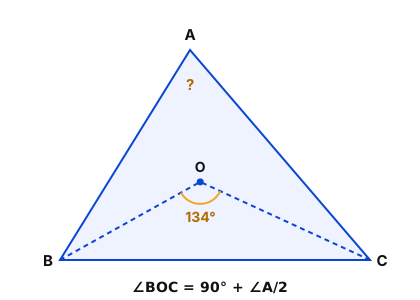
Yaad rakhein: Internal bisectors → ; external bisectors → .
Answer: (D)
अवधारणा: और के आंतरिक समद्विभाजक O पर मिलें तो ।
याद रखें: आंतरिक समद्विभाजक → ; बाह्य समद्विभाजक → ।
उत्तर: (D)
SSC CPO Paper IQuantitative AptitudeGeometry – Angle BisectorsSSC CPO Paper I 2020 · 25 Nov Shift 1
Q1422.A takes 2 hours 30 minutes more than B to walk 40 km. If A doubles his speed, then he can make it in 1 hour less than B. What is the average time taken by A and B to walk a 40 km distance?
A को 40 km पैदल चलने में B से 2 घंटे 30 मिनट अधिक लगते हैं। यदि A अपनी चाल दोगुनी कर दे, तो वह यह दूरी B से 1 घंटा कम समय में तय कर सकता है। A और B द्वारा 40 km की दूरी पैदल चलने में लिया गया औसत समय कितना है?
- A7 hours 15 minutes7 घंटे 15 मिनट
- B5 hours 45 minutes5 घंटे 45 मिनट
- C6 hours6 घंटे
- D5 hours 15 minutes5 घंटे 15 मिनट
Show answer
Concept: Doubling the speed halves the time for the same distance.
- Let B take h; A takes h
- With double speed A takes
- h; A h
- Average h h 45 min
Trick: Check: A's half time 3.5 h is 1 h less than 4.5 h ✓.
Answer: (B) 5 hours 45 minutes
अवधारणा: समान दूरी पर चाल दुगुनी करने से समय आधा हो जाता है।
- B का समय घंटे; A का घंटे
- दुगुनी चाल पर A का समय
- घंटे; A घंटे
- औसत घंटे घंटे 45 मिनट
ट्रिक: जाँच: A का आधा समय 3.5 घंटे, जो 4.5 से 1 घंटा कम ✓।
उत्तर: (B) 5 घंटे 45 मिनट
SSC CPO Paper IQuantitative AptitudeTime and DistanceSSC CPO Paper I 2020 · 25 Nov Shift 1
Q1423.The given pie charts represent the popularity of ice-cream flavours in the years 2005 and 2015.
| Flavour | 2005 | 2015 |
|---|
| Vanilla | 21.9% | 16.5% |
| Chocolate | 32.7% | 25.8% |
| Butterscotch | 10.8% | 16.6% |
| Strawberry | 18.9% | 20.5% |
| Other | 15.7% | 20.6% |
If a percentage point shift results in annual additional sales of ₹5,000, how much (in ₹), did the combined annual strawberry and butterscotch sales increase from 2005 to 2015?
दिए गए पाई चार्ट वर्ष 2005 और 2015 में आइसक्रीम के स्वादों की लोकप्रियता को दर्शाते हैं।
| स्वाद | 2005 | 2015 |
|---|
| वनीला | 21.9% | 16.5% |
| चॉकलेट | 32.7% | 25.8% |
| बटरस्कॉच | 10.8% | 16.6% |
| स्ट्रॉबेरी | 18.9% | 20.5% |
| अन्य | 15.7% | 20.6% |
यदि एक प्रतिशत बिंदु के परिवर्तन से ₹5,000 की वार्षिक अतिरिक्त बिक्री होती है, तो 2005 से 2015 तक स्ट्रॉबेरी और बटरस्कॉच की संयुक्त वार्षिक बिक्री में कितनी (₹ में) वृद्धि हुई?
- A74,000
- B37,000
- C65,000
- D10,000
Show answer
Concept: Increase in percentage points × value of one point.
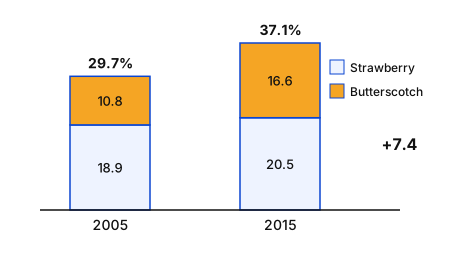
- 2005: strawberry + butterscotch
- 2015:
- Shift points
- Increase ₹37000
Trick: Add the individual changes: .
Answer: (B) ₹37,000
अवधारणा: प्रतिशत-अंक (percentage point) में वृद्धि × एक अंक का मान।
- 2005: स्ट्रॉबेरी + बटरस्कॉच
- 2015:
- बदलाव अंक
- वृद्धि ₹37000
ट्रिक: अलग-अलग बदलाव जोड़ें: ।
उत्तर: (B) ₹37,000
SSC CPO Paper IQuantitative AptitudeData Interpretation – Pie ChartSSC CPO Paper I 2020 · 25 Nov Shift 1
Q1424.The given histogram shows the height of the students.
| Height class (cm) | Number of students |
|---|
| 150-155 | 15 |
| 155-160 | 13 |
| 160-165 | 10 |
| 165-170 | 14 |
| 170-175 | 12 |
| 175-180 | 6 |
The number of students whose height is in the class interval 165-170 is what percentage less than the number of students whose height is in the interval 150-155? (correct to one decimal place)
दिया गया आयतचित्र (histogram) विद्यार्थियों की ऊँचाई दर्शाता है।
| ऊँचाई वर्ग (cm) | विद्यार्थियों की संख्या |
|---|
| 150-155 | 15 |
| 155-160 | 13 |
| 160-165 | 10 |
| 165-170 | 14 |
| 170-175 | 12 |
| 175-180 | 6 |
165-170 वर्ग अंतराल में ऊँचाई वाले विद्यार्थियों की संख्या, 150-155 अंतराल में ऊँचाई वाले विद्यार्थियों की संख्या से कितने प्रतिशत कम है? (एक दशमलव स्थान तक सही)
- A4.8%
- B6.7%
- C1.9%
- D5.5%
Show answer
Concept: "% less than" , base = value after "than".
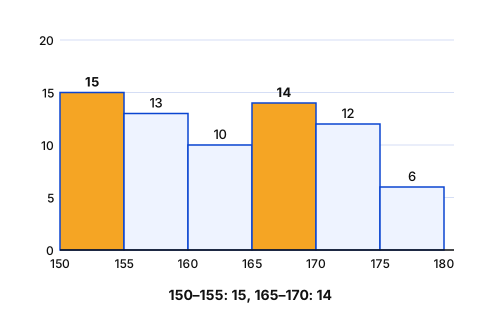
- 165–170: 14 students; 150–155: 15 students
- Correct to one decimal place:
Trick: – worth remembering.
Answer: (B)
अवधारणा: "से % कम" , आधार = "से" वाला मान।
- 165–170: 14 छात्र; 150–155: 15 छात्र
- एक दशमलव तक:
ट्रिक: – याद रखें।
उत्तर: (B)
SSC CPO Paper IQuantitative AptitudeData Interpretation – HistogramSSC CPO Paper I 2020 · 25 Nov Shift 1
Q1425.If decreasing 110 by gives the same result as increasing 50 by , then of 650 is what percentage (correct to the nearest integer) more than of 780?
यदि 110 को घटाने पर वही परिणाम प्राप्त होता है जो 50 को बढ़ाने पर प्राप्त होता है, तो 650 का , 780 के से कितने प्रतिशत (निकटतम पूर्णांक तक सही) अधिक है?
- A12%
- B17%
- C14%
- D18%
Show answer
Concept: Form an equation for , then use % more .
- of 650 ; of 780
Trick: Decrease of 110 = increase of 50 → .
Answer: (C)
अवधारणा: के लिए समीकरण बनाएँ, फिर % अधिक ।
- 650 का ; 780 का
ट्रिक: 110 की कमी = 50 की वृद्धि → ।
उत्तर: (C)
SSC CPO Paper IQuantitative AptitudePercentageSSC CPO Paper I 2020 · 25 Nov Shift 1
Q1426.The given pie chart represents the popularity of ice-cream flavours in the year 2015.
| Flavour | 2015 |
|---|
| Vanilla | 16.5% |
| Chocolate | 25.8% |
| Butterscotch | 16.6% |
| Strawberry | 20.5% |
| Other | 20.6% |
In 2015, if the total sale of chocolate flavour is for ₹5,160, then the total sale (in ₹) for vanilla flavour is:
दिया गया पाई चार्ट वर्ष 2015 में आइसक्रीम के स्वादों की लोकप्रियता को दर्शाता है।
| स्वाद | 2015 |
|---|
| वनीला | 16.5% |
| चॉकलेट | 25.8% |
| बटरस्कॉच | 16.6% |
| स्ट्रॉबेरी | 20.5% |
| अन्य | 20.6% |
2015 में, यदि चॉकलेट स्वाद की कुल बिक्री ₹5,160 की है, तो वनीला स्वाद की कुल बिक्री (₹ में) है:
- A4,100
- B4,120
- C3,300
- D5,160
Show answer
Concept: Find the value of from the known sector, then scale.
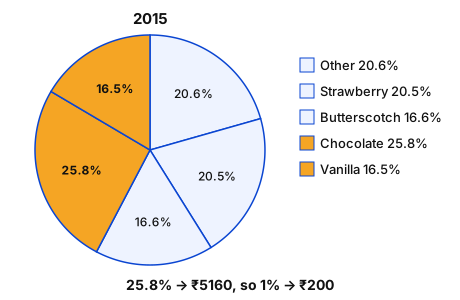
- Chocolate ₹5160 → ₹200
- Vanilla ₹3300
Trick: Vanilla : Chocolate , so ₹.
Answer: (C) ₹3,300
अवधारणा: ज्ञात भाग से का मान निकालें, फिर गुणा करें।
- चॉकलेट ₹5160 → ₹200
- वनीला ₹3300
ट्रिक: वनीला : चॉकलेट , अतः ₹।
उत्तर: (C) ₹3,300
SSC CPO Paper IQuantitative AptitudeData Interpretation – Pie ChartSSC CPO Paper I 2020 · 25 Nov Shift 1
Q1427.A person sold an article at a loss of 16%. Had he sold it for ₹660 more, he would have gained 8%. If the article is sold at ₹3,080, then how much profit percentage is gained?
एक व्यक्ति ने एक वस्तु 16% की हानि पर बेची। यदि उसने इसे ₹660 अधिक में बेचा होता, तो उसे 8% का लाभ होता। यदि वस्तु ₹3,080 में बेची जाती है, तो कितने प्रतिशत लाभ प्राप्त होगा?
- A10%
- B15%
- C20%
- D12%
Show answer
Concept: Change from 16% loss to 8% gain is of CP.
- of CP ₹660 → CP ₹2750
- Sold at ₹3080: profit ₹330
- Profit %
Trick: of CP ; .
Answer: (D)
अवधारणा: 16% हानि से 8% लाभ तक का अंतर क्रय मूल्य (CP) का है।
- CP का ₹660 → CP ₹2750
- ₹3080 पर बेचने पर लाभ ₹330
- लाभ %
ट्रिक: CP का ; ।
उत्तर: (D)
SSC CPO Paper IQuantitative AptitudeProfit and LossSSC CPO Paper I 2020 · 25 Nov Shift 1
Q1428.The sides of a triangle are 24 cm, 26 cm and 10 cm. At each of its vertex, circles of radius 4.2 cm are drawn. What is the area (in cm2) of the portion covered by the three sectors of the circle?
एक त्रिभुज की भुजाएँ 24 cm, 26 cm और 10 cm हैं। इसके प्रत्येक शीर्ष पर 4.2 cm त्रिज्या वाले वृत्त खींचे गए हैं। वृत्त के तीनों त्रिज्यखंडों द्वारा घेरे गए भाग का क्षेत्रफल (cm2 में) कितना है?
- A92.28
- B120
- C105.86
- D27.72
Show answer
Concept: The three sector angles are the triangle's angles, which add to – together they form a semicircle.
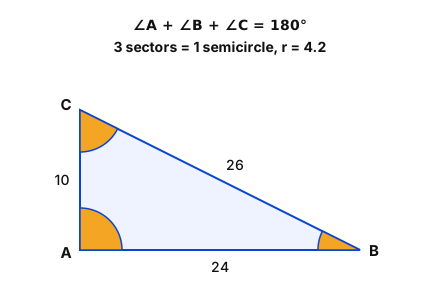
- Total angle → area
Trick: Side lengths 24, 26, 10 are not needed at all – only matters.
Answer: (D)
अवधारणा: तीनों त्रिज्यखंडों के कोण त्रिभुज के कोण हैं, जिनका योग – मिलकर एक अर्धवृत्त।
- कुल कोण → क्षेत्रफल
ट्रिक: भुजाएँ 24, 26, 10 की ज़रूरत ही नहीं – केवल चाहिए।
उत्तर: (D)
SSC CPO Paper IQuantitative AptitudeMensuration – SectorsSSC CPO Paper I 2020 · 25 Nov Shift 1
Q1429.Seven years ago, the ratio of the ages of A and B was 4 : 5. Eight years hence, the ratio of the ages of A and B will be 9 : 10. What is the difference between their present ages in years?
सात वर्ष पहले, A और B की आयु का अनुपात 4 : 5 था। आठ वर्ष बाद, A और B की आयु का अनुपात 9 : 10 होगा। उनकी वर्तमान आयु (वर्षों में) के बीच कितना अंतर है?
- A3
- B2
- C4
- D6
Show answer
Concept: The difference of ages never changes; take ages 7 years ago as and .
- 8 years hence (15 years after that):
- Difference years
Trick: Ratio and both have difference 1 part; check ✓.
Answer: (A)
अवधारणा: आयु का अंतर कभी नहीं बदलता; 7 वर्ष पहले की आयु व लें।
- 8 वर्ष बाद (अर्थात उसके 15 वर्ष बाद):
- अंतर वर्ष
ट्रिक: और दोनों में अंतर 1 भाग; जाँच ✓।
उत्तर: (A)
SSC CPO Paper IQuantitative AptitudeAgesSSC CPO Paper I 2020 · 25 Nov Shift 1
Q1430.If is divided by 10, then what is the remainder?
यदि को 10 से विभाजित किया जाए, तो शेषफल क्या होगा?
- A3
- B9
- C0
- D8
Show answer
Concept: Remainder on division by 10 = unit digit of the product.
- Unit digits: 3, 2 and 5
- → unit digit 0
- Remainder
Trick: An even number × a number ending in 5 always ends in 0.
Answer: (C)
अवधारणा: 10 से भाग देने पर शेषफल = गुणनफल का इकाई अंक।
- इकाई अंक: 3, 2 और 5
- → इकाई अंक 0
- शेषफल
ट्रिक: सम संख्या × 5 पर खत्म होने वाली संख्या = हमेशा 0 पर खत्म।
उत्तर: (C)
SSC CPO Paper IQuantitative AptitudeNumber System – Unit DigitSSC CPO Paper I 2020 · 25 Nov Shift 1
Q1431.If each side of a square is decreased by 17%, then by what percentage does its area decrease?
यदि एक वर्ग की प्रत्येक भुजा को 17% घटा दिया जाए, तो उसका क्षेत्रफल कितने प्रतिशत घट जाएगा?
- A25%
- B30.79%
- C31.11%
- D44.31%
Show answer
Concept: Area side; for a change of in each side, area changes by (with sign).
- New side of old
- New area of old
- Decrease
Trick: .
Answer: (C)
अवधारणा: क्षेत्रफल भुजा; प्रत्येक भुजा में बदलाव पर क्षेत्रफल में (चिह्न सहित) बदलाव।
- नई भुजा पुरानी का
- नया क्षेत्रफल गुना
- कमी
ट्रिक: ।
उत्तर: (C)
SSC CPO Paper IQuantitative AptitudePercentage – AreaSSC CPO Paper I 2020 · 25 Nov Shift 1
Q1432.The given bar graph shows the number of students of two schools over a period of six years.
| Year | School A | School B |
|---|
| 2008 | 640 | 550 |
| 2009 | 800 | 820 |
| 2010 | 500 | 600 |
| 2011 | 700 | 750 |
| 2012 | 900 | 500 |
| 2013 | 750 | 480 |
In the bar graph, in which year is the absolute difference of the students from schools A to B taken together, the maximum?
दिया गया दंड आरेख (bar graph) छह वर्षों की अवधि में दो स्कूलों के विद्यार्थियों की संख्या दर्शाता है।
| वर्ष | स्कूल A | स्कूल B |
|---|
| 2008 | 640 | 550 |
| 2009 | 800 | 820 |
| 2010 | 500 | 600 |
| 2011 | 700 | 750 |
| 2012 | 900 | 500 |
| 2013 | 750 | 480 |
दंड आरेख में, किस वर्ष स्कूल A और स्कूल B के विद्यार्थियों का निरपेक्ष अंतर अधिकतम है?
- A2012
- B2011
- C2013
- D2010
Show answer
Concept: For every year find and pick the largest.
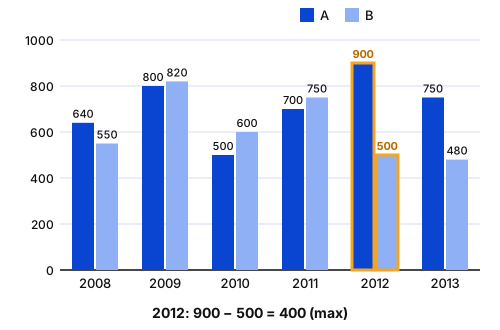
- 2008: 90, 2009: 20, 2010: 100, 2011: 50
- 2012: ; 2013:
- Maximum difference is in 2012
Trick: Look for the pair of bars with the biggest visual gap – 2012 stands out.
Answer: (A) 2012
अवधारणा: हर वर्ष का निकालें और सबसे बड़ा चुनें।
- 2008: 90, 2009: 20, 2010: 100, 2011: 50
- 2012: ; 2013:
- अधिकतम अंतर 2012 में
ट्रिक: जिन दो दंडों में ऊँचाई का अंतर सबसे ज़्यादा दिखे – 2012 साफ़ दिखता है।
उत्तर: (A) 2012
SSC CPO Paper IQuantitative AptitudeData Interpretation – Bar GraphSSC CPO Paper I 2020 · 25 Nov Shift 1
Q1433.If A’s salary is 30% more than B’s salary, then by what percentage is B’s salary less than that of A? (correct to one decimal place)
यदि A का वेतन, B के वेतन से 30% अधिक है, तो B का वेतन A के वेतन से कितने प्रतिशत कम है? (एक दशमलव स्थान तक सही)
- A17.5%
- B23.1%
- C25%
- D19.7%
Show answer
Concept: If A is more than B, then B is less than A.
- Let B , then A
- B is less than A by
- Correct to one decimal:
Trick: .
Answer: (B)
अवधारणा: यदि A, B से अधिक है, तो B, A से कम है।
- B मानें, तो A
- B, A से कम
- एक दशमलव तक:
ट्रिक: ।
उत्तर: (B)
SSC CPO Paper IQuantitative AptitudePercentageSSC CPO Paper I 2020 · 25 Nov Shift 1
Q1434.If a nine-digit number is divisible by 72, then the value of is:
यदि नौ अंकों की एक संख्या , 72 से विभाज्य है, तो का मान है:
- A20
- B12
- C10
- D5
Show answer
Concept: : last three digits divisible by 8 and digit sum divisible by 9.
- divisible by 8:
- Digit sum
- divisible by 9
Trick: Always fix the 8-rule digit first (), then use the 9-rule for .
Answer: (C)
अवधारणा: : अंतिम तीन अंक 8 से और अंकों का योग 9 से विभाज्य।
- को 8 से विभाज्य:
- अंकों का योग
- को 9 से विभाज्य
ट्रिक: पहले 8 के नियम से , फिर 9 के नियम से निकालें।
उत्तर: (C)
SSC CPO Paper IQuantitative AptitudeDivisibilitySSC CPO Paper I 2020 · 25 Nov Shift 1
Q1435.If , , then the value of is:
यदि , है, तो का मान है:
- A
- B
- C
- D
Show answer
Concept: Replace to get a quadratic in .
- (since ),
Trick: , so the answer must be negative – only (D).
Answer: (D)
अवधारणा: रखकर में द्विघात समीकरण बनाएँ।
- (क्योंकि ),
ट्रिक: , अतः उत्तर ऋणात्मक – केवल (D)।
उत्तर: (D)
SSC CPO Paper IQuantitative AptitudeTrigonometrySSC CPO Paper I 2020 · 25 Nov Shift 1
Q1436.Pipes A and B can fill a tank in 16 hours and 24 hours, respectively, whereas pipe C can empty the full tank in 40 hours. All three pipes are opened together, but pipe C is closed after 10 hours. After how many hours will the remaining part of the tank be filled?
पाइप A और B एक टंकी को क्रमशः 16 घंटे और 24 घंटे में भर सकते हैं, जबकि पाइप C पूरी भरी टंकी को 40 घंटे में खाली कर सकता है। तीनों पाइप एक साथ खोले जाते हैं, लेकिन पाइप C को 10 घंटे बाद बंद कर दिया जाता है। टंकी का शेष भाग कितने घंटे बाद भर जाएगा?
- A
- B2
- C
- D5
Show answer
Concept: Take tank capacity = LCM of times and work with units per hour.
- Capacity units; A , B , C per hour
- First 10 hours: units
- Remaining units by A + B at 25 per hour hours
Trick: The LCM method avoids fractions completely.
Answer: (B)
अवधारणा: टंकी की क्षमता = समयों का LCM लें और प्रति घंटा इकाइयों में हल करें।
- क्षमता इकाई; A , B , C प्रति घंटा
- पहले 10 घंटे: इकाई
- शेष इकाई, A + B 25 प्रति घंटा से घंटे
ट्रिक: LCM विधि से भिन्नें पूरी तरह बच जाती हैं।
उत्तर: (B)
SSC CPO Paper IQuantitative AptitudePipes and CisternsSSC CPO Paper I 2020 · 25 Nov Shift 1
Q1437.If , , then what is the value of ?
यदि , है, तो का मान क्या है?
- A8
- B14
- C6
- D4
Show answer
Concept: Step down using .
- ()
Trick: Chain : each time add 2 and take the square root.
Answer: (C)
अवधारणा: से नीचे उतरें।
- ()
ट्रिक: श्रृंखला : हर बार 2 जोड़कर वर्गमूल लें।
उत्तर: (C)
SSC CPO Paper IQuantitative AptitudeAlgebraSSC CPO Paper I 2020 · 25 Nov Shift 1
Q1438.The value of is:
का मान है:
- A
- B
- C
- D
Show answer
Concept: BODMAS – brackets first, then "of", then division/multiplication, then addition/subtraction.
Trick: "of" always beats – compute it first.
Answer: (A)
अवधारणा: BODMAS – पहले कोष्ठक, फिर "of" (का), फिर भाग/गुणा, फिर जोड़/घटाना।
ट्रिक: "of" हमेशा से पहले – उसे पहले हल करें।
उत्तर: (A)
SSC CPO Paper IQuantitative AptitudeSimplificationSSC CPO Paper I 2020 · 25 Nov Shift 1
Q1439.The value of is:
का मान है:
- A0.09
- B0.9
- C90
- D9
Show answer
Concept: .
- Let , ; the denominator because ,
- Value
Trick: Watch the decimal shift – the denominator numbers are 10 times bigger, so divide by 100.
Answer: (A)
अवधारणा: ।
- , ; हर क्योंकि ,
- मान
ट्रिक: दशमलव पर ध्यान दें – हर की संख्याएँ 10 गुना बड़ी हैं, अतः 100 से भाग।
उत्तर: (A)
SSC CPO Paper IQuantitative AptitudeAlgebraic IdentitiesSSC CPO Paper I 2020 · 25 Nov Shift 1
Q1440.One side of a rhombus is 13 cm and one of its diagonals is 24 cm. What is the area (in cm2) of rhombus?
एक समचतुर्भुज की एक भुजा 13 cm है और उसका एक विकर्ण 24 cm है। समचतुर्भुज का क्षेत्रफल (cm2 में) कितना है?
- A120
- B90
- C30
- D60
Show answer
Concept: Diagonals of a rhombus bisect each other at right angles; area .
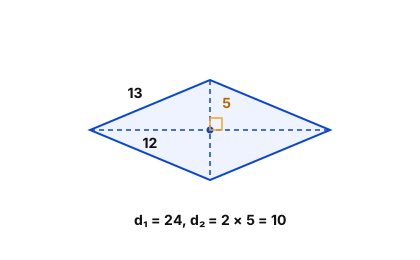
- Half of the given diagonal ; side
- Half of the other diagonal →
- Area
Trick: 5-12-13 is a Pythagorean triplet.
Answer: (A)
अवधारणा: समचतुर्भुज के विकर्ण एक-दूसरे को समकोण पर समद्विभाजित करते हैं; क्षेत्रफल ।
- दिए विकर्ण का आधा ; भुजा
- दूसरे विकर्ण का आधा →
- क्षेत्रफल
ट्रिक: 5-12-13 पाइथागोरस त्रिक है।
उत्तर: (A)
SSC CPO Paper IQuantitative AptitudeMensuration – RhombusSSC CPO Paper I 2020 · 25 Nov Shift 1

