Q1501.A and B can do a piece of work in 36 days. B and C can do the same work in 60 days. A and C can do the same work in 45 days. In how many days can B alone complete the same work?
A और B किसी कार्य को 36 दिनों में कर सकते हैं। B और C उसी कार्य को 60 दिनों में कर सकते हैं। A और C उसी कार्य को 45 दिनों में कर सकते हैं। B अकेले उसी कार्य को कितने दिनों में पूरा कर सकता है?
- A45
- B60
- C90
- D120
Show answer
Concept: Take total work = LCM of the days; add the three pair-rates to get twice the rate of .
- Total work units.
- Rates: , , units/day.
- units/day.
- units/day, so B alone takes days.
Trick: B alone ; always remove the pair that does not contain B.
Answer: (C) 90 days
अवधारणा: कुल कार्य = दिनों का LCM लें; तीनों जोड़ों की दरें जोड़ने पर की दुगनी दर मिलती है।
- कुल कार्य इकाई।
- दरें: , , इकाई/दिन।
- इकाई/दिन।
- इकाई/दिन, अतः B अकेला दिन लेगा।
ट्रिक: B अकेला ; जिस जोड़े में B नहीं है उसे घटाएँ।
उत्तर: (C) 90 दिन
SSC CPO Paper IQuantitative AptitudeTime and WorkSSC CPO Paper I 2020 · 24 Nov Shift 1
Q1502.A sum of ₹8,200 was divided among A, B and C in such a way that A had ₹500 more than B and C had ₹300 more than A. How much was C’s share (in ₹)?
₹8,200 की एक राशि A, B और C के बीच इस प्रकार विभाजित की गई कि A को B से ₹500 अधिक और C को A से ₹300 अधिक मिले। C का हिस्सा (₹ में) कितना था?
- A3,100
- B2,000
- C2,300
- D2,800
Show answer
Concept: Express every share in terms of one share and use the total.
- Let B = . Then A , C .
- .
- C .
Trick: Check: ✔.
Answer: (A) ₹3,100
अवधारणा: सभी हिस्सों को एक ही हिस्से के रूप में लिखें और कुल से समीकरण बनाएँ।
- B = मानें। तब A , C ।
- ।
- C ।
ट्रिक: जाँच: ✔।
उत्तर: (A) ₹3,100
SSC CPO Paper IQuantitative AptitudePartnership / Division of SumSSC CPO Paper I 2020 · 24 Nov Shift 1
Q1503.If the average price of three chairs is ₹14,014 and their prices are in the ratio of 3 : 4 : 7, then the highest price (in ₹) of chair is:
यदि तीन कुर्सियों का औसत मूल्य ₹14,014 है और उनके मूल्य 3 : 4 : 7 के अनुपात में हैं, तो कुर्सी का उच्चतम मूल्य (₹ में) कितना है?
- A3,003
- B1,001
- C7,007
- D5,005
Show answer
Concept: Sum of ratio terms ; highest share of the amount being divided.
- If ₹14,014 is divided in : one part .
- Highest price .
- (Taking ₹14,014 strictly as the average, the total is , one part and the highest price would be , which is not among the choices; the choices are built on dividing ₹14,014 in .)
Trick: , so each ratio unit is 1001 — highest share is simply .
Answer: (C) ₹7,007
अवधारणा: अनुपात पदों का योग ; सबसे बड़ा भाग भाग।
- ₹14,014 को में बाँटने पर एक भाग ।
- सबसे ऊँची कीमत ।
- (₹14,014 को औसत मानें तो कुल , एक भाग और सबसे ऊँची कीमत होगी, जो विकल्पों में नहीं है; विकल्प ₹14,014 को में बाँटकर बने हैं।)
ट्रिक: , अतः एक इकाई ।
उत्तर: (C) ₹7,007
SSC CPO Paper IQuantitative AptitudeAverage and RatioSSC CPO Paper I 2020 · 24 Nov Shift 1
Q1504.ABCD is a cyclic quadrilateral such that AB is a diameter of the circle circumscribing it and . What is the measure of ?
ABCD एक चक्रीय चतुर्भुज है, जिसमें AB इसके परिगत वृत्त का व्यास है और है। का माप क्या है?
- A
- B
- C
- D
Show answer
Concept: Opposite angles of a cyclic quadrilateral add to ; the angle in a semicircle is .
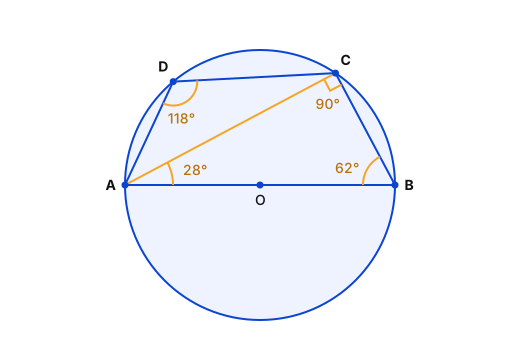
- .
- AB is a diameter, so .
- In : .
Trick: Directly: .
Answer: (A)
अवधारणा: चक्रीय चतुर्भुज के सम्मुख कोणों का योग होता है; अर्धवृत्त में बना कोण होता है।
- ।
- AB व्यास है, अतः ।
- में ।
ट्रिक: सीधे: ।
उत्तर: (A)
SSC CPO Paper IQuantitative AptitudeCircle – Cyclic QuadrilateralSSC CPO Paper I 2020 · 24 Nov Shift 1
Q1505.The two parallel sides of a trapezium are 17 cm and 15 cm, respectively. If the height of the trapezium is 6 cm, then its area (in m2) is:
किसी समलंब की दो समांतर भुजाएँ क्रमशः 17 cm और 15 cm हैं। यदि समलंब की ऊँचाई 6 cm है, तो इसका क्षेत्रफल (m2 में) कितना है?
- A9.6
- B960
- C0.96
- D0.0096
Show answer
Concept: Area of trapezium ; .
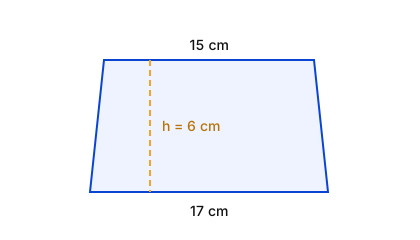
- Area .
- In : .
Trick: : divide by (shift the decimal 4 places left).
Answer: (D) 0.0096
अवधारणा: समलंब का क्षेत्रफल ; ।
- क्षेत्रफल ।
- में: ।
ट्रिक: से के लिए से भाग दें।
उत्तर: (D) 0.0096
SSC CPO Paper IQuantitative AptitudeMensuration – TrapeziumSSC CPO Paper I 2020 · 24 Nov Shift 1
Q1506.The given bar graph represents the number of boys and girls in five different schools. Read the graph and answer the question that follows.
Number of Boys and Girls in different Schools:
| School | A | B | C | D | E |
|---|
| Boys | 600 | 450 | 750 | 700 | 800 |
| Girls | 500 | 550 | 650 | 600 | 650 |
What is the average number of students (girls and boys) in schools A, B, C, D and E?
दिया गया दंड आलेख पाँच अलग-अलग विद्यालयों में लड़कों और लड़कियों की संख्या को दर्शाता है। आलेख को पढ़िए और उसके बाद दिए गए प्रश्न का उत्तर दीजिए।
विभिन्न विद्यालयों में लड़कों और लड़कियों की संख्या:
| विद्यालय | A | B | C | D | E |
|---|
| लड़के | 600 | 450 | 750 | 700 | 800 |
| लड़कियाँ | 500 | 550 | 650 | 600 | 650 |
विद्यालयों A, B, C, D और E में विद्यार्थियों (लड़कियों और लड़कों) की औसत संख्या कितनी है?
- A1250
- B625
- C660
- D596
Show answer
Concept: Average students per school .
- Boys: .
- Girls: .
- Average .
Trick: School totals 1100, 1000, 1400, 1300, 1450 — their average is .
Answer: (A) 1250
अवधारणा: प्रति स्कूल औसत छात्र ।
- लड़के: ।
- लड़कियाँ: ।
- औसत ।
ट्रिक: स्कूलवार योग 1100, 1000, 1400, 1300, 1450 — औसत ।
उत्तर: (A) 1250
SSC CPO Paper IQuantitative AptitudeData Interpretation – Bar GraphSSC CPO Paper I 2020 · 24 Nov Shift 1
Q1507.The given histogram shows the frequency distribution of the speed of cars passing through a particular spot on a highway. Read the graph and answer the following question.
| Speed (km/h) | 40-50 | 50-60 | 60-70 | 70-80 | 80-90 | 90-100 |
|---|
| Number of cars | 50 | 70 | 85 | 90 | 60 | 45 |
What is the ratio of the number of cars with speed less than 60 km/h to the number of cars with speed more than 70 km/h?
दिया गया आयतचित्र (histogram) किसी राजमार्ग पर एक विशेष स्थान से गुज़रने वाली कारों की चाल के बारंबारता बंटन को दर्शाता है। आलेख को पढ़िए और निम्नलिखित प्रश्न का उत्तर दीजिए।
| चाल (km/h) | 40-50 | 50-60 | 60-70 | 70-80 | 80-90 | 90-100 |
|---|
| कारों की संख्या | 50 | 70 | 85 | 90 | 60 | 45 |
60 km/h से कम चाल वाली कारों की संख्या का 70 km/h से अधिक चाल वाली कारों की संख्या से अनुपात कितना है?
- A8 : 13
- B5 : 8
- C13 : 8
- D8 : 5
Show answer
Concept: Add the class frequencies below 60 and above 70, then simplify.
- Less than 60: .
- More than 70: .
- (divide by 15).
Trick: Both numbers are multiples of 15 — divide by it at once.
Answer: (A) 8 : 13
अवधारणा: 60 से कम और 70 से अधिक वर्गों की आवृत्तियाँ जोड़ें।
- 60 से कम: ।
- 70 से अधिक: ।
- ।
ट्रिक: दोनों 15 के गुणज हैं — सीधे 15 से भाग दें।
उत्तर: (A) 8 : 13
SSC CPO Paper IQuantitative AptitudeData Interpretation – HistogramSSC CPO Paper I 2020 · 24 Nov Shift 1
Q1508.The length of the shadow of a vertical pole on the ground is 36 m. If the angle of elevation of the sun at that time is , such that , then what is the height (in cm) of the pole?
ज़मीन पर एक ऊर्ध्वाधर खंभे की छाया की लंबाई 36 m है। यदि उस समय सूर्य का उन्नयन कोण है, जहाँ है, तो खंभे की ऊँचाई (cm में) कितनी है?
- A12
- B15
- C18
- D9
Show answer
Concept: ; from use the triplet .
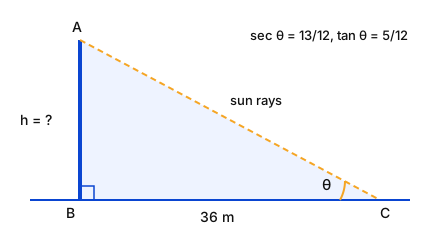
- .
- Height .
- So the pole is 15 units tall (15 m with the shadow in metres), matching the option 15.
Trick: -- triangle: shadow 36 , so height .
Answer: (B) 15
अवधारणा: ; से त्रिक ।
- ।
- ऊँचाई ।
- अतः खंभा 15 इकाई ऊँचा है (छाया मीटर में हो तो 15 m), विकल्प 15।
ट्रिक: -- त्रिभुज: , ऊँचाई ।
उत्तर: (B) 15
SSC CPO Paper IQuantitative AptitudeHeights and DistancesSSC CPO Paper I 2020 · 24 Nov Shift 1
Q1509.A bus covers a 60 kilometre distance in 1 hour 30 minutes, whereas the same distance is covered by a car in 45 minutes. What is the ratio of the speed of the car to the speed of the bus?
एक बस 60 किलोमीटर की दूरी 1 घंटा 30 मिनट में तय करती है, जबकि वही दूरी एक कार 45 मिनट में तय करती है। कार की चाल का बस की चाल से अनुपात कितना है?
- A5 : 3
- B3 : 5
- C1 : 2
- D2 : 1
Show answer
Concept: For the same distance, speed is inversely proportional to time.
- Time of bus min, car min.
- Speed car : bus .
- (Speeds: car , bus .)
Trick: Same distance ⇒ invert the time ratio.
Answer: (D) 2 : 1
अवधारणा: समान दूरी के लिए चाल समय के व्युत्क्रमानुपाती होती है।
- बस का समय मिनट, कार का मिनट।
- कार : बस ।
- (कार , बस ।)
ट्रिक: समान दूरी ⇒ समय का अनुपात उलट दें।
उत्तर: (D) 2 : 1
SSC CPO Paper IQuantitative AptitudeSpeed and DistanceSSC CPO Paper I 2020 · 24 Nov Shift 1
Q1510.A man bought an article and sold it at a gain of 10%. If he had bought the article at 20% less and sold it for ₹1,000 more, he would have made a profit of 40%. The earlier selling price of the article (in ₹) is:
एक व्यक्ति ने एक वस्तु खरीदी और उसे 10% के लाभ पर बेच दिया। यदि उसने वस्तु को 20% कम मूल्य पर खरीदा होता और ₹1,000 अधिक में बेचा होता, तो उसे 40% का लाभ होता। वस्तु का पहले वाला विक्रय मूल्य (₹ में) कितना है?
- A55,000
- B60,000
- C50,000
- D40,000
Show answer
Concept: Write both selling prices in terms of CP and equate the difference to ₹1,000.
- Let CP ; SP .
- New CP ; new SP .
- .
- Earlier SP .
Trick: Difference in SP of CP ⇒ CP , SP .
Answer: (A) ₹55,000
अवधारणा: दोनों विक्रय मूल्यों को क्रय मूल्य में लिखकर अंतर ₹1,000 रखें।
- क्रय मूल्य ; विक्रय मूल्य ।
- नया क्रय मूल्य ; नया विक्रय मूल्य ।
- ।
- पहला विक्रय मूल्य ।
ट्रिक: विक्रय मूल्य का अंतर = क्रय मूल्य का ।
उत्तर: (A) ₹55,000
SSC CPO Paper IQuantitative AptitudeProfit and LossSSC CPO Paper I 2020 · 24 Nov Shift 1
Q1511.PA and PB are two tangents from a point P outside the circle with centre O at the points A and B on it. If , then is equal to:
PA और PB, केंद्र O वाले वृत्त के बाहर स्थित बिंदु P से वृत्त के बिंदुओं A और B पर खींची गई दो स्पर्श रेखाएँ हैं। यदि है, तो किसके बराबर है?
- A
- B
- C
- D
Show answer
Concept: Radius ⟂ tangent, so OAPB has and .
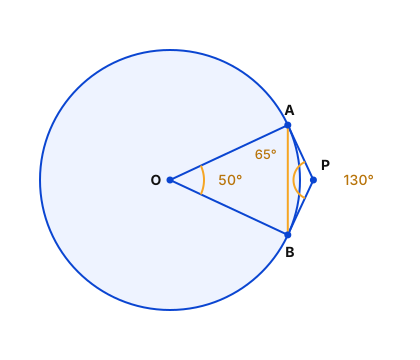
- .
- , so is isosceles.
- .
Trick: always: .
Answer: (D)
अवधारणा: त्रिज्या स्पर्शरेखा पर लंब होती है, अतः ।
- ।
- , अतः समद्विबाहु है।
- ।
ट्रिक: ।
उत्तर: (D)
SSC CPO Paper IQuantitative AptitudeCircle – TangentsSSC CPO Paper I 2020 · 24 Nov Shift 1
Q1512.A person covers a distance of 300 km and then returns to the starting point. The time taken by him for the outward journey is 5 hours more than the time taken for the return journey. If he returned at a speed of 10 km/h more than the speed of going, what was the speed (in km/h) for the outward journey?
एक व्यक्ति 300 km की दूरी तय करता है और फिर आरंभिक बिंदु पर लौट आता है। जाने की यात्रा में उसके द्वारा लिया गया समय, वापसी की यात्रा में लिए गए समय से 5 घंटे अधिक है। यदि वह जाने की चाल से 10 km/h अधिक चाल से लौटा, तो जाने की यात्रा की चाल (km/h में) कितनी थी?
- A15
- B20
- C30
- D25
Show answer
Concept: Time ; form the time-difference equation.
- Let outward speed . .
- .
- .
Trick: Option test: ✔.
Answer: (B)
अवधारणा: समय ; समय-अंतर का समीकरण बनाएँ।
- जाने की चाल : ।
- ।
- ।
ट्रिक: विकल्प जाँच: ✔।
उत्तर: (B)
SSC CPO Paper IQuantitative AptitudeSpeed and DistanceSSC CPO Paper I 2020 · 24 Nov Shift 1
Q1513.The given pie chart shows the percentage distribution of 450 employees in an organisation. Read the pie chart and answer the question that follows.
Percentage of Employees in different Departments (Total 450 Employees):
| Department | A | B | C | D | E | F |
|---|
| Percentage of employees | 20% | 14% | 16% | 8% | 20% | 22% |
What is the central angle of the sector representing the number of employees in department E?
दिया गया पाई चार्ट किसी संगठन के 450 कर्मचारियों के प्रतिशत बंटन को दर्शाता है। पाई चार्ट को पढ़िए और उसके बाद दिए गए प्रश्न का उत्तर दीजिए।
विभिन्न विभागों में कर्मचारियों का प्रतिशत (कुल 450 कर्मचारी):
| विभाग | A | B | C | D | E | F |
|---|
| कर्मचारियों का प्रतिशत | 20% | 14% | 16% | 8% | 20% | 22% |
विभाग E में कर्मचारियों की संख्या को निरूपित करने वाले त्रिज्यखंड का केंद्रीय कोण कितना है?
- A
- B
- C
- D
Show answer
Concept: Central angle , i.e. .
- Department E .
- Angle .
Trick: of a pie .
Answer: (C)
अवधारणा: केंद्रीय कोण , अर्थात ।
- विभाग E ।
- कोण ।
ट्रिक: पाई चार्ट में ।
उत्तर: (C)
SSC CPO Paper IQuantitative AptitudeData Interpretation – Pie ChartSSC CPO Paper I 2020 · 24 Nov Shift 1
Q1514.A solid metallic cube of side 9 cm and a solid metallic cuboid having dimensions 5 cm, 13 cm, 31 cm are melted to form a single cube. How much (in ₹) is the cost to polish the new cube at a rate of ₹10 per cm2?
9 cm भुजा वाले एक ठोस धात्विक घन और 5 cm, 13 cm, 31 cm विमाओं वाले एक ठोस धात्विक घनाभ को पिघलाकर एक घन बनाया जाता है। नए घन को ₹10 प्रति cm2 की दर से पॉलिश करने का खर्च (₹ में) कितना होगा?
- A8,650
- B27,440
- C13,620
- D11,760
Show answer
Concept: Volume is conserved on melting; surface area of a cube .
- Volume .
- New side .
- Surface area .
- Cost .
Yaad rakhein: — remember cubes up to .
Answer: (D) ₹11,760
अवधारणा: पिघलाने पर आयतन समान रहता है; घन का पृष्ठीय क्षेत्रफल ।
- आयतन ।
- नई भुजा ।
- पृष्ठीय क्षेत्रफल ।
- लागत ।
याद रखें: — तक के घन याद रखें।
उत्तर: (D) ₹11,760
SSC CPO Paper IQuantitative AptitudeMensuration – CubeSSC CPO Paper I 2020 · 24 Nov Shift 1
Q1515.If house tax is paid before the due date, one gets a reduction of 12% on the amount of the bill. By paying the tax before the due date, a person got a reduction of ₹2,100. The amount (in ₹) of house tax paid was:
यदि गृह कर नियत तिथि से पहले चुकाया जाता है, तो बिल की राशि पर 12% की छूट मिलती है। नियत तिथि से पहले कर चुकाने पर एक व्यक्ति को ₹2,100 की छूट मिली। चुकाए गए गृह कर की राशि (₹ में) कितनी थी?
- A21,000
- B15,400
- C25,000
- D17,500
Show answer
Concept: Reduction is of the bill; amount paid of the bill.
- Bill .
- Amount paid .
Trick: Paid directly. (17,500 is the bill, not the amount paid.)
Answer: (B) ₹15,400
अवधारणा: छूट बिल का ; भुगतान राशि बिल का ।
- बिल ।
- भुगतान ।
ट्रिक: सीधे: (17,500 बिल है, भुगतान नहीं)।
उत्तर: (B) ₹15,400
SSC CPO Paper IQuantitative AptitudePercentageSSC CPO Paper I 2020 · 24 Nov Shift 1
Q1516.The value of is:
का मान कितना है?
- A3
- B0
- C
- D
Show answer
Concept: Spot , and use and .
- , so numerator .
- and , so denominator .
- Fraction .
- Total .
Trick: .
Answer: (D)
अवधारणा: , लेकर और पहचानें।
- , अतः अंश ।
- , , अतः हर ।
- भिन्न ।
- कुल ।
ट्रिक: ।
उत्तर: (D)
SSC CPO Paper IQuantitative AptitudeSimplification – Algebraic IdentitiesSSC CPO Paper I 2020 · 24 Nov Shift 1
Q1517.A rectangular lawn whose length is twice of its breadth is extended by having four semi-circular portions on its sides. What is the total area (in m2) of the lawn if the smaller side of the rectangle is 12 m? (Take )
एक आयताकार लॉन, जिसकी लंबाई उसकी चौड़ाई की दोगुनी है, की भुजाओं पर चार अर्धवृत्ताकार भाग जोड़कर उसका विस्तार किया जाता है। यदि आयत की छोटी भुजा 12 m है, तो लॉन का कुल क्षेत्रफल (m2 में) कितना है? ( लीजिए)
- A853.2
- B308.64
- C444
- D548.32
Show answer
Concept: Total area = rectangle + two semicircles on the long sides + two on the short sides (two equal semicircles = one full circle).
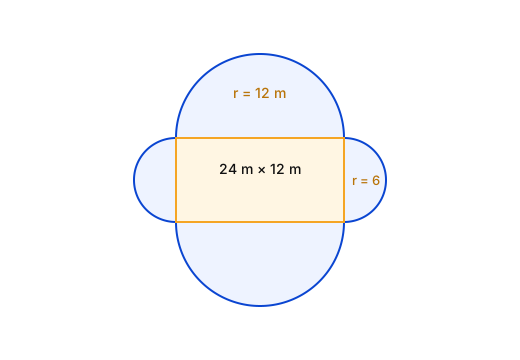
- Rectangle .
- Semicircles on 24 m sides (radius 12): .
- Semicircles on 12 m sides (radius 6): .
- Total .
Trick: Pair of semicircles on opposite sides = one full circle.
Answer: (A)
अवधारणा: कुल क्षेत्रफल = आयत + लंबी भुजाओं पर दो अर्धवृत्त + छोटी भुजाओं पर दो अर्धवृत्त।
- आयत ।
- 24 m भुजाओं पर (त्रिज्या 12): ।
- 12 m भुजाओं पर (त्रिज्या 6): ।
- कुल ।
ट्रिक: आमने-सामने के दो अर्धवृत्त = एक पूरा वृत्त।
उत्तर: (A)
SSC CPO Paper IQuantitative AptitudeMensuration – Rectangle and SemicirclesSSC CPO Paper I 2020 · 24 Nov Shift 1
Q1518.The given histogram shows the frequency distribution of the speed of cars passing through a particular spot on a highway. Read the graph and answer the following question.
| Speed (km/h) | 40-50 | 50-60 | 60-70 | 70-80 | 80-90 | 90-100 |
|---|
| Number of cars | 50 | 70 | 85 | 90 | 60 | 45 |
The number of cars with speed (km/h) in the interval (60 – 70) km/h is what percentage less than the number of cars with speed (km/h) in the interval (70 – 80) km/h? (correct to one decimal place)
दिया गया आयतचित्र (histogram) किसी राजमार्ग पर एक विशेष स्थान से गुज़रने वाली कारों की चाल के बारंबारता बंटन को दर्शाता है। आलेख को पढ़िए और निम्नलिखित प्रश्न का उत्तर दीजिए।
| चाल (km/h) | 40-50 | 50-60 | 60-70 | 70-80 | 80-90 | 90-100 |
|---|
| कारों की संख्या | 50 | 70 | 85 | 90 | 60 | 45 |
(60 – 70) km/h अंतराल में चाल (km/h) वाली कारों की संख्या, (70 – 80) km/h अंतराल में चाल (km/h) वाली कारों की संख्या से कितने प्रतिशत कम है? (एक दशमलव स्थान तक सही)
- A5.9%
- B5.6%
- C7.5%
- D8.6%
Show answer
Concept: Percentage less .
- (60–70): 85 cars; (70–80): 90 cars.
- .
Trick: “Less than X” ⇒ X is the base. (5.9% comes from wrongly dividing by 85.)
Answer: (B)
अवधारणा: कितना प्रतिशत कम ।
- (60–70): 85; (70–80): 90।
- ।
ट्रिक: “X से कम” ⇒ आधार X; 85 से भाग देने पर गलत 5.9% आता है।
उत्तर: (B)
SSC CPO Paper IQuantitative AptitudeData Interpretation – HistogramSSC CPO Paper I 2020 · 24 Nov Shift 1
Q1519.If , then the value of is:
यदि है, तो का मान कितना है?
- A5
- B6
- C9
- D7
Show answer
Concept: Divide by to get ; divide numerator and denominator by to get cubes.
- .
- (divide top and bottom by ).
- .
- Value .
Trick: .
Answer: (B) 6
अवधारणा: से भाग देकर निकालें; अंश-हर को से भाग देकर घन बनाएँ।
- ।
- व्यंजक ।
- ।
- मान ।
ट्रिक: ।
उत्तर: (B) 6
SSC CPO Paper IQuantitative AptitudeAlgebra – Reciprocal IdentitiesSSC CPO Paper I 2020 · 24 Nov Shift 1
Q1520.If the difference between the compound interest and simple interest at 17% on a sum of money for 2 years (compounded annually) is ₹433.50, then the compound interest (in ₹) is:
यदि किसी धनराशि पर 17% की दर से 2 वर्षों के लिए चक्रवृद्धि ब्याज (वार्षिक रूप से संयोजित) और साधारण ब्याज का अंतर ₹433.50 है, तो चक्रवृद्धि ब्याज (₹ में) कितना है?
- A2,735.50
- B2,500
- C5,100
- D5,533.50
Show answer
Concept: For 2 years: .
- .
- .
- .
Trick: CI = SI + difference; don’t stop at 5,100 (that is SI).
Answer: (D) ₹5,533.50
अवधारणा: 2 वर्ष के लिए: ।
- ।
- साधारण ब्याज ।
- चक्रवृद्धि ब्याज ।
ट्रिक: CI = SI + अंतर; 5,100 साधारण ब्याज है।
उत्तर: (D) ₹5,533.50
SSC CPO Paper IQuantitative AptitudeCompound InterestSSC CPO Paper I 2020 · 24 Nov Shift 1

