Q1541.Select the misspelt word.
- Apursue
- Btyrrany
- Cvicious
- Dresistance
Show answer
Concept: The correct spelling is tyranny – single ‘r’, double ‘n’.
- tyrant → ty-r-a-nn-y.
- ‘tyrrany’ doubles the ‘r’ and has a single ‘n’ – misspelt.
- ‘pursue’, ‘vicious’ and ‘resistance’ are correct.
Yaad rakhein: tyrant + ny = tyranny (one r, two n).
Answer: (B) tyrrany
अवधारणा: सही वर्तनी tyranny है – एक ‘r’, दो ‘n’।
- tyrant → ty-r-a-nn-y।
- ‘tyrrany’ में ‘r’ दो बार और ‘n’ एक बार है – गलत।
- ‘pursue’, ‘vicious’, ‘resistance’ सही हैं।
याद रखें: tyranny = एक r, दो n।
उत्तर: (B) tyrrany
SSC CPO Paper IEnglish ComprehensionSpellingSSC CPO Paper I 2020 · 24 Nov Shift 1
Q1542.Select the most appropriate synonym of the given word.
DESPISE
- Aapprove
- Babhor
- Cadmire
- Dadore
Show answer
Concept: Despise = to feel contempt or deep dislike for.
- Abhor = to hate intensely – same meaning.
- ‘approve’, ‘admire’ and ‘adore’ express liking – opposites.
Yaad rakhein: Despise = Abhor = Loathe = Detest (ghrina karna).
Answer: (B) abhor
अवधारणा: Despise = घृणा करना, तिरस्कार करना।
- Abhor = अत्यधिक घृणा करना – समान अर्थ।
- ‘approve’, ‘admire’, ‘adore’ पसंद दर्शाते हैं – विलोम।
याद रखें: Despise = Abhor = Loathe (घृणा करना)।
उत्तर: (B) abhor
SSC CPO Paper IEnglish ComprehensionSynonymsSSC CPO Paper I 2020 · 24 Nov Shift 1
Q1543.Select the most appropriate meaning of the given idiom.
Kith and kin
- Acolleagues
- Bneighbours
- Cfamily relations
- Ddistant enemies
Show answer
Concept: Kith and kin = friends and relatives; one’s own family and people.
- ‘kin’ means blood relatives, ‘kith’ means friends/acquaintances.
- Of the options, the phrase’s meaning is best given by family relations.
- ‘colleagues’, ‘neighbours’ and ‘distant enemies’ do not fit.
Yaad rakhein: Kith and kin = sage-sambandhi (friends and relatives).
Answer: (C) family relations
अवधारणा: Kith and kin = मित्र और सगे-संबंधी; अपने लोग।
- ‘kin’ = रक्त-संबंधी, ‘kith’ = मित्र/परिचित।
- विकल्पों में सबसे उपयुक्त अर्थ family relations है।
- ‘colleagues’, ‘neighbours’, ‘distant enemies’ मेल नहीं खाते।
याद रखें: Kith and kin = सगे-संबंधी।
उत्तर: (C) family relations
SSC CPO Paper IEnglish ComprehensionIdioms and PhrasesSSC CPO Paper I 2020 · 24 Nov Shift 1
Q1544.Select the most appropriate option to substitute the underlined segment in the given sentence. If there is no need to substitute it, select ‘No substitution required’.
The mare hurt its hooves when running to the forest.
- Awith running across
- Bwhile running through
- CNo substitution required
- Dwhen running into
Show answer
Concept: For an action happening at the same time as another, use while + -ing; for movement inside an area like a forest, use through.
- ‘running to the forest’ means on the way towards it, but the hooves were hurt in the forest terrain.
- Correct: “The mare hurt its hooves while running through the forest.”
- ‘with running across’ is unidiomatic; ‘running into’ means entering/colliding.
Yaad rakhein: Through = from one side to the other inside (through the forest, through the tunnel).
Answer: (B) while running through
अवधारणा: एक साथ चल रही क्रिया के लिए while + -ing; जंगल जैसे क्षेत्र के भीतर से गति के लिए through।
- ‘running to the forest’ = जंगल की ओर जाना, पर खुर जंगल के रास्ते में घायल हुए।
- सही: “The mare hurt its hooves while running through the forest.”
- ‘with running across’ अस्वाभाविक है; ‘running into’ = अंदर घुसना/टकराना।
याद रखें: Through = भीतर से होकर (through the forest)।
उत्तर: (B) while running through
SSC CPO Paper IEnglish ComprehensionSentence ImprovementSSC CPO Paper I 2020 · 24 Nov Shift 1
Q1545.Select the most appropriate one-word substitution for the given group of words.
A large bedroom for a number of people in an institution
- Aauditorium
- Bapartment
- Cdormitory
- Dchamber
Show answer
Concept: A large room with many beds, as in a hostel or school, is a dormitory.
- dormitory: Latin ‘dormire’ = to sleep.
- ‘auditorium’ = hall for an audience; ‘apartment’ = a flat; ‘chamber’ = a room in general.
Yaad rakhein: Dorm = sleep (dormant, dormitory).
Answer: (C) dormitory
अवधारणा: किसी संस्था (हॉस्टल, स्कूल) में अनेक लोगों के सोने का बड़ा कमरा = dormitory (शयनागार)।
- dormitory: Latin ‘dormire’ = सोना।
- ‘auditorium’ = सभागार; ‘apartment’ = फ्लैट; ‘chamber’ = कक्ष (सामान्य)।
याद रखें: Dorm = नींद (dormant, dormitory)।
उत्तर: (C) dormitory
SSC CPO Paper IEnglish ComprehensionOne Word SubstitutionSSC CPO Paper I 2020 · 24 Nov Shift 1
Read the passage and answer the questions that follow.
Greek religious traditions encompassed a large pantheon of gods, complex mythologies,
rituals and cult practices. Greece was a polytheistic society, and looked to its gods and
mythology to explain natural mysteries as well as current events. Religious festivals and
ceremonies were held throughout the year, and animal sacrifice and votive offerings were popular ways to appease and worship the gods. Religious life, rituals and practices were one of the unifying aspects of Greece across regions and poleis (cities, or city-states, such as Athens and Sparta).
Greek gods were immortal beings who possessed human-like qualities and were represented as completely human in visual art. They were moral and immoral, petty and just, and often vain. The gods were invoked to intervene and assist in all matters large, small, private and public.
City-states claimed individual gods and goddesses as their patrons. Temples and sanctuaries to the gods were built in every city. Many cities became cult sites due to their connection with a god or goddess and specific myths. For instance, the city of Delphi was known for its oracle and sanctuary of Apollo, because Apollo was believed to have killed a dragon that inhabited Delphi.
The history of the Greek pantheon begins with the primordial deities Gaia (Mother Earth) and Uranus (Father Sky), who were the parents of the first of twelve giants known as Titans.
Among these Titans were six males and six females. The males were named Oceanus,
Hyperion, Coeus, Crius, Iapetus, and Kronos. The females were named Themis, Mnemosyne, Tethys, Theia, Phoebe, and Rhea.
Kronos eventually overthrew Uranus and ruled during a mythological Golden Age. Over time, he and Rhea had twelve children who would become the Olympian gods. However, Kronos heard a prophecy that his son would overthrow him, as he did to Uranus. In an effort to avert fate, he ordered Rhea to allow him to devour each of the children upon their birth.
Best known among the pantheon are the twelve Olympian gods and goddesses who resided on Mt. Olympus in northern Greece. Zeus, the youngest son of Rhea and Kronos, was hidden from his father, instead of being swallowed. Once he became a man, he challenged his
father’s rule, forcing Kronos to regurgitate the rest of his swallowed children. These children were Zeus’s siblings, and together they overthrew Kronos, making Zeus the father of gods and men.
Q1546.Animal sacrifices were made to Gods to:
- Aunderstand nature’s mysteries
- Bpacify and worship them
- Cknow about future events
- Denrage and challenge them
Show answer
Concept: Find the line about sacrifice in paragraph 1.
- The passage: “animal sacrifice and votive offerings were popular ways to appease and worship the gods.”
- ‘appease’ = pacify, so the answer is pacify and worship them.
- Understanding nature’s mysteries is why they looked to mythology, not why they sacrificed.
Yaad rakhein: Appease = pacify = calm/please someone.
Answer: (B) pacify and worship them
अवधारणा: पहले अनुच्छेद में बलि वाली पंक्ति देखें।
- गद्यांश: “animal sacrifice and votive offerings were popular ways to appease and worship the gods.”
- ‘appease’ = pacify (प्रसन्न/शांत करना), अतः उत्तर pacify and worship them।
- प्रकृति के रहस्य समझने के लिए वे पौराणिक कथाओं को देखते थे, बलि का कारण यह नहीं था।
याद रखें: Appease = pacify = शांत/प्रसन्न करना।
उत्तर: (B) pacify and worship them
SSC CPO Paper IEnglish ComprehensionReading ComprehensionSSC CPO Paper I 2020 · 24 Nov Shift 1
Read the passage and answer the questions that follow.
Greek religious traditions encompassed a large pantheon of gods, complex mythologies,
rituals and cult practices. Greece was a polytheistic society, and looked to its gods and
mythology to explain natural mysteries as well as current events. Religious festivals and
ceremonies were held throughout the year, and animal sacrifice and votive offerings were popular ways to appease and worship the gods. Religious life, rituals and practices were one of the unifying aspects of Greece across regions and poleis (cities, or city-states, such as Athens and Sparta).
Greek gods were immortal beings who possessed human-like qualities and were represented as completely human in visual art. They were moral and immoral, petty and just, and often vain. The gods were invoked to intervene and assist in all matters large, small, private and public.
City-states claimed individual gods and goddesses as their patrons. Temples and sanctuaries to the gods were built in every city. Many cities became cult sites due to their connection with a god or goddess and specific myths. For instance, the city of Delphi was known for its oracle and sanctuary of Apollo, because Apollo was believed to have killed a dragon that inhabited Delphi.
The history of the Greek pantheon begins with the primordial deities Gaia (Mother Earth) and Uranus (Father Sky), who were the parents of the first of twelve giants known as Titans.
Among these Titans were six males and six females. The males were named Oceanus,
Hyperion, Coeus, Crius, Iapetus, and Kronos. The females were named Themis, Mnemosyne, Tethys, Theia, Phoebe, and Rhea.
Kronos eventually overthrew Uranus and ruled during a mythological Golden Age. Over time, he and Rhea had twelve children who would become the Olympian gods. However, Kronos heard a prophecy that his son would overthrow him, as he did to Uranus. In an effort to avert fate, he ordered Rhea to allow him to devour each of the children upon their birth.
Best known among the pantheon are the twelve Olympian gods and goddesses who resided on Mt. Olympus in northern Greece. Zeus, the youngest son of Rhea and Kronos, was hidden from his father, instead of being swallowed. Once he became a man, he challenged his
father’s rule, forcing Kronos to regurgitate the rest of his swallowed children. These children were Zeus’s siblings, and together they overthrew Kronos, making Zeus the father of gods and men.
Q1547.Kronos devoured his children at birth because:
- Ahis son was predicted to overthrow him
- Bhe did not have faith in his wife
- Che was a titan who hated children
- Dit was a cult practice to please the gods
Show answer
Concept: Look at the paragraph on Kronos and the prophecy.
- “Kronos heard a prophecy that his son would overthrow him, as he did to Uranus.”
- “In an effort to avert fate, he ordered Rhea to allow him to devour each of the children.”
- So he devoured them because his son was predicted to overthrow him.
Yaad rakhein: Prophecy = prediction → fear of being overthrown → devouring children.
Answer: (A) his son was predicted to overthrow him
अवधारणा: Kronos और भविष्यवाणी वाला अनुच्छेद देखें।
- “Kronos heard a prophecy that his son would overthrow him, as he did to Uranus.”
- “In an effort to avert fate, he ordered Rhea to allow him to devour each of the children.”
- अतः उसने बच्चों को निगला क्योंकि his son was predicted to overthrow him।
याद रखें: Prophecy = भविष्यवाणी → सत्ता छिनने का डर → बच्चों को निगलना।
उत्तर: (A) his son was predicted to overthrow him
SSC CPO Paper IEnglish ComprehensionReading ComprehensionSSC CPO Paper I 2020 · 24 Nov Shift 1
Read the passage and answer the questions that follow.
Greek religious traditions encompassed a large pantheon of gods, complex mythologies,
rituals and cult practices. Greece was a polytheistic society, and looked to its gods and
mythology to explain natural mysteries as well as current events. Religious festivals and
ceremonies were held throughout the year, and animal sacrifice and votive offerings were popular ways to appease and worship the gods. Religious life, rituals and practices were one of the unifying aspects of Greece across regions and poleis (cities, or city-states, such as Athens and Sparta).
Greek gods were immortal beings who possessed human-like qualities and were represented as completely human in visual art. They were moral and immoral, petty and just, and often vain. The gods were invoked to intervene and assist in all matters large, small, private and public.
City-states claimed individual gods and goddesses as their patrons. Temples and sanctuaries to the gods were built in every city. Many cities became cult sites due to their connection with a god or goddess and specific myths. For instance, the city of Delphi was known for its oracle and sanctuary of Apollo, because Apollo was believed to have killed a dragon that inhabited Delphi.
The history of the Greek pantheon begins with the primordial deities Gaia (Mother Earth) and Uranus (Father Sky), who were the parents of the first of twelve giants known as Titans.
Among these Titans were six males and six females. The males were named Oceanus,
Hyperion, Coeus, Crius, Iapetus, and Kronos. The females were named Themis, Mnemosyne, Tethys, Theia, Phoebe, and Rhea.
Kronos eventually overthrew Uranus and ruled during a mythological Golden Age. Over time, he and Rhea had twelve children who would become the Olympian gods. However, Kronos heard a prophecy that his son would overthrow him, as he did to Uranus. In an effort to avert fate, he ordered Rhea to allow him to devour each of the children upon their birth.
Best known among the pantheon are the twelve Olympian gods and goddesses who resided on Mt. Olympus in northern Greece. Zeus, the youngest son of Rhea and Kronos, was hidden from his father, instead of being swallowed. Once he became a man, he challenged his
father’s rule, forcing Kronos to regurgitate the rest of his swallowed children. These children were Zeus’s siblings, and together they overthrew Kronos, making Zeus the father of gods and men.
Q1548.The twelve Olympian Gods and Goddesses were the children of:
- AGaia and Uranus
- BKronos and Rhea
- CHyperion and Theia
- DZeus and Phoebe
Show answer
Concept: Trace the family line given in the passage.
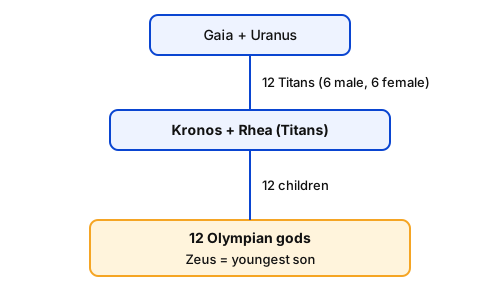
- Gaia and Uranus were the parents of the twelve Titans, including Kronos and Rhea.
- “He (Kronos) and Rhea had twelve children who would become the Olympian gods.”
- So the Olympians were children of Kronos and Rhea; Zeus was one of them, not their parent.
Yaad rakhein: Gaia + Uranus → Titans; Kronos + Rhea → Olympians (Zeus youngest).
Answer: (B) Kronos and Rhea
अवधारणा: गद्यांश में दी गई वंश-परंपरा देखें।
- Gaia और Uranus बारह Titans के माता-पिता थे, जिनमें Kronos और Rhea भी थे।
- “He (Kronos) and Rhea had twelve children who would become the Olympian gods.”
- अतः Olympian देवता Kronos और Rhea की संतान थे; Zeus उनमें से एक था, माता-पिता नहीं।
याद रखें: Gaia + Uranus → Titans; Kronos + Rhea → Olympians (Zeus सबसे छोटा)।
उत्तर: (B) Kronos and Rhea
SSC CPO Paper IEnglish ComprehensionReading ComprehensionSSC CPO Paper I 2020 · 24 Nov Shift 1
Read the passage and answer the questions that follow.
Greek religious traditions encompassed a large pantheon of gods, complex mythologies,
rituals and cult practices. Greece was a polytheistic society, and looked to its gods and
mythology to explain natural mysteries as well as current events. Religious festivals and
ceremonies were held throughout the year, and animal sacrifice and votive offerings were popular ways to appease and worship the gods. Religious life, rituals and practices were one of the unifying aspects of Greece across regions and poleis (cities, or city-states, such as Athens and Sparta).
Greek gods were immortal beings who possessed human-like qualities and were represented as completely human in visual art. They were moral and immoral, petty and just, and often vain. The gods were invoked to intervene and assist in all matters large, small, private and public.
City-states claimed individual gods and goddesses as their patrons. Temples and sanctuaries to the gods were built in every city. Many cities became cult sites due to their connection with a god or goddess and specific myths. For instance, the city of Delphi was known for its oracle and sanctuary of Apollo, because Apollo was believed to have killed a dragon that inhabited Delphi.
The history of the Greek pantheon begins with the primordial deities Gaia (Mother Earth) and Uranus (Father Sky), who were the parents of the first of twelve giants known as Titans.
Among these Titans were six males and six females. The males were named Oceanus,
Hyperion, Coeus, Crius, Iapetus, and Kronos. The females were named Themis, Mnemosyne, Tethys, Theia, Phoebe, and Rhea.
Kronos eventually overthrew Uranus and ruled during a mythological Golden Age. Over time, he and Rhea had twelve children who would become the Olympian gods. However, Kronos heard a prophecy that his son would overthrow him, as he did to Uranus. In an effort to avert fate, he ordered Rhea to allow him to devour each of the children upon their birth.
Best known among the pantheon are the twelve Olympian gods and goddesses who resided on Mt. Olympus in northern Greece. Zeus, the youngest son of Rhea and Kronos, was hidden from his father, instead of being swallowed. Once he became a man, he challenged his
father’s rule, forcing Kronos to regurgitate the rest of his swallowed children. These children were Zeus’s siblings, and together they overthrew Kronos, making Zeus the father of gods and men.
Q1549.How did Zeus bring back his siblings?
- Aby challenging and slaying Crius
- Bby reviving them with an elixir
- Cby making Kronos vomit the swallowed children
- Dby worshipping the sanctuary of Apollo
Show answer
Concept: See the last paragraph about Zeus.
- Zeus, hidden from his father, grew up and “challenged his father’s rule, forcing Kronos to regurgitate the rest of his swallowed children”.
- ‘regurgitate’ = bring swallowed food back up = vomit.
- So he brought them back by making Kronos vomit the swallowed children.
Yaad rakhein: Regurgitate = vomit / bring back up.
Answer: (C) by making Kronos vomit the swallowed children
अवधारणा: Zeus के बारे में अंतिम अनुच्छेद देखें।
- Zeus बड़ा होकर “challenged his father’s rule, forcing Kronos to regurgitate the rest of his swallowed children”।
- ‘regurgitate’ = निगली हुई चीज़ को बाहर उगलना = vomit।
- अतः उसने भाई-बहनों को Kronos से उल्टी करवाकर (vomit) वापस लाया।
याद रखें: Regurgitate = उगलना / उल्टी करना।
उत्तर: (C) by making Kronos vomit the swallowed children
SSC CPO Paper IEnglish ComprehensionReading ComprehensionSSC CPO Paper I 2020 · 24 Nov Shift 1
Read the passage and answer the questions that follow.
Greek religious traditions encompassed a large pantheon of gods, complex mythologies,
rituals and cult practices. Greece was a polytheistic society, and looked to its gods and
mythology to explain natural mysteries as well as current events. Religious festivals and
ceremonies were held throughout the year, and animal sacrifice and votive offerings were popular ways to appease and worship the gods. Religious life, rituals and practices were one of the unifying aspects of Greece across regions and poleis (cities, or city-states, such as Athens and Sparta).
Greek gods were immortal beings who possessed human-like qualities and were represented as completely human in visual art. They were moral and immoral, petty and just, and often vain. The gods were invoked to intervene and assist in all matters large, small, private and public.
City-states claimed individual gods and goddesses as their patrons. Temples and sanctuaries to the gods were built in every city. Many cities became cult sites due to their connection with a god or goddess and specific myths. For instance, the city of Delphi was known for its oracle and sanctuary of Apollo, because Apollo was believed to have killed a dragon that inhabited Delphi.
The history of the Greek pantheon begins with the primordial deities Gaia (Mother Earth) and Uranus (Father Sky), who were the parents of the first of twelve giants known as Titans.
Among these Titans were six males and six females. The males were named Oceanus,
Hyperion, Coeus, Crius, Iapetus, and Kronos. The females were named Themis, Mnemosyne, Tethys, Theia, Phoebe, and Rhea.
Kronos eventually overthrew Uranus and ruled during a mythological Golden Age. Over time, he and Rhea had twelve children who would become the Olympian gods. However, Kronos heard a prophecy that his son would overthrow him, as he did to Uranus. In an effort to avert fate, he ordered Rhea to allow him to devour each of the children upon their birth.
Best known among the pantheon are the twelve Olympian gods and goddesses who resided on Mt. Olympus in northern Greece. Zeus, the youngest son of Rhea and Kronos, was hidden from his father, instead of being swallowed. Once he became a man, he challenged his
father’s rule, forcing Kronos to regurgitate the rest of his swallowed children. These children were Zeus’s siblings, and together they overthrew Kronos, making Zeus the father of gods and men.
Q1550.Which of the following statements about Greek Gods is NOT true?
- AGreek Gods were mortals.
- BThey possessed human qualities.
- CSome of them were immoral, petty and vain.
- DThey were invoked to aid in all matters.
Show answer
Concept: Check each statement against paragraph 2.
- The passage says “Greek gods were immortal beings” – so ‘Greek Gods were mortals’ is NOT true.
- They “possessed human-like qualities”, were “moral and immoral, petty and just, and often vain”, and “were invoked to intervene and assist in all matters” – options (B), (C), (D) are true.
Yaad rakhein: Immortal = never dies; Mortal = must die.
Answer: (A) Greek Gods were mortals.
अवधारणा: हर कथन को दूसरे अनुच्छेद से मिलाएँ।
- गद्यांश: “Greek gods were immortal beings” – अतः ‘Greek Gods were mortals’ सत्य नहीं है।
- वे “possessed human-like qualities”, “moral and immoral, petty and just, and often vain” थे और “invoked … in all matters” – विकल्प (B), (C), (D) सत्य हैं।
याद रखें: Immortal = अमर; Mortal = नश्वर।
उत्तर: (A) Greek Gods were mortals.
SSC CPO Paper IEnglish ComprehensionReading ComprehensionSSC CPO Paper I 2020 · 24 Nov Shift 1
Q1551.Identify the segment in the sentence which contains a grammatical error.
Do you earn so much to make both ends meet?
- Amake both
- BDo you earn
- Cends meet
- Dso much to
Show answer
Concept: To show that something is sufficient for a purpose we use adjective/adverb + enough + to-infinitive, not 'so much to'.
- 'So much' needs a result clause with that (so much that …) or 'as to'; 'so much to make' is incorrect.
- The idea is sufficiency: earning sufficient money to meet expenses.
- Correct sentence: Do you earn enough to make both ends meet?
- 'Do you earn', 'make both', 'ends meet' are correct (idiom: make both ends meet = manage expenses).
Trick: Sufficient for a purpose → enough to; result → so … that.
Answer: (D) so much to
अवधारणा: किसी काम के लिए 'पर्याप्त' बताने हेतु enough + to-infinitive आता है, 'so much to' नहीं।
- 'So much' के साथ परिणाम बताने के लिए that (so much that …) या 'as to' चाहिए; 'so much to make' गलत है।
- यहाँ भाव 'पर्याप्त कमाई' का है।
- सही वाक्य: Do you earn enough to make both ends meet?
- 'make both ends meet' = खर्च चला पाना – यह मुहावरा सही है।
ट्रिक: उद्देश्य के लिए पर्याप्त → enough to; परिणाम → so … that।
उत्तर: (D) so much to
SSC CPO Paper IEnglish ComprehensionError Spotting – 'enough to'SSC CPO Paper I 2020 · 23 Nov Shift 3
Q1552.Select the most appropriate synonym of the given word.
CATASTROPHE
- Arestraint
- Bprosperity
- Cexpansion
- Dcalamity
Show answer
Concept: Catastrophe means a sudden event causing great damage or suffering; a disaster.
- Calamity = a great misfortune or disaster – same meaning.
- Restraint = self-control; prosperity = wealth/success (nearly opposite); expansion = growth.
Yaad rakhein: Catastrophe ≈ calamity ≈ disaster ≈ tragedy.
Answer: (D) calamity
अवधारणा: Catastrophe का अर्थ है – महाविपत्ति, आपदा (भारी नुकसान वाली घटना)।
- Calamity = विपत्ति, आपदा – समान अर्थ।
- Restraint = संयम; prosperity = समृद्धि (लगभग विपरीत); expansion = विस्तार।
याद रखें: Catastrophe ≈ calamity ≈ disaster (आपदा)।
उत्तर: (D) calamity
SSC CPO Paper IEnglish ComprehensionSynonymsSSC CPO Paper I 2020 · 23 Nov Shift 3
Q1553.Identify the segment in the sentence which contains a grammatical error.
Nobody has ever listened to me so attentive.
- Ato me
- BNobody has
- Cever listened
- Dso attentive
Show answer
Concept: A verb is modified by an adverb, not an adjective.
- The word describes how somebody 'listened' (a verb).
- 'Attentive' is an adjective; the adverb is 'attentively'.
- Correct: Nobody has ever listened to me so attentively.
- Other parts ('Nobody has', 'ever listened', 'to me') are correct.
Trick: Ask 'how?' about the verb → answer must be an -ly adverb.
Answer: (D) so attentive
अवधारणा: Verb (क्रिया) को विशेषित करने के लिए adverb चाहिए, adjective नहीं।
- शब्द यह बता रहा है कि 'listened' कैसे किया – यानी verb की विशेषता।
- 'Attentive' adjective है; adverb रूप 'attentively' है।
- सही वाक्य: Nobody has ever listened to me so attentively.
- बाकी हिस्से सही हैं।
ट्रिक: Verb से 'कैसे?' पूछें → उत्तर -ly वाला adverb होगा।
उत्तर: (D) so attentive
SSC CPO Paper IEnglish ComprehensionError Spotting – Adjective vs AdverbSSC CPO Paper I 2020 · 23 Nov Shift 3
Q1554.Select the most appropriate ANTONYM of the given word.
IMPUDENT
- Aarrant
- Bbrazen
- Cblatant
- Dmodest
Show answer
Concept: Impudent means rude and disrespectful; shamelessly bold.
- Arrant, brazen and blatant all suggest shameless or open boldness – close to impudent, not opposite.
- Modest = humble, polite, not boastful – the opposite of impudent.
Yaad rakhein: Impudent ↔ modest / respectful / courteous.
Answer: (D) modest
अवधारणा: Impudent का अर्थ है – ढीठ, बेअदब, निर्लज्ज।
- Arrant, brazen, blatant – सभी निर्लज्जता/खुलेपन का भाव देते हैं; ये समानार्थी जैसे हैं।
- Modest = विनम्र, शालीन – impudent का विपरीत।
याद रखें: Impudent (ढीठ) ↔ modest (विनम्र)।
उत्तर: (D) modest
SSC CPO Paper IEnglish ComprehensionAntonymsSSC CPO Paper I 2020 · 23 Nov Shift 3
Q1555.Select the most appropriate meaning of the given idiom.
Speak one’s mind
- Ato speak without thinking
- Bto speak in an assembly
- Cto voice one’s thoughts plainly
- Dto put one’s thoughts in writing
Show answer
Concept: The idiom speak one's mind means to say openly and honestly what one thinks.
- It is about frankness, not carelessness, so 'to speak without thinking' is wrong.
- It has nothing to do with an assembly or with writing.
- Example: She always speaks her mind, even before her seniors.
Yaad rakhein: Speak one's mind = be frank and outspoken.
Answer: (C) to voice one’s thoughts plainly
अवधारणा: Speak one's mind = अपने विचार साफ़-साफ़ और खुलकर कहना।
- यह स्पष्टवादिता है, बिना सोचे बोलना नहीं।
- इसका सभा या लिखने से कोई संबंध नहीं।
- उदाहरण: She always speaks her mind, even before her seniors.
याद रखें: Speak one's mind = मन की बात खुलकर कहना।
उत्तर: (C) to voice one’s thoughts plainly
SSC CPO Paper IEnglish ComprehensionIdioms and PhrasesSSC CPO Paper I 2020 · 23 Nov Shift 3
Q1556.Select the most appropriate one-word substitution for the given group of words.
One who is easily deceived
- Aplausible
- Bagreeable
- Ccredible
- Dgullible
Show answer
Concept: A person who is easily deceived or tricked is gullible.
- Plausible = seeming reasonable or believable (used for statements).
- Credible = trustworthy, believable; agreeable = pleasant.
- Gullible fits: A gullible buyer trusted the fake offer.
Trick: Gullible → think 'gull' = to fool someone; a gullible person is easily fooled.
Answer: (D) gullible
अवधारणा: जो आसानी से धोखा खा जाए, उसे gullible (भोला, जल्दी ठगा जाने वाला) कहते हैं।
- Plausible = विश्वसनीय लगने वाला (बात के लिए)।
- Credible = भरोसेमंद; agreeable = सुखद, सहमत।
- अतः gullible सही है।
ट्रिक: 'gull' = मूर्ख बनाना; gullible = जो आसानी से मूर्ख बने।
उत्तर: (D) gullible
SSC CPO Paper IEnglish ComprehensionOne Word SubstitutionSSC CPO Paper I 2020 · 23 Nov Shift 3
Q1557.Fill in the blank with the most appropriate word.
______! What have you done to your hair? You are looking so odd.
- AHurrah
- BBother
- CBravo
- DGoodness gracious
Show answer
Concept: An interjection must match the emotion of the sentence – here surprise/shock at an odd hairstyle.
- 'Goodness gracious!' expresses surprise or shock – fits 'What have you done to your hair?'
- Hurrah and Bravo express joy or praise – unsuitable for 'looking so odd'.
- Bother expresses annoyance at one's own trouble, not surprise at someone's look.
Trick: Match the interjection with the feeling: surprise → Goodness gracious / Oh my God; joy → Hurrah; praise → Bravo.
Answer: (D) Goodness gracious
अवधारणा: Interjection वाक्य की भावना से मेल खाना चाहिए – यहाँ अजीब बाल देखकर आश्चर्य/हैरानी है।
- 'Goodness gracious!' आश्चर्य/हैरानी दिखाता है – सही।
- Hurrah (खुशी) और Bravo (शाबाश) – 'looking so odd' के साथ नहीं जमते।
- Bother झुंझलाहट दिखाता है, आश्चर्य नहीं।
ट्रिक: आश्चर्य → Goodness gracious; खुशी → Hurrah; प्रशंसा → Bravo।
उत्तर: (D) Goodness gracious
SSC CPO Paper IEnglish ComprehensionFill in the Blank – InterjectionSSC CPO Paper I 2020 · 23 Nov Shift 3
Q1558.Select the most appropriate one-word substitution for the given group of words.
A person with the same name as another
- Aalias
- Bimposter
- Cnamesake
- Dancestor
Show answer
Concept: A person having the same name as another is a namesake.
- Alias = a false or assumed name.
- Imposter = one who pretends to be someone else; ancestor = forefather.
- Example: My namesake in the class often gets my marks.
Yaad rakhein: Name + sake → same name.
Answer: (C) namesake
अवधारणा: किसी दूसरे के समान नाम वाला व्यक्ति namesake (हमनाम) कहलाता है।
- Alias = उपनाम/झूठा नाम।
- Imposter = धोखे से किसी और का रूप धरने वाला; ancestor = पूर्वज।
- अतः namesake सही है।
याद रखें: Namesake = हमनाम।
उत्तर: (C) namesake
SSC CPO Paper IEnglish ComprehensionOne Word SubstitutionSSC CPO Paper I 2020 · 23 Nov Shift 3
Q1559.Fill in the blank with the most appropriate word.
She has inherited her fondness ______ tennis from her parents.
- Ato
- Bat
- Cfor
- Dby
Show answer
Concept: The noun fondness (like the adjective fond) takes the preposition for.
- Fixed usage: fondness for something; but fond of something.
- Correct: She has inherited her fondness for tennis from her parents.
- 'to', 'at', 'by' are not used with fondness.
Yaad rakhein: fond of but fondness for (love for, liking for, passion for).
Answer: (C) for
अवधारणा: संज्ञा fondness के साथ preposition for आता है।
- निश्चित प्रयोग: fondness for; परन्तु fond of।
- सही वाक्य: She has inherited her fondness for tennis from her parents.
- 'to', 'at', 'by' इसके साथ नहीं आते।
याद रखें: fond of लेकिन fondness for (love for, liking for जैसे)।
उत्तर: (C) for
SSC CPO Paper IEnglish ComprehensionPrepositionsSSC CPO Paper I 2020 · 23 Nov Shift 3
Q1560.Fill in the blank with the most appropriate word.
The doctor often made his patients ______ for long.
- Awaited
- Bwaiting
- Cto wait
- Dwait
Show answer
Concept: Causative make + object + bare infinitive (verb without 'to').
- Pattern: made + his patients + wait.
- 'To wait' is used only in the passive: patients were made to wait.
- 'Waited' and 'waiting' do not fit this pattern.
- Correct: The doctor often made his patients wait for long.
Trick: make / let / have + object + V1 (no 'to') in active voice.
Answer: (D) wait
अवधारणा: Causative make + object + bare infinitive (बिना 'to' वाला V1)।
- संरचना: made + his patients + wait।
- 'to wait' केवल passive में आता है: patients were made to wait।
- 'waited', 'waiting' यहाँ गलत हैं।
- सही वाक्य: The doctor often made his patients wait for long.
ट्रिक: Active में make / let / have + object + V1 (बिना 'to')।
उत्तर: (D) wait
SSC CPO Paper IEnglish ComprehensionCausative Verb 'make'SSC CPO Paper I 2020 · 23 Nov Shift 3

