Q141.If + means −, − means ×, × means ÷, ÷ means +, what will come in place of the question mark (?) in the given equation?
यदि + का अर्थ − है, − का अर्थ × है, × का अर्थ ÷ है, ÷ का अर्थ + है, तो दिए गए समीकरण में प्रश्न चिह्न (?) के स्थान पर क्या आएगा?
- A7
- B5
- C12
- D10
Show answer
Concept: Replace each sign by its meaning and apply BODMAS.
- + → −, − → ×, × → ÷, ÷ → +.
- becomes .
- , .
- .
Trick: Simplify the × and ÷ block first: .
Answer: (A) 7
अवधारणा: हर चिह्न को उसके अर्थ से बदलें और BODMAS लगाएँ।
- + → −, − → ×, × → ÷, ÷ → +।
- बनता है ।
- , ।
- ।
ट्रिक: पहले × और ÷ वाला भाग: ।
उत्तर: (A) 7
SSC CPO Paper IGeneral Intelligence and ReasoningMathematical OperationsSSC CPO Paper I 2024 · 29 Jun Shift 1
Q142.Which of the following numbers will replace the question marks (?) in the given
series?
2, 6, 12, 20, ?, ?, 56, 72
दी गई
शृंखला में प्रश्न चिह्नों (?) के स्थान पर निम्नलिखित में से कौन-सी संख्याएँ आएँगी?
2, 6, 12, 20, ?, ?, 56, 72
- A36, 40
- B30, 38
- C30, 42
- D32, 44
Show answer
Concept: Terms are of the form .
- , , , .
- , .
- Check: , ✓.
Trick: Differences 4, 6, 8, 10, 12, 14, 16 also give 30 and 42.
Answer: (C) 30, 42
अवधारणा: पद के रूप में हैं।
- , , , ।
- , ।
- जाँच: , ✓।
ट्रिक: अंतर 4, 6, 8, 10, 12, 14, 16 से भी 30 और 42 मिलते हैं।
उत्तर: (C) 30, 42
SSC CPO Paper IGeneral Intelligence and ReasoningNumber SeriesSSC CPO Paper I 2024 · 29 Jun Shift 1
Q143.Select the number from among the given options that can replace the question mark (?) in the following series.
1024, 899, 835, 808, 800, ?
दिए गए विकल्पों में से उस संख्या का चयन कीजिए जो निम्नलिखित शृंखला में प्रश्न चिह्न (?) का स्थान ले सकती है।
1024, 899, 835, 808, 800, ?
- A795
- B798
- C797
- D799
Show answer
Concept: The differences are descending perfect cubes.
- , .
- , .
- The next subtraction is the smallest non-zero cube, : .
Trick: Spot cubes 125, 64, 27, 8 in the differences.
Answer: (D) 799
अवधारणा: अंतर घटते हुए पूर्ण घन (cubes) हैं।
- , ।
- , ।
- अगला घटाव सबसे छोटा शून्येतर घन : ।
ट्रिक: अंतरों में घन 125, 64, 27, 8 पहचानें।
उत्तर: (D) 799
SSC CPO Paper IGeneral Intelligence and ReasoningNumber SeriesSSC CPO Paper I 2024 · 29 Jun Shift 1
Q144.A dice has its faces marked by numbers 11, 12, 13, 14, 15 and 16. Two positions of the same dice are given below. Which face is opposite to face 14?
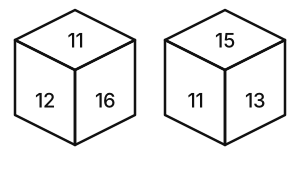
एक पासे के फलकों पर संख्याएँ 11, 12, 13, 14, 15 और 16 अंकित हैं। नीचे उसी पासे की दो स्थितियाँ दी गई हैं। फलक 14 के विपरीत कौन-सा फलक है?
- A12
- B15
- C16
- D11
Show answer
Concept: The face common to both positions is adjacent to all faces seen with it.
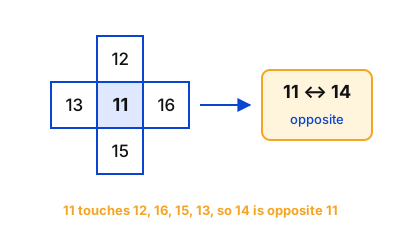
- 11 appears in both positions.
- With 11 we see 12, 16 (first) and 15, 13 (second).
- So 11 touches 12, 13, 15, 16; the remaining face 14 is opposite 11.
Trick: Common face + four different neighbours → the sixth face is opposite.
Answer: (D) 11
अवधारणा: दोनों स्थितियों में उभयनिष्ठ फलक, साथ दिखे सभी फलकों का आसन्न है।
- 11 दोनों स्थितियों में है।
- 11 के साथ 12, 16 (पहली) और 15, 13 (दूसरी) दिखते हैं।
- अतः 11 के पड़ोसी 12, 13, 15, 16; बचा फलक 14, 11 के विपरीत है।
ट्रिक: उभयनिष्ठ फलक + चार अलग पड़ोसी → छठा फलक विपरीत।
उत्तर: (D) 11
SSC CPO Paper IGeneral Intelligence and ReasoningDiceSSC CPO Paper I 2024 · 29 Jun Shift 1
Q145.Two statements are given, followed by two conclusions numbered I and II. Assuming the statements to be true, even if they seem to be at variance with commonly known facts, decide which of the conclusions logically follow(s) from the statements.
Statements:
All notebooks are erasers.
All erasers are pens.
Conclusions:
I.All notebooks are pens.
II.Some pens are notebooks.
दो कथन दिए गए हैं, जिनके बाद I और II से संख्यांकित दो निष्कर्ष दिए गए हैं। कथनों को सत्य मानते हुए, भले ही वे सामान्य रूप से ज्ञात तथ्यों से भिन्न प्रतीत होते हों, निर्णय लीजिए कि कौन-सा/से निष्कर्ष कथनों का तार्किक रूप से अनुसरण करता है/करते हैं।
कथन:
सभी नोटबुक, रबड़ हैं।
सभी रबड़, पेन हैं।
निष्कर्ष:
I.सभी नोटबुक, पेन हैं।
II.कुछ पेन, नोटबुक हैं।
- ANeither conclusion I nor II followsन तो निष्कर्ष I और न ही II अनुसरण करता है
- BOnly conclusion I followsकेवल निष्कर्ष I अनुसरण करता है
- COnly conclusion II followsकेवल निष्कर्ष II अनुसरण करता है
- DBoth conclusions I and II followनिष्कर्ष I और II दोनों अनुसरण करते हैं
Show answer
Concept: All + All gives an All conclusion.
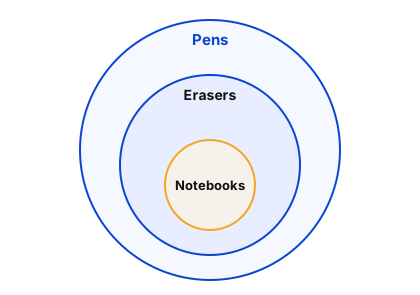
- Notebooks ⊂ Erasers ⊂ Pens.
- So All notebooks are pens – I follows.
- Conversion of I gives Some pens are notebooks – II follows.
Yaad rakhein: All A are B + All B are C ⇒ All A are C, and also Some C are A.
Answer: (D) Both conclusions I and II follow
अवधारणा: All + All से All निष्कर्ष निकलता है।
- Notebooks ⊂ Erasers ⊂ Pens।
- अतः All notebooks are pens – I सत्य।
- I का रूपांतरण → Some pens are notebooks – II सत्य।
याद रखें: All A are B + All B are C ⇒ All A are C, और Some C are A भी।
उत्तर: (D) Both conclusions I and II follow
SSC CPO Paper IGeneral Intelligence and ReasoningSyllogismSSC CPO Paper I 2024 · 29 Jun Shift 1
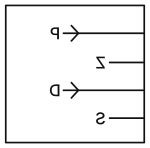
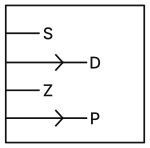
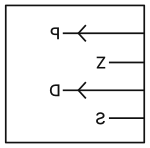
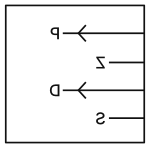
Q146.Select the correct mirror image of the given figure when the mirror is placed at MN as shown below.
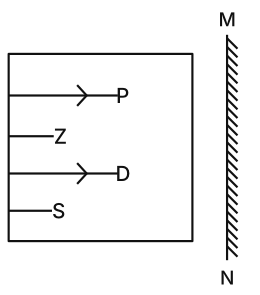
जब दर्पण को नीचे दर्शाए अनुसार MN पर रखा जाता है, तो दी गई आकृति के सही दर्पण प्रतिबिंब का चयन कीजिए।
- A
- B
- C
- D
Show answer
Concept: A vertical mirror MN on the right swaps left and right; the top-to-bottom order stays the same.
- Lines now start from the right edge and arrowheads point left.
- Order from top remains P, Z, D, S; each letter is laterally inverted (Z, P, D, S all appear reversed).
- Option (D) has reversed P, Z, D, S with left-pointing arrows; (C) keeps Z unreversed, (B) is upside down, (A) has the arrowheads pointing the wrong way.
Trick: In a side mirror, letters like Z also flip – check the non-symmetric letters first.
Answer: (D) the fourth figure
अवधारणा: दाईं ओर ऊर्ध्वाधर दर्पण MN में बायाँ-दायाँ बदलता है; ऊपर से नीचे का क्रम वही रहता है।
- रेखाएँ अब दाएँ किनारे से शुरू होंगी और तीर बाईं ओर इंगित करेंगे।
- ऊपर से क्रम P, Z, D, S ही रहेगा; हर अक्षर पार्श्व रूप से उलटा (Z, P, D, S सब उलटे)।
- विकल्प (D) में उलटे P, Z, D, S और बाईं ओर तीर हैं; (C) में Z उलटा नहीं, (B) उल्टा-पुल्टा है, (A) में तीर की दिशा गलत है।
ट्रिक: पार्श्व दर्पण में Z जैसे अक्षर भी पलटते हैं – असममित अक्षर पहले जाँचें।
उत्तर: (D) चौथी आकृति
SSC CPO Paper IGeneral Intelligence and ReasoningMirror ImageSSC CPO Paper I 2024 · 29 Jun Shift 1
Q147.In a certain code language, ‘revise the lesson’ is written as ‘rx cd st’ and ‘the lesson plan’ is written as ‘cd nq rx’. How is ‘revise’ written in the given language?
एक निश्चित कूट भाषा में, ‘revise the lesson’ को ‘rx cd st’ लिखा जाता है और ‘the lesson plan’ को ‘cd nq rx’ लिखा जाता है। दी गई भाषा में ‘revise’ को कैसे लिखा जाता है?
- Ast
- Bcd
- Crx
- Dnq
Show answer
Concept: Common words share common codes.
- 'the' and 'lesson' are in both sentences; common codes are rx and cd.
- So 'the', 'lesson' → {rx, cd}.
- The remaining word of the first sentence, 'revise', gets the remaining code st.
Trick: Eliminate the common words and codes; what is left pairs up.
Answer: (A) st
अवधारणा: उभयनिष्ठ शब्दों के कोड भी उभयनिष्ठ होते हैं।
- 'the' और 'lesson' दोनों वाक्यों में; उभयनिष्ठ कोड rx और cd।
- अतः 'the', 'lesson' → {rx, cd}।
- पहले वाक्य का बचा शब्द 'revise' → बचा कोड st।
ट्रिक: उभयनिष्ठ शब्द और कोड हटाएँ; जो बचे वही जोड़ी है।
उत्तर: (A) st
SSC CPO Paper IGeneral Intelligence and ReasoningCoding-DecodingSSC CPO Paper I 2024 · 29 Jun Shift 1
Q148.In a certain code language, ‘print the cards’ is written as ‘cd fm px’ and ‘cards for sale’ is written as ‘nt px ym’. How is ‘cards’ written in the given language?
एक निश्चित कूट भाषा में, ‘print the cards’ को ‘cd fm px’ लिखा जाता है और ‘cards for sale’ को ‘nt px ym’ लिखा जाता है। दी गई भाषा में ‘cards’ को कैसे लिखा जाता है?
- Apx
- Bcd
- Cnt
- Dfm
Show answer
Concept: The word common to both sentences has the code common to both.
- 'cards' is the only common word in 'print the cards' and 'cards for sale'.
- The only common code in 'cd fm px' and 'nt px ym' is px.
- So cards = px.
Trick: One common word ↔ one common code.
Answer: (A) px
अवधारणा: दोनों वाक्यों में उभयनिष्ठ शब्द का कोड भी उभयनिष्ठ होगा।
- 'print the cards' और 'cards for sale' में केवल 'cards' उभयनिष्ठ है।
- 'cd fm px' और 'nt px ym' में केवल px उभयनिष्ठ है।
- अतः cards = px।
ट्रिक: एक उभयनिष्ठ शब्द ↔ एक उभयनिष्ठ कोड।
उत्तर: (A) px
SSC CPO Paper IGeneral Intelligence and ReasoningCoding-DecodingSSC CPO Paper I 2024 · 29 Jun Shift 1
Q149.Three different positions of the same die are shown below. What is the number on the face opposite to the one having 6?
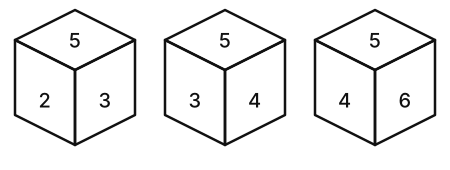
नीचे एक ही पासे की तीन भिन्न स्थितियाँ दर्शाई गई हैं। 6 वाले फलक के विपरीत फलक पर कौन-सी संख्या है?
- A1
- B4
- C3
- D5
Show answer
Concept: Use the common face to find one opposite pair, then the others.
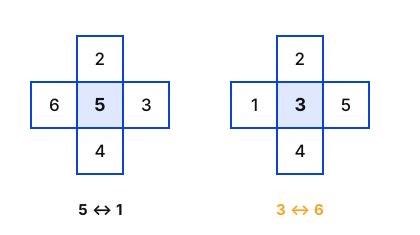
- 5 is on top in all three positions and is seen with 2, 3, 4, 6 → 5 is opposite 1.
- 3 is seen with 2 and 4 (and with 5, hence also adjacent to 1).
- The only face left for 3 to be opposite is 6. (Then 2 is opposite 4.)
Trick: Once one pair is fixed, a face's opposite is the one not among its neighbours.
Answer: (C) 3
अवधारणा: उभयनिष्ठ फलक से एक विपरीत जोड़ा निकालें, फिर बाकी।
- तीनों स्थितियों में ऊपर 5 है और उसके साथ 2, 3, 4, 6 दिखते हैं → 5 के विपरीत 1।
- 3 के साथ 2 और 4 दिखते हैं (और 5 भी, अतः 1 भी आसन्न)।
- 3 के विपरीत केवल 6 बचता है। (फिर 2 के विपरीत 4।)
ट्रिक: एक जोड़ा तय होने पर, किसी फलक का विपरीत वही जो उसके पड़ोसियों में नहीं।
उत्तर: (C) 3
SSC CPO Paper IGeneral Intelligence and ReasoningDiceSSC CPO Paper I 2024 · 29 Jun Shift 1
Q150.Based on the English alphabetical order, three of the following four letter-clusters are alike in a certain way and thus form a group. Which letter-cluster does not belong to that group?
(Note: The odd letter-cluster is not based on the number of consonants/vowels or their position in the letter-cluster.)
अंग्रेज़ी वर्णमाला क्रम के आधार पर, निम्नलिखित चार अक्षर-समूहों में से तीन किसी निश्चित प्रकार से एकसमान हैं और इस प्रकार एक समूह बनाते हैं। कौन-सा अक्षर-समूह उस समूह से संबंधित नहीं है?
(नोट: असंगत अक्षर-समूह, उस अक्षर-समूह में व्यंजनों/स्वरों की संख्या या उनके स्थान पर आधारित नहीं है।)
- APUR
- BRWT
- CNSP
- DTYU
Show answer
Concept: Check the gaps between consecutive letters of each cluster.
- PUR: P(16) +5 → U(21), −3 → R(18).
- RWT: R(18) +5 → W(23), −3 → T(20). NSP: N(14) +5 → S(19), −3 → P(16).
- TYU: T(20) +5 → Y(25), but −4 → U(21). So TYU breaks the +5, −3 pattern.
Trick: The third letter is always 2 ahead of the first in the group (P→R, R→T, N→P); T→U is only 1.
Answer: (D) TYU
अवधारणा: हर गुच्छे के क्रमागत अक्षरों का अंतर देखें।
- PUR: P(16) +5 → U(21), −3 → R(18)।
- RWT: R(18) +5 → W(23), −3 → T(20)। NSP: N(14) +5 → S(19), −3 → P(16)।
- TYU: T(20) +5 → Y(25), पर −4 → U(21)। अतः TYU पैटर्न +5, −3 तोड़ता है।
ट्रिक: समूह में तीसरा अक्षर पहले से 2 आगे है (P→R, R→T, N→P); T→U केवल 1 आगे।
उत्तर: (D) TYU
SSC CPO Paper IGeneral Intelligence and ReasoningOdd One Out (Letters)SSC CPO Paper I 2024 · 29 Jun Shift 1
Q151.Select the figure from among the given options that can logically replace the question mark (?) in the following series.

दिए गए विकल्पों में से उस आकृति का चयन कीजिए जो निम्नलिखित श्रृंखला में प्रश्न चिह्न (?) के स्थान पर तार्किक रूप से आ सकती है।
- A
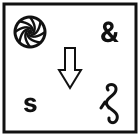
- B
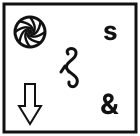
- C
- D
Show answer
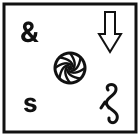
Concept: Track each symbol separately; all five move one step along the same fixed path Centre → TR → BR → BL → TL → Centre.
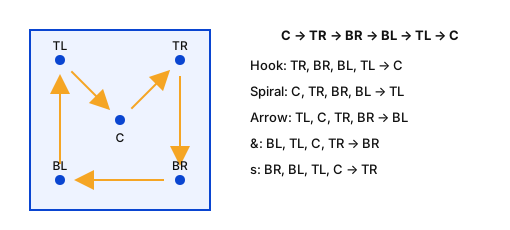
- Hook: TR, BR, BL, TL → next Centre.
- Spiral: Centre, TR, BR, BL → next TL. Arrow: TL, Centre, TR, BR → next BL.
- &: BL, TL, Centre, TR → next BR; s: BR, BL, TL, Centre → next TR.
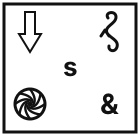
- So figure 5: spiral TL, s TR, hook in centre, arrow BL, & BR.
Trick: Find the path of one symbol (e.g. the hook); every other symbol follows the same path.
Answer: (B) Spiral top-left, s top-right, hook centre, arrow bottom-left, & bottom-right.
अवधारणा: हर चिह्न को अलग से देखें; पाँचों एक ही निश्चित मार्ग Centre → TR → BR → BL → TL → Centre पर एक-एक कदम चलते हैं।
- Hook: TR, BR, BL, TL → अगला Centre।
- Spiral: Centre, TR, BR, BL → अगला TL; Arrow: TL, Centre, TR, BR → अगला BL।
- &: BL, TL, Centre, TR → अगला BR; s: BR, BL, TL, Centre → अगला TR।
- अतः आकृति 5: spiral TL, s TR, hook centre, arrow BL, & BR।
ट्रिक: एक चिह्न (जैसे hook) का मार्ग पहचानें; बाकी सब उसी मार्ग पर चलते हैं।
उत्तर: (B) Spiral ऊपर-बाएँ, s ऊपर-दाएँ, hook बीच में, arrow नीचे-बाएँ, & नीचे-दाएँ।
SSC CPO Paper IGeneral Intelligence and ReasoningFigure Series (Position Shift)SSC CPO Paper I 2024 · 28 Jun Shift 3
Q152.Select the set in which the numbers are related in the same way as are the numbers of the following sets.
(NOTE: Operations should be performed on the whole numbers, without breaking
down the numbers into its constituent digits. E.g. 13 – Operations on 13 such as
adding /deleting /multiplying etc. to 13 can be performed. Breaking down 13 into 1 and 3 and then performing mathematical operations on 1 and 3 is not allowed)
(16, 48 , 4)
(24, 72, 6)
उस समुच्चय का चयन कीजिए जिसमें संख्याएँ आपस में उसी प्रकार संबंधित हैं, जिस प्रकार निम्नलिखित समुच्चयों की संख्याएँ आपस में संबंधित हैं।
(ध्यान दें: संख्याओं को उनके घटक अंकों में विभाजित किए बिना, पूर्ण संख्याओं पर संक्रियाएँ की जानी चाहिए।
उदाहरण: 13 – 13 पर संक्रियाएँ, जैसे 13 में
जोड़ना/घटाना/गुणा करना आदि की जा सकती हैं। 13 को 1 और 3 में विभाजित करना और फिर 1 और 3 पर गणितीय संक्रियाएँ करना वर्जित है।)
(16, 48 , 4)
(24, 72, 6)
- A(21, 60, 6)
- B(20, 60, 6)
- C(21, 60, 5)
- D(20, 60, 5)
Show answer
Concept: Find how the 2nd and 3rd numbers come from the 1st.
- : and .
- : and .
- Check : , ✓. Option (B) fails because .
Trick: Second = first × 3, third = first ÷ 4 — test only the first number of each option.
Answer: (D)
अवधारणा: पहली संख्या से दूसरी और तीसरी कैसे बनती है, यह खोजें।
- : और ।
- : और ।
- जाँच : , ✓; (B) में ।
ट्रिक: दूसरी = पहली × 3, तीसरी = पहली ÷ 4।
उत्तर: (D)
SSC CPO Paper IGeneral Intelligence and ReasoningNumber Set AnalogySSC CPO Paper I 2024 · 28 Jun Shift 3
Q153.In a certain code language, ‘god is great’ is coded as ‘tg so rf’ and ‘we love god’ is
coded as ‘ae rf xd’. How is ‘god’ coded in that language?
एक निश्चित कूट भाषा में, ‘god is great’ को ‘tg so rf’ के रूप में कूटबद्ध किया जाता है और ‘we love god’ को
‘ae rf xd’ के रूप में कूटबद्ध किया जाता है। उस भाषा में ‘god’ को किस प्रकार कूटबद्ध किया जाता है?
- Axd
- Brf
- Ctg
- Dae
Show answer
Concept: A word common to two sentences takes the code common to both coded sentences.
- 'god is great' → 'tg so rf'; 'we love god' → 'ae rf xd'.
- Common word: god; common code: rf.
- So god = rf.
Trick: Common word ↔ common code.
Answer: (B) rf
अवधारणा: दो वाक्यों में समान शब्द का कोड दोनों कोडों में समान कोड होता है।
- 'god is great' → 'tg so rf'; 'we love god' → 'ae rf xd'।
- समान शब्द god, समान कोड rf।
- अतः god = rf।
ट्रिक: समान शब्द ↔ समान कोड।
उत्तर: (B) rf
SSC CPO Paper IGeneral Intelligence and ReasoningCoding-Decoding (Common Word)SSC CPO Paper I 2024 · 28 Jun Shift 3
Q154.Select the Venn diagram that best illustrates the relationship between the following classes.
Teacher, Guitarist, Lawyer
उस वेन आरेख का चयन कीजिए जो निम्नलिखित वर्गों के बीच संबंध को सर्वोत्तम ढंग से दर्शाता है।
शिक्षक, गिटारवादक, वकील
- A

- B

- C

- D

Show answer
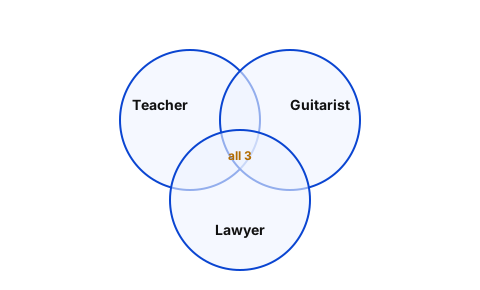
Concept: Teacher, Guitarist and Lawyer are three independent groups; a person can belong to any one, two or all three of them.
- A teacher may play the guitar, and a guitarist may be a lawyer.
- A lawyer may also teach, and one person can even be all three.
- So all three circles must overlap each other, with a common central region.
Yaad rakhein: Three independent professions/hobbies → three mutually intersecting circles.
Answer: (B) Three circles all overlapping one another.
अवधारणा: Teacher, Guitarist और Lawyer तीन स्वतंत्र वर्ग हैं; एक व्यक्ति इनमें से एक, दो या तीनों हो सकता है।
- एक teacher गिटार बजा सकता है, और guitarist lawyer हो सकता है।
- lawyer पढ़ा भी सकता है, और कोई व्यक्ति तीनों भी हो सकता है।
- अतः तीनों वृत्त आपस में एक-दूसरे को काटेंगे, बीच में साझा भाग होगा।
याद रखें: तीन स्वतंत्र पेशे/शौक → तीन परस्पर काटते वृत्त।
उत्तर: (B) तीनों वृत्त एक-दूसरे को काटते हुए।
SSC CPO Paper IGeneral Intelligence and ReasoningVenn DiagramSSC CPO Paper I 2024 · 28 Jun Shift 3
Q155.Anil starts from point A and drives 8 km towards North. He then takes a right turn,
drives 2 km, turns right and drives 11 km. He then takes a right turn and drives 5 km. He takes a final right turn, drives 3 km and stops at point P. How far (shortest distance) and towards which direction should he drive in order to reach point A again? (All turns are 90 degrees turns only unless specified.)
अनिल बिंदु A से चलना शुरू करता है और उत्तर की ओर 8 km गाड़ी चलाता है। फिर वह दाएँ मुड़ता है,
2 km गाड़ी चलाता है, दाएँ मुड़ता है और 11 km गाड़ी चलाता है। फिर वह दाएँ मुड़ता है और 5 km गाड़ी चलाता है। वह अंतिम बार दाएँ मुड़ता है, 3 km गाड़ी चलाता है और बिंदु P पर रुक जाता है। बिंदु A पर फिर से पहुँचने के लिए उसे कितनी दूरी (न्यूनतम दूरी) तक और किस दिशा में गाड़ी चलानी चाहिए? (जब तक निर्दिष्ट न किया जाए, सभी मोड़ केवल 90 डिग्री के हैं।)
- A3 km towards Eastपूर्व की ओर 3 km
- B2 km towards Eastपूर्व की ओर 2 km
- C2 km towards Westपश्चिम की ओर 2 km
- D3 km towards Northउत्तर की ओर 3 km
Show answer
Concept: Plot each move on axes (North = up, East = right) and compare P with A.
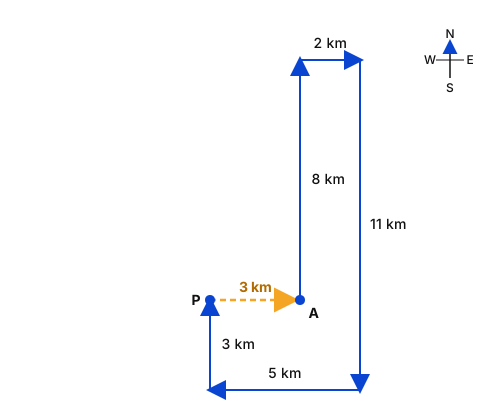
- From A: 8 km North, right turn → 2 km East, right → 11 km South, right → 5 km West, right → 3 km North.
- East–West: → P is 3 km West of A's line.
- North–South: → P is on the same level as A.
- So A is 3 km East of P.
Trick: Net N–S means the answer is a pure East/West distance.
Answer: (A) 3 km towards East
अवधारणा: हर चाल को अक्षों पर दर्शाएँ (North = ऊपर, East = दाएँ) और P की तुलना A से करें।
- A से: 8 km North, दाएँ → 2 km East, दाएँ → 11 km South, दाएँ → 5 km West, दाएँ → 3 km North।
- East–West: → P, A से 3 km West है।
- North–South: → P, A के समान स्तर पर है।
- अतः A तक पहुँचने के लिए 3 km East जाना होगा।
ट्रिक: N–S का कुल हो तो उत्तर केवल East/West दूरी होगा।
उत्तर: (A) 3 km East की ओर
SSC CPO Paper IGeneral Intelligence and ReasoningDirection and DistanceSSC CPO Paper I 2024 · 28 Jun Shift 3
Q156.Based on the English alphabetical order, three of the following four letter-clusters are alike in a certain way and thus form a group. Which letter-cluster does not belong to that group?
(Note: The odd letter-cluster is not based on the number of consonants/vowels or their position in the letter-cluster.)
अंग्रेज़ी वर्णमाला क्रम के आधार पर, निम्नलिखित चार अक्षर-समूहों में से तीन किसी निश्चित प्रकार से एकसमान हैं और इस प्रकार एक समूह बनाते हैं। कौन-सा अक्षर-समूह उस समूह से संबंधित नहीं है?
(ध्यान दें: असंगत अक्षर-समूह, उस अक्षर-समूह में व्यंजनों/स्वरों की संख्या या उनके स्थान पर आधारित नहीं है।)
- AQNR
- BTQV
- CNKP
- DKHM
Show answer
Concept: Check the gaps between consecutive letters by alphabet position.
- TQV: , .
- NKP: , ; KHM: , .
- QNR: but → breaks the pattern.
Trick: Pattern ; the cluster with is odd.
Answer: (A) QNR
अवधारणा: क्रमागत अक्षरों के बीच अंतर (alphabet position) जाँचें।
- TQV: , ।
- NKP: , ; KHM: , ।
- QNR: पर → पैटर्न टूटता है।
ट्रिक: पैटर्न ; जिसमें है वह विषम है।
उत्तर: (A) QNR
SSC CPO Paper IGeneral Intelligence and ReasoningOdd One Out (Letter Cluster)SSC CPO Paper I 2024 · 28 Jun Shift 3
Q157.Point A is 35 m to the east of Point B. Point C is 48 m to the north of Point A. Point D is 23 m to the east of Point C. Point D is 14 m to the north of Point E. Point E is 48 m to the east of Point F. In which direction is Point F with respect to Point A?
बिंदु A, बिंदु B के पूर्व में 35 m की दूरी पर है। बिंदु C, बिंदु A के उत्तर में 48 m की दूरी पर है। बिंदु D, बिंदु C के पूर्व में 23 m की दूरी पर है। बिंदु D, बिंदु E के उत्तर में 14 m की दूरी पर है। बिंदु E, बिंदु F के पूर्व में 48 m की दूरी पर है। बिंदु A के सापेक्ष बिंदु F किस दिशा में है?
- ANorth-eastउत्तर-पूर्व
- BNorthउत्तर
- CEastपूर्व
- DNorth-westउत्तर-पश्चिम
Show answer
Concept: Take A as origin and fix every point's position.
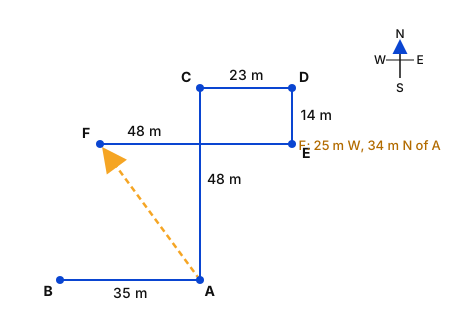
- B is 35 m West of A; C is 48 m North of A; D is 23 m East of C.
- E is 14 m South of D → E is 23 m East, 34 m North of A.
- F is 48 m West of E → F is m West and 34 m North of A.
- West + North → F is North-west of A.
Trick: Only signs matter for direction: (West, North) = North-west.
Answer: (D) North-west
अवधारणा: A को मूल बिंदु मानकर हर बिंदु की स्थिति तय करें।
- B, A से 35 m West; C, A से 48 m North; D, C से 23 m East।
- E, D से 14 m South → E, A से 23 m East, 34 m North।
- F, E से 48 m West → F, A से m West और 34 m North।
- West + North → F, A के North-west में है।
ट्रिक: दिशा के लिए केवल चिह्न देखें: (West, North) = North-west।
उत्तर: (D) North-west (उत्तर-पश्चिम)
SSC CPO Paper IGeneral Intelligence and ReasoningDirection SenseSSC CPO Paper I 2024 · 28 Jun Shift 3
Q158.Select the option that is related to the third word in the same way as the second word is related to the first word.
(The words must be considered as meaningful English words and must not be related to each other based on the number of letters/number of consonants/ vowels in the
word.)
Summon : Call :: Disperse : ?
उस विकल्प का चयन कीजिए जो तीसरे शब्द से उसी प्रकार संबंधित है, जिस प्रकार दूसरा शब्द पहले शब्द से संबंधित है।
(शब्दों को अर्थपूर्ण अंग्रेज़ी शब्द माना जाना चाहिए और उन्हें शब्द में अक्षरों की संख्या/व्यंजनों/स्वरों की संख्या के आधार पर
एक-दूसरे से संबंधित नहीं किया जाना चाहिए।)
Summon : Call :: Disperse : ?
- ASurround
- BRemove
- CSpread
- DDisappear
Show answer
Concept: Summon and Call are synonyms, so we need a synonym of Disperse.
- Summon = call (someone) to come.
- Disperse = scatter / spread over a wide area.
- Remove and Disappear are different ideas; Surround is nearly opposite.
Trick: Pair type first: synonym → synonym.
Answer: (C) Spread
अवधारणा: Summon और Call समानार्थी हैं, इसलिए Disperse का समानार्थी चाहिए।
- Summon = बुलाना।
- Disperse = बिखेरना / फैलाना (spread)।
- Remove (हटाना), Disappear (गायब होना) अलग अर्थ हैं; Surround (घेरना) लगभग विपरीत है।
ट्रिक: पहले जोड़ी का प्रकार पहचानें: समानार्थी → समानार्थी।
उत्तर: (C) Spread
SSC CPO Paper IGeneral Intelligence and ReasoningWord Analogy (Synonym)SSC CPO Paper I 2024 · 28 Jun Shift 3
Q159.In a code language, ‘MARS’ is written as ‘KXPP’, and ‘BODY’ is written as ‘ZLBV’. How will ‘TEST’ be written in that language?
एक कूट भाषा में, ‘MARS’ को ‘KXPP’ लिखा जाता है और ‘BODY’ को ‘ZLBV’ लिखा जाता है। उसी भाषा में ‘TEST’ को किस प्रकार लिखा जाएगा?
- ARBQQ
- BRQBQ
- CQQRB
- DQRQB
Show answer
Concept: Compare each letter with its code letter.
- MARS → KXPP: , , , .
- BODY → ZLBV: , , , ✓.
- TEST: , , , → RBQQ.
Trick: Alternate shifts.
Answer: (A) RBQQ
अवधारणा: हर अक्षर की तुलना उसके कोड अक्षर से करें।
- MARS → KXPP: , , , ।
- BODY → ZLBV: , , , ✓।
- TEST: , , , → RBQQ।
ट्रिक: बारी-बारी से ।
उत्तर: (A) RBQQ
SSC CPO Paper IGeneral Intelligence and ReasoningCoding-Decoding (Letter Shift)SSC CPO Paper I 2024 · 28 Jun Shift 3
Q160.Select the option that represents the correct order of the given words as they would appear in an English dictionary.
1. Breathable
2. Brevetting
3. Breakfast
4. Breviaries
5. Breacher
6. Breakthrough
उस विकल्प का चयन कीजिए जो दिए गए शब्दों के उस सही क्रम को दर्शाता है, जिस क्रम में वे अंग्रेज़ी शब्दकोश में आते हैं।
1. Breathable
2. Brevetting
3. Breakfast
4. Breviaries
5. Breacher
6. Breakthrough
- A5, 6, 3, 1, 4, 2
- B6, 5, 3, 1, 4, 2
- C6, 3, 5, 1, 2, 4
- D5, 3, 6, 1, 2, 4
Show answer
Concept: All start with 'Bre'; compare from the 4th letter onward.
- 4th letter: a (Breacher, Breakfast, Breakthrough, Breathable) before v (Brevetting, Breviaries).
- Brea-c < Brea-k < Brea-t: Breacher, then Breakfast (break-f) before Breakthrough (break-t), then Breathable.
- Breve-t before Brevi-a (e before i): Brevetting, Breviaries.
- Order: 5, 3, 6, 1, 2, 4.
Trick: Strip the common prefix and compare the first differing letter only.
Answer: (D) 5, 3, 6, 1, 2, 4
अवधारणा: सभी 'Bre' से शुरू; चौथे अक्षर से तुलना करें।
- चौथा अक्षर: a वाले (Breacher, Breakfast, Breakthrough, Breathable) पहले, v वाले (Brevetting, Breviaries) बाद में।
- Brea-c < Brea-k < Brea-t: Breacher, फिर Breakfast (break-f), Breakthrough (break-t), फिर Breathable।
- Breve-t, Brevi-a से पहले (e, i से पहले): Brevetting, Breviaries।
- क्रम: 5, 3, 6, 1, 2, 4।
ट्रिक: समान prefix हटाकर पहला भिन्न अक्षर देखें।
उत्तर: (D) 5, 3, 6, 1, 2, 4
SSC CPO Paper IGeneral Intelligence and ReasoningDictionary OrderSSC CPO Paper I 2024 · 28 Jun Shift 3

