Q141.Which of the following is a joint sector industry in India?
निम्नलिखित में से कौन-सा भारत में संयुक्त क्षेत्र का उद्योग है?
- ADaburडाबर
- BNALCO
- COil India Limitedऑयल इंडिया लिमिटेड
- DTISCO
Show answer
Concept: A joint sector industry is jointly owned and run by the government and private parties.
- Oil India Limited was formed in 1959 as a joint venture between the Government of India and Burmah Oil Company (private).
- Dabur and TISCO (Tata Steel) are private sector; NALCO is a public sector undertaking.
Yaad rakhein: Joint = Government + private → Oil India (GoI + Burmah Oil).
Answer: (C) Oil India Limited
अवधारणा: संयुक्त क्षेत्र (joint sector) का उद्योग सरकार और निजी पक्ष दोनों के स्वामित्व में होता है।
- ऑयल इंडिया लिमिटेड 1959 में भारत सरकार और बर्मा ऑयल कंपनी (निजी) के संयुक्त उद्यम के रूप में बनी।
- डाबर और TISCO (टाटा स्टील) निजी क्षेत्र के हैं; NALCO सार्वजनिक क्षेत्र का उपक्रम है।
याद रखें: संयुक्त = सरकार + निजी → ऑयल इंडिया (GoI + बर्मा ऑयल)।
उत्तर: (C) Oil India Limited
SSC CPO Paper IGeneral Knowledge and General AwarenessJoint sectorSSC CPO Paper I 2024 · 29 Jun Shift 1
Q142.Which Article of the Indian Constitution states that “There shall be a High Court for each state”?
भारतीय संविधान के किस अनुच्छेद में कहा गया है कि “प्रत्येक राज्य के लिए एक उच्च न्यायालय होगा”?
- AArticle 214अनुच्छेद 214
- BArticle 125अनुच्छेद 125
- CArticle 245अनुच्छेद 245
- DArticle 275अनुच्छेद 275
Show answer
Concept: Chapter V of Part VI of the Constitution deals with the High Courts in the States.
- Article 214: 'There shall be a High Court for each State.'
- Art. 124 – Supreme Court; Art. 245 – extent of laws made by Parliament and State Legislatures; Art. 275 – grants-in-aid from the Union.
Yaad rakhein: SC starts at Art. 124; HC starts at Art. 214 (difference 90).
Answer: (A) Article 214
अवधारणा: संविधान के भाग VI का अध्याय V राज्यों के उच्च न्यायालयों से संबंधित है।
- अनुच्छेद 214: 'प्रत्येक राज्य के लिए एक उच्च न्यायालय होगा।'
- अनु. 124 – सर्वोच्च न्यायालय; अनु. 245 – संसद व राज्य विधानमंडल के कानूनों का विस्तार; अनु. 275 – संघ से अनुदान।
याद रखें: SC अनु. 124 से; HC अनु. 214 से (अंतर 90)।
उत्तर: (A) Article 214
SSC CPO Paper IGeneral Knowledge and General AwarenessJudiciarySSC CPO Paper I 2024 · 29 Jun Shift 1
Q143.How much will be 59°F in Celsius?
59°F, सेल्सियस में कितना होगा?
- A45°C
- B59°C
- C15°C
- D30°C
Show answer
Concept: Celsius and Fahrenheit are related by (water freezes at , boils at ).
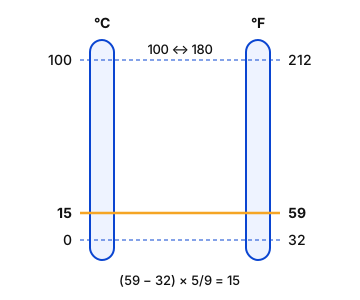
- So .
Yaad rakhein: Subtract 32, then take : . Also is the same on both scales.
Answer: (C)
अवधारणा: सेल्सियस और फ़ॉरेनहाइट का संबंध: (जल पर जमता, पर उबलता है)।
- अतः ।
याद रखें: पहले 32 घटाएँ, फिर से गुणा: । दोनों पैमानों पर समान है।
उत्तर: (C)
SSC CPO Paper IGeneral Knowledge and General AwarenessTemperature conversionSSC CPO Paper I 2024 · 29 Jun Shift 1
Q144.As per the National Multidimensional Poverty Index Report 2023, which of the
following UTs has the lowest poverty rate?
राष्ट्रीय बहुआयामी गरीबी सूचकांक रिपोर्ट 2023 के अनुसार, निम्नलिखित में से किस
केंद्र शासित प्रदेश में गरीबी दर सबसे कम है?
- ALakshadweepलक्षद्वीप
- BLadakhलद्दाख
- CJammu and Kashmirजम्मू और कश्मीर
- DPuducherryपुडुचेरी
Show answer
Concept: NITI Aayog's National Multidimensional Poverty Index: A Progress Review 2023 compares poverty headcount in states and UTs (NFHS-5, 2019–21).
- Among the options, Puducherry has the lowest share of multidimensionally poor people (under 1%).
- Lakshadweep, Ladakh and Jammu and Kashmir have higher headcount ratios than Puducherry.
Yaad rakhein: MPI 2023 – lowest poverty: Kerala (state), Puducherry (UT).
Answer: (D) Puducherry
अवधारणा: नीति आयोग की राष्ट्रीय बहुआयामी गरीबी सूचकांक: प्रगति समीक्षा 2023 (NFHS-5, 2019–21) राज्यों व UTs की गरीबी दर की तुलना करती है।
- दिए गए विकल्पों में पुडुचेरी में बहुआयामी गरीबों का अनुपात सबसे कम (1% से कम) है।
- लक्षद्वीप, लद्दाख और जम्मू-कश्मीर का अनुपात पुडुचेरी से अधिक है।
याद रखें: MPI 2023 – न्यूनतम गरीबी: केरल (राज्य), पुडुचेरी (UT)।
उत्तर: (D) Puducherry
SSC CPO Paper IGeneral Knowledge and General AwarenessMultidimensional Poverty IndexSSC CPO Paper I 2024 · 29 Jun Shift 1
Q145.Who is the Chief Executive Head of the State?
राज्य का मुख्य कार्यकारी प्रमुख कौन होता है?
- APMप्रधानमंत्री
- BGovernorराज्यपाल
- CPresidentराष्ट्रपति
- DCMमुख्यमंत्री
Show answer
Concept: Under Article 154, the executive power of the State is vested in the Governor.
- The Governor is the constitutional (nominal) chief executive head of the State; all executive action is taken in his name.
- The Chief Minister is the real executive head; the President and PM are heads at the Union level.
Yaad rakhein: State: Governor (nominal) + CM (real); Union: President + PM.
Answer: (B) Governor
अवधारणा: अनुच्छेद 154 के तहत राज्य की कार्यपालिका शक्ति राज्यपाल में निहित है।
- राज्यपाल राज्य का संवैधानिक (नाममात्र) मुख्य कार्यकारी प्रमुख है; सभी कार्यकारी कार्य उसके नाम से होते हैं।
- मुख्यमंत्री वास्तविक कार्यकारी प्रमुख है; राष्ट्रपति और प्रधानमंत्री संघ स्तर के प्रमुख हैं।
याद रखें: राज्य: राज्यपाल (नाममात्र) + CM (वास्तविक); संघ: राष्ट्रपति + PM।
उत्तर: (B) Governor
SSC CPO Paper IGeneral Knowledge and General AwarenessState executiveSSC CPO Paper I 2024 · 29 Jun Shift 1
Q146.In which year, for the first time, was a resolution on the National Sports Policy laid in both Houses of Parliament?
किस वर्ष, पहली बार संसद के दोनों सदनों में राष्ट्रीय खेल नीति पर एक संकल्प रखा गया था?
- A1948
- B2000
- C1984
- D2014
Show answer
Concept: India's first National Sports Policy came in the 1980s, after the 1982 Asian Games in Delhi.
- A resolution on the National Sports Policy was laid in both Houses of Parliament for the first time in 1984.
- It was later revised as the National Sports Policy 2001.
Yaad rakhein: Sports Policy: 1984 first, 2001 revised.
Answer: (C) 1984
अवधारणा: भारत की पहली राष्ट्रीय खेल नीति 1982 के दिल्ली एशियाई खेलों के बाद 1980 के दशक में आई।
- राष्ट्रीय खेल नीति पर प्रस्ताव पहली बार 1984 में संसद के दोनों सदनों में रखा गया।
- बाद में इसे राष्ट्रीय खेल नीति 2001 के रूप में संशोधित किया गया।
याद रखें: खेल नीति: 1984 पहली, 2001 संशोधित।
उत्तर: (C) 1984
SSC CPO Paper IGeneral Knowledge and General AwarenessNational Sports PolicySSC CPO Paper I 2024 · 29 Jun Shift 1
Q147.Which of the following committees recommended the fundamental duties?
निम्नलिखित में से किस समिति ने मौलिक कर्तव्यों की सिफारिश की थी?
- AAshok Mehta Committeeअशोक मेहता समिति
- BNehru Committeeनेहरू समिति
- CBalwinder Singh Committeeबलविंदर सिंह समिति
- DSwaran Singh Committeeस्वर्ण सिंह समिति
Show answer
Concept: Fundamental Duties were not in the original Constitution; they were added on a committee's advice during the Emergency.
- The Swaran Singh Committee (1976) recommended them; the 42nd Amendment Act, 1976 inserted Part IV-A (Article 51A).
- Ashok Mehta Committee – Panchayati Raj (1977); Nehru Committee – constitution draft (1928).
Yaad rakhein: Duties – Swaran Singh – 1976 – 42nd Amendment.
Answer: (D) Swaran Singh Committee
अवधारणा: मौलिक कर्तव्य मूल संविधान में नहीं थे; आपातकाल के दौरान एक समिति की सलाह पर जोड़े गए।
- स्वर्ण सिंह समिति (1976) ने इनकी सिफारिश की; 42वें संशोधन अधिनियम, 1976 ने भाग IV-A (अनुच्छेद 51A) जोड़ा।
- अशोक मेहता समिति – पंचायती राज (1977); नेहरू समिति – संविधान प्रारूप (1928)।
याद रखें: कर्तव्य – स्वर्ण सिंह – 1976 – 42वाँ संशोधन।
उत्तर: (D) Swaran Singh Committee
SSC CPO Paper IGeneral Knowledge and General AwarenessFundamental dutiesSSC CPO Paper I 2024 · 29 Jun Shift 1
Q148.Which of the following dance forms is represented by Kelucharan Mohapatra?
केलुचरण महापात्र निम्नलिखित में से किस नृत्य शैली का प्रतिनिधित्व करते हैं?
- ABharatnatyamभरतनाट्यम
- BManipuriमणिपुरी
- COdissiओडिसी
- DKathakकथक
Show answer
Concept: Guru Kelucharan Mohapatra (1926–2004) of Odisha is credited with reviving Odissi.
- He was a legendary Odissi dancer and guru, awarded the Padma Vibhushan (2000).
- Bharatanatyam – e.g., Rukmini Devi Arundale; Kathak – Birju Maharaj; Manipuri – Guru Bipin Singh.
Yaad rakhein: Kelucharan Mohapatra – Odissi; Birju Maharaj – Kathak.
Answer: (C) Odissi
अवधारणा: ओडिशा के गुरु केलुचरण महापात्र (1926–2004) को ओडिसी के पुनरुद्धार का श्रेय है।
- वे महान ओडिसी नर्तक और गुरु थे; उन्हें पद्म विभूषण (2000) मिला।
- भरतनाट्यम – रुक्मिणी देवी अरुंडेल; कथक – बिरजू महाराज; मणिपुरी – गुरु बिपिन सिंह।
याद रखें: केलुचरण महापात्र – ओडिसी; बिरजू महाराज – कथक।
उत्तर: (C) Odissi
SSC CPO Paper IGeneral Knowledge and General AwarenessClassical dancersSSC CPO Paper I 2024 · 29 Jun Shift 1
Q149.____________ wins the Best Male Playback Singer at the 67 National Film Awards.
67वें राष्ट्रीय फिल्म पुरस्कारों में ____________ ने सर्वश्रेष्ठ पुरुष पार्श्व गायक का पुरस्कार जीता।
- AB Praakबी प्राक
- BSonu Nigamसोनू निगम
- CShaanशान
- DArijit Singhअरिजीत सिंह
Show answer
Concept: The 67th National Film Awards (for films of 2019) were presented in October 2021.
- B Praak won Best Male Playback Singer for 'Teri Mitti' from the film Kesari.
- Savani Ravindra won Best Female Playback Singer at the same awards.
Yaad rakhein: 67th NFA – B Praak – 'Teri Mitti' (Kesari).
Answer: (A) B Praak
अवधारणा: 67वें राष्ट्रीय फ़िल्म पुरस्कार (2019 की फ़िल्मों के लिए) अक्टूबर 2021 में दिए गए।
- बी प्राक को फ़िल्म केसरी के गीत 'तेरी मिट्टी' के लिए सर्वश्रेष्ठ पुरुष पार्श्व गायक का पुरस्कार मिला।
- इसी समारोह में सावनी रवींद्र को सर्वश्रेष्ठ महिला पार्श्व गायिका पुरस्कार मिला।
याद रखें: 67वाँ NFA – बी प्राक – 'तेरी मिट्टी' (केसरी)।
उत्तर: (A) B Praak
SSC CPO Paper IGeneral Knowledge and General AwarenessNational Film AwardsSSC CPO Paper I 2024 · 29 Jun Shift 1
Q150.Who among the following is the author of the book ‘Those Pricey Thakur Girls’?
निम्नलिखित में से कौन ‘Those Pricey Thakur Girls’ पुस्तक की/के लेखक/लेखिका है/हैं?
- AAnuja Chauhanअनुजा चौहान
- BAnita Nairअनीता नायर
- CPratibha Rayप्रतिभा राय
- DPreeti Shenoyप्रीति शेनॉय
Show answer
Concept: Those Pricey Thakur Girls (2013) is a novel about the five Thakur sisters of Delhi.
- It was written by Anuja Chauhan, also known for The Zoya Factor and Battle for Bittora.
- Anita Nair wrote Ladies Coupé; Pratibha Ray wrote Yajnaseni; Preeti Shenoy wrote Life Is What You Make It.
Yaad rakhein: Anuja Chauhan – Zoya Factor, Thakur Girls.
Answer: (A) Anuja Chauhan
अवधारणा: Those Pricey Thakur Girls (2013) दिल्ली की पाँच ठाकुर बहनों पर आधारित उपन्यास है।
- इसकी लेखिका अनुजा चौहान हैं, जो The Zoya Factor और Battle for Bittora के लिए भी जानी जाती हैं।
- अनीता नायर – Ladies Coupé; प्रतिभा राय – Yajnaseni; प्रीति शेनॉय – Life Is What You Make It।
याद रखें: अनुजा चौहान – Zoya Factor, Thakur Girls।
उत्तर: (A) Anuja Chauhan
SSC CPO Paper IGeneral Knowledge and General AwarenessBooks and authorsSSC CPO Paper I 2024 · 29 Jun Shift 1
Q151.Why are the intermediate goods NOT included in the National Income?
मध्यवर्ती वस्तुओं को राष्ट्रीय आय में शामिल क्यों नहीं किया जाता है?
- AFor the prevention of double accounting.दोहरी गणना की रोकथाम के लिए।
- BIntermediate goods decreases the income.मध्यवर्ती वस्तुएँ आय को कम करती हैं।
- CIntermediate goods are not reliable.मध्यवर्ती वस्तुएँ विश्वसनीय नहीं होती हैं।
- DIntermediate goods increases the income.मध्यवर्ती वस्तुएँ आय को बढ़ाती हैं।
Show answer
Concept: National income counts only the value of final goods and services. Intermediate goods are used up in producing other goods, so their value is already inside the price of the final good.
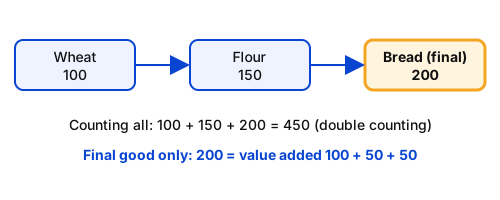
- Example: wheat → flour → bread. The price of bread already includes the value of flour and wheat.
- Adding wheat, flour and bread together would count the same value two or three times (double counting).
- So economists use either final-goods value or the value-added method (sum of value added at each stage).
Yaad rakhein: Intermediate = already counted inside final; leave it out to avoid double counting.
Answer: (A) For the prevention of double accounting.
अवधारणा: राष्ट्रीय आय में केवल अंतिम (final) वस्तुओं और सेवाओं का मूल्य जोड़ा जाता है। मध्यवर्ती वस्तुएँ (intermediate goods) दूसरी वस्तु बनाने में खप जाती हैं, इसलिए उनका मूल्य अंतिम वस्तु की कीमत में पहले से शामिल होता है।
- उदाहरण: गेहूँ → आटा → ब्रेड। ब्रेड की कीमत में आटे और गेहूँ का मूल्य पहले से है।
- तीनों को जोड़ने पर एक ही मूल्य बार-बार गिना जाएगा — इसे दोहरी गणना (double counting) कहते हैं।
- इसलिए अंतिम वस्तुओं का मूल्य या मूल्य-वर्धन विधि (value added method) अपनाई जाती है।
याद रखें: मध्यवर्ती वस्तु = अंतिम वस्तु में पहले से गिनी हुई; दोहरी गणना से बचने के लिए छोड़ दें।
उत्तर: (A) For the prevention of double accounting (दोहरी गणना रोकने के लिए)।
SSC CPO Paper IGeneral Knowledge and General AwarenessNational IncomeSSC CPO Paper I 2024 · 28 Jun Shift 3
Q152.Who among the following is a famous personality of the dance form Mohiniyattam?
निम्नलिखित में से कौन मोहिनीअट्टम नृत्य शैली की एक प्रसिद्ध हस्ती हैं?
- ASitara Deviसितारा देवी
- BDamayanti Joshiदमयंती जोशी
- CPandit Birju Maharajपंडित बिरजू महाराज
- DSunanda Nairसुनंदा नायर
Show answer
Concept: Mohiniyattam is the graceful solo classical dance of Kerala, traditionally performed by women.
- Sunanda Nair is a well-known Mohiniyattam dancer and teacher (trained under Kalamandalam Kalyanikutty Amma's tradition).
- Sitara Devi and Pandit Birju Maharaj are legends of Kathak.
- Damayanti Joshi was also a noted Kathak dancer.
Yaad rakhein: Mohiniyattam names: Kalamandalam Kalyanikutty Amma, Sunanda Nair, Bharati Shivaji, Gopika Varma.
Answer: (D) Sunanda Nair
अवधारणा: मोहिनीअट्टम केरल का लास्य-प्रधान एकल शास्त्रीय नृत्य है, जिसे परंपरागत रूप से महिलाएँ करती हैं।
- सुनंदा नायर प्रसिद्ध मोहिनीअट्टम नृत्यांगना और गुरु हैं।
- सितारा देवी और पंडित बिरजू महाराज कथक के दिग्गज हैं।
- दमयंती जोशी भी कथक की प्रसिद्ध नृत्यांगना थीं।
याद रखें: मोहिनीअट्टम: कलामंडलम कल्याणिकुट्टी अम्मा, सुनंदा नायर, भारती शिवाजी, गोपिका वर्मा।
उत्तर: (D) Sunanda Nair (सुनंदा नायर)
SSC CPO Paper IGeneral Knowledge and General AwarenessIndian Classical Dance – MohiniyattamSSC CPO Paper I 2024 · 28 Jun Shift 3
Q153.Brij Bhushan Kabra was considered an expert in which of the following instruments in the field of Indian classical music?
बृज भूषण काबरा को भारतीय शास्त्रीय संगीत के क्षेत्र में निम्नलिखित में से किस वाद्ययंत्र का विशेषज्ञ माना जाता था?
- AVeenaवीणा
- BGuitarगिटार
- CSantoorसंतूर
- DViolinवायलिन
Show answer
Concept: Some Indian classical musicians adapted Western instruments; the slide (Hawaiian) guitar entered Hindustani music this way.
- Brij Bhushan Kabra is credited with introducing the slide guitar to Hindustani classical music.
- His album Call of the Valley (1967), with Shivkumar Sharma (santoor) and Hariprasad Chaurasia (flute), became famous.
- Santoor is linked with Shivkumar Sharma; violin with L. Subramaniam/N. Rajam; veena with E. Gayathri, etc.
Yaad rakhein: Guitar in Hindustani music: Brij Bhushan Kabra, Vishwa Mohan Bhatt (Mohan Veena), Debashish Bhattacharya.
Answer: (B) Guitar
अवधारणा: कुछ भारतीय शास्त्रीय संगीतकारों ने पश्चिमी वाद्यों को अपनाया; स्लाइड (हवाईयन) गिटार इसी प्रकार हिंदुस्तानी संगीत में आया।
- बृज भूषण काबरा को हिंदुस्तानी शास्त्रीय संगीत में स्लाइड गिटार लाने का श्रेय है।
- शिवकुमार शर्मा (संतूर) और हरिप्रसाद चौरसिया (बाँसुरी) के साथ उनका एल्बम Call of the Valley (1967) बहुत प्रसिद्ध हुआ।
- संतूर — शिवकुमार शर्मा; वायलिन — एल. सुब्रमण्यम/एन. राजम।
याद रखें: हिंदुस्तानी संगीत में गिटार: बृज भूषण काबरा, विश्व मोहन भट्ट (मोहन वीणा), देबाशीष भट्टाचार्य।
उत्तर: (B) Guitar (गिटार)
SSC CPO Paper IGeneral Knowledge and General AwarenessIndian Music – InstrumentalistsSSC CPO Paper I 2024 · 28 Jun Shift 3
Q154.Identify the option that contains the correct sequence of Indian states in terms of
decreasing average annual rainfall.
उस विकल्प की पहचान कीजिए जिसमें औसत वार्षिक वर्षा के घटते क्रम में भारतीय राज्यों का
सही अनुक्रम दिया गया है।
- ARajasthan > Assam > Biharराजस्थान > असम > बिहार
- BHaryana > Bihar > Rajasthanहरियाणा > बिहार > राजस्थान
- CAssam > Bihar > Rajasthanअसम > बिहार > राजस्थान
- DUttar Pradesh > Bihar > West Bengalउत्तर प्रदेश > बिहार > पश्चिम बंगाल
Show answer
Concept: Rainfall in India generally decreases from the north-east and east towards the north-west, as the Bay of Bengal branch of the monsoon loses moisture while moving west.
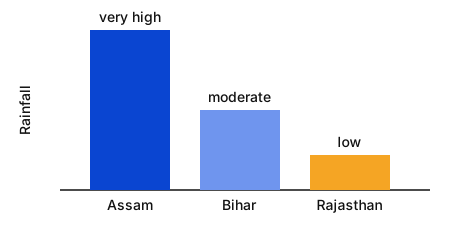
- Assam (north-east) gets very heavy rainfall, well above 200 cm a year in most parts.
- Bihar in the middle Ganga plain gets moderate rainfall (around 100–150 cm).
- Rajasthan (Thar region) is the driest state, with very low rainfall in the west.
- So the decreasing order is Assam > Bihar > Rajasthan. Options (A), (B), (D) break this east-to-west pattern.
Yaad rakhein: Moving along the Ganga plain from east to west, rainfall keeps falling: Assam → West Bengal → Bihar → UP → Haryana → Rajasthan.
Answer: (C) Assam > Bihar > Rajasthan
अवधारणा: भारत में वर्षा सामान्यतः उत्तर-पूर्व और पूर्व से उत्तर-पश्चिम की ओर घटती है, क्योंकि बंगाल की खाड़ी की मानसून शाखा पश्चिम की ओर बढ़ते हुए नमी खोती जाती है।
- असम (उत्तर-पूर्व) में बहुत भारी वर्षा होती है, अधिकांश भागों में 200 cm से अधिक।
- मध्य गंगा मैदान के बिहार में मध्यम वर्षा (लगभग 100–150 cm) होती है।
- राजस्थान (थार क्षेत्र) सबसे शुष्क राज्य है।
- अतः घटता क्रम: Assam > Bihar > Rajasthan। अन्य विकल्प पूर्व-से-पश्चिम क्रम को तोड़ते हैं।
याद रखें: गंगा मैदान में पूर्व से पश्चिम जाते हुए वर्षा घटती है: असम → प. बंगाल → बिहार → उ.प्र. → हरियाणा → राजस्थान।
उत्तर: (C) Assam > Bihar > Rajasthan
SSC CPO Paper IGeneral Knowledge and General AwarenessRainfall Distribution in IndiaSSC CPO Paper I 2024 · 28 Jun Shift 3
Q155.What is the national male workforce participation rate as per the Census of India 2011?
भारत की जनगणना 2011 के अनुसार, राष्ट्रीय पुरुष कार्यबल सहभागिता दर कितनी है?
- A53.26%
- B51.26%
- C50.26%
- D52.26%
Show answer
Concept: Work Participation Rate (WPR) = percentage of workers (main + marginal) in the total population.
- As per Census 2011, India's overall WPR was .
- Male WPR was and female WPR was .
- Hence the national male WPR is .
Yaad rakhein: Census 2011 WPR: Total ≈ 40, Male ≈ 53, Female ≈ 25.5 (per cent).
Answer: (A)
अवधारणा: कार्य सहभागिता दर (WPR) = कुल जनसंख्या में श्रमिकों (मुख्य + सीमांत) का प्रतिशत।
- जनगणना 2011 के अनुसार भारत की कुल WPR थी।
- पुरुष WPR और महिला WPR थी।
- अतः राष्ट्रीय पुरुष कार्य सहभागिता दर है।
याद रखें: जनगणना 2011 WPR: कुल ≈ 40, पुरुष ≈ 53, महिला ≈ 25.5 (प्रतिशत)।
उत्तर: (A)
SSC CPO Paper IGeneral Knowledge and General AwarenessCensus 2011 – Work ParticipationSSC CPO Paper I 2024 · 28 Jun Shift 3
Q156.What is the name of the northern part of the western coastal plain between Mumbai and Goa?
मुंबई और गोवा के बीच पश्चिमी तटीय मैदान के उत्तरी भाग का क्या नाम है?
- AKonkan coastकोंकण तट
- BCoromandel coastकोरोमंडल तट
- CMalabar coastमालाबार तट
- DKannad plainकन्नड़ मैदान
Show answer
Concept: The western coastal plain is divided into three parts from north to south: Konkan, Kannad (Canara) and Malabar.
- Konkan coast: Mumbai to Goa (northern part).
- Kannad plain: Goa to Mangaluru (central part).
- Malabar coast: Mangaluru to Kanyakumari (southern part).
- Coromandel coast is on the eastern side (Tamil Nadu).
Yaad rakhein: West coast north → south: K-K-M = Konkan, Kannad, Malabar.
Answer: (A) Konkan coast
अवधारणा: पश्चिमी तटीय मैदान उत्तर से दक्षिण तीन भागों में बँटा है: कोंकण, कन्नड़ (केनरा) और मालाबार।
- कोंकण तट: मुंबई से गोवा (उत्तरी भाग)।
- कन्नड़ मैदान: गोवा से मंगलुरु (मध्य भाग)।
- मालाबार तट: मंगलुरु से कन्याकुमारी (दक्षिणी भाग)।
- कोरोमंडल तट पूर्वी तट (तमिलनाडु) पर है।
याद रखें: पश्चिमी तट उत्तर → दक्षिण: K-K-M = कोंकण, कन्नड़, मालाबार।
उत्तर: (A) Konkan coast (कोंकण तट)
SSC CPO Paper IGeneral Knowledge and General AwarenessCoastal Plains of IndiaSSC CPO Paper I 2024 · 28 Jun Shift 3
Q157.Which amongst the following statements about the Indian social reformers of the 19th century is INCORRECT?
19वीं शताब्दी के भारतीय समाज सुधारकों के बारे में निम्नलिखित में से कौन-सा कथन गलत है?
- AIshwar Chandra Vidyasagar was the founder of the Brahmo Samaj.ईश्वर चंद्र विद्यासागर ब्रह्म समाज के संस्थापक थे।
- BThe Aligarh Movement was started by Sir Syed Ahmad Khan in 1875.अलीगढ़ आंदोलन 1875 में सर सैयद अहमद खान द्वारा शुरू किया गया था।
- CMahadev Govind Ranade is associated with the Poona Sarvajanik Sabhaमहादेव गोविंद रानाडे पूना सार्वजनिक सभा से संबद्ध हैं
- DDayanand Saraswati founded the Arya Samaj in 1875.दयानंद सरस्वती ने 1875 में आर्य समाज की स्थापना की।
Show answer
Concept: Match each reformer with the organisation he actually founded or led.
- Brahmo Samaj (1828) was founded by Raja Ram Mohan Roy, not Ishwar Chandra Vidyasagar — so (A) is incorrect.
- Vidyasagar is known for widow remarriage (Act of 1856) and women's education.
- Sir Syed Ahmad Khan founded the MAO College at Aligarh in 1875 (Aligarh Movement); Ranade was linked with the Poona Sarvajanik Sabha; Dayanand Saraswati founded the Arya Samaj in 1875 (Bombay).
Yaad rakhein: Brahmo – Ram Mohan Roy; Arya – Dayanand; Prarthana – Atmaram Pandurang; Aligarh – Syed Ahmad Khan.
Answer: (A) Ishwar Chandra Vidyasagar was the founder of the Brahmo Samaj.
अवधारणा: प्रत्येक सुधारक को उसी संस्था से मिलाएँ जिसकी स्थापना उसने की थी।
- ब्रह्म समाज (1828) की स्थापना राजा राममोहन राय ने की थी, ईश्वरचंद्र विद्यासागर ने नहीं — अतः (A) गलत है।
- विद्यासागर विधवा पुनर्विवाह (1856 अधिनियम) और स्त्री शिक्षा के लिए प्रसिद्ध हैं।
- सर सैयद अहमद खान ने 1875 में अलीगढ़ में MAO कॉलेज (अलीगढ़ आंदोलन) शुरू किया; रानाडे पूना सार्वजनिक सभा से जुड़े; दयानंद सरस्वती ने 1875 में आर्य समाज बनाया।
याद रखें: ब्रह्म – राममोहन राय; आर्य – दयानंद; प्रार्थना – आत्माराम पांडुरंग; अलीगढ़ – सैयद अहमद खान।
उत्तर: (A) Ishwar Chandra Vidyasagar was the founder of the Brahmo Samaj.
SSC CPO Paper IGeneral Knowledge and General AwarenessSocio-Religious Reform MovementsSSC CPO Paper I 2024 · 28 Jun Shift 3
Q158.Which of the following is an INCORRECTLY stated social impact of the Green
Revolution?
निम्नलिखित में से कौन-सा हरित
क्रांति का गलत रूप से उल्लिखित सामाजिक प्रभाव है?
- APrimarily, the medium and large farmers were benefitedमुख्य रूप से, मध्यम और बड़े किसान लाभान्वित हुए
- BWorsened the condition of landless and marginal farmersभूमिहीन और सीमांत किसानों की स्थिति और खराब हो गई
- COnly farmers involved in subsistence agriculture were benefittedकेवल निर्वाह कृषि में लगे किसान ही लाभान्वित हुए
- DThere was displacement of service caste groupसेवा जाति समूह का विस्थापन हुआ
Show answer
Concept: The Green Revolution (HYV seeds + fertilisers + irrigation) needed money and inputs, so its benefits went mostly to farmers who could invest.
- Medium and large farmers gained the most — statement (A) is correct.
- Landless labourers and marginal farmers often became worse off — (B) is correct; mechanisation also displaced service castes (artisans, etc.) — (D) is correct.
- Subsistence farmers lacked capital for HYV inputs, so they were not the main beneficiaries — (C) is stated incorrectly.
Yaad rakhein: Green Revolution = 'rich got richer': big farmers, Punjab–Haryana–western UP, wheat.
Answer: (C) Only farmers involved in subsistence agriculture were benefitted
अवधारणा: हरित क्रांति (HYV बीज + उर्वरक + सिंचाई) में पूँजी की ज़रूरत थी, इसलिए लाभ मुख्यतः उन किसानों को मिला जो निवेश कर सकते थे।
- मध्यम और बड़े किसानों को सर्वाधिक लाभ — कथन (A) सही।
- भूमिहीन और सीमांत किसानों की हालत बिगड़ी — (B) सही; मशीनीकरण से सेवा जातियाँ (कारीगर आदि) विस्थापित हुईं — (D) सही।
- निर्वाह (subsistence) खेती करने वाले किसानों के पास HYV के लिए पूँजी नहीं थी, अतः उन्हें ही लाभ मिला — यह कथन (C) गलत है।
याद रखें: हरित क्रांति = 'अमीर और अमीर': बड़े किसान, पंजाब–हरियाणा–पश्चिमी उ.प्र., गेहूँ।
उत्तर: (C) Only farmers involved in subsistence agriculture were benefitted
SSC CPO Paper IGeneral Knowledge and General AwarenessGreen Revolution – Social ImpactSSC CPO Paper I 2024 · 28 Jun Shift 3
Q159.The 42nd Amendment of the Indian Constitution (1976) states that India is a/an
__________________ nation.
भारतीय संविधान के 42वें संशोधन (1976) में कहा गया है कि भारत एक
__________________ राष्ट्र है।
- Aaristocraticअभिजाततंत्रीय
- Boligarchicअल्पतंत्रीय
- Ccapitalistपूँजीवादी
- Dsecularधर्मनिरपेक्ष
Show answer
Concept: The 42nd Amendment Act, 1976 (the 'mini-Constitution') changed the Preamble.
- It added three words to the Preamble: Socialist, Secular and Integrity.
- So India was described as a 'Sovereign Socialist Secular Democratic Republic'.
- Aristocratic, oligarchic or capitalist are not words of the Preamble.
Yaad rakhein: 42nd Amendment → Preamble got 'S-S-I': Socialist, Secular, Integrity.
Answer: (D) secular
अवधारणा: 42वाँ संशोधन अधिनियम, 1976 ('लघु संविधान') ने प्रस्तावना (Preamble) में बदलाव किया।
- इसने प्रस्तावना में तीन शब्द जोड़े: समाजवादी (Socialist), पंथनिरपेक्ष (Secular) और अखंडता (Integrity)।
- अतः भारत 'Sovereign Socialist Secular Democratic Republic' कहलाया।
- aristocratic, oligarchic, capitalist प्रस्तावना के शब्द नहीं हैं।
याद रखें: 42वाँ संशोधन → प्रस्तावना में 'S-S-I': Socialist, Secular, Integrity।
उत्तर: (D) secular (पंथनिरपेक्ष)
SSC CPO Paper IGeneral Knowledge and General Awareness42nd Constitutional AmendmentSSC CPO Paper I 2024 · 28 Jun Shift 3
Q160.Choose the correct statement about the peninsular rivers.
a. The Narmada rises in the Malwa plateau.
b. The Godavari rises from the slopes of the Western Ghats near Nashik.
c. The Mahanadi rises in the highlands of Chhattisgarh.
d. The Krishna rises from a spring near Mahabaleshwar.
प्रायद्वीपीय नदियों के बारे में सही कथन का चयन कीजिए।
a. नर्मदा का उद्गम मालवा पठार में होता है।
b. गोदावरी का उद्गम नासिक के पास पश्चिमी घाट की ढलानों से होता है।
c. महानदी का उद्गम छत्तीसगढ़ की उच्चभूमि में होता है।
d. कृष्णा का उद्गम महाबलेश्वर के पास एक झरने से होता है।
- AOnly b, c and dकेवल b, c और d
- BOnly a, b and cकेवल a, b और c
- Ca, b, c and da, b, c और d
- DOnly a, c and dकेवल a, c और d
Show answer
Concept: Check the source (origin) of each peninsular river.
- (a) Wrong: the Narmada rises at Amarkantak plateau (Maikal range), not the Malwa plateau.
- (b) Correct: the Godavari rises at Trimbakeshwar near Nashik on the Western Ghats.
- (c) Correct: the Mahanadi rises near Sihawa in the highlands of Chhattisgarh.
- (d) Correct: the Krishna rises from a spring near Mahabaleshwar (Maharashtra). Hence only b, c and d.
Yaad rakhein: Amarkantak gives two rivers: Narmada (west) and Son (north).
Answer: (A) Only b, c and d
अवधारणा: प्रत्येक प्रायद्वीपीय नदी का उद्गम स्थान जाँचें।
- (a) गलत: नर्मदा अमरकंटक पठार (मैकाल श्रेणी) से निकलती है, मालवा पठार से नहीं।
- (b) सही: गोदावरी नासिक के पास त्र्यंबकेश्वर (पश्चिमी घाट) से निकलती है।
- (c) सही: महानदी छत्तीसगढ़ के उच्चभूमि क्षेत्र में सिहावा के पास से निकलती है।
- (d) सही: कृष्णा महाबलेश्वर (महाराष्ट्र) के पास एक झरने से निकलती है। अतः केवल b, c और d।
याद रखें: अमरकंटक से दो नदियाँ: नर्मदा (पश्चिम) और सोन (उत्तर)।
उत्तर: (A) Only b, c and d
SSC CPO Paper IGeneral Knowledge and General AwarenessPeninsular Rivers – SourcesSSC CPO Paper I 2024 · 28 Jun Shift 3

