Q1581.The remainder when is divided by 34 is:
को 34 से विभाजित करने पर शेषफल क्या होगा?
- A15
- B18
- C22
- D12
Show answer
Concept: Remainder of a product product of individual remainders (then reduce again).
- Mod 34: , , ,
- ;
Trick: Pair numbers so that one product is just above a multiple of 34 ().
Answer: (D)
अवधारणा: गुणनफल का शेषफल अलग-अलग शेषफलों का गुणनफल (फिर से भाग दें)।
- 34 से: , , ,
- ;
- उत्तर
ट्रिक: ऐसे जोड़े बनाएँ कि गुणनफल 34 के गुणज से 1 अधिक हो।
उत्तर: (D)
SSC CPO Paper IQuantitative AptitudeRemaindersSSC CPO Paper I 2020 · 23 Nov Shift 3
Q1582.The given histogram shows the frequency distribution of the speed of cars passing though at a particular spot on a highway. Study the graph and answer the question that follows.
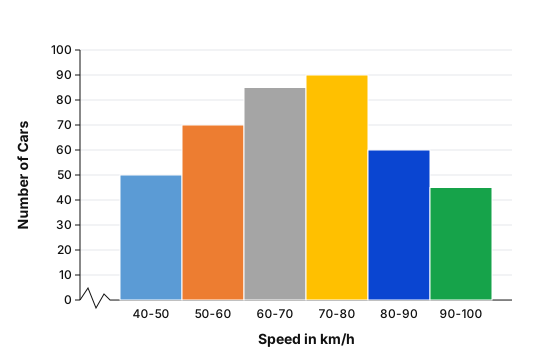
What percentage of cars were running with speed less than 70 km/h?
दिया गया आयतचित्र (histogram) किसी राजमार्ग पर एक विशेष स्थान से गुज़रने वाली कारों की गति के बारंबारता बंटन को दर्शाता है। आलेख का अध्ययन कीजिए और उसके बाद दिए गए प्रश्न का उत्तर दीजिए।
कितने प्रतिशत कारें 70 km/h से कम गति से चल रही थीं?
- A45.75%
- B60%
- C30%
- D51.25%
Show answer
Concept: Percentage .
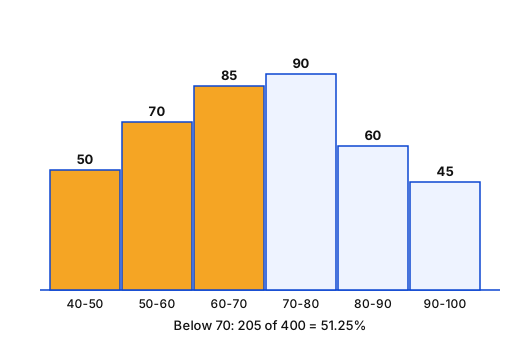
- Total
- Below 70
Trick: directly.
Answer: (D)
अवधारणा: प्रतिशत ।
- कुल
- 70 से कम
ट्रिक: ।
उत्तर: (D)
SSC CPO Paper IQuantitative AptitudeData Interpretation – HistogramSSC CPO Paper I 2020 · 23 Nov Shift 3
Q1583.A person's salary increased from ₹8,100 to ₹9,000. What is the percentage increase in his salary?
एक व्यक्ति का वेतन ₹8,100 से बढ़कर ₹9,000 हो गया। उसके वेतन में प्रतिशत वृद्धि कितनी है?
- A
- B
- C
- D
Show answer
Concept: % increase .
- Increase
Trick: .
Answer: (C)
अवधारणा: % वृद्धि ।
- वृद्धि
ट्रिक: ।
उत्तर: (C)
SSC CPO Paper IQuantitative AptitudePercentage IncreaseSSC CPO Paper I 2020 · 23 Nov Shift 3
Q1584.A bus covers a 50-kilometre distance in 1 hour 15 minutes, whereas the same distance is covered by a car in 45 minutes. What is the ratio of the speed of the bus to the speed of the car?
एक बस 50 किलोमीटर की दूरी 1 घंटे 15 मिनट में तय करती है, जबकि वही दूरी एक कार द्वारा 45 मिनट में तय की जाती है। बस की चाल और कार की चाल का अनुपात क्या है?
- A1 : 3
- B5 : 3
- C3 : 1
- D3 : 5
Show answer
Concept: For the same distance, speed .
- Bus time min, car time min
- Speed ratio
Trick: Invert the time ratio → .
Answer: (D)
अवधारणा: समान दूरी के लिए चाल ।
- बस मिनट, कार मिनट
- चाल अनुपात
ट्रिक: समय अनुपात उलटें → ।
उत्तर: (D)
SSC CPO Paper IQuantitative AptitudeSpeed – RatioSSC CPO Paper I 2020 · 23 Nov Shift 3
Q1585.ABCD is a cyclic quadrilateral such that AB is a diameter of the circle circumscribing it and . What is the measure of the ?
ABCD एक चक्रीय चतुर्भुज है, जिसमें AB इसके परिगत वृत्त का व्यास है और है। का माप क्या है?
- A
- B
- C
- D
Show answer
Concept: Opposite angles of a cyclic quadrilateral add to ; angle in a semicircle .
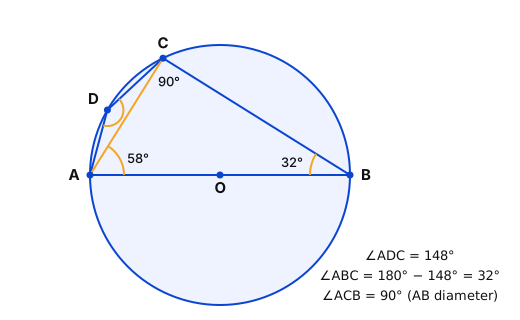
- AB is a diameter, so
Trick: .
Answer: (C)
अवधारणा: चक्रीय चतुर्भुज के सम्मुख कोणों का योग ; अर्धवृत्त में कोण ।
- AB व्यास है, अतः
ट्रिक: ।
उत्तर: (C)
SSC CPO Paper IQuantitative AptitudeCircles – Cyclic QuadrilateralSSC CPO Paper I 2020 · 23 Nov Shift 3
Q1586.A rectangular lawn whose length is twice of its breadth is extended by having four semi-circular portions on its sides. What is the total cost (in ₹) of levelling the entire lawn at the rate of ₹100 per square metre, if the smaller side of the rectangular lawn is 12 m? (Take )
एक आयताकार लॉन, जिसकी लंबाई उसकी चौड़ाई की दोगुनी है, की भुजाओं पर चार अर्धवृत्ताकार भाग जोड़कर उसका विस्तार किया जाता है। यदि आयताकार लॉन की छोटी भुजा 12 m है, तो ₹100 प्रति वर्ग मीटर की दर से पूरे लॉन को समतल करने की कुल लागत (₹ में) कितनी होगी? ( लीजिए)
- A85,320
- B78,650
- C86,540
- D97,625
Show answer
Concept: Total area rectangle two semicircles on each pair of sides (each pair one full circle).
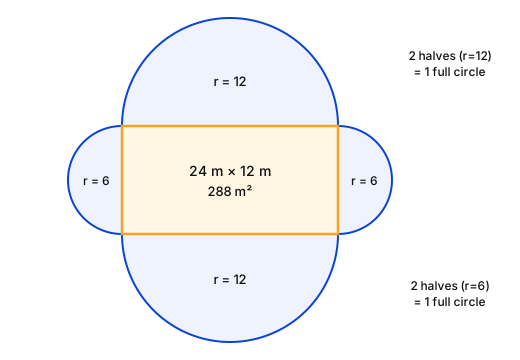
- Rectangle
- On length (r ):
- On breadth (r ):
- Total ; cost
Trick: ; add .
Answer: (A) ₹
अवधारणा: कुल क्षेत्रफल आयत हर जोड़ी भुजाओं पर दो अर्धवृत्त (एक पूरा वृत्त)।
- आयत
- लंबाई पर (r ):
- चौड़ाई पर (r ):
- कुल ; लागत
ट्रिक: , फिर जोड़ें।
उत्तर: (A) ₹
SSC CPO Paper IQuantitative AptitudeMensuration – Composite AreaSSC CPO Paper I 2020 · 23 Nov Shift 3
Q1587.A 9 cm solid metallic cube and a solid metallic cuboid having dimensions 5 cm, 13 cm, 31 cm are melted and recast into a single cube. What is the total surface area (in cm2) of the new cube?
9 cm भुजा वाले धातु के एक ठोस घन और 5 cm, 13 cm, 31 cm विमाओं वाले धातु के एक ठोस घनाभ को पिघलाकर एक घन में ढाला जाता है। नए घन का संपूर्ण पृष्ठीय क्षेत्रफल (cm2 में) कितना है?
- A865
- B1176
- C1362
- D2744
Show answer
Concept: Volume is conserved; TSA of a cube .
- Volume
- Side
- TSA
Trick: (option D) is the volume – the TSA is .
Answer: (B)
अवधारणा: आयतन संरक्षित रहता है; घन का सम्पूर्ण पृष्ठीय क्षेत्रफल ।
- आयतन
- भुजा
- TSA
ट्रिक: आयतन है, TSA नहीं।
उत्तर: (B)
SSC CPO Paper IQuantitative AptitudeMensuration – Melting and RecastingSSC CPO Paper I 2020 · 23 Nov Shift 3
Q1588.X can do a work in 3 days, Y does three times the same work in 8 days, and Z does five times the same work in 12 days. If they have to work together for 6 hours in a day, then in how much time can they complete the work?
X किसी कार्य को 3 दिनों में कर सकता है, Y उसी कार्य का तीन गुना 8 दिनों में करता है, और Z उसी कार्य का पाँच गुना 12 दिनों में करता है। यदि उन्हें एक दिन में 6 घंटे एक साथ कार्य करना है, तो वे कार्य को कितने समय में पूरा कर सकते हैं?
- A4 hours4 घंटे
- B5 hours 20 minutes5 घंटे 20 मिनट
- C4 hours 10 minutes4 घंटे 10 मिनट
- D5 hours5 घंटे
Show answer
Concept: Find each one's rate per day, add, then convert days into hours (1 day hours).
- X , Y , Z work/day
- Together work/day
- Time day h h min
Trick: Y and Z do multiple works: rate .
Answer: (B) 5 hours 20 minutes
अवधारणा: हर व्यक्ति की दैनिक दर जोड़ें, फिर दिन को घंटों में बदलें (1 दिन घंटे)।
- X , Y , Z कार्य/दिन
- मिलकर कार्य/दिन
- समय घंटे घंटे मिनट
ट्रिक: दर ।
उत्तर: (B) 5 घंटे 20 मिनट
SSC CPO Paper IQuantitative AptitudeTime and Work – Working HoursSSC CPO Paper I 2020 · 23 Nov Shift 3
Q1589.The value of is equal to:
का मान किसके बराबर है?
- A
- B
- C
- D
Show answer
Concept: Use standard values and , i.e. .
- , ,
- Numerator
- Denominator
- Value
Yaad rakhein: → complementary pair gives .
Answer: (D)
अवधारणा: मानक मान और (पूरक कोण) का प्रयोग करें।
- ,
- अंश
- हर
- मान
याद रखें: → गुणनफल ।
उत्तर: (D)
SSC CPO Paper IQuantitative AptitudeTrigonometry – Standard ValuesSSC CPO Paper I 2020 · 23 Nov Shift 3
Q1590.The value of is:
का मान क्या है?
- A
- B
- C
- D
Show answer
Concept: Solve each bracket ('of' before ), then , , from left to right.
- ;
- ; result
Yaad rakhein: 'of' means multiply and is done before .
Answer: (B)
अवधारणा: हर कोष्ठक हल करें ('of' पहले), फिर बाएँ से दाएँ , , ।
- पहला कोष्ठक
- दूसरा: ;
- ; परिणाम
याद रखें: 'of' का अर्थ गुणा, और यह से पहले होता है।
उत्तर: (B)
SSC CPO Paper IQuantitative AptitudeSimplification – BODMASSSC CPO Paper I 2020 · 23 Nov Shift 3
Q1591.If house tax is paid before the due date, one gets a reduction of 12% on the amount of the bill. By paying the tax before the due date, a person got a reduction of ₹2,100. The amount (in ₹) of house tax was:
यदि गृह कर नियत तिथि से पहले चुकाया जाता है, तो बिल की राशि पर 12% की छूट मिलती है। नियत तिथि से पहले कर चुकाकर, एक व्यक्ति को ₹2,100 की छूट मिली। गृह कर की राशि (₹ में) कितनी थी?
- A21,000
- B17,500
- C25,000
- D18,000
Show answer
Concept: If of the bill ₹2100, the bill .
- Bill
Trick: , so .
Answer: (B) ₹
अवधारणा: यदि बिल का ₹2100, तो बिल ।
- बिल
ट्रिक: → ।
उत्तर: (B) ₹
SSC CPO Paper IQuantitative AptitudePercentageSSC CPO Paper I 2020 · 23 Nov Shift 3
Q1592.The least number which is exactly divisible by 5, 6, 8, 10 and 12 is:
वह छोटी से छोटी संख्या, जो 5, 6, 8, 10 और 12 से पूर्णतः विभाज्य है, कौन-सी है?
- A180
- B240
- C120
- D150
Show answer
Concept: Least number divisible by all LCM of the numbers.
- , , , ,
- LCM
Trick: Check options from smallest: is divisible by 5, 6, 8, 10, 12.
Answer: (C)
अवधारणा: सबसे छोटी संख्या जो सबसे विभाज्य हो LCM।
- , ,
- LCM
ट्रिक: सबसे छोटे विकल्प से जाँचें: सभी से विभाज्य।
उत्तर: (C)
SSC CPO Paper IQuantitative AptitudeLCMSSC CPO Paper I 2020 · 23 Nov Shift 3
Q1593.The value of is:
का मान क्या है?
- A
- B
- C
- D
Show answer
Concept: Let , . Check: ; ; .
- Expression
Trick: When numbers look odd, test if they are , , of the visible numbers.
Answer: (B)
अवधारणा: माना , । जाँच: ; ; ।
- व्यंजक
ट्रिक: अजीब संख्याएँ दिखें तो जाँचें कि वे , , तो नहीं।
उत्तर: (B)
SSC CPO Paper IQuantitative AptitudeSimplification – Algebraic IdentitiesSSC CPO Paper I 2020 · 23 Nov Shift 3
Q1594.The given bar graph represents the number of boys and girls in five different schools. Study the graph and answer the question that follows.
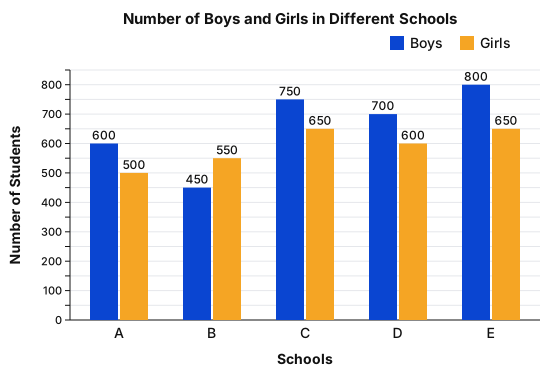
What is the average number of boys in schools A, B, C, D and E?
दिया गया दंड आलेख पाँच विभिन्न विद्यालयों में लड़कों और लड़कियों की संख्या को दर्शाता है। आलेख का अध्ययन कीजिए और उसके बाद दिए गए प्रश्न का उत्तर दीजिए।
विद्यालयों A, B, C, D और E में लड़कों की औसत संख्या कितनी है?
- A660
- B616
- C596
- D569
Show answer
Concept: Average .
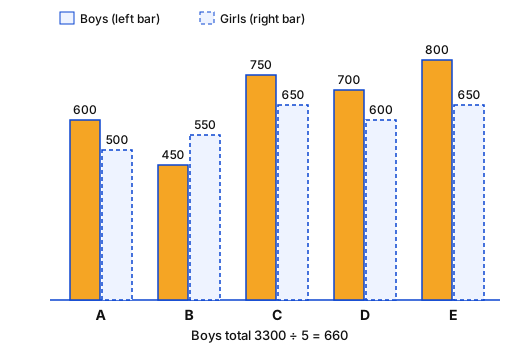
- Boys
- Average
Trick: Deviation from 600: ; .
Answer: (A)
अवधारणा: औसत ।
- लड़के
- औसत
ट्रिक: 600 से विचलन का योग ; ।
उत्तर: (A)
SSC CPO Paper IQuantitative AptitudeData Interpretation – Bar GraphSSC CPO Paper I 2020 · 23 Nov Shift 3
Q1595.If , where is an acute angle, then x is equal to:
यदि है, जहाँ एक न्यून कोण है, तो x किसके बराबर है?
- A
- B
- C
- D
Show answer
Concept: If (both acute), then .
Yaad rakhein: .
Answer: (B)
अवधारणा: यदि (दोनों न्यूनकोण), तो ।
याद रखें: ।
उत्तर: (B)
SSC CPO Paper IQuantitative AptitudeTrigonometry – Complementary AnglesSSC CPO Paper I 2020 · 23 Nov Shift 3
Q1596.The given histogram shows the frequency distribution of the speed of cars passing though at a particular spot on a highway. Study the graph and answer the question that follows.
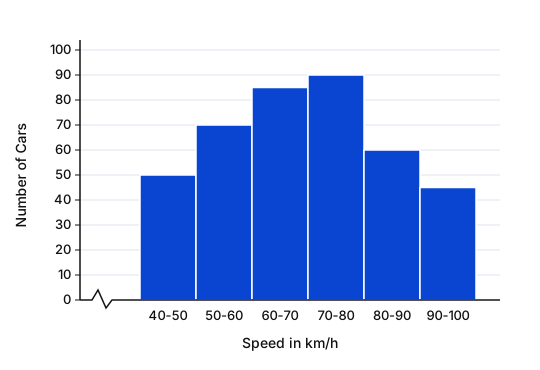
What is the ratio of the number of cars with speed less than 60 km/h to the number of cars with speed more than 80 km/h?
दिया गया आयतचित्र (histogram) किसी राजमार्ग पर एक विशेष स्थान से गुज़रने वाली कारों की गति के बारंबारता बंटन को दर्शाता है। आलेख का अध्ययन कीजिए और उसके बाद दिए गए प्रश्न का उत्तर दीजिए।
60 km/h से कम गति वाली कारों की संख्या का 80 km/h से अधिक गति वाली कारों की संख्या से अनुपात क्या है?
- A8 : 7
- B4 : 5
- C5 : 4
- D7 : 8
Show answer
Concept: Add the class frequencies on each side and simplify the ratio.
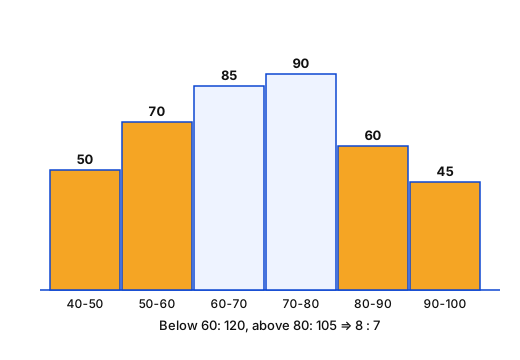
- Below 60 :
- Above 80 :
Trick: Divide both by 15.
Answer: (A)
अवधारणा: दोनों ओर की आवृत्तियाँ जोड़कर अनुपात सरल करें।
- 60 से कम:
- 80 से अधिक:
ट्रिक: दोनों को 15 से भाग दें।
उत्तर: (A)
SSC CPO Paper IQuantitative AptitudeData Interpretation – HistogramSSC CPO Paper I 2020 · 23 Nov Shift 3
Q1597.When operated separately, pipe A takes 5 hours less than pipe B to fill a cistern, and when both pipes are operated together, the cistern gets filled in 6 hours. In how much time (in hours) will pipe B fill the cistern, if operated separately?
अलग-अलग चलाए जाने पर, पाइप A किसी टंकी को भरने में पाइप B से 5 घंटे कम समय लेता है, और जब दोनों पाइप एक साथ चलाए जाते हैं, तो टंकी 6 घंटे में भर जाती है। अलग से चलाए जाने पर पाइप B टंकी को कितने समय (घंटों में) में भरेगा?
- A15
- B18
- C10
- D9
Show answer
Concept: If B takes hours, A takes ; combined rate .
- ; is impossible (), so
Trick: Test options: → A ; ✓.
Answer: (A)
अवधारणा: B को घंटे लगें तो A को ; मिलकर दर ।
- ( असंभव)
ट्रिक: विकल्प जाँचें: ✓।
उत्तर: (A)
SSC CPO Paper IQuantitative AptitudePipes and Cisterns – QuadraticSSC CPO Paper I 2020 · 23 Nov Shift 3
Q1598.The average weight of a group of 3 people A, B and C is 70 kg. When D joins this group, the average becomes 60 kg. One man E, whose weight is 5 kg more than that of D, replaces A and the average weight of B, C, D, and E now becomes 59 kg. A's weight (in kg) is:
3 व्यक्तियों A, B और C के एक समूह का औसत भार 70 kg है। जब D इस समूह में शामिल होता है, तो औसत 60 kg हो जाता है। एक व्यक्ति E, जिसका भार D के भार से 5 kg अधिक है, A का स्थान लेता है और अब B, C, D और E का औसत भार 59 kg हो जाता है। A का भार (kg में) कितना है?
- A50
- B40
- C39
- D59
Show answer
Concept: Convert every average into a total.
- ; with D:
Yaad rakhein: Total average count, at every stage.
Answer: (C)
अवधारणा: हर औसत को योग में बदलें।
- ;
याद रखें: योग औसत संख्या।
उत्तर: (C)
SSC CPO Paper IQuantitative AptitudeAverage – ReplacementSSC CPO Paper I 2020 · 23 Nov Shift 3
Q1599.If the annual rate of simple interest increases from 11% to , a person's yearly income increases by ₹1,071.20. The principal amount invested (in ₹) is:
यदि साधारण ब्याज की वार्षिक दर 11% से बढ़कर हो जाती है, तो एक व्यक्ति की वार्षिक आय में ₹1,071.20 की वृद्धि हो जाती है। निवेश की गई मूलधन राशि (₹ में) कितनी है?
- A19,120
- B16,480
- C17,250
- D10,710
Show answer
Concept: Change in yearly SI .
- Rate change
Trick: → .
Answer: (B) ₹
अवधारणा: वार्षिक ब्याज में परिवर्तन ।
- दर परिवर्तन
ट्रिक: → ।
उत्तर: (B) ₹
SSC CPO Paper IQuantitative AptitudeSimple InterestSSC CPO Paper I 2020 · 23 Nov Shift 3
Q1600.A person travels a distance of 300 km and then returns to the starting point. The time taken by him for the outward journey is 5 hours more than the time taken for the return journey. If he returns at a speed of 10 km/h more than the speed of going, what is the average speed (in km/h) for the entire journey?
एक व्यक्ति 300 km की दूरी तय करता है और फिर प्रारंभिक बिंदु पर लौट आता है। जाने की यात्रा में उसके द्वारा लिया गया समय, वापसी की यात्रा में लिए गए समय से 5 घंटे अधिक है। यदि वह जाने की चाल से 10 km/h अधिक चाल से लौटता है, तो पूरी यात्रा के लिए औसत चाल (km/h में) कितनी है?
- A20
- B15
- C24
- D30
Show answer
Concept: Average speed .
- Let outward speed :
- Times: h and h
- Average
Trick: Check: .
Answer: (C)
अवधारणा: औसत चाल ।
- जाने की चाल :
- समय: घंटे और घंटे
- औसत
ट्रिक: ।
उत्तर: (C)
SSC CPO Paper IQuantitative AptitudeSpeed – Average SpeedSSC CPO Paper I 2020 · 23 Nov Shift 3

