Q1661.In which year was ‘Self Help Group – Bank Linkage Programme’ (SHG-BLP) introduced in India?
भारत में ‘स्वयं सहायता समूह – बैंक सहलग्नता कार्यक्रम’ (SHG-BLP) किस वर्ष आरंभ किया गया था?
- A1996
- B2000
- C1992
- D1984
Show answer
Concept: The SHG–Bank Linkage Programme was launched by NABARD in 1992 as a pilot project.
- It linked 500 Self Help Groups to banks in the pilot phase.
- It enables SHGs (mostly rural women) to save and borrow from formal banks without collateral.
Yaad rakhein: NABARD (1982) → SHG-BLP (1992).
Answer: (C) 1992
अवधारणा: स्वयं सहायता समूह–बैंक लिंकेज कार्यक्रम (SHG-BLP) NABARD ने 1992 में पायलट परियोजना के रूप में शुरू किया।
- पायलट चरण में 500 SHGs को बैंकों से जोड़ा गया।
- इससे SHGs (मुख्यतः ग्रामीण महिलाएँ) बिना जमानत के बैंक से बचत व ऋण ले पाते हैं।
याद रखें: NABARD (1982) → SHG-BLP (1992)।
उत्तर: (C) 1992
SSC CPO Paper IGeneral Knowledge and General AwarenessBanking – Financial InclusionSSC CPO Paper I 2024 · 27 Jun Shift 1
Q1662.According to Hindu calendar, Diwali falls in which of the following months?
हिंदू पंचांग के अनुसार, दीवाली निम्नलिखित में से किस माह में आती है?
- AMaghaमाघ
- BAshwinआश्विन
- CChaitraचैत्र
- DKartikaकार्तिक
Show answer
Concept: Diwali is celebrated on Amavasya (new-moon day) of the month of Kartika in the Hindu lunar calendar (October–November).
- Ashwin — Navratri and Dussehra (Vijayadashami).
- Magha — Vasant Panchami; Chaitra — Ram Navami and Chaitra Navratri.
Yaad rakhein: Ashwin → Dussehra; Kartika Amavasya → Diwali (about 20 days later).
Answer: (D) Kartika
अवधारणा: दीपावली हिंदू चंद्र पंचांग के कार्तिक मास की अमावस्या (अक्टूबर–नवंबर) को मनाई जाती है।
- आश्विन — नवरात्र और दशहरा (विजयादशमी)।
- माघ — वसंत पंचमी; चैत्र — रामनवमी व चैत्र नवरात्र।
याद रखें: आश्विन → दशहरा; कार्तिक अमावस्या → दीपावली (लगभग 20 दिन बाद)।
उत्तर: (D) Kartika (कार्तिक)
SSC CPO Paper IGeneral Knowledge and General AwarenessFestivals – Hindu CalendarSSC CPO Paper I 2024 · 27 Jun Shift 1
Q1663.In which Article does the Finance Commission of India find a mention?
भारत के वित्त आयोग का उल्लेख किस अनुच्छेद में मिलता है?
- AArticle 370अनुच्छेद 370
- BArticle 280अनुच्छेद 280
- CArticle 375अनुच्छेद 375
- DArticle 292अनुच्छेद 292
Show answer
Concept: The Finance Commission is a quasi-judicial constitutional body under Article 280.
- It is constituted by the President every five years (Chairman + 4 members).
- It recommends distribution of tax revenue between the Centre and States.
- Art. 292 = borrowing by the Centre; Art. 370 = former special status of J&K.
Yaad rakhein: Finance Commission → Art. 280; State Finance Commission → Art. 243-I.
Answer: (B) Article 280
अवधारणा: वित्त आयोग अनुच्छेद 280 के अंतर्गत एक अर्ध-न्यायिक संवैधानिक निकाय है।
- राष्ट्रपति हर पाँच वर्ष में इसका गठन करते हैं (अध्यक्ष + 4 सदस्य)।
- यह केंद्र और राज्यों के बीच कर-राजस्व के बँटवारे की सिफ़ारिश करता है।
- अनु. 292 = केंद्र द्वारा उधार; अनु. 370 = J&K का पूर्व विशेष दर्जा।
याद रखें: वित्त आयोग → अनु. 280; राज्य वित्त आयोग → अनु. 243-I।
उत्तर: (B) अनुच्छेद 280
SSC CPO Paper IGeneral Knowledge and General AwarenessIndian Polity – Constitutional BodiesSSC CPO Paper I 2024 · 27 Jun Shift 1
Q1664.Biological Diversity Act 2002 was passed by the Government of India. It fulfilled ideals of which article of Directive Principles of State Policy in the Constitution of India?
भारत सरकार द्वारा जैविक विविधता अधिनियम 2002 पारित किया गया था। इसने भारत के संविधान में राज्य के नीति निदेशक तत्वों के किस अनुच्छेद के आदर्शों को पूरा किया?
- AArticle 48अनुच्छेद 48
- BArticle 48Aअनुच्छेद 48A
- CArticle 49अनुच्छेद 49
- DArticle 47अनुच्छेद 47
Show answer
Concept: Article 48A (added by the 42nd Amendment, 1976) directs the State to protect and improve the environment and to safeguard forests and wildlife.
- The Biological Diversity Act, 2002 conserves biodiversity — directly fulfilling Art. 48A.
- Art. 48 = agriculture and animal husbandry (cow protection); Art. 49 = monuments; Art. 47 = nutrition, public health, prohibition.
Yaad rakhein: Environment: DPSP Art. 48A (State) + Fundamental Duty Art. 51A(g) (citizen).
Answer: (B) Article 48A
अवधारणा: अनुच्छेद 48A (42वाँ संशोधन, 1976) राज्य को पर्यावरण की रक्षा व सुधार तथा वन और वन्यजीवों की सुरक्षा का निर्देश देता है।
- जैव विविधता अधिनियम, 2002 जैव विविधता का संरक्षण करता है — यह सीधे अनु. 48A को पूरा करता है।
- अनु. 48 = कृषि व पशुपालन; अनु. 49 = स्मारक; अनु. 47 = पोषण, जन-स्वास्थ्य, मद्यनिषेध।
याद रखें: पर्यावरण: नीति निदेशक तत्व अनु. 48A (राज्य) + मौलिक कर्तव्य अनु. 51A(g) (नागरिक)।
उत्तर: (B) अनुच्छेद 48A
SSC CPO Paper IGeneral Knowledge and General AwarenessDPSP – EnvironmentSSC CPO Paper I 2024 · 27 Jun Shift 1
Q1665.What are the two main parts corresponding to Lasya and Tandava elements in
Manipuri dance?
मणिपुरी नृत्य में लास्य और तांडव तत्वों के अनुरूप दो मुख्य भाग
कौन-से हैं?
- ABhangi and Striभंगी और स्त्री
- BJagoi and Cholomजगोई और चोलम
- CVarnam and Paranवर्णम और परण
- DVira and Todaवीर और तोड़ा
Show answer
Concept: Manipuri dance has two main parts: Jagoi (graceful, Lasya element) and Cholom (vigorous, Tandava element).
- Jagoi — soft, feminine style (Lasya), seen in Raas Leela.
- Cholom — energetic, masculine style (Tandava), e.g., Pung Cholom (drum dance).
- Varnam belongs to Bharatanatyam; Toda/Paran are terms of Kathak.
Yaad rakhein: Manipuri: Jagoi = Lasya, Cholom = Tandava.
Answer: (B) Jagoi and Cholom
अवधारणा: मणिपुरी नृत्य के दो मुख्य भाग हैं: जगोई (Jagoi — कोमल, लास्य) और चोलम (Cholom — ओजस्वी, तांडव)।
- जगोई — कोमल, स्त्री-शैली (लास्य), जैसे रास लीला।
- चोलम — ऊर्जावान, पुरुष-शैली (तांडव), जैसे पुंग चोलम (ढोल नृत्य)।
- Varnam भरतनाट्यम का भाग है; Toda/Paran कथक के शब्द हैं।
याद रखें: मणिपुरी: Jagoi = लास्य, Cholom = तांडव।
उत्तर: (B) Jagoi and Cholom
SSC CPO Paper IGeneral Knowledge and General AwarenessClassical Dance – ManipuriSSC CPO Paper I 2024 · 27 Jun Shift 1
Q1666.Shyamamani Devi was awarded the Padma Shri in 2022 for her contributions to
_________ music.
श्यामामणि देवी को वर्ष 2022 में _________ संगीत में उनके योगदान के लिए
पद्म श्री से सम्मानित किया गया था।
- AOdishiओडिसी
- BGujaratiगुजराती
- CTamilतमिल
- DMalayaliमलयाली
Show answer
Concept: Shyamamani Devi, a veteran vocalist from Odisha, received the Padma Shri in 2022 for her contribution to Odissi music.
- Odissi music is the classical music tradition of Odisha, linked to Jayadeva's Gita Govinda.
- She has sung Odissi music for over six decades.
Yaad rakhein: Shyamamani Devi → Odissi music (Padma Shri 2022).
Answer: (A) Odishi
अवधारणा: ओडिशा की वरिष्ठ गायिका श्यामामणि देवी को ओडिसी संगीत में योगदान के लिए 2022 में पद्म श्री मिला।
- ओडिसी संगीत ओडिशा की शास्त्रीय संगीत परंपरा है, जो जयदेव के गीत गोविंद से जुड़ी है।
- वे छह दशकों से अधिक समय से ओडिसी संगीत गा रही हैं।
याद रखें: श्यामामणि देवी → ओडिसी संगीत (पद्म श्री 2022)।
उत्तर: (A) Odishi (ओडिसी)
SSC CPO Paper IGeneral Knowledge and General AwarenessAwards – Padma ShriSSC CPO Paper I 2024 · 27 Jun Shift 1
Q1667.Which of the following is NOT one of the four primary explicit goals of five-year plans?
निम्नलिखित में से कौन-सा पंचवर्षीय योजनाओं के चार प्राथमिक सुस्पष्ट लक्ष्यों में से एक नहीं है?
- AEquityसमता
- BSelf-relianceआत्मनिर्भरता
- CEducationशिक्षा
- DGrowthसंवृद्धि
Show answer
Concept: The four broad goals of India's five-year plans were Growth, Modernisation, Self-reliance and Equity.
- Growth — increase in GDP; Modernisation — new technology and social change.
- Self-reliance — less dependence on imports; Equity — benefits reach the poor.
- Education is a sectoral target, not one of these four goals.
Yaad rakhein: G-M-S-E: Growth, Modernisation, Self-reliance, Equity.
Answer: (C) Education
अवधारणा: भारत की पंचवर्षीय योजनाओं के चार मुख्य लक्ष्य थे: संवृद्धि (Growth), आधुनिकीकरण (Modernisation), आत्मनिर्भरता (Self-reliance) और समानता (Equity)।
- संवृद्धि — GDP में वृद्धि; आधुनिकीकरण — नई तकनीक व सामाजिक परिवर्तन।
- आत्मनिर्भरता — आयात पर कम निर्भरता; समानता — लाभ गरीबों तक पहुँचे।
- शिक्षा (Education) क्षेत्रीय लक्ष्य है, इन चार में शामिल नहीं।
याद रखें: G-M-S-E: Growth, Modernisation, Self-reliance, Equity।
उत्तर: (C) Education
SSC CPO Paper IGeneral Knowledge and General AwarenessFive-Year PlansSSC CPO Paper I 2024 · 27 Jun Shift 1
Q1668.As per Article ________ of the Indian Constitution, the Council of Ministers are
collectively responsible to the Lok Sabha.
भारतीय संविधान के अनुच्छेद ________ के अनुसार, मंत्रिपरिषद
लोकसभा के प्रति सामूहिक रूप से उत्तरदायी है।
- A75(3)
- B74(1)
- C73(2)
- D72(1)
Show answer
Concept: Article 75(3): the Council of Ministers shall be collectively responsible to the House of the People (Lok Sabha).
- Art. 74(1) — Council of Ministers headed by the PM to aid and advise the President.
- Art. 72 — pardoning power of the President.
- Collective responsibility means if a no-confidence motion passes, the whole ministry resigns.
Yaad rakhein: Art. 75(3) = collective responsibility to Lok Sabha; State level = Art. 164(2).
Answer: (A) 75(3)
अवधारणा: अनुच्छेद 75(3): मंत्रिपरिषद सामूहिक रूप से लोक सभा के प्रति उत्तरदायी होगी।
- अनु. 74(1) — राष्ट्रपति को सहायता व सलाह देने हेतु प्रधानमंत्री के नेतृत्व में मंत्रिपरिषद।
- अनु. 72 — राष्ट्रपति की क्षमादान शक्ति।
- सामूहिक उत्तरदायित्व: अविश्वास प्रस्ताव पारित होने पर पूरा मंत्रिमंडल त्यागपत्र देता है।
याद रखें: अनु. 75(3) = लोक सभा के प्रति सामूहिक उत्तरदायित्व; राज्य स्तर = अनु. 164(2)।
उत्तर: (A) 75(3)
SSC CPO Paper IGeneral Knowledge and General AwarenessIndian Polity – Council of MinistersSSC CPO Paper I 2024 · 27 Jun Shift 1
Q1669.Which of the following figures accurately depicts the inter-conversion of the three
states of matter?
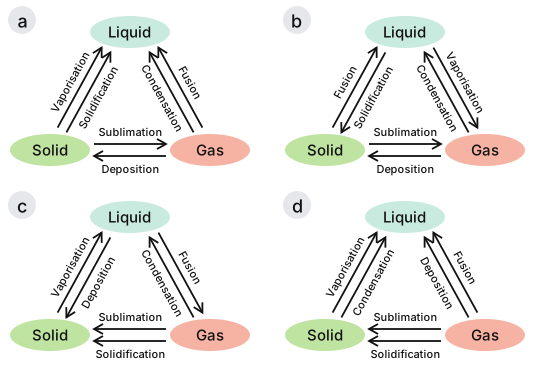
निम्नलिखित में से कौन-सी आकृति द्रव्य की तीनों अवस्थाओं के अंतः-रूपांतरण को
सटीक रूप से दर्शाती है?
- Ad
- Ba
- Cc
- Db
Show answer
Concept: Each pair of states is linked by two opposite processes: Solid ⇄ Liquid (fusion / solidification), Liquid ⇄ Gas (vaporisation / condensation), Solid ⇄ Gas (sublimation / deposition).
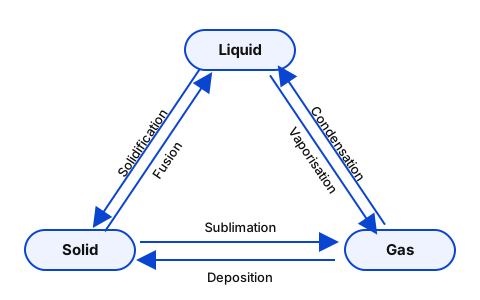
- Check figure b: Solid → Liquid labelled Fusion, Liquid → Solid labelled Solidification ✓.
- Liquid → Gas Vaporisation, Gas → Liquid Condensation ✓; Solid → Gas Sublimation, Gas → Solid Deposition ✓.
- Figures a, c and d mislabel at least one arrow (e.g., Gas → Solid called Solidification, or Liquid → Solid called Deposition).
Yaad rakhein: Sublimation and deposition always join Solid and Gas directly; solidification only joins Liquid → Solid.
Answer: (D) b
अवधारणा: हर दो अवस्थाओं के बीच दो विपरीत प्रक्रियाएँ होती हैं: ठोस ⇄ द्रव (fusion / solidification), द्रव ⇄ गैस (vaporisation / condensation), ठोस ⇄ गैस (sublimation / deposition)।
- चित्र b: ठोस → द्रव = Fusion, द्रव → ठोस = Solidification ✓।
- द्रव → गैस = Vaporisation, गैस → द्रव = Condensation ✓; ठोस → गैस = Sublimation, गैस → ठोस = Deposition ✓।
- चित्र a, c, d में कम से कम एक तीर गलत नाम वाला है (जैसे गैस → ठोस को Solidification कहना)।
याद रखें: Sublimation और deposition सीधे ठोस–गैस को जोड़ते हैं; solidification केवल द्रव → ठोस है।
उत्तर: (D) b
SSC CPO Paper IGeneral Knowledge and General AwarenessStates of MatterSSC CPO Paper I 2024 · 27 Jun Shift 1
Q1670.Which of the following factors does NOT control the climate of a place?
निम्नलिखित में से कौन-सा कारक किसी स्थान की जलवायु को नियंत्रित नहीं करता है?
- ALatitudeअक्षांश
- BDistance between two citiesदो शहरों के बीच की दूरी
- COcean currentsमहासागरीय धाराएँ
- DRelief featuresउच्चावच लक्षण
Show answer
Concept: The climate of a place is controlled by latitude, altitude, pressure and wind system, distance from the sea, ocean currents and relief features.
- Latitude decides the amount of solar energy received.
- Ocean currents and relief (mountains) modify temperature and rainfall.
- Distance between two cities has no effect on either city's climate.
Yaad rakhein: Six factors (NCERT): latitude, altitude, pressure & winds, distance from sea, ocean currents, relief.
Answer: (B) Distance between two cities
अवधारणा: किसी स्थान की जलवायु अक्षांश, ऊँचाई, वायुदाब व पवन तंत्र, समुद्र से दूरी, महासागरीय धाराएँ और उच्चावच (relief) से नियंत्रित होती है।
- अक्षांश से प्राप्त सौर ऊर्जा की मात्रा तय होती है।
- महासागरीय धाराएँ व पर्वत तापमान और वर्षा बदलते हैं।
- दो शहरों के बीच की दूरी का किसी शहर की जलवायु पर कोई प्रभाव नहीं।
याद रखें: छह कारक (NCERT): अक्षांश, ऊँचाई, वायुदाब व पवन, समुद्र से दूरी, महासागरीय धाराएँ, उच्चावच।
उत्तर: (B) Distance between two cities
SSC CPO Paper IGeneral Knowledge and General AwarenessClimate – Controlling FactorsSSC CPO Paper I 2024 · 27 Jun Shift 1
Q1671.The Shailendra kings who had close contacts with the Indian rulers were followers of which of the following religions?
भारतीय शासकों के साथ घनिष्ठ संबंध रखने वाले शैलेंद्र राजा निम्नलिखित में से किस धर्म के अनुयायी थे?
- AJainismजैन धर्म
- BVaishnavismवैष्णव धर्म
- CShaivismशैव धर्म
- DBuddhismबौद्ध धर्म
Show answer
Concept: The Shailendra dynasty ruled Java and Sumatra (8th–9th century) and were followers of Mahayana Buddhism.
- They built the famous Borobudur Buddhist stupa in Java.
- Shailendra king Balaputradeva got a monastery built at Nalanda; Pala king Devapala granted villages for it.
Yaad rakhein: Shailendra → Buddhism → Borobudur (Java).
Answer: (D) Buddhism
अवधारणा: शैलेंद्र वंश ने जावा और सुमात्रा (8वीं–9वीं सदी) पर शासन किया; वे महायान बौद्ध धर्म के अनुयायी थे।
- उन्होंने जावा में प्रसिद्ध बोरोबुदुर बौद्ध स्तूप बनवाया।
- शैलेंद्र राजा बालपुत्रदेव ने नालंदा में विहार बनवाया; पाल राजा देवपाल ने इसके लिए गाँव दान किए।
याद रखें: शैलेंद्र → बौद्ध धर्म → बोरोबुदुर (जावा)।
उत्तर: (D) Buddhism (बौद्ध धर्म)
SSC CPO Paper IGeneral Knowledge and General AwarenessAncient History – South-East AsiaSSC CPO Paper I 2024 · 27 Jun Shift 1
Q1672.Select the name of the hydrocarbon with a structural formula CH3 – CH2 – CH2 – CH2 – CH2 – CH3.
संरचनात्मक सूत्र CH3 – CH2 – CH2 – CH2 – CH2 – CH3 वाले हाइड्रोकार्बन के नाम का चयन कीजिए।
- A2,2-Dimethylbutane2,2-डाइमेथिलब्यूटेन
- B3-methyl hexane3-मेथिल हेक्सेन
- Cn-Hexanen-हेक्सेन
- D2-Methylpentane2-मेथिलपेन्टेन
Show answer
Concept: The given structure CH3–CH2–CH2–CH2–CH2–CH3 is a straight (unbranched) chain of carbon atoms joined by single bonds — an alkane.
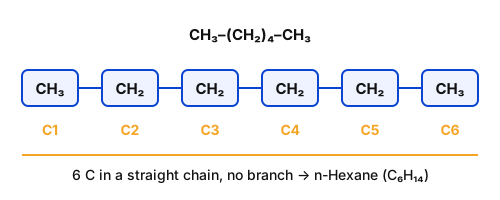
- Count carbons: 2 terminal CH3 + 4 CH2 = 6 carbons → prefix "hex".
- All single bonds → "-ane"; no branch → "n-" (normal). Name: n-Hexane, .
- 2,2-Dimethylbutane and 2-Methylpentane are branched isomers of hexane; 3-methylhexane has 7 carbons.
Yaad rakhein: Unbranched chain → prefix n- ; branched isomers carry locants like 2-methyl.
Answer: (C) n-Hexane
अवधारणा: दी गई संरचना CH3–CH2–CH2–CH2–CH2–CH3 एकल बंध वाली सीधी (अशाखित) कार्बन श्रृंखला है — एक alkane।
- कार्बन गिनें: 2 सिरे वाले CH3 + 4 CH2 = 6 कार्बन → "hex"।
- सभी एकल बंध → "-ane"; कोई शाखा नहीं → "n-"। नाम: n-Hexane, ।
- 2,2-Dimethylbutane व 2-Methylpentane हेक्सेन के शाखित समावयवी हैं; 3-methylhexane में 7 कार्बन हैं।
याद रखें: अशाखित श्रृंखला → n- ; शाखित समावयवी में 2-methyl जैसे स्थान-अंक लगते हैं।
उत्तर: (C) n-Hexane
SSC CPO Paper IGeneral Knowledge and General AwarenessOrganic Chemistry – IUPAC NamingSSC CPO Paper I 2024 · 27 Jun Shift 1
Q1673.What is the average elevation of the Eastern Ghats of India?
भारत के पूर्वी घाट की औसत ऊँचाई कितनी है?
- A400 metres400 मीटर
- B200 metres200 मीटर
- C900 metres900 मीटर
- D600 metres600 मीटर
Show answer
Concept: According to NCERT, the average elevation of the Eastern Ghats is about 600 metres.
- The Western Ghats are higher, with an average elevation of 900–1600 metres.
- The Eastern Ghats are discontinuous, cut by rivers (Mahanadi, Godavari, Krishna, Kaveri); highest peak — Mahendragiri (1,501 m).
Yaad rakhein: Eastern Ghats ≈ 600 m (Mahendragiri highest); Western Ghats 900–1600 m (Anamudi highest).
Answer: (D) 600 metres
अवधारणा: NCERT के अनुसार पूर्वी घाट की औसत ऊँचाई लगभग 600 मीटर है।
- पश्चिमी घाट अधिक ऊँचे हैं — औसत ऊँचाई 900–1600 मीटर।
- पूर्वी घाट असतत हैं, नदियों (महानदी, गोदावरी, कृष्णा, कावेरी) द्वारा कटे हुए; सबसे ऊँची चोटी महेंद्रगिरि (1,501 मी)।
याद रखें: पूर्वी घाट ≈ 600 मी (महेंद्रगिरि); पश्चिमी घाट 900–1600 मी (अनामुडी)।
उत्तर: (D) 600 metres (600 मीटर)
SSC CPO Paper IGeneral Knowledge and General AwarenessIndian Physiography – Eastern GhatsSSC CPO Paper I 2024 · 27 Jun Shift 1
Q1674.Who among the following envoys was sent by Seleucus I to the court of Chandragupta Maurya?
निम्नलिखित में से किस राजदूत को सेल्यूकस I द्वारा चंद्रगुप्त मौर्य के दरबार में भेजा गया था?
- AFa-Hienफाह्यान
- BDeimachusडाइमेकस
- CAl-Biruniअल-बिरूनी
- DMegasthenesमेगस्थनीज़
Show answer
Concept: Seleucus I Nicator sent Megasthenes as his ambassador to the court of Chandragupta Maurya at Pataliputra.
- Megasthenes wrote 'Indica', describing Mauryan administration and society.
- Deimachus was sent (by Antiochus I) to Bindusara's court — the tempting wrong option.
- Fa-Hien came during Chandragupta II (Gupta); Al-Biruni came with Mahmud of Ghazni.
Yaad rakhein: Chandragupta – Megasthenes; Bindusara – Deimachus; Ashoka – Dionysius (Ptolemy).
Answer: (D) Megasthenes
अवधारणा: सेल्यूकस प्रथम निकेटर ने मेगस्थनीज़ को राजदूत के रूप में चंद्रगुप्त मौर्य के पाटलिपुत्र दरबार में भेजा।
- मेगस्थनीज़ ने 'इंडिका' लिखी, जिसमें मौर्य प्रशासन व समाज का वर्णन है।
- डाइमेकस (Deimachus) बिंदुसार के दरबार में आया था — यही भ्रामक विकल्प है।
- फाह्यान चंद्रगुप्त द्वितीय (गुप्त) के समय आया; अल-बरूनी महमूद गज़नवी के साथ आया।
याद रखें: चंद्रगुप्त – मेगस्थनीज़; बिंदुसार – डाइमेकस; अशोक – डायोनिसियस।
उत्तर: (D) Megasthenes (मेगस्थनीज़)
SSC CPO Paper IGeneral Knowledge and General AwarenessMauryan EmpireSSC CPO Paper I 2024 · 27 Jun Shift 1
Q1675.What does M stand for in MUDRA yojana?
MUDRA योजना में M का पूर्ण रूप क्या है?
- AMicro
- BMoney
- CMajor
- DMacro
Show answer
Concept: MUDRA stands for Micro Units Development and Refinance Agency; Pradhan Mantri MUDRA Yojana was launched in April 2015.
- It provides collateral-free loans up to ₹10 lakh (raised to ₹20 lakh in 2024) to non-corporate, non-farm micro and small enterprises.
- Loan categories: Shishu (up to ₹50,000), Kishore (up to ₹5 lakh), Tarun (up to ₹10 lakh).
Yaad rakhein: M of MUDRA = Micro; categories Shishu → Kishore → Tarun.
Answer: (A) Micro
अवधारणा: MUDRA का पूरा नाम Micro Units Development and Refinance Agency है; प्रधानमंत्री मुद्रा योजना अप्रैल 2015 में शुरू हुई।
- यह गैर-कॉर्पोरेट, गैर-कृषि सूक्ष्म व लघु उद्यमों को ₹10 लाख तक (2024 में ₹20 लाख तक बढ़ा) बिना गारंटी ऋण देती है।
- श्रेणियाँ: शिशु (₹50,000 तक), किशोर (₹5 लाख तक), तरुण (₹10 लाख तक)।
याद रखें: MUDRA में M = Micro; श्रेणियाँ शिशु → किशोर → तरुण।
उत्तर: (A) Micro
SSC CPO Paper IGeneral Knowledge and General AwarenessGovernment Schemes – MUDRASSC CPO Paper I 2024 · 27 Jun Shift 1
Q1676.Chitra Visweswaran is a famous dancer of which of the following dance genres?
चित्रा विश्वेश्वरन निम्नलिखित में से किस नृत्य शैली की प्रसिद्ध नृत्यांगना हैं?
- AKuchipudiकुचिपुड़ी
- BKathakaliकथकली
- CBharatnatyamभरतनाट्यम
- DSattriyaसत्रिया
Show answer
Concept: Chitra Visweswaran (Chennai) is a renowned Bharatanatyam dancer and choreographer.
- She received the Padma Shri (1992) and the Sangeet Natak Akademi Award (1987).
- She founded the dance school Chidambaram Academy of Performing Arts in Chennai.
Yaad rakhein: Tamil Nadu dancers → Bharatanatyam (Chitra Visweswaran, Rukmini Devi Arundale, Padma Subrahmanyam).
Answer: (C) Bharatnatyam
अवधारणा: चित्रा विश्वेश्वरन (चेन्नई) प्रसिद्ध भरतनाट्यम नृत्यांगना और कोरियोग्राफ़र हैं।
- उन्हें पद्म श्री (1992) और संगीत नाटक अकादमी पुरस्कार (1987) मिला।
- उन्होंने चेन्नई में Chidambaram Academy of Performing Arts की स्थापना की।
याद रखें: तमिलनाडु के नर्तक → भरतनाट्यम (चित्रा विश्वेश्वरन, रुक्मिणी देवी अरुंडेल, पद्मा सुब्रह्मण्यम)।
उत्तर: (C) Bharatnatyam (भरतनाट्यम)
SSC CPO Paper IGeneral Knowledge and General AwarenessClassical Dance – PersonalitiesSSC CPO Paper I 2024 · 27 Jun Shift 1
Q1677.Which Article of the Indian Constitution pertains to the Fundamental Duties?
भारतीय संविधान का कौन-सा अनुच्छेद मौलिक कर्तव्यों से संबंधित है?
- AArticle 51-Aअनुच्छेद 51-A
- BArticle 50-Aअनुच्छेद 50-A
- CArticle 53-Aअनुच्छेद 53-A
- DArticle 52-Aअनुच्छेद 52-A
Show answer
Concept: Fundamental Duties are listed in Article 51-A in Part IV-A of the Constitution.
- Added by the 42nd Amendment (1976) on the Swaran Singh Committee's recommendation — originally 10 duties.
- The 86th Amendment (2002) added the 11th duty (education of children aged 6–14).
- Inspired by the Constitution of the former USSR.
Yaad rakhein: Part IV-A, Art. 51-A, 11 duties (10 + 1 by 86th Amendment).
Answer: (A) Article 51-A
अवधारणा: मौलिक कर्तव्य संविधान के भाग IV-A के अनुच्छेद 51-A में हैं।
- स्वर्ण सिंह समिति की सिफ़ारिश पर 42वें संशोधन (1976) से जोड़े गए — प्रारंभ में 10 कर्तव्य।
- 86वें संशोधन (2002) ने 11वाँ कर्तव्य जोड़ा (6–14 वर्ष के बच्चों की शिक्षा)।
- पूर्व सोवियत संघ (USSR) के संविधान से प्रेरित।
याद रखें: भाग IV-A, अनु. 51-A, 11 कर्तव्य (10 + 1, 86वाँ संशोधन)।
उत्तर: (A) Article 51-A
SSC CPO Paper IGeneral Knowledge and General AwarenessFundamental DutiesSSC CPO Paper I 2024 · 27 Jun Shift 1
Q1678.Ustad Asad Ali Khan was one of the masters of the ___________.
उस्ताद असद अली खान ___________ के उस्तादों में से एक थे।
- Amridangamमृदंगम
- Brudra veenaरुद्र वीणा
- Csarangiसारंगी
- Dtanpuraतानपुरा
Show answer
Concept: Ustad Asad Ali Khan (1937–2011) was a master of the rudra veena in the Dhrupad tradition (Khandar baani) of the Jaipur Beenkar gharana.
- He received the Padma Bhushan (2008).
- Rudra veena is a large plucked string instrument with two gourd resonators, used in Dhrupad.
Yaad rakhein: Rudra veena: Asad Ali Khan, Zia Mohiuddin Dagar, Bahauddin Dagar.
Answer: (B) rudra veena
अवधारणा: उस्ताद असद अली खान (1937–2011) जयपुर बीनकार घराने की ध्रुपद परंपरा के रुद्र वीणा के उस्ताद थे।
- उन्हें पद्म भूषण (2008) मिला।
- रुद्र वीणा दो तुंबों वाला बड़ा तंतु वाद्य है, जो ध्रुपद में बजाया जाता है।
याद रखें: रुद्र वीणा: असद अली खान, ज़िया मोहिउद्दीन डागर, बहाउद्दीन डागर।
उत्तर: (B) rudra veena (रुद्र वीणा)
SSC CPO Paper IGeneral Knowledge and General AwarenessMusicians and InstrumentsSSC CPO Paper I 2024 · 27 Jun Shift 1
Q1679.Which of the following programmes is NOT a part of the Tenth Five-Year Plan?
निम्नलिखित में से कौन-सा कार्यक्रम दसवीं पंचवर्षीय योजना का भाग नहीं है?
- AJute Technology Missionजूट प्रौद्योगिकी मिशन
- BDrought Prone Area Programmeसूखा प्रवण क्षेत्र कार्यक्रम
- CNational Horticulture Missionराष्ट्रीय बागवानी मिशन
- DMicro Irrigation Programmeसूक्ष्म सिंचाई कार्यक्रम
Show answer
Concept: The Tenth Five-Year Plan ran from 2002 to 2007; several missions were launched during it.
- National Horticulture Mission (2005-06), Micro Irrigation scheme (2006) and Jute Technology Mission (2006-07) were all started in the Tenth Plan.
- The Drought Prone Areas Programme (DPAP) is much older — launched in 1973-74 during the Fourth Plan.
Yaad rakhein: DPAP (1973) and Desert Development Programme (1977-78) are old area-development programmes.
Answer: (B) Drought Prone Area Programme
अवधारणा: दसवीं पंचवर्षीय योजना 2002 से 2007 तक चली; इसमें कई मिशन शुरू हुए।
- राष्ट्रीय बागवानी मिशन (2005-06), सूक्ष्म सिंचाई योजना (2006) और जूट प्रौद्योगिकी मिशन (2006-07) दसवीं योजना में शुरू हुए।
- सूखा-प्रवण क्षेत्र कार्यक्रम (DPAP) बहुत पुराना है — 1973-74 में चौथी योजना में शुरू हुआ।
याद रखें: DPAP (1973) और मरु विकास कार्यक्रम (1977-78) पुराने क्षेत्र-विकास कार्यक्रम हैं।
उत्तर: (B) Drought Prone Area Programme
SSC CPO Paper IGeneral Knowledge and General AwarenessFive-Year Plans – Tenth PlanSSC CPO Paper I 2024 · 27 Jun Shift 1
Q1680.Which of the following is NOT included in the Indian Food Guide Pyramid for healthy eating?
निम्नलिखित में से कौन-सा स्वस्थ आहार के लिए भारतीय खाद्य मार्गदर्शक पिरामिड में शामिल नहीं है?
- AFats and sugarवसा और शर्करा
- BPulses and legumesदालें और फलियाँ
- CMilk, meat and productsदूध, मांस और उत्पाद
- DAlcoholic beveragesमादक पेय
Show answer
Concept: The Indian Food Guide Pyramid (NIN, Hyderabad) shows the food groups for a balanced diet and their relative amounts.
- Base: cereals and millets; then vegetables and fruits; then pulses, legumes, milk, meat and products.
- Top (eat sparingly): fats, oils and sugar.
- Alcoholic beverages are not part of the pyramid — they are not recommended at all.
Yaad rakhein: Pyramid: eat more at the base (cereals), less at the top (fats & sugar); alcohol — not included.
Answer: (D) Alcoholic beverages
अवधारणा: भारतीय खाद्य मार्गदर्शक पिरामिड (NIN, हैदराबाद) संतुलित आहार के खाद्य समूह और उनकी मात्रा दिखाता है।
- आधार: अनाज व मोटे अनाज; फिर सब्ज़ियाँ व फल; फिर दालें, दूध, मांस आदि।
- शीर्ष (कम मात्रा में): वसा, तेल और चीनी।
- मादक पेय (alcohol) पिरामिड में शामिल नहीं — इनकी अनुशंसा ही नहीं की जाती।
याद रखें: पिरामिड: आधार (अनाज) अधिक, शीर्ष (वसा व चीनी) कम; शराब — शामिल नहीं।
उत्तर: (D) Alcoholic beverages
SSC CPO Paper IGeneral Knowledge and General AwarenessNutrition – Food PyramidSSC CPO Paper I 2024 · 27 Jun Shift 1

