Q41.The decreasing order of
NMR chemical shifts of the marked carbon atoms x, y, z and p in compound (I) is
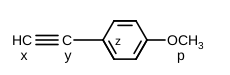
यौगिक (I) में चिन्हित कार्बन परमाणुओं x, y, z और p के
एन.एम.आर. में रासायनिक विस्तरण का घटता क्रम है
- Az > y > x > p
- Bz > x > y > p
- Cy > z > x > p
- Dy > p > z > x
Show answer
Concept: Typical (ppm): aromatic C 110–160 > alkyne C 65–90 > OCH3 ~55.
- z (aromatic C bearing the alkyne, para to OMe) ≈ 114 ppm.
- y (internal ≡C–Ar) ≈ 84 ppm; x (terminal ≡CH) ≈ 76 ppm – the substituted alkyne carbon is downfield.
- p (OCH3) ≈ 55 ppm. Order: z > y > x > p.
Short trick: 13C: C=O > aromatic/alkene > alkyne > O–CH3 > alkyl.
अवधारणा: सामान्य (ppm): ऐरोमैटिक C 110–160 > ऐल्काइन C 65–90 > OCH3 ~55।
- z (ऐल्काइन वहन करने वाला ऐरोमैटिक C, OMe के पैरा) ≈ 114 ppm।
- y (आंतरिक ≡C–Ar) ≈ 84 ppm; x (अंतस्थ ≡CH) ≈ 76 ppm – प्रतिस्थापित ऐल्काइन कार्बन अधिक निम्नक्षेत्र में।
- p (OCH3) ≈ 55 ppm। क्रम: z > y > x > p।
याद रखें: 13C: C=O > ऐरोमैटिक/ऐल्कीन > ऐल्काइन > O–CH3 > ऐल्किल।
UPHESC Assistant Professor ChemistryChemistry13C NMR chemical shiftsUPHESC Assistant Professor Chemistry 2025 · 16 Apr Shift 2
Q42.The metal ion present in the active site of nitrogenase enzyme co-factor are
नाइट्रोजिनेस एन्जाइम को-फैक्टर के सक्रिय साइट में मौजूद धातु आयन इस प्रकार है
- AFe, Mo
- BFe, W
- CFe, Cu
- DFe, Ni
Show answer
Concept: N2 is reduced to NH3 at the iron–molybdenum cofactor (FeMoco) of nitrogenase.
- FeMoco = cluster with homocitrate (central carbide).
- The Fe-protein supplies electrons (with ATP hydrolysis) to the MoFe-protein.
- Alternative nitrogenases use V or only Fe, but the classical cofactor is Fe–Mo; W, Cu, Ni are not involved.
Short trick: Nitrogenase = FeMo; N2 + 8H+ + 8e− + 16 ATP → 2NH3 + H2.
अवधारणा: नाइट्रोजिनेज़ के लौह–मॉलिब्डेनम सहकारक (FeMoco) पर N2 का NH3 में अपचयन होता है।
- FeMoco = समूह, होमोसाइट्रेट सहित (केन्द्रीय कार्बाइड)।
- Fe-प्रोटीन (ATP जलअपघटन के साथ) MoFe-प्रोटीन को इलेक्ट्रॉन देता है।
- वैकल्पिक नाइट्रोजिनेज़ में V या केवल Fe होता है, पर मानक सहकारक Fe–Mo है।
याद रखें: नाइट्रोजिनेज़ = FeMo।
UPHESC Assistant Professor ChemistryChemistryNitrogenase – FeMo cofactorUPHESC Assistant Professor Chemistry 2025 · 16 Apr Shift 2
Q43.The Clausius-Clapeyron equation for the applicability of this equation which one of the following statement is not correct ?
क्लासियस-क्लेपियरान समीकरण के अनुप्रयोज्य होने के लिए निम्नांकित कथनों में कौन-सा सही नहीं है ?
- AIt tells the effect of temperature on the vapour pressure of a liquidयह किसी द्रव के वाष्प दाब पर ताप का प्रभाव बतलाता है
- BIt tells the effect of pressure on the boiling point of a liquidयह किसी द्रव के क्वथनांक पर दाब का प्रभाव बतलाता है
- CIt is applicable in case of solid-liquid equilibriumयह ठोस-द्रव साम्यवस्था में अनुप्रयोज्य है
- DIt tells that as intermolecular forces increases, also increases which results in lowering the boiling pointयह बताता है कि जैसे अन्तरआणुविक बल बढ़ता है, भी बढ़ता है जिससे क्वथनांक में कमी होती है
Show answer
Concept: The integrated Clausius–Clapeyron equation assumes the vapour is an ideal gas and the condensed-phase volume is negligible; it applies to liquid ⇌ vapour (and solid ⇌ vapour).
- (A) and (B) are correct: it relates vapour pressure with temperature, i.e. boiling point with external pressure.
- (C) is not correct: for solid ⇌ liquid there is no vapour phase, so only the general Clapeyron equation applies.
- (D) is also not correct: stronger intermolecular forces raise and raise the boiling point.
- Since two statements are incorrect, the question has no single answer.
Short trick: Clausius–Clapeyron: liquid/solid ⇌ vapour only; higher ΔHvap → higher b.p.
अवधारणा: समाकलित क्लासियस–क्लेपेरॉन समीकरण वाष्प को आदर्श गैस मानता है तथा संघनित प्रावस्था का आयतन नगण्य मानता है; यह द्रव ⇌ वाष्प (तथा ठोस ⇌ वाष्प) पर लागू है।
- (A) व (B) सही: यह वाष्पदाब का ताप से, अर्थात क्वथनांक का बाह्य दाब से संबंध बताता है।
- (C) सही नहीं: ठोस ⇌ द्रव में वाष्प प्रावस्था नहीं होती, वहाँ केवल सामान्य क्लेपेरॉन समीकरण लागू होता है।
- (D) भी सही नहीं: प्रबल अन्तराअणुक बल बढ़ाते हैं और क्वथनांक को बढ़ाते हैं।
- दो कथन गलत होने से प्रश्न का एकल उत्तर नहीं बनता।
याद रखें: क्लासियस–क्लेपेरॉन: केवल द्रव/ठोस ⇌ वाष्प; अधिक ΔHvap → अधिक क्वथनांक।
UPHESC Assistant Professor ChemistryChemistryClausius–Clapeyron equationUPHESC Assistant Professor Chemistry 2025 · 16 Apr Shift 2
Q44.How many Bravai's lattices are present in the following crystals ?
a = Rhombohedral
b = Triclinic
c = Hexagonal
निम्नलिखित क्रिस्टल में कितने ब्रावैस लैटिस मौजूद है ?
a = रोम्बोहैड्रल
b = ट्राइक्लिनिक
c = षटकोणीय
- Aa = 2, b = 1, c = 3
- Ba = 1, b = 1, c = 1
- Ca = 1, b = 1, c = 3
- Da = 2, b = 1, c = 1
Show answer
Concept: 14 Bravais lattices are distributed among 7 crystal systems.
- Cubic 3 (P, I, F); tetragonal 2 (P, I); orthorhombic 4 (P, C, I, F); monoclinic 2 (P, C).
- Triclinic 1 (P); hexagonal 1 (P); rhombohedral/trigonal 1 (R).
- So a = 1, b = 1, c = 1.
Short trick: 3 + 2 + 4 + 2 + 1 + 1 + 1 = 14.
अवधारणा: 14 ब्रावे जालक 7 क्रिस्टल तंत्रों में बँटे हैं।
- घनीय 3 (P, I, F); चतुष्कोणीय 2 (P, I); विषमलंबाक्ष 4 (P, C, I, F); एकनताक्ष 2 (P, C)।
- त्रिनताक्ष 1 (P); षट्कोणीय 1 (P); त्रिसमनताक्ष 1 (R)।
- अतः a = 1, b = 1, c = 1।
याद रखें: 3 + 2 + 4 + 2 + 1 + 1 + 1 = 14।
UPHESC Assistant Professor ChemistryChemistryBravais latticesUPHESC Assistant Professor Chemistry 2025 · 16 Apr Shift 2
Q45.Debye's law is given by the following equation
डीबाई- नियम को निम्न समीकरण द्वारा दिया जाता है
- A
- B
- C
- D
Show answer
Concept: At the Debye model gives per mole.
- Dimensional check: must have units of R and must appear as a dimensionless ratio cubed – only (A) satisfies this.
- Numerically J K−1 mol−1 × ; used to extrapolate to 0 K for third-law entropies.
Short trick: Debye: Cv ∝ T3, constant 12π4R/5.
अवधारणा: पर डीबाई मॉडल से प्रति मोल ।
- विमीय जाँच: की इकाई R जैसी हो तथा विमाहीन अनुपात के घन रूप में हो – केवल (A) में ऐसा है।
- J K−1 mol−1 × ; तृतीय नियम एन्ट्रॉपी हेतु 0 K तक बहिर्वेशन में प्रयुक्त।
याद रखें: डीबाई: Cv ∝ T3, स्थिरांक 12π4R/5।
UPHESC Assistant Professor ChemistryChemistryHeat capacity of solids – Debye theoryUPHESC Assistant Professor Chemistry 2025 · 16 Apr Shift 2
Q46.The pH before and after the addition of 0.01 mole of NaOH to one litre of buffer solution that is 0.1 mole in acetic acid and 0.1 mole sodium acetate will be
The dissociation constant of acetic acid is
0.01 मोल NaOH को एक लीटर बफर विलयन में मिलाने पर जिसमें 0.1 मोल एसीटिक अम्ल और 0.1 मोल सोडियम एसीटेट मिलाने के पूर्व और बाद में pH मान होगा
एसिटिक अम्ल का वियोजन स्थिरांक है
- A4.76, 4.847
- B4.96, 5.012
- C4.64, 4.72
- D4.52, 4.60
Show answer
Concept: ; .
- Before: [A−] = [HA] = 0.1 → pH = 4.76.
- NaOH converts 0.01 mol HA to A−: [A−] = 0.11, [HA] = 0.09.
- pH = 4.757 + log(0.11/0.09) = 4.757 + 0.087 = 4.84 ≈ 4.847.
Short trick: Equal acid and salt → pH = pKa; base added shifts the ratio, not much the pH.
अवधारणा: ; ।
- पहले: [A−] = [HA] = 0.1 → pH = 4.76।
- NaOH 0.01 mol HA को A− में बदलता है: [A−] = 0.11, [HA] = 0.09।
- pH = 4.757 + log(0.11/0.09) = 4.757 + 0.087 = 4.84 ≈ 4.847।
याद रखें: अम्ल = लवण → pH = pKa।
UPHESC Assistant Professor ChemistryChemistryBuffer – Henderson equationUPHESC Assistant Professor Chemistry 2025 · 16 Apr Shift 2
Q47.The point group of molecule is
का बिन्दु समूह है
- A
- B
- C
- D
Show answer
Concept: (gas) is trigonal bipyramidal (, no lone pair).
- Principal axis through the two axial Cl; three axes along the equatorial P–Cl bonds (⊥ ) → D group.
- Horizontal mirror plane containing the three equatorial Cl → → .
- Same point group: (planar), .
Short trick: TBP = D3h; octahedral = Oh; square pyramid = C4v.
अवधारणा: (गैस) त्रिकोणीय द्विपिरामिडी है (, एकाकी युग्म नहीं)।
- मुख्य अक्ष दोनों अक्षीय Cl से होकर; विषुवतीय P–Cl बंधों के अनुदिश तीन अक्ष (⊥ ) → D समूह।
- तीनों विषुवतीय Cl वाला क्षैतिज दर्पण तल → → ।
- यही समूह: , ।
याद रखें: TBP = D3h; अष्टफलकीय = Oh; वर्ग पिरामिड = C4v।
UPHESC Assistant Professor ChemistryChemistryPoint groups – trigonal bipyramidUPHESC Assistant Professor Chemistry 2025 · 16 Apr Shift 2
Q48.The combination of two reflections about an intersecting mirror plane is equivalent to
दो रिफ्लेक्शन का संयोजन जो कि किसी इन्टरसेक्टिंग मिरर प्लेन के गिर्द हो वह इसके बराबर होता है
- A
- B
- C
- Di
Show answer
Concept: Two successive reflections in planes that intersect along a line at angle θ equal a rotation by 2θ about that line.
- Each reflection reverses handedness; two reflections restore it, so the result is a proper rotation.
- E.g. in : (planes at 90° → rotation by 180°).
- and i are improper operations (odd number of reflections).
Short trick: σ × σ (intersecting) = Cn; σh × Cn = Sn.
अवधारणा: रेखा पर θ कोण से प्रतिच्छेदी दो तलों में क्रमिक परावर्तन उस रेखा के परितः 2θ घूर्णन के तुल्य है।
- प्रत्येक परावर्तन हस्तता उलटता है; दो परावर्तन उसे पुनः स्थापित करते हैं, अतः परिणाम उचित घूर्णन है।
- उदा. में: (90° पर तल → 180° घूर्णन)।
- तथा i अनुचित संक्रियाएँ हैं (विषम संख्या में परावर्तन)।
याद रखें: σ × σ (प्रतिच्छेदी) = Cn; σh × Cn = Sn।
UPHESC Assistant Professor ChemistryChemistryProducts of symmetry operationsUPHESC Assistant Professor Chemistry 2025 · 16 Apr Shift 2
Q49.Which of the following electronic configuration gives kinetically inert octahedral complexes ?
निम्नलिखित में से कौन-सा इलैक्ट्रानिक विन्यास, गतिकी रूप से अक्रिय अष्टफलकीय यौगिक देता है ?
- A
- B
- C
- D
Show answer
Concept: Taube: octahedral complexes are inert when there are no eg electrons and no vacant t2g orbital, and CFAE is large.
- (low-spin , e.g. Co(III)) – very high CFSE, no eg electron → inert.
- (high-spin ) and () have eg electrons → labile.
- ( low spin) has a vacant t2g slot → comparatively labile.
Short trick: Inert: d3, low-spin d4–d6 (best d6 LS, e.g. Co3+, Cr3+).
अवधारणा: टाउबे: जब eg में इलेक्ट्रॉन न हों, t2g में रिक्त कक्षक न हो तथा CFAE अधिक हो, तब अष्टफलकीय संकुल अक्रिय होते हैं।
- (निम्न-चक्रण , जैसे Co(III)) – अति उच्च CFSE, eg रिक्त → अक्रिय।
- (उच्च-चक्रण ) व () में eg इलेक्ट्रॉन → अस्थिर।
- में एक t2g रिक्त स्थान → अपेक्षाकृत अस्थिर।
याद रखें: अक्रिय: d3, निम्न-चक्रण d4–d6 (Co3+, Cr3+)।
UPHESC Assistant Professor ChemistryChemistryLabile and inert complexes (Taube)UPHESC Assistant Professor Chemistry 2025 · 16 Apr Shift 2
Q50.Which one is the correct formula of simple silicate anion ?
सामान्य सिलिकेट ऋणायन का सही सूत्र कौन-सा है ?
- A
- B
- C
- D
Show answer
Concept: The basic unit of all silicates is the tetrahedron.
- Si (+4) with four O (−2 each) → net charge −4: (orthosilicate, e.g. in olivine, zircon).
- Sharing of corners gives , chains , sheets , 3-D .
Short trick: Simple silicate = orthosilicate SiO44−.
अवधारणा: सभी सिलिकेटों की मूल इकाई चतुष्फलक है।
- Si (+4) तथा चार O (प्रत्येक −2) → कुल आवेश −4: (ऑर्थोसिलिकेट, जैसे ज़िरकॉन)।
- कोनों के साझे से , श्रृंखला , परत , त्रिविम ।
याद रखें: सरल सिलिकेट = SiO44−।
UPHESC Assistant Professor ChemistryChemistrySilicates – orthosilicate unitUPHESC Assistant Professor Chemistry 2025 · 16 Apr Shift 2
Q51.Equivalent conductance of an electrolyte and equivalent ionic conductances for cations and anions forming electrolyte are , and at infinite dilution respectively. What is the correct relationship between these ?
विद्युत अपघट्य की अनन्त तनुता पर तुल्यांक चालकता, विद्युत अपघट्य को बनाने वाले धनायन और ऋणायन की तुल्यांक आयनी चालकता क्रमश: , और है । इनके बीच सही सम्बन्ध क्या है ?
- A
- B
- C
- D
Show answer
Concept: Kohlrausch's law of independent migration: at infinite dilution each ion contributes independently.
- (equivalent conductances).
- Dividing: .
Short trick: Λ°(salt) = λ°(+) + λ°(−).
अवधारणा: कोलराउश का स्वतंत्र आयन अभिगमन नियम: अनन्त तनुता पर प्रत्येक आयन स्वतंत्र रूप से योगदान देता है।
- (तुल्यांक चालकताएँ)।
- भाग देने पर: ।
याद रखें: Λ°(लवण) = λ°(+) + λ°(−)।
UPHESC Assistant Professor ChemistryChemistryKohlrausch's lawUPHESC Assistant Professor Chemistry 2025 · 16 Apr Shift 2
Q52.In the following Robinson annulation, the major product (P) is
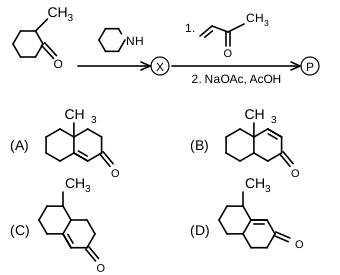
निम्न रोबिन्सन एनूलेशन में मुख्य उत्पाद (P) है
- AStructure (A)संरचना (A)
- BStructure (B)संरचना (B)
- CStructure (C)संरचना (C)
- DStructure (D)संरचना (D)
Show answer
Concept: With a secondary amine, 2-methylcyclohexanone forms the less substituted enamine (double bond towards C-6), because the more substituted enamine suffers A1,3-strain between CH3 and the N-ring.
- X = enamine at C-6; Michael addition to methyl vinyl ketone occurs at C-6 (the CH2 side), not at the methyl-bearing C-2.
- Hydrolysis and intramolecular aldol (NaOAc/AcOH) – the CH3CO of the side chain attacks the ring C=O – then dehydration gives the conjugated octalone.
- The CH3 ends up on the carbon next to the ring-fusion alkene carbon (not angular) → structure (D). Base-catalysed Robinson annulation (via the thermodynamic enolate) would give the angular-methyl product (A).
Short trick: Enamine → less substituted α-C; enolate (thermodynamic) → more substituted α-C.
अवधारणा: द्वितीयक ऐमीन के साथ 2-मेथिलसाइक्लोहेक्सेनोन कम प्रतिस्थापित इनैमीन (C-6 की ओर द्विबंध) बनाता है, क्योंकि अधिक प्रतिस्थापित इनैमीन में CH3 व N-वलय के बीच A1,3-विकृति होती है।
- X = C-6 पर इनैमीन; मेथिल विनाइल कीटोन पर माइकेल योग C-6 (CH2 पक्ष) पर होता है, CH3 वाले C-2 पर नहीं।
- जलअपघटन तथा अंतराअणुक ऐल्डॉल (NaOAc/AcOH) – पार्श्व श्रृंखला का CH3CO वलय C=O पर आक्रमण करता है – फिर निर्जलीकरण से संयुग्मी ऑक्टालोन बनता है।
- CH3 वलय-संधि ऐल्कीन कार्बन के पड़ोसी कार्बन पर रहता है (कोणीय नहीं) → संरचना (D)। क्षार-उत्प्रेरित रॉबिन्सन वलयन (ऊष्मागतिक ईनोलेट) से कोणीय मेथिल उत्पाद (A) बनता।
याद रखें: इनैमीन → कम प्रतिस्थापित α-C; ईनोलेट (ऊष्मागतिक) → अधिक प्रतिस्थापित α-C।
UPHESC Assistant Professor ChemistryChemistryStork enamine – Robinson annulationUPHESC Assistant Professor Chemistry 2025 · 16 Apr Shift 2
Q53.Arrange the following compounds in decreasing order of their
reaction.
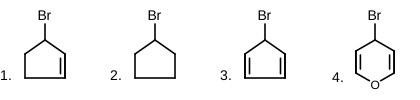
निम्नलिखित यौगिकों को उनके
अभिक्रिया के घटते क्रम में व्यवस्थित कीजिए ।
- A3 > 1 > 2 > 4
- B1 > 3 > 2 > 4
- C4 > 1 > 2 > 3
- D3 > 1 > 4 > 2
Show answer
Concept: rate follows the stability of the carbocation formed on loss of Br−.
- 4 → pyrylium ion: planar, 6π electrons, aromatic → most stable → fastest.
- 1 → cyclopentenyl (allylic) cation, resonance-stabilised → next.
- 2 → plain secondary cyclopentyl cation.
- 3 → cyclopentadienyl cation: 4π electrons, antiaromatic → very unstable → slowest. Order 4 > 1 > 2 > 3.
Short trick: Aromatic cation > allylic > simple 2° > antiaromatic.
अवधारणा: की दर Br− निकलने पर बने कार्बधनायन के स्थायित्व पर निर्भर है।
- 4 → पाइरिलियम आयन: समतल, 6π इलेक्ट्रॉन, ऐरोमैटिक → सर्वाधिक स्थायी → सबसे तीव्र।
- 1 → साइक्लोपेन्टेनिल (ऐलिलिक) धनायन, अनुनाद-स्थिर → इसके बाद।
- 2 → साधारण द्वितीयक साइक्लोपेन्टिल धनायन।
- 3 → साइक्लोपेन्टाडाइनिल धनायन: 4π इलेक्ट्रॉन, प्रतिऐरोमैटिक → अत्यंत अस्थायी → सबसे धीमा। क्रम 4 > 1 > 2 > 3।
याद रखें: ऐरोमैटिक धनायन > ऐलिलिक > साधारण 2° > प्रतिऐरोमैटिक।
UPHESC Assistant Professor ChemistryChemistrySN1 reactivity – carbocation stability and aromaticityUPHESC Assistant Professor Chemistry 2025 · 16 Apr Shift 2
Q54.Which of the following ions are aromatic ?
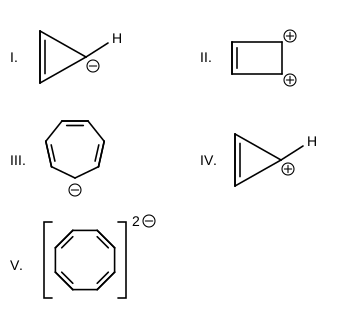
निम्न में से कौन-से आयन एरोमैटिक है ?
- AI, II, III
- BII, IV, V
- CI, II, IV, V
- DII, III, IV, V
Show answer
Concept: Aromatic: cyclic, planar, fully conjugated with (4n + 2) π electrons; 4n π → antiaromatic.
- I cyclopropenyl anion: 4π → antiaromatic. IV cyclopropenyl cation: 2π → aromatic.
- II cyclobutadiene dication: 2π → aromatic.
- III cycloheptatrienyl anion: 8π → antiaromatic.
- V cyclooctatetraene dianion: 10π, planar → aromatic. So II, IV, V.
Short trick: Count π e: 2, 6, 10, 14 → aromatic; 4, 8, 12 → antiaromatic.
अवधारणा: ऐरोमैटिक: चक्रीय, समतल, पूर्ण संयुग्मित तथा (4n + 2) π इलेक्ट्रॉन; 4n π → प्रतिऐरोमैटिक।
- I साइक्लोप्रोपेनिल ऋणायन: 4π → प्रतिऐरोमैटिक। IV साइक्लोप्रोपेनिल धनायन: 2π → ऐरोमैटिक।
- II साइक्लोब्यूटाडाईन द्विधनायन: 2π → ऐरोमैटिक।
- III साइक्लोहेप्टाट्राइनिल ऋणायन: 8π → प्रतिऐरोमैटिक।
- V साइक्लोऑक्टाटेट्राईन द्विऋणायन: 10π, समतल → ऐरोमैटिक। अतः II, IV, V।
याद रखें: π e गिनें: 2, 6, 10, 14 → ऐरोमैटिक; 4, 8, 12 → प्रतिऐरोमैटिक।
UPHESC Assistant Professor ChemistryChemistryHückel's rule for ionsUPHESC Assistant Professor Chemistry 2025 · 16 Apr Shift 2
Q55.The property measured in TGA is
TGA में मापित गुण होता है
- AChange in temperatureतापमान में परिवर्तन
- BChange in heat evolved or absorbedउत्सर्जित या अवशोषित उष्मा में परिवर्तन
- CRate of change in weightभार में परिवर्तन की दर
- DChange in weightभार में परिवर्तन
Show answer
Concept: Thermogravimetric analysis (TGA) records the mass (weight) of a sample as it is heated at a controlled rate.
- DTA measures the temperature difference (ΔT) between sample and reference.
- DSC measures heat flow (heat evolved/absorbed).
- DTG (derivative TGA) plots the rate of change of weight, dm/dt.
Short trick: TGA – mass; DTA – ΔT; DSC – heat; DTG – dm/dt.
अवधारणा: तापभारमितीय विश्लेषण (TGA) नियंत्रित दर से गर्म करते समय नमूने का द्रव्यमान (भार) अंकित करता है।
- DTA नमूने व संदर्भ के बीच ताप अंतर (ΔT) मापता है।
- DSC ऊष्मा प्रवाह (उत्सर्जित/अवशोषित ऊष्मा) मापता है।
- DTG (अवकलज TGA) भार परिवर्तन की दर dm/dt दर्शाता है।
याद रखें: TGA – द्रव्यमान; DTA – ΔT; DSC – ऊष्मा; DTG – dm/dt।
UPHESC Assistant Professor ChemistryChemistryThermal methods of analysisUPHESC Assistant Professor Chemistry 2025 · 16 Apr Shift 2
Q56.Why gelatin is added during polarographic measurements ?
पोलेरोग्राफीक माप के समय जिलेटिन क्यों मिलाया जाता है ?
- ATo reduce streaming motion of falling mercury dropगिरती हुई मरकरी की बूँद की प्रवाह गति कम करने के लिए
- BTo decrease viscosity of solutionश्यानता में कमी करने के लिए
- CTo eliminate residual currentअवशेष प्रवाह खत्म करने के लिए
- DTo prevent oxidation of HgHg का आक्सीकरण रोकने के लिए
Show answer
Concept: Polarograms often show sharp 'maxima' caused by streaming (convective) motion of the solution around the growing mercury drop.
- A trace of surface-active substance such as gelatin or Triton X-100 adsorbs on the drop and damps this streaming → maxima suppressed.
- Gelatin raises (not lowers) viscosity slightly; residual current is due to impurities/charging current and is not removed; dissolved O2 is removed by N2 purging.
Short trick: Gelatin = maximum suppressor; N2 = O2 remover; KCl = supporting electrolyte.
अवधारणा: पोलेरोग्रामों में प्रायः तीक्ष्ण 'उच्चिष्ठ' (मैक्सिमा) आते हैं, जो बढ़ती पारद बूँद के चारों ओर विलयन की प्रवाह (संवहन) गति से होते हैं।
- जिलेटिन या ट्राइटॉन X-100 जैसा पृष्ठ-सक्रिय पदार्थ बूँद पर अधिशोषित होकर यह प्रवाह गति कम करता है → उच्चिष्ठ दब जाते हैं।
- जिलेटिन श्यानता घटाता नहीं; अवशिष्ट धारा नहीं हटती; घुली O2, N2 प्रवाहित कर हटाई जाती है।
याद रखें: जिलेटिन = उच्चिष्ठ दमनकारी; N2 = O2 निष्कासक; KCl = सहायक विद्युत-अपघट्य।
UPHESC Assistant Professor ChemistryChemistryPolarography – maximum suppressorsUPHESC Assistant Professor Chemistry 2025 · 16 Apr Shift 2
Q57.Increasing order of electronegativity of the elements is
तत्वों की विद्युत ऋणात्मकता का बढ़ता हुआ अनुक्रम है
- AC, N, Si, P
- BN, Si, C, P
- CSi, P, C, N
- DP, Si, C, N
Show answer
Concept: Pauling values: Si 1.90, P 2.19, C 2.55, N 3.04.
- Electronegativity increases across a period (Si < P; C < N) and decreases down a group (C > Si; N > P).
- Period-2 elements C and N exceed both period-3 elements here → Si < P < C < N.
Short trick: Up and right → more electronegative.
अवधारणा: पॉलिंग मान: Si 1.90, P 2.19, C 2.55, N 3.04।
- आवर्त में बाएँ से दाएँ विद्युतऋणता बढ़ती है (Si < P; C < N) तथा वर्ग में नीचे घटती है (C > Si; N > P)।
- द्वितीय आवर्त के C व N यहाँ तृतीय आवर्त वालों से अधिक हैं → Si < P < C < N।
याद रखें: ऊपर व दाएँ → अधिक विद्युतऋणी।
UPHESC Assistant Professor ChemistryChemistryElectronegativity trendsUPHESC Assistant Professor Chemistry 2025 · 16 Apr Shift 2
Q58.The radius of the first orbit for hydrogen atom is
हाइड्रोजन परमाणु के प्रथम कक्षा की त्रिज्या है
- A cm
- B cm
- C cm
- D0.53 cm
Show answer
Concept: Bohr radius Å.
- 1 Å = cm = m.
- So cm (= m = 52.9 pm).
Short trick: rn = 0.529 n2/Z Å.
अवधारणा: बोर त्रिज्या Å।
- 1 Å = cm = m।
- अतः cm (= m = 52.9 pm)।
याद रखें: rn = 0.529 n2/Z Å।
UPHESC Assistant Professor ChemistryChemistryBohr radiusUPHESC Assistant Professor Chemistry 2025 · 16 Apr Shift 2
Q59.The value of for a system containing equal number of particles with molecular weight 10000 and 20000 will be
10000 एवं 20000 आणविक भार वाले समान संख्या में कणों वाले सिस्टम के लिए का मान होगा
- A18182
- B16667
- C15667
- D16182
Show answer
Concept: .
- With : numerator = .
- Denominator = 10000 + 20000 = 30000.
- (while = 15000).
Short trick: Mw ≥ Mn; PDI = Mw/Mn.
अवधारणा: ।
- लेने पर अंश = ।
- हर = 10000 + 20000 = 30000।
- (जबकि = 15000)।
याद रखें: Mw ≥ Mn; PDI = Mw/Mn।
UPHESC Assistant Professor ChemistryChemistryPolymer molar masses – weight averageUPHESC Assistant Professor Chemistry 2025 · 16 Apr Shift 2
Q60.Carbon atom in graphite is hybridised
ग्रेफाइट में कार्बन परमाणु संकरित होता है
- Asp
- B
- C
- D
Show answer
Concept: In graphite each C is bonded to three others in a planar hexagonal sheet.
- Three σ bonds (120°) → ; the fourth electron in the unhybridised p orbital is delocalised over the sheet → electrical conductivity.
- Diamond is ; carbyne/acetylene-type carbon is sp.
Short trick: Graphite, graphene, fullerene – sp2; diamond – sp3.
अवधारणा: ग्रेफाइट में प्रत्येक C समतल षट्कोणीय परत में तीन अन्य C से जुड़ा होता है।
- तीन σ बंध (120°) → ; चौथा इलेक्ट्रॉन असंकरित p कक्षक में परत पर विस्थानित → विद्युत चालकता।
- हीरा ; कार्बाइन sp।
याद रखें: ग्रेफाइट, ग्रैफीन, फुलरीन – sp2; हीरा – sp3।
UPHESC Assistant Professor ChemistryChemistryAllotropes of carbonUPHESC Assistant Professor Chemistry 2025 · 16 Apr Shift 2

