

- A
- B
- C
- D
Show answer
Concept: When a folded paper is cut, every cut appears once in each layer. On unfolding, the cuts are reflected across every fold line, so the final design is symmetric about each fold.
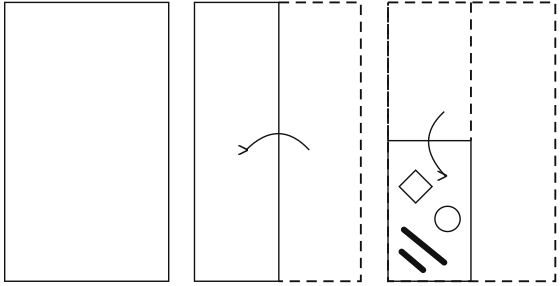
- The paper is folded twice (once vertically and once horizontally), so the final piece has 4 layers and every cut appears 4 times.
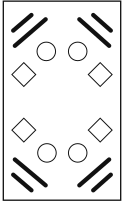
- In the folded piece there is a diamond, a circle and a pair of slanting bars. Opening the last fold mirrors them top-to-bottom; opening the first fold mirrors them left-to-right.
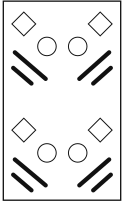
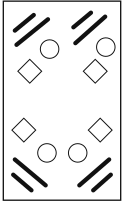
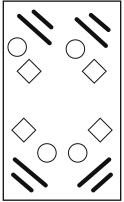
- So the upper half must be the upside-down mirror of the lower half: bars at the outer top corners, then circles, then diamonds, and the lower half the reverse.
- Only option (D) shows this double mirror symmetry; in (A), (B) and (C) the top half is not the exact reflection of the bottom half.
Trick: Check one fold at a time: the shapes nearest a fold line in the folded piece stay nearest that line in both halves after unfolding.
Answer: (D) the figure with bars at all four outer corners, mirrored about both centre lines
अवधारणा: मुड़े हुए कागज़ पर किया गया हर cut हर परत में बनता है। खोलने पर cut हर fold-line के सापेक्ष mirror होकर दिखते हैं, इसलिए अंतिम आकृति हर fold के सापेक्ष सममित (symmetric) होती है।
- कागज़ दो बार मोड़ा गया है (एक बार खड़ी रेखा पर, एक बार आड़ी रेखा पर), अतः 4 परतें बनती हैं और हर cut 4 बार दिखेगा।
- मुड़े हिस्से में एक diamond, एक circle और दो तिरछी पट्टियाँ हैं। अंतिम fold खोलने पर ये ऊपर-नीचे mirror होंगी और पहला fold खोलने पर बाएँ-दाएँ।
- इसलिए ऊपरी आधा भाग निचले आधे का उल्टा प्रतिबिंब होगा: पट्टियाँ बाहरी कोनों पर, फिर circle, फिर diamond।
- केवल विकल्प (D) में यह दोहरी symmetry है; (A), (B), (C) में ऊपरी भाग निचले भाग का सही प्रतिबिंब नहीं है।
ट्रिक: एक-एक fold उल्टे क्रम में खोलें: fold-line के पास वाली आकृतियाँ खोलने के बाद भी दोनों ओर उसी line के पास रहती हैं।
उत्तर: (D) चारों बाहरी कोनों पर पट्टियों वाली, दोनों मध्य रेखाओं के सापेक्ष सममित आकृति