Question bank

Q&A: practice questions with answers

Search questions on any topic. Filter by exam category, exam, subject and topic, try the question, then open the answer and explanation.

Courses – airGurukul

20,719 questions found.

Q1981.
P, Q and R started a business by investing ₹2,030, ₹1,700 and ₹1,010 respectively. If Q's share in the profit earned by them is ₹975, then what is the difference (in ₹) between the profits earned by P and R?
P, Q और R ने क्रमशः ₹2,030, ₹1,700 और ₹1,010 का निवेश करके एक व्यवसाय शुरू किया। यदि उनके द्वारा अर्जित लाभ में Q का हिस्सा ₹975 है, तो P और R द्वारा अर्जित लाभ के बीच का अंतर (₹ में) क्या है?
  1. A₹585
  2. B₹586
  3. C₹584
  4. D₹583
Show answer

Concept: For equal time, profit is shared in the ratio of investments.

  1. Ratio P:Q:R=2030:1700:1010=203:170:101.
  2. Q's 170 parts = ₹975 → 1 part =975170.
  3. P−R=203−101=102 parts =975×102170=975×0.6=585.

Trick: 102170=35, so the difference is 35 of Q's share.

Answer: (A) ₹585

अवधारणा: समान समय के लिए लाभ निवेश के अनुपात में बँटता है।

  1. अनुपात P:Q:R=2030:1700:1010=203:170:101।
  2. Q के 170 भाग = ₹975 → 1 भाग =975170।
  3. P−R=203−101=102 भाग =975×102170=975×0.6=585।

ट्रिक: 102170=35, अतः अंतर = Q के हिस्से का 35।

उत्तर: (A) ₹585

RRB NTPC Undergraduate CBT 1MathematicsPartnershipRRB NTPC Undergraduate CBT 1 2024 · 20 Aug Shift 3 →
Q1982.
If x is the third proportional to 32 and 24, then find the value of x.
यदि x, 32 और 24 का तृतीयानुपाती है, तो x का मान ज्ञात कीजिए।
  1. A17
  2. B20
  3. C16
  4. D18
Show answer

Concept: Third proportional to a and b is x where a:b=b:x, i.e. x=b2a.

  1. x=24232=57632
  2. x=18

Yaad rakhein: Third proportional =b2a; mean proportional =ab.

Answer: (D) 18

अवधारणा: a और b का तृतीयानुपाती x है यदि a:b=b:x, अर्थात् x=b2a।

  1. x=24232=57632
  2. x=18

याद रखें: तृतीयानुपाती =b2a; मध्यानुपाती =ab।

उत्तर: (D) 18

RRB NTPC Undergraduate CBT 1MathematicsThird proportionalRRB NTPC Undergraduate CBT 1 2024 · 20 Aug Shift 3 →
Q1983.
The cost of 7 pens and 8 pencils is ₹230. If the price of a pen decreases by ₹1 per pen and the price of a pencil increases by ₹7 per pencil, then the cost of 14 pens and 4 pencils becomes ₹150. What will be the original cost of 8 pens and 8 pencils?
7 पेन और 8 पेंसिलों का मूल्य ₹230 है। यदि एक पेन का मूल्य ₹1 प्रति पेन कम हो जाता है और एक पेंसिल का मूल्य ₹7 प्रति पेंसिल बढ़ जाता है, तो 14 पेन और 4 पेंसिलों का मूल्य ₹150 हो जाता है। 8 पेन और 8 पेंसिलों का मूल मूल्य क्या होगा?
  1. A₹230
  2. B₹228
  3. C₹232
  4. D₹229
Show answer

Concept: Form two linear equations in pen price p and pencil price c.

  1. 7p+8c=230 …(1)
  2. 14(p−1)+4(c+7)=150⇒14p+4c=136⇒7p+2c=68 …(2)
  3. (1) − (2): 6c=162⇒c=27; then 7p=230−216=14⇒p=2.
  4. 8p+8c=8(2+27)=232

Trick: Halve the second equation to match the 7p term and subtract directly.

Answer: (C) ₹232

अवधारणा: पेन का मूल्य p और पेंसिल का मूल्य c लेकर दो रैखिक समीकरण बनाएँ।

  1. 7p+8c=230 …(1)
  2. 14(p−1)+4(c+7)=150⇒14p+4c=136⇒7p+2c=68 …(2)
  3. (1) − (2): 6c=162⇒c=27; फिर 7p=230−216=14⇒p=2।
  4. 8p+8c=8(2+27)=232

ट्रिक: दूसरे समीकरण को 2 से भाग देकर 7p पद बराबर करें और सीधे घटाएँ।

उत्तर: (C) ₹232

RRB NTPC Undergraduate CBT 1MathematicsLinear equationsRRB NTPC Undergraduate CBT 1 2024 · 20 Aug Shift 3 →
Q1984.
Find the number of prime numbers between 389 and 403, both numbers included.
389 और 403 के बीच (दोनों संख्याओं को सम्मिलित करते हुए) अभाज्य संख्याओं की संख्या ज्ञात कीजिए।
  1. A6
  2. B3
  3. C1
  4. D8
Show answer

Concept: Test odd numbers for divisibility by primes up to 403≈20 (2, 3, 5, 7, 11, 13, 17, 19).

  1. Odd numbers: 389, 391, 393, 395, 397, 399, 401, 403.
  2. 391=17×23, 393=3×131, 395=5×79, 399=3×133, 403=13×31 → composite.
  3. 389, 397, 401 are prime → 3 primes.

Trick: Digit sum divisible by 3 (393, 399) and ending in 5 (395) are removed at once.

Answer: (B) 3

अवधारणा: विषम संख्याओं की 403≈20 तक के अभाज्यों (2, 3, 5, 7, 11, 13, 17, 19) से विभाज्यता जाँचें।

  1. विषम संख्याएँ: 389, 391, 393, 395, 397, 399, 401, 403।
  2. 391=17×23, 393=3×131, 395=5×79, 399=3×133, 403=13×31 → भाज्य।
  3. 389, 397, 401 अभाज्य हैं → 3 अभाज्य संख्याएँ।

ट्रिक: अंकों का योग 3 से विभाज्य (393, 399) और 5 पर समाप्त (395) संख्याएँ तुरंत हटाएँ।

उत्तर: (B) 3

RRB NTPC Undergraduate CBT 1MathematicsPrime numbersRRB NTPC Undergraduate CBT 1 2024 · 20 Aug Shift 3 →
Q1985.
₹28,000 is divided among A, B and C such that 2 times A's share = 9 times B's share = 6 times C's share. Find A's share.
₹28,000 को A, B और C के बीच इस प्रकार बाँटा जाता है कि A के हिस्से का 2 गुना = B के हिस्से का 9 गुना = C के हिस्से का 6 गुना हो। A का हिस्सा ज्ञात कीजिए।
  1. A₹17,845
  2. B₹18,195
  3. C₹18,140
  4. D₹18,000
Show answer

Concept: If 2A=9B=6C=k, then A:B:C=12:19:16.

  1. Multiply by LCM 18: A:B:C=9:2:3; total =14 parts.
  2. A's share =914×28000=18000.

Trick: Shares are inversely proportional to the multipliers 2, 9, 6.

Answer: (D) ₹18,000

अवधारणा: यदि 2A=9B=6C=k, तो A:B:C=12:19:16।

  1. LCM 18 से गुणा करें: A:B:C=9:2:3; कुल =14 भाग।
  2. A का हिस्सा =914×28000=18000।

ट्रिक: हिस्से गुणकों 2, 9, 6 के व्युत्क्रमानुपाती होते हैं।

उत्तर: (D) ₹18,000

RRB NTPC Undergraduate CBT 1MathematicsRatio – division of moneyRRB NTPC Undergraduate CBT 1 2024 · 20 Aug Shift 3 →
Q1986.
Simplify the following.
3((53)x2−28x+15)−5(x2+6x−15)
निम्नलिखित को सरल कीजिए।
3((53)x2−28x+15)−5(x2+6x−15)
  1. A114x − 120
  2. B114x + 120
  3. C−114x − 120
  4. D−114x + 120
Show answer

Concept: Expand each bracket, then combine like terms.

  1. 3(53x2−28x+15)=5x2−84x+45
  2. −5(x2+6x−15)=−5x2−30x+75
  3. Add: (5x2−5x2)+(−84x−30x)+(45+75)=−114x+120

Trick: The x2 terms cancel; only track the x terms (−84−30) and constants (45+75).

Answer: (D) −114x+120

अवधारणा: प्रत्येक कोष्ठक खोलें, फिर समान पदों को जोड़ें।

  1. 3(53x2−28x+15)=5x2−84x+45
  2. −5(x2+6x−15)=−5x2−30x+75
  3. जोड़ें: (5x2−5x2)+(−84x−30x)+(45+75)=−114x+120

ट्रिक: x2 वाले पद कट जाते हैं; केवल x पद (−84−30) और अचर (45+75) देखें।

उत्तर: (D) −114x+120

RRB NTPC Undergraduate CBT 1MathematicsAlgebraic simplificationRRB NTPC Undergraduate CBT 1 2024 · 20 Aug Shift 3 →
Q1987.
The average price of three items of furniture is ₹5,310. If their prices are in the ratio 3 : 5 : 7, then find the price (in ₹) of the cheapest item.
फर्नीचर की तीन वस्तुओं का औसत मूल्य ₹5,310 है। यदि उनके मूल्य 3 : 5 : 7 के अनुपात में हैं, तो सबसे सस्ती वस्तु का मूल्य (₹ में) ज्ञात कीजिए।
  1. A5,310
  2. B3,186
  3. C7,434
  4. D1,062
Show answer

Concept: Total = average × number; then share in ratio.

  1. Total price =3×5310=15930.
  2. Ratio sum =3+5+7=15.
  3. Cheapest =315×15930=3186.

Trick: Average of the parts =5 parts =5310 → 1 part =1062 → 3 parts =3186.

Answer: (B) 3,186

अवधारणा: कुल = औसत × संख्या; फिर अनुपात में बाँटें।

  1. कुल मूल्य =3×5310=15930।
  2. अनुपात का योग =3+5+7=15।
  3. सबसे सस्ती वस्तु =315×15930=3186।

ट्रिक: औसत =5 भाग =5310 → 1 भाग =1062 → 3 भाग =3186।

उत्तर: (B) 3,186

RRB NTPC Undergraduate CBT 1MathematicsAverage and ratioRRB NTPC Undergraduate CBT 1 2024 · 20 Aug Shift 3 →
Q1988.
A can lay a railway track between two stations in 22 days and B can complete the same work in 10 days. With the help of C, they completed the work in only 2 days. In how many days can C alone complete the work?
A दो स्टेशनों के बीच रेल पटरी को 22 दिनों में बिछा सकता है और B उसी कार्य को 10 दिनों में पूरा कर सकता है। C की सहायता से, उन्होंने यह कार्य केवल 2 दिनों में पूरा कर लिया। C अकेले इस कार्य को कितने दिनों में पूरा कर सकता है?
  1. A113239 days113239 दिन
  2. B83239 days83239 दिन
  3. C123239 days123239 दिन
  4. D23239 days23239 दिन
Show answer

Concept: One-day work of C = (A+B+C) work − A's work − B's work.

  1. 1C=12−122−110
  2. LCM 110: 55−5−11110=39110
  3. C alone =11039=23239 days.

Trick: All three finish in 2 days, so C alone must take more than 2 days but fewer than A or B — only 23239 fits.

Answer: (D) 23239 days

अवधारणा: C का एक दिन का काम = (A+B+C) का काम − A का काम − B का काम।

  1. 1C=12−122−110
  2. LCM 110: 55−5−11110=39110
  3. C अकेले =11039=23239 दिन।

ट्रिक: तीनों मिलकर 2 दिन लेते हैं, अतः C अकेले 2 दिन से अधिक पर A या B से कम समय लेगा — केवल 23239 ठीक बैठता है।

उत्तर: (D) 23239 दिन

RRB NTPC Undergraduate CBT 1MathematicsTime and workRRB NTPC Undergraduate CBT 1 2024 · 20 Aug Shift 3 →
Q1989.
An article with a marked price of ₹38,800 is available at a single discount of 25% or at two successive discounts of 10% and 15%. What will be the difference between the selling prices under these discount schemes?
₹38,800 अंकित मूल्य वाली एक वस्तु 25% की एकल छूट पर या 10% और 15% की दो क्रमिक छूटों पर उपलब्ध है। इन छूट योजनाओं के अंतर्गत विक्रय मूल्यों के बीच कितना अंतर होगा?
  1. A₹825
  2. B₹800
  3. C₹628
  4. D₹582
Show answer

Concept: Successive discounts a% and b% equal a single discount of a+b−ab100.

  1. Equivalent discount =10+15−150100=23.5%.
  2. Difference in discount =25%−23.5%=1.5%.
  3. Difference in SP =1.5% of 38800=582.

Trick: No need to find both SPs — just take the gap between the two equivalent discounts on the MP.

Answer: (D) ₹582

अवधारणा: क्रमिक छूट a% और b% = एकल छूट a+b−ab100।

  1. समतुल्य छूट =10+15−150100=23.5%।
  2. छूट में अंतर =25%−23.5%=1.5%।
  3. विक्रय मूल्य में अंतर =38800 का 1.5%=582।

ट्रिक: दोनों विक्रय मूल्य निकालने की आवश्यकता नहीं — अंकित मूल्य पर दोनों समतुल्य छूटों का अंतर लें।

उत्तर: (D) ₹582

RRB NTPC Undergraduate CBT 1MathematicsDiscount – successive discountsRRB NTPC Undergraduate CBT 1 2024 · 20 Aug Shift 3 →
Q1990.
If 2 times Ram's age is 25 years more than 9 times Ramya's age, and 5 times Ramya's age is 4 years less than Ram's age, then find the difference (in years) between the ages of Ram and Ramya.
यदि राम की आयु का 2 गुना, रम्या की आयु के 9 गुने से 25 वर्ष अधिक है, और रम्या की आयु का 5 गुना, राम की आयु से 4 वर्ष कम है, तो राम और रम्या की आयु के बीच का अंतर (वर्षों में) ज्ञात कीजिए।
  1. A72
  2. B77
  3. C74
  4. D75
Show answer

Concept: Let Ram =R, Ramya =r and form two equations.

  1. 2R=9r+25 and 5r=R−4⇒R=5r+4.
  2. 2(5r+4)=9r+25⇒10r+8=9r+25⇒r=17.
  3. R=5(17)+4=89; difference =89−17=72.

Trick: Substitute R=5r+4 straight away — one variable remains.

Answer: (A) 72

अवधारणा: माना राम की आयु =R, रम्या की आयु =r; दो समीकरण बनाएँ।

  1. 2R=9r+25 और 5r=R−4⇒R=5r+4।
  2. 2(5r+4)=9r+25⇒10r+8=9r+25⇒r=17।
  3. R=5(17)+4=89; अंतर =89−17=72 वर्ष।

ट्रिक: सीधे R=5r+4 रखें — एक ही चर बचता है।

उत्तर: (A) 72

RRB NTPC Undergraduate CBT 1MathematicsProblems on agesRRB NTPC Undergraduate CBT 1 2024 · 20 Aug Shift 3 →
Q1991.
A wholesaler offers a scheme discount of 10% on a marked price of ₹400. Find the selling price.
एक थोक विक्रेता ₹400 के अंकित मूल्य पर 10% की योजना छूट देता है। विक्रय मूल्य ज्ञात कीजिए।
  1. A₹360
  2. B₹350
  3. C₹380
  4. D₹370
Show answer

Concept: SP=MP×100−d100.

  1. Discount =10% of 400=40.
  2. SP =400−40=360.

Trick: 10% off → multiply MP by 0.9: 400×0.9=360.

Answer: (A) ₹360

अवधारणा: SP=MP×100−d100।

  1. छूट =400 का 10%=40।
  2. विक्रय मूल्य =400−40=360।

ट्रिक: 10% छूट → अंकित मूल्य को 0.9 से गुणा करें: 400×0.9=360।

उत्तर: (A) ₹360

RRB NTPC Undergraduate CBT 1MathematicsDiscountRRB NTPC Undergraduate CBT 1 2024 · 20 Aug Shift 3 →
Q1992.
Find the simple interest (in ₹) at 6.75% per annum on a sum of ₹4,000 deposited on 21 February 2024 and withdrawn on 22 April 2024.
21 फरवरी 2024 को जमा की गई और 22 अप्रैल 2024 को निकाली गई ₹4,000 की राशि पर 6.75% वार्षिक दर से साधारण ब्याज (₹ में) ज्ञात कीजिए।
  1. A₹45
  2. B₹46
  3. C₹44
  4. D₹43
Show answer

Concept: Count days excluding the deposit day and including the withdrawal day; SI=P×R×T100.

  1. 2024 is a leap year: February 29−21=8 days, March 31, April 22 → 61 days.
  2. T=61366 year.
  3. SI=4000×6.75×61100×366=16470366=45

Yaad rakhein: Count only one of the two end dates; with 365 days the SI is 45.12≈45, the same option.

Answer: (A) ₹45

अवधारणा: जमा का दिन छोड़कर और निकासी का दिन जोड़कर दिन गिनें; SI=P×R×T100।

  1. 2024 लीप वर्ष है: फरवरी 29−21=8 दिन, मार्च 31, अप्रैल 22 → 61 दिन।
  2. T=61366 वर्ष।
  3. SI=4000×6.75×61100×366=16470366=45

याद रखें: दोनों तिथियों में से केवल एक गिनें; 365 दिन लेने पर भी ब्याज 45.12≈45 आता है।

उत्तर: (A) ₹45

RRB NTPC Undergraduate CBT 1MathematicsSimple interest – daysRRB NTPC Undergraduate CBT 1 2024 · 20 Aug Shift 3 →
Q1993.
Given that 70.07=x, 70.07=y and xz=y3, then the value of z will be closest to __________.
दिया गया है कि 70.07=x, 70.07=y और xz=y3, तो z का मान __________ के सबसे निकट होगा।
  1. A3.41
  2. B3
  3. C5.42
  4. D1.23
Show answer

Concept: If the bases are equal, the exponents are equal.

  1. Both x and y equal 70.07, so x=y.
  2. xz=y3⇒(70.07)z=(70.07)3.
  3. 0.07z=0.21⇒z=3.

Trick: x=y (and x≠1), so xz=x3 gives z=3 at once.

Answer: (B) 3

अवधारणा: आधार समान हों तो घातें समान होती हैं।

  1. x और y दोनों 70.07 के बराबर हैं, अतः x=y।
  2. xz=y3⇒(70.07)z=(70.07)3।
  3. 0.07z=0.21⇒z=3।

ट्रिक: x=y (और x≠1), अतः xz=x3 से सीधे z=3।

उत्तर: (B) 3

RRB NTPC Undergraduate CBT 1MathematicsIndicesRRB NTPC Undergraduate CBT 1 2024 · 20 Aug Shift 3 →
Q1994.
A person driving a car at a speed of 79 km/hr crosses a bridge in 3.6 minutes. Find the length of the bridge.
79 km/hr की चाल से कार चला रहा एक व्यक्ति एक पुल को 3.6 मिनट में पार करता है। पुल की लंबाई ज्ञात कीजिए।
  1. A4.01 km
  2. B4.88 km
  3. C4.74 km
  4. D4.21 km
Show answer

Concept: Distance = speed × time (same units). The car's own length is negligible.

  1. 3.6 min =3.660=0.06 h.
  2. Length =79×0.06=4.74km.

Trick: Minutes → hours: divide by 60; 3.6÷60=0.06.

Answer: (C) 4.74km

अवधारणा: दूरी = चाल × समय (समान इकाई में)। कार की लंबाई नगण्य है।

  1. 3.6 मिनट =3.660=0.06 घंटा।
  2. पुल की लंबाई =79×0.06=4.74km।

ट्रिक: मिनट → घंटा: 60 से भाग दें; 3.6÷60=0.06।

उत्तर: (C) 4.74km

RRB NTPC Undergraduate CBT 1MathematicsSpeed, time and distanceRRB NTPC Undergraduate CBT 1 2024 · 20 Aug Shift 3 →
Q1995.
The H.C.F. and L.C.M. of two numbers are 5 and 495 respectively. If one of the numbers is 55, then find the other number.
दो संख्याओं का म.स.प. (H.C.F.) और ल.स.प. (L.C.M.) क्रमशः 5 और 495 हैं। यदि उनमें से एक संख्या 55 है, तो दूसरी संख्या ज्ञात कीजिए।
  1. A45
  2. B64
  3. C8
  4. D9
Show answer

Concept: Product of two numbers = HCF × LCM.

  1. 55×x=5×495=2475
  2. x=247555=45
  3. Check: HCF(55, 45) =5 ✔

Trick: The other number must be a multiple of the HCF 5 — rules out 64, 8, 9 instantly.

Answer: (A) 45

अवधारणा: दो संख्याओं का गुणनफल = HCF × LCM।

  1. 55×x=5×495=2475
  2. x=247555=45
  3. जाँच: HCF(55, 45) =5 ✔

ट्रिक: दूसरी संख्या HCF 5 का गुणज होनी चाहिए — 64, 8, 9 तुरंत हट जाते हैं।

उत्तर: (A) 45

RRB NTPC Undergraduate CBT 1MathematicsHCF and LCMRRB NTPC Undergraduate CBT 1 2024 · 20 Aug Shift 3 →
Q1996.
Refer to the following number and symbol series and answer the question given below. Counting is to be done from left to right only.
(Left) $ \ % % # > ? > ^ # 6 5 > > 4 9 \ 6 ^ \ / (Right)
How many such numbers are there each of which is immediately preceded by a symbol and also immediately followed by a symbol?
निम्नलिखित संख्या और प्रतीक श्रृंखला को देखिए और नीचे दिए गए प्रश्न का उत्तर दीजिए। गिनती केवल बाएँ से दाएँ की जानी है।
(बाएँ) $ \ % % # > ? > ^ # 6 5 > > 4 9 \ 6 ^ \ / (दाएँ)
ऐसी कितनी संख्याएँ हैं जिनमें से प्रत्येक के ठीक पहले एक प्रतीक है और ठीक बाद में भी एक प्रतीक है?
  1. AOneएक
  2. BTwoदो
  3. CFourचार
  4. DThreeतीन
Show answer

Concept: Check every number: the element just before AND just after it must both be symbols.

  1. Numbers in order: 6, 5, 4, 9, 6.
  2. First 6: before # (symbol), after 5 (number) ✘. 5: before 6 ✘. 4: before >, after 9 ✘. 9: before 4 ✘.
  3. Last 6: before \ (symbol), after ^ (symbol) ✔.
  4. Only one such number.

Trick: Numbers that sit in pairs (6 5, 4 9) can never qualify — only isolated numbers need checking.

Answer: (A) One

अवधारणा: प्रत्येक संख्या जाँचें: उसके ठीक पहले और ठीक बाद, दोनों प्रतीक होने चाहिए।

  1. क्रम से संख्याएँ: 6, 5, 4, 9, 6।
  2. पहला 6: पहले # (प्रतीक), बाद में 5 (संख्या) ✘। 5: पहले 6 ✘। 4: पहले >, बाद में 9 ✘। 9: पहले 4 ✘।
  3. अंतिम 6: पहले \ (प्रतीक), बाद में ^ (प्रतीक) ✔।
  4. केवल एक ऐसी संख्या है।

ट्रिक: जोड़े में आने वाली संख्याएँ (6 5, 4 9) कभी शर्त पूरी नहीं करतीं — केवल अकेली संख्याएँ जाँचें।

उत्तर: (A) एक

RRB NTPC Undergraduate CBT 1General Intelligence and ReasoningNumber–symbol seriesRRB NTPC Undergraduate CBT 1 2024 · 20 Aug Shift 3 →
Q1997.
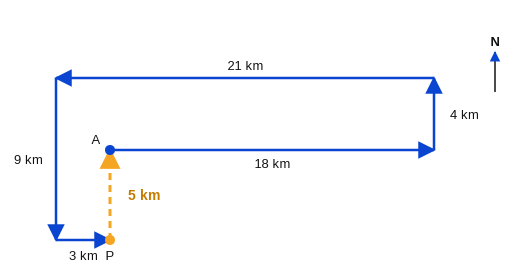
Jhik starts driving from point A and drives 18 km towards the east. Then he turns left and drives 4 km, then he turns left and drives 21 km. Then he turns left and drives 9 km. He takes a final left turn, drives 3 km and stops at point P. How far (shortest distance) and in which direction should he drive to reach point A again? (All turns are 90° turns only unless specified.)
झिक बिंदु A से गाड़ी चलाना शुरू करता है और पूर्व की ओर 18 km गाड़ी चलाता है। फिर वह बाएँ मुड़ता है और 4 km गाड़ी चलाता है, फिर वह बाएँ मुड़ता है और 21 km गाड़ी चलाता है। फिर वह बाएँ मुड़ता है और 9 km गाड़ी चलाता है। वह अंतिम बार बाएँ मुड़ता है, 3 km गाड़ी चलाता है और बिंदु P पर रुक जाता है। बिंदु A पर फिर से पहुँचने के लिए उसे कितनी दूर (न्यूनतम दूरी) और किस दिशा में गाड़ी चलानी चाहिए? (जब तक निर्दिष्ट न किया जाए, सभी मोड़ केवल 90° के मोड़ हैं।)
  1. A6 km towards north6 km उत्तर की ओर
  2. B5 km towards north5 km उत्तर की ओर
  3. C6 km towards east6 km पूर्व की ओर
  4. D5 km towards south5 km दक्षिण की ओर
Show answer

Concept: Track net east–west and north–south displacement with A as origin.

  1. East–west: +18−21+3=0 → P is directly in line with A.
  2. North–south: +4−9=−5 → P is 5 km south of A.
  3. To return, drive 5 km towards north.

Trick: Four left turns from east: E → N → W → S → E; just add same-axis moves.

Answer: (B) 5 km towards north

अवधारणा: A को मूल बिंदु मानकर पूर्व–पश्चिम और उत्तर–दक्षिण का कुल विस्थापन निकालें।

  1. पूर्व–पश्चिम: +18−21+3=0 → P, A की सीध में है।
  2. उत्तर–दक्षिण: +4−9=−5 → P, A से 5 km दक्षिण में है।
  3. वापस पहुँचने के लिए 5 km उत्तर की ओर जाना होगा।

ट्रिक: पूर्व से चार बार बाएँ: पूर्व → उत्तर → पश्चिम → दक्षिण → पूर्व; एक ही अक्ष की दूरियाँ जोड़ें।

उत्तर: (B) 5 km उत्तर की ओर

RRB NTPC Undergraduate CBT 1General Intelligence and ReasoningDirection and distanceRRB NTPC Undergraduate CBT 1 2024 · 20 Aug Shift 3 →
Q1998.
Mr. Tony is 69th from the top and 13th from the bottom in his class. How many students are there in his class in total?
श्री टोनी अपनी कक्षा में ऊपर से 69वें और नीचे से 13वें स्थान पर है। उसकी कक्षा में कुल कितने विद्यार्थी हैं?
  1. A82
  2. B83
  3. C80
  4. D81
Show answer

Concept: Total = rank from top + rank from bottom −1.

  1. Total =69+13−1
  2. =81

Yaad rakhein: Subtract 1 because Tony is counted in both ranks.

Answer: (D) 81

अवधारणा: कुल = ऊपर से स्थान + नीचे से स्थान −1।

  1. कुल =69+13−1
  2. =81

याद रखें: 1 घटाएँ क्योंकि टोनी दोनों गिनतियों में शामिल है।

उत्तर: (D) 81

RRB NTPC Undergraduate CBT 1General Intelligence and ReasoningRankingRRB NTPC Undergraduate CBT 1 2024 · 20 Aug Shift 3 →
Q1999.
Seven boxes A, B, C, D, E, F and G are placed one above the other, but not necessarily in the same order.
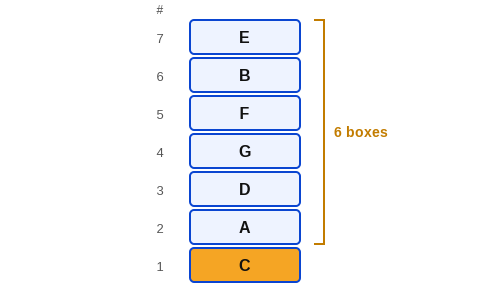
F is placed immediately above G. A is placed immediately above C. Only E is placed above B. Only two boxes are placed above F. A is not placed third from the bottom. How many boxes are placed above C?
सात डिब्बे A, B, C, D, E, F और G एक के ऊपर एक रखे गए हैं, लेकिन आवश्यक नहीं कि इसी क्रम में हों।
F को G के ठीक ऊपर रखा गया है। A को C के ठीक ऊपर रखा गया है। B के ऊपर केवल E रखा गया है। F के ऊपर केवल दो डिब्बे रखे गए हैं। A को नीचे से तीसरे स्थान पर नहीं रखा गया है। C के ऊपर कितने डिब्बे रखे गए हैं?
  1. AThreeतीन
  2. BFiveपाँच
  3. CSixछह
  4. DFourचार
Show answer

Concept: Fix the definite positions first (number from bottom =1 to top =7).

  1. Only E above B → E =7, B =6.
  2. Only two above F → F =5; G just below F → G =4.
  3. A just above C in positions 3, 2, 1; A is not 3rd → A =2, C =1, D =3.
  4. C is at the bottom, so 6 boxes are above it.

Trick: "Only X above Y" fixes the top two boxes at once.

Answer: (C) Six

अवधारणा: पहले निश्चित स्थान तय करें (नीचे से 1 से ऊपर 7 तक)।

  1. B के ऊपर केवल E → E =7, B =6।
  2. F के ऊपर केवल दो → F =5; G ठीक F के नीचे → G =4।
  3. A ठीक C के ऊपर, स्थान 3, 2, 1 में; A तीसरे स्थान पर नहीं → A =2, C =1, D =3।
  4. C सबसे नीचे है, अतः उसके ऊपर 6 बक्से हैं।

ट्रिक: "Y के ऊपर केवल X" से सबसे ऊपर के दो बक्से तुरंत तय हो जाते हैं।

उत्तर: (C) छह

RRB NTPC Undergraduate CBT 1General Intelligence and ReasoningBox arrangementRRB NTPC Undergraduate CBT 1 2024 · 20 Aug Shift 3 →
Q2000.
Based on the English alphabetical order, three of the following four letter-cluster pairs are alike in a certain way and thus form a group. Which letter-cluster pair does NOT belong to that group? (Note: The odd letter-cluster pair is not based on the number of consonants/vowels or their position in the letter cluster.)
अंग्रेज़ी वर्णमाला क्रम के आधार पर, निम्नलिखित चार अक्षर-समूह युग्मों में से तीन किसी निश्चित प्रकार से एकसमान हैं और इस प्रकार एक समूह बनाते हैं। कौन-सा अक्षर-समूह युग्म उस समूह से संबंधित नहीं है? (ध्यान दें: असंगत अक्षर-समूह युग्म, उस अक्षर-समूह में व्यंजनों/स्वरों की संख्या या उनके स्थान पर आधारित नहीं है।)
  1. ATM - OO
  2. BCP - XS
  3. CIY - DA
  4. DNH - IJ
Show answer

Concept: Compare first-to-first and second-to-second letters by their positions.

  1. TM - OO: T(20) −5 = O(15); M(13) +2 = O(15).
  2. IY - DA: I(9) −5 = D(4); Y(25) +2 = A(1, wrap). NH - IJ: N(14) −5 = I(9); H(8) +2 = J(10).
  3. CP - XS: C −5 = X ✔ but P(16) +2 = R, not S ✘.

Trick: Rule (−5,+2); CP - XS uses +3 in the second letter.

Answer: (B) CP - XS

अवधारणा: पहले-से-पहले और दूसरे-से-दूसरे अक्षर की स्थिति की तुलना करें।

  1. TM - OO: T(20) −5 = O(15); M(13) +2 = O(15)।
  2. IY - DA: I(9) −5 = D(4); Y(25) +2 = A(1, चक्रीय)। NH - IJ: N(14) −5 = I(9); H(8) +2 = J(10)।
  3. CP - XS: C −5 = X ✔ पर P(16) +2 = R, S नहीं ✘।

ट्रिक: नियम (−5,+2); CP - XS के दूसरे अक्षर में +3 है।

उत्तर: (B) CP - XS

RRB NTPC Undergraduate CBT 1General Intelligence and ReasoningOdd one out – letter pairsRRB NTPC Undergraduate CBT 1 2024 · 20 Aug Shift 3 →