Question bank

Q&A: practice questions with answers

Search questions on any topic. Filter by exam category, exam, subject and topic, try the question, then open the answer and explanation.

Courses – airGurukul

20,719 questions found.

Q2361.
In May 2025, India approved the execution model for which indigenous fifth-generation fighter aircraft program?
मई 2025 में भारत ने किस स्वदेशी पाँचवीं पीढ़ी के लड़ाकू विमान कार्यक्रम के निष्पादन मॉडल को मंज़ूरी दी?
  1. AAdvanced Medium Combat Aircraft (AMCA)उन्नत मध्यम लड़ाकू विमान (AMCA)
  2. BMedium Combat Aircraft (MCA)मध्यम लड़ाकू विमान (MCA)
  3. CHAL Twin Engine Deck Based Fighter (TEDBF)HAL ट्विन इंजन डेक आधारित लड़ाकू विमान (TEDBF)
  4. DTejas Mk2तेजस Mk2
Show answer

Concept: The Advanced Medium Combat Aircraft (AMCA) is India's indigenous fifth-generation stealth fighter programme.

  1. In May 2025 the Defence Minister approved its execution model, led by the Aeronautical Development Agency (ADA) with industry partnership (private and public firms can bid).
  2. Tejas Mk2 is a 4.5-generation fighter; TEDBF is a carrier-based fighter.

Yaad rakhein: AMCA – 5th gen stealth – ADA; Tejas – light combat aircraft.

Answer: (A) Advanced Medium Combat Aircraft (AMCA)

अवधारणा: एडवांस्ड मीडियम कॉम्बैट एयरक्राफ़्ट (AMCA) भारत का स्वदेशी पाँचवीं पीढ़ी का स्टेल्थ लड़ाकू विमान कार्यक्रम है।

  1. मई 2025 में रक्षा मंत्री ने इसके क्रियान्वयन मॉडल को मंज़ूरी दी, जिसका नेतृत्व ADA करेगी और उद्योग साझेदारी (निजी व सार्वजनिक कंपनियाँ) होगी।
  2. तेजस Mk2 4.5 पीढ़ी का विमान है; TEDBF विमानवाहक पोत आधारित लड़ाकू विमान है।

याद रखें: AMCA – 5वीं पीढ़ी स्टेल्थ – ADA; तेजस – हल्का लड़ाकू विमान।

उत्तर: (A) AMCA
RRB NTPC Undergraduate CBT 1General AwarenessDefence 2025RRB NTPC Undergraduate CBT 1 2024 · 19 Aug Shift 2 →
Q2362.
In which of the following cities was the Sepak Takraw 2025 World Cup (ISTAF) held in India in March 2025?
मार्च 2025 में भारत में सेपक टकरा 2025 विश्व कप (ISTAF) निम्नलिखित में से किस शहर में आयोजित किया गया था?
  1. AMumbaiमुंबई
  2. BPatnaपटना
  3. CBengaluruबेंगलुरु
  4. DNew Delhiनई दिल्ली
Show answer

Concept: Sepak Takraw ('kick volleyball') is a sport played with the feet, knees and head over a net.

  1. The ISTAF Sepak Takraw World Cup 2025 was held in Patna, Bihar in March 2025 – the first time India hosted it.
  2. India won medals including a historic gold in the men's quad event.

Yaad rakhein: Sepak Takraw World Cup 2025 – Patna (Bihar).

Answer: (B) Patna

अवधारणा: सेपक टकरॉ ('किक वॉलीबॉल') जाल के ऊपर पैरों, घुटनों और सिर से खेला जाने वाला खेल है।

  1. ISTAF सेपक टकरॉ विश्व कप 2025 मार्च 2025 में पटना, बिहार में हुआ – भारत ने पहली बार इसकी मेज़बानी की।
  2. भारत ने पुरुष क्वाड स्पर्धा में ऐतिहासिक स्वर्ण सहित पदक जीते।

याद रखें: सेपक टकरॉ विश्व कप 2025 – पटना (बिहार)।

उत्तर: (B) पटना

RRB NTPC Undergraduate CBT 1General AwarenessSports events 2025RRB NTPC Undergraduate CBT 1 2024 · 19 Aug Shift 2 →
Q2363.
Which Rajput ruler founded the Gurjara-Pratihara dynasty in Malwa during the 8th century CE?
8वीं शताब्दी ई. में किस राजपूत शासक ने मालवा में गुर्जर-प्रतिहार राजवंश की स्थापना की?
  1. ANagabhatta Iनागभट्ट प्रथम
  2. BMihira Bhojaमिहिर भोज
  3. CVatsarajaवत्सराज
  4. DDhruvaध्रुव
Show answer

Concept: The Gurjara-Pratiharas were one of the three powers of the Tripartite Struggle for Kannauj (with Palas and Rashtrakutas).

  1. Nagabhata I (c. 730–760 CE) founded the dynasty in Malwa (Avanti/Ujjain) and resisted the Arab invasions.
  2. Vatsaraja and Mihira Bhoja were later rulers – Mihira Bhoja was the greatest; Dhruva was a Rashtrakuta king.

Yaad rakhein: Pratihara: founder Nagabhata I; greatest Mihira Bhoja (Adivaraha).

Answer: (A) Nagabhatta I

अवधारणा: गुर्जर-प्रतिहार कन्नौज के त्रिपक्षीय संघर्ष की तीन शक्तियों में से एक थे (पाल और राष्ट्रकूट के साथ)।

  1. नागभट्ट प्रथम (लगभग 730–760 ई.) ने मालवा (अवंति/उज्जैन) में राजवंश की स्थापना की और अरब आक्रमणों का प्रतिरोध किया।
  2. वत्सराज और मिहिर भोज बाद के शासक थे – मिहिर भोज सबसे महान; ध्रुव राष्ट्रकूट राजा था।

याद रखें: प्रतिहार: संस्थापक नागभट्ट प्रथम; सबसे महान मिहिर भोज (आदिवराह)।

उत्तर: (A) नागभट्ट प्रथम

RRB NTPC Undergraduate CBT 1General AwarenessEarly medieval IndiaRRB NTPC Undergraduate CBT 1 2024 · 19 Aug Shift 2 →
Q2364.
Who led the Tamar tribal revolts against the British in India?
भारत में अंग्रेज़ों के विरुद्ध तमाड़ जनजातीय विद्रोहों का नेतृत्व किसने किया?
  1. ATilka Manjhiतिलका मांझी
  2. BSidhu Murmuसिद्धू मुर्मू
  3. CGanga Narain Singhगंगा नारायण सिंह
  4. DBhola Nath Sahayभोला नाथ सहाय
Show answer

Concept: The Tamar revolt (1789–94) was a tribal uprising in the Tamar region of Chota Nagpur (present Jharkhand) against British land and revenue policies.

  1. It was led by Bhola Nath Sahay.
  2. Tilka Manjhi led an early Santhal/Paharia uprising (1784–85), Sidhu Murmu led the Santhal Hul (1855) and Ganga Narain Singh led the Bhumij revolt (1832).

Yaad rakhein: Tamar – Bhola Nath Sahay; Bhumij – Ganga Narain; Santhal – Sidhu–Kanhu.

Answer: (D) Bhola Nath Sahay

अवधारणा: तमाड़ विद्रोह (1789–94) छोटा नागपुर (वर्तमान झारखंड) के तमाड़ क्षेत्र में ब्रिटिश भूमि व राजस्व नीतियों के विरुद्ध जनजातीय विद्रोह था।

  1. इसका नेतृत्व भोलानाथ सहाय ने किया।
  2. तिलका माँझी ने प्रारंभिक संथाल/पहाड़िया विद्रोह (1784–85), सिद्धू मुर्मू ने संथाल हूल (1855) और गंगा नारायण सिंह ने भूमिज विद्रोह (1832) का नेतृत्व किया।

याद रखें: तमाड़ – भोलानाथ सहाय; भूमिज – गंगा नारायण; संथाल – सिद्धू–कान्हू।

उत्तर: (D) भोलानाथ सहाय

RRB NTPC Undergraduate CBT 1General AwarenessTribal revoltsRRB NTPC Undergraduate CBT 1 2024 · 19 Aug Shift 2 →
Q2365.
Which of the following is a primary function of the District Courts in India?
निम्नलिखित में से कौन-सा भारत में जिला न्यायालयों का प्राथमिक कार्य है?
  1. AAdvising the President of Indiaभारत के राष्ट्रपति को सलाह देना
  2. BHearing appeals from lower courts within the districtजिले के भीतर अधीनस्थ न्यायालयों से अपीलों की सुनवाई करना
  3. CSettling disputes between Union and State governmentsकेंद्र और राज्य सरकारों के बीच विवादों का निपटारा करना
  4. DIssuing writs to enforce fundamental rights (without High Court)मौलिक अधिकारों को लागू करने के लिए रिट जारी करना (उच्च न्यायालय के बिना)
Show answer

Concept: The District Court is the highest court in a district, under the supervision of the High Court.

  1. It hears appeals from subordinate (lower) civil and criminal courts in the district and also tries serious cases.
  2. Advising the President is done by the Supreme Court (Art. 143); Centre–State disputes go to the Supreme Court (Art. 131); writs are issued by the Supreme Court (Art. 32) and High Courts (Art. 226).

Yaad rakhein: Writs → SC and HC only; Centre–State dispute → SC original jurisdiction.

Answer: (B) Hearing appeals from lower courts within the district

अवधारणा: ज़िला न्यायालय ज़िले का सर्वोच्च न्यायालय है, जो उच्च न्यायालय की निगरानी में कार्य करता है।

  1. यह ज़िले के अधीनस्थ दीवानी और फ़ौजदारी न्यायालयों से आई अपीलें सुनता है और गंभीर मामलों का विचारण भी करता है।
  2. राष्ट्रपति को सलाह सर्वोच्च न्यायालय देता है (अनु. 143); केंद्र–राज्य विवाद सर्वोच्च न्यायालय में (अनु. 131); रिट सर्वोच्च न्यायालय (अनु. 32) और उच्च न्यायालय (अनु. 226) जारी करते हैं।

याद रखें: रिट → केवल SC और HC; केंद्र–राज्य विवाद → SC का मूल क्षेत्राधिकार।

उत्तर: (B) ज़िले के अधीनस्थ न्यायालयों से अपीलें सुनना

RRB NTPC Undergraduate CBT 1General AwarenessJudiciaryRRB NTPC Undergraduate CBT 1 2024 · 19 Aug Shift 2 →
Q2366.
The average of first 150 odd natural numbers, is:
प्रथम 150 विषम प्राकृत संख्याओं का औसत कितना है?
  1. A150.5
  2. B151
  3. C150
  4. D149.5
Show answer

Concept: Sum of first n odd natural numbers =n2, so their average =n2n=n.

  1. Here n=150.
  2. Sum =1502=22500.
  3. Average =22500150=150.

Trick: Average of first n odd numbers =n; of first n even numbers =n+1.

Answer: (C) 150

अवधारणा: पहली n विषम प्राकृत संख्याओं का योग =n2, अतः औसत =n2n=n।

  1. यहाँ n=150।
  2. योग =1502=22500।
  3. औसत =22500150=150।

ट्रिक: पहली n विषम संख्याओं का औसत =n; पहली n सम संख्याओं का औसत =n+1।

उत्तर: (C) 150

RRB NTPC Undergraduate CBT 1MathematicsAverageRRB NTPC Undergraduate CBT 1 2024 · 19 Aug Shift 2 →
Q2367.
If the interest earned during the 2nd year on a certain sum is ₹3,342, and the rate of interest is 20% per annum compounded annually, then the sum is:
यदि किसी निश्चित धनराशि पर दूसरे (2nd) वर्ष के दौरान अर्जित ब्याज ₹3,342 है, और ब्याज की दर 20% वार्षिक है, जो वार्षिक रूप से चक्रवृद्धि होती है, तो धनराशि ज्ञात कीजिए।
  1. A₹13,285
  2. B₹13,925
  3. C₹14,900
  4. D₹14,075
Show answer

Concept: With CI, the 2nd-year interest is the rate applied to (principal + 1st-year interest): I2=P×r100×(1+r100).

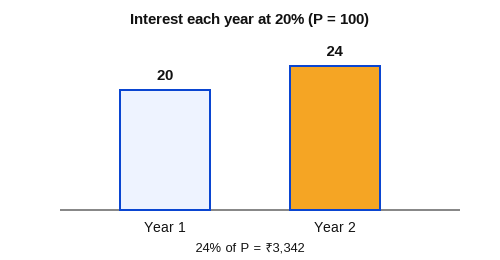
  1. Take P=100: 1st-year interest =20, amount =120.
  2. 2nd-year interest =20% of 120=24, i.e., 24% of P.
  3. 0.24P=3342⇒P=33420.24=13925.

Trick: 2nd-year CI =P×r100×100+r100; at 20% it is 625P.

Answer: (B) ₹13,925

अवधारणा: चक्रवृद्धि ब्याज में दूसरे वर्ष का ब्याज (मूलधन + पहले वर्ष का ब्याज) पर लगता है: I2=P×r100×(1+r100)।

  1. मान लें P=100: पहले वर्ष ब्याज =20, मिश्रधन =120।
  2. दूसरे वर्ष ब्याज =120 का 20%=24, अर्थात P का 24%।
  3. 0.24P=3342⇒P=33420.24=13925।

ट्रिक: दूसरे वर्ष का CI =P×r100×100+r100; 20% पर यह 625P है।

उत्तर: (B) ₹13,925

RRB NTPC Undergraduate CBT 1MathematicsCompound interestRRB NTPC Undergraduate CBT 1 2024 · 19 Aug Shift 2 →
Q2368.
If 2 times a son's age is added to his father's age, the sum is 36 years. If 2.5 times the father's age is added to the son's age, the sum is 72 years. What is the father's age (in years)?
यदि पुत्र की आयु के 2 गुने को उसके पिता की आयु में जोड़ा जाए, तो योग 36 वर्ष होता है। यदि पिता की आयु के 2.5 गुने को पुत्र की आयु में जोड़ा जाए, तो योग 72 वर्ष होता है। पिता की आयु (वर्षों में) कितनी है?
  1. A27
  2. B31
  3. C23
  4. D32
Show answer

Concept: Form two linear equations with son's age s and father's age f and solve.

  1. 2s+f=36 … (i) and s+2.5f=72 … (ii).
  2. Multiply (ii) by 2: 2s+5f=144.
  3. Subtract (i): 4f=108⇒f=27.
  4. Check: s=36−272=4.5 and 4.5+2.5×27=72 ✓.

Trick: Make the coefficient of s equal (×2) and subtract to remove s in one step.

Answer: (A) 27

अवधारणा: पुत्र की आयु s और पिता की आयु f लेकर दो रैखिक समीकरण बनाएँ।

  1. 2s+f=36 … (i) तथा s+2.5f=72 … (ii)।
  2. (ii) को 2 से गुणा: 2s+5f=144।
  3. (i) घटाएँ: 4f=108⇒f=27।
  4. जाँच: s=36−272=4.5 तथा 4.5+2.5×27=72 ✓।

ट्रिक: s के गुणांक बराबर करें (×2) और घटाएँ – s एक बार में हट जाएगा।

उत्तर: (A) 27

RRB NTPC Undergraduate CBT 1MathematicsProblems on agesRRB NTPC Undergraduate CBT 1 2024 · 19 Aug Shift 2 →
Q2369.
The HCF of two numbers is 9 and the product of the two numbers is 8100. How many pairs of numbers satisfy the given conditions?
दो संख्याओं का महत्तम समापवर्तक (HCF) 9 है और दोनों संख्याओं का गुणनफल 8100 है। ऐसी कितनी संख्या-युग्म दी गई शर्तों को संतुष्ट करते हैं?
  1. A5
  2. B3
  3. C2
  4. D4
Show answer

Concept: If HCF =h, the numbers are ha and hb where a,b are co-prime.

  1. 9a×9b=8100⇒ab=810081=100.
  2. Factor pairs of 100: (1,100),(2,50),(4,25),(5,20),(10,10).
  3. Co-prime pairs: only (1,100) and (4,25).
  4. Numbers: (9,900) and (36,225) – so 2 pairs.

Trick: Co-prime pairs with product p =2k−1, where k = number of distinct primes of p; 100=22×52 gives 21=2.

Answer: (C) 2

अवधारणा: यदि म.स. =h है, तो संख्याएँ ha और hb होंगी, जहाँ a,b सह-अभाज्य (co-prime) हैं।

  1. 9a×9b=8100⇒ab=810081=100।
  2. 100 के गुणनखंड युग्म: (1,100),(2,50),(4,25),(5,20),(10,10)।
  3. सह-अभाज्य युग्म: केवल (1,100) और (4,25)।
  4. संख्याएँ: (9,900) और (36,225) – अतः 2 युग्म।

ट्रिक: गुणनफल p वाले सह-अभाज्य युग्म =2k−1, जहाँ k = p के भिन्न अभाज्य गुणनखंड; 100=22×52 से 21=2।

उत्तर: (C) 2

RRB NTPC Undergraduate CBT 1MathematicsHCF and LCMRRB NTPC Undergraduate CBT 1 2024 · 19 Aug Shift 2 →
Q2370.
The product of two consecutive positive natural numbers is 650. The greater of the two numbers is:
दो क्रमागत धनात्मक प्राकृत संख्याओं का गुणनफल 650 है। दोनों संख्याओं में से बड़ी संख्या कौन-सी है?
  1. A29
  2. B43
  3. C26
  4. D31
Show answer

Concept: Two consecutive numbers n and n+1 lie close to product.

  1. 650≈25.5, so try 25 and 26.
  2. 25×26=650 ✓.
  3. Greater number =26.

Trick: Unit digit of 650 is 0: consecutive numbers ending in 5 and 6 give unit digit 0 (5×6=30).

Answer: (C) 26

अवधारणा: दो क्रमागत संख्याएँ n और n+1, गुणनफल के पास होती हैं।

  1. 650≈25.5, अतः 25 और 26 लें।
  2. 25×26=650 ✓।
  3. बड़ी संख्या =26।

ट्रिक: 650 का इकाई अंक 0 है: 5 और 6 पर समाप्त क्रमागत संख्याएँ इकाई अंक 0 देती हैं (5×6=30)।

उत्तर: (C) 26

RRB NTPC Undergraduate CBT 1MathematicsNumber systemRRB NTPC Undergraduate CBT 1 2024 · 19 Aug Shift 2 →
Q2371.
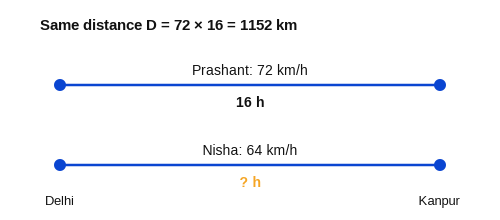
Prashant and Nisha have to travel from Delhi to Kanpur in their respective cars. Prashant is driving at 72 km/hr while Nisha is driving at 64 km/hr. Find the time taken by Nisha to reach Kanpur if Prashant takes 16 hours.
प्रशांत और निशा को अपनी-अपनी कारों से दिल्ली से कानपुर की यात्रा करनी है। प्रशांत 72 km/hr की चाल से गाड़ी चला रहा है, जबकि निशा 64 km/hr की चाल से गाड़ी चला रही है। यदि प्रशांत को 16 घंटे लगते हैं, तो निशा द्वारा कानपुर पहुँचने में लिया गया समय ज्ञात कीजिए।
  1. A24 hours24 घंटे
  2. B18 hours18 घंटे
  3. C8 hours8 घंटे
  4. D20 hours20 घंटे
Show answer

Concept: For the same distance, time is inversely proportional to speed: S1T1=S2T2.

  1. Distance =72×16=1152km.
  2. Nisha's time =115264=18 hours.
  3. Check by ratio: T2=16×7264=16×98=18.

Trick: Speed ratio 72:64=9:8 ⇒ time ratio 8:9; 8→16 so 9→18.

Answer: (B) 18 hours

अवधारणा: समान दूरी के लिए समय, चाल के व्युत्क्रमानुपाती होता है: S1T1=S2T2।

  1. दूरी =72×16=1152km।
  2. निशा का समय =115264=18 घंटे।
  3. अनुपात से जाँच: T2=16×7264=16×98=18।

ट्रिक: चाल अनुपात 72:64=9:8 ⇒ समय अनुपात 8:9; 8→16 तो 9→18।

उत्तर: (B) 18 घंटे

RRB NTPC Undergraduate CBT 1MathematicsSpeed, time and distanceRRB NTPC Undergraduate CBT 1 2024 · 19 Aug Shift 2 →
Q2372.
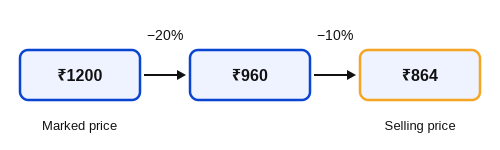
An item is marked at ₹1,200. Successive discounts of 20% and 10% are given. What is the final selling price?
एक वस्तु का अंकित मूल्य ₹1,200 है। उस पर 20% और 10% की क्रमिक छूट दी जाती है। अंतिम विक्रय मूल्य क्या है?
  1. A₹864
  2. B₹960
  3. C₹900
  4. D₹880
Show answer

Concept: Successive discounts are applied one after another: SP=MP×100−d1100×100−d2100.

  1. After 20%: 1200×0.8=960.
  2. After 10%: 960×0.9=864.
  3. Equivalent single discount =20+10−20×10100=28%; 1200×0.72=864.

Trick: Two discounts a%,b% ⇒ single discount a+b−ab100 (not a+b).

Answer: (A) ₹864

अवधारणा: क्रमिक छूट एक के बाद एक लगती है: विक्रय मूल्य=अंकित मूल्य×100−d1100×100−d2100।

  1. 20% के बाद: 1200×0.8=960।
  2. 10% के बाद: 960×0.9=864।
  3. समतुल्य एकल छूट =20+10−20×10100=28%; 1200×0.72=864।

ट्रिक: दो छूट a%,b% ⇒ एकल छूट a+b−ab100 (न कि a+b)।

उत्तर: (A) ₹864

RRB NTPC Undergraduate CBT 1MathematicsSuccessive discountsRRB NTPC Undergraduate CBT 1 2024 · 19 Aug Shift 2 →
Q2373.
Find the simple interest (in ₹) on ₹1,200 at an interest rate of 3% per month in 7 months.
₹1,200 पर 3% प्रति माह की ब्याज दर से 7 महीने का साधारण ब्याज (₹ में) ज्ञात कीजिए।
  1. A252
  2. B41
  3. C21
  4. D42
Show answer

Concept: SI=P×R×T100, with R and T in the same time unit.

  1. P=1200, R=3% per month, T=7 months.
  2. SI=1200×3×7100=12×21=252.

Trick: Rate per month × months directly – no need to convert to years (3%×7=21% of 1200).

Answer: (A) 252

अवधारणा: साधारण ब्याज=P×R×T100, जहाँ R और T एक ही समय-इकाई में हों।

  1. P=1200, R=3% प्रति माह, T=7 माह।
  2. SI=1200×3×7100=12×21=252।

ट्रिक: मासिक दर × महीने सीधे – वर्षों में बदलने की ज़रूरत नहीं (3%×7=1200 का 21%)।

उत्तर: (A) 252

RRB NTPC Undergraduate CBT 1MathematicsSimple interestRRB NTPC Undergraduate CBT 1 2024 · 19 Aug Shift 2 →
Q2374.
The H.C.F. and the L.C.M. of two numbers are 51 and 306 respectively. If one of the numbers is 102, find the other one.
दो संख्याओं का म.स. (H.C.F.) और ल.स. (L.C.M.) क्रमशः 51 और 306 हैं। यदि उनमें से एक संख्या 102 है, तो दूसरी संख्या ज्ञात कीजिए।
  1. A102
  2. B204
  3. C175
  4. D153
Show answer

Concept: For two numbers: HCF×LCM=product of the numbers.

  1. 51×306=102×x.
  2. x=51×306102=3062=153.
  3. Check: 153=51×3, 102=51×2; HCF =51, LCM =51×6=306 ✓.

Trick: 102=2×51, so x=3062 instantly.

Answer: (D) 153

अवधारणा: दो संख्याओं के लिए: म.स.×ल.स.=संख्याओं का गुणनफल।

  1. 51×306=102×x।
  2. x=51×306102=3062=153।
  3. जाँच: 153=51×3, 102=51×2; म.स. =51, ल.स. =51×6=306 ✓।

ट्रिक: 102=2×51, अतः तुरंत x=3062।

उत्तर: (D) 153

RRB NTPC Undergraduate CBT 1MathematicsHCF and LCMRRB NTPC Undergraduate CBT 1 2024 · 19 Aug Shift 2 →
Q2375.
Nitin bought some sharpeners at the rate of ₹180/dozen. He sold them for ₹20 each. His profit percentage is ______% (rounded off to two decimal places).
नितिन ने ₹180/दर्जन की दर से कुछ शार्पनर खरीदे। उसने उन्हें ₹20 प्रति शार्पनर की दर से बेच दिया। उसका लाभ प्रतिशत ______% है (दो दशमलव स्थानों तक पूर्णांकित)।
  1. A33.33
  2. B35.33
  3. C31.33
  4. D37.33
Show answer

Concept: Find cost price per item, then Profit%=SP−CPCP×100.

  1. CP of one sharpener =18012= ₹15; SP = ₹20.
  2. Profit =20−15= ₹5.
  3. Profit%=515×100=33.33%.

Trick: Profit is 13 of CP ⇒ 3313%.

Answer: (A) 33.33

अवधारणा: प्रति वस्तु क्रय मूल्य निकालें, फिर लाभ%=विक्रय मूल्य−क्रय मूल्यक्रय मूल्य×100।

  1. एक शार्पनर का क्रय मूल्य =18012= ₹15; विक्रय मूल्य = ₹20।
  2. लाभ =20−15= ₹5।
  3. लाभ%=515×100=33.33%।

ट्रिक: लाभ क्रय मूल्य का 13 है ⇒ 3313%।

उत्तर: (A) 33.33

RRB NTPC Undergraduate CBT 1MathematicsProfit and lossRRB NTPC Undergraduate CBT 1 2024 · 19 Aug Shift 2 →
Q2376.
A can do a work in 17 days and B can do the same work in 19 days. If they work on it together for 6 days, then what fraction of the work is left?
A किसी कार्य को 17 दिनों में और B उसी कार्य को 19 दिनों में कर सकता है। यदि वे मिलकर 6 दिनों तक उस पर कार्य करते हैं, तो कार्य का कितना भाग शेष रह जाता है?
  1. A107323
  2. B109323
  3. C110323
  4. D104323
Show answer

Concept: One day's work of a person =1days; work done together in t days =t(1a+1b).

  1. One day's work of A + B =117+119=19+17323=36323.
  2. Work in 6 days =6×36323=216323.
  3. Work left =1−216323=107323.

Trick: Take total work =17×19=323 units; A does 19, B does 17 units/day → 36 units/day → 6×36=216 done, 323−216=107 left.

Answer: (A) 107323

अवधारणा: एक दिन का कार्य =1दिन; मिलकर t दिनों में कार्य =t(1a+1b)।

  1. A + B का एक दिन का कार्य =117+119=36323।
  2. 6 दिनों का कार्य =6×36323=216323।
  3. शेष कार्य =1−216323=107323।

ट्रिक: कुल कार्य =17×19=323 इकाई मानें; A 19, B 17 इकाई/दिन → 36 इकाई/दिन → 216 पूरा, 107 शेष।

उत्तर: (A) 107323

RRB NTPC Undergraduate CBT 1MathematicsTime and WorkRRB NTPC Undergraduate CBT 1 2024 · 19 Aug Shift 2 →
Q2377.
Aanya has to reach Bangalore which is 861 km away in 15 hours. His starting speed for 8 hours was 37 km/hr. For the next 136 km his speed was 34 km/hr. By what speed he must travel now so as to reach Bangalore in the decided time of 15 hours?
आन्या को 861 km दूर स्थित बैंगलोर 15 घंटे में पहुँचना है। प्रारंभिक 8 घंटों के लिए उसकी चाल 37 km/hr थी। अगले 136 km के लिए उसकी चाल 34 km/hr थी। निर्धारित 15 घंटे के समय में बैंगलोर पहुँचने के लिए अब उसे किस चाल से यात्रा करनी होगी?
  1. A141 km/hr
  2. B143 km/hr
  3. C147 km/hr
  4. D146 km/hr
Show answer

Concept: Distance = Speed × Time. Required speed =remaining distanceremaining time.

  1. First part: 37×8=296km.
  2. Second part: 136 km at 34 km/h takes 13634=4h.
  3. Covered =296+136=432km in 8+4=12h.
  4. Remaining: 861−432=429km in 15−12=3h → speed =4293=143km/h.

Trick: Keep a running total of distance and time; only the leftover part decides the new speed.

Answer: (B) 143 km/hr

अवधारणा: दूरी = चाल × समय। आवश्यक चाल =शेष दूरीशेष समय।

  1. पहला भाग: 37×8=296km।
  2. दूसरा भाग: 136 km, 34 km/h से → 13634=4h।
  3. कुल तय =432km, समय =12h।
  4. शेष 861−432=429km, 3h में → 4293=143km/h।

ट्रिक: दूरी और समय का चालू योग रखें; बची दूरी ÷ बचा समय = नई चाल।

उत्तर: (B) 143 km/hr

RRB NTPC Undergraduate CBT 1MathematicsSpeed, Time and DistanceRRB NTPC Undergraduate CBT 1 2024 · 19 Aug Shift 2 →
Q2378.
Evaluate: 16 + 12 ÷ 6 − 3 × 4
मान ज्ञात कीजिए: 16 + 12 ÷ 6 − 3 × 4
  1. A8
  2. B5
  3. C9
  4. D6
Show answer

Concept: BODMAS: Division and Multiplication are done before Addition and Subtraction.

  1. 12÷6=2 and 3×4=12.
  2. Expression becomes 16+2−12.
  3. =18−12=6.

Trick: Never go left to right blindly: first finish all ÷ and ×, then + and −.

Answer: (D) 6

अवधारणा: BODMAS: भाग और गुणा पहले, फिर जोड़ और घटाव।

  1. 12÷6=2 और 3×4=12।
  2. व्यंजक =16+2−12।
  3. =18−12=6।

ट्रिक: पहले सारे ÷ और × हल करें, फिर +, −।

उत्तर: (D) 6

RRB NTPC Undergraduate CBT 1MathematicsSimplification (BODMAS)RRB NTPC Undergraduate CBT 1 2024 · 19 Aug Shift 2 →
Q2379.
Find the value of x satisfying: 3(2x2 − 5) − 2(3x2 + 4x − 8) = 20
x का वह मान ज्ञात कीजिए जो निम्नलिखित को संतुष्ट करता है: 3(2x2 − 5) − 2(3x2 + 4x − 8) = 20
  1. A−298
  2. B−118
  3. C−198
  4. D−218
Show answer

Concept: Open the brackets; the x2 terms cancel, leaving a linear equation in x.

  1. 3(2x2−5)=6x2−15 and 2(3x2+4x−8)=6x2+8x−16.
  2. 6x2−15−6x2−8x+16=20 → 1−8x=20.
  3. −8x=19 → x=−198.

Trick: Check the sign when distributing the minus: −2(…−8) gives +16.

Answer: (C) −198

अवधारणा: कोष्ठक खोलें; x2 वाले पद कट जाते हैं और रैखिक समीकरण बचता है।

  1. 3(2x2−5)=6x2−15, 2(3x2+4x−8)=6x2+8x−16।
  2. 6x2−15−6x2−8x+16=20 → 1−8x=20।
  3. −8x=19 → x=−198।

ट्रिक: ऋण चिह्न बाँटते समय ध्यान: −2(…−8)=+16।

उत्तर: (C) −198

RRB NTPC Undergraduate CBT 1MathematicsLinear EquationsRRB NTPC Undergraduate CBT 1 2024 · 19 Aug Shift 2 →
Q2380.
Simplify the following.
18×(3×(32))÷13+66−74
निम्नलिखित को सरल कीजिए।
18×(3×(32))÷13+66−74
  1. A39113
  2. B38713
  3. C38213
  4. D38913
Show answer

Concept: BODMAS: brackets and powers first, then × / ÷ from left to right, then + / −.

  1. 32=9, so 3×9=27.
  2. 18×27=486, then 486÷13=48613.
  3. 66−74=−8=−10413.
  4. Total =486−10413=38213.

Trick: All options have denominator 13, so convert the integer part to thirteenths: 8=10413.

Answer: (C) 38213

अवधारणा: BODMAS: पहले कोष्ठक और घात, फिर बाएँ से दाएँ ×/÷, फिर +/−।

  1. 32=9, अतः 3×9=27।
  2. 18×27=486, 486÷13=48613।
  3. 66−74=−8=−10413।
  4. कुल =486−10413=38213।

ट्रिक: सभी विकल्पों का हर 13 है, इसलिए 8=10413 लिखकर घटाएँ।

उत्तर: (C) 38213

RRB NTPC Undergraduate CBT 1MathematicsSimplification (BODMAS)RRB NTPC Undergraduate CBT 1 2024 · 19 Aug Shift 2 →