Question bank

Q&A: practice questions with answers

Search questions on any topic. Filter by exam category, exam, subject and topic, try the question, then open the answer and explanation.

Courses – airGurukul

20,719 questions found.

Q2581.
7 years ago, the age of a father was 20 years more than twice his son's age. After how many years, from now, will he be twice his son's age?
7 वर्ष पहले, एक पिता की आयु उसके पुत्र की आयु के दोगुने से 20 वर्ष अधिक थी। अब से कितने वर्ष बाद पिता की आयु उसके पुत्र की आयु की दोगुनी होगी?
  1. A13
  2. B16
  3. C11
  4. D12
Show answer

Concept: Write present ages as F and S and form equations.

  1. 7 years ago: F−7=2(S−7)+20⇒F=2S+13.
  2. After x years: F+x=2(S+x)⇒x=F−2S.
  3. x=13 years.

Trick: In “father = 2 × son” problems, x=F−2S; just read it from the equation.

Answer: (A) 13

अवधारणा: वर्तमान आयु F (पिता) और S (पुत्र) लें।

  1. 7 वर्ष पहले: F−7=2(S−7)+20⇒F=2S+13।
  2. x वर्ष बाद: F+x=2(S+x)⇒x=F−2S।
  3. x=13 वर्ष।

ट्रिक: “पिता = 2 × पुत्र” वाले प्रश्नों में x=F−2S सीधे मिल जाता है।

उत्तर: (A) 13

RRB NTPC Undergraduate CBT 1MathematicsProblems on AgesRRB NTPC Undergraduate CBT 1 2024 · 18 Aug Shift 3 →
Q2582.
A table has a marked price of ₹8,000. A shopkeeper purchased it at two successive discounts of 20% and 25%. He sold the table for ₹8,000 after spending ₹300 on transportation. Find his profit percentage.
एक मेज़ का अंकित मूल्य ₹8,000 है। एक दुकानदार ने इसे 20% और 25% की दो क्रमिक छूटों पर खरीदा। उसने परिवहन पर ₹300 खर्च करने के बाद मेज़ को ₹8,000 में बेच दिया। उसका लाभ प्रतिशत ज्ञात कीजिए।
  1. A564351%
  2. B564551%
  3. C564451%
  4. D564251%
Show answer

Concept: Cost price = marked price after successive discounts + extra expenses; Profit%=ProfitCP×100.

  1. Purchase price =8000×0.80×0.75= ₹4,800.
  2. Total CP =4800+300= ₹5,100.
  3. Profit =8000−5100= ₹2,900.
  4. Profit%=29005100×100=290051=564451%.

Trick: 20% and 25% successive = 40% single discount, so purchase price =0.6×8000.

Answer: (C) 564451%

अवधारणा: लागत = क्रमागत छूट के बाद मूल्य + अतिरिक्त खर्च; लाभ%=लाभलागत×100।

  1. खरीद मूल्य =8000×0.80×0.75= ₹4,800।
  2. कुल लागत =4800+300= ₹5,100।
  3. लाभ =8000−5100= ₹2,900।
  4. लाभ%=290051=564451%।

ट्रिक: 20% और 25% क्रमागत = 40% एकल छूट।

उत्तर: (C) 564451%

RRB NTPC Undergraduate CBT 1MathematicsDiscount and ProfitRRB NTPC Undergraduate CBT 1 2024 · 18 Aug Shift 3 →
Q2583.
Find the simple interest (in ₹) on ₹1,200 at an interest rate of 4% per month for 8 months.
₹1,200 पर 4% प्रति माह की ब्याज दर से 8 माह का साधारण ब्याज (₹ में) ज्ञात कीजिए।
  1. A₹52
  2. B₹64
  3. C₹32
  4. D₹384
Show answer

Concept: SI=P×R×T100, where R and T must use the same time unit.

  1. Rate is per month and time is in months: R=4, T=8.
  2. SI=1200×4×8100= ₹384.
  3. (Had the rate been 4% per annum, the interest for 8 months would be 1200×4×81200= ₹32.)

Trick: Monthly rate × number of months gives the total percentage: 4×8=32% of ₹1,200 = ₹384.

Answer: (D) ₹384

अवधारणा: SI=P×R×T100; दर और समय की इकाई समान होनी चाहिए।

  1. दर प्रति माह और समय महीनों में: R=4, T=8।
  2. SI=1200×4×8100= ₹384।
  3. (यदि दर 4% वार्षिक होती तो 8 महीने का ब्याज 1200×4×81200= ₹32 होता।)

ट्रिक: मासिक दर × महीने = कुल प्रतिशत: 4×8=32%, ₹1,200 का 32% = ₹384।

उत्तर: (D) ₹384

RRB NTPC Undergraduate CBT 1MathematicsSimple InterestRRB NTPC Undergraduate CBT 1 2024 · 18 Aug Shift 3 →
Q2584.
X, Y and Z invest a sum in the ratio of 16 : 85 : 54, respectively. If they earned a total profit of ₹3,750 at the end of the year, then what is the difference between share of Y and Z?
X, Y और Z किसी राशि का निवेश क्रमशः 16 : 85 : 54 के अनुपात में करते हैं। यदि वर्ष के अंत में उन्होंने कुल ₹3,750 का लाभ अर्जित किया, तो Y और Z के हिस्सों के बीच का अंतर कितना है?
  1. A₹676
  2. B₹750
  3. C₹706
  4. D₹742
Show answer

Concept: Profit is shared in the ratio of investments.

  1. Total parts =16+85+54=155.
  2. 1 part =3750155=75031.
  3. Difference Y − Z =85−54=31 parts =31×75031= ₹750.

Trick: Difference of 31 parts out of 155 = 15 of the profit =37505.

Answer: (B) ₹750

अवधारणा: लाभ निवेश के अनुपात में बँटता है।

  1. कुल भाग =155।
  2. 1 भाग =3750155।
  3. Y − Z =31 भाग =3750×31155= ₹750।

ट्रिक: 155 में से 31 भाग = लाभ का 15।

उत्तर: (B) ₹750

RRB NTPC Undergraduate CBT 1MathematicsPartnershipRRB NTPC Undergraduate CBT 1 2024 · 18 Aug Shift 3 →
Q2585.
Which of the following numbers divides 769501?
निम्नलिखित में से कौन-सी संख्या 769501 को विभाजित करती है?
  1. A105
  2. B96
  3. C90
  4. D97
Show answer

Concept: Eliminate options with divisibility rules, then divide.

  1. 769501 is odd → not divisible by 96 or 90; it does not end in 0 or 5 → not divisible by 105.
  2. Check 97: 97×7933=769501.
  3. So 97 divides it exactly.

Trick: An odd number can never be divided by an even number (96, 90).

Answer: (D) 97

अवधारणा: विभाज्यता नियमों से विकल्प हटाएँ, फिर भाग दें।

  1. 769501 विषम है → 96, 90 से विभाज्य नहीं; अंत 0 या 5 नहीं → 105 से नहीं।
  2. 97×7933=769501।
  3. अतः 97 पूर्ण विभाजक है।

ट्रिक: विषम संख्या कभी सम संख्या से विभाज्य नहीं होती।

उत्तर: (D) 97

RRB NTPC Undergraduate CBT 1MathematicsDivisibilityRRB NTPC Undergraduate CBT 1 2024 · 18 Aug Shift 3 →
Q2586.
The product of two consecutive natural numbers is 870. The greater of the two numbers is:
दो क्रमागत प्राकृत संख्याओं का गुणनफल 870 है। दोनों में से बड़ी संख्या है:
  1. A38
  2. B30
  3. C41
  4. D21
Show answer

Concept: Consecutive numbers n and n+1 lie close to product.

  1. 870≈29.5.
  2. 29×30=870.
  3. Greater number =30.

Trick: Product ending in 0 → one number ends in 0 or 5; 29×30 fits.

Answer: (B) 30

अवधारणा: क्रमागत संख्याएँ गुणनफल के पास होती हैं।

  1. 870≈29.5।
  2. 29×30=870।
  3. बड़ी संख्या =30।

ट्रिक: गुणनफल का इकाई अंक 0 → एक संख्या का अंत 0 या 5।

उत्तर: (B) 30

RRB NTPC Undergraduate CBT 1MathematicsNumber SystemRRB NTPC Undergraduate CBT 1 2024 · 18 Aug Shift 3 →
Q2587.
The simple interest on a certain sum for 612 years at the rate of 6.4% per annum is ₹9,204.
What will be the amount payable on the same sum at the rate of 7.6% per annum simple interest in 623 years?
किसी निश्चित राशि पर 612 वर्ष के लिए 6.4% वार्षिक दर से साधारण ब्याज ₹9,204 है।
उसी राशि पर 7.6% वार्षिक साधारण ब्याज की दर से 623 वर्ष में देय मिश्रधन कितना होगा?
  1. A₹33,336
  2. B₹33,335
  3. C₹33,348
  4. D₹33,340
Show answer

Concept: SI=P×R×T100, Amount =P+SI.

  1. 9204=P×6.4×132100=0.416P⇒P= ₹22,125.
  2. New SI =22125×7.6×203100= ₹11,210.
  3. Amount =22125+11210= ₹33,335.

Trick: R×T first: 6.4×6.5=41.6% and 7.6×203=1523%.

Answer: (B) ₹33,335

अवधारणा: SI=P×R×T100, मिश्रधन =P+SI।

  1. 9204=0.416P⇒P= ₹22,125।
  2. नया SI =22125×7.6×203100= ₹11,210।
  3. मिश्रधन =22125+11210= ₹33,335।

ट्रिक: पहले R×T निकालें: 6.4×6.5=41.6%।

उत्तर: (B) ₹33,335

RRB NTPC Undergraduate CBT 1MathematicsSimple InterestRRB NTPC Undergraduate CBT 1 2024 · 18 Aug Shift 3 →
Q2588.
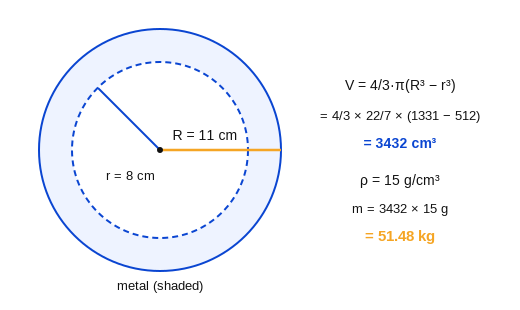
A hollow spherical shell is made of a metal of density 15 g/cm3. Its internal and external radii are 8 cm and 11 cm, respectively. What is the mass (in kg) of the shell?
(Take π=227.)
एक खोखला गोलीय कोश 15 g/cm3 घनत्व वाली धातु से बना है। इसकी आंतरिक और बाहरी त्रिज्याएँ क्रमशः 8 cm और 11 cm हैं। कोश का द्रव्यमान (kg में) कितना है?
(π=227 लीजिए।)
  1. A48.48
  2. B52.96
  3. C51.48
  4. D52.67
Show answer

Concept: Volume of a hollow sphere =43π(R3−r3); mass = volume × density.

  1. R3−r3=1331−512=819.
  2. V=43×227×819=3432cm3.
  3. Mass =3432×15=51480g=51.48kg.

Trick: 819=7×117, so 227 cancels neatly.

Answer: (C) 51.48

अवधारणा: खोखले गोले का आयतन =43π(R3−r3); द्रव्यमान = आयतन × घनत्व।

  1. R3−r3=1331−512=819।
  2. V=43×227×819=3432cm3।
  3. द्रव्यमान =3432×15=51480g=51.48kg।

ट्रिक: 819=7×117, इसलिए 7 कट जाता है।

उत्तर: (C) 51.48

RRB NTPC Undergraduate CBT 1MathematicsMensuration – SphereRRB NTPC Undergraduate CBT 1 2024 · 18 Aug Shift 3 →
Q2589.
The LCM of two numbers is seven times their HCF. The difference between the HCF and LCM is 222. Find the product of the two numbers.
दो संख्याओं का LCM उनके HCF का सात गुना है। HCF और LCM का अंतर 222 है। दोनों संख्याओं का गुणनफल ज्ञात कीजिए।
  1. A9158
  2. B9276
  3. C9583
  4. D9086
Show answer

Concept: Product of two numbers = HCF × LCM.

  1. Let HCF =h, LCM =7h.
  2. 7h−h=222⇒h=37, LCM =259.
  3. Product =37×259=9583.

Trick: Product =7h2=7×372=7×1369=9583.

Answer: (C) 9583

अवधारणा: दो संख्याओं का गुणनफल = HCF × LCM।

  1. HCF =h, LCM =7h।
  2. 6h=222⇒h=37, LCM =259।
  3. गुणनफल =37×259=9583।

ट्रिक: गुणनफल =7h2=7×1369=9583।

उत्तर: (C) 9583

RRB NTPC Undergraduate CBT 1MathematicsHCF and LCMRRB NTPC Undergraduate CBT 1 2024 · 18 Aug Shift 3 →
Q2590.
The average of first 154 odd natural numbers, is:
प्रथम 154 विषम प्राकृत संख्याओं का औसत है:
  1. A153.5
  2. B154
  3. C155
  4. D154.5
Show answer

Concept: Sum of the first n odd natural numbers =n2.

  1. Sum =1542.
  2. Average =1542154=154.

Trick: Average of the first n odd numbers is always n itself.

Answer: (B) 154

अवधारणा: पहली n विषम प्राकृत संख्याओं का योग =n2।

  1. योग =1542।
  2. औसत =1542154=154।

ट्रिक: पहली n विषम संख्याओं का औसत =n।

उत्तर: (B) 154

RRB NTPC Undergraduate CBT 1MathematicsAverageRRB NTPC Undergraduate CBT 1 2024 · 18 Aug Shift 3 →
Q2591.
A bus travelling at 36 km/hr completes a journey in 5 hours. What should be its speed to cover the same distance in 10 hours?
36 km/hr की चाल से चलने वाली एक बस 5 घंटे में यात्रा पूरी करती है। समान दूरी को 10 घंटे में तय करने के लिए उसकी चाल कितनी होनी चाहिए?
  1. A17 km/hr
  2. B18 km/hr
  3. C22 km/hr
  4. D9 km/hr
Show answer

Concept: Distance = speed × time; for the same distance, speed is inversely proportional to time.

  1. Distance =36×5=180km.
  2. Required speed =18010=18km/h.

Trick: Time doubles → speed halves: 362=18.

Answer: (B) 18 km/hr

अवधारणा: दूरी = चाल × समय; समान दूरी पर चाल समय के व्युत्क्रमानुपाती।

  1. दूरी =36×5=180km।
  2. चाल =18010=18km/h।

ट्रिक: समय दोगुना → चाल आधी।

उत्तर: (B) 18 km/hr

RRB NTPC Undergraduate CBT 1MathematicsSpeed, Time and DistanceRRB NTPC Undergraduate CBT 1 2024 · 18 Aug Shift 3 →
Q2592.
₹44,200 was divided among A, B and C such that 3 times the share of A = 9 times the share of B = 4 times the share of C. Find the share of A.
₹44,200 को A, B और C में इस प्रकार बाँटा गया कि A के हिस्से का 3 गुना = B के हिस्से का 9 गुना = C के हिस्से का 4 गुना। A का हिस्सा ज्ञात कीजिए।
  1. A₹21,304
  2. B₹21,216
  3. C₹21,081
  4. D₹21,178
Show answer

Concept: If 3A=9B=4C=k, then A:B:C=13:19:14.

  1. Multiply by LCM 36: A:B:C=12:4:9.
  2. Total parts =25; 1 part =4420025=1768.
  3. A =12×1768= ₹21,216.

Trick: Take k=36 (LCM of 3, 9, 4) to get the ratio directly.

Answer: (B) ₹21,216

अवधारणा: यदि 3A=9B=4C=k, तो A:B:C=13:19:14।

  1. LCM 36 से गुणा: 12:4:9।
  2. कुल 25 भाग; 1 भाग =1768।
  3. A =12×1768= ₹21,216।

ट्रिक: k=36 (3, 9, 4 का LCM) मानें।

उत्तर: (B) ₹21,216

RRB NTPC Undergraduate CBT 1MathematicsRatio and ProportionRRB NTPC Undergraduate CBT 1 2024 · 18 Aug Shift 3 →
Q2593.
Simplify x(3x − 6) + 5(x2 − 4) + 19.
x(3x − 6) + 5(x2 − 4) + 19 को सरल कीजिए।
  1. A8x2 − 6x − 1
  2. B−8x2 − 6x − 1
  3. C−8x2 − 6x + 1
  4. D8x2 − 6x + 1
Show answer

Concept: Expand the brackets and combine like terms.

  1. x(3x−6)=3x2−6x.
  2. 5(x2−4)=5x2−20.
  3. Sum +19: 8x2−6x−20+19=8x2−6x−1.

Trick: Put x=1: −3+(−15)+19=1 and 8−6−1=1 ✓.

Answer: (A) 8x2−6x−1

अवधारणा: कोष्ठक खोलें और समान पद जोड़ें।

  1. x(3x−6)=3x2−6x।
  2. 5(x2−4)=5x2−20।
  3. कुल: 8x2−6x−1।

ट्रिक: x=1 रखें: दोनों ओर 1 आता है ✓।

उत्तर: (A) 8x2−6x−1

RRB NTPC Undergraduate CBT 1MathematicsAlgebra – SimplificationRRB NTPC Undergraduate CBT 1 2024 · 18 Aug Shift 3 →
Q2594.
The value of 289+0.0324−7.29=
289+0.0324−7.29= का मान
  1. A14.48
  2. B12.59
  3. C9.08
  4. D11.21
Show answer

Concept: Use known squares: 172=289, 182=324, 272=729.

  1. 289=17.
  2. 0.0324=0.18, 7.29=2.7.
  3. 17+0.18−2.7=14.48.

Trick: For decimals, pair digits after the point: 0.0324→0.18 (2 decimal places).

Answer: (A) 14.48

अवधारणा: ज्ञात वर्ग: 172=289, 182=324, 272=729।

  1. 289=17।
  2. 0.0324=0.18, 7.29=2.7।
  3. 17+0.18−2.7=14.48।

ट्रिक: दशमलव के बाद अंकों के जोड़े बनाएँ: 0.0324→0.18।

उत्तर: (A) 14.48

RRB NTPC Undergraduate CBT 1MathematicsSquare RootsRRB NTPC Undergraduate CBT 1 2024 · 18 Aug Shift 3 →
Q2595.
Daksh travels 168 km at 21 km/hr, the next 100 km at 20 km/hr and the next 371 km at 53 km/hr. What is his average speed (in km/hr) for the whole journey?
दक्ष 168 km की दूरी 21 km/hr की चाल से, अगले 100 km 20 km/hr की चाल से और अगले 371 km 53 km/hr की चाल से तय करता है। पूरी यात्रा के लिए उसकी औसत चाल (km/hr में) कितनी है?
  1. A36.61
  2. B23.34
  3. C29.63
  4. D31.95
Show answer

Concept: Average speed=Total distanceTotal time.

  1. Times: 16821=8 h, 10020=5 h, 37153=7 h.
  2. Total distance =639km, total time =20 h.
  3. Average =63920=31.95km/h.

Trick: Never average the speeds directly; the times here come out whole.

Answer: (D) 31.95

अवधारणा: औसत चाल=कुल दूरीकुल समय।

  1. समय: 8 h, 5 h, 7 h।
  2. कुल दूरी =639km, कुल समय =20 h।
  3. औसत =63920=31.95km/h।

ट्रिक: चालों का सीधा औसत न लें।

उत्तर: (D) 31.95

RRB NTPC Undergraduate CBT 1MathematicsAverage SpeedRRB NTPC Undergraduate CBT 1 2024 · 18 Aug Shift 3 →
Q2596.
Select the pair that follows the same pattern as that followed by the two pairs given below. Both pairs follow the same pattern.
CSL : FPG
KGX : NDS
उस युग्म का चयन कीजिए जो उसी पैटर्न का अनुसरण करता है जिसका अनुसरण नीचे दिए गए दो युग्मों द्वारा किया जाता है। दोनों युग्म एक ही पैटर्न का अनुसरण करते हैं।
CSL : FPG
KGX : NDS
  1. AMMX : PQS
  2. BDJF : GGA
  3. CJKY : MMT
  4. DNGN : QJJ
Show answer

Concept: Find the position change of each letter.

  1. CSL → FPG: C+3=F, S−3=P, L−5=G.
  2. KGX → NDS: K+3=N, G−3=D, X−5=S.
  3. DJF: D+3=G, J−3=G, F−5=A → GGA ✓.

Trick: Check only the first letter (+3) to drop options, then verify the rest.

Answer: (B) DJF : GGA

अवधारणा: हर अक्षर का स्थान परिवर्तन देखें।

  1. CSL → FPG: +3, −3, −5।
  2. KGX → NDS: +3, −3, −5।
  3. DJF: G, G, A → GGA ✓।

ट्रिक: पहले केवल पहला अक्षर (+3) जाँचें, फिर बाकी।

उत्तर: (B) DJF : GGA

RRB NTPC Undergraduate CBT 1General Intelligence and ReasoningLetter AnalogyRRB NTPC Undergraduate CBT 1 2024 · 18 Aug Shift 3 →
Q2597.
KHIG is related to HEFD in a certain way based on the English alphabetical order. In the same way, DABZ is related to AXYW. To which of the given options is BYZX related, following the same logic?
अंग्रेज़ी वर्णमाला क्रम के आधार पर KHIG एक निश्चित प्रकार से HEFD से संबंधित है। उसी प्रकार DABZ, AXYW से संबंधित है। समान तर्क का अनुसरण करते हुए, BYZX दिए गए विकल्पों में से किससे संबंधित है?
  1. AYVVU
  2. BYWVD
  3. CYVWU
  4. DYUVU
Show answer

Concept: Each letter moves back by 3.

  1. KHIG → HEFD: each −3.
  2. DABZ → AXYW: each −3 (A−3=X wraps around).
  3. BYZX → B−3=Y, Y−3=V, Z−3=W, X−3=U → YVWU.

Trick: Backward wrap: A−3 = X, B−3 = Y.

Answer: (C) YVWU

अवधारणा: हर अक्षर 3 पीछे जाता है।

  1. KHIG → HEFD: −3।
  2. DABZ → AXYW: −3।
  3. BYZX → YVWU।

ट्रिक: पीछे घूमना: A−3 = X, B−3 = Y।

उत्तर: (C) YVWU

RRB NTPC Undergraduate CBT 1General Intelligence and ReasoningLetter AnalogyRRB NTPC Undergraduate CBT 1 2024 · 18 Aug Shift 3 →
Q2598.
Based on the English alphabetical order, three of the following four letter-clusters are alike in a certain way and thus form a group. Which letter-cluster DOES NOT belong to that group?
(Note: The odd one out is not based on the number of consonants/vowels or their position in the letter-cluster.)
अंग्रेज़ी वर्णमाला क्रम के आधार पर, निम्नलिखित चार अक्षर-समूहों में से तीन किसी निश्चित प्रकार से एकसमान हैं और इस प्रकार एक समूह बनाते हैं। कौन-सा अक्षर-समूह उस समूह से संबंधित नहीं है?
(ध्यान दें: असंगत अक्षर-समूह, उस अक्षर-समूह में व्यंजनों/स्वरों की संख्या या उनके स्थान पर आधारित नहीं है।)
  1. ALID
  2. BROK
  3. CMJF
  4. DFCY
Show answer

Concept: Find the gaps between consecutive letters (positions).

  1. ROK: 18, 15, 11 → −3, −4.
  2. MJF: 13, 10, 6 → −3, −4.
  3. FCY: 6, 3, 25 → −3, −4 (C−4 wraps to Y).
  4. LID: 12, 9, 4 → −3, −5 ✗.

Trick: Remember wrap-around: C − 4 = Y.

Answer: (A) LID

अवधारणा: अक्षरों के बीच अंतर देखें।

  1. ROK: −3, −4।
  2. MJF: −3, −4।
  3. FCY: −3, −4 (C−4 = Y)।
  4. LID: −3, −5 ✗।

ट्रिक: चक्र में घूमना याद रखें: C − 4 = Y।

उत्तर: (A) LID

RRB NTPC Undergraduate CBT 1General Intelligence and ReasoningOdd One Out – LettersRRB NTPC Undergraduate CBT 1 2024 · 18 Aug Shift 3 →
Q2599.
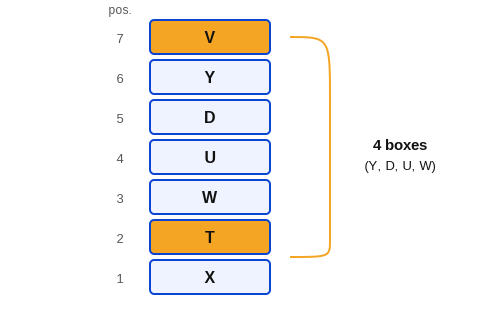
Seven boxes T, U, V, W, X, Y and D are kept one over the other but not necessarily in the same order. Only two boxes are kept below W. Only one box is kept above Y. Only one box is kept between Y and U. T is kept immediately above X. D is kept at some place below V. How many boxes are kept between V and T?
सात डिब्बे T, U, V, W, X, Y और D एक के ऊपर एक रखे गए हैं, लेकिन आवश्यक नहीं कि इसी क्रम में हों। W के नीचे केवल दो डिब्बे रखे गए हैं। Y के ऊपर केवल एक डिब्बा रखा गया है। Y और U के बीच केवल एक डिब्बा रखा गया है। T, X के ठीक ऊपर रखा गया है। D, V के नीचे किसी स्थान पर रखा गया है। V और T के बीच कितने डिब्बे रखे गए हैं?
  1. ATwoदो
  2. BOneएक
  3. CFourचार
  4. DThreeतीन
Show answer

Concept: Number positions 1 (bottom) to 7 (top) and fix definite clues first.

  1. Two boxes below W → W = 3. One box above Y → Y = 6.
  2. One box between Y and U → U = 4.
  3. T immediately above X: only free pair is X = 1, T = 2.
  4. D below V → D = 5, V = 7. Between V (7) and T (2): Y, D, U, W = 4.

Trick: Fixed-count clues (“only two below”) give exact positions – place them first.

Answer: (C) Four

अवधारणा: स्थान 1 (नीचे) से 7 (ऊपर) तक लें, पहले निश्चित संकेत लगाएँ।

  1. W के नीचे दो → W = 3; Y के ऊपर एक → Y = 6।
  2. Y और U के बीच एक → U = 4।
  3. T, X के ठीक ऊपर → X = 1, T = 2।
  4. D, V के नीचे → D = 5, V = 7। V और T के बीच: Y, D, U, W = 4।

ट्रिक: “केवल दो नीचे” जैसे संकेत सीधा स्थान देते हैं।

उत्तर: (C) चार

RRB NTPC Undergraduate CBT 1General Intelligence and ReasoningVertical ArrangementRRB NTPC Undergraduate CBT 1 2024 · 18 Aug Shift 3 →
Q2600.
What should come in place of the question mark (?) in the given series?
61 60 56 47 31 ?
दी गई श्रृंखला में प्रश्न चिह्न (?) के स्थान पर क्या आना चाहिए?
61 60 56 47 31 ?
  1. A6
  2. B14
  3. C28
  4. D9
Show answer

Concept: Differences are perfect squares.

  1. 61−1=60, 60−4=56, 56−9=47, 47−16=31.
  2. Next: 31−25=6.

Trick: Subtracted terms 12,22,32,42,52.

Answer: (A) 6

अवधारणा: अंतर पूर्ण वर्ग हैं।

  1. −1,−4,−9,−16।
  2. अगला: 31−25=6।

ट्रिक: घटाए गए पद 12,22,32,…

उत्तर: (A) 6

RRB NTPC Undergraduate CBT 1General Intelligence and ReasoningNumber SeriesRRB NTPC Undergraduate CBT 1 2024 · 18 Aug Shift 3 →