Question bank

Q&A: practice questions with answers

Search questions on any topic. Filter by exam category, exam, subject and topic, try the question, then open the answer and explanation.

Courses – airGurukul

20,719 questions found.

Q2681.
What sum of money (in ₹) will amount to ₹2,280 in 5 years at 5% per annum simple interest?
कितनी धनराशि (₹ में) 5% वार्षिक साधारण ब्याज की दर से 5 वर्षों में ₹2,280 हो जाएगी?
  1. A₹1,774
  2. B₹1,874
  3. C₹9,120
  4. D₹1,824
Show answer

Concept: Amount =P(1+RT100) under simple interest.

  1. RT=5×5=25%, so amount =1.25P.
  2. 1.25P=2280 ⇒ P=22801.25=1824.

Trick: 25%=14: amount =54P, so P=45×2280.

Answer: (D) ₹1,824

अवधारणा: साधारण ब्याज में मिश्रधन =P(1+RT100)।

  1. RT=5×5=25%, अतः मिश्रधन =1.25P।
  2. 1.25P=2280 ⇒ P=22801.25=1824।

ट्रिक: 25%=14: मिश्रधन =54P, इसलिए P=45×2280।

उत्तर: (D) ₹1,824

RRB NTPC Undergraduate CBT 1MathematicsSimple interestRRB NTPC Undergraduate CBT 1 2024 · 18 Aug Shift 2 →
Q2682.
The marked price of a laptop is ₹50,000. On the occasion of a festival, a shopkeeper gives a discount of 10%, and then an additional discount of 8% on the reduced price. What is the final selling price of the laptop?
एक लैपटॉप का अंकित मूल्य ₹50,000 है। एक त्योहार के अवसर पर, एक दुकानदार 10% की छूट देता है, और फिर घटे हुए मूल्य पर 8% की अतिरिक्त छूट देता है। लैपटॉप का अंतिम विक्रय मूल्य क्या है?
  1. A₹42,200
  2. B₹42,000
  3. C₹41,400
  4. D₹41,800
Show answer

Concept: Successive discounts multiply: SP=MP×(1−d1)(1−d2).

  1. After 10%: 50000×0.9=45000.
  2. After 8% more: 45000×0.92=41400.

Trick: Net discount =10+8−10×8100=17.2%; 50000×0.828=41400.

Answer: (C) ₹41,400

अवधारणा: क्रमिक छूट गुणा होती है: SP=MP×(1−d1)(1−d2)।

  1. 10% के बाद: 50000×0.9=45000।
  2. अतिरिक्त 8% के बाद: 45000×0.92=41400।

ट्रिक: कुल छूट =10+8−10×8100=17.2%; 50000×0.828=41400।

उत्तर: (C) ₹41,400

RRB NTPC Undergraduate CBT 1MathematicsSuccessive discountRRB NTPC Undergraduate CBT 1 2024 · 18 Aug Shift 2 →
Q2683.
Pipe A can fill a tank in 13 hours, pipe B can fill the same tank in 26 hours and pipe C can fill the same tank in 17 hours. If they are all opened together, how much time will they take to fill the same tank?
पाइप A एक टंकी को 13 घंटे में भर सकता है, पाइप B उसी टंकी को 26 घंटे में भर सकता है और पाइप C उसी टंकी को 17 घंटे में भर सकता है। यदि इन सभी को एक साथ खोल दिया जाए, तो वे उसी टंकी को भरने में कितना समय लेंगे?
  1. A95777 hours95777 घंटे
  2. B45777 hours45777 घंटे
  3. C55777 hours55777 घंटे
  4. D85777 hours85777 घंटे
Show answer

Concept: Rates add: part filled per hour =1a+1b+1c.

  1. 113+126=326.
  2. 326+117=51+26442=77442.
  3. Time =44277=55777 hours.

Trick: All options share 5777; just check the whole part: 77×5=385<442<462.

Answer: (C) 55777 hours

अवधारणा: दर जुड़ती हैं: प्रति घंटा भरा भाग =1a+1b+1c।

  1. 113+126=326।
  2. 326+117=51+26442=77442।
  3. समय =44277=55777 घंटे।

ट्रिक: सभी विकल्पों में 5777 समान है; केवल पूर्णांक देखें: 77×5=385<442<462।

उत्तर: (C) 55777 घंटे

RRB NTPC Undergraduate CBT 1MathematicsPipes and cisternsRRB NTPC Undergraduate CBT 1 2024 · 18 Aug Shift 2 →
Q2684.
If the volume of a cuboid is 440 cm3 and the area of its base is 88 cm2, find the height of the cuboid.
यदि एक घनाभ का आयतन 440 cm3 है और उसके आधार का क्षेत्रफल 88 cm2 है, तो घनाभ की ऊँचाई ज्ञात कीजिए।
  1. A2 cm
  2. B44 cm
  3. C5 cm
  4. D8 cm
Show answer

Concept: Volume of cuboid =base area×height.

  1. Height =44088=5cm.

Trick: 88×5=440 – check by multiplying back.

Answer: (C) 5cm

अवधारणा: घनाभ का आयतन =आधार क्षेत्रफल×ऊँचाई।

  1. ऊँचाई =44088=5cm।

ट्रिक: 88×5=440 – गुणा करके जाँचें।

उत्तर: (C) 5cm

RRB NTPC Undergraduate CBT 1MathematicsCuboid volumeRRB NTPC Undergraduate CBT 1 2024 · 18 Aug Shift 2 →
Q2685.
On selling an article at 410 of its actual selling price, Nirbhay incurs a loss of 28%. If he sells it at 82% of its actual selling price, find the profit percentage.
किसी वस्तु को उसके वास्तविक विक्रय मूल्य के 410 पर बेचने पर, निर्भय को 28% की हानि होती है। यदि वह उसे उसके वास्तविक विक्रय मूल्य के 82% पर बेचता है, तो लाभ प्रतिशत ज्ञात कीजिए।
  1. A48.8%
  2. B47.6%
  3. C49.5%
  4. D50.3%
Show answer

Concept: Selling at a fraction of a price changes SP proportionally; compare with CP.

  1. Let actual SP =S, CP =C. 410S=0.72C (loss 28%).
  2. S=0.72C0.4=1.8C.
  3. At 82%: 0.82×1.8C=1.476C ⇒ profit =47.6%.

Trick: Take C=100: S=180, 0.82×180=147.6 ⇒ 47.6%.

Answer: (B) 47.6%

अवधारणा: मूल्य का भिन्न भाग लेने पर SP उसी अनुपात में बदलता है; CP से तुलना करें।

  1. मान लें वास्तविक SP =S, CP =C। 410S=0.72C (28% हानि)।
  2. S=0.72C0.4=1.8C।
  3. 82% पर: 0.82×1.8C=1.476C ⇒ लाभ =47.6%।

ट्रिक: C=100 लें: S=180, 0.82×180=147.6 ⇒ 47.6%।

उत्तर: (B) 47.6%

RRB NTPC Undergraduate CBT 1MathematicsProfit and lossRRB NTPC Undergraduate CBT 1 2024 · 18 Aug Shift 2 →
Q2686.
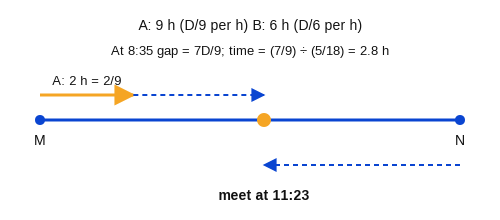
Train A leaves station M at 6:35 AM and reaches station N at 3:35 PM on the same day. Train B leaves station N at 8:35 AM and reaches station M at 2:35 PM on the same day. Find the time at which trains A and B meet.
ट्रेन A स्टेशन M से सुबह 6:35 बजे (AM) चलती है और उसी दिन दोपहर 3:35 बजे (PM) स्टेशन N पहुँचती है। ट्रेन B स्टेशन N से सुबह 8:35 बजे (AM) चलती है और उसी दिन दोपहर 2:35 बजे (PM) स्टेशन M पहुँचती है। वह समय ज्ञात कीजिए जब ट्रेन A और B मिलती हैं।
  1. A11:43 AM
  2. B11:03 AM
  3. C12:23 PM
  4. D11:23 AM
Show answer

Concept: Take distance MN=D; speed =Djourney time; after both start, gap closes at the sum of speeds.

  1. A takes 9 h (speed D9), B takes 6 h (speed D6).
  2. By 8:35 AM, A has run 2 h: covered 2D9, gap =7D9.
  3. Relative speed =D9+D6=5D18; time =79÷518=2.8 h =2 h 48 min.
  4. Meeting time =8:35+2:48=11:23 AM.

Trick: Distance cancels – always use D or LCM of times (18 units).

Answer: (D) 11:23 AM

अवधारणा: दूरी MN=D मानें; चाल =Dयात्रा समय; दोनों के चलने के बाद दूरी चालों के योग से घटती है।

  1. A को 9 घंटे (चाल D9), B को 6 घंटे (चाल D6)।
  2. 8:35 AM तक A ने 2 घंटे चलकर 2D9 तय किया, शेष 7D9।
  3. सापेक्ष चाल =D9+D6=5D18; समय =79÷518=2.8 घंटे =2 घंटे 48 मिनट।
  4. मिलने का समय =8:35+2:48=11:23 AM।

ट्रिक: दूरी कट जाती है – D=18 इकाई (समयों का LCM) मानकर हल करें।

उत्तर: (D) 11:23 AM

RRB NTPC Undergraduate CBT 1MathematicsTrains meeting timeRRB NTPC Undergraduate CBT 1 2024 · 18 Aug Shift 2 →
Q2687.
The product of two positive numbers is 1805. If the first number is five times the second number, find the sum of the two numbers.
दो धनात्मक संख्याओं का गुणनफल 1805 है। यदि पहली संख्या दूसरी संख्या की पाँच गुनी है, तो दोनों संख्याओं का योगफल ज्ञात कीजिए।
  1. A127
  2. B126
  3. C114
  4. D107
Show answer

Concept: Write both numbers in terms of one variable.

  1. Let numbers be 5x and x: 5x2=1805 ⇒ x2=361 ⇒ x=19.
  2. Numbers 95 and 19; sum =114.

Trick: Sum =6x, so it must be a multiple of 6: only 114 and 126 qualify; x=19 gives 114.

Answer: (C) 114

अवधारणा: दोनों संख्याओं को एक चर में लिखें।

  1. संख्याएँ 5x और x: 5x2=1805 ⇒ x2=361 ⇒ x=19।
  2. संख्याएँ 95 और 19; योग =114।

ट्रिक: योग =6x, अतः 6 का गुणज होना चाहिए; x=19 से 114।

उत्तर: (C) 114

RRB NTPC Undergraduate CBT 1MathematicsNumbersRRB NTPC Undergraduate CBT 1 2024 · 18 Aug Shift 2 →
Q2688.
If 5 times the son's age is added to the father's age, the sum is 42 years. If 2.8 times the father's age is added to the son's age, the sum is 76 years. Find the father's age (in years).
यदि पुत्र की आयु के 5 गुने को पिता की आयु में जोड़ा जाए, तो योगफल 42 वर्ष होता है। यदि पिता की आयु के 2.8 गुने को पुत्र की आयु में जोड़ा जाए, तो योगफल 76 वर्ष होता है। पिता की आयु (वर्षों में) ज्ञात कीजिए।
  1. A26
  2. B31
  3. C30
  4. D21
Show answer

Concept: Form two equations and solve by substitution.

  1. F+5S=42 and 2.8F+S=76.
  2. F=42−5S ⇒ 2.8(42−5S)+S=76 ⇒ 117.6−13S=76 ⇒ S=3.2.
  3. F=42−16=26.

Trick: Check options: F=26 ⇒ S=3.2, and 2.8×26+3.2=76 ✓.

Answer: (A) 26

अवधारणा: दो समीकरण बनाकर प्रतिस्थापन से हल करें।

  1. F+5S=42 और 2.8F+S=76।
  2. F=42−5S ⇒ 2.8(42−5S)+S=76 ⇒ 117.6−13S=76 ⇒ S=3.2।
  3. F=42−16=26।

ट्रिक: विकल्प जाँचें: F=26 ⇒ S=3.2, और 2.8×26+3.2=76 ✓।

उत्तर: (A) 26

RRB NTPC Undergraduate CBT 1MathematicsAges – linear equationsRRB NTPC Undergraduate CBT 1 2024 · 18 Aug Shift 2 →
Q2689.
9 men can complete a piece of work in 8 days, while 4 women can complete it in 9 days. In how many days can 2 women and 4 men complete this work?
9 पुरुष किसी कार्य को 8 दिनों में पूरा कर सकते हैं, जबकि 4 महिलाएँ उसे 9 दिनों में पूरा कर सकती हैं। 2 महिलाएँ और 4 पुरुष इस कार्य को कितने दिनों में पूरा कर सकते हैं?
  1. A6 days6 दिन
  2. B11 days11 दिन
  3. C9 days9 दिन
  4. D8 days8 दिन
Show answer

Concept: Total work in man-days stays constant; convert women into men.

  1. Work =9×8=72 man-days =4×9=36 woman-days.
  2. So 1 woman =2 men.
  3. 2 women +4 men =8 men ⇒ days =728=9.

Trick: Equate total work: 72M=36W ⇒ W=2M.

Answer: (C) 9 days

अवधारणा: कुल कार्य (व्यक्ति-दिन) स्थिर रहता है; महिलाओं को पुरुषों में बदलें।

  1. कार्य =9×8=72 पुरुष-दिन =4×9=36 महिला-दिन।
  2. अतः 1 महिला =2 पुरुष।
  3. 2 महिलाएँ +4 पुरुष =8 पुरुष ⇒ दिन =728=9।

ट्रिक: कुल कार्य बराबर रखें: 72M=36W ⇒ W=2M।

उत्तर: (C) 9 दिन

RRB NTPC Undergraduate CBT 1MathematicsTime and workRRB NTPC Undergraduate CBT 1 2024 · 18 Aug Shift 2 →
Q2690.
Raman's income is ₹44,000. He saves 18.5% of his income. If his income increases by 17% and his expenditure increases by 40%, then his savings will ___________________.
रमन की आय ₹44,000 है। वह अपनी आय का 18.5% बचाता है। यदि उसकी आय में 17% की वृद्धि होती है और उसके व्यय में 40% की वृद्धि होती है, तो उसकी बचत ___________________।
  1. Aincrease by ₹6,862₹6,862 बढ़ जाएगी
  2. Bdecrease by ₹6,864₹6,864 घट जाएगी
  3. Cdecrease by ₹6,860₹6,860 घट जाएगी
  4. Dincrease by ₹6,859₹6,859 बढ़ जाएगी
Show answer

Concept: Savings = Income − Expenditure; increase income and expenditure separately.

  1. Savings =18.5% of 44000=8140; expenditure =35860.
  2. New income =44000×1.17=51480; new expenditure =35860×1.4=50204.
  3. New savings =51480−50204=1276.
  4. Change =8140−1276=6864 decrease.

Trick: Expenditure grows faster (40% vs 17%) on a big base – savings must fall, ruling out A and D.

Answer: (B) ₹6,864 decrease

अवधारणा: बचत = आय − व्यय; आय और व्यय को अलग-अलग बढ़ाएँ।

  1. बचत =44000 का 18.5%=8140; व्यय =35860।
  2. नई आय =44000×1.17=51480; नया व्यय =35860×1.4=50204।
  3. नई बचत =51480−50204=1276।
  4. परिवर्तन =8140−1276=6864 की कमी।

ट्रिक: व्यय बड़े आधार पर तेज़ी से (40%) बढ़ा – बचत घटेगी, A और D बाहर।

उत्तर: (B) ₹6,864 की कमी

RRB NTPC Undergraduate CBT 1MathematicsIncome, expenditure, savingsRRB NTPC Undergraduate CBT 1 2024 · 18 Aug Shift 2 →
Q2691.
Find the median of the observations 6, 48, 32, 3, 37 and 18.
प्रेक्षणों 6, 48, 32, 3, 37 और 18 की माध्यिका ज्ञात कीजिए।
  1. A25
  2. B27
  3. C30
  4. D32
Show answer

Concept: Median of an even number of observations = average of the two middle values (after sorting).

  1. Sorted: 3,6,18,32,37,48.
  2. Middle values: 18 and 32.
  3. Median =18+322=25.

Trick: Always sort first – never take the middle of the given order.

Answer: (A) 25

अवधारणा: सम संख्या में प्रेक्षण हों तो माध्यिका = दो मध्य मानों का औसत (क्रम में लगाने के बाद)।

  1. क्रम: 3,6,18,32,37,48।
  2. मध्य मान: 18 और 32।
  3. माध्यिका =18+322=25।

ट्रिक: पहले आरोही क्रम लगाएँ – दिए गए क्रम का मध्य न लें।

उत्तर: (A) 25

RRB NTPC Undergraduate CBT 1MathematicsMedianRRB NTPC Undergraduate CBT 1 2024 · 18 Aug Shift 2 →
Q2692.
The H.C.F. and L.C.M. of two numbers are 4 and 2600 respectively. If one of the numbers is 104, find the other number.
दो संख्याओं का म.स.प. (H.C.F.) और ल.स.प. (L.C.M.) क्रमशः 4 और 2600 हैं। यदि उनमें से एक संख्या 104 है, तो दूसरी संख्या ज्ञात कीजिए।
  1. A250
  2. B50
  3. C200
  4. D100
Show answer

Concept: HCF×LCM= product of the two numbers.

  1. 4×2600=10400.
  2. Other number =10400104=100.

Trick: Check: HCF(104,100)=4 ✓.

Answer: (D) 100

अवधारणा: HCF×LCM= दोनों संख्याओं का गुणनफल।

  1. 4×2600=10400।
  2. दूसरी संख्या =10400104=100।

ट्रिक: जाँच: HCF(104,100)=4 ✓।

उत्तर: (D) 100

RRB NTPC Undergraduate CBT 1MathematicsHCF and LCMRRB NTPC Undergraduate CBT 1 2024 · 18 Aug Shift 2 →
Q2693.
A person goes from Kanpur to Lucknow at a speed of 15 km/hr and returns to Kanpur by the same route at a speed of 30 km/hr. Find his average speed (in km/hr) for the whole journey.
एक व्यक्ति कानपुर से लखनऊ 15 km/hr की चाल से जाता है और उसी मार्ग से 30 km/hr की चाल से कानपुर लौटता है। पूरी यात्रा के लिए उसकी औसत चाल (km/hr में) ज्ञात कीजिए।
  1. A22
  2. B19
  3. C20
  4. D14
Show answer

Concept: For equal distances, average speed =2xyx+y.

  1. 2×15×3015+30=90045=20km/h.

Trick: Average speed is always below the simple average 22.5.

Answer: (C) 20

अवधारणा: समान दूरी पर औसत चाल =2xyx+y।

  1. 2×15×3015+30=90045=20km/h।

ट्रिक: औसत चाल हमेशा सामान्य औसत 22.5 से कम होती है।

उत्तर: (C) 20

RRB NTPC Undergraduate CBT 1MathematicsAverage speedRRB NTPC Undergraduate CBT 1 2024 · 18 Aug Shift 2 →
Q2694.
If x is the third proportional of 28 and 70, find the value of x.
यदि x, 28 और 70 का तृतीयानुपाती है, तो x का मान ज्ञात कीजिए।
  1. A174
  2. B175
  3. C173
  4. D172
Show answer

Concept: Third proportional of a and b is x where a:b=b:x, i.e. x=b2a.

  1. x=70228=490028=175.

Trick: 7028=2.5, so x=70×2.5=175.

Answer: (B) 175

अवधारणा: a और b का तृतीयानुपाती x: a:b=b:x, अर्थात x=b2a।

  1. x=70228=490028=175।

ट्रिक: 7028=2.5, अतः x=70×2.5=175।

उत्तर: (B) 175

RRB NTPC Undergraduate CBT 1MathematicsThird proportionalRRB NTPC Undergraduate CBT 1 2024 · 18 Aug Shift 2 →
Q2695.
Find the value of 55−6÷555×55−8.
55−6÷555×55−8 का मान ज्ञात कीजिए।
  1. A55−20
  2. B55−19
  3. C55−13
  4. D55−17
Show answer

Concept: am÷an=am−n and am×an=am+n (left to right).

  1. 55−6÷555=55−11.
  2. 55−11×55−8=55−19.

Trick: Just add/subtract powers: −6−5−8=−19.

Answer: (B) 55−19

अवधारणा: am÷an=am−n और am×an=am+n (बाएँ से दाएँ)।

  1. 55−6÷555=55−11।
  2. 55−11×55−8=55−19।

ट्रिक: घातें जोड़ें/घटाएँ: −6−5−8=−19।

उत्तर: (B) 55−19

RRB NTPC Undergraduate CBT 1MathematicsLaws of exponentsRRB NTPC Undergraduate CBT 1 2024 · 18 Aug Shift 2 →
Q2696.
What should come in place of the question mark (?) in the given series?
12 13 15 19 27 ?
दी गई श्रृंखला में प्रश्न चिह्न (?) के स्थान पर क्या आना चाहिए?
12 13 15 19 27 ?
  1. A43
  2. B44
  3. C45
  4. D48
Show answer

Concept: Look at the differences between consecutive terms.

  1. Differences: 1,2,4,8 – each doubles.
  2. Next difference =16: 27+16=43.

Trick: Doubling differences: 1,2,4,8,16.

Answer: (A) 43

अवधारणा: क्रमागत पदों का अंतर देखें।

  1. अंतर: 1,2,4,8 – हर बार दोगुना।
  2. अगला अंतर =16: 27+16=43।

ट्रिक: अंतर दोगुने होते हैं: 1,2,4,8,16।

उत्तर: (A) 43

RRB NTPC Undergraduate CBT 1General Intelligence and ReasoningNumber seriesRRB NTPC Undergraduate CBT 1 2024 · 18 Aug Shift 2 →
Q2697.
In a certain code language, 'BALD' is coded as '6184' and 'LAMB' is coded as '4136'. What is the code for 'M' in the given code language?
एक निश्चित कूट भाषा में, 'BALD' को '6184' और 'LAMB' को '4136' के रूप में कूटबद्ध किया जाता है। दी गई कूट भाषा में 'M' के लिए कूट क्या है?
  1. A3
  2. B1
  3. C6
  4. D4
Show answer

Concept: Letters common to both words share the common digits.

  1. BALD → 6184, LAMB → 4136.
  2. Common letters B, A, L ↔ common digits 6, 1, 4.
  3. Left over: M in LAMB ↔ 3 in 4136 (D ↔ 8).

Trick: Strike out common letters and digits; the leftovers pair up.

Answer: (A) 3

अवधारणा: दोनों शब्दों के समान अक्षरों के कूट भी समान अंक होते हैं।

  1. BALD → 6184, LAMB → 4136।
  2. समान अक्षर B, A, L ↔ समान अंक 6, 1, 4।
  3. शेष: LAMB का M ↔ 4136 का 3 (D ↔ 8)।

ट्रिक: समान अक्षर और अंक काटें; बचे हुए आपस में जुड़ते हैं।

उत्तर: (A) 3

RRB NTPC Undergraduate CBT 1General Intelligence and ReasoningCoding-decodingRRB NTPC Undergraduate CBT 1 2024 · 18 Aug Shift 2 →
Q2698.
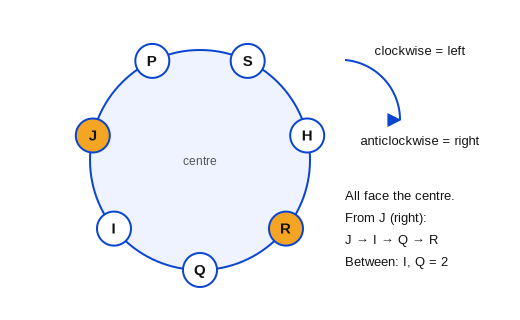
H, I, J, P, Q, R and S are sitting around a circular table facing the centre. P sits third to the left of Q. R sits second to the left of S. Q is the immediate neighbour of both I and R. H is not an immediate neighbour of P.
How many people sit between J and R when counted from the right of J?
H, I, J, P, Q, R और S एक वृत्ताकार मेज़ के चारों ओर केंद्र की ओर मुख करके बैठे हैं। P, Q के बाएँ से तीसरे स्थान पर बैठा है। R, S के बाएँ से दूसरे स्थान पर बैठा है। Q, I और R दोनों का निकटतम पड़ोसी है। H, P का निकटतम पड़ोसी नहीं है।
J के दाएँ से गिनने पर J और R के बीच कितने व्यक्ति बैठे हैं?
  1. AOneएक
  2. BTwoदो
  3. CThreeतीन
  4. DFourचार
Show answer

Concept: Facing the centre: left = clockwise, right = anticlockwise.

  1. Fix Q. P is 3rd to the left of Q; I and R sit on either side of Q.
  2. If R were on Q's left, S (two to R's right) would clash with I – so R is on Q's right, I on Q's left, and S is two places right of R.
  3. H is not next to P, so H sits between R and S; J takes the last seat (next to P and I).
  4. Going right from J: I, Q, then R – 2 persons between.

Trick: Fix the person mentioned most often (Q) first.

Answer: (B) Two

अवधारणा: केंद्र की ओर मुख: बायाँ = दक्षिणावर्त, दायाँ = वामावर्त।

  1. Q को स्थिर करें। P, Q के बाएँ तीसरा है; I और R, Q के दोनों ओर।
  2. यदि R, Q के बाएँ हो तो S (R के दाएँ दूसरा) I से टकराएगा – अतः R, Q के दाएँ, I बाएँ, और S, R से दो स्थान दाएँ।
  3. H, P का पड़ोसी नहीं, अतः H, R और S के बीच; J शेष सीट पर (P और I के बीच)।
  4. J के दाएँ से: I, Q, फिर R – बीच में 2 व्यक्ति।

ट्रिक: सबसे अधिक बार आए व्यक्ति (Q) को पहले स्थिर करें।

उत्तर: (B) दो

RRB NTPC Undergraduate CBT 1General Intelligence and ReasoningCircular seatingRRB NTPC Undergraduate CBT 1 2024 · 18 Aug Shift 2 →
Q2699.
Each digit of the number 8234619 is arranged in ascending order from left to right. How many digits will remain in the same position as in the original number?
संख्या 8234619 के प्रत्येक अंक को बाएँ से दाएँ आरोही क्रम में व्यवस्थित किया जाता है। कितने अंकों का स्थान मूल संख्या के समान ही रहेगा?
  1. ASixछह
  2. BFiveपाँच
  3. CThreeतीन
  4. DFourचार
Show answer

Concept: Write the digits in ascending order and compare position by position.

  1. Original: 8 2 3 4 6 1 9.
  2. Ascending: 1 2 3 4 6 8 9.
  3. Same positions: 2, 3, 4, 6, 9 – five digits.

Trick: Line the two numbers one under the other and tick matches.

Answer: (B) Five

अवधारणा: अंकों को आरोही क्रम में लिखकर हर स्थान की तुलना करें।

  1. मूल: 8 2 3 4 6 1 9।
  2. आरोही: 1 2 3 4 6 8 9।
  3. समान स्थान: 2, 3, 4, 6, 9 – पाँच अंक।

ट्रिक: दोनों संख्याएँ एक के नीचे एक लिखकर मिलान करें।

उत्तर: (B) पांच

RRB NTPC Undergraduate CBT 1General Intelligence and ReasoningDigit arrangementRRB NTPC Undergraduate CBT 1 2024 · 18 Aug Shift 2 →
Q2700.
If '÷' and '−' are interchanged and '×' and '+' are interchanged, what will come in place of the question mark (?) in the following equation?
45 + 5 ÷ 5 × 6 − 3 + 24 × 9 ÷ 3 × 2 = ?
यदि '÷' और '−' को आपस में बदल दिया जाए तथा '×' और '+' को आपस में बदल दिया जाए, तो निम्नलिखित समीकरण में प्रश्न चिह्न (?) के स्थान पर क्या आएगा?
45 + 5 ÷ 5 × 6 − 3 + 24 × 9 ÷ 3 × 2 = ?
  1. A198
  2. B260
  3. C276
  4. D246
Show answer

Concept: Interchange the signs first, then apply BODMAS.

  1. After swapping (÷↔−, ×↔+): 45×5−5+6÷3×24+9−3+2.
  2. 45×5=225; 6÷3×24=48.
  3. 225−5+48+9−3+2=276.

Trick: Rewrite the whole expression with new signs before calculating.

Answer: (C) 276

अवधारणा: पहले चिह्न बदलें, फिर BODMAS लगाएँ।

  1. बदलने पर (÷↔−, ×↔+): 45×5−5+6÷3×24+9−3+2।
  2. 45×5=225; 6÷3×24=48।
  3. 225−5+48+9−3+2=276।

ट्रिक: गणना से पहले पूरा व्यंजक नए चिह्नों के साथ लिख लें।

उत्तर: (C) 276

RRB NTPC Undergraduate CBT 1General Intelligence and ReasoningSymbol interchangeRRB NTPC Undergraduate CBT 1 2024 · 18 Aug Shift 2 →