Question bank

Q&A: practice questions with answers

Search questions on any topic. Filter by exam category, exam, subject and topic, try the question, then open the answer and explanation.

Courses – airGurukul

20,719 questions found.

Q2701.
Select the pair that follows the same pattern as that followed by the two pairs given below. Both pairs follow the same pattern.
PGS : LBO
HWK : DRG
उस युग्म का चयन कीजिए जो उसी पैटर्न का अनुसरण करता है जिसका अनुसरण नीचे दिए गए दो युग्मों द्वारा किया जाता है। दोनों युग्म एक ही पैटर्न का अनुसरण करते हैं।
PGS : LBO
HWK : DRG
  1. ALHC : PEG
  2. BQFM : VKP
  3. CCAL : GVP
  4. DXQA : TLW
Show answer

Concept: Find the letter-position shifts in the given pairs.

  1. PGS → LBO: P−4=L, G−5=B, S−4=O.
  2. HWK → DRG: H−4=D, W−5=R, K−4=G.
  3. XQA: X−4=T, Q−5=L, A−4=W (wrap back from A) → TLW.

Trick: Pattern −4,−5,−4; for A, count back to W.

Answer: (D) XQA : TLW

अवधारणा: दिए गए युग्मों में अक्षरों का स्थान-अंतर देखें।

  1. PGS → LBO: P−4=L, G−5=B, S−4=O।
  2. HWK → DRG: H−4=D, W−5=R, K−4=G।
  3. XQA: X−4=T, Q−5=L, A−4=W (A से पीछे गिनें) → TLW।

ट्रिक: पैटर्न −4,−5,−4; A से पीछे Z, Y, X, W।

उत्तर: (D) XQA : TLW
RRB NTPC Undergraduate CBT 1General Intelligence and ReasoningLetter analogyRRB NTPC Undergraduate CBT 1 2024 · 18 Aug Shift 2 →
Q2702.
Which of the following letter-number clusters will replace the question mark (?) in the given series to make it logically complete?
IVP 16 HQM 5 GLJ -6 ? EBD -28
दी गई श्रृंखला को तार्किक रूप से पूर्ण करने के लिए निम्नलिखित में से कौन-सा अक्षर-संख्या समूह प्रश्न चिह्न (?) को प्रतिस्थापित करेगा?
IVP 16 HQM 5 GLJ -6 ? EBD -28
  1. AHJI 21
  2. BGHI -30
  3. CFGG -17
  4. DBHJ 19
Show answer

Concept: Track each letter position and the number separately.

  1. 1st letters: I, H, G, F, E (−1).
  2. 2nd letters: V, Q, L, G, B (−5); 3rd letters: P, M, J, G, D (−3).
  3. Numbers: 16,5,−6,−17,−28 (−11).
  4. Missing term: FGG −17.

Trick: Check the number first: only −17 fits −6−11.

Answer: (C) FGG −17

अवधारणा: हर अक्षर-स्थान और संख्या को अलग-अलग देखें।

  1. पहले अक्षर: I, H, G, F, E (−1)।
  2. दूसरे: V, Q, L, G, B (−5); तीसरे: P, M, J, G, D (−3)।
  3. संख्याएँ: 16,5,−6,−17,−28 (−11)।
  4. लुप्त पद: FGG −17।

ट्रिक: पहले संख्या जाँचें: केवल −17 ही −6−11 है।

उत्तर: (C) FGG −17

RRB NTPC Undergraduate CBT 1General Intelligence and ReasoningAlpha-numeric seriesRRB NTPC Undergraduate CBT 1 2024 · 18 Aug Shift 2 →
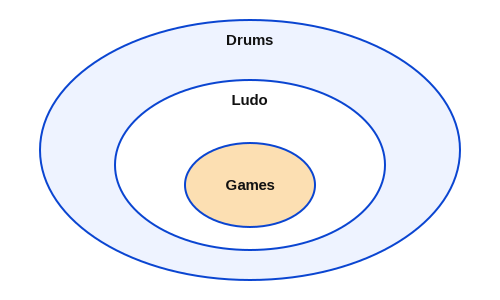
Q2703.
Read the given statements and conclusions carefully. Assuming that the information given in the statements is true, even if it appears to be at variance with commonly known facts, decide which of the given conclusions logically follow(s) from the statements.
Statements: All games are ludos. All ludos are drums.
Conclusion (I): Some drums are ludos.
Conclusion (II): All games are drums.
दिए गए कथनों और निष्कर्षों को ध्यानपूर्वक पढ़िए। यह मानते हुए कि कथनों में दी गई जानकारी सत्य है, भले ही वह सामान्य रूप से ज्ञात तथ्यों से भिन्न प्रतीत होती हो, निर्णय कीजिए कि दिए गए निष्कर्षों में से कौन-सा/से निष्कर्ष कथनों का तार्किक रूप से अनुसरण करता है/करते हैं।
कथन: सभी गेम, लूडो हैं। सभी लूडो, ड्रम हैं।
निष्कर्ष (I): कुछ ड्रम, लूडो हैं।
निष्कर्ष (II): सभी गेम, ड्रम हैं।
  1. AOnly conclusion (II) follows.केवल निष्कर्ष (II) अनुसरण करता है।
  2. BBoth conclusions (I) and (II) follow.निष्कर्ष (I) और (II) दोनों अनुसरण करते हैं।
  3. COnly conclusion (I) follows.केवल निष्कर्ष (I) अनुसरण करता है।
  4. DNeither conclusion (I) nor (II) follows.न तो निष्कर्ष (I) और न ही (II) अनुसरण करता है।
Show answer

Concept: Draw the Venn diagram with the minimum possible overlap.

  1. Games ⊂ Ludo ⊂ Drums.
  2. (I) Ludo lies inside Drums, so some drums are ludo – follows.
  3. (II) Games inside Ludo inside Drums – all games are drums – follows.

Trick: "All A are B" + "All B are C" ⇒ "All A are C"; and "All" always gives "Some" in reverse.

Answer: (B) Both conclusions (I) and (II) follow

अवधारणा: न्यूनतम संभव ओवरलैप के साथ वेन आरेख बनाएँ।

  1. खेल ⊂ लूडो ⊂ ड्रम।
  2. (I) लूडो पूरी तरह ड्रम के अंदर, अतः कुछ ड्रम लूडो हैं – अनुसरण करता है।
  3. (II) खेल ⊂ लूडो ⊂ ड्रम – सभी खेल ड्रम हैं – अनुसरण करता है।

ट्रिक: "सभी A, B हैं" + "सभी B, C हैं" ⇒ "सभी A, C हैं"; "सभी" से उल्टा "कुछ" हमेशा निकलता है।

उत्तर: (B) निष्कर्ष (I) और (II) दोनों अनुसरण करते हैं

RRB NTPC Undergraduate CBT 1General Intelligence and ReasoningSyllogismRRB NTPC Undergraduate CBT 1 2024 · 18 Aug Shift 2 →
Q2704.
If '+' means '−', '−' means '×', '×' means '÷' and '÷' means '+', what will come in place of the question mark (?) in the following equation?
26 + 14 − 2 ÷ 56 × 7 = ?
यदि '+' का अर्थ '−', '−' का अर्थ '×', '×' का अर्थ '÷' और '÷' का अर्थ '+' है, तो निम्नलिखित समीकरण में प्रश्न चिह्न (?) के स्थान पर क्या आएगा?
26 + 14 − 2 ÷ 56 × 7 = ?
  1. A6
  2. B21
  3. C10
  4. D14
Show answer

Concept: Replace the signs as told, then use BODMAS.

  1. 26−14×2+56÷7.
  2. 14×2=28, 56÷7=8.
  3. 26−28+8=6.

Trick: Write the new expression fully before solving.

Answer: (A) 6

अवधारणा: बताए अनुसार चिह्न बदलें, फिर BODMAS लगाएँ।

  1. 26−14×2+56÷7।
  2. 14×2=28, 56÷7=8।
  3. 26−28+8=6।

ट्रिक: हल करने से पहले नया व्यंजक पूरा लिखें।

उत्तर: (A) 6

RRB NTPC Undergraduate CBT 1General Intelligence and ReasoningMathematical operationsRRB NTPC Undergraduate CBT 1 2024 · 18 Aug Shift 2 →
Q2705.
Based on the English alphabetical order, three of the following four letter-cluster pairs are alike in a certain way and thus form a group. Which letter-cluster pair does NOT belong to that group? (Note: The odd letter-cluster pair is not based on the number of consonants/vowels or their position in the letter-cluster pair.)
अंग्रेज़ी वर्णमाला क्रम के आधार पर, निम्नलिखित चार अक्षर-समूह युग्मों में से तीन किसी निश्चित प्रकार से एकसमान हैं और इस प्रकार एक समूह बनाते हैं। कौन-सा अक्षर-समूह युग्म उस समूह से संबंधित नहीं है? (ध्यान दें: असंगत अक्षर-समूह युग्म, उस अक्षर-समूह युग्म में व्यंजनों/स्वरों की संख्या या उनके स्थान पर आधारित नहीं है।)
  1. ADH-KB
  2. BMQ-TK
  3. CJN-QG
  4. DGK-NE
Show answer

Concept: Compare the letter positions of the two groups in each pair.

  1. DH-KB: D+7=K, H−6=B.
  2. MQ-TK: M+7=T, Q−6=K; GK-NE: G+7=N, K−6=E.
  3. JN-QG: J+7=Q but N−6=H, not G – odd one.

Trick: Check the second letter: N(14)−6 = H(8), while G is 7.

Answer: (C) JN-QG

अवधारणा: हर युग्म में दोनों समूहों के अक्षर-स्थान की तुलना करें।

  1. DH-KB: D+7=K, H−6=B।
  2. MQ-TK: M+7=T, Q−6=K; GK-NE: G+7=N, K−6=E।
  3. JN-QG: J+7=Q, पर N−6=H, G नहीं – विषम।

ट्रिक: दूसरा अक्षर जाँचें: N(14)−6 = H(8), जबकि G = 7।

उत्तर: (C) JN-QG

RRB NTPC Undergraduate CBT 1General Intelligence and ReasoningOdd letter pairRRB NTPC Undergraduate CBT 1 2024 · 18 Aug Shift 2 →
Q2706.
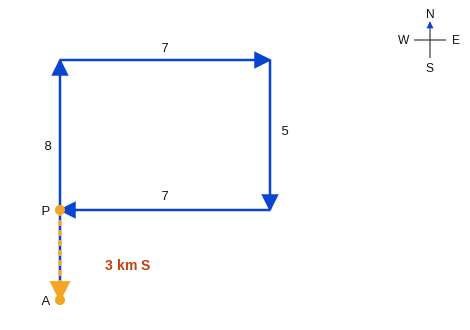
Manish started from point A and travelled 8 km towards North. Then he turned right and travelled 7 km. Then he turned right and travelled 5 km. Then he turned right, travelled 7 km and stopped at point P. How far (shortest distance) and in which direction should he travel to reach point A? (All turns are 90-degree turns only.)
मनीष ने बिंदु A से चलना शुरू किया और उत्तर की ओर 8 km की यात्रा की। फिर वह दाएँ मुड़ा और 7 km की यात्रा की। फिर वह दाएँ मुड़ा और 5 km की यात्रा की। फिर वह दाएँ मुड़ा, 7 km की यात्रा की और बिंदु P पर रुक गया। बिंदु A तक पहुँचने के लिए उसे कितनी दूरी (न्यूनतम दूरी) और किस दिशा में यात्रा करनी चाहिए? (सभी मोड़ केवल 90 डिग्री के मोड़ हैं।)
  1. A2 km, towards West2 km, पश्चिम की ओर
  2. B5 km, towards North5 km, उत्तर की ओर
  3. C4 km, towards East4 km, पूर्व की ओर
  4. D3 km, towards South3 km, दक्षिण की ओर
Show answer

Concept: Trace the path on axes (N up, E right) and join the end to the start.

  1. North 8 km, right → East 7 km, right → South 5 km, right → West 7 km.
  2. East-West: 7−7=0; North-South: 8−5=3 km north of A.
  3. So P is 3 km north of A ⇒ go 3 km south.

Trick: Equal east and west moves cancel; only the vertical difference remains.

Answer: (D) 3 km, towards South

अवधारणा: अक्ष पर रास्ता बनाएँ (ऊपर उत्तर, दाएँ पूर्व) और अंतिम बिंदु को आरंभ से जोड़ें।

  1. उत्तर 8 km, दाएँ → पूर्व 7 km, दाएँ → दक्षिण 5 km, दाएँ → पश्चिम 7 km।
  2. पूर्व-पश्चिम: 7−7=0; उत्तर-दक्षिण: 8−5=3 km (A के उत्तर)।
  3. अतः P, A से 3 km उत्तर ⇒ 3 km दक्षिण जाना होगा।

ट्रिक: बराबर पूर्व-पश्चिम दूरियाँ कट जाती हैं; केवल ऊर्ध्वाधर अंतर बचता है।

उत्तर: (D) 3 km, दक्षिण की ओर

RRB NTPC Undergraduate CBT 1General Intelligence and ReasoningDirection and distanceRRB NTPC Undergraduate CBT 1 2024 · 18 Aug Shift 2 →
Q2707.
Refer to the following number and symbol series and answer the question given below. Counting is to be done from left to right only.
(Note: All numbers are single-digit numbers only)
(Left) 5 ^ * # 0 2 4 @ % 9 $ % 3 > @ 7 & * (Right)
If all the numbers are removed from the series, which of the following will be sixth from the left?
निम्नलिखित संख्या और प्रतीक श्रृंखला को देखिए और नीचे दिए गए प्रश्न का उत्तर दीजिए। गिनती केवल बाएँ से दाएँ की जानी है।
(ध्यान दें: सभी संख्याएँ केवल एक-अंकीय संख्याएँ हैं)
(बाएँ) 5 ^ * # 0 2 4 @ % 9 $ % 3 > @ 7 & * (दाएँ)
यदि श्रृंखला से सभी संख्याएँ हटा दी जाएँ, तो निम्नलिखित में से कौन-सा बाएँ से छठे स्थान पर होगा?
  1. A#
  2. B@
  3. C%
  4. D$
Show answer

Concept: Remove the numbers and rewrite the remaining symbols in order.

  1. Symbols only: ^ * # @ % $ % > @ & *.
  2. Count from the left: ^(1), *(2), #(3), @(4), %(5), $(6).

Trick: Cross out digits on paper first, then count – avoids skipping.

Answer: (D) $

अवधारणा: संख्याएँ हटाकर बचे प्रतीक क्रम से लिखें।

  1. केवल प्रतीक: ^ * # @ % $ % > @ & *।
  2. बाएँ से गिनें: ^(1), *(2), #(3), @(4), %(5), $(6)।

ट्रिक: पहले अंक काट दें, फिर गिनें – कोई छूटेगा नहीं।

उत्तर: (D) $

RRB NTPC Undergraduate CBT 1General Intelligence and ReasoningNumber-symbol seriesRRB NTPC Undergraduate CBT 1 2024 · 18 Aug Shift 2 →
Q2708.
Based on the English alphabetical order, three of the following four letter-clusters are alike in a certain way and thus form a group. Which letter-cluster does NOT belong to that group? (Note: The odd letter-cluster is not based on the number of consonants/vowels or their position in the letter-cluster.)
अंग्रेज़ी वर्णमाला क्रम के आधार पर, निम्नलिखित चार अक्षर-समूहों में से तीन किसी निश्चित प्रकार से एकसमान हैं और इस प्रकार एक समूह बनाते हैं। कौन-सा अक्षर-समूह उस समूह से संबंधित नहीं है? (ध्यान दें: असंगत अक्षर-समूह, उस अक्षर-समूह में व्यंजनों/स्वरों की संख्या या उनके स्थान पर आधारित नहीं है।)
  1. AKFH
  2. BNIL
  3. CUPR
  4. DRMO
Show answer

Concept: Check the gaps between consecutive letters.

  1. KFH: K−5=F, F+2=H.
  2. UPR: U−5=P, P+2=R; RMO: R−5=M, M+2=O.
  3. NIL: N−5=I, but I+3=L – odd one.

Trick: Pattern −5,+2; NIL breaks it with +3.

Answer: (B) NIL

अवधारणा: क्रमागत अक्षरों के अंतर देखें।

  1. KFH: K−5=F, F+2=H।
  2. UPR: U−5=P, P+2=R; RMO: R−5=M, M+2=O।
  3. NIL: N−5=I, पर I+3=L – विषम।

ट्रिक: पैटर्न −5,+2; NIL में +3 है।

उत्तर: (B) NIL

RRB NTPC Undergraduate CBT 1General Intelligence and ReasoningOdd letter clusterRRB NTPC Undergraduate CBT 1 2024 · 18 Aug Shift 2 →
Q2709.
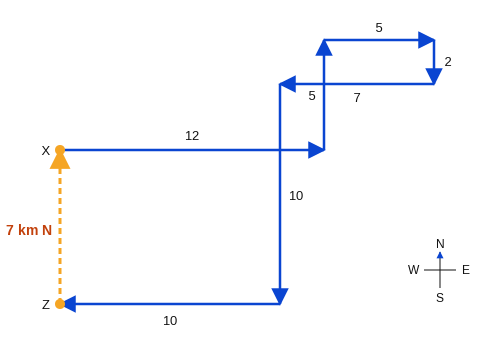
Shivam starts from point X and drives 12 km towards East. Then he turns left, drives 5 km, turns right and drives 5 km. Then he turns right and drives 2 km. Then he turns right and drives 7 km. Again he turns left and drives 10 km. Then he turns right for the last time, drives 10 km and stops at point Z. How far and in which direction should he drive to reach point X again? (All turns are 90-degree turns unless specified otherwise.)
शिवम बिंदु X से चलना शुरू करता है और पूर्व की ओर 12 km गाड़ी चलाता है। फिर वह बाएँ मुड़ता है, 5 km गाड़ी चलाता है, दाएँ मुड़ता है और 5 km गाड़ी चलाता है। फिर वह दाएँ मुड़ता है और 2 km गाड़ी चलाता है। फिर वह दाएँ मुड़ता है और 7 km गाड़ी चलाता है। पुनः वह बाएँ मुड़ता है और 10 km गाड़ी चलाता है। फिर वह अंतिम बार दाएँ मुड़ता है, 10 km गाड़ी चलाता है और बिंदु Z पर रुक जाता है। पुनः बिंदु X पर पहुँचने के लिए उसे कितनी दूरी और किस दिशा में गाड़ी चलानी चाहिए? (जब तक अन्यथा निर्दिष्ट न हो, सभी मोड़ 90 डिग्री के मोड़ हैं।)
  1. A5 km South5 km दक्षिण
  2. B10 km North10 km उत्तर
  3. C7 km South7 km दक्षिण
  4. D7 km North7 km उत्तर
Show answer

Concept: Track net East-West and North-South displacement.

  1. E 12 → left N 5 → right E 5 → right S 2 → right W 7 → left S 10 → right W 10.
  2. East-West: 12+5−7−10=0.
  3. North-South: 5−2−10=−7, i.e. Z is 7 km south of X.
  4. So drive 7 km north.

Trick: Net East and net North separately; a zero in one gives a straight-line answer.

Answer: (D) 7 km North

अवधारणा: कुल पूर्व-पश्चिम और उत्तर-दक्षिण विस्थापन निकालें।

  1. पूर्व 12 → बाएँ उत्तर 5 → दाएँ पूर्व 5 → दाएँ दक्षिण 2 → दाएँ पश्चिम 7 → बाएँ दक्षिण 10 → दाएँ पश्चिम 10।
  2. पूर्व-पश्चिम: 12+5−7−10=0।
  3. उत्तर-दक्षिण: 5−2−10=−7, अर्थात Z, X से 7 km दक्षिण।
  4. अतः 7 km उत्तर जाना होगा।

ट्रिक: पूर्व और उत्तर का कुल अलग-अलग निकालें; एक शून्य हो तो उत्तर सीधी रेखा में।

उत्तर: (D) 7 km उत्तर

RRB NTPC Undergraduate CBT 1General Intelligence and ReasoningDirection and distanceRRB NTPC Undergraduate CBT 1 2024 · 18 Aug Shift 2 →
Q2710.
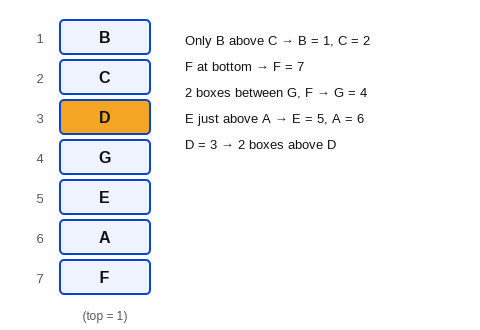
Seven boxes A, B, C, D, E, F and G are kept one above the other, but not necessarily in the same order. Only B is kept above C. Exactly two boxes are kept between G and F. E is kept immediately above A. No box is kept below F. How many boxes are kept above D?
सात बक्से A, B, C, D, E, F और G एक के ऊपर एक रखे गए हैं, लेकिन जरूरी नहीं कि इसी क्रम में हों। केवल B को C के ऊपर रखा गया है। G और F के बीच ठीक दो बक्से रखे गए हैं। E को A के ठीक ऊपर रखा गया है। F के नीचे कोई बक्सा नहीं रखा गया है। D के ऊपर कितने बक्से रखे गए हैं?
  1. AThreeतीन
  2. BTwoदो
  3. COneएक
  4. DFourचार
Show answer

Concept: Fix the definite positions first (top/bottom), then fill the rest.

  1. Only B is above C ⇒ B = 1st, C = 2nd from top.
  2. No box below F ⇒ F = 7th; two boxes between G and F ⇒ G = 4th.
  3. E just above A needs two adjacent free places ⇒ E = 5th, A = 6th; D = 3rd.
  4. Boxes above D: B and C = two.

Trick: "Only X above Y" means X is the topmost box and Y second.

Answer: (B) Two

अवधारणा: पहले निश्चित स्थान (ऊपर/नीचे) तय करें, फिर बाकी भरें।

  1. केवल B, C के ऊपर ⇒ B = 1, C = 2 (ऊपर से)।
  2. F के नीचे कोई नहीं ⇒ F = 7; G और F के बीच दो ⇒ G = 4।
  3. E ठीक A के ऊपर – दो लगातार खाली स्थान ⇒ E = 5, A = 6; D = 3।
  4. D के ऊपर: B और C = दो।

ट्रिक: "केवल X, Y के ऊपर" का अर्थ X सबसे ऊपर और Y दूसरा।

उत्तर: (B) दो

RRB NTPC Undergraduate CBT 1General Intelligence and ReasoningBox arrangementRRB NTPC Undergraduate CBT 1 2024 · 18 Aug Shift 2 →
Q2711.
Refer to the following number and symbol series and answer the question given below. Counting is to be done from left to right only.
(Left) 2 & * 4 6 % @ 7 $ & 1 # Ω 3 @ 8 * £ 5 9 (Right)
How many such symbols are there, each of which is immediately preceded by a number and immediately followed by another number?
निम्नलिखित संख्या और प्रतीक श्रृंखला को देखिए और नीचे दिए गए प्रश्न का उत्तर दीजिए। गिनती केवल बाएँ से दाएँ की जानी है।
(बाएँ) 2 & * 4 6 % @ 7 $ & 1 # Ω 3 @ 8 * £ 5 9 (दाएँ)
ऐसे कितने प्रतीक हैं, जिनमें से प्रत्येक के ठीक पहले एक संख्या है और ठीक बाद में एक अन्य संख्या है?
  1. AMore than twoदो से अधिक
  2. BNoneएक भी नहीं
  3. COneएक
  4. DTwoदो
Show answer

Concept: Check every symbol: digit just before it AND digit just after it.

  1. & (after 2) is followed by * ✗; % (after 6) followed by @ ✗; $ (after 7) followed by & ✗; # (after 1) followed by Ω ✗.
  2. @ in "3 @ 8": 3 before, 8 after ✓.
  3. Other symbols are preceded by a symbol ✗. Count = one.

Trick: Scan only symbols that follow a digit – it halves the work.

Answer: (C) One

अवधारणा: हर प्रतीक जाँचें: ठीक पहले अंक और ठीक बाद अंक।

  1. & (2 के बाद) के बाद * ✗; % (6 के बाद) के बाद @ ✗; $ (7 के बाद) के बाद & ✗; # (1 के बाद) के बाद Ω ✗।
  2. "3 @ 8" में @: पहले 3, बाद 8 ✓।
  3. बाकी प्रतीकों से पहले प्रतीक है ✗। संख्या = एक।

ट्रिक: केवल उन्हीं प्रतीकों को देखें जिनसे पहले अंक है।

उत्तर: (C) एक

RRB NTPC Undergraduate CBT 1General Intelligence and ReasoningNumber-symbol seriesRRB NTPC Undergraduate CBT 1 2024 · 18 Aug Shift 2 →
Q2712.
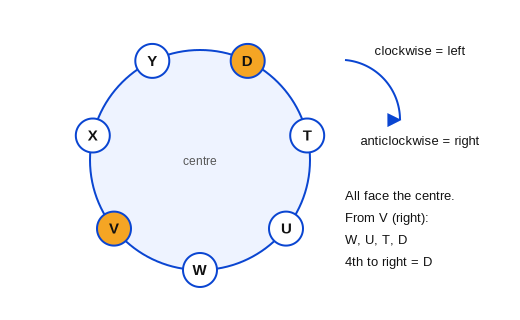
Seven persons, T, U, V, W, X, Y and D, are sitting around a circular table facing the centre of the table. Only two persons sit between X and U when counted from the right of X. Only three persons sit between Y and W when counted from the right of W. U sits to the immediate right of W. D sits to the immediate right of T. Who sits fourth to the right of V?
सात व्यक्ति, T, U, V, W, X, Y और D, एक वृत्ताकार मेज़ के चारों ओर मेज़ के केंद्र की ओर मुख करके बैठे हैं। X के दाएँ से गिनने पर X और U के बीच केवल दो व्यक्ति बैठे हैं। W के दाएँ से गिनने पर Y और W के बीच केवल तीन व्यक्ति बैठे हैं। U, W के ठीक दाएँ बैठा है। D, T के ठीक दाएँ बैठा है। V के दाएँ से चौथे स्थान पर कौन बैठा है?
  1. AD
  2. BU
  3. CX
  4. DT
Show answer

Concept: Facing the centre: right = anticlockwise, left = clockwise.

  1. Fix W; U is immediately to the right of W.
  2. Y is 4th to the right of W (three persons between, counted from W's right).
  3. X and U have two persons between, counted from X's right ⇒ X is 3rd to the left of U (2nd to the left of W).
  4. T and D (D right of T) fill the two seats between U and Y; V takes the last seat (left of W).
  5. 4th to the right of V: W, U, T, D ⇒ D.

Trick: Seat the "immediate neighbour" pairs first – they lock the circle quickly.

Answer: (A) D

अवधारणा: केंद्र की ओर मुख: दायाँ = वामावर्त, बायाँ = दक्षिणावर्त।

  1. W को स्थिर करें; U, W के ठीक दाएँ।
  2. Y, W के दाएँ चौथा (W के दाएँ से गिनने पर बीच में तीन)।
  3. X के दाएँ से गिनने पर X और U के बीच दो ⇒ X, U के बाएँ तीसरा (W के बाएँ दूसरा)।
  4. T और D (D, T के दाएँ) U और Y के बीच की दो सीटों पर; V शेष सीट (W के बाएँ)।
  5. V के दाएँ चौथा: W, U, T, D ⇒ D।

ट्रिक: पहले "ठीक पड़ोसी" वाले जोड़े बैठाएँ – वृत्त जल्दी तय होता है।

उत्तर: (A) D

RRB NTPC Undergraduate CBT 1General Intelligence and ReasoningCircular seatingRRB NTPC Undergraduate CBT 1 2024 · 18 Aug Shift 2 →
Q2713.
Based on the English alphabetical order, AGPV is related to DKSZ in a certain way. In the same way, MWBL is related to PAEP. Following the same logic, to which of the given options is VIKX related?
अंग्रेज़ी वर्णमाला क्रम के आधार पर, AGPV एक निश्चित प्रकार से DKSZ से संबंधित है। उसी प्रकार, MWBL, PAEP से संबंधित है। समान तर्क का अनुसरण करते हुए, VIKX दिए गए विकल्पों में से किससे संबंधित है?
  1. AYMNB
  2. BYBNM
  3. CTBNH
  4. DYMBN
Show answer

Concept: Find the shift applied to each letter.

  1. AGPV → DKSZ: +3,+4,+3,+4.
  2. MWBL → PAEP: M+3=P, W+4=A, B+3=E, L+4=P ✓.
  3. VIKX: V+3=Y, I+4=M, K+3=N, X+4=B → YMNB.

Trick: Alternate +3,+4; wrap after Z (X+4 = B).

Answer: (A) YMNB

अवधारणा: हर अक्षर पर लगा परिवर्तन देखें।

  1. AGPV → DKSZ: +3,+4,+3,+4।
  2. MWBL → PAEP: M+3=P, W+4=A, B+3=E, L+4=P ✓।
  3. VIKX: V+3=Y, I+4=M, K+3=N, X+4=B → YMNB।

ट्रिक: बारी-बारी +3,+4; Z के बाद A से गिनें (X+4 = B)।

उत्तर: (A) YMNB

RRB NTPC Undergraduate CBT 1General Intelligence and ReasoningLetter analogyRRB NTPC Undergraduate CBT 1 2024 · 18 Aug Shift 2 →
Q2714.
In a certain code language, 'keep it fun' is coded as 'tr cj ly' and 'lets have fun' is coded as 'mg ly ev'. How will 'fun' be coded in the given language?
एक निश्चित कूट भाषा में, 'keep it fun' को 'tr cj ly' और 'lets have fun' को 'mg ly ev' के रूप में कूटबद्ध किया जाता है। दी गई भाषा में 'fun' को किस प्रकार कूटबद्ध किया जाएगा?
  1. Acj
  2. Bev
  3. Ctr
  4. Dly
Show answer

Concept: A word common to two sentences has the code common to both.

  1. "keep it fun" → tr cj ly; "lets have fun" → mg ly ev.
  2. Common word: fun; common code: ly.

Trick: One common word ↔ one common code.

Answer: (D) ly

अवधारणा: दोनों वाक्यों में समान शब्द का कूट भी समान होता है।

  1. "keep it fun" → tr cj ly; "lets have fun" → mg ly ev।
  2. समान शब्द: fun; समान कूट: ly।

ट्रिक: एक समान शब्द ↔ एक समान कूट।

उत्तर: (D) ly

RRB NTPC Undergraduate CBT 1General Intelligence and ReasoningCoding-decodingRRB NTPC Undergraduate CBT 1 2024 · 18 Aug Shift 2 →
Q2715.
In the following triads, each group of letters is related to the next group following a certain logic. Select the option that follows the same logic.
PACK – AKCP – KCAP
FOLD – ODLF – DLOF
निम्नलिखित त्रिकों में, अक्षरों का प्रत्येक समूह एक निश्चित तर्क का अनुसरण करते हुए अगले समूह से संबंधित है। उस विकल्प का चयन कीजिए जो समान तर्क का अनुसरण करता है।
PACK – AKCP – KCAP
FOLD – ODLF – DLOF
  1. ASUIT – USIT – TUIS
  2. BBELT – EBLT – TELB
  3. CCLAP – LPAC – PALC
  4. DAPES – AEPS – SEPA
Show answer

Concept: Number the letters of the first word 1-2-3-4 and see how they move.

  1. PACK (1234) → AKCP = letters 2, 4, 3, 1.
  2. Third group = first word reversed: PACK → KCAP; FOLD → ODLF → DLOF ✓.
  3. CLAP → (2,4,3,1) LPAC → reversed PALC ✓.

Trick: Test the easy rule first: is the third group just the reverse?

Answer: (C) CLAP – LPAC – PALC

अवधारणा: पहले शब्द के अक्षरों को 1-2-3-4 क्रमांक देकर उनका स्थान देखें।

  1. PACK (1234) → AKCP = अक्षर 2, 4, 3, 1।
  2. तीसरा समूह = पहला शब्द उल्टा: PACK → KCAP; FOLD → ODLF → DLOF ✓।
  3. CLAP → (2,4,3,1) LPAC → उल्टा PALC ✓।

ट्रिक: पहले आसान नियम जाँचें: क्या तीसरा समूह उल्टा शब्द है?

उत्तर: (C) CLAP – LPAC – PALC

RRB NTPC Undergraduate CBT 1General Intelligence and ReasoningLetter rearrangementRRB NTPC Undergraduate CBT 1 2024 · 18 Aug Shift 2 →
Q2716.
Based on the English alphabetical order, three of the following four letter-clusters are alike in a certain way and thus form a group. Which letter-cluster does NOT belong to that group? (Note: The odd letter-cluster is not based on the number of consonants/vowels or their position in the letter-cluster.)
अंग्रेज़ी वर्णमाला क्रम के आधार पर, निम्नलिखित चार अक्षर-समूहों में से तीन किसी निश्चित प्रकार से एकसमान हैं और इस प्रकार एक समूह बनाते हैं। कौन-सा अक्षर-समूह उस समूह से संबंधित नहीं है? (ध्यान दें: असंगत अक्षर-समूह, उस अक्षर-समूह में व्यंजनों/स्वरों की संख्या या उनके स्थान पर आधारित नहीं है।)
  1. ABZX
  2. BHFD
  3. CTRP
  4. DYOU
Show answer

Concept: Check the step between consecutive letters.

  1. BZX: B−2=Z (wrap), Z−2=X.
  2. HFD and TRP: −2,−2.
  3. YOU: Y−10=O, O+6=U – odd one.

Trick: Pattern −2,−2; YOU only looks like a word.

Answer: (D) YOU

अवधारणा: क्रमागत अक्षरों का अंतर देखें।

  1. BZX: B−2=Z (A के बाद Z), Z−2=X।
  2. HFD और TRP: −2,−2।
  3. YOU: Y−10=O, O+6=U – विषम।

ट्रिक: पैटर्न −2,−2; YOU केवल अर्थपूर्ण शब्द जैसा दिखता है।

उत्तर: (D) YOU

RRB NTPC Undergraduate CBT 1General Intelligence and ReasoningOdd letter clusterRRB NTPC Undergraduate CBT 1 2024 · 18 Aug Shift 2 →
Q2717.
Based on the English alphabetical order, what should come in place of the question mark (?) in the given series?
VOR TMP RKN PIL ?
अंग्रेज़ी वर्णमाला क्रम के आधार पर, दी गई श्रृंखला में प्रश्न चिह्न (?) के स्थान पर क्या आना चाहिए?
VOR TMP RKN PIL ?
  1. ANHJ
  2. BNGJ
  3. CNGI
  4. DNHI
Show answer

Concept: Track each letter position separately.

  1. 1st: V, T, R, P → N (−2).
  2. 2nd: O, M, K, I → G (−2).
  3. 3rd: R, P, N, L → J (−2).

Trick: Every position moves back by 2.

Answer: (B) NGJ

अवधारणा: हर स्थान के अक्षर अलग-अलग देखें।

  1. पहला: V, T, R, P → N (−2)।
  2. दूसरा: O, M, K, I → G (−2)।
  3. तीसरा: R, P, N, L → J (−2)।

ट्रिक: हर स्थान 2 पीछे जाता है।

उत्तर: (B) NGJ

RRB NTPC Undergraduate CBT 1General Intelligence and ReasoningLetter seriesRRB NTPC Undergraduate CBT 1 2024 · 18 Aug Shift 2 →
Q2718.
Select the number from among the given options that can replace the question mark (?) in the following series.
174 152 134 120 110 ?
दिए गए विकल्पों में से उस संख्या का चयन कीजिए जो निम्नलिखित श्रृंखला में प्रश्न चिह्न (?) को प्रतिस्थापित कर सकती है।
174 152 134 120 110 ?
  1. A90
  2. B94
  3. C104
  4. D100
Show answer

Concept: Look at the differences.

  1. Differences: −22,−18,−14,−10 (shrinking by 4).
  2. Next difference =−6: 110−6=104.

Trick: Differences form an AP with step 4.

Answer: (C) 104

अवधारणा: अंतर देखें।

  1. अंतर: −22,−18,−14,−10 (हर बार 4 कम)।
  2. अगला अंतर =−6: 110−6=104।

ट्रिक: अंतर 4 के चरण वाली समांतर श्रेणी में हैं।

उत्तर: (C) 104

RRB NTPC Undergraduate CBT 1General Intelligence and ReasoningNumber seriesRRB NTPC Undergraduate CBT 1 2024 · 18 Aug Shift 2 →
Q2719.
What should come in place of the question mark (?) in the given series?
93 108 131 162 201 ?
दी गई श्रृंखला में प्रश्न चिह्न (?) के स्थान पर क्या आना चाहिए?
93 108 131 162 201 ?
  1. A235
  2. B241
  3. C228
  4. D248
Show answer

Concept: Look at the differences.

  1. Differences: 15,23,31,39 (increase by 8).
  2. Next difference =47: 201+47=248.

Trick: Second differences constant (8).

Answer: (D) 248

अवधारणा: अंतर देखें।

  1. अंतर: 15,23,31,39 (हर बार 8 अधिक)।
  2. अगला अंतर =47: 201+47=248।

ट्रिक: दूसरे क्रम के अंतर स्थिर (8)।

उत्तर: (D) 248

RRB NTPC Undergraduate CBT 1General Intelligence and ReasoningNumber seriesRRB NTPC Undergraduate CBT 1 2024 · 18 Aug Shift 2 →
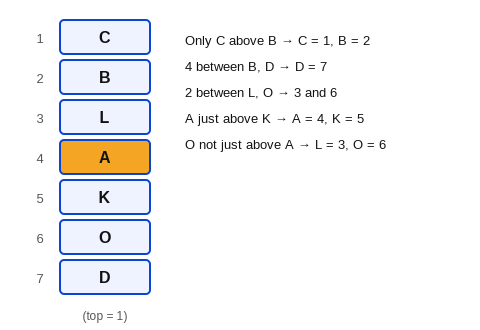
Q2720.
Seven boxes A, B, C, D, K, L and O are kept one above the other but not necessarily in the same order. Only four boxes are kept between B and D. Only C is kept above B. Only two boxes are kept between L and O. A is kept immediately above K. O is not kept immediately above A.
Which box is kept fourth from the top?
सात बक्से A, B, C, D, K, L और O एक के ऊपर एक रखे गए हैं, लेकिन जरूरी नहीं कि इसी क्रम में हों। B और D के बीच केवल चार बक्से रखे गए हैं। केवल C को B के ऊपर रखा गया है। L और O के बीच केवल दो बक्से रखे गए हैं। A को K के ठीक ऊपर रखा गया है। O को A के ठीक ऊपर नहीं रखा गया है।
ऊपर से चौथे स्थान पर कौन-सा बक्सा रखा गया है?
  1. AC
  2. BA
  3. CD
  4. DL
Show answer

Concept: Place the boxes with fixed positions first.

  1. Only C above B ⇒ C = 1st, B = 2nd.
  2. Four boxes between B and D ⇒ D = 7th.
  3. L and O with two between must take 3rd and 6th; A, K (A just above K) take 4th, 5th.
  4. O not just above A ⇒ O ≠ 3rd ⇒ L = 3rd, O = 6th. 4th from top = A.

Trick: Gaps like "four between" in a 7-stack almost fix the position at once.

Answer: (B) A

अवधारणा: पहले निश्चित स्थान वाले बॉक्स रखें।

  1. केवल C, B के ऊपर ⇒ C = 1, B = 2।
  2. B और D के बीच चार ⇒ D = 7।
  3. L और O (बीच में दो) – स्थान 3 और 6; A, K (A ठीक K के ऊपर) – स्थान 4, 5।
  4. O ठीक A के ऊपर नहीं ⇒ O ≠ 3 ⇒ L = 3, O = 6। ऊपर से चौथा = A।

ट्रिक: 7 के ढेर में "बीच में चार" जैसा अंतर स्थान लगभग तुरंत तय कर देता है।

उत्तर: (B) A

RRB NTPC Undergraduate CBT 1General Intelligence and ReasoningBox arrangementRRB NTPC Undergraduate CBT 1 2024 · 18 Aug Shift 2 →