Question bank

Q&A: practice questions with answers

Search questions on any topic. Filter by exam category, exam, subject and topic, try the question, then open the answer and explanation.

Courses – airGurukul

20,719 questions found.

Q261.
Select the set in which the numbers are related in the same way as are the numbers of the following sets.
(NOTE : Operations should be performed on the whole numbers, without breaking down the numbers into its constituent digits. E.g. 13 – Operations on 13 such as adding / subtracting /multiplying etc. to 13 can be performed. Breaking down 13 into 1 and 3 and then performing mathematical operations on 1 and 3 is not allowed.)
(10, 5, 60)
(9, 6, 64)
उस समुच्चय का चयन कीजिए जिसमें संख्याएँ उसी प्रकार संबंधित हैं जिस प्रकार निम्नलिखित समुच्चयों की संख्याएँ संबंधित हैं।
(नोट: संख्याओं को उनके घटक अंकों में तोड़े बिना, पूर्ण संख्याओं पर संक्रियाएँ की जानी चाहिए। उदाहरण के लिए, 13 – 13 पर संक्रियाएँ जैसे 13 में जोड़ना/घटाना/गुणा करना आदि किया जा सकता है। 13 को 1 और 3 में तोड़कर फिर 1 और 3 पर गणितीय संक्रियाएँ करने की अनुमति नहीं है।)
(10, 5, 60)
(9, 6, 64)
  1. A(17, 5, 85)
  2. B(11, 6, 86)
  3. C(12, 4, 58)
  4. D(8, 9, 62)
Show answer

Concept: Third number = first × second + 10.

  1. 10 × 5 + 10 = 60 ✓; 9 × 6 + 10 = 64 ✓.
  2. A: 17×5+10 = 95 ✗; B: 11×6+10 = 76 ✗; C: 12×4+10 = 58 ✓; D: 8×9+10 = 82 ✗.

Short trick: Subtract product from 3rd number: 60−50 = 64−54 = 10; only C gives 58−48 = 10.

Answer: (C) (12, 4, 58)

अवधारणा: तीसरी संख्या = पहली × दूसरी + 10।

  1. 10 × 5 + 10 = 60 ✓; 9 × 6 + 10 = 64 ✓।
  2. A: 95 ✗; B: 76 ✗; C: 12×4+10 = 58 ✓; D: 82 ✗।

शॉर्ट ट्रिक: तीसरी संख्या − गुणनफल = 10; केवल C में 58 − 48 = 10।

उत्तर: (C) (12, 4, 58)

RRB ALP CBT 1General Intelligence and ReasoningNumber analogy – triadsRRB ALP CBT 1 2025 · 17 Feb Shift 3 →
Q262.
Refer to the following letter series and answer the question that follows. Counting to be done from left to right only.
(Left) T S I C X Z O A K L N T E W A K O D F H A G U K (Right)
How many such consonants are there, each of which is immediately preceded by a vowel and also immediately followed by a vowel?
निम्नलिखित अक्षर श्रृंखला को देखिए और उसके बाद दिए गए प्रश्न का उत्तर दीजिए। गिनती केवल बाएँ से दाएँ की जानी है।
(बाएँ) T S I C X Z O A K L N T E W A K O D F H A G U K (दाएँ)
ऐसे कितने व्यंजन हैं, जिनमें से प्रत्येक के ठीक पहले एक स्वर है और ठीक बाद में भी एक स्वर है?
  1. ANoneकोई नहीं
  2. BTwoदो
  3. CThreeतीन
  4. DOneएक
Show answer

Concept: Pattern needed: vowel – consonant – vowel.

  1. Scan for V-C-V triplets: E W A, A K O, A G U.
  2. Others fail, e.g. I C X (X not vowel), O A K L (L not vowel).
  3. Count = 3.

Short trick: Look only at each vowel and see if the letter two places ahead is also a vowel with a consonant between.

Answer: (C) Three

अवधारणा: आवश्यक पैटर्न: स्वर – व्यंजन – स्वर।

  1. स्वर-व्यंजन-स्वर त्रिक: E W A, A K O, A G U।
  2. बाकी असफल, जैसे I C X, A K L।
  3. संख्या = 3।

शॉर्ट ट्रिक: प्रत्येक स्वर से दो स्थान आगे देखें – वहाँ भी स्वर हो और बीच में व्यंजन।

उत्तर: (C) तीन

RRB ALP CBT 1General Intelligence and ReasoningLetter series – countingRRB ALP CBT 1 2025 · 17 Feb Shift 3 →
Q263.
Each letter in the word PERSON is changed to the second letter following it in the English alphabetical order, and then all the letters thus formed are arranged in the English alphabetical order. Which letter will be fifth from the right in the new group of letters formed?
शब्द PERSON के प्रत्येक अक्षर को अंग्रेजी वर्णमाला क्रम में उसके बाद आने वाले दूसरे अक्षर से बदल दिया जाता है, और फिर इस प्रकार बने सभी अक्षरों को अंग्रेजी वर्णमाला क्रम में व्यवस्थित किया जाता है। अक्षरों के इस नए समूह में दाएँ से पाँचवाँ अक्षर कौन-सा होगा?
  1. AE
  2. BQ
  3. CT
  4. DP
Show answer

Concept: Shift +2 then sort.

  1. P→R, E→G, R→T, S→U, O→Q, N→P ⇒ R G T U Q P.
  2. Sorted: G P Q R T U.
  3. 5th from right = 2nd from left (6 letters) = P.

Short trick: 5th from right of 6 letters = 2nd from left – just find the second smallest new letter.

Answer: (D) P

अवधारणा: +2 करें फिर क्रम में लगाएँ।

  1. P→R, E→G, R→T, S→U, O→Q, N→P ⇒ R G T U Q P।
  2. क्रम में: G P Q R T U।
  3. दाएँ से 5वाँ = बाएँ से दूसरा = P।

शॉर्ट ट्रिक: 6 अक्षरों में दाएँ से 5वाँ = बाएँ से दूसरा।

उत्तर: (D) P

RRB ALP CBT 1General Intelligence and ReasoningLetter shifting and arrangementRRB ALP CBT 1 2025 · 17 Feb Shift 3 →
Q264.
Two sets of numbers are given below. In each set of numbers, a certain mathematical operation on the first number results in the second number. Similarly, certain mathematical operation on the second number results in the third number and so on. Which of the given options follows the same set of operations as in the given sets? (NOTE – A two/three digit number cannot be broken into individual digits for operations e.g. if 37 is followed by 10, the operation cannot be 3+7 as a two digit number cannot be broken into individual digits)
14 - 84 - 86 - 82
15 - 90 - 92 - 88
नीचे संख्याओं के दो समुच्चय दिए गए हैं। संख्याओं के प्रत्येक समुच्चय में, पहली संख्या पर एक निश्चित गणितीय संक्रिया करने पर दूसरी संख्या प्राप्त होती है। इसी प्रकार, दूसरी संख्या पर निश्चित गणितीय संक्रिया करने पर तीसरी संख्या प्राप्त होती है और इसी प्रकार आगे भी। दिए गए विकल्पों में से कौन-सा विकल्प, दिए गए समुच्चयों के समान संक्रियाओं के समुच्चय का अनुसरण करता है? (नोट – दो/तीन अंकों की संख्या को संक्रियाओं के लिए अलग-अलग अंकों में नहीं तोड़ा जा सकता, उदाहरण के लिए यदि 37 के बाद 10 आता है, तो संक्रिया 3+7 नहीं हो सकती क्योंकि दो अंकों की संख्या को अलग-अलग अंकों में नहीं तोड़ा जा सकता)
14 - 84 - 86 - 82
15 - 90 - 92 - 88
  1. A34 - 70 - 79 - 78
  2. B22 - 90 - 100 - 99
  3. C37 - 298 - 299 - 287
  4. D8 - 48 - 50 - 46
Show answer

Concept: Rule: ×6, +2, −4.

  1. 14×6 = 84, +2 = 86, −4 = 82 ✓; 15×6 = 90, 92, 88 ✓.
  2. D: 8×6 = 48, +2 = 50, −4 = 46 ✓.
  3. A: 34×6 = 204 ✗; B: 22×6 = 132 ✗; C: 37×6 = 222 ✗.

Short trick: Last two steps +2, −4 ⇒ 4th = 2nd − 2. Only D: 48 − 2 = 46.

Answer: (D) 8 - 48 - 50 - 46

अवधारणा: नियम: ×6, +2, −4।

  1. 14×6 = 84, +2 = 86, −4 = 82 ✓; 15 वाले में भी यही।
  2. D: 8×6 = 48, 50, 46 ✓।
  3. A, B, C में पहला चरण ×6 नहीं है।

शॉर्ट ट्रिक: चौथी संख्या = दूसरी − 2; केवल D: 48 − 2 = 46।

उत्तर: (D) 8 - 48 - 50 - 46

RRB ALP CBT 1General Intelligence and ReasoningNumber operations – setsRRB ALP CBT 1 2025 · 17 Feb Shift 3 →
Q265.
This question is based on the following words:
FAT HOG NIP LUX
In each of the words, each vowel is changed to the letter immediately following it in the English alphabetical order and each consonant is changed to the letter immediately preceding it in the English alphabetical order. In how many letter-clusters thus formed, will no vowel appear?
यह प्रश्न निम्नलिखित शब्दों पर आधारित है:
FAT HOG NIP LUX
प्रत्येक शब्द में, प्रत्येक स्वर को अंग्रेजी वर्णमाला क्रम में उसके ठीक बाद वाले अक्षर से बदल दिया जाता है और प्रत्येक व्यंजन को अंग्रेजी वर्णमाला क्रम में उसके ठीक पहले वाले अक्षर से बदल दिया जाता है। इस प्रकार बने कितने अक्षर-समूहों में कोई स्वर नहीं आएगा?
  1. ANoneकोई नहीं
  2. BOneएक
  3. CTwoदो
  4. DThreeतीन
Show answer

Concept: Vowel → +1, consonant → −1.

  1. WordNewVowel?
    FATE B SE – yes
    HOGG P Fno
    NIPM J OO – yes
    LUXK V Wno
  2. Clusters without a vowel: GPF and KVW = 2.

Short trick: A vowel can appear only from consonants F (→E), J (→I), P (→O), V (→U), B (→A); FAT has F, NIP has P ⇒ 2 have vowels, 2 do not.

Answer: (C) Two

अवधारणा: स्वर → +1, व्यंजन → −1।

  1. शब्दनयास्वर?
    FATE B SE – हाँ
    HOGG P Fनहीं
    NIPM J OO – हाँ
    LUXK V Wनहीं
  2. बिना स्वर वाले समूह: GPF और KVW = 2।

शॉर्ट ट्रिक: स्वर केवल F, J, P, V, B व्यंजनों से बनता है; FAT में F, NIP में P ⇒ 2 में स्वर, 2 में नहीं।

उत्तर: (C) दो

RRB ALP CBT 1General Intelligence and ReasoningLetter coding – vowels and consonantsRRB ALP CBT 1 2025 · 17 Feb Shift 3 →
Q266.
Select the pair which follows the same pattern as that followed by the two pairs given below. Both pairs follow the same pattern.
FPD : ENB
RUN : QSL
उस युग्म का चयन कीजिए जो उसी पैटर्न का अनुसरण करता है जिसका अनुसरण नीचे दिए गए दो युग्म करते हैं। दोनों युग्म एक ही पैटर्न का अनुसरण करते हैं।
FPD : ENB
RUN : QSL
  1. AALM : BNP
  2. BWHX : VEU
  3. CZYB : YTZ
  4. DKFQ : JDO
Show answer

Concept: Position-wise shift.

  1. F→E −1, P→N −2, D→B −2; R→Q −1, U→S −2, N→L −2.
  2. D: K→J −1, F→D −2, Q→O −2 ✓.
  3. A: +1…; B: H→E −3 ✗; C: Y→T −5 ✗.

Short trick: First letter must go back by 1: only B (W→V), C (Z→Y), D (K→J); 2nd letter −2 only in D.

Answer: (D) KFQ : JDO

अवधारणा: स्थान-वार विस्थापन।

  1. F→E −1, P→N −2, D→B −2; RUN→QSL में भी −1, −2, −2।
  2. D: K→J −1, F→D −2, Q→O −2 ✓।
  3. B: H→E −3 ✗; C: Y→T −5 ✗; A: आगे की ओर ✗।

शॉर्ट ट्रिक: पहला अक्षर −1: B, C, D; दूसरा अक्षर −2 केवल D में।

उत्तर: (D) KFQ : JDO

RRB ALP CBT 1General Intelligence and ReasoningLetter-pair analogyRRB ALP CBT 1 2025 · 17 Feb Shift 3 →
Q267.
In a certain code language, ‘TASH’ is coded as ‘6348’ and ‘BAHT’ is coded as ‘8653’. What is the code for ‘B’ in the given code language?
एक निश्चित कूट भाषा में, 'TASH' को '6348' लिखा जाता है और 'BAHT' को '8653' लिखा जाता है। उस कूट भाषा में 'B' का कूट क्या है?
  1. A6
  2. B5
  3. C8
  4. D3
Show answer

Concept: Common letters ↔ common digits.

  1. TASH = 6348, BAHT = 8653.
  2. Common letters T, A, H ↔ common digits 6, 3, 8.
  3. B ↔ remaining digit 5.

Short trick: {8,6,5,3} − {6,3,8} = 5.

Answer: (B) 5

अवधारणा: उभयनिष्ठ अक्षर ↔ उभयनिष्ठ अंक।

  1. TASH = 6348, BAHT = 8653।
  2. उभयनिष्ठ T, A, H ↔ 6, 3, 8।
  3. B ↔ बचा अंक 5।

शॉर्ट ट्रिक: {8,6,5,3} − {6,3,8} = 5।

उत्तर: (B) 5

RRB ALP CBT 1General Intelligence and ReasoningCoding – common lettersRRB ALP CBT 1 2025 · 17 Feb Shift 3 →
Q268.
Refer to the given number, symbol series and answer the question that follows. Counting to be done from left to right only. (All numbers are single digit numbers only) (Left) 6 £ 2 @ % 7 8 # 1 3 * 9 $ & 4 ^ ≺ 5 (Right)
How many such symbols are there each of which is immediately preceded by an odd number but not immediately followed by an even number?
दी गई संख्या, प्रतीक श्रृंखला को देखिए और उसके बाद दिए गए प्रश्न का उत्तर दीजिए। गिनती केवल बाएँ से दाएँ की जानी है। (सभी संख्याएँ केवल एक अंक वाली संख्याएँ हैं)
(बाएँ) 6 £ 2 @ % 7 8 # 1 3 * 9 $ & 4 ^ ≺ 5 (दाएँ)
ऐसे कितने प्रतीक हैं जिनमें से प्रत्येक के ठीक पहले एक विषम संख्या है लेकिन ठीक बाद में सम संख्या नहीं है?
  1. AOneएक
  2. BNoneकोई नहीं
  3. CTwoदो
  4. DThreeतीन
Show answer

Concept: Find symbols with an odd number just before them, then reject those followed by an even number.

  1. Symbols preceded by an odd digit: 3 * 9 and 9 $ &.
  2. * is followed by 9 (odd) ✓; $ is followed by & (not even) ✓.
  3. # is preceded by 8 (even) – rejected. Count = 2.

Short trick: Start from odd digits (7, 1, 3, 9, 5) and look only at the next symbol – only 3 and 9 have a symbol after them.

Answer: (C) Two

अवधारणा: पहले वे प्रतीक खोजें जिनके ठीक पहले विषम संख्या है, फिर जिनके बाद सम संख्या है उन्हें हटाएँ।

  1. विषम अंक के बाद प्रतीक: 3 * 9 और 9 $ &।
  2. * के बाद 9 (विषम) ✓; $ के बाद & (सम नहीं) ✓।
  3. # के पहले 8 (सम) – अस्वीकार। संख्या = 2।

शॉर्ट ट्रिक: विषम अंकों (7, 1, 3, 9, 5) से शुरू करें – केवल 3 और 9 के बाद प्रतीक है।

उत्तर: (C) दो

RRB ALP CBT 1General Intelligence and ReasoningNumber–symbol series countingRRB ALP CBT 1 2025 · 17 Feb Shift 3 →
Q269.
Among five people named V, W, X, Y and Z, each have a certain age. The age of X is 12. V is four times the age of Z. Y is half the age of V. W is thrice the age of X. If Z is one ninth the age of W, what is the age of Y?
V, W, X, Y और Z नाम के पाँच व्यक्तियों में से प्रत्येक की एक निश्चित आयु है। X की आयु 12 है। V की आयु, Z की आयु की चार गुनी है। Y की आयु, V की आयु की आधी है। W की आयु, X की आयु की तीन गुनी है। यदि Z की आयु, W की आयु का नौवाँ भाग है, तो Y की आयु कितनी है?
  1. A12
  2. B8
  3. C6
  4. D10
Show answer

Concept: Work along the chain from the known value.

  1. X = 12 ⇒ W = 3 × 12 = 36.
  2. Z = 36 ÷ 9 = 4 ⇒ V = 4 × 4 = 16.
  3. Y = 16 ÷ 2 = 8.

Short trick: Y = ½ × 4 × Z = 2Z = 2 × (36/9) = 8.

Answer: (B) 8

अवधारणा: ज्ञात मान से श्रृंखला में आगे बढ़ें।

  1. X = 12 ⇒ W = 36।
  2. Z = 36 ÷ 9 = 4 ⇒ V = 16।
  3. Y = 16 ÷ 2 = 8।

शॉर्ट ट्रिक: Y = 2Z = 2 × 4 = 8।

उत्तर: (B) 8

RRB ALP CBT 1General Intelligence and ReasoningAge-based puzzleRRB ALP CBT 1 2025 · 17 Feb Shift 3 →
Q270.
Each of A, C, I, M, O, Q and W has an exam on a different day of a week starting from Monday and ending on Sunday of the same week.
W has an exam on Friday. Exactly 3 people have exams between A and M, neither of whom has an exam on Sunday. Q has an exam immediately after I. O has an exam immediately before M. How many people have exams after Q?
A, C, I, M, O, Q और W में से प्रत्येक की परीक्षा सोमवार से शुरू होकर उसी सप्ताह के रविवार को समाप्त होने वाले सप्ताह के अलग-अलग दिन है।
W की परीक्षा शुक्रवार को है। A और M के बीच ठीक 3 व्यक्तियों की परीक्षाएँ हैं, इन दोनों में से किसी की भी परीक्षा रविवार को नहीं है। Q की परीक्षा, I के ठीक बाद है। O की परीक्षा, M के ठीक पहले है। Q के बाद कितने व्यक्तियों की परीक्षाएँ हैं?
  1. A3
  2. B2
  3. C1
  4. D4
Show answer

Concept: Number days Mon = 1 … Sun = 7; W = 5.

  1. A and M are 4 days apart, neither on 7, neither on 5 ⇒ {A, M} = {2, 6}.
  2. O is just before M: if M = 6 then O = 5 (W) ✗ ⇒ M = 2 (Tue), O = 1 (Mon), A = 6 (Sat).
  3. Free days 3, 4, 7: I–Q consecutive ⇒ I = 3, Q = 4, C = 7.
  4. MonTueWedThuFriSatSun
    OMIQWAC
  5. After Q (Thu): W, A, C = 3.

Short trick: Gap-4 pairs avoiding Fri & Sun leave only Tue–Sat; "O before M" forces M = Tue.

Answer: (A) 3

अवधारणा: दिन संख्या: सोम = 1 … रवि = 7; W = 5।

  1. A और M में 4 दिन का अंतर, कोई 7 या 5 पर नहीं ⇒ {A, M} = {2, 6}।
  2. O, M के ठीक पहले: M = 6 हो तो O = 5 (W) ✗ ⇒ M = 2, O = 1, A = 6।
  3. खाली दिन 3, 4, 7: I–Q लगातार ⇒ I = 3, Q = 4, C = 7।
  4. सोममंगलबुधगुरुशुक्रशनिरवि
    OMIQWAC
  5. Q (गुरुवार) के बाद: W, A, C = 3।

शॉर्ट ट्रिक: 4 दिन के अंतर वाले युग्मों में शुक्र और रवि हटाने पर केवल मंगल–शनि बचता है।

उत्तर: (A) 3

RRB ALP CBT 1General Intelligence and ReasoningScheduling puzzle – days of weekRRB ALP CBT 1 2025 · 17 Feb Shift 3 →
Q271.
In this question, a question is followed by two statements numbered (I) and (II). You have to decide whether the data provided in the statements are sufficient to answer the question. Read both the statements and decide the appropriate answer.
Among the five poles—R, A, M, E, and N—each having a different height, which pole is the shortest?
(I) N is taller than only two poles. E is taller than N but shorter than M.
(II) R is taller than A.
इस प्रश्न में, एक प्रश्न के बाद दो कथन (I) और (II) दिए गए हैं। आपको यह निर्णय लेना है कि कथनों में दिए गए आँकड़े प्रश्न का उत्तर देने के लिए पर्याप्त हैं या नहीं। दोनों कथनों को पढ़िए और उपयुक्त उत्तर का निर्णय कीजिए।
पाँच खंभों—R, A, M, E और N—में से प्रत्येक की ऊँचाई अलग-अलग है। सबसे छोटा खंभा कौन-सा है?
(I) N केवल दो खंभों से ऊँचा है। E, N से ऊँचा है लेकिन M से छोटा है।
(II) R, A से ऊँचा है।
  1. AData in statement I alone is sufficient to answer the question while data in statement II is notकेवल कथन I के आँकड़े प्रश्न का उत्तर देने के लिए पर्याप्त हैं, जबकि कथन II के आँकड़े पर्याप्त नहीं हैं
  2. BData in statement II alone is sufficient to answer the question while data in statement I is notकेवल कथन II के आँकड़े प्रश्न का उत्तर देने के लिए पर्याप्त हैं, जबकि कथन I के आँकड़े पर्याप्त नहीं हैं
  3. CBoth statements I and II together are NOT sufficient to answer the questionकथन I और II दोनों मिलकर भी प्रश्न का उत्तर देने के लिए पर्याप्त नहीं हैं
  4. DBoth statements I and II together (and not statement I alone or statement II alone) are sufficient to answer the questionकथन I और II दोनों मिलकर (न कि केवल कथन I या केवल कथन II) प्रश्न का उत्तर देने के लिए पर्याप्त हैं
Show answer

Concept: Combine ranks.

  1. (I): N is 3rd from bottom; M > E > N ⇒ M, E are top two; R and A are the bottom two – order unknown.
  2. (II) alone: only R > A – not enough.
  3. I + II: R > A ⇒ A is the shortest.
  4. Tallest → shortest
    M > E > N > R > A

Short trick: (I) narrows the shortest to {R, A}; (II) breaks the tie ⇒ both needed.

Answer: (D) Both statements together are sufficient

अवधारणा: क्रमों को जोड़ें।

  1. (I): N नीचे से तीसरा; M > E > N ⇒ M, E शीर्ष दो; R और A नीचे के दो – क्रम अज्ञात।
  2. (II) अकेले: केवल R > A – अपर्याप्त।
  3. I + II: R > A ⇒ A सबसे छोटा।
  4. सबसे ऊँचा → सबसे छोटा
    M > E > N > R > A

शॉर्ट ट्रिक: (I) से सबसे छोटा {R, A} में से; (II) निर्णय करता है ⇒ दोनों आवश्यक।

उत्तर: (D) दोनों कथन मिलकर पर्याप्त हैं

RRB ALP CBT 1General Intelligence and ReasoningData sufficiency – rankingRRB ALP CBT 1 2025 · 17 Feb Shift 3 →
Q272.
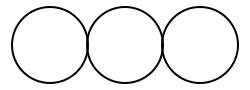
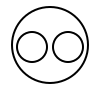
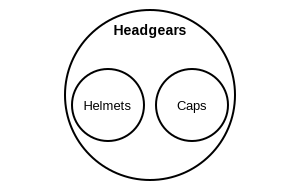
Select the Venn diagram that best illustrates the relationship between the following classes.
Headgears, Helmets, Caps
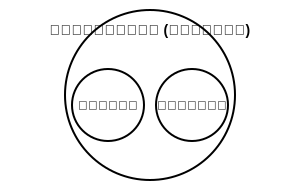
उस वेन आरेख का चयन कीजिए जो निम्नलिखित वर्गों के बीच संबंध को सबसे अच्छी तरह दर्शाता है।
शिरस्त्राण (हेडगियर), हेलमेट, टोपियाँ
  1. A
  2. B
  3. C
  4. D
Show answer

Concept: Find the "parent" class and check whether the sub-classes overlap.

  1. Helmets are headgears; caps are headgears.
  2. A helmet is not a cap and a cap is not a helmet ⇒ two separate circles.
  3. So two disjoint circles inside one big circle.

Short trick: Two different items of the same category = "two eggs in one basket".

Answer: (D) Figure (D)

अवधारणा: "मुख्य" वर्ग खोजें और देखें कि उप-वर्ग आपस में मिलते हैं या नहीं।

  1. हेलमेट शिरस्त्राण हैं; टोपियाँ भी शिरस्त्राण हैं।
  2. हेलमेट टोपी नहीं है और टोपी हेलमेट नहीं ⇒ दो अलग वृत्त।
  3. अतः एक बड़े वृत्त के अंदर दो अलग-अलग वृत्त।

शॉर्ट ट्रिक: एक ही श्रेणी की दो अलग वस्तुएँ = "एक टोकरी में दो अंडे"।

उत्तर: (D) आकृति (D)

RRB ALP CBT 1General Intelligence and ReasoningVenn diagram – classesRRB ALP CBT 1 2025 · 17 Feb Shift 3 →
Q273.
What should come in place of the question mark (?) in the given series based on the English alphabetical order?
XJI PBA HTS ZLK ?
अंग्रेजी वर्णमाला क्रम के आधार पर दी गई श्रृंखला में प्रश्न चिह्न (?) के स्थान पर क्या आना चाहिए?
XJI PBA HTS ZLK ?
  1. ARED
  2. BTDS
  3. CRDC
  4. DRCD
Show answer

Concept: Each position moves −8 (with wrap-around).

  1. 1st: X → P → H → Z → R.
  2. 2nd: J → B → T → L → D.
  3. 3rd: I → A → S → K → C.
  4. Answer: RDC.

Short trick: In every term 3rd letter = 2nd − 1 (J/I, B/A, T/S, L/K) ⇒ only RDC fits (D/C).

Answer: (C) RDC

अवधारणा: प्रत्येक स्थान −8 चलता है (घुमाव सहित)।

  1. पहला: X → P → H → Z → R।
  2. दूसरा: J → B → T → L → D।
  3. तीसरा: I → A → S → K → C।
  4. उत्तर: RDC।

शॉर्ट ट्रिक: हर पद में तीसरा अक्षर = दूसरा − 1 ⇒ केवल RDC (D/C)।

उत्तर: (C) RDC

RRB ALP CBT 1General Intelligence and ReasoningLetter seriesRRB ALP CBT 1 2025 · 17 Feb Shift 3 →
Q274.
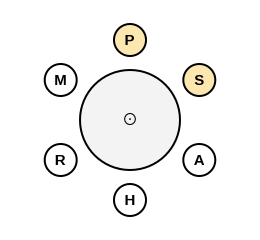
H, P, R, A, S and M are sitting around a circular table facing the centre. R is sitting second to the right of P and to the immediate left of H. S is sitting second to the left of M and to the immediate right of A. Who is sitting to the immediate left of P?
H, P, R, A, S और M एक वृत्ताकार मेज के चारों ओर केंद्र की ओर मुख करके बैठे हैं। R, P के दाएँ से दूसरे स्थान पर और H के ठीक बाएँ बैठा है। S, M के बाएँ से दूसरे स्थान पर और A के ठीक दाएँ बैठा है। P के ठीक बाएँ कौन बैठा है?
  1. AM
  2. BS
  3. CA
  4. DH
Show answer

Concept: Facing the centre: right = anticlockwise, left = clockwise.

  1. Place P; R is 2nd to the right of P; H is immediately right of R (R is to H's immediate left).
  2. Two seats left: between P and R, and next to H/P. A–S must be adjacent with S to the right of A, and M 2 places right of S.
  3. Only arrangement (anticlockwise from H): H, A, S, P, M, R.
  4. Immediate left of P = S.

Short trick: S is right of A and P sits right after them – so the person to P's left is S.

Answer: (B) S

अवधारणा: केंद्र की ओर मुख: दायाँ = वामावर्त, बायाँ = दक्षिणावर्त।

  1. P रखें; R, P के दाएँ से दूसरा; R, H के ठीक बाएँ ⇒ H, R के ठीक दाएँ।
  2. A–S साथ-साथ (S, A के दाएँ) और M, S से दाएँ दूसरा।
  3. एकमात्र व्यवस्था (H से वामावर्त): H, A, S, P, M, R।
  4. P के ठीक बाएँ = S।

शॉर्ट ट्रिक: P के बाएँ वाला व्यक्ति S है।

उत्तर: (B) S

RRB ALP CBT 1General Intelligence and ReasoningCircular seating – 6 personsRRB ALP CBT 1 2025 · 17 Feb Shift 3 →
Q275.
What will come in the place of ‘?’ in the following equation, if ‘+’ and ‘-‘ are interchanged and ‘×’ and ‘÷’ are interchanged?
31 - 1 × 2 ÷ 28 + 26 = ?
यदि '+' और '-' को आपस में बदल दिया जाए तथा '×' और '÷' को आपस में बदल दिया जाए, तो निम्नलिखित समीकरण में '?' के स्थान पर क्या आएगा?
31 - 1 × 2 ÷ 28 + 26 = ?
  1. A20
  2. B19
  3. C21
  4. D17
Show answer

Concept: Interchange the signs, then apply BODMAS.

  1. New: 31 + 1 ÷ 2 × 28 − 26.
  2. 1 ÷ 2 × 28 = 14.
  3. 31 + 14 − 26 = 19.

Short trick: Unit digit check: 1 + 4 − 6 ⇒ ends in 9 ⇒ 19.

Answer: (B) 19

अवधारणा: चिह्न बदलें, फिर BODMAS लगाएँ।

  1. नया: 31 + 1 ÷ 2 × 28 − 26।
  2. 1 ÷ 2 × 28 = 14।
  3. 31 + 14 − 26 = 19।

शॉर्ट ट्रिक: इकाई अंक: 1 + 4 − 6 ⇒ 9 ⇒ 19।

उत्तर: (B) 19

RRB ALP CBT 1General Intelligence and ReasoningMathematical operations – interchangeRRB ALP CBT 1 2025 · 17 Feb Shift 3 →
Q276.
What should come in place of ? in the given series?
57 65 81 113 177 ?
दी गई श्रृंखला में ? के स्थान पर क्या आना चाहिए?
57 65 81 113 177 ?
  1. A305
  2. B306
  3. C307
  4. D304
Show answer

Concept: Look at the differences.

  1. Differences: 8, 16, 32, 64 – each doubles.
  2. Next difference = 128 ⇒ 177 + 128 = 305.

Short trick: Each term = previous + 8 × 2ⁿ; last digit check: 7 + 8 = 15 ⇒ ends in 5 ⇒ 305.

Answer: (A) 305

अवधारणा: अंतर देखें।

  1. अंतर: 8, 16, 32, 64 – हर बार दुगुना।
  2. अगला अंतर = 128 ⇒ 177 + 128 = 305।

शॉर्ट ट्रिक: इकाई अंक: 7 + 8 = 15 ⇒ 5 पर समाप्त ⇒ 305।

उत्तर: (A) 305

RRB ALP CBT 1General Intelligence and ReasoningNumber series – doubling differencesRRB ALP CBT 1 2025 · 17 Feb Shift 3 →
Q277.
Refer to the following series and answer the question that follows. Counting to be done from left to right. All numbers are single-digit numbers only.
(Left) 1 3 5 7 5 5 7 4 5 8 9 5 4 4 5 5 4 5 7 7 6 5 7 6 (Right)
How many such odd digits are there, each of which is immediately preceded by an even digit and also immediately followed by an odd digit?
निम्नलिखित श्रृंखला को देखिए और उसके बाद दिए गए प्रश्न का उत्तर दीजिए। गिनती बाएँ से दाएँ की जानी है। सभी संख्याएँ केवल एक अंक वाली संख्याएँ हैं।
(बाएँ) 1 3 5 7 5 5 7 4 5 8 9 5 4 4 5 5 4 5 7 7 6 5 7 6 (दाएँ)
ऐसे कितने विषम अंक हैं, जिनमें से प्रत्येक के ठीक पहले एक सम अंक है और ठीक बाद में भी एक विषम अंक है?
  1. ATHREEतीन
  2. BFOURचार
  3. CONEएक
  4. DFIVEपाँच
Show answer

Concept: Pattern: even – odd – odd.

  1. Start at every even digit and check the next two digits.
  2. 8 9 5 ✓, 4 5 5 ✓, 4 5 7 ✓, 6 5 7 ✓.
  3. 4 5 8 ✗ (8 even), 4 4 ✗, last 6 is at the end.
  4. Count = 4.

Short trick: Only even digits can start the pattern – there are just 7 of them (4, 8, 4, 4, 4, 6, 6); test each.

Answer: (B) FOUR

अवधारणा: पैटर्न: सम – विषम – विषम।

  1. प्रत्येक सम अंक से शुरू करके अगले दो अंक देखें।
  2. 8 9 5 ✓, 4 5 5 ✓, 4 5 7 ✓, 6 5 7 ✓।
  3. 4 5 8 ✗, 4 4 ✗।
  4. संख्या = 4।

शॉर्ट ट्रिक: केवल सम अंक से पैटर्न शुरू होता है – कुल 7 सम अंक हैं, प्रत्येक को जाँचें।

उत्तर: (B) चार

RRB ALP CBT 1General Intelligence and ReasoningNumber series – counting digitsRRB ALP CBT 1 2025 · 17 Feb Shift 3 →
Q278.
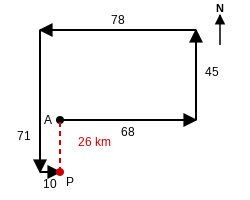
Tanisha starts from Point A and drives 68 km towards east. He then takes a left turn, drives 45 km, turns left and drives 78 km. He then takes a left turn and drives 71 km. He takes a final left turn, drives 10 km and stops at Point P. How far (shortest distance) and towards which direction should he drive in order to reach Point A again? (All turns are 90 degrees turns only unless specified)
तनीषा बिंदु A से शुरू करके पूर्व की ओर 68 km गाड़ी चलाती है। फिर वह बाएँ मुड़ती है, 45 km गाड़ी चलाती है, बाएँ मुड़ती है और 78 km गाड़ी चलाती है। फिर वह बाएँ मुड़ती है और 71 km गाड़ी चलाती है। वह अंतिम बार बाएँ मुड़ती है, 10 km गाड़ी चलाती है और बिंदु P पर रुक जाती है। बिंदु A पर फिर से पहुँचने के लिए उसे कितनी दूरी (न्यूनतम दूरी) तक और किस दिशा में गाड़ी चलानी चाहिए? (जब तक निर्दिष्ट न हो, सभी मोड़ केवल 90 डिग्री के मोड़ हैं)
  1. A25 km to the north25 km उत्तर की ओर
  2. B27 km to the south27 km दक्षिण की ओर
  3. C26 km to the north26 km उत्तर की ओर
  4. D24 km to the north24 km उत्तर की ओर
Show answer

Concept: Take A = (0, 0), east = +x, north = +y; four left turns: E → N → W → S → E.

  1. x: +68 − 78 + 10 = 0.
  2. y: +45 − 71 = −26 ⇒ P is 26 km south of A.
  3. To return: 26 km towards north.

Short trick: East–west cancels (68 + 10 = 78) – just do N − S: 45 − 71 = −26 ⇒ go 26 km north.

Answer: (C) 26 km to the north

अवधारणा: A = (0, 0), पूर्व = +x, उत्तर = +y; चार बार बाएँ: पूर्व → उत्तर → पश्चिम → दक्षिण → पूर्व।

  1. x: +68 − 78 + 10 = 0।
  2. y: +45 − 71 = −26 ⇒ P, A से 26 km दक्षिण में।
  3. वापस जाने के लिए: 26 km उत्तर की ओर।

शॉर्ट ट्रिक: पूर्व–पश्चिम बराबर (68 + 10 = 78) – केवल उत्तर − दक्षिण: 45 − 71 = −26 ⇒ 26 km उत्तर।

उत्तर: (C) 26 km उत्तर की ओर

RRB ALP CBT 1General Intelligence and ReasoningDirection sense – shortest distanceRRB ALP CBT 1 2025 · 17 Feb Shift 3 →
Q279.
Each of G, J, M, O, R, S and T has an exam on a different day of a week, starting from Monday and ending on Sunday of the same week. Only two people have exams before R. Only one person has an exam after M. Only three people have exams between R and T. Only one person has an exam between S and G. J has an exam immediately before S. Who among the following has an exam on Friday?
G, J, M, O, R, S और T में से प्रत्येक की परीक्षा सोमवार से शुरू होकर उसी सप्ताह के रविवार को समाप्त होने वाले सप्ताह के अलग-अलग दिन है। R से पहले केवल दो व्यक्तियों की परीक्षाएँ हैं। M के बाद केवल एक व्यक्ति की परीक्षा है। R और T के बीच केवल तीन व्यक्तियों की परीक्षाएँ हैं। S और G के बीच केवल एक व्यक्ति की परीक्षा है। J की परीक्षा S के ठीक पहले है। निम्नलिखित में से किसकी परीक्षा शुक्रवार को है?
  1. AG
  2. BJ
  3. CO
  4. DM
Show answer

Concept: Fix definite days first (Mon = 1).

  1. R = 3 (Wed), M = 6 (Sat).
  2. T is 4 days from R ⇒ T = 7 (Sun).
  3. J–S consecutive with G two days from S: free days 1, 2, 4, 5 ⇒ J = 1, S = 2, G = 4.
  4. Remaining O = 5 (Friday).
  5. MonTueWedThuFriSatSun
    JSRGOMT

Short trick: R = Wed, M = Sat, T = Sun fixed in one line; J-S must be Mon-Tue, so Fri is left for O.

Answer: (C) O

अवधारणा: पहले निश्चित दिन तय करें (सोम = 1)।

  1. R = 3 (बुध), M = 6 (शनि)।
  2. T, R से 4 दिन दूर ⇒ T = 7 (रवि)।
  3. J–S लगातार और G, S से दो दिन दूर: खाली दिन 1, 2, 4, 5 ⇒ J = 1, S = 2, G = 4।
  4. शेष O = 5 (शुक्रवार)।
  5. सोममंगलबुधगुरुशुक्रशनिरवि
    JSRGOMT

शॉर्ट ट्रिक: R = बुध, M = शनि, T = रवि; J-S = सोम-मंगल, अतः शुक्रवार O का।

उत्तर: (C) O

RRB ALP CBT 1General Intelligence and ReasoningScheduling puzzle – days of weekRRB ALP CBT 1 2025 · 17 Feb Shift 3 →
Q280.
Read the given statements and conclusions carefully. Assuming that the information given in the statements is true, even if it appears to be at variance with commonly known facts, decide which of the given conclusions logically follow(s) from the statements.
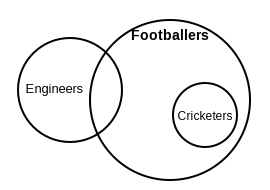
Statements:
Some engineers are footballers.
All cricketers are footballers.
Conclusions:
(I) Some engineers are cricketers.
(II) All footballers are cricketers.
दिए गए कथनों और निष्कर्षों को ध्यानपूर्वक पढ़िए। यह मानते हुए कि कथनों में दी गई जानकारी सत्य है, भले ही वह सामान्य रूप से ज्ञात तथ्यों से भिन्न प्रतीत होती हो, निर्णय कीजिए कि दिए गए निष्कर्षों में से कौन-सा/से निष्कर्ष कथनों का तार्किक रूप से अनुसरण करता है/करते हैं।
कथन:
कुछ इंजीनियर, फुटबॉलर हैं।
सभी क्रिकेटर, फुटबॉलर हैं।
निष्कर्ष:
(I) कुछ इंजीनियर, क्रिकेटर हैं।
(II) सभी फुटबॉलर, क्रिकेटर हैं।
  1. AOnly conclusion (I) followsकेवल निष्कर्ष (I) अनुसरण करता है
  2. BOnly conclusion (II) followsकेवल निष्कर्ष (II) अनुसरण करता है
  3. CNeither conclusion (I) nor (II) followsन तो निष्कर्ष (I) और न ही (II) अनुसरण करता है
  4. DBoth conclusions (I) and (II) followनिष्कर्ष (I) और (II) दोनों अनुसरण करते हैं
Show answer

Concept: Draw the least-overlap diagram.

  1. Cricketers lie inside Footballers; Engineers touch Footballers only in some part.
  2. Engineers need not touch Cricketers ⇒ (I) does not follow.
  3. "All C are F" cannot be reversed to "All F are C" ⇒ (II) does not follow.

Short trick: Two "middle-term" (Footballer) links never give a definite E–C relation; and "All" never converts to "All".

Answer: (C) Neither conclusion (I) nor (II) follows

अवधारणा: न्यूनतम संबंध वाला आरेख बनाएँ।

  1. क्रिकेटर, फुटबॉलर के अंदर; इंजीनियर केवल फुटबॉलर के कुछ भाग को छूते हैं।
  2. इंजीनियर का क्रिकेटर को छूना आवश्यक नहीं ⇒ (I) अनुसरण नहीं करता।
  3. "सभी C, F हैं" को उलटकर "सभी F, C हैं" नहीं कह सकते ⇒ (II) अनुसरण नहीं करता।

शॉर्ट ट्रिक: "सभी" का रूपांतरण "सभी" नहीं होता; और "कुछ" + "सभी" (मध्य पद विधेय में) से कोई निश्चित निष्कर्ष नहीं।

उत्तर: (C) न तो (I) और न ही (II) अनुसरण करता है

RRB ALP CBT 1General Intelligence and ReasoningSyllogismRRB ALP CBT 1 2025 · 17 Feb Shift 3 →