Question bank

Q&A: practice questions with answers

Search questions on any topic. Filter by exam category, exam, subject and topic, try the question, then open the answer and explanation.

Courses – airGurukul

20,719 questions found.

Q2901.
Refer to the following number and symbol series and answer the question that follows. Counting to be done from left to right only.
(Left) / / 9 3 * > * ? 5 6 2 $ # 3 ^ $ 4 + 6 < + (Right)
How many such numbers are there, each of which is immediately preceded by another number and also immediately followed by a symbol?
निम्नलिखित संख्या और प्रतीक श्रृंखला को देखिए और उसके बाद आने वाले प्रश्न का उत्तर दीजिए। गिनती केवल बाएँ से दाएँ की जानी है।
(बाएँ) / / 9 3 * > * ? 5 6 2 $ # 3 ^ $ 4 + 6 < + (दाएँ)
ऐसी कितनी संख्याएँ हैं, जिनमें से प्रत्येक के ठीक पहले एक अन्य संख्या है और ठीक बाद एक प्रतीक भी है?
  1. AOneएक
  2. BNoneकोई नहीं
  3. CFourचार
  4. DTwoदो
Show answer

Concept: Check every number: the element just before it must be a number and the element just after it must be a symbol.

  1. Series: / / 9 3 * > * ? 5 6 2 $ # 3 ^ $ 4 + 6 < +
  2. 3 (after 9, before *) ✓; 2 (after 6, before $) ✓.
  3. Others fail: 9 (after /), 5 (after ?), 6 (followed by 2), 3 (after #), 4 (after $), 6 (after +).
  4. Total =2.

Trick: Scan for "number–number–symbol" triplets and count the middle number.

Answer: (D) Two

अवधारणा: हर संख्या जाँचें: उसके ठीक पहले संख्या और ठीक बाद प्रतीक होना चाहिए।

  1. श्रृंखला: / / 9 3 * > * ? 5 6 2 $ # 3 ^ $ 4 + 6 < +
  2. 3 (9 के बाद, * से पहले) ✓; 2 (6 के बाद, $ से पहले) ✓।
  3. बाकी असफल: 9 (/ के बाद), 5 (? के बाद), 6 (बाद में 2), 3 (# के बाद), 4 ($ के बाद), 6 (+ के बाद)।
  4. कुल =2।

ट्रिक: "संख्या–संख्या–प्रतीक" त्रिक खोजें और बीच वाली संख्या गिनें।

उत्तर: (D) दो (Two)
RRB NTPC Undergraduate CBT 1General Intelligence and ReasoningNumber–Symbol SeriesRRB NTPC Undergraduate CBT 1 2024 · 14 Aug Shift 3 →
Q2902.
What should come in place of the question mark (?) in the given series?
31 58 94 139 193 ?
दी गई श्रृंखला में प्रश्न चिह्न (?) के स्थान पर क्या आना चाहिए?
31 58 94 139 193 ?
  1. A272
  2. B263
  3. C281
  4. D256
Show answer

Concept: Find the differences between consecutive terms.

  1. Differences: 27,36,45,54 (each increases by 9).
  2. Next difference =63 ⇒ 193+63=256.

Trick: Differences are multiples of 9: 9×3,9×4,9×5,…

Answer: (D) 256

अवधारणा: क्रमागत पदों के अंतर ज्ञात करें।

  1. अंतर: 27,36,45,54 (हर बार 9 बढ़ता है)।
  2. अगला अंतर =63 ⇒ 193+63=256।

ट्रिक: अंतर 9 के गुणज हैं: 9×3,9×4,9×5,…

उत्तर: (D) 256

RRB NTPC Undergraduate CBT 1General Intelligence and ReasoningNumber SeriesRRB NTPC Undergraduate CBT 1 2024 · 14 Aug Shift 3 →
Q2903.
IMJI is related to GKHG in a certain way based on the English alphabetical order. In the same way, FJGF is related to DHED. To which of the given options is XBYX related, following the same logic?
अंग्रेज़ी वर्णमाला क्रम के आधार पर IMJI एक निश्चित प्रकार से GKHG से संबंधित है। उसी प्रकार, FJGF, DHED से संबंधित है। समान तर्क का अनुसरण करते हुए, XBYX दिए गए विकल्पों में से किससे संबंधित है?
  1. AVZVV
  2. BVAVX
  3. CVYVV
  4. DVZWV
Show answer

Concept: Each letter moves back by 2 positions.

  1. IMJI → GKHG: I−2=G, M−2=K, J−2=H, I−2=G.
  2. FJGF → DHED: same −2 rule.
  3. XBYX → X−2=V, B−2=Z (cyclic), Y−2=W, X−2=V ⇒ VZWV.

Trick: Repeated letters stay repeated: 1st and 4th letters of the answer must be the same and 3rd must be W.

Answer: (D) VZWV

अवधारणा: हर अक्षर 2 स्थान पीछे जाता है।

  1. IMJI → GKHG: I−2=G, M−2=K, J−2=H, I−2=G।
  2. FJGF → DHED: वही −2 नियम।
  3. XBYX → X−2=V, B−2=Z (चक्रीय), Y−2=W, X−2=V ⇒ VZWV।

ट्रिक: Y−2 = W, अतः तीसरा अक्षर W वाला विकल्प ही सही।

उत्तर: (D) VZWV

RRB NTPC Undergraduate CBT 1General Intelligence and ReasoningLetter AnalogyRRB NTPC Undergraduate CBT 1 2024 · 14 Aug Shift 3 →
Q2904.
If 1 is added to each even digit and 2 is subtracted from each odd digit in the number 5237894, what will be difference between the highest and lowest digits in the number thus formed?
यदि संख्या 5237894 में प्रत्येक सम अंक में 1 जोड़ा जाए और प्रत्येक विषम अंक में से 2 घटाया जाए, तो इस प्रकार बनी संख्या में सबसे बड़े और सबसे छोटे अंक के बीच कितना अंतर होगा?
  1. A6
  2. B7
  3. C8
  4. D9
Show answer

Concept: Apply the rule digit by digit: even digit +1, odd digit −2.

  1. 5 2 3 7 8 9 4 → 3 3 1 5 9 7 5.
  2. Highest digit =9, lowest =1.
  3. Difference =9−1=8.

Trick: Only the extremes matter: 8 becomes 9 (max) and 3 becomes 1 (min).

Answer: (C) 8

अवधारणा: हर अंक पर नियम लगाएँ: सम अंक +1, विषम अंक −2।

  1. 5 2 3 7 8 9 4 → 3 3 1 5 9 7 5।
  2. सबसे बड़ा अंक =9, सबसे छोटा =1।
  3. अंतर =9−1=8।

ट्रिक: केवल सिरे देखें: 8 → 9 (अधिकतम) और 3 → 1 (न्यूनतम)।

उत्तर: (C) 8

RRB NTPC Undergraduate CBT 1General Intelligence and ReasoningDigit OperationsRRB NTPC Undergraduate CBT 1 2024 · 14 Aug Shift 3 →
Q2905.
Which of the following letter-number clusters will replace the question mark (?) in the given series to make it logically complete?
LTB 83, OWE 74, RZH 65, UCK 56, XFN 47, ?
दी गई श्रृंखला को तार्किक रूप से पूर्ण करने के लिए निम्नलिखित में से कौन-सा अक्षर-संख्या समूह प्रश्न चिह्न (?) के स्थान पर आएगा?
LTB 83, OWE 74, RZH 65, UCK 56, XFN 47, ?
  1. AAMQ 36
  2. BBIQ 42
  3. CAIO 40
  4. DAIQ 38
Show answer

Concept: Each letter moves forward by 3 positions; the number decreases by 9.

  1. LTB → OWE → RZH → UCK → XFN: every letter +3.
  2. XFN + 3: X→A, F→I, N→Q ⇒ AIQ.
  3. Numbers: 83,74,65,56,47 (−9 each) ⇒ 47−9=38.

Trick: Number part alone settles it: only AIQ has 38.

Answer: (D) AIQ 38

अवधारणा: हर अक्षर 3 स्थान आगे और संख्या 9 कम होती है।

  1. LTB → OWE → RZH → UCK → XFN: हर अक्षर +3।
  2. XFN + 3: X→A, F→I, N→Q ⇒ AIQ।
  3. संख्याएँ: 83,74,65,56,47 (हर बार −9) ⇒ 47−9=38।

ट्रिक: केवल संख्या से ही हल: 38 केवल AIQ के साथ है।

उत्तर: (D) AIQ 38

RRB NTPC Undergraduate CBT 1General Intelligence and ReasoningLetter–Number SeriesRRB NTPC Undergraduate CBT 1 2024 · 14 Aug Shift 3 →
Q2906.
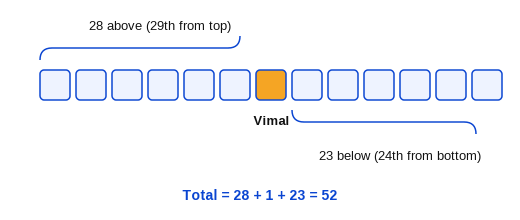
Vimal ranked 29th from the top and 24th from the bottom in his class. How many students are there in his class?
विमल की अपनी कक्षा में रैंक ऊपर से 29वीं और नीचे से 24वीं है। उसकी कक्षा में कितने विद्यार्थी हैं?
  1. A54
  2. B52
  3. C53
  4. D51
Show answer

Concept: Total = rank from top + rank from bottom −1.

  1. Above Vimal: 28; below Vimal: 23.
  2. Total =29+24−1=52.

Trick: Subtract 1 because Vimal is counted in both ranks.

Answer: (B) 52

अवधारणा: कुल = ऊपर से रैंक + नीचे से रैंक −1।

  1. विमल के ऊपर: 28; नीचे: 23।
  2. कुल =29+24−1=52।

ट्रिक: 1 घटाते हैं क्योंकि विमल दोनों रैंकों में गिना गया है।

उत्तर: (B) 52

RRB NTPC Undergraduate CBT 1General Intelligence and ReasoningRankingRRB NTPC Undergraduate CBT 1 2024 · 14 Aug Shift 3 →
Q2907.
Select the pair that follows the same pattern as that followed by the two pairs given below. Both pairs follow the same pattern.
GOF : IQE
SNG : UPF
उस युग्म का चयन कीजिए जो उसी पैटर्न का अनुसरण करता है जिसका अनुसरण नीचे दिए गए दो युग्म करते हैं। दोनों युग्म एक ही पैटर्न का अनुसरण करते हैं।
GOF : IQE
SNG : UPF
  1. ANNL : PQK
  2. BQUK : SXJ
  3. CQRQ : STR
  4. DELM : GNL
Show answer

Concept: Find the change in each letter position: +2,+2,−1.

  1. GOF → IQE: G+2=I, O+2=Q, F−1=E. SNG → UPF: same.
  2. ELM → GNL: E+2=G, L+2=N, M−1=L ✓.
  3. NNL : PQK (+2,+3,−1), QUK : SXJ (+2,+3,−1), QRQ : STR (+2,+2,+1) ✗.

Trick: Check the third letter first (−1): it removes QRQ : STR; then the middle (+2) removes the other two.

Answer: (D) ELM : GNL

अवधारणा: हर अक्षर के स्थान में परिवर्तन: +2,+2,−1।

  1. GOF → IQE: G+2=I, O+2=Q, F−1=E। SNG → UPF: वही।
  2. ELM → GNL: E+2=G, L+2=N, M−1=L ✓।
  3. NNL : PQK (+2,+3,−1), QUK : SXJ (+2,+3,−1), QRQ : STR (+2,+2,+1) ✗।

ट्रिक: पहले तीसरा अक्षर (−1) जाँचें, फिर बीच वाला (+2)।

उत्तर: (D) ELM : GNL

RRB NTPC Undergraduate CBT 1General Intelligence and ReasoningLetter AnalogyRRB NTPC Undergraduate CBT 1 2024 · 14 Aug Shift 3 →
Q2908.
What should come in place of the question mark (?) in the given series?
6 13 27 48 76 ?
दी गई श्रृंखला में प्रश्न चिह्न (?) के स्थान पर क्या आना चाहिए?
6 13 27 48 76 ?
  1. A100
  2. B109
  3. C105
  4. D111
Show answer

Concept: Find the differences between consecutive terms.

  1. Differences: 7,14,21,28 (multiples of 7).
  2. Next difference =35 ⇒ 76+35=111.

Trick: Differences form the 7-table: 7×1,7×2,…

Answer: (D) 111

अवधारणा: क्रमागत पदों के अंतर ज्ञात करें।

  1. अंतर: 7,14,21,28 (7 के गुणज)।
  2. अगला अंतर =35 ⇒ 76+35=111।

ट्रिक: अंतर 7 का पहाड़ा हैं: 7×1,7×2,…

उत्तर: (D) 111

RRB NTPC Undergraduate CBT 1General Intelligence and ReasoningNumber SeriesRRB NTPC Undergraduate CBT 1 2024 · 14 Aug Shift 3 →
Q2909.
Select the set in which the numbers are related in the same way as are the numbers of the following sets.
(NOTE: Operations should be performed on the whole numbers, without breaking down the numbers into their constituent digits. E.g. 13 – Operations on 13 such as adding to/subtracting from/multiplying with 13 can be performed. Breaking down 13 into 1 and 3 and then performing mathematical operations on 1 and 3 is not allowed.)
(28, 140, 5)
(41, 533, 13)
उस समुच्चय का चयन कीजिए जिसमें संख्याएँ उसी प्रकार संबंधित हैं जिस प्रकार निम्नलिखित समुच्चयों की संख्याएँ संबंधित हैं।
(ध्यान दें: संख्याओं को उनके घटक अंकों में तोड़े बिना, पूर्ण संख्याओं पर संक्रियाएँ की जानी चाहिए। उदाहरण के लिए 13 – 13 पर संक्रियाएँ जैसे 13 में जोड़ना/घटाना/गुणा करना आदि किया जा सकता है। 13 को 1 और 3 में तोड़ना और फिर 1 और 3 पर गणितीय संक्रियाएँ करना वर्जित है।)
(28, 140, 5)
(41, 533, 13)
  1. A(44, 355, 8)
  2. B(1, 25, 22)
  3. C(35, 735, 21)
  4. D(25, 103, 4)
Show answer

Concept: In each set, the middle number = first number × third number.

  1. 28×5=140 ✓; 41×13=533 ✓.
  2. (35, 735, 21): 35×21=735 ✓.
  3. Others: 44×8=352≠355; 1×22=22≠25; 25×4=100≠103.

Trick: Divide the middle number by the third: it must give the first exactly.

Answer: (C) (35, 735, 21)

अवधारणा: हर समुच्चय में बीच वाली संख्या = पहली × तीसरी।

  1. 28×5=140 ✓; 41×13=533 ✓।
  2. (35, 735, 21): 35×21=735 ✓।
  3. अन्य: 44×8=352≠355; 1×22=22≠25; 25×4=100≠103।

ट्रिक: बीच की संख्या को तीसरी से भाग दें – पहली संख्या ठीक-ठीक आनी चाहिए।

उत्तर: (C) (35, 735, 21)

RRB NTPC Undergraduate CBT 1General Intelligence and ReasoningNumber Analogy – SetsRRB NTPC Undergraduate CBT 1 2024 · 14 Aug Shift 3 →
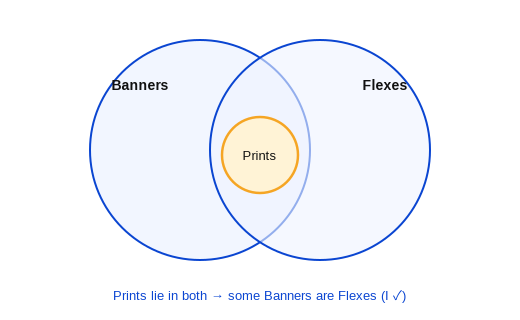
Q2910.
Read the given statement(s) and conclusions carefully. Assuming that the information given in the statements is true, even if it appears to be at variance with commonly known facts, decide which of the given conclusions logically follow(s) from the statement(s).
Statements:
All prints are banners.
All prints are flexes.
Conclusions:
(I) Some banners are flexes.
(II) All flexes are prints.
दिए गए कथन/कथनों और निष्कर्षों को ध्यानपूर्वक पढ़िए। यह मानते हुए कि कथनों में दी गई जानकारी सत्य है, भले ही वह सामान्य रूप से ज्ञात तथ्यों से भिन्न प्रतीत होती हो, निर्णय कीजिए कि दिए गए निष्कर्षों में से कौन-सा/से निष्कर्ष कथन/कथनों का तार्किक रूप से अनुसरण करता है/करते हैं।
कथन:
सभी प्रिंट, बैनर हैं।
सभी प्रिंट, फ्लेक्स हैं।
निष्कर्ष:
(I) कुछ बैनर, फ्लेक्स हैं।
(II) सभी फ्लेक्स, प्रिंट हैं।
  1. AOnly conclusion (I) follows.केवल निष्कर्ष (I) अनुसरण करता है।
  2. BBoth conclusions (I) and (II) follow.निष्कर्ष (I) और (II) दोनों अनुसरण करते हैं।
  3. COnly conclusion (II) follows.केवल निष्कर्ष (II) अनुसरण करता है।
  4. DNeither conclusion (I) nor (II) follows.न तो निष्कर्ष (I) और न ही (II) अनुसरण करता है।
Show answer

Concept: If the same class (prints) lies inside two classes, those two classes must overlap.

  1. All prints are banners and all prints are flexes ⇒ prints are common to both ⇒ some banners are flexes ⇒ I follows.
  2. Flexes may contain things that are not prints ⇒ "All flexes are prints" is not certain ⇒ II does not follow.

Trick: Two "All" statements with the same subject always give "Some" between the two predicates.

Answer: (A) Only conclusion (I) follows.

अवधारणा: यदि एक ही वर्ग (prints) दो वर्गों के अंदर हो तो वे दोनों वर्ग अवश्य मिलते हैं।

  1. सभी prints, banners हैं और सभी prints, flexes हैं ⇒ prints दोनों में उभयनिष्ठ ⇒ कुछ banners, flexes हैं ⇒ I अनुसरण करता है।
  2. Flexes में prints के अलावा भी कुछ हो सकता है ⇒ II निश्चित नहीं।

ट्रिक: एक ही उद्देश्य वाले दो "All" कथन दोनों विधेयों के बीच "Some" देते हैं।

उत्तर: (A) केवल निष्कर्ष (I) अनुसरण करता है।

RRB NTPC Undergraduate CBT 1General Intelligence and ReasoningSyllogismRRB NTPC Undergraduate CBT 1 2024 · 14 Aug Shift 3 →
Q2911.
Based on the English alphabetical order, three of the following four letter-clusters are alike in a certain way and thus form a group. Which letter-cluster DOES NOT belong to that group?
(Note: The odd one out is not based on the number of consonants/vowels or their position in the letter-cluster.)
अंग्रेज़ी वर्णमाला क्रम के आधार पर, निम्नलिखित चार अक्षर-समूहों में से तीन किसी निश्चित प्रकार से एकसमान हैं और इस प्रकार एक समूह बनाते हैं। कौन-सा अक्षर-समूह उस समूह से संबंधित नहीं है?
(ध्यान दें: असंगत का निर्धारण अक्षर-समूह में व्यंजनों/स्वरों की संख्या या उनके स्थान पर आधारित नहीं है।)
  1. ASOK
  2. BQKG
  3. CEAW
  4. DRNJ
Show answer

Concept: Write position values and check the gaps between consecutive letters.

  1. SOK: 19, 15, 11 (−4, −4). RNJ: 18, 14, 10 (−4, −4).
  2. EAW: 5, 1, 23 (−4, then 1−4 → 23 cyclic) (−4, −4).
  3. QKG: 17, 11, 7 (−6, −4) ✗.

Trick: In the odd cluster the first gap differs: Q to K is 6 steps, not 4.

Answer: (B) QKG

अवधारणा: स्थानीय मान लिखें और क्रमागत अक्षरों का अंतर देखें।

  1. SOK: 19, 15, 11 (−4, −4)। RNJ: 18, 14, 10 (−4, −4)।
  2. EAW: 5, 1, 23 (−4, फिर चक्रीय −4)।
  3. QKG: 17, 11, 7 (−6, −4) ✗।

ट्रिक: विषम समूह में पहला अंतर अलग: Q से K तक 6 कदम।

उत्तर: (B) QKG

RRB NTPC Undergraduate CBT 1General Intelligence and ReasoningOdd One Out – Letter ClustersRRB NTPC Undergraduate CBT 1 2024 · 14 Aug Shift 3 →
Q2912.
Based on the English alphabetical order, three of the following four letter-clusters are alike in a certain way and thus form a group. Which letter-cluster DOES NOT belong to that group?
(Note: The odd one out is not based on the number of consonants/vowels or their position in the letter-cluster.)
अंग्रेज़ी वर्णमाला क्रम के आधार पर, निम्नलिखित चार अक्षर-समूहों में से तीन किसी निश्चित प्रकार से एकसमान हैं और इस प्रकार एक समूह बनाते हैं। कौन-सा अक्षर-समूह उस समूह से संबंधित नहीं है?
(ध्यान दें: असंगत का निर्धारण अक्षर-समूह में व्यंजनों/स्वरों की संख्या या उनके स्थान पर आधारित नहीं है।)
  1. AQWS
  2. BNTP
  3. CTZU
  4. DKQM
Show answer

Concept: Pattern: 1st → 2nd is +6, 2nd → 3rd is −4.

  1. QWS: 17, 23, 19 (+6, −4) ✓. NTP: 14, 20, 16 ✓. KQM: 11, 17, 13 ✓.
  2. TZU: 20, 26, 21 (+6, −5) ✗.

Trick: Check the last step only: Z−4 would be V, not U.

Answer: (C) TZU

अवधारणा: पैटर्न: पहले से दूसरा +6, दूसरे से तीसरा −4।

  1. QWS: 17, 23, 19 (+6, −4) ✓। NTP: 14, 20, 16 ✓। KQM: 11, 17, 13 ✓।
  2. TZU: 20, 26, 21 (+6, −5) ✗।

ट्रिक: केवल अंतिम चरण देखें: Z−4 = V होना चाहिए, U नहीं।

उत्तर: (C) TZU

RRB NTPC Undergraduate CBT 1General Intelligence and ReasoningOdd One Out – Letter ClustersRRB NTPC Undergraduate CBT 1 2024 · 14 Aug Shift 3 →
Q2913.
What will come in place of the question mark (?) in the following equation, if ‘+’ and ‘−’ are interchanged and ‘×’ and ‘÷’ are interchanged?
42 + 75 × 3 − 11 ÷ 3 = ?
यदि ‘+’ और ‘−’ को आपस में बदल दिया जाए तथा ‘×’ और ‘÷’ को आपस में बदल दिया जाए, तो निम्नलिखित समीकरण में प्रश्न चिह्न (?) के स्थान पर क्या आएगा?
42 + 75 × 3 − 11 ÷ 3 = ?
  1. A43
  2. B23
  3. C32
  4. D50
Show answer

Concept: Interchange the signs first, then apply BODMAS.

  1. 42+75×3−11÷3 becomes 42−75÷3+11×3.
  2. =42−25+33.
  3. =50.

Trick: Rewrite the whole expression with new signs before calculating – never swap mid-way.

Answer: (D) 50

अवधारणा: पहले चिह्न बदलें, फिर BODMAS लगाएँ।

  1. 42+75×3−11÷3 बन जाता है 42−75÷3+11×3।
  2. =42−25+33।
  3. =50।

ट्रिक: गणना से पहले पूरा व्यंजक नए चिह्नों के साथ लिख लें।

उत्तर: (D) 50

RRB NTPC Undergraduate CBT 1General Intelligence and ReasoningMathematical OperationsRRB NTPC Undergraduate CBT 1 2024 · 14 Aug Shift 3 →
Q2914.
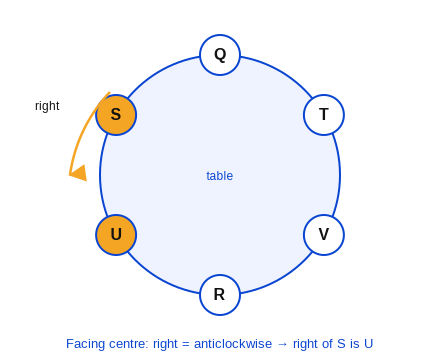
Six friends Q, R, S, T, U and V are sitting around a circular table, facing the centre. S sits third to the right of V. V sits second to the left of Q. U sits to the immediate left of R. Who sits to the immediate right of S?
छह मित्र Q, R, S, T, U और V एक वृत्ताकार मेज़ के चारों ओर केंद्र की ओर मुख करके बैठे हैं। S, V के दाएँ से तीसरे स्थान पर बैठा है। V, Q के बाएँ से दूसरे स्थान पर बैठा है। U, R के ठीक बाएँ बैठा है। S के ठीक दाएँ कौन बैठा है?
  1. AR
  2. BT
  3. CU
  4. DQ
Show answer

Concept: Facing the centre: left = clockwise, right = anticlockwise.

  1. Place Q. V is second to the left of Q ⇒ two seats clockwise from Q.
  2. S is third to the right of V ⇒ S sits opposite V.
  3. Remaining seats (between Q and V, opposite Q, and next to S) take T, R, U; U immediately left of R fits only with R opposite Q and U between R and S; T between Q and V.
  4. Immediate right of S (anticlockwise) is U.

Trick: In a 6-seat circle, "third to the right/left" always means the person directly opposite.

Answer: (C) U

अवधारणा: केंद्र की ओर मुख: बायाँ = दक्षिणावर्त, दायाँ = वामावर्त।

  1. Q को रखें। V, Q के बाएँ दूसरा ⇒ Q से दो सीट दक्षिणावर्त।
  2. S, V के दाएँ तीसरा ⇒ S, V के ठीक सामने।
  3. बची सीटें T, R, U की; U, R के ठीक बाएँ – यह केवल तभी संभव जब R, Q के सामने और U, R व S के बीच हो; T, Q व V के बीच।
  4. S के ठीक दाएँ (वामावर्त) U है।

ट्रिक: 6 व्यक्तियों के वृत्त में "तीसरा दाएँ/बाएँ" यानी ठीक सामने वाला।

उत्तर: (C) U

RRB NTPC Undergraduate CBT 1General Intelligence and ReasoningCircular Seating ArrangementRRB NTPC Undergraduate CBT 1 2024 · 14 Aug Shift 3 →
Q2915.
In the following triad, each group of letters is related to the subsequent one following a certain logic. Select from the given options, the one which follows the same logic. SINK - ISNK - KISN
PLAY - LPAY - YLPA
निम्नलिखित त्रय में, अक्षरों का प्रत्येक समूह एक निश्चित तर्क का अनुसरण करते हुए अगले समूह से संबंधित है। दिए गए विकल्पों में से उसका चयन कीजिए जो समान तर्क का अनुसरण करता है। SINK - ISNK - KISN
PLAY - LPAY - YLPA
  1. AHOLD - OHLD - DOHL
  2. BCLAY - LCAY - LAYC
  3. CMARK - MRAK - KRAM
  4. DDINE - IDNE - EIND
Show answer

Concept: Step 1: swap the first two letters. Step 2: move the last letter to the front.

  1. SINK → ISNK → KISN; PLAY → LPAY → YLPA.
  2. HOLD → OHLD (swap) → DOHL (D to front) ✓.
  3. CLAY → LCAY → YLCA (not LAYC); MARK → AMRK (not MRAK); DINE → IDNE → EIDN (not EIND).

Trick: Check the third term: it must start with the last letter of the second term.

Answer: (A) HOLD - OHLD - DOHL

अवधारणा: चरण 1: पहले दो अक्षर आपस में बदलें। चरण 2: अंतिम अक्षर को सबसे आगे लाएँ।

  1. SINK → ISNK → KISN; PLAY → LPAY → YLPA।
  2. HOLD → OHLD (अदला-बदली) → DOHL (D आगे) ✓।
  3. CLAY → LCAY → YLCA (LAYC नहीं); MARK → AMRK (MRAK नहीं); DINE → IDNE → EIDN (EIND नहीं)।

ट्रिक: तीसरा पद दूसरे पद के अंतिम अक्षर से शुरू होना चाहिए।

उत्तर: (A) HOLD - OHLD - DOHL

RRB NTPC Undergraduate CBT 1General Intelligence and ReasoningLetter Triads – PatternRRB NTPC Undergraduate CBT 1 2024 · 14 Aug Shift 3 →
Q2916.
If ‘A’ stands for ‘÷’, ‘B’ stands for ‘×’, ‘C’ stands for ‘+’ and ‘D’ stands for ‘−’, then what will come in place of the question mark (?) in the following equation?
25 A 5 D 10 B 3 C 42 = ?
यदि ‘A’ का अर्थ ‘÷’, ‘B’ का अर्थ ‘×’, ‘C’ का अर्थ ‘+’ और ‘D’ का अर्थ ‘−’ है, तो निम्नलिखित समीकरण में प्रश्न चिह्न (?) के स्थान पर क्या आएगा?
25 A 5 D 10 B 3 C 42 = ?
  1. A24
  2. B14
  3. C21
  4. D17
Show answer

Concept: Replace letters by signs (A = ÷, B = ×, C = +, D = −) and apply BODMAS.

  1. 25÷5−10×3+42.
  2. =5−30+42.
  3. =17.

Trick: Do ÷ and × first, then + and − from left to right.

Answer: (D) 17

अवधारणा: अक्षरों को चिह्नों से बदलें (A = ÷, B = ×, C = +, D = −) और BODMAS लगाएँ।

  1. 25÷5−10×3+42।
  2. =5−30+42।
  3. =17।

ट्रिक: पहले ÷ और ×, फिर बाएँ से दाएँ + और −।

उत्तर: (D) 17

RRB NTPC Undergraduate CBT 1General Intelligence and ReasoningMathematical OperationsRRB NTPC Undergraduate CBT 1 2024 · 14 Aug Shift 3 →
Q2917.
In a certain code language, ‘GLUE’ is coded as ‘2475’ and ‘UNIT’ is coded as ‘1536’. What is the code for ‘U’ in that language?
एक निश्चित कूट भाषा में, ‘GLUE’ को ‘2475’ के रूप में कूटबद्ध किया जाता है और ‘UNIT’ को ‘1536’ के रूप में कूटबद्ध किया जाता है। उस भाषा में ‘U’ का कूट क्या है?
  1. A1
  2. B3
  3. C5
  4. D7
Show answer

Concept: A letter common to both words must have the digit common to both codes.

  1. GLUE → 2475 and UNIT → 1536.
  2. Common letter: U. Common digit: 5.
  3. So U = 5.

Trick: Match the common letter with the common digit.

Answer: (C) 5

अवधारणा: दोनों शब्दों में उभयनिष्ठ अक्षर का कोड दोनों कोडों में उभयनिष्ठ अंक होगा।

  1. GLUE → 2475 और UNIT → 1536।
  2. उभयनिष्ठ अक्षर: U; उभयनिष्ठ अंक: 5।
  3. अतः U = 5।

ट्रिक: उभयनिष्ठ अक्षर = उभयनिष्ठ अंक।

उत्तर: (C) 5

RRB NTPC Undergraduate CBT 1General Intelligence and ReasoningCoding–DecodingRRB NTPC Undergraduate CBT 1 2024 · 14 Aug Shift 3 →
Q2918.
What should come in place of the question mark (?) in the given series based on the English alphabetical order?
XSW TOS PKO LGK ?
अंग्रेज़ी वर्णमाला क्रम के आधार पर दी गई श्रृंखला में प्रश्न चिह्न (?) के स्थान पर क्या आना चाहिए?
XSW TOS PKO LGK ?
  1. AHCG
  2. BHCF
  3. CHBG
  4. DHBF
Show answer

Concept: Each letter of a term is 4 positions behind the corresponding letter of the previous term.

  1. XSW → TOS → PKO → LGK: every letter −4.
  2. LGK − 4: L→H, G→C, K→G ⇒ HCG.

Trick: Within each term, 3rd letter = 1st letter −1 (X/W, T/S, P/O, L/K) ⇒ H/G.

Answer: (A) HCG

अवधारणा: हर पद का प्रत्येक अक्षर पिछले पद के संगत अक्षर से 4 स्थान पीछे है।

  1. XSW → TOS → PKO → LGK: हर अक्षर −4।
  2. LGK − 4: L→H, G→C, K→G ⇒ HCG।

ट्रिक: हर पद में तीसरा अक्षर = पहला अक्षर −1 ⇒ H के बाद G।

उत्तर: (A) HCG

RRB NTPC Undergraduate CBT 1General Intelligence and ReasoningLetter SeriesRRB NTPC Undergraduate CBT 1 2024 · 14 Aug Shift 3 →
Q2919.
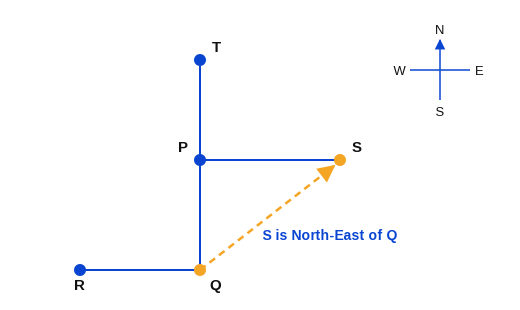
Town P is to the north of town Q. Town Q is to the east of town R. Town T is to the north of town P. Town S is to the east of town P. What is the position of town S with respect to town Q?
नगर P, नगर Q के उत्तर में है। नगर Q, नगर R के पूर्व में है। नगर T, नगर P के उत्तर में है। नगर S, नगर P के पूर्व में है। नगर Q के सापेक्ष नगर S की स्थिति क्या है?
  1. ANortheastउत्तर-पूर्व
  2. BNorthउत्तर
  3. CSoutheastदक्षिण-पूर्व
  4. DNorthwestउत्तर-पश्चिम
Show answer

Concept: Place Q at the origin and plot each town relative to it.

  1. P is north of Q; R is west of Q; T is north of P.
  2. S is east of P ⇒ S is to the north (via P) and east of Q.
  3. North + East ⇒ S is northeast of Q.

Trick: Combine the two moves from Q: up (north) then right (east) ⇒ northeast.

Answer: (A) Northeast

अवधारणा: Q को मूल बिंदु मानकर हर नगर की स्थिति बनाएँ।

  1. P, Q के उत्तर में; R, Q के पश्चिम में; T, P के उत्तर में।
  2. S, P के पूर्व में ⇒ S, Q से उत्तर (P होते हुए) और पूर्व में।
  3. उत्तर + पूर्व ⇒ S, Q के उत्तर-पूर्व में।

ट्रिक: Q से दो चालें जोड़ें: ऊपर (उत्तर) फिर दाएँ (पूर्व) ⇒ उत्तर-पूर्व।

उत्तर: (A) उत्तर-पूर्व (Northeast)

RRB NTPC Undergraduate CBT 1General Intelligence and ReasoningDirection SenseRRB NTPC Undergraduate CBT 1 2024 · 14 Aug Shift 3 →
Q2920.
This question is based on the five, three-digit numbers given below.
(Left) 731 890 923 286 378 (Right)
(Example: 697 – First digit = 6, second digit = 9 and third digit = 7)
(NOTE: All operations to be done from left to right.)
In how many numbers is the sum of the 1st and 3rd digits greater than the 2nd digit?
यह प्रश्न नीचे दी गई तीन-तीन अंकों वाली पाँच संख्याओं पर आधारित है।
(बाएँ) 731 890 923 286 378 (दाएँ)
(उदाहरण: 697 – पहला अंक = 6, दूसरा अंक = 9 और तीसरा अंक = 7)
(ध्यान दें: सभी संक्रियाएँ बाएँ से दाएँ की जानी हैं।)
कितनी संख्याओं में 1ले और 3रे अंक का योग 2रे अंक से अधिक है?
  1. ATwoदो
  2. BThreeतीन
  3. COneएक
  4. DFourचार
Show answer

Concept: For each number, compare (1st digit + 3rd digit) with the 2nd digit.

  1. 731: 7+1=8>3 ✓; 890: 8+0=8<9 ✗.
  2. 923: 9+3=12>2 ✓; 286: 2+6=8, not greater than 8 ✗.
  3. 378: 3+8=11>7 ✓ ⇒ three numbers.

Trick: "Greater than" is strict – an equal sum (286) does not count.

Answer: (B) Three

अवधारणा: हर संख्या में (पहला अंक + तीसरा अंक) की तुलना दूसरे अंक से करें।

  1. 731: 7+1=8>3 ✓; 890: 8+0=8<9 ✗।
  2. 923: 9+3=12>2 ✓; 286: 2+6=8, 8 से बड़ा नहीं ✗।
  3. 378: 3+8=11>7 ✓ ⇒ तीन संख्याएँ।

ट्रिक: "बड़ा" का अर्थ सख्ती से बड़ा – बराबर (286) नहीं गिना जाएगा।

उत्तर: (B) तीन (Three)

RRB NTPC Undergraduate CBT 1General Intelligence and ReasoningNumber Operations – DigitsRRB NTPC Undergraduate CBT 1 2024 · 14 Aug Shift 3 →