Question bank

Q&A: practice questions with answers

Search questions on any topic. Filter by exam category, exam, subject and topic, try the question, then open the answer and explanation.

Courses – airGurukul

20,719 questions found.

Q3081.
By how much is 65% of 65 greater than 25 of 25?
65 का 65%, 25 के 25 से कितना अधिक है?
  1. A29.25
  2. B30.25
  3. C26.25
  4. D32.25
Show answer

Concept: Find each quantity separately and subtract.

  1. 65% of 65=65×65100=4225100=42.25.
  2. 25 of 25=10.
  3. Difference =42.25−10=32.25.

Trick: 652=4225 (numbers ending in 5: 6×7=42, then 25).

Answer: (D) 32.25

अवधारणा: दोनों राशियाँ अलग-अलग ज्ञात करके घटाएँ।

  1. 65 का 65%=65×65100=4225100=42.25।
  2. 25 का 25=10।
  3. अंतर =42.25−10=32.25।

ट्रिक: 652=4225 (5 पर समाप्त संख्या: 6×7=42, फिर 25)।

उत्तर: (D) 32.25

RRB NTPC Undergraduate CBT 1MathematicsPercentage & FractionsRRB NTPC Undergraduate CBT 1 2024 · 14 Aug Shift 1 →
Q3082.
4 men can complete a piece of work in 10 days, while 3 women can do it in 16 days. In how many days can 6 women and 5 men complete this work?
4 पुरुष एक कार्य को 10 दिनों में पूरा कर सकते हैं, जबकि 3 महिलाएँ उसे 16 दिनों में पूरा कर सकती हैं। 6 महिलाएँ और 5 पुरुष मिलकर इस कार्य को कितने दिनों में पूरा कर सकते हैं?
  1. A5 days5 दिन
  2. B3 days3 दिन
  3. C4 days4 दिन
  4. D6 days6 दिन
Show answer

Concept: One person’s one-day work = 1persons×days.

  1. 1 man’s 1-day work =14×10=140; 1 woman’s =13×16=148.
  2. 6 women + 5 men per day =648+540=18+18=14.
  3. Time =4 days.

Trick: Total work =40 man-days =48 woman-days → 6 W = 18, 5 M = 18 per day.

Answer: (C) 4 days

अवधारणा: एक व्यक्ति का एक दिन का काम =1व्यक्ति×दिन।

  1. 1 पुरुष का 1 दिन का काम =14×10=140; 1 महिला का =13×16=148।
  2. 6 महिलाएँ + 5 पुरुष प्रतिदिन =648+540=18+18=14।
  3. समय =4 दिन।

ट्रिक: कुल काम =40 पुरुष-दिन =48 महिला-दिन → 6 म = 18, 5 पु = 18 प्रतिदिन।

उत्तर: (C) 4 दिन

RRB NTPC Undergraduate CBT 1MathematicsTime and WorkRRB NTPC Undergraduate CBT 1 2024 · 14 Aug Shift 1 →
Q3083.
Zeeshan travels 612 km at 68 km/hr, the next 312 km at 39 km/hr and the next 620 km at 62 km/hr. What is his average speed (in km/hr) for the whole journey? (Round off your answer to two decimal places)
ज़ीशान 612 km की दूरी 68 km/hr की चाल से, अगली 312 km की दूरी 39 km/hr की चाल से और अगली 620 km की दूरी 62 km/hr की चाल से तय करता है। पूरी यात्रा के लिए उसकी औसत चाल (km/hr में) कितनी है? (अपने उत्तर को दो दशमलव स्थानों तक पूर्णांकित कीजिए)
  1. A51.18
  2. B57.19
  3. C66.13
  4. D58.22
Show answer

Concept: Average speed=Total distanceTotal time.

  1. Times: 61268=9 h, 31239=8 h, 62062=10 h → total 27 h.
  2. Distance =612+312+620=1544 km.
  3. Average =154427≈57.19km/h.

Trick: Never average the speeds directly; each part here gives an exact whole-number time.

Answer: (B) 57.19

अवधारणा: औसत चाल=कुल दूरीकुल समय।

  1. समय: 61268=9 घंटे, 31239=8 घंटे, 62062=10 घंटे → कुल 27 घंटे।
  2. दूरी =612+312+620=1544 km।
  3. औसत =154427≈57.19km/h।

ट्रिक: चालों का सीधा औसत कभी न लें; यहाँ हर भाग का समय पूर्ण संख्या है।

उत्तर: (B) 57.19

RRB NTPC Undergraduate CBT 1MathematicsAverage SpeedRRB NTPC Undergraduate CBT 1 2024 · 14 Aug Shift 1 →
Q3084.
Which of the following numbers divides 718754023?
निम्नलिखित में से कौन-सी संख्या 718754023 को विभाजित करती है?
  1. A21
  2. B3
  3. C18
  4. D13
Show answer

Concept: Digit-sum test for 3 (and hence 18, 21); direct division for 13.

  1. Digit sum =7+1+8+7+5+4+0+2+3=37 → not divisible by 3, so 3, 18 and 21 (all multiples of 3) are ruled out.
  2. 718754023÷13=55288771 exactly.

Trick: If a number fails the 3-test, every option that is a multiple of 3 is eliminated at once.

Answer: (D) 13

अवधारणा: 3 (और इसलिए 18, 21) के लिए अंकों के योग का नियम; 13 के लिए सीधा भाग।

  1. अंकों का योग =7+1+8+7+5+4+0+2+3=37 → 3 से विभाज्य नहीं, अतः 3, 18 और 21 (सभी 3 के गुणज) बाहर।
  2. 718754023÷13=55288771 पूर्णतः।

ट्रिक: यदि संख्या 3 से विभाज्य नहीं, तो 3 के सभी गुणज वाले विकल्प तुरंत हट जाते हैं।

उत्तर: (D) 13

RRB NTPC Undergraduate CBT 1MathematicsDivisibilityRRB NTPC Undergraduate CBT 1 2024 · 14 Aug Shift 1 →
Q3085.
A, B and C invested a sum in the ratio of 8 : 36 : 76, respectively. If they earned a total profit of ₹3,030 at the end of the year, what is the difference between the shares of B and C?
A, B और C ने एक राशि का निवेश क्रमशः 8 : 36 : 76 के अनुपात में किया। यदि वर्ष के अंत में उन्होंने कुल ₹3,030 का लाभ अर्जित किया, तो B और C के हिस्सों के बीच का अंतर कितना है?
  1. A₹1,051
  2. B₹1,010
  3. C₹1,046
  4. D₹993
Show answer

Concept: Profit is shared in the ratio of investments.

  1. 8:36:76=2:9:19, total 30 parts.
  2. 1 part =303030=101.
  3. C − B =(19−9)×101=1010.

Trick: Difference of shares = difference of ratio parts × value of one part.

Answer: (B) ₹1,010

अवधारणा: लाभ निवेश के अनुपात में बँटता है।

  1. 8:36:76=2:9:19, कुल 30 भाग।
  2. 1 भाग =303030=101।
  3. C − B =(19−9)×101=1010।

ट्रिक: हिस्सों का अंतर = अनुपात भागों का अंतर × एक भाग का मान।

उत्तर: (B) ₹1,010

RRB NTPC Undergraduate CBT 1MathematicsPartnershipRRB NTPC Undergraduate CBT 1 2024 · 14 Aug Shift 1 →
Q3086.
₹30,600 was divided among A, B and C such that 8 times the share of A = 4 times the share of B = 3 times the share of C. Find the share of A.
₹30,600 को A, B और C के बीच इस प्रकार विभाजित किया गया कि A के हिस्से का 8 गुना = B के हिस्से का 4 गुना = C के हिस्से का 3 गुना है। A का हिस्सा ज्ञात कीजिए।
  1. A₹5,400
  2. B₹5,252
  3. C₹5,594
  4. D₹5,377
Show answer

Concept: If 8A=4B=3C=k, then A:B:C=18:14:13.

  1. Multiply by LCM 24: A:B:C=3:6:8, total 17 parts.
  2. 1 part =3060017=1800.
  3. A =3×1800=5400.

Trick: Take k=24: A = 3, B = 6, C = 8 directly.

Answer: (A) ₹5,400

अवधारणा: यदि 8A=4B=3C=k, तो A:B:C=18:14:13।

  1. LCM 24 से गुणा: A:B:C=3:6:8, कुल 17 भाग।
  2. 1 भाग =3060017=1800।
  3. A =3×1800=5400।

ट्रिक: k=24 लें: A = 3, B = 6, C = 8 सीधे।

उत्तर: (A) ₹5,400

RRB NTPC Undergraduate CBT 1MathematicsRatioRRB NTPC Undergraduate CBT 1 2024 · 14 Aug Shift 1 →
Q3087.
If the radius of the base of a right circular cylinder is decreased by 18% and its height is increased by 141%, then what is the percentage increase (closest integer) in its volume?
यदि एक लंब वृत्तीय बेलन के आधार की त्रिज्या में 18% की कमी की जाती है और उसकी ऊँचाई में 141% की वृद्धि की जाती है, तो उसके आयतन में प्रतिशत वृद्धि (निकटतम पूर्णांक) कितनी है?
  1. A74%
  2. B92%
  3. C43%
  4. D62%
Show answer

Concept: V=πr2h, so new volume factor =(radius factor)2×height factor.

  1. Radius factor =0.82, height factor =2.41.
  2. 0.822×2.41=0.6724×2.41=1.6205.
  3. Increase ≈62.05%≈62%.

Trick: Percent change formula for r2: −18−18+324100=−32.76%; then with +141%: −32.76+141−46.19≈62%.

Answer: (D) 62%

अवधारणा: V=πr2h, अतः नया आयतन गुणक =(त्रिज्या गुणक)2×ऊँचाई गुणक।

  1. त्रिज्या गुणक =0.82, ऊँचाई गुणक =2.41।
  2. 0.822×2.41=0.6724×2.41=1.6205।
  3. वृद्धि ≈62.05%≈62%।

ट्रिक: r2 के लिए: −18−18+324100=−32.76%; फिर +141% के साथ: −32.76+141−46.19≈62%।

उत्तर: (D) 62%

RRB NTPC Undergraduate CBT 1MathematicsMensuration – CylinderRRB NTPC Undergraduate CBT 1 2024 · 14 Aug Shift 1 →
Q3088.
A man walks to a viewpoint and returns to the starting point by his car maintaining a constant speed and thus, takes a total time of 4 hours 45 minutes. He would have gained 2 hours by driving both ways. How long would it have taken for him to walk both ways with the same walking speed?
एक व्यक्ति पैदल चलकर एक दर्शनीय स्थल (viewpoint) तक जाता है और एक स्थिर चाल बनाए रखते हुए अपनी कार से प्रारंभिक बिंदु पर लौटता है, और इस प्रकार कुल 4 घंटे 45 मिनट का समय लेता है। यदि वह दोनों ओर कार से जाता, तो उसके 2 घंटे बच जाते। यदि वह उसी पैदल चाल से दोनों ओर पैदल चलता, तो उसे कितना समय लगता?
  1. A6 hours 30 minutes6 घंटे 30 मिनट
  2. B7 hours 15 minutes7 घंटे 15 मिनट
  3. C5 hours 45 minutes5 घंटे 45 मिनट
  4. D6 hours 45 minutes6 घंटे 45 मिनट
Show answer

Concept: Walk one way + drive one way = 4 h 45 min; drive both ways is 2 h less.

  1. Drive both ways =4.75−2=2.75 h → drive one way =1.375 h.
  2. Walk one way =4.75−1.375=3.375 h.
  3. Walk both ways =2×3.375=6.75 h =6 h 45 min.

Trick: Walk both =2×(mixed)−drive both=9.5−2.75=6.75 h.

Answer: (D) 6 hours 45 minutes

अवधारणा: एक ओर पैदल + एक ओर कार = 4 घंटे 45 मिनट; दोनों ओर कार से 2 घंटे कम।

  1. दोनों ओर कार =4.75−2=2.75 घंटे → एक ओर कार =1.375 घंटे।
  2. एक ओर पैदल =4.75−1.375=3.375 घंटे।
  3. दोनों ओर पैदल =2×3.375=6.75 घंटे =6 घंटे 45 मिनट।

ट्रिक: दोनों ओर पैदल =2×(मिश्रित)−दोनों ओर कार=9.5−2.75=6.75 घंटे।

उत्तर: (D) 6 घंटे 45 मिनट

RRB NTPC Undergraduate CBT 1MathematicsTime and DistanceRRB NTPC Undergraduate CBT 1 2024 · 14 Aug Shift 1 →
Q3089.
The average runs scored by a batsman in 23 matches is 43. In the next 10 matches, the batsman scored an average of 14 runs. Find his average runs scored (rounded off to two decimal places) in all the 33 matches.
एक बल्लेबाज़ द्वारा 23 मैचों में बनाए गए रनों का औसत 43 है। अगले 10 मैचों में, बल्लेबाज़ ने औसतन 14 रन बनाए। सभी 33 मैचों में उसके द्वारा बनाए गए रनों का औसत (दो दशमलव स्थानों तक पूर्णांकित) ज्ञात कीजिए।
  1. A35.21
  2. B34.21
  3. C33.21
  4. D36.21
Show answer

Concept: Overall average = total runs ÷ total matches.

  1. Runs in 23 matches =23×43=989; next 10 matches =10×14=140.
  2. Total =1129 runs in 33 matches.
  3. Average =112933≈34.21.

Trick: 43−10×(43−14)33=43−29033=43−8.79=34.21.

Answer: (B) 34.21

अवधारणा: कुल औसत = कुल रन ÷ कुल मैच।

  1. 23 मैचों के रन =23×43=989; अगले 10 मैच =10×14=140।
  2. कुल =1129 रन, 33 मैचों में।
  3. औसत =112933≈34.21।

ट्रिक: 43−10×(43−14)33=43−29033=43−8.79=34.21।

उत्तर: (B) 34.21

RRB NTPC Undergraduate CBT 1MathematicsAverageRRB NTPC Undergraduate CBT 1 2024 · 14 Aug Shift 1 →
Q3090.
Find the value of [135 ÷ {25 + 5 × (7 − 3)}].
[135 ÷ {25 + 5 × (7 − 3)}] का मान ज्ञात कीजिए।
  1. A3
  2. B5
  3. C2
  4. D4
Show answer

Concept: Solve innermost bracket first, then multiplication, addition and division (BODMAS).

  1. (7−3)=4.
  2. {25+5×4}=25+20=45.
  3. 135÷45=3.

Trick: Brackets order: ( ) → { } → [ ].

Answer: (A) 3

अवधारणा: पहले सबसे भीतरी कोष्ठक, फिर गुणा, जोड़ और भाग (BODMAS)।

  1. (7−3)=4।
  2. {25+5×4}=25+20=45।
  3. 135÷45=3।

ट्रिक: कोष्ठक क्रम: ( ) → { } → [ ]।

उत्तर: (A) 3

RRB NTPC Undergraduate CBT 1MathematicsSimplification (BODMAS)RRB NTPC Undergraduate CBT 1 2024 · 14 Aug Shift 1 →
Q3091.
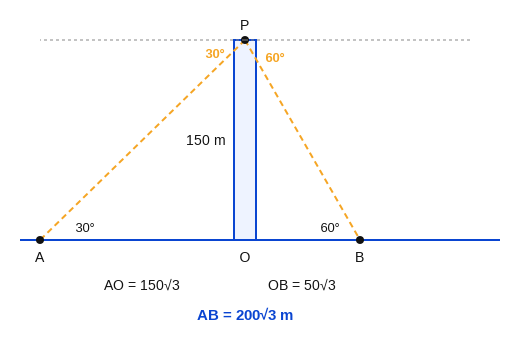
Aditya is standing on a light house of 150 m height and watching two boats on either side with angles of depression of 30∘ and 60∘, respectively. Find the distance between the two boats.
आदित्य 150 m ऊँचे एक प्रकाश स्तंभ (light house) पर खड़ा है और दोनों ओर स्थित दो नावों को क्रमशः 30∘ और 60∘ के अवनमन कोण (angles of depression) पर देख रहा है। दोनों नावों के बीच की दूरी ज्ञात कीजिए।
  1. A300m
  2. B1503m
  3. C250m
  4. D2003m
Show answer

Concept: Angle of depression from the top = angle of elevation at the boat; tanθ=heightdistance. Boats are on opposite sides, so add the distances.

  1. AO=150tan30∘=1503 m.
  2. OB=150tan60∘=1503=503 m.
  3. AB=1503+503=2003 m.

Trick: For 30° and 60° on opposite sides: distance =h(3+13)=4h3.

Answer: (D) 2003m

अवधारणा: शीर्ष से अवनमन कोण = नाव पर उन्नयन कोण; tanθ=ऊँचाईदूरी। नावें विपरीत ओर हैं, अतः दूरियाँ जोड़ें।

  1. AO=150tan30∘=1503 m।
  2. OB=150tan60∘=1503=503 m।
  3. AB=1503+503=2003 m।

ट्रिक: विपरीत ओर 30° और 60°: दूरी =h(3+13)=4h3।

उत्तर: (D) 2003m

RRB NTPC Undergraduate CBT 1MathematicsHeights and DistancesRRB NTPC Undergraduate CBT 1 2024 · 14 Aug Shift 1 →
Q3092.
Salil’s salary was first reduced by 25% and subsequently raised by 12%. What percentage was his final salary lower than his initial salary?
सलिल के वेतन में पहले 25% की कमी की गई और बाद में 12% की वृद्धि की गई। उसका अंतिम वेतन उसके प्रारंभिक वेतन से कितने प्रतिशत कम था?
  1. A3%
  2. B16%
  3. C12%
  4. D25%
Show answer

Concept: Successive changes multiply: net factor =(1−0.25)(1+0.12).

  1. 0.75×1.12=0.84.
  2. Final salary is 84% of initial → lower by 16%.

Trick: Net % =a+b+ab100=−25+12−300100=−16%.

Answer: (B) 16%

अवधारणा: क्रमिक परिवर्तन गुणा होते हैं: शुद्ध गुणक =(1−0.25)(1+0.12)।

  1. 0.75×1.12=0.84।
  2. अंतिम वेतन प्रारंभिक का 84% → 16% कम।

ट्रिक: शुद्ध % =a+b+ab100=−25+12−300100=−16%।

उत्तर: (B) 16%

RRB NTPC Undergraduate CBT 1MathematicsSuccessive Percentage ChangeRRB NTPC Undergraduate CBT 1 2024 · 14 Aug Shift 1 →
Q3093.
The LCM of the numbers 4.7 and 0.04 is:
संख्याओं 4.7 और 0.04 का LCM (लघुत्तम समापवर्त्य) है:
  1. A94
  2. B0.94
  3. C9.4
  4. D0.094
Show answer

Concept: Make equal decimal places, find LCM of the whole numbers, then put back the decimal places.

  1. 4.70 and 0.04 → 470 and 4 (two decimal places).
  2. LCM(470,4)=940.
  3. Put back 2 decimal places → 9.40=9.4.

Trick: LCM of decimals = LCM of numerators ÷ common power of 10.

Answer: (C) 9.4

अवधारणा: दशमलव स्थान बराबर करें, पूर्ण संख्याओं का LCM निकालें, फिर दशमलव वापस लगाएँ।

  1. 4.70 और 0.04 → 470 और 4 (दो दशमलव स्थान)।
  2. LCM(470,4)=940।
  3. 2 दशमलव स्थान वापस → 9.40=9.4।

ट्रिक: दशमलव का LCM = अंशों का LCM ÷ 10 की समान घात।

उत्तर: (C) 9.4

RRB NTPC Undergraduate CBT 1MathematicsLCM of DecimalsRRB NTPC Undergraduate CBT 1 2024 · 14 Aug Shift 1 →
Q3094.
If the third proportional of 16 and 40 be x, then what is the value of x?
यदि 16 और 40 का तृतीयानुपाती x है, तो x का मान कितना है?
  1. A102
  2. B99
  3. C101
  4. D100
Show answer

Concept: Third proportional of a and b: a:b=b:x → x=b2a.

  1. x=40216=160016.
  2. x=100.

Yaad rakhein: Third proportional =(second)2first.

Answer: (D) 100

अवधारणा: a और b का तृतीयानुपाती: a:b=b:x → x=b2a।

  1. x=40216=160016।
  2. x=100।

याद रखें: तृतीयानुपाती =(दूसरा)2पहला।

उत्तर: (D) 100

RRB NTPC Undergraduate CBT 1MathematicsProportionRRB NTPC Undergraduate CBT 1 2024 · 14 Aug Shift 1 →
Q3095.
The value of √(1.0201) is _______.
√(1.0201) का मान _______ है।
  1. A1.02
  2. B10.1
  3. C101
  4. D1.01
Show answer

Concept: A decimal with 4 decimal places has a square root with 2 decimal places.

  1. 1.0201=1020110000.
  2. 10201=101 since 1012=10201.
  3. 1.0201=101100=1.01.

Trick: (1.01)2=1.0201 — check the option by squaring.

Answer: (D) 1.01

अवधारणा: 4 दशमलव स्थान वाली संख्या के वर्गमूल में 2 दशमलव स्थान होते हैं।

  1. 1.0201=1020110000।
  2. 10201=101 क्योंकि 1012=10201।
  3. 1.0201=101100=1.01।

ट्रिक: (1.01)2=1.0201 — विकल्प का वर्ग करके जाँचें।

उत्तर: (D) 1.01

RRB NTPC Undergraduate CBT 1MathematicsSquare RootRRB NTPC Undergraduate CBT 1 2024 · 14 Aug Shift 1 →
Q3096.
Refer to the following number and symbol series and answer the question that follows. Counting to be done from left to right only.
(Left) @ + 1 < 9 6 9 2 % \ $ \ + 2 & $ 3 2 ^ 9 9 (Right)
How many such numbers are there that are immediately preceded by a symbol and immediately followed by another number?
निम्नलिखित संख्या और प्रतीक श्रृंखला को देखिए और उसके बाद दिए गए प्रश्न का उत्तर दीजिए। गणना केवल बाएँ से दाएँ की जानी है।
(बाएँ) @ + 1 < 9 6 9 2 % \ $ \ + 2 & $ 3 2 ^ 9 9 (दाएँ)
ऐसी कितनी संख्याएँ हैं जिनके ठीक पहले एक प्रतीक है और ठीक बाद एक अन्य संख्या है?
  1. AThreeतीन
  2. BOneएक
  3. CTwoदो
  4. DFourचार
Show answer

Concept: Check each number: the element just before must be a symbol and the element just after must be a number.

  1. Series: @ + 1 < 9 6 9 2 % \ $ \ + 2 & $ 3 2 ^ 9 9.
  2. 1: before “+”, after “<” (symbol) ✗. 9 (after “<”): followed by 6 ✓.
  3. 2 (after “+”): followed by “&” ✗. 3 (after “$”): followed by 2 ✓.
  4. 9 (after “^”): followed by 9 ✓. Total = 3.

Trick: Scan only numbers that come right after a symbol, then look one step right.

Answer: (A) Three

अवधारणा: हर संख्या जाँचें: ठीक पहले प्रतीक हो और ठीक बाद संख्या हो।

  1. श्रृंखला: @ + 1 < 9 6 9 2 % \ $ \ + 2 & $ 3 2 ^ 9 9।
  2. 1: पहले “+”, बाद में “<” (प्रतीक) ✗। 9 (“<” के बाद): बाद में 6 ✓।
  3. 2 (“+” के बाद): बाद में “&” ✗। 3 (“$” के बाद): बाद में 2 ✓।
  4. 9 (“^” के बाद): बाद में 9 ✓। कुल = 3।

ट्रिक: केवल प्रतीक के ठीक बाद आने वाली संख्याएँ देखें, फिर उनके दाएँ एक कदम देखें।

उत्तर: (A) तीन

RRB NTPC Undergraduate CBT 1General Intelligence and ReasoningNumber-Symbol SeriesRRB NTPC Undergraduate CBT 1 2024 · 14 Aug Shift 1 →
Q3097.
If + means −, − means ×, × means ÷ and ÷ means +, then what will come in place of the question mark (?) in the following equation?
75 × 5 + 11 − 2 ÷ 18 = ?
यदि + का अर्थ −, − का अर्थ ×, × का अर्थ ÷ और ÷ का अर्थ + है, तो निम्नलिखित समीकरण में प्रश्न चिह्न (?) के स्थान पर क्या आएगा?
75 × 5 + 11 − 2 ÷ 18 = ?
  1. A21
  2. B17
  3. C26
  4. D11
Show answer

Concept: Replace the signs as given, then apply BODMAS.

  1. 75×5+11−2÷18 becomes 75÷5−11×2+18.
  2. =15−22+18.
  3. =11.

Trick: Write the converted expression fully before calculating — most errors come from mixing old and new signs.

Answer: (D) 11

अवधारणा: दिए अनुसार चिह्न बदलें, फिर BODMAS लगाएँ।

  1. 75×5+11−2÷18 बनता है 75÷5−11×2+18।
  2. =15−22+18।
  3. =11।

ट्रिक: गणना से पहले बदला हुआ व्यंजक पूरा लिख लें — अधिकतर गलतियाँ पुराने-नए चिह्न मिलाने से होती हैं।

उत्तर: (D) 11

RRB NTPC Undergraduate CBT 1General Intelligence and ReasoningMathematical OperationsRRB NTPC Undergraduate CBT 1 2024 · 14 Aug Shift 1 →
Q3098.
Based on the English alphabetical order, three of the following four letter-cluster pairs are alike in a certain way and thus form a group. Which is the letter-cluster pair that DOES NOT belong to that group?
(Note: The odd one out is not based on the number of consonants/vowels or their position in the letter-cluster.)
अंग्रेज़ी वर्णमाला क्रम के आधार पर, निम्नलिखित चार अक्षर-समूह युग्मों में से तीन किसी निश्चित प्रकार से एकसमान हैं और इस प्रकार एक समूह बनाते हैं। वह अक्षर-समूह युग्म कौन-सा है जो उस समूह से संबंधित नहीं है?
(ध्यान दें: असंगत का चयन व्यंजनों/स्वरों की संख्या या अक्षर-समूह में उनकी स्थिति पर आधारित नहीं है।)
  1. AKE-MF
  2. BEY-GZ
  3. CYS-AT
  4. DPJ-RI
Show answer

Concept: Compare the first letters and the second letters of the two clusters separately (positions: A = 1 … Z = 26).

  1. KE-MF: K→M (+2), E→F (+1). EY-GZ: E→G (+2), Y→Z (+1).
  2. YS-AT: Y→A (+2, wrapping), S→T (+1).
  3. PJ-RI: P→R (+2) but J→I (−1) → odd.

Trick: Pattern “+2, +1” — the pair breaking it in any one letter is the odd one.

Answer: (D) PJ-RI

अवधारणा: दोनों समूहों के पहले अक्षरों और दूसरे अक्षरों की अलग-अलग तुलना करें (A = 1 … Z = 26)।

  1. KE-MF: K→M (+2), E→F (+1)। EY-GZ: E→G (+2), Y→Z (+1)।
  2. YS-AT: Y→A (+2, चक्रीय), S→T (+1)।
  3. PJ-RI: P→R (+2) पर J→I (−1) → विषम।

ट्रिक: पैटर्न “+2, +1” — जो जोड़ा किसी एक अक्षर में इसे तोड़े, वही विषम।

उत्तर: (D) PJ-RI

RRB NTPC Undergraduate CBT 1General Intelligence and ReasoningLetter-Cluster Odd One OutRRB NTPC Undergraduate CBT 1 2024 · 14 Aug Shift 1 →
Q3099.
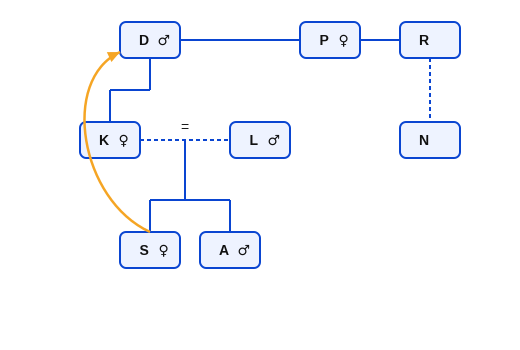
A is the brother of S. S is the daughter of L. L is married to K. K is the daughter of D. D is the father of P. P is the sister of R. R is married to N. How is D related to S?
A, S का भाई है। S, L की पुत्री है। L का विवाह K से हुआ है। K, D की पुत्री है। D, P का पिता है। P, R की बहन है। R का विवाह N से हुआ है। D का S से क्या संबंध है?
  1. AFather's brotherपिता का भाई
  2. BFatherपिता
  3. CMother's fatherमाता का पिता
  4. DFather's fatherपिता का पिता
Show answer

Concept: Fix genders first: a “daughter” is female; the spouse of a female is male.

  1. S is the daughter of L; L is married to K, and K is a daughter (female) → K is S’s mother, L is S’s father.
  2. K is the daughter of D, and D is a father (male).
  3. So D is the father of S’s mother.

Trick: Draw generations in rows: D → K → S; going up through the mother gives “mother’s father”.

Answer: (C) Mother’s father

अवधारणा: पहले लिंग तय करें: “बेटी” स्त्री है; स्त्री का जीवनसाथी पुरुष है।

  1. S, L की बेटी है; L का विवाह K से, और K बेटी (स्त्री) है → K, S की माँ और L, S के पिता।
  2. K, D की बेटी है, और D पिता (पुरुष) है।
  3. अतः D, S की माँ के पिता (नाना) हैं।

ट्रिक: पीढ़ियाँ पंक्तियों में बनाएँ: D → K → S; माँ के रास्ते ऊपर जाने पर “माँ के पिता”।

उत्तर: (C) माँ के पिता (Mother’s father)

RRB NTPC Undergraduate CBT 1General Intelligence and ReasoningBlood RelationRRB NTPC Undergraduate CBT 1 2024 · 14 Aug Shift 1 →
Q3100.
Each of the digits in the number 5341289 is arranged in ascending order from left to right. The position(s) of how many digits will remain unchanged as compared to that in the original number?
संख्या 5341289 के प्रत्येक अंक को बाएँ से दाएँ आरोही क्रम में व्यवस्थित किया जाता है। मूल संख्या की तुलना में कितने अंकों का स्थान अपरिवर्तित रहेगा?
  1. ATwoदो
  2. BOneएक
  3. CNoneकोई नहीं
  4. DThreeतीन
Show answer

Concept: Sort the digits and compare position by position.

  1. Original: 5 3 4 1 2 8 9.
  2. Ascending: 1 2 3 4 5 8 9.
  3. Same place: 8 (6th) and 9 (7th) → two digits.

Trick: Write both numbers one under the other and tick the matching columns.

Answer: (A) Two

अवधारणा: अंकों को क्रम में लगाकर हर स्थान की तुलना करें।

  1. मूल: 5 3 4 1 2 8 9।
  2. आरोही: 1 2 3 4 5 8 9।
  3. समान स्थान: 8 (6वाँ) और 9 (7वाँ) → दो अंक।

ट्रिक: दोनों संख्याएँ एक के नीचे एक लिखें और मिलते स्तंभों पर निशान लगाएँ।

उत्तर: (A) दो

RRB NTPC Undergraduate CBT 1General Intelligence and ReasoningDigit ArrangementRRB NTPC Undergraduate CBT 1 2024 · 14 Aug Shift 1 →