Question bank

Q&A: practice questions with answers

Search questions on any topic. Filter by exam category, exam, subject and topic, try the question, then open the answer and explanation.

Courses – airGurukul

20,719 questions found.

Q3221.
Based on the English alphabetical order, three of the following four letter-cluster pairs are alike in a certain way and thus form a group. Which letter-cluster pair DOES NOT belong to that group?
(Note: The odd one out is not based on the number of consonants/vowels or their position in the letter-cluster.)
अंग्रेज़ी वर्णमाला क्रम के आधार पर, निम्नलिखित चार अक्षर-समूह युग्मों में से तीन किसी निश्चित प्रकार से एकसमान हैं और इस प्रकार एक समूह बनाते हैं। कौन-सा अक्षर-समूह युग्म उस समूह से संबंधित नहीं है?
(ध्यान दें: असंगत अक्षर-समूह, व्यंजनों/स्वरों की संख्या या अक्षर-समूह में उनके स्थान पर आधारित नहीं है।)
  1. AFL - PG
  2. BHN - RI
  3. CDJ - NE
  4. DBH - LD
Show answer

Concept: Write letter positions: first→second (+6), first→third (+10), third→fourth (−9).

  1. FL-PG: 6, 12, 16, 7 → +6, +10, −9
  2. HN-RI: 8, 14, 18, 9 ✓; DJ-NE: 4, 10, 14, 5 ✓
  3. BH-LD: 2, 8, 12, 4 → last step −8 → odd

Trick: Check the last gap of each pair – three show −9, one shows −8.

Answer: (D) BH - LD

अवधारणा: अक्षरों की स्थिति लिखें: पहला→दूसरा (+6), पहला→तीसरा (+10), तीसरा→चौथा (−9)।

  1. FL-PG: 6, 12, 16, 7 → +6, +10, −9
  2. HN-RI: 8, 14, 18, 9 ✓; DJ-NE: 4, 10, 14, 5 ✓
  3. BH-LD: 2, 8, 12, 4 → अंतिम चरण −8 → विषम

ट्रिक: हर जोड़ी का अंतिम अंतर देखें – तीन में −9, एक में −8।

उत्तर: (D) BH - LD
RRB NTPC Undergraduate CBT 1General Intelligence and ReasoningOdd One Out – Letter PairsRRB NTPC Undergraduate CBT 1 2024 · 13 Aug Shift 3 →
Q3222.
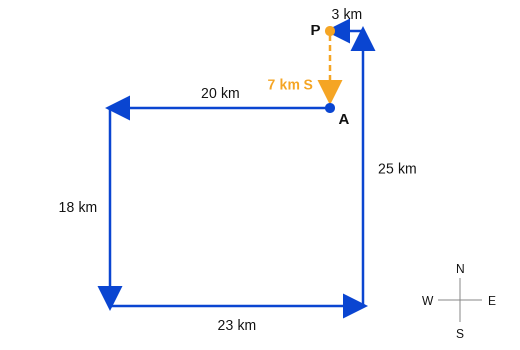
Gyamel starts from Point A and drives 20 km towards West. He then takes a left turn, drives 18 km, turns left and drives 23 km. He then takes a left turn and drives 25 km. He takes a final left turn, drives 3 km and stops at Point P. How far (shortest distance) and towards which direction should he drive in order to reach Point A again? (All turns are 90° turns only unless specified.)
ग्यामेल बिंदु A से चलना शुरू करता है और पश्चिम की ओर 20 km गाड़ी चलाता है। फिर वह बाएँ मुड़ता है, 18 km गाड़ी चलाता है, बाएँ मुड़ता है और 23 km गाड़ी चलाता है। फिर वह बाएँ मुड़ता है और 25 km गाड़ी चलाता है। वह अंतिम बार बाएँ मुड़ता है, 3 km गाड़ी चलाता है और बिंदु P पर रुक जाता है। बिंदु A पर फिर से पहुँचने के लिए उसे कितनी दूरी (न्यूनतम दूरी) और किस दिशा में गाड़ी चलानी चाहिए? (जब तक निर्दिष्ट न किया जाए, सभी मोड़ केवल 90° के मोड़ हैं।)
  1. A5 km to the Westपश्चिम की ओर 5 km
  2. B4 km to the Southदक्षिण की ओर 4 km
  3. C7 km to the Southदक्षिण की ओर 7 km
  4. D6 km to the Northउत्तर की ओर 6 km
Show answer

Concept: Plot each leg; facing west, a left turn means south; four left turns go W → S → E → N → W.

  1. A → 20 km W; left (S) 18 km; left (E) 23 km; left (N) 25 km; left (W) 3 km → P
  2. East–west: −20 + 23 − 3 = 0 ⇒ P is in line with A
  3. North–south: −18 + 25 = 7 km north ⇒ go 7 km south

Trick: Net each axis separately: horizontal cancels, vertical leaves 7 km north.

Answer: (C) 7 km to the South

अवधारणा: हर चाल अंकित करें; पश्चिम की ओर मुँह हो तो बायाँ मोड़ = दक्षिण; चार बाएँ मोड़: W → S → E → N → W।

  1. A → 20 km पश्चिम; बाएँ (दक्षिण) 18 km; बाएँ (पूर्व) 23 km; बाएँ (उत्तर) 25 km; बाएँ (पश्चिम) 3 km → P
  2. पूर्व–पश्चिम: −20 + 23 − 3 = 0 ⇒ P, A की सीध में
  3. उत्तर–दक्षिण: −18 + 25 = 7 km उत्तर ⇒ 7 km दक्षिण जाएँ

ट्रिक: दोनों अक्ष अलग जोड़ें: क्षैतिज शून्य, ऊर्ध्वाधर 7 km उत्तर।

उत्तर: (C) 7 km दक्षिण की ओर

RRB NTPC Undergraduate CBT 1General Intelligence and ReasoningDirection and DistanceRRB NTPC Undergraduate CBT 1 2024 · 13 Aug Shift 3 →
Q3223.
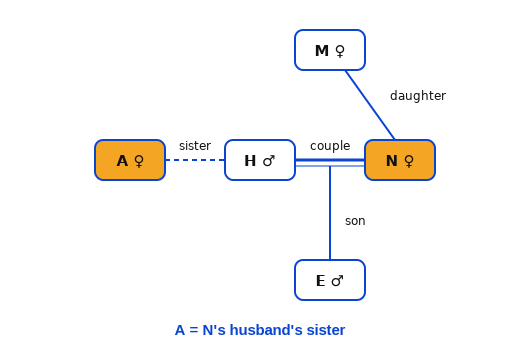
A is the sister of H. H is the father of E. E is the son of N. M is the mother of N. How is A related to N?
A, H की बहन है। H, E का पिता है। E, N का पुत्र है। M, N की माता है। A का N से क्या संबंध है?
  1. ADaughter's husband's motherपुत्री के पति की माता
  2. BDaughter's husband's sisterपुत्री के पति की बहन
  3. CHusband's motherपति की माता
  4. DHusband's sisterपति की बहन
Show answer

Concept: Build the family tree; parents of the same child are a couple.

  1. H is the father of E and E is the son of N ⇒ N is H's wife.
  2. A is H's sister.
  3. So A is N's husband's sister (M, N's mother, is extra information).

Trick: Husband's sister = 'nanad' – the common child links H and N as a couple.

Answer: (D) Husband's sister

अवधारणा: परिवार वृक्ष बनाएँ; एक ही संतान के माता-पिता पति-पत्नी होते हैं।

  1. H, E का पिता और E, N का पुत्र ⇒ N, H की पत्नी।
  2. A, H की बहन है।
  3. अतः A, N के पति की बहन (ननद) है; M (N की माँ) अतिरिक्त जानकारी है।

ट्रिक: पति की बहन = ननद – साझा संतान H और N को पति-पत्नी जोड़ती है।

उत्तर: (D) पति की बहन

RRB NTPC Undergraduate CBT 1General Intelligence and ReasoningBlood RelationsRRB NTPC Undergraduate CBT 1 2024 · 13 Aug Shift 3 →
Q3224.
In the following triad, each group of letters is related to the subsequent one following a certain logic. Select from the given options, the one which follows the same logic. GAIN - AIGN - NIAG
SINE - INSE - ENIS
निम्नलिखित त्रयी में, अक्षरों का प्रत्येक समूह एक निश्चित तर्क का अनुसरण करते हुए अपने अगले समूह से संबंधित है। दिए गए विकल्पों में से उसका चयन कीजिए जो उसी तर्क का अनुसरण करता है। GAIN - AIGN - NIAG
SINE - INSE - ENIS
  1. AGAME - AMGE - AMEG
  2. BMONK - OMNK - KONM
  3. CSEAT - SAET - TAES
  4. DRICE - ICRE - ECIR
Show answer

Concept: Step 1: letters 1, 2, 3, 4 → order 2, 3, 1, 4. Step 3: the original word reversed.

  1. GAIN → AIGN (A I G N) → NIAG (GAIN reversed)
  2. SINE → INSE → ENIS ✓
  3. RICE → ICRE (I C R E) → ECIR (RICE reversed) ✓

Trick: Check the third word first – it must be the first word reversed; only RICE–ECIR and SEAT–TAES pass, and SAET fails step 1.

Answer: (D) RICE - ICRE - ECIR

अवधारणा: चरण 1: अक्षर 1, 2, 3, 4 → क्रम 2, 3, 1, 4। तीसरा शब्द: मूल शब्द उल्टा।

  1. GAIN → AIGN (A I G N) → NIAG (GAIN उल्टा)
  2. SINE → INSE → ENIS ✓
  3. RICE → ICRE (I C R E) → ECIR (RICE उल्टा) ✓

ट्रिक: पहले तीसरा शब्द जाँचें – वह पहले शब्द का उल्टा हो; RICE–ECIR और SEAT–TAES बचते हैं, पर SAET चरण 1 में विफल।

उत्तर: (D) RICE - ICRE - ECIR

RRB NTPC Undergraduate CBT 1General Intelligence and ReasoningLetter Rearrangement TriadRRB NTPC Undergraduate CBT 1 2024 · 13 Aug Shift 3 →
Q3225.
In the following triad, each group of letters is related to the subsequent one following a certain logic. Select from the given options, the one that follows the same logic. MARK - MKRA - KRAM
PLAY - PYAL - YALP
निम्नलिखित त्रयी में, अक्षरों का प्रत्येक समूह एक निश्चित तर्क का अनुसरण करते हुए अपने अगले समूह से संबंधित है। दिए गए विकल्पों में से उसका चयन कीजिए जो उसी तर्क का अनुसरण करता है। MARK - MKRA - KRAM
PLAY - PYAL - YALP
  1. ATRAY - TRYA - RAYT
  2. BFIRE - IFRE - EIRF
  3. CGATE - GTAE - ETAG
  4. DBUSH - BHSU - HSUB
Show answer

Concept: Step 1: letters 1, 2, 3, 4 → order 1, 4, 3, 2. Step 3: the original word reversed.

  1. MARK → MKRA → KRAM (MARK reversed)
  2. PLAY → PYAL → YALP ✓
  3. BUSH → BHSU (B H S U) → HSUB (BUSH reversed) ✓

Trick: Third word = first word reversed; middle word keeps the first letter and swaps 2nd and 4th.

Answer: (D) BUSH - BHSU - HSUB

अवधारणा: चरण 1: अक्षर 1, 2, 3, 4 → क्रम 1, 4, 3, 2। तीसरा शब्द: मूल शब्द उल्टा।

  1. MARK → MKRA → KRAM (MARK उल्टा)
  2. PLAY → PYAL → YALP ✓
  3. BUSH → BHSU (B H S U) → HSUB (BUSH उल्टा) ✓

ट्रिक: तीसरा शब्द = पहला उल्टा; बीच वाले में पहला अक्षर वही, दूसरा और चौथा अदला-बदली।

उत्तर: (D) BUSH - BHSU - HSUB

RRB NTPC Undergraduate CBT 1General Intelligence and ReasoningLetter Rearrangement TriadRRB NTPC Undergraduate CBT 1 2024 · 13 Aug Shift 3 →
Q3226.
Which of the following is an impact of river meandering in plains?
मैदानों में नदी के विसर्पण (meandering) का निम्नलिखित में से कौन-सा प्रभाव है?
  1. AFormation of waterfallsजलप्रपातों का निर्माण
  2. BFormation of oxbow lakesगोखुर झीलों (oxbow lakes) का निर्माण
  3. CFormation of rift valleysभ्रंश घाटियों (rift valleys) का निर्माण
  4. DFormation of rapidsक्षिप्रिकाओं (rapids) का निर्माण
Show answer

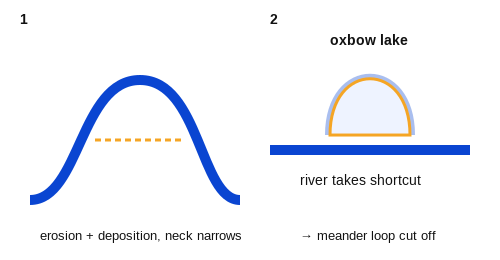
Concept: In the plains a mature river flows slowly and swings in wide loops called meanders.

  1. Water erodes the outer bank (faster flow) and deposits on the inner bank, so the loops keep growing.
  2. The neck of a loop becomes very narrow; during a flood the river cuts straight across it.
  3. The abandoned loop is left as a crescent-shaped lake – an oxbow lake.
  4. Waterfalls and rapids form in the youthful (mountain) stage; rift valleys form by faulting, not by rivers.

Yaad rakhein: Meander → cut-off → oxbow lake: a typical landform of the lower course (e.g., Ganga plains).

Answer: (B) Formation of oxbow lakes

अवधारणा: मैदानों में परिपक्व नदी धीमी गति से बहती है और चौड़े घुमाव (meanders) बनाती है।

  1. बाहरी किनारे पर अपरदन और भीतरी किनारे पर निक्षेपण से घुमाव बढ़ता जाता है।
  2. घुमाव की गर्दन (neck) बहुत संकरी हो जाती है; बाढ़ के समय नदी सीधा रास्ता बना लेती है।
  3. छूटा हुआ घुमाव अर्धचंद्राकार झील बन जाता है – गोखुर झील (oxbow lake)।
  4. जलप्रपात व क्षिप्रिका (rapids) युवा अवस्था (पर्वतीय भाग) में बनते हैं; भ्रंश घाटी (rift valley) भ्रंशन से बनती है।

याद रखें: विसर्प (meander) → कट-ऑफ → गोखुर झील: नदी के निचले मार्ग (जैसे गंगा मैदान) की पहचान।

उत्तर: (B) गोखुर झीलों का निर्माण (Formation of oxbow lakes)

RRB NTPC Undergraduate CBT 1General AwarenessFluvial landformsRRB NTPC Undergraduate CBT 1 2024 · 13 Aug Shift 2 →
Q3227.
When was the Rural Landless Employment Guarantee Programme (RLEGP) launched?
ग्रामीण भूमिहीन रोज़गार गारंटी कार्यक्रम (RLEGP) कब शुरू किया गया था?
  1. A2 October 19852 अक्टूबर 1985
  2. B15 August 198315 अगस्त 1983
  3. C1 April 19801 अप्रैल 1980
  4. D26 January 198226 जनवरी 1982
Show answer

Concept: RLEGP was a centrally sponsored wage-employment programme for landless rural households.

  1. It was launched on 15 August 1983 to give guaranteed employment of up to 100 days to at least one member of every landless household.
  2. In 1989 RLEGP and NREP (1980) were merged into the Jawahar Rozgar Yojana (JRY).

Yaad rakhein: NREP – 1980, RLEGP – 1983, both merged into JRY – 1989.

Answer: (B) 15 August 1983

अवधारणा: RLEGP भूमिहीन ग्रामीण परिवारों के लिए केंद्र प्रायोजित मज़दूरी-रोज़गार कार्यक्रम था।

  1. इसे 15 अगस्त 1983 को शुरू किया गया; उद्देश्य हर भूमिहीन परिवार के कम से कम एक सदस्य को 100 दिन तक रोज़गार देना था।
  2. 1989 में RLEGP और NREP (1980) को मिलाकर जवाहर रोज़गार योजना (JRY) बनाई गई।

याद रखें: NREP – 1980, RLEGP – 1983, दोनों का विलय JRY – 1989 में।

उत्तर: (B) 15 अगस्त 1983

RRB NTPC Undergraduate CBT 1General AwarenessRural employment programmesRRB NTPC Undergraduate CBT 1 2024 · 13 Aug Shift 2 →
Q3228.
Which of the following is NOT an instrument of parliamentary control over the executive in India?
निम्नलिखित में से कौन-सा भारत में कार्यपालिका पर संसदीय नियंत्रण का साधन नहीं है?
  1. AJudicial review of executive actionsकार्यपालिका के कार्यों की न्यायिक समीक्षा
  2. BQuestion Hour in the Lok Sabhaलोकसभा में प्रश्नकाल
  3. CApproval of government bills (laws) by the Parliamentसंसद द्वारा सरकारी विधेयकों (कानूनों) का अनुमोदन
  4. DNo-confidence motion against the Council of Ministersमंत्रिपरिषद के विरुद्ध अविश्वास प्रस्ताव
Show answer

Concept: Parliament controls the executive through its own devices – questions, motions, debates and passing of bills/budget.

  1. Question Hour, no-confidence motion and the need for Parliament's approval of bills are all parliamentary tools.
  2. Judicial review is the power of the courts (Supreme Court and High Courts) to strike down unconstitutional executive or legislative action.
  3. So it is a judicial control, not a parliamentary one.

Trick: Ask "who uses the tool?" – if it is the court, it is not parliamentary control.

Answer: (A) Judicial review of executive actions

अवधारणा: संसद अपने साधनों – प्रश्न, प्रस्ताव, बहस तथा विधेयक/बजट पारित करने – के द्वारा कार्यपालिका पर नियंत्रण रखती है।

  1. प्रश्नकाल, अविश्वास प्रस्ताव और विधेयकों की संसदीय स्वीकृति – सभी संसदीय साधन हैं।
  2. न्यायिक पुनरावलोकन (Judicial review) न्यायालयों (सर्वोच्च व उच्च न्यायालय) की शक्ति है जिससे वे असंवैधानिक कार्यों को रद्द करते हैं।
  3. अतः यह न्यायिक नियंत्रण है, संसदीय नहीं।

ट्रिक: पूछें "साधन कौन प्रयोग करता है?" – यदि न्यायालय, तो वह संसदीय नियंत्रण नहीं है।

उत्तर: (A) कार्यपालिका के कार्यों का न्यायिक पुनरावलोकन

RRB NTPC Undergraduate CBT 1General AwarenessParliamentary control over executiveRRB NTPC Undergraduate CBT 1 2024 · 13 Aug Shift 2 →
Q3229.
The concept of 'watershed' is primarily associated with:
'जलविभाजक (watershed)' की अवधारणा मुख्य रूप से किससे संबंधित है?
  1. AMountain formationपर्वत निर्माण
  2. BClimate zonesजलवायु क्षेत्र
  3. CRiver catchment areaनदी जलग्रहण क्षेत्र
  4. DRainfall distributionवर्षा वितरण
Show answer

Concept: A watershed is the land area from which all rain water drains into a common stream, river or lake.

  1. It is bounded by a ridge (water divide) and is also called the catchment or drainage basin of that river.
  2. Watershed management (soil and water conservation) is planned on this river-catchment unit.

Yaad rakhein: Watershed = catchment area of a river; its boundary line is the water divide.

Answer: (C) River catchment area

अवधारणा: जलसंभर (watershed) वह भू-क्षेत्र है जहाँ का सारा वर्षा जल बहकर एक ही धारा, नदी या झील में पहुँचता है।

  1. इसकी सीमा एक कटक (जल-विभाजक) बनाती है; इसे नदी का जलग्रहण क्षेत्र (catchment) या अपवाह बेसिन भी कहते हैं।
  2. जलसंभर प्रबंधन (मृदा व जल संरक्षण) इसी नदी-जलग्रहण इकाई पर किया जाता है।

याद रखें: Watershed = नदी का जलग्रहण क्षेत्र; इसकी सीमा रेखा = जल-विभाजक।

उत्तर: (C) नदी जलग्रहण क्षेत्र (River catchment area)

RRB NTPC Undergraduate CBT 1General AwarenessWatershedRRB NTPC Undergraduate CBT 1 2024 · 13 Aug Shift 2 →
Q3230.
Microliths, which are tiny stone tools usually stuck on to handles of bones or woods to make tools like saws and sickles. These were mostly found in which age?
माइक्रोलिथ (सूक्ष्म पाषाण उपकरण), जो छोटे पत्थर के औज़ार होते हैं और आरी तथा हँसिया जैसे औज़ार बनाने के लिए प्रायः हड्डी या लकड़ी के हत्थों पर चिपकाए जाते थे। ये अधिकतर किस युग में पाए गए थे?
  1. APaleolithic ageपुरापाषाण युग
  2. BChalcolithic ageताम्रपाषाण युग
  3. CMesolithic ageमध्यपाषाण युग
  4. DNeolithic ageनवपाषाण युग
Show answer

Concept: Microliths are very small stone blades (about 1–5 cm) – the characteristic tool of the Mesolithic (Middle Stone) Age.

  1. They were hafted on bone or wooden handles to make composite tools such as saws, sickles and arrowheads.
  2. Sites: Bagor (Rajasthan), Adamgarh (MP), Langhnaj (Gujarat).
  3. Palaeolithic = large hand-axes, choppers; Neolithic = polished stone tools.

Yaad rakhein: Mesolithic = Microlithic age ("micro" = small blades).

Answer: (C) Mesolithic age

अवधारणा: माइक्रोलिथ (सूक्ष्म पाषाण उपकरण) बहुत छोटे पत्थर के ब्लेड (लगभग 1–5 cm) हैं – मध्यपाषाण (Mesolithic) युग की पहचान।

  1. इन्हें हड्डी या लकड़ी के हत्थों पर लगाकर आरी, हँसिया, बाणाग्र जैसे मिश्रित औज़ार बनाए जाते थे।
  2. स्थल: बागोर (राजस्थान), आदमगढ़ (म.प्र.), लंघनाज (गुजरात)।
  3. पुरापाषाण = बड़े हस्त-कुठार; नवपाषाण = पॉलिश किए पत्थर के औज़ार।

याद रखें: मध्यपाषाण युग = सूक्ष्मपाषाण (Microlithic) युग।

उत्तर: (C) मध्यपाषाण युग (Mesolithic age)

RRB NTPC Undergraduate CBT 1General AwarenessStone Age toolsRRB NTPC Undergraduate CBT 1 2024 · 13 Aug Shift 2 →
Q3231.
The President of India is also the Supreme Commander of which force in India?
भारत के राष्ट्रपति भारत में किस बल के सर्वोच्च कमांडर भी हैं?
  1. AIntelligence Agenciesखुफिया एजेंसियाँ
  2. BArmed Forcesसशस्त्र बल
  3. CBorder Security Forceसीमा सुरक्षा बल
  4. DPolice Forcesपुलिस बल
Show answer

Concept: Article 53(2) vests the supreme command of the Defence Forces of the Union in the President.

  1. The President is the Supreme Commander of the Armed Forces – Army, Navy and Air Force.
  2. BSF and police are under the Home Ministry/States; intelligence agencies are under the government, not a 'command' of the President.

Yaad rakhein: Art. 53(2): President = Supreme Commander of the three Armed Forces.

Answer: (B) Armed Forces

अवधारणा: अनुच्छेद 53(2) संघ के रक्षा बलों की सर्वोच्च कमान राष्ट्रपति में निहित करता है।

  1. राष्ट्रपति सशस्त्र बलों – थलसेना, नौसेना और वायुसेना – के सर्वोच्च सेनापति हैं।
  2. BSF व पुलिस गृह मंत्रालय/राज्यों के अधीन हैं; खुफिया एजेंसियाँ सरकार के अधीन हैं।

याद रखें: अनु. 53(2): राष्ट्रपति = तीनों सेनाओं के सर्वोच्च कमांडर।

उत्तर: (B) सशस्त्र बल (Armed Forces)

RRB NTPC Undergraduate CBT 1General AwarenessPresident of India – powersRRB NTPC Undergraduate CBT 1 2024 · 13 Aug Shift 2 →
Q3232.
Human development is a key aspect of economic development. As per the UNDP’s Human Development Report 2025, where does India rank globally?
मानव विकास आर्थिक विकास का एक प्रमुख पहलू है। UNDP की मानव विकास रिपोर्ट 2025 के अनुसार, वैश्विक स्तर पर भारत का स्थान क्या है?
  1. A100
  2. B144
  3. C119
  4. D130
Show answer

Concept: UNDP's Human Development Report 2025 (released May 2025) ranks countries on the Human Development Index (HDI).

  1. India is ranked 130th out of 193 countries, up from 133rd in the previous report.
  2. India's HDI value rose to 0.685 and it remains in the 'medium human development' category.

Yaad rakhein: HDR 2025 theme: AI – "A matter of choice: People and possibilities in the age of AI"; India 130.

Answer: (D) 130

अवधारणा: UNDP की मानव विकास रिपोर्ट 2025 (मई 2025) देशों को मानव विकास सूचकांक (HDI) पर रैंक करती है।

  1. भारत 193 देशों में 130वें स्थान पर है (पिछली रिपोर्ट में 133वाँ)।
  2. भारत का HDI मान 0.685 हुआ; भारत 'मध्यम मानव विकास' श्रेणी में है।

याद रखें: HDR 2025 की थीम AI पर आधारित; भारत की रैंक 130।

उत्तर: (D) 130

RRB NTPC Undergraduate CBT 1General AwarenessHuman Development Report 2025RRB NTPC Undergraduate CBT 1 2024 · 13 Aug Shift 2 →
Q3233.
Which Act provided separate legislative subjects for the Centre and Provinces with three distinct lists?
किस अधिनियम ने तीन अलग-अलग सूचियों के साथ केंद्र और प्रांतों के लिए पृथक विधायी विषयों का प्रावधान किया?
  1. AIndian Independence Act 1947भारतीय स्वतंत्रता अधिनियम 1947
  2. BGovernment of India Act 1858भारत सरकार अधिनियम 1858
  3. CGovernment of India Act 1919भारत सरकार अधिनियम 1919
  4. DGovernment of India Act 1935भारत सरकार अधिनियम 1935
Show answer

Concept: The Government of India Act 1935 introduced provincial autonomy and an all-India federation.

  1. It divided powers into three lists – Federal List, Provincial List and Concurrent List.
  2. The 1919 Act had only separated central and provincial subjects (no three lists); the Constitution's Seventh Schedule borrows the three-list idea from 1935.

Yaad rakhein: 1919 – dyarchy in provinces; 1935 – three lists, provincial autonomy, dyarchy at centre.

Answer: (D) Government of India Act 1935

अवधारणा: भारत सरकार अधिनियम 1935 ने प्रांतीय स्वायत्तता और अखिल भारतीय संघ का प्रावधान किया।

  1. इसने शक्तियों को तीन सूचियों – संघीय, प्रांतीय और समवर्ती सूची – में बाँटा।
  2. 1919 के अधिनियम में केवल केंद्रीय व प्रांतीय विषय अलग किए गए थे (तीन सूचियाँ नहीं); संविधान की सातवीं अनुसूची यह विचार 1935 से लेती है।

याद रखें: 1919 – प्रांतों में द्वैध शासन; 1935 – तीन सूचियाँ, प्रांतीय स्वायत्तता, केंद्र में द्वैध शासन।

उत्तर: (D) भारत सरकार अधिनियम 1935

RRB NTPC Undergraduate CBT 1General AwarenessGovernment of India Act 1935RRB NTPC Undergraduate CBT 1 2024 · 13 Aug Shift 2 →
Q3234.
How many public sector banks are operating in India, as on 1 May 2025?
1 मई 2025 की स्थिति के अनुसार, भारत में कितने सार्वजनिक क्षेत्र के बैंक कार्यरत हैं?
  1. A8
  2. B14
  3. C12
  4. D10
Show answer

Concept: After the mega-merger of 2020 (effective 1 April 2020), the number of public sector banks fell from 27 (2017) to 12.

  1. The 12 PSBs include SBI, PNB, Bank of Baroda, Canara Bank, Union Bank of India, Bank of India, Indian Bank, Central Bank of India, Indian Overseas Bank, UCO Bank, Bank of Maharashtra and Punjab & Sind Bank.
  2. This count of 12 still held as on 1 May 2025.

Yaad rakhein: PSBs: 27 → 12 after the 2019–20 mergers; largest is SBI.

Answer: (C) 12

अवधारणा: 2020 के बड़े विलय (1 अप्रैल 2020 से प्रभावी) के बाद सार्वजनिक क्षेत्र के बैंकों की संख्या 27 (2017) से घटकर 12 रह गई।

  1. 12 PSB: SBI, PNB, बैंक ऑफ बड़ौदा, केनरा बैंक, यूनियन बैंक, बैंक ऑफ इंडिया, इंडियन बैंक, सेंट्रल बैंक, इंडियन ओवरसीज़ बैंक, UCO बैंक, बैंक ऑफ महाराष्ट्र और पंजाब एंड सिंध बैंक।
  2. 1 मई 2025 को भी यह संख्या 12 ही थी।

याद रखें: PSB: विलय के बाद 27 → 12; सबसे बड़ा SBI।

उत्तर: (C) 12

RRB NTPC Undergraduate CBT 1General AwarenessPublic sector banksRRB NTPC Undergraduate CBT 1 2024 · 13 Aug Shift 2 →
Q3235.
Tourism is classified as a tertiary activity because it involves:
पर्यटन को तृतीयक गतिविधि के रूप में वर्गीकृत किया जाता है क्योंकि इसमें निम्नलिखित शामिल है:
  1. Aextracting natural resourcesप्राकृतिक संसाधनों का निष्कर्षण
  2. Bproduction of goodsवस्तुओं का उत्पादन
  3. Cselling of machineryमशीनरी की बिक्री
  4. Dproviding services to peopleलोगों को सेवाएँ प्रदान करना
Show answer

Concept: Tertiary activities do not produce goods; they provide services (transport, trade, banking, tourism, health…).

  1. Tourism provides travel, hotel, guide and entertainment services to people.
  2. Extracting natural resources is primary; production of goods is secondary; selling machinery is trade of goods, not the core of tourism.

Yaad rakhein: Primary – extract, Secondary – make, Tertiary – serve.

Answer: (D) providing services to people

अवधारणा: तृतीयक क्रियाएँ वस्तुएँ नहीं बनातीं; वे सेवाएँ प्रदान करती हैं (परिवहन, व्यापार, बैंकिंग, पर्यटन, स्वास्थ्य…)।

  1. पर्यटन लोगों को यात्रा, होटल, गाइड व मनोरंजन सेवाएँ देता है।
  2. प्राकृतिक संसाधन निकालना प्राथमिक; वस्तुओं का उत्पादन द्वितीयक क्रिया है।

याद रखें: प्राथमिक – निकालना, द्वितीयक – बनाना, तृतीयक – सेवा देना।

उत्तर: (D) लोगों को सेवाएँ प्रदान करना

RRB NTPC Undergraduate CBT 1General AwarenessEconomic activitiesRRB NTPC Undergraduate CBT 1 2024 · 13 Aug Shift 2 →
Q3236.
Which of the following is a dimensionless quantity?
निम्नलिखित में से कौन-सी एक विमाहीन (dimensionless) राशि है?
  1. AVelocityवेग
  2. BAccelerationत्वरण
  3. CRefractive indexअपवर्तनांक (refractive index)
  4. DGravitational forceगुरुत्वाकर्षण बल
Show answer

Concept: A quantity is dimensionless if it is a ratio of two like quantities, so all dimensions cancel.

  1. Refractive index n=cv = speed ÷ speed → [M0L0T0], no unit.
  2. Velocity [LT−1], acceleration [LT−2], force [MLT−2] all have dimensions.

Trick: Ratio of the same quantity (refractive index, strain, relative density) → dimensionless.

Answer: (C) Refractive index

अवधारणा: कोई राशि विमाहीन होती है यदि वह दो समान राशियों का अनुपात हो, जिससे सारी विमाएँ कट जाएँ।

  1. अपवर्तनांक n=cv = चाल ÷ चाल → [M0L0T0], कोई मात्रक नहीं।
  2. वेग [LT−1], त्वरण [LT−2], बल [MLT−2] – सबकी विमाएँ हैं।

ट्रिक: समान राशियों का अनुपात (अपवर्तनांक, विकृति, आपेक्षिक घनत्व) → विमाहीन।

उत्तर: (C) अपवर्तनांक (Refractive index)

RRB NTPC Undergraduate CBT 1General AwarenessDimensions of physical quantitiesRRB NTPC Undergraduate CBT 1 2024 · 13 Aug Shift 2 →
Q3237.
When was Maha Shivaratri celebrated in 2025?
2025 में महाशिवरात्रि कब मनाई गई थी?
  1. A26 February26 फरवरी
  2. B12 May12 मई
  3. C7 June7 जून
  4. D14 March14 मार्च
Show answer

Concept: Maha Shivaratri falls on the Chaturdashi of the Krishna Paksha of Phalguna (Magha in the amanta calendar).

  1. In 2025 it was celebrated on Wednesday, 26 February 2025.
  2. The day also marked the final Amrit Snan of the Maha Kumbh 2025 at Prayagraj.

Yaad rakhein: Maha Kumbh 2025 ran from 13 January to 26 February (Maha Shivaratri).

Answer: (A) 26 February

अवधारणा: महाशिवरात्रि फाल्गुन (अमांत पंचांग में माघ) कृष्ण पक्ष की चतुर्दशी को मनाई जाती है।

  1. 2025 में यह बुधवार, 26 फरवरी 2025 को मनाई गई।
  2. इसी दिन प्रयागराज महाकुंभ 2025 का अंतिम अमृत स्नान भी हुआ।

याद रखें: महाकुंभ 2025: 13 जनवरी से 26 फरवरी (महाशिवरात्रि) तक।

उत्तर: (A) 26 फरवरी

RRB NTPC Undergraduate CBT 1General AwarenessFestivals 2025RRB NTPC Undergraduate CBT 1 2024 · 13 Aug Shift 2 →
Q3238.
In December 2024, at the King Cup International Badminton Open, whom did Lakshya Sen defeat to claim the third place?
दिसंबर 2024 में, किंग कप इंटरनेशनल बैडमिंटन ओपन में लक्ष्य सेन ने तीसरा स्थान प्राप्त करने के लिए किसे हराया?
  1. AViktor Axelsen
  2. BKento Momota
  3. CAlex Lanier
  4. DAnthony Sinisuka Ginting
Show answer

Concept: The King Cup International Badminton Open was held at Shenzhen, China in December 2024.

  1. India's Lakshya Sen lost in the semi-final and then played the match for third place.
  2. He defeated France's Alex Lanier to finish third (bronze).

Yaad rakhein: King Cup 2024 (Shenzhen): Lakshya Sen – bronze, beating Alex Lanier of France.

Answer: (C) Alex Lanier

अवधारणा: किंग कप अंतरराष्ट्रीय बैडमिंटन ओपन दिसंबर 2024 में शेनझेन (चीन) में आयोजित हुआ।

  1. भारत के लक्ष्य सेन सेमीफाइनल हार गए और फिर तीसरे स्थान का मैच खेला।
  2. उन्होंने फ्रांस के एलेक्स लैनियर को हराकर तीसरा स्थान प्राप्त किया।

याद रखें: किंग कप 2024 (शेनझेन): लक्ष्य सेन – तीसरा स्थान, फ्रांस के एलेक्स लैनियर को हराकर।

उत्तर: (C) एलेक्स लैनियर (Alex Lanier)

RRB NTPC Undergraduate CBT 1General AwarenessSports – BadmintonRRB NTPC Undergraduate CBT 1 2024 · 13 Aug Shift 2 →
Q3239.
In May 2025, which Indian state signed an MoU with IN-SPACe to establish a Space Tech Manufacturing Park and Centre of Excellence?
मई 2025 में, किस भारतीय राज्य ने स्पेस टेक मैन्युफैक्चरिंग पार्क और सेंटर ऑफ एक्सीलेंस स्थापित करने के लिए IN-SPACe के साथ एक समझौता ज्ञापन (MoU) पर हस्ताक्षर किए?
  1. AGujaratगुजरात
  2. BKarnatakaकर्नाटक
  3. CTelanganaतेलंगाना
  4. DMaharashtraमहाराष्ट्र
Show answer

Concept: IN-SPACe (Indian National Space Promotion and Authorization Centre) promotes private participation in space.

  1. In May 2025 the Government of Karnataka signed an MoU with IN-SPACe to set up a Space Tech Manufacturing Park and a Centre of Excellence in the state.
  2. Bengaluru already hosts ISRO HQ and many space start-ups, making Karnataka the natural hub.

Yaad rakhein: IN-SPACe HQ – Ahmedabad; Karnataka – MoU for Space Manufacturing Park (May 2025).

Answer: (B) Karnataka

अवधारणा: IN-SPACe (भारतीय राष्ट्रीय अंतरिक्ष संवर्धन एवं प्राधिकरण केंद्र) अंतरिक्ष क्षेत्र में निजी भागीदारी को बढ़ावा देता है।

  1. मई 2025 में कर्नाटक सरकार ने IN-SPACe के साथ स्पेस टेक मैन्युफैक्चरिंग पार्क व सेंटर ऑफ एक्सीलेंस स्थापित करने हेतु MoU किया।
  2. बेंगलुरु में ISRO मुख्यालय और कई स्पेस स्टार्ट-अप हैं।

याद रखें: IN-SPACe मुख्यालय – अहमदाबाद; कर्नाटक – स्पेस मैन्युफैक्चरिंग पार्क MoU (मई 2025)।

उत्तर: (B) कर्नाटक

RRB NTPC Undergraduate CBT 1General AwarenessSpace sector – IN-SPACeRRB NTPC Undergraduate CBT 1 2024 · 13 Aug Shift 2 →
Q3240.
Which of the following deserts is visible in the southern part of the world map?
निम्नलिखित में से कौन-सा मरुस्थल विश्व मानचित्र के दक्षिणी भाग में दिखाई देता है?
  1. AGobi Desertगोबी मरुस्थल
  2. BThar Desertथार मरुस्थल
  3. CKalahari Desertकालाहारी मरुस्थल
  4. DSonoran Desertसोनोरन मरुस्थल
Show answer

Concept: Deserts south of the Equator lie in the southern part of the world map.

  1. The Kalahari Desert is in southern Africa (Botswana, Namibia, South Africa) – Southern Hemisphere.
  2. Gobi (Mongolia–China), Thar (India–Pakistan) and Sonoran (USA–Mexico) are all in the Northern Hemisphere.

Yaad rakhein: Southern-hemisphere deserts: Kalahari, Namib, Atacama, Patagonian, Great Australian deserts.

Answer: (C) Kalahari Desert

अवधारणा: भूमध्य रेखा के दक्षिण के मरुस्थल विश्व मानचित्र के दक्षिणी भाग में दिखते हैं।

  1. कालाहारी मरुस्थल दक्षिणी अफ्रीका (बोत्सवाना, नामीबिया, दक्षिण अफ्रीका) में है – दक्षिणी गोलार्ध।
  2. गोबी (मंगोलिया–चीन), थार (भारत–पाकिस्तान) और सोनोरन (अमेरिका–मेक्सिको) उत्तरी गोलार्ध में हैं।

याद रखें: दक्षिणी गोलार्ध के मरुस्थल: कालाहारी, नामीब, अटाकामा, पैटागोनिया, ग्रेट ऑस्ट्रेलियन।

उत्तर: (C) कालाहारी मरुस्थल

RRB NTPC Undergraduate CBT 1General AwarenessWorld desertsRRB NTPC Undergraduate CBT 1 2024 · 13 Aug Shift 2 →