Question bank

Q&A: practice questions with answers

Search questions on any topic. Filter by exam category, exam, subject and topic, try the question, then open the answer and explanation.

Courses – airGurukul

20,719 questions found.

Q3281.
Find the mean proportional of 98 and 18.
98 और 18 का मध्यानुपाती ज्ञात कीजिए।
  1. A39
  2. B45
  3. C42
  4. D44
Show answer

Concept: Mean proportional of a and b =ab.

  1. 98×18=1764.
  2. 98×18=(2×49)×(2×9)=4×49×9.
  3. 4×49×9=2×7×3=42.

Trick: Pair the factors: 22×72×32=42 – no long multiplication needed.

Answer: (C) 42

अवधारणा: a और b का मध्यानुपाती =ab।

  1. 98×18=1764।
  2. 98×18=4×49×9।
  3. 4×49×9=2×7×3=42।

ट्रिक: गुणनखंडों के जोड़े बनाएँ: 22×72×32=42।

उत्तर: (C) 42

RRB NTPC Undergraduate CBT 1MathematicsMean proportionalRRB NTPC Undergraduate CBT 1 2024 · 13 Aug Shift 2 →
Q3282.
A dealer runs a scheme offering 'buy 5 items and get 2 items free'. Each item is priced at ₹250. What is the total discount amount for a customer buying under this scheme?
एक डीलर '5 वस्तुएँ खरीदें और 2 वस्तुएँ मुफ़्त पाएँ' की योजना चलाता है। प्रत्येक वस्तु का मूल्य ₹250 है। इस योजना के अंतर्गत खरीदारी करने वाले ग्राहक के लिए कुल छूट राशि कितनी है?
  1. A₹500
  2. B₹700
  3. C₹750
  4. D₹600
Show answer

Concept: In 'buy x get y free', the customer receives x+y items but pays for only x; discount = value of free items.

  1. Customer gets 5+2=7 items, pays for 5.
  2. Free items =2, each worth ₹250.
  3. Discount =2×250=500 rupees.

Yaad rakhein: Discount % in such a scheme =yx+y×100=27×100≈28.6%.

Answer: (A) ₹500

अवधारणा: 'x खरीदें, y मुफ़्त' में ग्राहक को x+y वस्तुएँ मिलती हैं पर भुगतान केवल x का; छूट = मुफ़्त वस्तुओं का मूल्य।

  1. ग्राहक को 5+2=7 वस्तुएँ मिलीं, भुगतान 5 का।
  2. मुफ़्त वस्तुएँ =2, प्रत्येक ₹250 की।
  3. छूट =2×250=500 रुपये।

याद रखें: ऐसी योजना में छूट % =yx+y×100=27×100≈28.6%।

उत्तर: (A) ₹500

RRB NTPC Undergraduate CBT 1MathematicsDiscount schemesRRB NTPC Undergraduate CBT 1 2024 · 13 Aug Shift 2 →
Q3283.
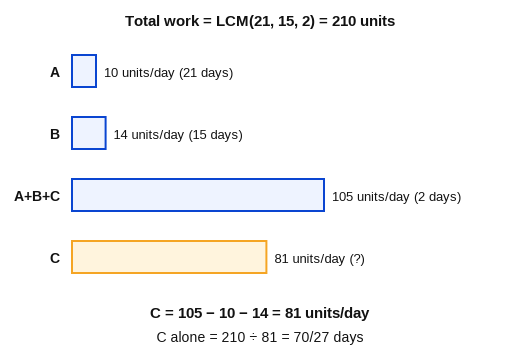
A can lay railway track between two given stations in 21 days and B can do the same job in 15 days. With the help of C, they did the job in 2 days only. Then, C alone can do the job in
A दो दिए गए स्टेशनों के बीच रेलवे ट्रैक 21 दिनों में बिछा सकता है और B वही कार्य 15 दिनों में कर सकता है। C की सहायता से, उन्होंने वह कार्य केवल 2 दिनों में कर दिया। तो, C अकेला उस कार्य को कितने दिनों में कर सकता है?
  1. A81627 days81627 दिन
  2. B21627 days21627 दिन
  3. C101627 days101627 दिन
  4. D121627 days121627 दिन
Show answer

Concept: Take total work = LCM of the days; each person's efficiency = work ÷ days.

  1. Total work =LCM(21,15,2)=210 units.
  2. A =21021=10, B =21015=14, A+B+C =2102=105 units/day.
  3. C =105−10−14=81 units/day.
  4. C alone =21081=7027=21627 days.

Trick: 1C=12−121−115=2770; C must be faster than both, so the answer is below 15 – only 21627 fits.

Answer: (B) 21627 days

अवधारणा: कुल कार्य = दिनों का LCM मानें; दक्षता = कार्य ÷ दिन।

  1. कुल कार्य =LCM(21,15,2)=210 इकाई।
  2. A =10, B =14, A+B+C =2102=105 इकाई/दिन।
  3. C =105−10−14=81 इकाई/दिन।
  4. C अकेला =21081=7027=21627 दिन।

ट्रिक: 1C=12−121−115=2770; तीनों मिलकर 2 दिन में करते हैं, अतः C का समय बहुत कम होगा – केवल 21627 उपयुक्त।

उत्तर: (B) 21627 दिन

RRB NTPC Undergraduate CBT 1MathematicsTime and workRRB NTPC Undergraduate CBT 1 2024 · 13 Aug Shift 2 →
Q3284.
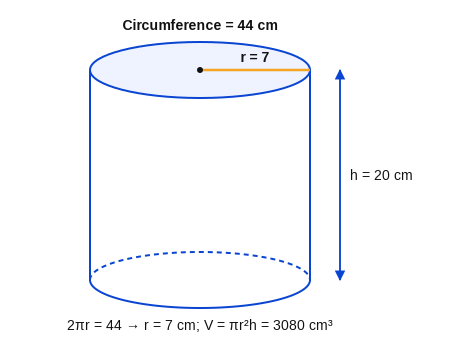
The volume of a right circular cylinder whose height is 20 cm and circumference of the base is 44 cm is:
(Take π=227)
एक लंब वृत्तीय बेलन का आयतन, जिसकी ऊँचाई 20 cm है और आधार की परिधि 44 cm है, कितना है?
(π=227 लीजिए)
  1. A3080 cu.cm3080 घन सेमी
  2. B7623 cu. cm7623 घन सेमी
  3. C1936 cu. cm1936 घन सेमी
  4. D5082 cu.cm5082 घन सेमी
Show answer

Concept: Circumference =2πr; volume of cylinder =πr2h.

  1. 2×227×r=44 → r=7cm.
  2. V=227×72×20.
  3. V=22×7×20=3080cm3.

Trick: Circumference 44 always gives r=7 with π=227; base area =154, so V=154×20=3080.

Answer: (A) 3080 cu. cm

अवधारणा: परिधि =2πr; बेलन का आयतन =πr2h।

  1. 2×227×r=44 → r=7cm।
  2. V=227×72×20।
  3. V=22×7×20=3080cm3।

ट्रिक: परिधि 44 हो तो r=7 और आधार क्षेत्रफल =154; V=154×20=3080।

उत्तर: (A) 3080 घन सेमी

RRB NTPC Undergraduate CBT 1MathematicsVolume of cylinderRRB NTPC Undergraduate CBT 1 2024 · 13 Aug Shift 2 →
Q3285.
If sinθ+cosecθ=2, then the value of sin120θ+cosec120θ is:
यदि sinθ+cosecθ=2 है, तो sin120θ+cosec120θ का मान है:
  1. A2
  2. B0
  3. C1
  4. D12
Show answer

Concept: If x+1x=2 then x=1; here x=sinθ since cosecθ=1sinθ.

  1. sinθ+1sinθ=2 → (sinθ−1)2=0 → sinθ=1.
  2. Then cosecθ=1.
  3. sin120θ+cosec120θ=1120+1120=2.

Trick: x+1x=2⇒xn+1xn=2 for every power n.

Answer: (A) 2

अवधारणा: यदि x+1x=2 हो तो x=1; यहाँ x=sinθ क्योंकि cosecθ=1sinθ।

  1. sinθ+1sinθ=2 → (sinθ−1)2=0 → sinθ=1।
  2. तब cosecθ=1।
  3. sin120θ+cosec120θ=1+1=2।

ट्रिक: x+1x=2⇒xn+1xn=2 (किसी भी घात n के लिए)।

उत्तर: (A) 2

RRB NTPC Undergraduate CBT 1MathematicsTrigonometric identitiesRRB NTPC Undergraduate CBT 1 2024 · 13 Aug Shift 2 →
Q3286.
9 years ago, the age of a father was 25 years more than twice his son's age. After how many years, from now, will he be twice his son's age?
9 वर्ष पहले, एक पिता की आयु उसके पुत्र की आयु के दोगुने से 25 वर्ष अधिक थी। अब से कितने वर्ष बाद उसकी आयु उसके पुत्र की आयु की दोगुनी होगी?
  1. A21
  2. B18
  3. C19
  4. D16
Show answer

Concept: Form an equation from the past condition, then use it for the future condition.

  1. Let present ages be F and S. F−9=2(S−9)+25 → F=2S+16.
  2. After x years: F+x=2(S+x) → x=F−2S.
  3. x=(2S+16)−2S=16 years.

Trick: 'Twice' condition: the gap F−2S shrinks by 1 each year. 9 years ago F−2S was 25; now it is 25−9=16, so after 16 years it becomes 0.

Answer: (D) 16

अवधारणा: भूतकाल की शर्त से समीकरण बनाएँ, फिर भविष्य की शर्त में प्रयोग करें।

  1. वर्तमान आयु F तथा S। F−9=2(S−9)+25 → F=2S+16।
  2. x वर्ष बाद: F+x=2(S+x) → x=F−2S।
  3. x=(2S+16)−2S=16 वर्ष।

ट्रिक: F−2S का अंतर हर वर्ष 1 घटता है: 9 वर्ष पहले 25, अब 25−9=16; अतः 16 वर्ष बाद यह शून्य होगा।

उत्तर: (D) 16

RRB NTPC Undergraduate CBT 1MathematicsProblems on agesRRB NTPC Undergraduate CBT 1 2024 · 13 Aug Shift 2 →
Q3287.
The total surface area of a cube having side 74 cm is:
74 cm भुजा वाले घन का कुल पृष्ठीय क्षेत्रफल है:
  1. A32856 cm2
  2. B32896 cm2
  3. C32857 cm2
  4. D32846 cm2
Show answer

Concept: Total surface area of a cube =6a2.

  1. a2=742=5476.
  2. 6×5476=32856cm2.

Trick: Unit digit: 42 ends in 6, 6×6 ends in 6 → options ending in 6: 32856, 32896, 32846; 742≈5500, 6×5476=32856.

Answer: (A) 32856cm2

अवधारणा: घन का संपूर्ण पृष्ठीय क्षेत्रफल =6a2।

  1. a2=742=5476।
  2. 6×5476=32856cm2।

ट्रिक: इकाई अंक: 42 का अंतिम अंक 6, 6×6 का भी 6; फिर 6×5476=32856 से पुष्टि करें।

उत्तर: (A) 32856cm2

RRB NTPC Undergraduate CBT 1MathematicsSurface area of cubeRRB NTPC Undergraduate CBT 1 2024 · 13 Aug Shift 2 →
Q3288.
The average of first 171 even numbers is
प्रथम 171 सम संख्याओं का औसत है
  1. A172
  2. B173
  3. C172.5
  4. D171.5
Show answer

Concept: Sum of first n even numbers =n(n+1), so their average =n+1.

  1. Here n=171.
  2. Sum =171×172.
  3. Average =171×172171=172.

Yaad rakhein: Average of first n even numbers =n+1; of first n odd numbers =n; of first n natural numbers =n+12.

Answer: (A) 172

अवधारणा: प्रथम n सम संख्याओं का योग =n(n+1), अतः औसत =n+1।

  1. यहाँ n=171।
  2. योग =171×172।
  3. औसत =171×172171=172।

याद रखें: प्रथम n सम संख्याओं का औसत =n+1; विषम संख्याओं का =n; प्राकृत संख्याओं का =n+12।

उत्तर: (A) 172

RRB NTPC Undergraduate CBT 1MathematicsAverage of even numbersRRB NTPC Undergraduate CBT 1 2024 · 13 Aug Shift 2 →
Q3289.
The average weight (in kg) of a family of five members whose weights are 40 kg, 49 kg, 56 kg, 76 kg and 35 kg is:
पाँच सदस्यों वाले एक परिवार, जिनके भार 40 kg, 49 kg, 56 kg, 76 kg और 35 kg हैं, का औसत भार (kg में) है:
  1. A53.2
  2. B52.2
  3. C50.2
  4. D51.2
Show answer

Concept: Average=Sum of observationsNumber of observations.

  1. Sum =40+49+56+76+35=256kg.
  2. Average =2565=51.2kg.

Trick: Take 50 as base: deviations −10,−1,+6,+26,−15 total +6; 50+65=51.2.

Answer: (D) 51.2

अवधारणा: औसत=प्रेक्षणों का योगप्रेक्षणों की संख्या।

  1. योग =40+49+56+76+35=256kg।
  2. औसत =2565=51.2kg।

ट्रिक: 50 को आधार मानें: विचलन −10,−1,+6,+26,−15 का योग +6; 50+65=51.2।

उत्तर: (D) 51.2

RRB NTPC Undergraduate CBT 1MathematicsAverageRRB NTPC Undergraduate CBT 1 2024 · 13 Aug Shift 2 →
Q3290.
Simplify: x(3x - 7) + 7(x2 -4) + 18
सरल कीजिए: x(3x - 7) + 7(x2 -4) + 18
  1. A10x2 - 7x - 10
  2. B-10x2 -7x -10
  3. C10x2 - 7x + 10
  4. D-10x2 -7x + 10
Show answer

Concept: Expand each bracket and combine like terms.

  1. x(3x−7)=3x2−7x.
  2. 7(x2−4)=7x2−28.
  3. Total =3x2−7x+7x2−28+18=10x2−7x−10.

Trick: Check with x=1: 1(−4)+7(−3)+18=−7, and 10−7−10=−7 ✓.

Answer: (A) 10x2−7x−10

अवधारणा: प्रत्येक कोष्ठक खोलकर समान पदों को जोड़ें।

  1. x(3x−7)=3x2−7x।
  2. 7(x2−4)=7x2−28।
  3. कुल =3x2−7x+7x2−28+18=10x2−7x−10।

ट्रिक: x=1 रखकर जाँचें: 1(−4)+7(−3)+18=−7 तथा 10−7−10=−7 ✓।

उत्तर: (A) 10x2−7x−10

RRB NTPC Undergraduate CBT 1MathematicsAlgebraic simplificationRRB NTPC Undergraduate CBT 1 2024 · 13 Aug Shift 2 →
Q3291.
A number, when increased by 60%, gives 3580. The number is:
एक संख्या में 60% की वृद्धि करने पर 3580 प्राप्त होता है। वह संख्या है:
  1. A4475
  2. B6712.5
  3. C2237.5
  4. D1118.75
Show answer

Concept: If a number is increased by r%, new value =number×100+r100.

  1. x×160100=3580.
  2. x=3580×100160=35801.6=2237.5.

Trick: 160%→3580, so 10%→223.75 and 100%→2237.5.

Answer: (C) 2237.5

अवधारणा: किसी संख्या में r% वृद्धि पर नया मान =संख्या×100+r100।

  1. x×160100=3580।
  2. x=35801.6=2237.5।

ट्रिक: 160%→3580, तो 10%→223.75 और 100%→2237.5।

उत्तर: (C) 2237.5

RRB NTPC Undergraduate CBT 1MathematicsPercentageRRB NTPC Undergraduate CBT 1 2024 · 13 Aug Shift 2 →
Q3292.
By selling 6 buttons for a rupee, a man loses 45%. To gain 10% how many must he sell for a rupee?
एक रुपये में 6 बटन बेचने पर एक व्यक्ति को 45% की हानि होती है। 10% लाभ प्राप्त करने के लिए उसे एक रुपये में कितने बटन बेचने चाहिए?
  1. A2
  2. B4
  3. C3
  4. D5
Show answer

Concept: For a fixed amount (₹1), number of articles sold is inversely proportional to the SP percentage.

  1. At 45% loss, SP =55% of CP; at 10% gain, SP =110% of CP.
  2. Number sold per rupee ∝1SP: n2=6×55110.
  3. n2=3.

Trick: n1×(100−loss)=n2×(100+gain) → 6×55=n2×110 → n2=3.

Answer: (C) 3

अवधारणा: निश्चित राशि (₹1) में बेची गई वस्तुओं की संख्या, विक्रय मूल्य प्रतिशत के व्युत्क्रमानुपाती होती है।

  1. 45% हानि पर SP =55% CP; 10% लाभ पर SP =110% CP।
  2. n2=6×55110।
  3. n2=3।

ट्रिक: n1×(100−हानि)=n2×(100+लाभ) → 6×55=n2×110 → n2=3।

उत्तर: (C) 3

RRB NTPC Undergraduate CBT 1MathematicsProfit and loss (articles per rupee)RRB NTPC Undergraduate CBT 1 2024 · 13 Aug Shift 2 →
Q3293.
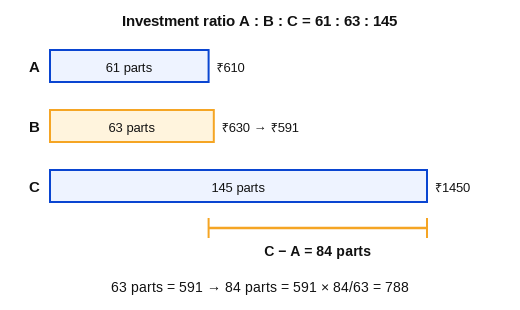
A, B and C started a business investing ₹610, ₹630 and ₹1,450, respectively. If B's share in the profit earned by them is ₹591. what is the difference in the profit (in ₹) earned by A and C?
A, B और C ने क्रमशः ₹610, ₹630 और ₹1,450 का निवेश करके एक व्यवसाय शुरू किया। यदि उनके द्वारा अर्जित लाभ में B का हिस्सा ₹591 है, तो A और C द्वारा अर्जित लाभ (₹ में) में कितना अंतर है?
  1. A₹785
  2. B₹786
  3. C₹791
  4. D₹788
Show answer

Concept: For the same time period, profit is shared in the ratio of investments.

  1. 610:630:1450=61:63:145.
  2. B's 63 parts =591 → 1 part =59163.
  3. C − A =145−61=84 parts.
  4. Difference =84×59163=43×591=788.

Trick: 8463=43, so the difference is simply 43 of B's share: 43×591=788.

Answer: (D) ₹788

अवधारणा: समान अवधि हो तो लाभ निवेश के अनुपात में बँटता है।

  1. 610:630:1450=61:63:145।
  2. B के 63 भाग =591 → 1 भाग =59163।
  3. C − A =145−61=84 भाग।
  4. अंतर =84×59163=43×591=788।

ट्रिक: 8463=43, अतः अंतर = B के हिस्से का 43 =788।

उत्तर: (D) ₹788

RRB NTPC Undergraduate CBT 1MathematicsPartnershipRRB NTPC Undergraduate CBT 1 2024 · 13 Aug Shift 2 →
Q3294.
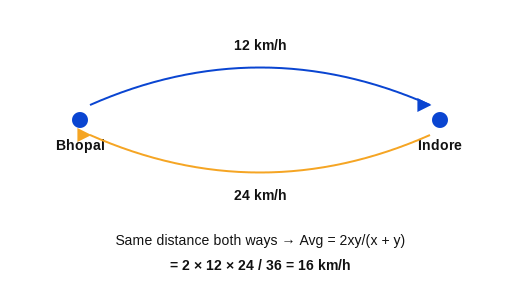
A man goes to Indore from Bhopal at a speed of 12 km/hr and returns to Bhopal at speed of 24 km/hr, through the same route. What is his average speed (in km/hr) of the entire journey?
एक व्यक्ति भोपाल से इंदौर 12 km/hr की चाल से जाता है और उसी मार्ग से 24 km/hr की चाल से भोपाल लौटता है। संपूर्ण यात्रा में उसकी औसत चाल (km/hr में) क्या है?
  1. A12
  2. B21
  3. C16
  4. D11
Show answer

Concept: When equal distances are covered at speeds x and y, average speed =2xyx+y.

  1. x=12, y=24.
  2. Average =2×12×2412+24=57636.
  3. =16km/h.

Trick: Assume distance 24 km: time 2+1=3 h for 48 km → 483=16km/h.

Answer: (C) 16

अवधारणा: समान दूरी x और y चाल से तय हो तो औसत चाल =2xyx+y।

  1. x=12, y=24।
  2. औसत =2×12×2436=57636।
  3. =16km/h।

ट्रिक: दूरी 24 km मानें: समय 2+1=3 घंटे, कुल दूरी 48 km → 483=16km/h।

उत्तर: (C) 16

RRB NTPC Undergraduate CBT 1MathematicsAverage speedRRB NTPC Undergraduate CBT 1 2024 · 13 Aug Shift 2 →
Q3295.
The number of prime numbers lying between 411 and 424, both included, is:
411 और 424 (दोनों सम्मिलित) के बीच स्थित अभाज्य संख्याओं की संख्या है:
  1. A4
  2. B3
  3. C2
  4. D5
Show answer

Concept: A number is prime if no prime up to its square root divides it (424<21, so test 2, 3, 5, 7, 11, 13, 17, 19).

  1. Odd numbers 411–423: 411 (3×137), 413 (7×59), 415 (5×83), 417 (3×139), 423 (3×141) are composite.
  2. 419 and 421 have no prime factor up to 19 → prime.
  3. So there are 2 primes.

Trick: Even numbers and those ending in 5 go out instantly; only test the rest with digit-sum (3), 7, 11, 13, 17, 19.

Answer: (C) 2

अवधारणा: कोई संख्या अभाज्य है यदि उसके वर्गमूल तक की कोई अभाज्य संख्या उसे न विभाजित करे (424<21)।

  1. विषम संख्याएँ: 411 (3×137), 413 (7×59), 415 (5×83), 417 (3×139), 423 (3×141) – भाज्य।
  2. 419 और 421 का 19 तक कोई अभाज्य गुणनखंड नहीं → अभाज्य।
  3. अतः कुल 2 अभाज्य संख्याएँ।

ट्रिक: सम संख्याएँ और 5 पर समाप्त होने वाली तुरंत हटाएँ; बाकी को 3, 7, 11, 13, 17, 19 से जाँचें।

उत्तर: (C) 2

RRB NTPC Undergraduate CBT 1MathematicsPrime numbersRRB NTPC Undergraduate CBT 1 2024 · 13 Aug Shift 2 →
Q3296.
If 2 is added to each even digit and 1 is subtracted from each odd digit in the number 52749631, then how many digits will appear more than once in the new number thus formed?
यदि संख्या 52749631 में प्रत्येक सम अंक में 2 जोड़ा जाए और प्रत्येक विषम अंक में से 1 घटाया जाए, तो इस प्रकार बनी नई संख्या में कितने अंक एक से अधिक बार आएँगे?
  1. ATwoदो
  2. BOneएक
  3. CFourचार
  4. DThreeतीन
Show answer

Concept: Apply the rule digit by digit: even digit +2, odd digit −1.

  1. 52749631 → 5→4, 2→4, 7→6, 4→6, 9→8, 6→8, 3→2, 1→0.
  2. New number: 44668820.
  3. 4, 6 and 8 each appear twice → three digits repeat.

Trick: Write the new digits in a row and tick pairs; don't count 2 and 0 (they appear once).

Answer: (D) Three

अवधारणा: प्रत्येक अंक पर नियम लगाएँ: सम अंक +2, विषम अंक −1।

  1. 52749631 → 5→4, 2→4, 7→6, 4→6, 9→8, 6→8, 3→2, 1→0।
  2. नई संख्या: 44668820।
  3. 4, 6 और 8 दो-दो बार आते हैं → तीन अंक।

ट्रिक: नए अंक एक पंक्ति में लिखकर जोड़े पहचानें; 2 और 0 केवल एक बार हैं।

उत्तर: (D) Three

RRB NTPC Undergraduate CBT 1General Intelligence and ReasoningNumber operationsRRB NTPC Undergraduate CBT 1 2024 · 13 Aug Shift 2 →
Q3297.
KNML is related to ADCB in a certain way based on the English alphabetical order. In the same way, WZYX is related to MPON. To which of the given options is SVUT related, following the same logic?
अंग्रेज़ी वर्णमाला क्रम के आधार पर KNML एक निश्चित प्रकार से ADCB से संबंधित है। उसी प्रकार, WZYX, MPON से संबंधित है। समान तर्क का अनुसरण करते हुए, SVUT दिए गए विकल्पों में से किससे संबंधित है?
  1. AIKLJ
  2. BIKJI
  3. CILKO
  4. DILKJ
Show answer

Concept: Find the letter shift between the pairs using alphabet positions.

  1. K(11)→A(1), N(14)→D(4), M(13)→C(3), L(12)→B(2): each −10.
  2. W(23)→M(13), Z→P, Y→O, X→N: each −10 ✓.
  3. S(19)→I(9), V(22)→L(12), U(21)→K(11), T(20)→J(10).

Trick: The first letter alone (S−10 = I) leaves 3 options; the second (V−10 = L) leaves ILKO and ILKJ; the last (T−10 = J) settles it.

Answer: (D) ILKJ

अवधारणा: वर्णमाला स्थानों से अक्षरों का अंतर ज्ञात करें।

  1. K(11)→A(1), N(14)→D(4), M(13)→C(3), L(12)→B(2): प्रत्येक −10।
  2. W(23)→M(13), Z→P, Y→O, X→N: प्रत्येक −10 ✓।
  3. S(19)→I(9), V(22)→L(12), U(21)→K(11), T(20)→J(10)।

ट्रिक: अंतिम अक्षर T−10 = J देखते ही ILKJ तय हो जाता है।

उत्तर: (D) ILKJ

RRB NTPC Undergraduate CBT 1General Intelligence and ReasoningLetter analogyRRB NTPC Undergraduate CBT 1 2024 · 13 Aug Shift 2 →
Q3298.
If 1 is added to each even digit of the number 36719542, then what will be the sum of the digits that are repeated more than once in the new number formed?
यदि संख्या 36719542 के प्रत्येक सम अंक में 1 जोड़ा जाए, तो बनी नई संख्या में एक से अधिक बार दोहराए गए अंकों का योग क्या होगा?
  1. A8
  2. B12
  3. C15
  4. D10
Show answer

Concept: Add 1 only to even digits; odd digits stay the same.

  1. 36719542: 3, 6→7, 7, 1, 9, 5, 4→5, 2→3.
  2. New number: 37719553.
  3. Repeated digits: 3 (twice), 7 (twice), 5 (twice).
  4. Sum =3+7+5=15.

Trick: 'Sum of the digits that are repeated' = add each repeated digit once, not every occurrence.

Answer: (C) 15

अवधारणा: केवल सम अंकों में 1 जोड़ें; विषम अंक वैसे ही रहेंगे।

  1. 36719542: 3, 6→7, 7, 1, 9, 5, 4→5, 2→3।
  2. नई संख्या: 37719553।
  3. दोहराए अंक: 3, 7 और 5 (प्रत्येक दो बार)।
  4. योग =3+7+5=15।

ट्रिक: दोहराए गए अंकों का योग = प्रत्येक दोहराए अंक को एक बार जोड़ें।

उत्तर: (C) 15

RRB NTPC Undergraduate CBT 1General Intelligence and ReasoningNumber operationsRRB NTPC Undergraduate CBT 1 2024 · 13 Aug Shift 2 →
Q3299.
In a certain code language, ‘CALM’ is coded as ‘3257’ and ‘MONK’ is coded as ‘1346’. What is the code for ‘M’ in the given code language?
एक निश्चित कूट भाषा में, ‘CALM’ को ‘3257’ के रूप में कूटबद्ध किया जाता है और ‘MONK’ को ‘1346’ के रूप में कूटबद्ध किया जाता है। दी गई कूट भाषा में ‘M’ का कूट क्या है?
  1. A5
  2. B3
  3. C1
  4. D7
Show answer

Concept: A letter common to two words takes the digit common to both codes.

  1. CALM → {3, 2, 5, 7}; MONK → {1, 3, 4, 6}.
  2. Common letter: M.
  3. Common digit: 3 → M = 3.

Trick: Compare only the common letter and common digit – order of digits in the code does not matter.

Answer: (B) 3

अवधारणा: दोनों शब्दों में समान अक्षर का कोड दोनों कोडों में समान अंक होता है।

  1. CALM → {3, 2, 5, 7}; MONK → {1, 3, 4, 6}।
  2. समान अक्षर: M।
  3. समान अंक: 3 → M = 3।

ट्रिक: केवल समान अक्षर और समान अंक मिलाएँ – कोड में अंकों का क्रम मायने नहीं रखता।

उत्तर: (B) 3

RRB NTPC Undergraduate CBT 1General Intelligence and ReasoningCoding-decodingRRB NTPC Undergraduate CBT 1 2024 · 13 Aug Shift 2 →
Q3300.
In a certain code language,
A $ B means ‘A is the son of B’
A + B means ‘A is the brother of B’
A @ B means ‘A is the wife of B’
A ÷ B means ‘A is the father of B’
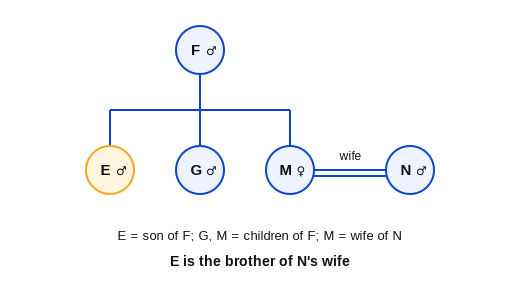
Based on the above, how is E related to N if ‘E $ F ÷ G + M @ N’?
एक निश्चित कूट भाषा में,
A $ B का अर्थ है ‘A, B का पुत्र है’
A + B का अर्थ है ‘A, B का भाई है’
A @ B का अर्थ है ‘A, B की पत्नी है’
A ÷ B का अर्थ है ‘A, B का पिता है’
उपर्युक्त के आधार पर, यदि ‘E $ F ÷ G + M @ N’ है, तो E, N से किस प्रकार संबंधित है?
  1. AWife's fatherपत्नी का पिता
  2. BWife's brotherपत्नी का भाई
  3. CFatherपिता
  4. DBrotherभाई
Show answer

Concept: Decode each symbol and draw the family tree.

  1. E $ F: E is the son of F (E is male).
  2. F ÷ G: F is the father of G; G + M: G is the brother of M.
  3. So E, G and M are children of F; M @ N: M is the wife of N.
  4. E is the brother of M, i.e. N's wife's brother.

Trick: Read the chain left to right and keep track of gender: '$' tells E is male, '@' tells M is female.

Answer: (B) Wife's brother

अवधारणा: प्रत्येक चिह्न का अर्थ लिखकर वंश-वृक्ष बनाएँ।

  1. E $ F: E, F का पुत्र है (E पुरुष)।
  2. F ÷ G: F, G का पिता; G + M: G, M का भाई।
  3. अतः E, G, M तीनों F की संतान; M @ N: M, N की पत्नी।
  4. E, M का भाई = N की पत्नी का भाई।

ट्रिक: शृंखला को बाएँ से दाएँ पढ़ें और लिंग नोट करें: '$' से E पुरुष, '@' से M स्त्री।

उत्तर: (B) Wife's brother (पत्नी का भाई)

RRB NTPC Undergraduate CBT 1General Intelligence and ReasoningBlood relations (coded)RRB NTPC Undergraduate CBT 1 2024 · 13 Aug Shift 2 →