Question bank

Q&A: practice questions with answers

Search questions on any topic. Filter by exam category, exam, subject and topic, try the question, then open the answer and explanation.

Courses – airGurukul

20,719 questions found.

Q3401.
What should come in place of the question mark (?) in the given series based on the English alphabetical order?
FIL ADG VYB QTW ?
अंग्रेज़ी वर्णमाला क्रम के आधार पर दी गई श्रृंखला में प्रश्न चिह्न (?) के स्थान पर क्या आना चाहिए?
FIL ADG VYB QTW ?
  1. ALRO
  2. BLOR
  3. CRLO
  4. DROL
Show answer

Concept: Track each letter position of the clusters separately.

  1. 1st letters: F → A → V → Q, each −5 (A −5 wraps to V); next Q −5 = L
  2. 2nd letters: I → D → Y → T, each −5; next O
  3. 3rd letters: L → G → B → W, each −5; next R

Trick: Each cluster is the previous one shifted back by 5 letters: QTW → LOR.

Answer: (B) LOR

अवधारणा: हर स्थान के अक्षरों को अलग-अलग देखें।

  1. पहले अक्षर: F → A → V → Q, हर बार −5; अगला L
  2. दूसरे अक्षर: I → D → Y → T, हर बार −5; अगला O
  3. तीसरे अक्षर: L → G → B → W, हर बार −5; अगला R

ट्रिक: हर समूह पिछले समूह से 5 अक्षर पीछे: QTW → LOR।

उत्तर: (B) LOR
RRB NTPC Undergraduate CBT 1General Intelligence and ReasoningLetter seriesRRB NTPC Undergraduate CBT 1 2024 · 13 Aug Shift 1 →
Q3402.
Select the pair which follows the same pattern as that followed by the two pairs given below. Both pairs follow the same pattern.
MUV : QPZ
UKD : YFH
उस युग्म का चयन कीजिए जो उसी पैटर्न का अनुसरण करता है जिसका अनुसरण नीचे दिए गए दो युग्म करते हैं। दोनों युग्म एक ही पैटर्न का अनुसरण करते हैं।
MUV : QPZ
UKD : YFH
  1. ATLW : XQA
  2. BFCV : KZQ
  3. CCAL : GVP
  4. DSLU : VGX
Show answer

Concept: Find the letter-wise shifts in the given pairs.

  1. MUV → QPZ: M +4 = Q, U −5 = P, V +4 = Z
  2. UKD → YFH: U +4 = Y, K −5 = F, D +4 = H
  3. CAL: C +4 = G, A −5 = V (wrap), L +4 = P → GVP ✔

Trick: Check the middle letter (−5) first – it rejects TLW (L → Q) and SLU at once.

Answer: (C) CAL : GVP

अवधारणा: दिए गए युग्मों में अक्षरों का खिसकाव ज्ञात करें।

  1. MUV → QPZ: M +4 = Q, U −5 = P, V +4 = Z
  2. UKD → YFH: U +4 = Y, K −5 = F, D +4 = H
  3. CAL: C +4 = G, A −5 = V, L +4 = P → GVP ✔

ट्रिक: पहले बीच वाला अक्षर (−5) जाँचें – TLW और SLU तुरंत हट जाते हैं।

उत्तर: (C) CAL : GVP

RRB NTPC Undergraduate CBT 1General Intelligence and ReasoningLetter analogyRRB NTPC Undergraduate CBT 1 2024 · 13 Aug Shift 1 →
Q3403.
In a certain code language, ‘LOAN’ is coded as ‘4257’ and ‘NIKE’ is coded as ‘1346’. What is the code for ‘N’ in the given code language?
एक निश्चित कूट भाषा में, ‘LOAN’ को ‘4257’ के रूप में और ‘NIKE’ को ‘1346’ के रूप में कूटबद्ध किया जाता है। दी गई कूट भाषा में ‘N’ के लिए कूट क्या है?
  1. A1
  2. B6
  3. C7
  4. D4
Show answer

Concept: A letter common to both words is coded by the digit common to both codes.

  1. LOAN → {4, 2, 5, 7}; NIKE → {1, 3, 4, 6}
  2. Only common letter: N; only common digit: 4
  3. So N = 4

Trick: One common letter ↔ one common digit.

Answer: (D) 4

अवधारणा: दोनों शब्दों का सामान्य अक्षर, दोनों कोडों के सामान्य अंक से कोडित होगा।

  1. LOAN → {4, 2, 5, 7}; NIKE → {1, 3, 4, 6}
  2. एकमात्र सामान्य अक्षर N; एकमात्र सामान्य अंक 4
  3. अतः N = 4

ट्रिक: एक सामान्य अक्षर ↔ एक सामान्य अंक।

उत्तर: (D) 4

RRB NTPC Undergraduate CBT 1General Intelligence and ReasoningCoding-decodingRRB NTPC Undergraduate CBT 1 2024 · 13 Aug Shift 1 →
Q3404.
Each of the digits in the number 95423671 is arranged in ascending order from left to right. What will be the sum of the digits that are third from the left and fourth from the right in the new number thus formed?
संख्या 95423671 के प्रत्येक अंक को बाएँ से दाएँ आरोही क्रम में व्यवस्थित किया जाता है। इस प्रकार बनी नई संख्या में बाएँ से तीसरे और दाएँ से चौथे अंकों का योग क्या होगा?
  1. A10
  2. B11
  3. C8
  4. D9
Show answer

Concept: Rearrange the digits and read positions carefully from each end.

  1. Ascending order: 1 2 3 4 5 6 7 9
  2. Third from left = 3
  3. Fourth from right (8 digits) = 5th from left = 5
  4. Sum =3+5=8

Trick: kth from right =(n−k+1)th from left; here 8−4+1=5.

Answer: (C) 8

अवधारणा: अंकों को व्यवस्थित कर दोनों सिरों से स्थान ध्यान से पढ़ें।

  1. आरोही क्रम: 1 2 3 4 5 6 7 9
  2. बाएँ से तीसरा = 3
  3. दाएँ से चौथा = बाएँ से 5वाँ = 5
  4. योग =3+5=8

ट्रिक: दाएँ से kवाँ =(n−k+1)वाँ बाएँ से; यहाँ 8−4+1=5।

उत्तर: (C) 8

RRB NTPC Undergraduate CBT 1General Intelligence and ReasoningDigit arrangementRRB NTPC Undergraduate CBT 1 2024 · 13 Aug Shift 1 →
Q3405.
Based on the English alphabetical order, three of the following four letter-cluster pairs are alike in a certain way and thus form a group. Which letter-cluster pair DOES NOT belong to that group?
(Note: The odd one out is not based on the number of consonants/vowels or their position in the letter-cluster.)
अंग्रेज़ी वर्णमाला क्रम के आधार पर, निम्नलिखित चार अक्षर-समूह युग्मों में से तीन किसी निश्चित प्रकार से एकसमान हैं और इस प्रकार एक समूह बनाते हैं। कौन-सा अक्षर-समूह युग्म उस समूह से संबंधित नहीं है?
(ध्यान दें: असंगत का निर्धारण व्यंजनों/स्वरों की संख्या या अक्षर-समूह में उनके स्थान के आधार पर नहीं किया गया है।)
  1. ANQ-SL
  2. BJM-OH
  3. CCF-HB
  4. DFI-KD
Show answer

Concept: Use positions: in each pair XY-ZW, compare Y, Z, W with X.

  1. NQ-SL: N14 → Q17 (+3), S19 (+5 from N), L12 (−7 from S)
  2. JM-OH: J10 → M13 (+3), O15 (+5), H8 (−7)
  3. FI-KD: F6 → I9, K11, D4 – same pattern
  4. CF-HB: C3 → F6, H8, but B2 is H −6 – odd

Trick: Only the last letter breaks the pattern, so compare 4th letter with 3rd first.

Answer: (C) CF-HB

अवधारणा: अक्षर स्थान लें: हर युग्म XY-ZW में Y, Z, W की X से तुलना करें।

  1. NQ-SL: N14 → Q17 (+3), S19 (+5), L12 (S से −7)
  2. JM-OH: J10 → M13 (+3), O15 (+5), H8 (−7)
  3. FI-KD: F6 → I9, K11, D4 – वही पैटर्न
  4. CF-HB: C3 → F6, H8, पर B2 = H −6 – विषम

ट्रिक: केवल अंतिम अक्षर पैटर्न तोड़ता है, इसलिए चौथे अक्षर की तीसरे से तुलना पहले करें।

उत्तर: (C) CF-HB

RRB NTPC Undergraduate CBT 1General Intelligence and ReasoningOdd one out (letter pairs)RRB NTPC Undergraduate CBT 1 2024 · 13 Aug Shift 1 →
Q3406.
What should come in place of the question mark (?) in the given series?
561 562 564 ? 571 576
दी गई श्रृंखला में प्रश्न चिह्न (?) के स्थान पर क्या आना चाहिए?
561 562 564 ? 571 576
  1. A569
  2. B566
  3. C567
  4. D568
Show answer

Concept: Look at the differences between consecutive terms.

  1. 561 +1​ 562 +2​ 564 +3​ ?
  2. 564+3=567; check 567+4=571, 571+5=576 ✔

Trick: Differences 1, 2, 3, 4, 5 – a simple increasing pattern.

Answer: (C) 567

अवधारणा: क्रमागत पदों के अंतर देखें।

  1. 561 +1​ 562 +2​ 564 +3​ ?
  2. 564+3=567; जाँच 567+4=571, 571+5=576 ✔

ट्रिक: अंतर 1, 2, 3, 4, 5 – सरल बढ़ता पैटर्न।

उत्तर: (C) 567

RRB NTPC Undergraduate CBT 1General Intelligence and ReasoningNumber seriesRRB NTPC Undergraduate CBT 1 2024 · 13 Aug Shift 1 →
Q3407.
Seven boxes A, B, C, D, E, F and G are kept one over the other but not necessarily in the same order. Only C is kept above D. Only two boxes are kept between D and E. Only A is kept below B. F is not kept immediately above E. How many boxes are kept between B and F?
सात बॉक्स A, B, C, D, E, F और G एक के ऊपर एक रखे गए हैं, लेकिन ज़रूरी नहीं कि इसी क्रम में हों। D के ऊपर केवल C रखा गया है। D और E के बीच केवल दो बॉक्स रखे गए हैं। B के नीचे केवल A रखा गया है। F को E के ठीक ऊपर नहीं रखा गया है। B और F के बीच कितने बॉक्स रखे गए हैं?
  1. AOneएक
  2. BTwoदो
  3. CThreeतीन
  4. DFourचार
Show answer

Concept: Use 'only X above / below' clues to fix the ends first.

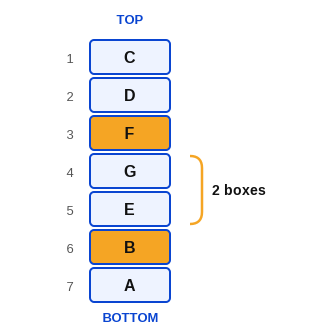
  1. Only C above D ⇒ C = 1st, D = 2nd (from top)
  2. Two boxes between D and E ⇒ E = 5th
  3. Only A below B ⇒ A = 7th, B = 6th
  4. F not immediately above E ⇒ F = 3rd, G = 4th. Between B and F: G, E

Trick: Two 'only' clues fix four boxes at once – start there.

Answer: (B) Two

अवधारणा: 'केवल X ऊपर/नीचे' वाले संकेतों से पहले सिरे तय करें।

  1. केवल C, D के ऊपर ⇒ C = 1, D = 2 (ऊपर से)
  2. D और E के बीच दो ⇒ E = 5
  3. केवल A, B के नीचे ⇒ A = 7, B = 6
  4. F, E के ठीक ऊपर नहीं ⇒ F = 3, G = 4। B और F के बीच: G, E

ट्रिक: दो 'केवल' संकेत चार बॉक्स तुरंत तय कर देते हैं।

उत्तर: (B) दो (Two)

RRB NTPC Undergraduate CBT 1General Intelligence and ReasoningBox arrangementRRB NTPC Undergraduate CBT 1 2024 · 13 Aug Shift 1 →
Q3408.
What will come in the place of the question mark (?) in the following equation, if ‘+’ and ‘−’ are interchanged and ‘×’ and ‘÷’ are interchanged?
7 ÷ 4 + 20 − 72 × 6 = ?
यदि ‘+’ और ‘−’ को आपस में बदल दिया जाए तथा ‘×’ और ‘÷’ को आपस में बदल दिया जाए, तो निम्नलिखित समीकरण में प्रश्न चिह्न (?) के स्थान पर क्या आएगा?
7 ÷ 4 + 20 − 72 × 6 = ?
  1. A33
  2. B26
  3. C13
  4. D20
Show answer

Concept: Swap the signs as instructed, then apply BODMAS.

  1. 7÷4+20−72×6 becomes 7×4−20+72÷6
  2. =28−20+12
  3. =20

Trick: Rewrite the whole expression first; swapping mentally while calculating causes errors.

Answer: (D) 20

अवधारणा: निर्देश के अनुसार चिह्न बदलें, फिर BODMAS लगाएँ।

  1. 7÷4+20−72×6 बनता है 7×4−20+72÷6
  2. =28−20+12
  3. =20

ट्रिक: पहले पूरा व्यंजक दोबारा लिखें, फिर हल करें।

उत्तर: (D) 20

RRB NTPC Undergraduate CBT 1General Intelligence and ReasoningInterchanging signsRRB NTPC Undergraduate CBT 1 2024 · 13 Aug Shift 1 →
Q3409.
Which of the following letter-number clusters will replace the question mark (?) in the given series to make it logically complete?
Z122Y V101U R82Q N65M ?
निम्नलिखित में से कौन-सा अक्षर-संख्या समूह दी गई श्रृंखला को तार्किक रूप से पूर्ण करने के लिए प्रश्न चिह्न (?) का स्थान लेगा?
Z122Y V101U R82Q N65M ?
  1. AJ49I
  2. BK50L
  3. CJ50I
  4. DK49L
Show answer

Concept: Treat the letters and the numbers as separate series.

  1. First letters: Z, V, R, N (−4 each) → J; last letters Y, U, Q, M (−4) → I
  2. Numbers: 122=112+1, 101=102+1, 82=92+1, 65=82+1
  3. Next number =72+1=50 → J50I

Trick: The last letter is always the letter just before the first one (Z-Y, V-U …), so J…I.

Answer: (C) J50I

अवधारणा: अक्षरों और संख्याओं को अलग श्रृंखला मानें।

  1. पहले अक्षर: Z, V, R, N (−4) → J; अंतिम अक्षर Y, U, Q, M (−4) → I
  2. संख्याएँ: 122=112+1, 101=102+1, 82=92+1, 65=82+1
  3. अगली संख्या =72+1=50 → J50I

ट्रिक: अंतिम अक्षर हमेशा पहले अक्षर से ठीक पहले वाला (Z-Y, V-U …), अतः J…I।

उत्तर: (C) J50I

RRB NTPC Undergraduate CBT 1General Intelligence and ReasoningLetter-number seriesRRB NTPC Undergraduate CBT 1 2024 · 13 Aug Shift 1 →
Q3410.
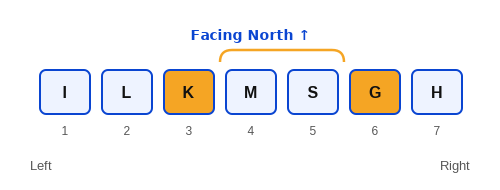
Seven people G, H, I, K, L, M and S are sitting in a row, facing north. Only three people sit between I and S. M sits to the immediate left of S. No one sits to the right of H. Only two people sit between H and M. K sits to the immediate right of L. How many people sit between G and K?
सात व्यक्ति G, H, I, K, L, M और S उत्तर की ओर मुख करके एक पंक्ति में बैठे हैं। I और S के बीच केवल तीन व्यक्ति बैठे हैं। M, S के ठीक बाएँ बैठा है। H के दाएँ कोई नहीं बैठा है। H और M के बीच केवल दो व्यक्ति बैठे हैं। K, L के ठीक दाएँ बैठा है। G और K के बीच कितने व्यक्ति बैठे हैं?
  1. AOneएक
  2. BThreeतीन
  3. CFourचार
  4. DTwoदो
Show answer

Concept: Facing north, left and right are the viewer's left and right; number the seats 1–7 from the left.

  1. No one right of H ⇒ H = 7; two between H and M ⇒ M = 4
  2. M immediately left of S ⇒ S = 5; three between I and S ⇒ I = 1
  3. L, K together (K right of L) in seats 2, 3 ⇒ L = 2, K = 3; G = 6
  4. Between G (6) and K (3): M, S

Trick: Anchor the end person (H) first; the chain H → M → S → I then fills almost the whole row.

Answer: (D) Two

अवधारणा: उत्तर की ओर मुख: बायाँ-दायाँ हमारे बायाँ-दायाँ; सीटें बाएँ से 1–7।

  1. H के दाएँ कोई नहीं ⇒ H = 7; H और M के बीच दो ⇒ M = 4
  2. M, S के ठीक बाएँ ⇒ S = 5; I और S के बीच तीन ⇒ I = 1
  3. L, K साथ (K, L के दाएँ) सीट 2, 3 में; G = 6
  4. G (6) और K (3) के बीच: M, S

ट्रिक: पहले छोर वाला व्यक्ति (H) तय करें; फिर H → M → S → I से पंक्ति भर जाती है।

उत्तर: (D) दो (Two)

RRB NTPC Undergraduate CBT 1General Intelligence and ReasoningLinear seating arrangementRRB NTPC Undergraduate CBT 1 2024 · 13 Aug Shift 1 →
Q3411.
Based on the English alphabetical order, three of the following four letter-clusters are alike in a certain way and thus form a group. Which letter-cluster DOES NOT belong to that group? (Note: The odd one out is not based on the number of consonants/vowels or their position in the letter-cluster.)
अंग्रेज़ी वर्णमाला क्रम के आधार पर, निम्नलिखित चार अक्षर-समूहों में से तीन किसी निश्चित प्रकार से एकसमान हैं और इस प्रकार एक समूह बनाते हैं। कौन-सा अक्षर-समूह उस समूह से संबंधित नहीं है? (ध्यान दें: असंगत का निर्धारण व्यंजनों/स्वरों की संख्या या अक्षर-समूह में उनके स्थान के आधार पर नहीं किया गया है।)
  1. AMHN
  2. BSNU
  3. CPKQ
  4. DIDJ
Show answer

Concept: Compare 2nd and 3rd letters with the 1st letter's position.

  1. MHN: M13, H8 (−5), N14 (+1)
  2. PKQ: P16, K11 (−5), Q17 (+1); IDJ: I9, D4 (−5), J10 (+1)
  3. SNU: S19, N14 (−5), U21 (+2) – odd

Trick: In the group, the 3rd letter is just the next letter after the 1st (M-N, P-Q, I-J); S-U breaks it.

Answer: (B) SNU

अवधारणा: दूसरे और तीसरे अक्षर की पहले अक्षर से तुलना करें।

  1. MHN: M13, H8 (−5), N14 (+1)
  2. PKQ: P16, K11 (−5), Q17 (+1); IDJ: I9, D4 (−5), J10 (+1)
  3. SNU: S19, N14 (−5), U21 (+2) – विषम

ट्रिक: समूह में तीसरा अक्षर पहले का अगला अक्षर है (M-N, P-Q, I-J); S-U नहीं।

उत्तर: (B) SNU

RRB NTPC Undergraduate CBT 1General Intelligence and ReasoningOdd one out (letter clusters)RRB NTPC Undergraduate CBT 1 2024 · 13 Aug Shift 1 →
Q3412.
CHRX is related to HMXD in a certain way based on the English alphabetical order. In the same way, WBPV is related to BGVB. To which of the given options is LQHN related, following the same logic?
अंग्रेज़ी वर्णमाला क्रम के आधार पर CHRX एक निश्चित प्रकार से HMXD से संबंधित है। उसी प्रकार, WBPV, BGVB से संबंधित है। समान तर्क का अनुसरण करते हुए, LQHN दिए गए विकल्पों में से किससे संबंधित है?
  1. AQTNV
  2. BQVTN
  3. CQTYU
  4. DQVNT
Show answer

Concept: Find the shift of each letter in the example pairs.

  1. CHRX → HMXD: +5,+5,+6,+6
  2. WBPV → BGVB: W +5 = B, B +5 = G, P +6 = V, V +6 = B ✔
  3. LQHN: L +5 = Q, Q +5 = V, H +6 = N, N +6 = T → QVNT

Trick: Option elimination: 2nd letter must be Q +5 = V, leaving QVTN and QVNT; 3rd letter H +6 = N decides.

Answer: (D) QVNT

अवधारणा: उदाहरण युग्मों में हर अक्षर का खिसकाव ज्ञात करें।

  1. CHRX → HMXD: +5,+5,+6,+6
  2. WBPV → BGVB: +5,+5,+6,+6 ✔
  3. LQHN: L +5 = Q, Q +5 = V, H +6 = N, N +6 = T → QVNT

ट्रिक: दूसरा अक्षर V होना चाहिए, तो QVTN या QVNT; तीसरा अक्षर H +6 = N से उत्तर तय।

उत्तर: (D) QVNT

RRB NTPC Undergraduate CBT 1General Intelligence and ReasoningLetter analogyRRB NTPC Undergraduate CBT 1 2024 · 13 Aug Shift 1 →
Q3413.
What should come in place of the question mark (?) in the given series?
18 23 17 24 16 ?
दी गई श्रृंखला में प्रश्न चिह्न (?) के स्थान पर क्या आना चाहिए?
18 23 17 24 16 ?
  1. A20
  2. B34
  3. C25
  4. D28
Show answer

Concept: Check the differences with alternating signs.

  1. 18 +5​ 23 −6​ 17 +7​ 24 −8​ 16
  2. Next: 16+9=25

Trick: Alternate terms also work: 18, 17, 16 (down by 1) and 23, 24, 25 (up by 1).

Answer: (C) 25

अवधारणा: बारी-बारी चिह्न वाले अंतर देखें।

  1. 18 +5​ 23 −6​ 17 +7​ 24 −8​ 16
  2. अगला: 16+9=25

ट्रिक: एकांतर पद: 18, 17, 16 (1 घटते) और 23, 24, 25 (1 बढ़ते)।

उत्तर: (C) 25

RRB NTPC Undergraduate CBT 1General Intelligence and ReasoningNumber seriesRRB NTPC Undergraduate CBT 1 2024 · 13 Aug Shift 1 →
Q3414.
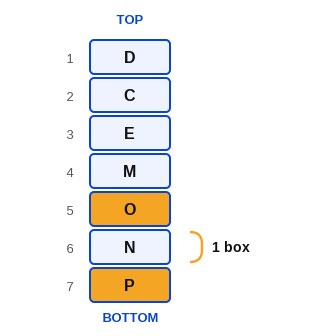
Seven boxes C, D, E, M, N, O and P are kept one over the other but not necessarily in the same order.
Only D is kept above C. Only E is kept between C and M. Only P is kept below N. How many boxes are kept between O and P?
सात बॉक्स C, D, E, M, N, O और P एक के ऊपर एक रखे गए हैं, लेकिन ज़रूरी नहीं कि इसी क्रम में हों।
C के ऊपर केवल D रखा गया है। C और M के बीच केवल E रखा गया है। N के नीचे केवल P रखा गया है। O और P के बीच कितने बॉक्स रखे गए हैं?
  1. ATwoदो
  2. BFourचार
  3. CThreeतीन
  4. DOneएक
Show answer

Concept: Fix the top and bottom boxes using the 'only' clues.

  1. Only D above C ⇒ D = 1st, C = 2nd (from top)
  2. Only E between C and M ⇒ E = 3rd, M = 4th
  3. Only P below N ⇒ P = 7th, N = 6th; O = 5th
  4. Between O (5th) and P (7th): N only

Trick: Once both ends are fixed, the single leftover box (O) drops into the only empty slot.

Answer: (D) One

अवधारणा: 'केवल' वाले संकेतों से ऊपर और नीचे के बॉक्स तय करें।

  1. केवल D, C के ऊपर ⇒ D = 1, C = 2 (ऊपर से)
  2. C और M के बीच केवल E ⇒ E = 3, M = 4
  3. केवल P, N के नीचे ⇒ P = 7, N = 6; O = 5
  4. O (5) और P (7) के बीच: केवल N

ट्रिक: दोनों छोर तय होते ही बचा बॉक्स (O) खाली स्थान में आ जाता है।

उत्तर: (D) एक (One)

RRB NTPC Undergraduate CBT 1General Intelligence and ReasoningBox arrangementRRB NTPC Undergraduate CBT 1 2024 · 13 Aug Shift 1 →
Q3415.
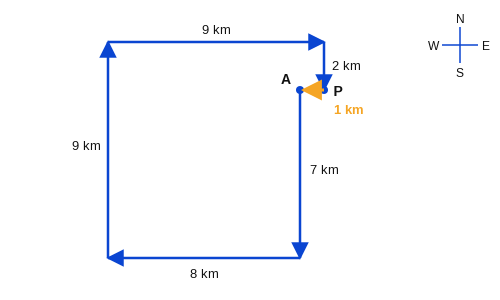
Laxman starts from Point A and drives 7 km towards south. He then takes a right turn, drives 8 km, turns right and drives 9 km. He then takes a right turn and drives 9 km. He takes a final right turn, drives 2 km and stops at Point P. How far (shortest distance) and towards which direction should he drive in order to reach Point A again? (All turns are 90° turns only unless specified.)
लक्ष्मण बिंदु A से चलना शुरू करता है और दक्षिण की ओर 7 km गाड़ी चलाता है। फिर वह दाएँ मुड़ता है, 8 km गाड़ी चलाता है, दाएँ मुड़ता है और 9 km गाड़ी चलाता है। फिर वह दाएँ मुड़ता है और 9 km गाड़ी चलाता है। वह अंतिम बार दाएँ मुड़ता है, 2 km गाड़ी चलाता है और बिंदु P पर रुक जाता है। बिंदु A पर पुनः पहुँचने के लिए उसे कितनी दूरी (न्यूनतम दूरी) तक और किस दिशा में गाड़ी चलानी चाहिए? (जब तक निर्दिष्ट न किया जाए, सभी मोड़ केवल 90° के हैं।)
  1. A2 km to westपश्चिम की ओर 2 km
  2. B3 km to westपश्चिम की ओर 3 km
  3. C1 km to westपश्चिम की ओर 1 km
  4. D4 km to westपश्चिम की ओर 4 km
Show answer

Concept: Plot the path on axes, taking A as the origin; each right turn rotates the direction clockwise.

  1. 7 km south: (0,−7); right → west 8 km: (−8,−7)
  2. Right → north 9 km: (−8,2); right → east 9 km: (1,2)
  3. Right → south 2 km: P =(1,0)
  4. A (0,0) is 1 km to the west of P

Trick: Net N–S: −7+9−2=0; net E–W: −8+9=+1 (east). So go back 1 km west.

Answer: (C) 1 km to west

अवधारणा: A को मूलबिंदु मानकर रास्ता बनाएँ; हर दायाँ मोड़ दिशा को दक्षिणावर्त घुमाता है।

  1. 7 km दक्षिण: (0,−7); दाएँ → पश्चिम 8 km: (−8,−7)
  2. दाएँ → उत्तर 9 km: (−8,2); दाएँ → पूर्व 9 km: (1,2)
  3. दाएँ → दक्षिण 2 km: P =(1,0)
  4. A (0,0), P से 1 km पश्चिम में है

ट्रिक: शुद्ध उत्तर–दक्षिण: −7+9−2=0; पूर्व–पश्चिम: −8+9=+1 (पूर्व)। अतः 1 km पश्चिम जाएँ।

उत्तर: (C) 1 km पश्चिम (west)

RRB NTPC Undergraduate CBT 1General Intelligence and ReasoningDirection and distanceRRB NTPC Undergraduate CBT 1 2024 · 13 Aug Shift 1 →
Q3416.
FI 11 is related to KN 8 in a certain way. In the same way, NQ 25 is related to SV 22. To which of the following is OR 17 related, following the same logic?
FI 11 एक निश्चित प्रकार से KN 8 से संबंधित है। उसी प्रकार, NQ 25, SV 22 से संबंधित है। समान तर्क का अनुसरण करते हुए, OR 17 निम्नलिखित में से किससे संबंधित है?
  1. ATW 15
  2. BUW 14
  3. CJM 11
  4. DTW 14
Show answer

Concept: Find what happens to the letters and to the number separately.

  1. FI 11 → KN 8: F +5 = K, I +5 = N, 11−3=8
  2. NQ 25 → SV 22: +5, +5, −3 ✔
  3. OR 17 → O +5 = T, R +5 = W, 17−3=14 → TW 14

Trick: Number part alone (17−3=14) leaves UW 14 and TW 14; O +5 = T settles it.

Answer: (D) TW 14

अवधारणा: अक्षरों और संख्या के बदलाव अलग-अलग देखें।

  1. FI 11 → KN 8: F +5 = K, I +5 = N, 11−3=8
  2. NQ 25 → SV 22: +5, +5, −3 ✔
  3. OR 17 → T, W, 17−3=14 → TW 14

ट्रिक: केवल संख्या (14) से UW 14 और TW 14 बचते हैं; O +5 = T से उत्तर तय।

उत्तर: (D) TW 14

RRB NTPC Undergraduate CBT 1General Intelligence and ReasoningLetter-number analogyRRB NTPC Undergraduate CBT 1 2024 · 13 Aug Shift 1 →
Q3417.
Read the given statements and conclusions carefully. Assuming that the information given in the statements is true, even if it appears to be at variance with commonly known facts, decide which of the given conclusions logically follow(s) from the statements.
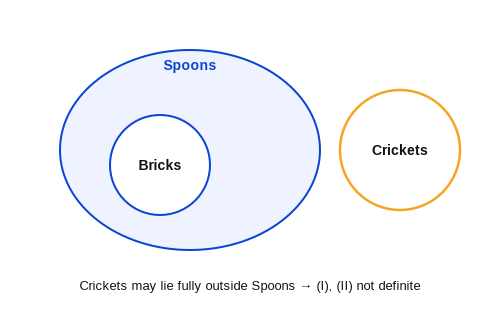
Statements: All bricks are spoons. No brick is a cricket.
Conclusion (I): Some crickets are spoons.
Conclusion (II): All spoons are crickets.
दिए गए कथनों और निष्कर्षों को ध्यानपूर्वक पढ़िए। यह मानते हुए कि कथनों में दी गई जानकारी सत्य है, भले ही वह सामान्य रूप से ज्ञात तथ्यों से भिन्न प्रतीत होती हो, निर्णय लीजिए कि दिए गए निष्कर्षों में से कौन-सा/कौन-से निष्कर्ष कथनों का तार्किक रूप से अनुसरण करता है/करते हैं।
कथन: सभी ईंटें, चम्मच हैं। कोई ईंट, झींगुर नहीं है।
निष्कर्ष (I): कुछ झींगुर, चम्मच हैं।
निष्कर्ष (II): सभी चम्मच, झींगुर हैं।
  1. AOnly conclusion (I) follows.केवल निष्कर्ष (I) अनुसरण करता है।
  2. BOnly conclusion (II) follows.केवल निष्कर्ष (II) अनुसरण करता है।
  3. CNeither conclusion (I) nor (II) follows.न तो निष्कर्ष (I) और न ही (II) अनुसरण करता है।
  4. DBoth conclusions (I) and (II) follow.निष्कर्ष (I) और (II) दोनों अनुसरण करते हैं।
Show answer

Concept: Draw the least-overlap Venn diagram; a conclusion follows only if it is true in every possible diagram.

  1. All bricks are spoons: Bricks circle inside Spoons
  2. No brick is a cricket: Crickets lie outside Bricks, but may or may not touch Spoons
  3. (I) Some crickets are spoons – not certain (Crickets can be fully outside Spoons)
  4. (II) All spoons are crickets – false (bricks are spoons but not crickets)

Trick: A 'No' statement never guarantees a 'Some' link with a third set.

Answer: (C) Neither conclusion (I) nor (II) follows.

अवधारणा: न्यूनतम मेल वाला वेन आरेख बनाएँ; निष्कर्ष तभी सही जब हर संभावित आरेख में सत्य हो।

  1. सभी ईंटें चम्मच हैं: Bricks, Spoons के अंदर
  2. कोई ईंट क्रिकेट नहीं: Crickets, Bricks से बाहर, Spoons से मिले या न मिले
  3. (I) कुछ क्रिकेट चम्मच हैं – निश्चित नहीं
  4. (II) सभी चम्मच क्रिकेट हैं – असत्य (ईंटें चम्मच हैं पर क्रिकेट नहीं)

ट्रिक: 'कोई नहीं' वाला कथन तीसरे समूह से 'कुछ' संबंध पक्का नहीं करता।

उत्तर: (C) न तो निष्कर्ष (I) और न ही (II) अनुसरण करता है।

RRB NTPC Undergraduate CBT 1General Intelligence and ReasoningSyllogismRRB NTPC Undergraduate CBT 1 2024 · 13 Aug Shift 1 →
Q3418.
Read the given statement(s) and conclusions carefully. Assuming that the information given in the statements is true, even if it appears to be at variance with commonly known facts, decide which of the given conclusions logically follow(s) from the statement(s).
Statements:
Some homestays are resorts.
Some resorts are palaces.
Conclusions:
(I) Some homestays are palaces.
(II) All palaces are resorts.
दिए गए कथन/कथनों और निष्कर्षों को ध्यानपूर्वक पढ़िए। यह मानते हुए कि कथनों में दी गई जानकारी सत्य है, भले ही वह सामान्य रूप से ज्ञात तथ्यों से भिन्न प्रतीत होती हो, निर्णय लीजिए कि दिए गए निष्कर्षों में से कौन-सा/कौन-से निष्कर्ष कथन/कथनों का तार्किक रूप से अनुसरण करता है/करते हैं।
कथन:
कुछ होमस्टे, रिसॉर्ट हैं।
कुछ रिसॉर्ट, महल हैं।
निष्कर्ष:
(I) कुछ होमस्टे, महल हैं।
(II) सभी महल, रिसॉर्ट हैं।
  1. AOnly conclusion (II) follows.केवल निष्कर्ष (II) अनुसरण करता है।
  2. BNeither conclusion (I) nor (II) follows.न तो निष्कर्ष (I) और न ही (II) अनुसरण करता है।
  3. COnly conclusion (I) follows.केवल निष्कर्ष (I) अनुसरण करता है।
  4. DBoth conclusions (I) and (II) follow.निष्कर्ष (I) और (II) दोनों अनुसरण करते हैं।
Show answer

Concept: With two 'Some' statements through a middle term, the end terms have no definite relation.

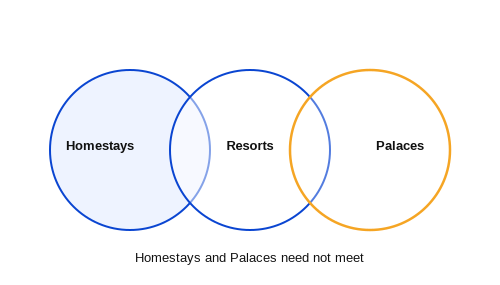
  1. Homestays overlap Resorts; Resorts overlap Palaces
  2. Homestays and Palaces may not meet at all → (I) not certain
  3. Palaces may lie partly outside Resorts → (II) not certain

Yaad rakhein: Some + Some = no conclusion between the two end terms.

Answer: (B) Neither conclusion (I) nor (II) follows.

अवधारणा: मध्य पद से जुड़े दो 'कुछ' कथनों से सिरों के पदों में कोई निश्चित संबंध नहीं बनता।

  1. Homestays, Resorts से मिलते हैं; Resorts, Palaces से मिलते हैं
  2. Homestays और Palaces का मिलना ज़रूरी नहीं → (I) निश्चित नहीं
  3. Palaces का कुछ भाग Resorts से बाहर हो सकता है → (II) निश्चित नहीं

याद रखें: कुछ + कुछ = सिरों के पदों में कोई निष्कर्ष नहीं।

उत्तर: (B) न तो निष्कर्ष (I) और न ही (II) अनुसरण करता है।

RRB NTPC Undergraduate CBT 1General Intelligence and ReasoningSyllogismRRB NTPC Undergraduate CBT 1 2024 · 13 Aug Shift 1 →
Q3419.
What will come in the place of the question mark (?) in the following equation, if ‘+’ and ‘−’ are interchanged and ‘×’ and ‘÷’ are interchanged?
32 + 8 × 2 − 12 ÷ 5 = ?
यदि ‘+’ और ‘−’ को आपस में बदल दिया जाए तथा ‘×’ और ‘÷’ को आपस में बदल दिया जाए, तो निम्नलिखित समीकरण में प्रश्न चिह्न (?) के स्थान पर क्या आएगा?
32 + 8 × 2 − 12 ÷ 5 = ?
  1. A85
  2. B88
  3. C89
  4. D87
Show answer

Concept: Swap the signs as instructed, then apply BODMAS.

  1. 32+8×2−12÷5 becomes 32−8÷2+12×5
  2. =32−4+60
  3. =88

Trick: Write the new expression completely before solving.

Answer: (B) 88

अवधारणा: निर्देश के अनुसार चिह्न बदलें, फिर BODMAS लगाएँ।

  1. 32+8×2−12÷5 बनता है 32−8÷2+12×5
  2. =32−4+60
  3. =88

ट्रिक: हल करने से पहले नया व्यंजक पूरा लिखें।

उत्तर: (B) 88

RRB NTPC Undergraduate CBT 1General Intelligence and ReasoningInterchanging signsRRB NTPC Undergraduate CBT 1 2024 · 13 Aug Shift 1 →
Q3420.
Based on the English alphabetical order, three of the following four letter-clusters are alike in a certain way and thus form a group. Which letter-cluster DOES NOT belong to that group?
(Note: The odd one out is not based on the number of consonants/vowels or their position in the letter-cluster.)
अंग्रेज़ी वर्णमाला क्रम के आधार पर, निम्नलिखित चार अक्षर-समूहों में से तीन किसी निश्चित प्रकार से एकसमान हैं और इस प्रकार एक समूह बनाते हैं। कौन-सा अक्षर-समूह उस समूह से संबंधित नहीं है?
(ध्यान दें: असंगत का निर्धारण व्यंजनों/स्वरों की संख्या या अक्षर-समूह में उनके स्थान के आधार पर नहीं किया गया है।)
  1. AYEI
  2. BBIL
  3. CPWZ
  4. DOVY
Show answer

Concept: Find the gaps between consecutive letters using their positions.

  1. BIL: B2 → I9 (+7) → L12 (+3)
  2. PWZ: P16 → W23 (+7) → Z26 (+3); OVY: O15 → V22 (+7) → Y25 (+3)
  3. YEI: Y25 → E5 (+6, wrapping) → I9 (+4) – odd

Trick: Pattern +7,+3 in three clusters; YEI gives +6,+4.

Answer: (A) YEI

अवधारणा: अक्षर स्थानों से क्रमागत अक्षरों का अंतर निकालें।

  1. BIL: B2 → I9 (+7) → L12 (+3)
  2. PWZ: P16 → W23 (+7) → Z26 (+3); OVY: O15 → V22 (+7) → Y25 (+3)
  3. YEI: Y25 → E5 (+6) → I9 (+4) – विषम

ट्रिक: तीन समूहों में +7,+3; YEI में +6,+4।

उत्तर: (A) YEI

RRB NTPC Undergraduate CBT 1General Intelligence and ReasoningOdd one out (letter clusters)RRB NTPC Undergraduate CBT 1 2024 · 13 Aug Shift 1 →