Question bank

Q&A: practice questions with answers

Search questions on any topic. Filter by exam category, exam, subject and topic, try the question, then open the answer and explanation.

Courses – airGurukul

20,719 questions found.

Q3561.
Which of the following initiatives was launched by the National Commission for Women (NCW) on 22 May 2025 to promote AI literacy and digital safety among women, especially in rural and semi-urban areas?
राष्ट्रीय महिला आयोग (NCW) द्वारा 22 मई 2025 को महिलाओं, विशेषकर ग्रामीण और अर्ध-शहरी क्षेत्रों की महिलाओं, में AI साक्षरता और डिजिटल सुरक्षा को बढ़ावा देने के लिए निम्नलिखित में से कौन-सी पहल शुरू की गई?
  1. AYashoda AI: Your AI SAKHIयशोदा AI: योर AI सखी (Your AI SAKHI)
  2. BTech Sakhi: Empowering Womenटेक सखी: एम्पावरिंग विमेन (Empowering Women)
  3. CDigital Shakti: Women in Techडिजिटल शक्ति: विमेन इन टेक (Women in Tech)
  4. DCyber Sakhi: AI Awareness Programसाइबर सखी: AI अवेयरनेस प्रोग्राम (AI Awareness Program)
Show answer

Concept: The National Commission for Women (NCW) works for women's rights and empowerment.

  1. On 22 May 2025, NCW launched 'Yashoda AI: Your AI SAKHI', a nationwide AI literacy campaign.
  2. It trains women, especially in rural and semi-urban areas, in using AI tools, cyber safety and data privacy.
  3. It was launched in partnership with the Future Shift Labs.

Yaad rakhein: NCW AI campaign = Yashoda AI – 'Your AI SAKHI'.

Answer: (A) Yashoda AI: Your AI SAKHI

अवधारणा: राष्ट्रीय महिला आयोग (NCW) महिलाओं के अधिकार और सशक्तिकरण के लिए काम करता है।

  1. 22 मई 2025 को NCW ने 'यशोदा AI: Your AI SAKHI' नामक राष्ट्रव्यापी AI साक्षरता अभियान शुरू किया।
  2. यह विशेषकर ग्रामीण और अर्ध-शहरी महिलाओं को AI टूल, साइबर सुरक्षा और डेटा गोपनीयता का प्रशिक्षण देता है।
  3. इसे Future Shift Labs के सहयोग से शुरू किया गया।

याद रखें: NCW का AI अभियान = यशोदा AI – 'Your AI SAKHI'।

उत्तर: (A) यशोदा AI: Your AI SAKHI
RRB NTPC Undergraduate CBT 1General AwarenessGovernment initiatives 2025RRB NTPC Undergraduate CBT 1 2024 · 12 Aug Shift 2 →
Q3562.
Harsabardhan Sahu who built a new record in the field of 49 kg (Clean and Jerk) Weightlifting category, at Khelo India Youth Games 2025 is from which state?
खेलो इंडिया यूथ गेम्स 2025 में 49 kg (क्लीन एंड जर्क) भारोत्तोलन वर्ग में नया रिकॉर्ड बनाने वाले हर्षवर्धन साहू किस राज्य से हैं?
  1. AAssamअसम
  2. BBiharबिहार
  3. COdishaओडिशा
  4. DMizoramमिज़ोरम
Show answer

Concept: Khelo India Youth Games 2025 were held in Bihar in May 2025.

  1. Odisha's weightlifter Harsabardhan Sahu won gold in the boys' 49 kg category.
  2. He set a new Games record in the clean and jerk lift.
  3. Odisha is a strong weightlifting state in youth competitions.

Yaad rakhein: Harsabardhan Sahu – Odisha – 49 kg weightlifting record (KIYG 2025).

Answer: (C) Odisha

अवधारणा: खेलो इंडिया यूथ गेम्स 2025 मई 2025 में बिहार में हुए।

  1. ओडिशा के भारोत्तोलक हर्षवर्धन साहू ने बालक 49 kg वर्ग में स्वर्ण जीता।
  2. उन्होंने क्लीन एंड जर्क में नया खेल रिकॉर्ड बनाया।
  3. युवा प्रतियोगिताओं में ओडिशा भारोत्तोलन में मज़बूत राज्य है।

याद रखें: हर्षवर्धन साहू – ओडिशा – 49 kg भारोत्तोलन रिकॉर्ड (KIYG 2025)।

उत्तर: (C) ओडिशा

RRB NTPC Undergraduate CBT 1General AwarenessSports 2025RRB NTPC Undergraduate CBT 1 2024 · 12 Aug Shift 2 →
Q3563.
The typical landform seen in the Thar Desert is:
थार मरुस्थल में दिखाई देने वाली विशिष्ट स्थलाकृति है:
  1. Asand dunesरेत के टीले
  2. Bglacial morainesहिमनदीय हिमोढ़ (glacial moraines)
  3. Criver deltasनदी डेल्टा
  4. Dalluvial plainsजलोढ़ मैदान
Show answer

Concept: The Thar (Great Indian) Desert lies mainly in western Rajasthan.

  1. Strong winds shape loose sand into dunes – barchans (crescent-shaped), longitudinal and transverse dunes are typical.
  2. Glacial moraines need glaciers (Himalaya); river deltas form at river mouths (Sundarbans).
  3. Alluvial plains are formed by river deposits (Indo-Gangetic plain).

Yaad rakhein: Desert landform = wind work = sand dunes (barchans).

Answer: (A) sand dunes

अवधारणा: थार (महान भारतीय) मरुस्थल मुख्यतः पश्चिमी राजस्थान में है।

  1. तेज़ हवाएँ ढीली रेत को टीलों में बदलती हैं – बरखान (अर्धचंद्राकार), अनुदैर्ध्य और अनुप्रस्थ टीले सामान्य हैं।
  2. हिमोढ़ (moraine) हिमनदों से बनते हैं; डेल्टा नदी के मुहाने पर।
  3. जलोढ़ मैदान नदियों के निक्षेप से बनते हैं (गंगा मैदान)।

याद रखें: मरुस्थल की स्थलाकृति = पवन का कार्य = रेत के टीले (बरखान)।

उत्तर: (A) रेत के टीले

RRB NTPC Undergraduate CBT 1General AwarenessPhysical geography of IndiaRRB NTPC Undergraduate CBT 1 2024 · 12 Aug Shift 2 →
Q3564.
Which of the following is the main objective of the Right to Information Act?
निम्नलिखित में से कौन-सा सूचना का अधिकार अधिनियम का मुख्य उद्देश्य है?
  1. ATo ensure secrecy in public administrationलोक प्रशासन में गोपनीयता सुनिश्चित करना
  2. BTo provide private data to media housesमीडिया संस्थानों को निजी डेटा उपलब्ध कराना
  3. CTo promote transparency and accountabilityपारदर्शिता और जवाबदेही को बढ़ावा देना
  4. DTo prevent public access to government recordsसरकारी अभिलेखों तक जनता की पहुँच को रोकना
Show answer

Concept: The Right to Information Act, 2005 lets citizens seek information from public authorities.

  1. Its preamble aims to promote transparency and accountability in the working of every public authority and to contain corruption.
  2. Information must normally be given within 30 days (48 hours if life or liberty is involved).
  3. It reduces secrecy – it does not promote secrecy or block access to records.

Yaad rakhein: RTI 2005 = Transparency + Accountability.

Answer: (C) To promote transparency and accountability

अवधारणा: सूचना का अधिकार अधिनियम, 2005 नागरिकों को सार्वजनिक प्राधिकरणों से सूचना माँगने का अधिकार देता है।

  1. इसकी प्रस्तावना का उद्देश्य हर सार्वजनिक प्राधिकरण के कामकाज में पारदर्शिता और जवाबदेही बढ़ाना तथा भ्रष्टाचार रोकना है।
  2. सूचना सामान्यतः 30 दिनों में देनी होती है (जीवन या स्वतंत्रता से जुड़ी हो तो 48 घंटे)।
  3. यह गोपनीयता घटाता है, बढ़ाता नहीं।

याद रखें: RTI 2005 = पारदर्शिता + जवाबदेही।

उत्तर: (C) पारदर्शिता और जवाबदेही बढ़ाना

RRB NTPC Undergraduate CBT 1General AwarenessGovernance – RTIRRB NTPC Undergraduate CBT 1 2024 · 12 Aug Shift 2 →
Q3565.
Tariff reforms were central to the liberalisation of trade. What happened to import tariffs after 1991?
टैरिफ सुधार व्यापार के उदारीकरण के केंद्र में थे। 1991 के बाद आयात शुल्क (import tariffs) का क्या हुआ?
  1. AIt increasedयह बढ़ गया
  2. BIt gradually reducedयह धीरे-धीरे कम हुआ
  3. CIt remained unchangedयह अपरिवर्तित रहा
  4. DIt was replaced with import bansइसे आयात प्रतिबंधों से प्रतिस्थापित कर दिया गया
Show answer

Concept: The 1991 New Economic Policy introduced Liberalisation, Privatisation and Globalisation (LPG).

  1. Under trade liberalisation, quantitative restrictions on imports were removed and import tariffs were gradually reduced.
  2. Peak customs duty fell from over 300% in 1991 to much lower levels over the decade.
  3. Lower tariffs made Indian industry more competitive and linked it to world markets.

Yaad rakhein: 1991 trade reforms: tariffs ↓, quotas removed, export duties removed.

Answer: (B) It gradually reduced

अवधारणा: 1991 की नई आर्थिक नीति ने उदारीकरण, निजीकरण और वैश्वीकरण (LPG) की शुरुआत की।

  1. व्यापार उदारीकरण में आयात पर मात्रात्मक प्रतिबंध हटाए गए और आयात शुल्क धीरे-धीरे घटाए गए।
  2. 1991 में 300% से अधिक की अधिकतम सीमा शुल्क दर दशक भर में काफी घटाई गई।
  3. कम शुल्क से भारतीय उद्योग अधिक प्रतिस्पर्धी हुए और विश्व बाज़ार से जुड़े।

याद रखें: 1991 व्यापार सुधार: शुल्क ↓, कोटा हटे, निर्यात शुल्क हटे।

उत्तर: (B) यह धीरे-धीरे घटाया गया

RRB NTPC Undergraduate CBT 1General AwarenessEconomic reforms 1991RRB NTPC Undergraduate CBT 1 2024 · 12 Aug Shift 2 →
Q3566.
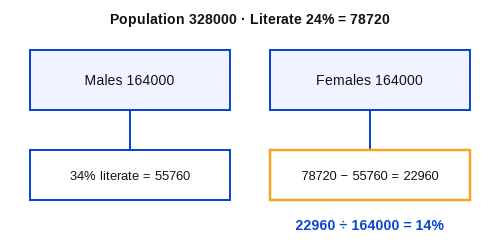
The population of a district is 328000, out of which 164000 are males. 24% of the population is literate. If 34% males are literate, then what percentage of females are literate?
एक ज़िले की जनसंख्या 328000 है, जिसमें से 164000 पुरुष हैं। जनसंख्या का 24% साक्षर है। यदि 34% पुरुष साक्षर हैं, तो कितने प्रतिशत महिलाएँ साक्षर हैं?
  1. A13%
  2. B11%
  3. C17%
  4. D14%
Show answer

Concept: Total literates = male literates + female literates.

  1. Females =328000−164000=164000.
  2. Total literates =24% of 328000=78720.
  3. Male literates =34% of 164000=55760.
  4. Female literates =78720−55760=22960, so 22960164000×100=14%.

Trick: Males = females (half each), so average rule: 34+x2=24⇒x=14%.

Answer: (D) 14%

अवधारणा: कुल साक्षर = साक्षर पुरुष + साक्षर महिलाएँ।

  1. महिलाएँ =328000−164000=164000।
  2. कुल साक्षर =328000 का 24%=78720।
  3. साक्षर पुरुष =164000 का 34%=55760।
  4. साक्षर महिलाएँ =78720−55760=22960, अतः 22960164000×100=14%।

ट्रिक: पुरुष = महिलाएँ (आधे-आधे), इसलिए औसत: 34+x2=24⇒x=14%।

उत्तर: (D) 14%

RRB NTPC Undergraduate CBT 1MathematicsPercentageRRB NTPC Undergraduate CBT 1 2024 · 12 Aug Shift 2 →
Q3567.
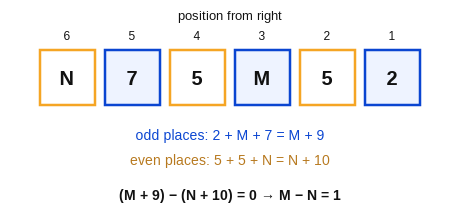
If the 6-digit number N75M52 is divisible by 11, then which of the options below can give a possible correct relation between M and N?
यदि 6-अंकीय संख्या N75M52, 11 से विभाज्य है, तो नीचे दिए गए विकल्पों में से कौन-सा M और N के बीच संभावित सही संबंध दे सकता है?
  1. AM = N
  2. BM - N = 1
  3. CM + N = -1
  4. DM - N = 5
Show answer

Concept: A number is divisible by 11 if (sum of digits at odd places) − (sum of digits at even places) is 0 or a multiple of 11.

  1. N75M52 from the right: odd places 2,M,7; even places 5,5,N.
  2. Odd sum =M+9, even sum =N+10.
  3. Difference =(M+9)−(N+10)=M−N−1.
  4. For divisibility, M−N−1=0⇒M−N=1 (e.g. M=4,N=3: 375452=11×34132).

Trick: Alternate signs from the right: 2−5+M−5+7−N=M−N−1.

Answer: (B) M−N=1

अवधारणा: कोई संख्या 11 से विभाज्य है यदि (विषम स्थानों के अंकों का योग) − (सम स्थानों के अंकों का योग) 0 या 11 का गुणज हो।

  1. N75M52 में दाएँ से: विषम स्थान 2,M,7; सम स्थान 5,5,N।
  2. विषम योग =M+9, सम योग =N+10।
  3. अंतर =(M+9)−(N+10)=M−N−1।
  4. विभाज्यता के लिए M−N−1=0⇒M−N=1 (जैसे M=4,N=3: 375452=11×34132)।

ट्रिक: दाएँ से बारी-बारी चिह्न: 2−5+M−5+7−N=M−N−1।

उत्तर: (B) M−N=1

RRB NTPC Undergraduate CBT 1MathematicsDivisibility rulesRRB NTPC Undergraduate CBT 1 2024 · 12 Aug Shift 2 →
Q3568.
A number, when decreased by 6%, gives 3760. The number is:
एक संख्या को 6% घटाने पर 3760 प्राप्त होता है। वह संख्या है:
  1. A2000
  2. B4000
  3. C12000
  4. D8000
Show answer

Concept: Decreasing a number by 6% leaves 94% of it.

  1. 94% of x=3760.
  2. x=3760×10094.
  3. x=40×100=4000.

Trick: 3760÷94=40, so the number is 4000. Check: 6% of 4000=240, 4000−240=3760.

Answer: (B) 4000

अवधारणा: किसी संख्या को 6% घटाने पर उसका 94% बचता है।

  1. x का 94%=3760।
  2. x=3760×10094।
  3. x=40×100=4000।

ट्रिक: 3760÷94=40, अतः संख्या 4000। जाँच: 4000 का 6%=240, 4000−240=3760।

उत्तर: (B) 4000

RRB NTPC Undergraduate CBT 1MathematicsPercentageRRB NTPC Undergraduate CBT 1 2024 · 12 Aug Shift 2 →
Q3569.
If the third proportional of 9 and 60 be x, then what is the value of x?
यदि 9 और 60 का तृतीयानुपाती x है, तो x का मान क्या है?
  1. A398
  2. B400
  3. C402
  4. D401
Show answer

Concept: The third proportional x of a and b satisfies a:b=b:x, i.e. x=b2a.

  1. 9:60=60:x.
  2. x=6029=36009.
  3. x=400.

Trick: Third proportional =(second)2first.

Answer: (B) 400

अवधारणा: a और b का तृतीयानुपाती x हो तो a:b=b:x, यानी x=b2a।

  1. 9:60=60:x।
  2. x=6029=36009।
  3. x=400।

ट्रिक: तृतीयानुपाती=(दूसरा)2पहला।

उत्तर: (B) 400

RRB NTPC Undergraduate CBT 1MathematicsRatio and proportionRRB NTPC Undergraduate CBT 1 2024 · 12 Aug Shift 2 →
Q3570.
The product of two consecutive natural numbers is 552. The greater of the two numbers is:
दो क्रमागत प्राकृत संख्याओं का गुणनफल 552 है। दोनों में से बड़ी संख्या है:
  1. A24
  2. B18
  3. C15
  4. D27
Show answer

Concept: For consecutive numbers n(n+1)=P, n is close to P.

  1. 552≈23.5, so try 23 and 24.
  2. 23×24=552. ✓
  3. Greater number =24.

Trick: Unit digit 2 needs ends like 3×4 or 8×9; near 552 only 23×24 fits.

Answer: (A) 24

अवधारणा: क्रमागत संख्याओं के लिए n(n+1)=P, तो n लगभग P होता है।

  1. 552≈23.5, अतः 23 और 24 जाँचें।
  2. 23×24=552 ✓
  3. बड़ी संख्या =24।

ट्रिक: इकाई अंक 2 के लिए 3×4 या 8×9 जैसे अंत; 552 के पास केवल 23×24।

उत्तर: (A) 24

RRB NTPC Undergraduate CBT 1MathematicsNumber systemRRB NTPC Undergraduate CBT 1 2024 · 12 Aug Shift 2 →
Q3571.
Which of the following numbers divides 6,30,605?
निम्नलिखित में से कौन-सी संख्या 6,30,605 को विभाजित करती है?
  1. A3
  2. B5
  3. C7
  4. D14
Show answer

Concept: Use quick divisibility tests on 630605.

  1. By 5: last digit is 5 → divisible ✓.
  2. By 3: digit sum 6+3+0+6+0+5=20, not a multiple of 3 → no.
  3. By 14: an odd number cannot be divisible by 14 (even). By 7: 630605=7×90086+3 → no.

Trick: Last digit 0 or 5 → divisible by 5 at a glance.

Answer: (B) 5

अवधारणा: 630605 पर विभाज्यता के नियम लगाएँ।

  1. 5 से: अंतिम अंक 5 है → विभाज्य ✓।
  2. 3 से: अंकों का योग 6+3+0+6+0+5=20, 3 का गुणज नहीं → नहीं।
  3. 14 से: विषम संख्या 14 (सम) से विभाज्य नहीं। 7 से: 630605=7×90086+3 → नहीं।

ट्रिक: अंतिम अंक 0 या 5 → तुरंत 5 से विभाज्य।

उत्तर: (B) 5

RRB NTPC Undergraduate CBT 1MathematicsDivisibility rulesRRB NTPC Undergraduate CBT 1 2024 · 12 Aug Shift 2 →
Q3572.
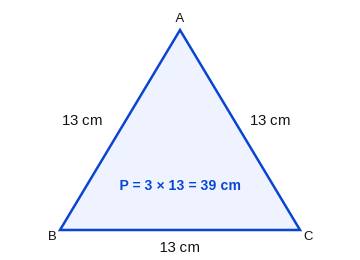
What is the perimeter of an equilateral triangle with side 13 cm?
13 cm भुजा वाले एक समबाहु त्रिभुज का परिमाप क्या है?
  1. A52 cm
  2. B39 cm
  3. C40 cm
  4. D26 cm
Show answer

Concept: All three sides of an equilateral triangle are equal, so perimeter =3a.

  1. Side a=13cm.
  2. Perimeter =3×13=39cm.

Trick: Equilateral: P=3a; square: P=4a.

Answer: (B) 39cm

अवधारणा: समबाहु त्रिभुज की तीनों भुजाएँ बराबर होती हैं, अतः परिमाप =3a।

  1. भुजा a=13cm।
  2. परिमाप =3×13=39cm।

ट्रिक: समबाहु त्रिभुज: P=3a; वर्ग: P=4a।

उत्तर: (B) 39cm

RRB NTPC Undergraduate CBT 1MathematicsMensuration – triangleRRB NTPC Undergraduate CBT 1 2024 · 12 Aug Shift 2 →
Q3573.
The LCM of 33 × 82 × 13, 32 × 132 × 16 and 83 × 132 × 162 is:
33 × 82 × 13, 32 × 132 × 16 और 83 × 132 × 162 का LCM है:
  1. A33 × 83 × 132 × 162
  2. B33 × 82 × 132 × 16
  3. C32 × 83 × 13 × 162
  4. D32 × 82 × 132 × 163
Show answer

Concept: LCM = product of each factor with its highest power appearing in the numbers.

  1. Highest power of 3: 33; of 8: 83; of 13: 132; of 16: 162.
  2. So LCM =33×83×132×162.
  3. Check with primes: 2-powers are 26,24,217; highest 217=83×162 – same result.

Trick: LCM → highest powers; HCF → lowest powers.

Answer: (A) 33×83×132×162

अवधारणा: LCM = प्रत्येक गुणनखंड की संख्याओं में आने वाली सबसे बड़ी घात का गुणनफल।

  1. 3 की सबसे बड़ी घात 33; 8 की 83; 13 की 132; 16 की 162।
  2. अतः LCM =33×83×132×162।
  3. अभाज्य रूप से जाँच: 2 की घातें 26,24,217; सबसे बड़ी 217=83×162 – वही उत्तर।

ट्रिक: LCM → सबसे बड़ी घातें; HCF → सबसे छोटी घातें।

उत्तर: (A) 33×83×132×162

RRB NTPC Undergraduate CBT 1MathematicsLCMRRB NTPC Undergraduate CBT 1 2024 · 12 Aug Shift 2 →
Q3574.
The number 253118139 is divisible by which of the following?
संख्या 253118139 निम्नलिखित में से किससे विभाज्य है?
  1. A3
  2. B12
  3. C5
  4. D8
Show answer

Concept: Apply divisibility tests to 253118139.

  1. By 3: digit sum 2+5+3+1+1+8+1+3+9=33, a multiple of 3 → divisible ✓.
  2. By 5: last digit 9 → no. By 8: last three digits 139 not divisible by 8 → no.
  3. By 12: needs divisibility by 4 and 3; the number is odd → no.

Trick: Odd number → straight away not divisible by 8 or 12.

Answer: (A) 3

अवधारणा: 253118139 पर विभाज्यता के नियम लगाएँ।

  1. 3 से: अंकों का योग 2+5+3+1+1+8+1+3+9=33, 3 का गुणज → विभाज्य ✓।
  2. 5 से: अंतिम अंक 9 → नहीं। 8 से: अंतिम तीन अंक 139, 8 से विभाज्य नहीं → नहीं।
  3. 12 से: 4 और 3 दोनों से विभाज्यता चाहिए; संख्या विषम है → नहीं।

ट्रिक: विषम संख्या → 8 या 12 से सीधे विभाज्य नहीं।

उत्तर: (A) 3

RRB NTPC Undergraduate CBT 1MathematicsDivisibility rulesRRB NTPC Undergraduate CBT 1 2024 · 12 Aug Shift 2 →
Q3575.
The average of first 169 even numbers is
प्रथम 169 सम संख्याओं का औसत है
  1. A170
  2. B171
  3. C169.5
  4. D170.5
Show answer

Concept: Sum of first n even numbers =n(n+1), so their average =n+1.

  1. First 169 even numbers: 2,4,…,338.
  2. Average =169×170169=170.
  3. Also, average =first+last2=2+3382=170.

Trick: Average of first n even numbers =n+1; of first n odd numbers =n.

Answer: (A) 170

अवधारणा: पहली n सम संख्याओं का योग =n(n+1), अतः औसत =n+1।

  1. पहली 169 सम संख्याएँ: 2,4,…,338।
  2. औसत =169×170169=170।
  3. या, औसत=पहला+अंतिम2=2+3382=170।

ट्रिक: पहली n सम संख्याओं का औसत =n+1; पहली n विषम संख्याओं का =n।

उत्तर: (A) 170

RRB NTPC Undergraduate CBT 1MathematicsAverageRRB NTPC Undergraduate CBT 1 2024 · 12 Aug Shift 2 →
Q3576.
A shopkeeper offers the following three schemes. Which scheme has the maximum discount percent?
I. Two successive discounts of 15% and 20%.
II. Buy 4 get 2 free.
III. Buy 6 get 4 free
एक दुकानदार निम्नलिखित तीन योजनाएँ प्रस्तुत करता है। किस योजना में अधिकतम छूट प्रतिशत है?
I. 15% और 20% की दो क्रमिक छूटें।
II. 4 खरीदें 2 मुफ़्त पाएँ।
III. 6 खरीदें 4 मुफ़्त पाएँ
  1. AIII onlyकेवल III
  2. BI onlyकेवल I
  3. CBoth I and III और II दोनों
  4. DII onlyकेवल II
Show answer

Concept: Compare the effective discount % of each scheme.

  1. I: 15+20−15×20100=32%.
  2. II: Buy 4 get 2 free → pay for 4, get 6: discount =26×100=33.33%.
  3. III: Buy 6 get 4 free → get 10: discount =410×100=40%.
  4. Maximum is 40% (scheme III).

Trick: Free-item discount =freepaid+free×100 – divide by the TOTAL items, not the paid ones.

Answer: (A) III only

अवधारणा: हर योजना की प्रभावी छूट % की तुलना करें।

  1. I: 15+20−15×20100=32%.
  2. II: 4 खरीदें 2 मुफ्त → 6 वस्तुएँ, छूट =26×100=33.33%.
  3. III: 6 खरीदें 4 मुफ्त → 10 वस्तुएँ, छूट =410×100=40%.
  4. अधिकतम 40% (योजना III)।

ट्रिक: मुफ्त वस्तु वाली छूट =मुफ्तकुल वस्तुएँ×100 – कुल वस्तुओं से भाग दें।

उत्तर: (A) केवल III

RRB NTPC Undergraduate CBT 1MathematicsDiscountRRB NTPC Undergraduate CBT 1 2024 · 12 Aug Shift 2 →
Q3577.
Daksh travels 200 km at 50 km/hr, the next 252 km at 42 km/hr and the next 204 km at 51 km/hr. What is his average speed (in km/hr) for the whole journey? (Round off your answer to two decimal places)
दक्ष 200 km की यात्रा 50 km/hr की चाल से, अगले 252 km की यात्रा 42 km/hr की चाल से और अगले 204 km की यात्रा 51 km/hr की चाल से करता है। पूरी यात्रा के लिए उसकी औसत चाल (km/hr में) क्या है? (अपने उत्तर को दो दशमलव स्थानों तक पूर्णांकित कीजिए)
  1. A53.31
  2. B38.25
  3. C46.86
  4. D53.45
Show answer

Concept: Average speed =total distancetotal time.

  1. Times: 20050=4 h, 25242=6 h, 20451=4 h → total 14 h.
  2. Distance =200+252+204=656 km.
  3. Average speed =65614=46.857≈46.86km/h.

Trick: Never average the speeds directly (50+42+513=47.67 is wrong); always use total distance ÷ total time.

Answer: (C) 46.86

अवधारणा: औसत चाल =कुल दूरीकुल समय।

  1. समय: 20050=4 घंटे, 25242=6 घंटे, 20451=4 घंटे → कुल 14 घंटे।
  2. कुल दूरी =200+252+204=656 km।
  3. औसत चाल =65614=46.857≈46.86km/h।

ट्रिक: चालों का सीधा औसत न लें; हमेशा कुल दूरी ÷ कुल समय।

उत्तर: (C) 46.86

RRB NTPC Undergraduate CBT 1MathematicsAverage SpeedRRB NTPC Undergraduate CBT 1 2024 · 12 Aug Shift 2 →
Q3578.
Veer bought some sharpeners at the rate of ₹180/dozen. He sold them for ₹23 each. His profit percentage is ______% (rounded off to two decimal places).
वीर ने ₹180/दर्जन की दर से कुछ शार्पनर खरीदे। उसने उन्हें ₹23 प्रति शार्पनर की दर से बेच दिया। उसका लाभ प्रतिशत ______% है (दो दशमलव स्थानों तक पूर्णांकित)।
  1. A51.33
  2. B53.33
  3. C57.33
  4. D55.33
Show answer

Concept: Profit%=SP−CPCP×100.

  1. CP of one sharpener =18012= ₹15.
  2. SP = ₹23, profit = ₹8.
  3. Profit%=815×100=53.33%.

Trick: Bring both prices to the same unit (per piece) first.

Answer: (B) 53.33

अवधारणा: लाभ%=विक्रय मूल्य−क्रय मूल्यक्रय मूल्य×100।

  1. एक शार्पनर का क्रय मूल्य =18012= ₹15।
  2. विक्रय मूल्य ₹23, लाभ ₹8।
  3. लाभ%=815×100=53.33%।

ट्रिक: पहले दोनों मूल्यों को एक ही इकाई (प्रति नग) में बदलें।

उत्तर: (B) 53.33

RRB NTPC Undergraduate CBT 1MathematicsProfit and LossRRB NTPC Undergraduate CBT 1 2024 · 12 Aug Shift 2 →
Q3579.
Pipe P can fill 23 part of a tank in 16 hours, and pipe Q can fill 56 part of the same tank in 20 hours. Both P and Q were kept open for 2 hours, then both were closed. Pipe R alone was then opened and it emptied the water in the tank in 8 hours. Pipes P, Q and R together can fill the empty tank in:
पाइप P किसी टंकी के 23 भाग को 16 घंटे में भर सकता है, और पाइप Q उसी टंकी के 56 भाग को 20 घंटे में भर सकता है। P और Q दोनों को 2 घंटे के लिए खुला रखा गया, फिर दोनों को बंद कर दिया गया। इसके बाद केवल पाइप R को खोला गया और उसने टंकी का पानी 8 घंटे में खाली कर दिया। पाइप P, Q और R एक साथ मिलकर खाली टंकी को कितने समय में भर सकते हैं?
  1. A8 hours8 घंटे
  2. B16 hours16 घंटे
  3. C29 hours29 घंटे
  4. D26 hours26 घंटे
Show answer

Concept: Find each pipe's full-tank time, then combine rates (filling +, emptying −).

  1. P fills 23 in 16 h → full tank in 24 h. Q fills 56 in 20 h → full in 24 h.
  2. In 2 h, P + Q fill 2(124+124)=16 of the tank.
  3. R empties 16 in 8 h → R empties a full tank in 48 h.
  4. Together: 124+124−148=348=116 → 16 hours.

Trick: Full time =given timefraction: 16÷23=24, 8÷16=48.

Answer: (B) 16 hours

अवधारणा: हर पाइप का पूरी टंकी का समय निकालें, फिर दरें जोड़ें (भरना +, खाली करना −)।

  1. P, 23 भाग 16 घंटे में → पूरी टंकी 24 घंटे। Q, 56 भाग 20 घंटे में → पूरी 24 घंटे।
  2. 2 घंटे में P + Q भरते हैं 2(124+124)=16 भाग।
  3. R यह 16 भाग 8 घंटे में खाली करता है → पूरी टंकी 48 घंटे में।
  4. तीनों साथ: 124+124−148=116 → 16 घंटे।

ट्रिक: पूरा समय =दिया समयभाग: 16÷23=24, 8÷16=48।

उत्तर: (B) 16 घंटे

RRB NTPC Undergraduate CBT 1MathematicsPipes and CisternsRRB NTPC Undergraduate CBT 1 2024 · 12 Aug Shift 2 →
Q3580.
Simplify x(9x − 8) + 7(x2 − 3) + 18.
x(9x − 8) + 7(x2 − 3) + 18 को सरल कीजिए।
  1. A16x2 − 8x + 3
  2. B−16x2 − 8x + 3
  3. C−16x2 − 8x − 3
  4. D16x2 − 8x − 3
Show answer

Concept: Expand the brackets and combine like terms.

  1. x(9x−8)=9x2−8x.
  2. 7(x2−3)=7x2−21.
  3. Sum +18: 16x2−8x−21+18=16x2−8x−3.

Trick: Check with x=1: 1+(−14)+18=5 and 16−8−3=5 ✓.

Answer: (D) 16x2−8x−3

अवधारणा: कोष्ठक खोलकर समान पद जोड़ें।

  1. x(9x−8)=9x2−8x।
  2. 7(x2−3)=7x2−21।
  3. जोड़ें +18: 16x2−8x−21+18=16x2−8x−3।

ट्रिक: x=1 रखकर जाँचें: 1−14+18=5 और 16−8−3=5 ✓।

उत्तर: (D) 16x2−8x−3

RRB NTPC Undergraduate CBT 1MathematicsAlgebraic SimplificationRRB NTPC Undergraduate CBT 1 2024 · 12 Aug Shift 2 →