Question bank

Q&A: practice questions with answers

Search questions on any topic. Filter by exam category, exam, subject and topic, try the question, then open the answer and explanation.

Courses – airGurukul

20,719 questions found.

Q3601.
SACU is related to ZHJB in a certain way based on the English alphabetical order. In the same way, UCEW is related to BJLD. To which of the following is PXZR related, following the same logic?
अंग्रेज़ी वर्णमाला क्रम के आधार पर SACU एक निश्चित प्रकार से ZHJB से संबंधित है। उसी प्रकार, UCEW, BJLD से संबंधित है। समान तर्क का अनुसरण करते हुए, PXZR निम्नलिखित में से किससे संबंधित है?
  1. AWEGY
  2. BGWER
  3. CGTRE
  4. DGERT
Show answer

Concept: Find the shift applied to each letter.

  1. S→Z, A→H, C→J, U→B: each +7 (U21+7=28→B).
  2. Check: U→B, C→J, E→L, W→D (+7) ✓.
  3. PXZR: P+7=W, X+7=E, Z+7=G, R+7=Y → WEGY.

Trick: +7 with wrap-around: subtract 26 when the position crosses 26.

Answer: (A) WEGY

अवधारणा: हर अक्षर पर लगा खिसकाव ज्ञात करें।

  1. S→Z, A→H, C→J, U→B: प्रत्येक +7 (U21+7=28→B)।
  2. जाँच: U→B, C→J, E→L, W→D (+7) ✓।
  3. PXZR: P+7=W, X+7=E, Z+7=G, R+7=Y → WEGY।

ट्रिक: +7, और 26 पार होने पर 26 घटाएँ।

उत्तर: (A) WEGY
RRB NTPC Undergraduate CBT 1General Intelligence and ReasoningLetter AnalogyRRB NTPC Undergraduate CBT 1 2024 · 12 Aug Shift 2 →
Q3602.
Manoj starts from point E and drives 4 km towards west. He then takes a left turn and drives 5 km. He takes a right turn and drives 2 km. He then takes a left turn and drives 2 km. He takes another left turn and drives 3 km. He again takes a left turn and drives 2 km. He takes a final right turn and drives 3 km to reach a point D. How far (shortest distance) and towards which direction should he drive in order to reach point E again? (All turns are 90-degree turns only unless otherwise specified.)
मनोज बिंदु E से चलना शुरू करता है और पश्चिम की ओर 4 km गाड़ी चलाता है। फिर वह बाएँ मुड़ता है और 5 km गाड़ी चलाता है। वह दाएँ मुड़ता है और 2 km गाड़ी चलाता है। फिर वह बाएँ मुड़ता है और 2 km गाड़ी चलाता है। वह फिर से बाएँ मुड़ता है और 3 km गाड़ी चलाता है। वह पुनः बाएँ मुड़ता है और 2 km गाड़ी चलाता है। वह अंतिम बार दाएँ मुड़ता है और 3 km गाड़ी चलाकर बिंदु D पर पहुँचता है। पुनः बिंदु E तक पहुँचने के लिए उसे कितनी दूरी (न्यूनतम दूरी) और किस दिशा में गाड़ी चलानी चाहिए? (जब तक अन्यथा निर्दिष्ट न हो, सभी मोड़ केवल 90 डिग्री के मोड़ हैं।)
  1. A4 km east4 km पूर्व
  2. B3 km east3 km पूर्व
  3. C5 km north5 km उत्तर
  4. D3 km north3 km उत्तर
Show answer

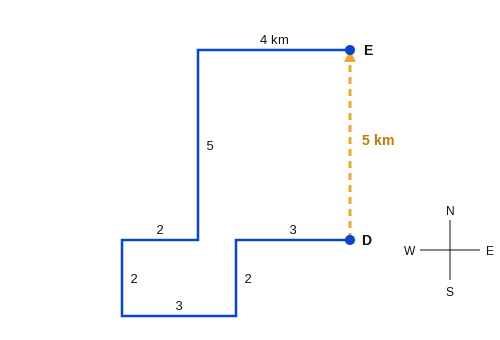
Concept: Trace each move; a left/right turn depends on the current facing direction.

  1. Take E at origin. 4 km west, left (south) 5, right (west) 2, left (south) 2.
  2. Left (east) 3, left (north) 2, right (east) 3 → D.
  3. Net east-west: −4−2+3+3=0; net north-south: −5−2+2=−5.
  4. D is 5 km south of E, so he must drive 5 km north.

Trick: Add all east-west moves and all north-south moves separately.

Answer: (C) 5 km north

अवधारणा: हर चाल बनाएँ; बाएँ/दाएँ मुड़ना उस समय की दिशा पर निर्भर है।

  1. E को मूल बिंदु मानें। 4 km पश्चिम, बाएँ (दक्षिण) 5, दाएँ (पश्चिम) 2, बाएँ (दक्षिण) 2।
  2. बाएँ (पूर्व) 3, बाएँ (उत्तर) 2, दाएँ (पूर्व) 3 → D।
  3. पूर्व-पश्चिम का शुद्ध: −4−2+3+3=0; उत्तर-दक्षिण: −5−2+2=−5।
  4. D, E से 5 km दक्षिण है, अतः 5 km उत्तर जाना होगा।

ट्रिक: पूर्व-पश्चिम और उत्तर-दक्षिण की चालें अलग-अलग जोड़ें।

उत्तर: (C) 5 km उत्तर

RRB NTPC Undergraduate CBT 1General Intelligence and ReasoningDirection and DistanceRRB NTPC Undergraduate CBT 1 2024 · 12 Aug Shift 2 →
Q3603.
Read the given statements and conclusions carefully. Assuming that the information given in the statements is true, even if it appears to be at variance with commonly known facts, decide which of the given conclusions logically follow(s) from the statements.
Statements:
All globes are ball.
All globes are map.
Conclusions:
(I): Some balls are map.
(II): All map are globe.
दिए गए कथनों और निष्कर्षों को ध्यानपूर्वक पढ़िए। यह मानते हुए कि कथनों में दी गई जानकारी सत्य है, भले ही वह सामान्य रूप से ज्ञात तथ्यों से भिन्न प्रतीत होती हो, निर्णय लीजिए कि दिए गए निष्कर्षों में से कौन-सा/कौन-से निष्कर्ष कथनों का तार्किक रूप से अनुसरण करता है/करते हैं।
कथन:
सभी ग्लोब, गेंद हैं।
सभी ग्लोब, मानचित्र हैं।
निष्कर्ष:
(I): कुछ गेंदें, मानचित्र हैं।
(II): सभी मानचित्र, ग्लोब हैं।
  1. AOnly conclusion (I) follows.केवल निष्कर्ष (I) अनुसरण करता है।
  2. BBoth conclusions (I) and (II) follow.निष्कर्ष (I) और (II) दोनों अनुसरण करते हैं।
  3. CNeither conclusion (I) nor (II) follows.न तो निष्कर्ष (I) और न ही (II) अनुसरण करता है।
  4. DOnly conclusion (II) follows.केवल निष्कर्ष (II) अनुसरण करता है।
Show answer

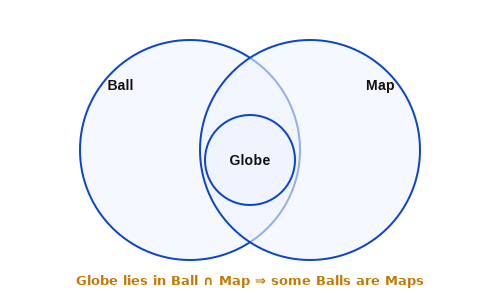
Concept: Draw the Venn diagram with the least overlap allowed.

  1. Globe lies inside Ball and inside Map, so Ball and Map share at least the globes.
  2. I: Some balls are map – true ✓.
  3. II: All map are globe – not necessary; Map can be bigger than Globe ✗.

Trick: Two 'All' statements with the same subject always give 'Some' between the two predicates.

Answer: (A) Only conclusion (I) follows.

अवधारणा: न्यूनतम ओवरलैप वाला वेन आरेख बनाएँ।

  1. Globe, Ball और Map दोनों के अंदर है, अतः Ball व Map में कम से कम globes उभयनिष्ठ।
  2. I: कुछ balls, map हैं – सत्य ✓।
  3. II: सभी map, globe हैं – आवश्यक नहीं ✗।

ट्रिक: एक ही उद्देश्य वाले दो 'सभी' कथन → दोनों विधेयों में 'कुछ' संबंध।

उत्तर: (A) केवल निष्कर्ष (I) अनुसरण करता है।

RRB NTPC Undergraduate CBT 1General Intelligence and ReasoningSyllogismRRB NTPC Undergraduate CBT 1 2024 · 12 Aug Shift 2 →
Q3604.
Based on the English alphabetical order, three of the following four letter-cluster pairs are alike in a certain way and thus form a group. Which letter-cluster pair DOES NOT belong to that group?
(Note: The odd one out is not based on the number of consonants/vowels or their position in the letter-cluster.)
अंग्रेज़ी वर्णमाला क्रम के आधार पर, निम्नलिखित चार अक्षर-समूह युग्मों में से तीन किसी निश्चित प्रकार से एक समान हैं और इस प्रकार एक समूह बनाते हैं। कौन-सा अक्षर-समूह युग्म उस समूह से संबंधित नहीं है?
(ध्यान दें: असंगत अक्षर-समूह युग्म, उस अक्षर-समूह में व्यंजनों/स्वरों की संख्या या उनके स्थान पर आधारित नहीं है।)
  1. AMG - RA
  2. BYE - DY
  3. CIL - NF
  4. DFV - KO
Show answer

Concept: Compare the first letters and second letters of each pair.

  1. MG – RA: M+5=R, G−6=A.
  2. YE – DY: Y+5=D, E−6=Y (wrapping) ✓; IL – NF: I+5=N, L−6=F ✓.
  3. FV – KO: F+5=K but V−7=O (not −6) – odd.

Trick: Use positions: V22 − 6 = 16 = P, not O.

Answer: (D) FV - KO

अवधारणा: हर युग्म के पहले-पहले और दूसरे-दूसरे अक्षर मिलाएँ।

  1. MG – RA: M+5=R, G−6=A।
  2. YE – DY: Y+5=D, E−6=Y ✓; IL – NF: I+5=N, L−6=F ✓।
  3. FV – KO: F+5=K पर V−7=O (−6 नहीं) – विषम।

ट्रिक: स्थान: V22 − 6 = 16 = P, O नहीं।

उत्तर: (D) FV - KO

RRB NTPC Undergraduate CBT 1General Intelligence and ReasoningOdd One Out – Letter PairsRRB NTPC Undergraduate CBT 1 2024 · 12 Aug Shift 2 →
Q3605.
In the following triad, each group of letters is related to the subsequent one following a certain logic. Select from the given options, the one which follows the same logic. SONG - OSNG - GNOS
DAWN - ADWN - NWAD
निम्नलिखित त्रय (triad) में, अक्षरों का प्रत्येक समूह एक निश्चित तर्क के अनुसार अगले समूह से संबंधित है। दिए गए विकल्पों में से उसका चयन कीजिए जो समान तर्क का अनुसरण करता है। SONG - OSNG - GNOS
DAWN - ADWN - NWAD
  1. APLOG - LPOG - GOLP
  2. BROLE - ORLE - OLER
  3. CEXIL - EIXL - LIXE
  4. DOPEN - POEN - NPEO
Show answer

Concept: Find the rule for the 2nd and 3rd groups.

  1. SONG → OSNG: first two letters swapped.
  2. SONG → GNOS: the original word reversed. Same for DAWN → ADWN → NWAD.
  3. PLOG → LPOG (swap) → GOLP (reverse of PLOG) ✓.

Trick: ROLE would need ELOR and OPEN would need NEPO – check the reverse quickly.

Answer: (A) PLOG - LPOG - GOLP

अवधारणा: दूसरे और तीसरे समूह का नियम पहचानें।

  1. SONG → OSNG: पहले दो अक्षर आपस में बदले।
  2. SONG → GNOS: मूल शब्द उलटा। DAWN → ADWN → NWAD भी ऐसे ही।
  3. PLOG → LPOG → GOLP (PLOG उलटा) ✓।

ट्रिक: ROLE के लिए ELOR और OPEN के लिए NEPO चाहिए – उलटा जल्दी जाँचें।

उत्तर: (A) PLOG - LPOG - GOLP

RRB NTPC Undergraduate CBT 1General Intelligence and ReasoningLetter TriadRRB NTPC Undergraduate CBT 1 2024 · 12 Aug Shift 2 →
Q3606.
What should come in place of the question mark (?) in the given series?
101 110 121 134 149 ?
दी गई शृंखला में प्रश्न चिह्न (?) के स्थान पर क्या आना चाहिए?
101 110 121 134 149 ?
  1. A163
  2. B159
  3. C156
  4. D166
Show answer

Concept: Differences increase by 2.

  1. Differences: +9,+11,+13,+15.
  2. Next: +17 → 149+17=166.

Trick: Consecutive odd-number differences.

Answer: (D) 166

अवधारणा: अंतर 2-2 बढ़ रहे हैं।

  1. अंतर: +9,+11,+13,+15।
  2. अगला +17 → 149+17=166।

ट्रिक: क्रमागत विषम संख्याओं के अंतर।

उत्तर: (D) 166

RRB NTPC Undergraduate CBT 1General Intelligence and ReasoningNumber SeriesRRB NTPC Undergraduate CBT 1 2024 · 12 Aug Shift 2 →
Q3607.
If ‘+’ means ‘subtraction’, ‘−’ means ‘multiplication’, ‘×’ means ‘division’ and ‘÷’ means ‘addition’, then what will come in place of the question mark (?) in the following equation?
9 − 5 + 82 × 2 ÷ 17 = ?
यदि ‘+’ का अर्थ ‘घटाना’, ‘−’ का अर्थ ‘गुणा’, ‘×’ का अर्थ ‘भाग’ और ‘÷’ का अर्थ ‘जोड़’ है, तो निम्नलिखित समीकरण में प्रश्न चिह्न (?) के स्थान पर क्या आएगा?
9 − 5 + 82 × 2 ÷ 17 = ?
  1. A31
  2. B27
  3. C21
  4. D24
Show answer

Concept: Replace each sign with its meaning, then BODMAS.

  1. 9×5−82÷2+17.
  2. =45−41+17.
  3. =21.

Trick: Write the converted expression in one line before calculating.

Answer: (C) 21

अवधारणा: हर चिह्न का अर्थ लगाकर BODMAS करें।

  1. 9×5−82÷2+17।
  2. =45−41+17।
  3. =21।

ट्रिक: हल करने से पहले बदला हुआ व्यंजक एक पंक्ति में लिखें।

उत्तर: (C) 21

RRB NTPC Undergraduate CBT 1General Intelligence and ReasoningMathematical OperationsRRB NTPC Undergraduate CBT 1 2024 · 12 Aug Shift 2 →
Q3608.
Based on the English alphabetical order, three of the following four letter-cluster pairs are alike in a certain way and thus form a group. Which letter-cluster pair DOES NOT belong to that group?
(Note: The odd one out is not based on the number of consonants/vowels or their position in the letter-cluster.)
अंग्रेज़ी वर्णमाला क्रम के आधार पर, निम्नलिखित चार अक्षर-समूह युग्मों में से तीन किसी निश्चित प्रकार से एक समान हैं और इस प्रकार एक समूह बनाते हैं। कौन-सा अक्षर-समूह युग्म उस समूह से संबंधित नहीं है?
(ध्यान दें: असंगत अक्षर-समूह युग्म, उस अक्षर-समूह में व्यंजनों/स्वरों की संख्या या उनके स्थान पर आधारित नहीं है।)
  1. AJN-IK
  2. BDH-CF
  3. CGK-FI
  4. DQU-PS
Show answer

Concept: Check the gap inside each cluster and between clusters.

  1. DH – CF: D+4=H, D−1=C, C+3=F.
  2. GK – FI and QU – PS follow the same (+4, −1, +3).
  3. JN – IK: J+4=N, J−1=I but I+2=K (not +3) – odd.

Trick: Second cluster gap: CF, FI, PS are +3; IK is +2.

Answer: (A) JN-IK

अवधारणा: क्लस्टर के भीतर और बीच अंतर देखें।

  1. DH – CF: D+4=H, D−1=C, C+3=F।
  2. GK – FI और QU – PS भी (+4, −1, +3)।
  3. JN – IK: J+4=N, J−1=I पर I+2=K (+3 नहीं) – विषम।

ट्रिक: दूसरे क्लस्टर का अंतर: CF, FI, PS में +3, IK में +2।

उत्तर: (A) JN-IK

RRB NTPC Undergraduate CBT 1General Intelligence and ReasoningOdd One Out – Letter PairsRRB NTPC Undergraduate CBT 1 2024 · 12 Aug Shift 2 →
Q3609.
Refer to the following number and symbol series and answer the question that follows. Counting to be done from left to right only.
(Left) < 7 5 9 @ ? 2 @ + $ 4 ? ? & 2 $ 5 ? 1 % * (Right)
How many such symbols are there, each of which is immediately preceded by a number and also immediately followed by a number?
निम्नलिखित संख्या और प्रतीक शृंखला को देखिए और उसके बाद दिए गए प्रश्न का उत्तर दीजिए। गिनती केवल बाएँ से दाएँ की जानी है।
(बाएँ) < 7 5 9 @ ? 2 @ + $ 4 ? ? & 2 $ 5 ? 1 % * (दाएँ)
ऐसे कितने प्रतीक हैं, जिनमें से प्रत्येक के ठीक पहले एक संख्या है और ठीक बाद भी एक संख्या है?
  1. ATwoदो
  2. BOneएक
  3. CFourचार
  4. DThreeतीन
Show answer

Concept: Look for the pattern number – symbol – number.

  1. Scan: … 2 $ 5 → $ is between 2 and 5 ✓.
  2. … 5 ? 1 → ? is between 5 and 1 ✓.
  3. No other symbol has a number on both sides (e.g. 9 @ ? and 4 ? ? fail).

Trick: Mark every symbol, then check only its two neighbours.

Answer: (A) Two

अवधारणा: संख्या – प्रतीक – संख्या का पैटर्न खोजें।

  1. … 2 $ 5 → $ के दोनों ओर संख्या ✓।
  2. … 5 ? 1 → ? के दोनों ओर संख्या ✓।
  3. किसी अन्य प्रतीक के दोनों ओर संख्या नहीं (जैसे 9 @ ? और 4 ? ?)।

ट्रिक: हर प्रतीक पर निशान लगाएँ और केवल उसके दोनों पड़ोसी देखें।

उत्तर: (A) दो

RRB NTPC Undergraduate CBT 1General Intelligence and ReasoningSymbol-Number SeriesRRB NTPC Undergraduate CBT 1 2024 · 12 Aug Shift 2 →
Q3610.
Read the given statements and conclusions carefully. Assuming that the information given in the statements is true, even if it appears to be at variance with commonly known facts, decide which of the given conclusions logically follow(s) from the statements.
Statements:
All sparrows are owls.
No sparrow is a parrot.
Conclusions:
(I): No owl is a parrot.
(II): No parrot is a sparrow.
दिए गए कथनों और निष्कर्षों को ध्यानपूर्वक पढ़िए। यह मानते हुए कि कथनों में दी गई जानकारी सत्य है, भले ही वह सामान्य रूप से ज्ञात तथ्यों से भिन्न प्रतीत होती हो, निर्णय लीजिए कि दिए गए निष्कर्षों में से कौन-सा/कौन-से निष्कर्ष कथनों का तार्किक रूप से अनुसरण करता है/करते हैं।
कथन:
सभी गौरैया, उल्लू हैं।
कोई गौरैया, तोता नहीं है।
निष्कर्ष:
(I): कोई उल्लू, तोता नहीं है।
(II): कोई तोता, गौरैया नहीं है।
  1. ANeither conclusion (I) nor (II) follows.न तो निष्कर्ष (I) और न ही (II) अनुसरण करता है।
  2. BBoth conclusions (I) and (II) follow.निष्कर्ष (I) और (II) दोनों अनुसरण करते हैं।
  3. COnly conclusion (II) follows.केवल निष्कर्ष (II) अनुसरण करता है।
  4. DOnly conclusion (I) follows.केवल निष्कर्ष (I) अनुसरण करता है।
Show answer

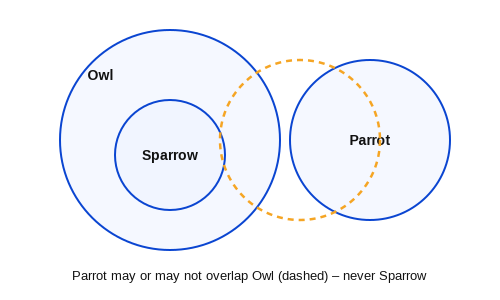
Concept: Draw the possible Venn diagrams.

  1. Sparrow is inside Owl; Parrot is outside Sparrow.
  2. I: No owl is a parrot – Parrot may still overlap the Owl region outside Sparrow, so not certain ✗.
  3. II: No parrot is a sparrow – direct converse of 'No sparrow is a parrot' ✓.

Trick: 'No A is B' always gives 'No B is A'.

Answer: (C) Only conclusion (II) follows.

अवधारणा: संभव वेन आरेख बनाएँ।

  1. Sparrow, Owl के अंदर; Parrot, Sparrow से बाहर।
  2. I: कोई owl, parrot नहीं – Parrot, Owl के बचे भाग से मिल सकता है, निश्चित नहीं ✗।
  3. II: कोई parrot, sparrow नहीं – 'कोई sparrow, parrot नहीं' का सीधा विलोम ✓।

ट्रिक: 'कोई A, B नहीं' से हमेशा 'कोई B, A नहीं'।

उत्तर: (C) केवल निष्कर्ष (II) अनुसरण करता है।

RRB NTPC Undergraduate CBT 1General Intelligence and ReasoningSyllogismRRB NTPC Undergraduate CBT 1 2024 · 12 Aug Shift 2 →
Q3611.
What should come in place of the question mark (?) in the given series based on the English alphabetical order?
QNK WTQ CZW IFC ?
अंग्रेज़ी वर्णमाला क्रम के आधार पर दी गई शृंखला में प्रश्न चिह्न (?) के स्थान पर क्या आना चाहिए?
QNK WTQ CZW IFC ?
  1. AOIL
  2. BLOI
  3. COLI
  4. DLIO
Show answer

Concept: Each letter position moves forward by 6.

  1. 1st: Q, W, C, I → O (+6).
  2. 2nd: N, T, Z, F → L (+6).
  3. 3rd: K, Q, W, C → I (+6).
  4. Next term: OLI.

Trick: +6 with wrap-around (W23+6=29→C).

Answer: (C) OLI

अवधारणा: हर स्थान का अक्षर 6 आगे बढ़ता है।

  1. पहला: Q, W, C, I → O (+6)।
  2. दूसरा: N, T, Z, F → L (+6)।
  3. तीसरा: K, Q, W, C → I (+6)।
  4. अगला पद: OLI।

ट्रिक: +6, 26 पार होने पर फिर से A से (W23+6=29→C)।

उत्तर: (C) OLI

RRB NTPC Undergraduate CBT 1General Intelligence and ReasoningLetter SeriesRRB NTPC Undergraduate CBT 1 2024 · 12 Aug Shift 2 →
Q3612.
Each of the digits in the number 8731245 is arranged in ascending order from left to right. The position(s) of how many digits will remain unchanged as compared to that in the original number?
संख्या 8731245 के प्रत्येक अंक को बाएँ से दाएँ आरोही क्रम में व्यवस्थित किया जाता है। मूल संख्या की तुलना में कितने अंकों का/के स्थान अपरिवर्तित रहेगा/रहेंगे?
  1. AOneएक
  2. BThreeतीन
  3. CTwoदो
  4. DNoneकोई नहीं
Show answer

Concept: Write the ascending number below the original and compare place by place.

  1. Original: 8 7 3 1 2 4 5.
  2. Ascending: 1 2 3 4 5 7 8.
  3. Only the 3rd digit (3) stays in place.

Trick: Compare column by column; don't count digits merely present in both.

Answer: (A) One

अवधारणा: मूल संख्या के नीचे आरोही क्रम लिखकर स्थान-दर-स्थान मिलाएँ।

  1. मूल: 8 7 3 1 2 4 5।
  2. आरोही: 1 2 3 4 5 7 8।
  3. केवल तीसरा अंक (3) अपनी जगह पर।

ट्रिक: स्तंभ-दर-स्तंभ मिलाएँ।

उत्तर: (A) एक

RRB NTPC Undergraduate CBT 1General Intelligence and ReasoningDigit ArrangementRRB NTPC Undergraduate CBT 1 2024 · 12 Aug Shift 2 →
Q3613.
Varun ranked 34th from the top and 11th from the bottom in his class. How many students are there in his class?
वरुण अपनी कक्षा में ऊपर से 34वें और नीचे से 11वें स्थान पर है। उसकी कक्षा में कितने विद्यार्थी हैं?
  1. A42
  2. B43
  3. C45
  4. D44
Show answer

Concept: Total = rank from top + rank from bottom −1.

  1. Total =34+11−1.
  2. =44.

Trick: Subtract 1 because Varun is counted twice.

Answer: (D) 44

अवधारणा: कुल = ऊपर से स्थान + नीचे से स्थान −1।

  1. कुल =34+11−1।
  2. =44।

ट्रिक: 1 घटाएँ क्योंकि वरुण दो बार गिना गया।

उत्तर: (D) 44

RRB NTPC Undergraduate CBT 1General Intelligence and ReasoningRankingRRB NTPC Undergraduate CBT 1 2024 · 12 Aug Shift 2 →
Q3614.
In a certain code language, ‘am with you’ is coded as ‘mp rk tp’ and ‘go with him’ is coded as ‘rk lo wt’. How is ‘with’ coded in the given language?
एक निश्चित कूट भाषा में, ‘am with you’ को ‘mp rk tp’ के रूप में और ‘go with him’ को ‘rk lo wt’ के रूप में कूटबद्ध किया जाता है। दी गई भाषा में ‘with’ को किस प्रकार कूटबद्ध किया जाता है?
  1. Ark
  2. Blo
  3. Cmp
  4. Dtp
Show answer

Concept: The word common to both sentences has the code common to both codes.

  1. 'am with you' → mp rk tp; 'go with him' → rk lo wt.
  2. Common word: with. Common code: rk.
  3. So with = rk.

Trick: Common word ↔ common code.

Answer: (A) rk

अवधारणा: दोनों वाक्यों में उभयनिष्ठ शब्द का कोड दोनों कोडों में उभयनिष्ठ होगा।

  1. 'am with you' → mp rk tp; 'go with him' → rk lo wt।
  2. उभयनिष्ठ शब्द: with; उभयनिष्ठ कोड: rk।
  3. अतः with = rk।

ट्रिक: उभयनिष्ठ शब्द ↔ उभयनिष्ठ कोड।

उत्तर: (A) rk

RRB NTPC Undergraduate CBT 1General Intelligence and ReasoningCoding-DecodingRRB NTPC Undergraduate CBT 1 2024 · 12 Aug Shift 2 →
Q3615.
Select the pair that follows the same pattern as that followed by the two pairs given below. Both pairs follow the same pattern.
HJS : JNV
ACJ : CGM
उस युग्म का चयन कीजिए जो उसी पैटर्न का अनुसरण करता है जिसका अनुसरण नीचे दिए गए दो युग्म करते हैं। दोनों युग्म समान पैटर्न का अनुसरण करते हैं।
HJS : JNV
ACJ : CGM
  1. ALHS : NLW
  2. BORC : QVF
  3. COPC : QSG
  4. DWSK : YWM
Show answer

Concept: Find the shift for each of the three letters.

  1. HJS → JNV: +2, +4, +3.
  2. ACJ → CGM: +2, +4, +3 ✓.
  3. ORC → QVF: O+2=Q, R+4=V, C+3=F ✓.

Trick: Check the middle letter (+4) first – it rules out LHS (H+4=L, but S+4) and OPC (P+3).

Answer: (B) ORC : QVF

अवधारणा: तीनों अक्षरों का खिसकाव ज्ञात करें।

  1. HJS → JNV: +2, +4, +3।
  2. ACJ → CGM: +2, +4, +3 ✓।
  3. ORC → QVF: O+2=Q, R+4=V, C+3=F ✓।

ट्रिक: पहले बीच वाला अक्षर (+4) जाँचें – इससे OPC तुरंत बाहर।

उत्तर: (B) ORC : QVF

RRB NTPC Undergraduate CBT 1General Intelligence and ReasoningLetter AnalogyRRB NTPC Undergraduate CBT 1 2024 · 12 Aug Shift 2 →
Q3616.
What should come in place of the question mark (?) in the given series?
40 , 48 , 58 , 66 , 76 , ?
दी गई शृंखला में प्रश्न चिह्न (?) के स्थान पर क्या आना चाहिए?
40 , 48 , 58 , 66 , 76 , ?
  1. A85
  2. B89
  3. C84
  4. D86
Show answer

Concept: Look for an alternating pattern in differences.

  1. Differences: +8,+10,+8,+10.
  2. Next: +8 → 76+8=84.

Trick: Alternating differences repeat in the same order.

Answer: (C) 84

अवधारणा: अंतरों में बारी-बारी पैटर्न देखें।

  1. अंतर: +8,+10,+8,+10।
  2. अगला +8 → 76+8=84।

ट्रिक: बारी-बारी वाले अंतर उसी क्रम में दोहराते हैं।

उत्तर: (C) 84

RRB NTPC Undergraduate CBT 1General Intelligence and ReasoningNumber SeriesRRB NTPC Undergraduate CBT 1 2024 · 12 Aug Shift 2 →
Q3617.
Seven people, I, J, K, L, M, N and O, are sitting in a row, facing north. Only three people sit between M and J. O sits to the immediate left of J. No one sits to the right of I. Only two people sit between I and O. N sits to the immediate right of L. How many people sit between K and N?
सात व्यक्ति, I, J, K, L, M, N और O, उत्तर की ओर मुख करके एक पंक्ति में बैठे हैं। M और J के बीच केवल तीन व्यक्ति बैठे हैं। O, J के ठीक बाएँ बैठा है। I के दाएँ कोई नहीं बैठा है। I और O के बीच केवल दो व्यक्ति बैठे हैं। N, L के ठीक दाएँ बैठा है। K और N के बीच कितने व्यक्ति बैठे हैं?
  1. AFourचार
  2. BThreeतीन
  3. COneएक
  4. DTwoदो
Show answer

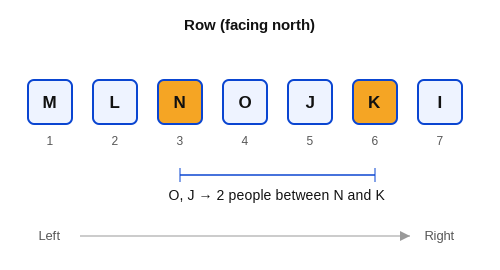
Concept: Facing north, the right end is position 7. Start with the fixed clues.

  1. No one right of I → I at 7. Two between I and O → O at 4; J immediate right of O → J at 5.
  2. Three between M and J → M at 1.
  3. N immediate right of L in the remaining seats 2, 3, 6 → L 2, N 3; K at 6.
  4. Between N (3) and K (6): O and J → two.

Trick: Begin with the extreme-end clue ('no one to the right').

Answer: (D) Two

अवधारणा: उत्तर की ओर मुख होने पर दायाँ सिरा स्थान 7 है। निश्चित संकेतों से शुरू करें।

  1. I के दाएँ कोई नहीं → I स्थान 7। I और O के बीच दो → O स्थान 4; J, O के ठीक दाएँ → J स्थान 5।
  2. M और J के बीच तीन → M स्थान 1।
  3. बचे स्थान 2, 3, 6; N, L के ठीक दाएँ → L 2, N 3; K 6।
  4. N (3) और K (6) के बीच: O, J → दो।

ट्रिक: सिरे वाले संकेत ('दाएँ कोई नहीं') से शुरुआत करें।

उत्तर: (D) दो

RRB NTPC Undergraduate CBT 1General Intelligence and ReasoningLinear Seating ArrangementRRB NTPC Undergraduate CBT 1 2024 · 12 Aug Shift 2 →
Q3618.
Piyush ranked 35th from the top and 18th from the bottom in his class. How many students are there in his class?
पीयूष अपनी कक्षा में ऊपर से 35वें और नीचे से 18वें स्थान पर है। उसकी कक्षा में कितने विद्यार्थी हैं?
  1. A53
  2. B52
  3. C54
  4. D51
Show answer

Concept: Total = rank from top + rank from bottom −1.

  1. Total =35+18−1.
  2. =52.

Trick: The person is counted in both ranks, so subtract 1.

Answer: (B) 52

अवधारणा: कुल = ऊपर से स्थान + नीचे से स्थान −1।

  1. कुल =35+18−1।
  2. =52।

ट्रिक: व्यक्ति दोनों रैंकों में गिना गया, अतः 1 घटाएँ।

उत्तर: (B) 52

RRB NTPC Undergraduate CBT 1General Intelligence and ReasoningRankingRRB NTPC Undergraduate CBT 1 2024 · 12 Aug Shift 2 →
Q3619.
Select the set in which the numbers are related in the same way as are the numbers of the following sets.
(NOTE: Operations should be performed on the whole numbers, without breaking down the numbers into their constituent digits. E.g. 13 – Operations on 13 such as adding to/subtracting from/multiplying with 13 can be performed. Breaking down 13 into 1 and 3 and then performing mathematical operations on 1 and 3 is not allowed.)
(112, 104, 96)
(136, 128, 120)
उस समुच्चय का चयन कीजिए जिसमें संख्याएँ उसी प्रकार संबंधित हैं जिस प्रकार निम्नलिखित समुच्चयों की संख्याएँ संबंधित हैं।
(ध्यान दें: संक्रियाएँ संख्याओं को उनके घटक अंकों में विभक्त किए बिना, पूर्ण संख्याओं पर की जानी चाहिए। उदाहरण के लिए, 13 – 13 पर की जाने वाली संक्रियाएँ, जैसे 13 में जोड़ना/13 में से घटाना/13 से गुणा करना आदि की जा सकती हैं। 13 को 1 और 3 में विभक्त करना और फिर 1 और 3 पर गणितीय संक्रियाएँ करना वर्जित है।)
(112, 104, 96)
(136, 128, 120)
  1. A(129, 121, 116)
  2. B(91, 83, 77)
  3. C(140, 134, 130)
  4. D(154, 146, 138)
Show answer

Concept: Find how the numbers change across each set.

  1. (112, 104, 96): −8, −8; (136, 128, 120): −8, −8.
  2. (154, 146, 138): −8, −8 ✓.
  3. Others: (129, 121, 116) −8,−5; (91, 83, 77) −8,−6; (140, 134, 130) −6,−4.

Trick: Check the second gap – the first is −8 in most options.

Answer: (D) (154, 146, 138)

अवधारणा: हर समूह में संख्याओं का बदलाव देखें।

  1. (112, 104, 96): −8, −8; (136, 128, 120): −8, −8।
  2. (154, 146, 138): −8, −8 ✓।
  3. बाकी: (129, 121, 116) −8,−5; (91, 83, 77) −8,−6; (140, 134, 130) −6,−4।

ट्रिक: दूसरा अंतर जाँचें – पहला ज़्यादातर −8 है।

उत्तर: (D) (154, 146, 138)

RRB NTPC Undergraduate CBT 1General Intelligence and ReasoningNumber Set AnalogyRRB NTPC Undergraduate CBT 1 2024 · 12 Aug Shift 2 →
Q3620.
Each of the digits in the number 81674293 is arranged in ascending order from left to right. Which of the following digits will be fourth from the left?
संख्या 81674293 के प्रत्येक अंक को बाएँ से दाएँ आरोही क्रम में व्यवस्थित किया जाता है। निम्नलिखित में से कौन-सा अंक बाएँ से चौथे स्थान पर होगा?
  1. A3
  2. B6
  3. C4
  4. D7
Show answer

Concept: Arrange all digits in ascending order.

  1. Digits: 8, 1, 6, 7, 4, 2, 9, 3.
  2. Ascending: 1 2 3 4 6 7 8 9.
  3. Fourth from left: 4.

Trick: Fourth smallest digit = 4th from left in ascending order.

Answer: (C) 4

अवधारणा: सभी अंक आरोही क्रम में लगाएँ।

  1. अंक: 8, 1, 6, 7, 4, 2, 9, 3।
  2. आरोही: 1 2 3 4 6 7 8 9।
  3. बाएँ से चौथा: 4।

ट्रिक: आरोही क्रम में बाएँ से चौथा = चौथा सबसे छोटा अंक।

उत्तर: (C) 4

RRB NTPC Undergraduate CBT 1General Intelligence and ReasoningDigit ArrangementRRB NTPC Undergraduate CBT 1 2024 · 12 Aug Shift 2 →