Question bank

Q&A: practice questions with answers

Search questions on any topic. Filter by exam category, exam, subject and topic, try the question, then open the answer and explanation.

Courses – airGurukul

20,719 questions found.

Q3681.
Pipe P can fill 34 part of a tank in 27 hours, and pipe Q can fill 23 part of the same tank in 12 hours. Both P and Q were kept open for 6 hours, then both were closed. Pipe R alone was then opened and it emptied the water in the tank in 8 hours. Pipes P, Q and R together can fill the empty tank in:
पाइप P किसी टंकी के 34 भाग को 27 घंटे में भर सकता है, और पाइप Q उसी टंकी के 23 भाग को 12 घंटे में भर सकता है। P और Q दोनों को 6 घंटे के लिए खुला रखा गया, फिर दोनों को बंद कर दिया गया। इसके बाद केवल पाइप R को खोला गया और उसने टंकी का पानी 8 घंटे में खाली कर दिया। पाइप P, Q और R एक साथ खाली टंकी को कितने समय में भर सकते हैं?
  1. A31 hours31 घंटे
  2. B37 hours37 घंटे
  3. C48 hours48 घंटे
  4. D45 hours45 घंटे
Show answer

Concept: Convert each pipe to a full-tank time; an emptying pipe has negative work.

  1. P: 34 in 27 h → full in 36 h; Q: 23 in 12 h → full in 18 h
  2. In 6 h: 6(136+118)=12 tank filled
  3. R empties 12 tank in 8 h → full tank in 16 h
  4. Together: 136+118−116=4+8−9144=148

Trick: Take tank = LCM(36, 18, 16) = 144 units: P = 4, Q = 8, R = −9 per hour → net 3 → 1443=48 h.

Answer: (C) 48 hours

अवधारणा: हर पाइप का पूरा टंकी भरने का समय निकालें; खाली करने वाला पाइप ऋणात्मक कार्य करता है।

  1. P: 34 भाग 27 घंटे में → पूरा 36 घंटे; Q: 23 भाग 12 घंटे में → पूरा 18 घंटे
  2. 6 घंटे में: 6(136+118)=12 टंकी
  3. R, 12 टंकी 8 घंटे में खाली करता है → पूरी 16 घंटे में
  4. तीनों साथ: 136+118−116=4+8−9144=148

ट्रिक: टंकी = LCM(36, 18, 16) = 144 इकाई: P = 4, Q = 8, R = −9 प्रति घंटा → शुद्ध 3 → 1443=48 घंटे।

उत्तर: (C) 48 घंटे

RRB NTPC Undergraduate CBT 1MathematicsPipes and CisternsRRB NTPC Undergraduate CBT 1 2024 · 12 Aug Shift 1 →
Q3682.
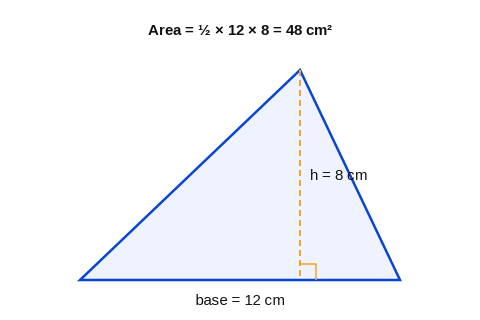
What is the area of a triangle with a base of 12 cm and a height of 8 cm?
12 cm आधार और 8 cm ऊँचाई वाले त्रिभुज का क्षेत्रफल कितना है?
  1. A16cm2
  2. B24cm2
  3. C48cm2
  4. D96cm2
Show answer

Concept: Area of triangle=12×base×height.

  1. 12×12×8
  2. =6×8=48cm2

Trick: 96 is the trap – it forgets the 12 (that is the rectangle's area).

Answer: (C) 48cm2

अवधारणा: त्रिभुज का क्षेत्रफल=12×आधार×ऊँचाई।

  1. 12×12×8
  2. =48cm2

ट्रिक: 96 वाला विकल्प 12 भूलने पर आता है (आयत का क्षेत्रफल)।

उत्तर: (C) 48cm2

RRB NTPC Undergraduate CBT 1MathematicsMensuration – TriangleRRB NTPC Undergraduate CBT 1 2024 · 12 Aug Shift 1 →
Q3683.
After giving two successive discounts, each of x% on the marked price of an article, the total discount is ₹18,000. If the marked price of the article is ₹50,000, find the value of x.
किसी वस्तु के अंकित मूल्य पर प्रत्येक x% की दो क्रमिक छूट देने के बाद कुल छूट ₹18,000 है। यदि वस्तु का अंकित मूल्य ₹50,000 है, तो x का मान ज्ञात कीजिए।
  1. A20
  2. B30
  3. C10
  4. D40
Show answer

Concept: After two discounts of x%, SP =MP(1−x100)2.

  1. SP =50000−18000=32000
  2. (1−x100)2=3200050000=0.64
  3. 1−x100=0.8⇒x=20

Trick: Check: 20% then 20% → 20+20−20×20100=36%, and 36% of 50000 = 18000.

Answer: (A) 20

अवधारणा: दो बार x% छूट के बाद विक्रय मूल्य =MP(1−x100)2।

  1. विक्रय मूल्य =50000−18000=32000
  2. (1−x100)2=0.64
  3. 1−x100=0.8⇒x=20

ट्रिक: जाँच: 20+20−20×20100=36%, और 50000 का 36% = 18000।

उत्तर: (A) 20

RRB NTPC Undergraduate CBT 1MathematicsSuccessive DiscountRRB NTPC Undergraduate CBT 1 2024 · 12 Aug Shift 1 →
Q3684.
The average of first 160 even numbers is
प्रथम 160 सम संख्याओं का औसत है
  1. A161.5
  2. B162
  3. C161
  4. D160.5
Show answer

Concept: Sum of first n even numbers =n(n+1), so their average =n+1.

  1. Sum =160×161
  2. Average =160×161160=161

Yaad rakhein: Average of first n even numbers =n+1; of first n odd numbers =n.

Answer: (C) 161

अवधारणा: पहली n सम संख्याओं का योग =n(n+1), अतः औसत =n+1।

  1. योग =160×161
  2. औसत =160×161160=161

याद रखें: पहली n सम संख्याओं का औसत =n+1; पहली n विषम संख्याओं का औसत =n।

उत्तर: (C) 161

RRB NTPC Undergraduate CBT 1MathematicsAverageRRB NTPC Undergraduate CBT 1 2024 · 12 Aug Shift 1 →
Q3685.
Pipe A can fill a tank in 18 hours, pipe B can fill the same tank in 21 hours and pipe C can fill the same tank in 16 hours. The time taken by them to fill the same tank if they operate together is::
पाइप A एक टंकी को 18 घंटे में भर सकता है, पाइप B उसी टंकी को 21 घंटे में भर सकता है और पाइप C उसी टंकी को 16 घंटे में भर सकता है। यदि वे एक साथ कार्य करें, तो उसी टंकी को भरने में उनके द्वारा लिया गया समय है::
  1. A66167hours
  2. B116167hours
  3. C76167hours
  4. D136167hours
Show answer

Concept: Add the one-hour work of all filling pipes.

  1. 118+121+116, LCM =1008
  2. =56+48+631008=1671008
  3. Time =1008167=66167 hours

Trick: Together they must beat the fastest pipe alone (16 h) yet take more than 16÷3≈5.3 h, so only the answer near 6 h fits.

Answer: (A) 66167 hours

अवधारणा: सभी भरने वाले पाइपों का एक घंटे का कार्य जोड़ें।

  1. 118+121+116, LCM =1008
  2. =56+48+631008=1671008
  3. समय =1008167=66167 घंटे

ट्रिक: तीनों साथ में सबसे तेज़ पाइप (16 घंटे) से काफ़ी कम समय लेंगे, लगभग 6 घंटे — केवल विकल्प (A) संभव।

उत्तर: (A) 66167 घंटे

RRB NTPC Undergraduate CBT 1MathematicsPipes and CisternsRRB NTPC Undergraduate CBT 1 2024 · 12 Aug Shift 1 →
Q3686.
Which of the following numbers divides 81,42,42,541?
निम्नलिखित में से कौन-सी संख्या 81,42,42,541 को विभाजित करती है?
  1. A7
  2. B12
  3. C8
  4. D15
Show answer

Concept: Divisibility by 7 (also 11, 13): make 3-digit groups from the right and take the alternating sum.

  1. The number is odd and ends in 1 → not divisible by 8, 12 or 15
  2. Groups from the right: 814 | 242 | 541 → 541−242+814=1113
  3. 1113=7×159 → divisible by 7; indeed 814242541=7×116320363

Trick: Last digit 1 kills every even option and 15 instantly; only 7 remains.

Answer: (A) 7

अवधारणा: 7 (और 11, 13) की विभाज्यता: दाएँ से 3-3 अंकों के समूह बनाकर एकांतर योग लें।

  1. संख्या विषम है और 1 पर समाप्त → 8, 12, 15 से विभाज्य नहीं
  2. समूह 814 | 242 | 541 → 541−242+814=1113
  3. 1113=7×159 → 7 से विभाज्य; 814242541=7×116320363

ट्रिक: अंतिम अंक 1 से सभी सम विकल्प और 15 तुरंत बाहर; केवल 7 बचता है।

उत्तर: (A) 7

RRB NTPC Undergraduate CBT 1MathematicsDivisibilityRRB NTPC Undergraduate CBT 1 2024 · 12 Aug Shift 1 →
Q3687.
In covering a distance of 30 km, Anmol takes 7 hours more than Nikhil. If Anmol doubles his speed, then he would take 8 hours less than Nikhil. Anmol's speed is:
30 km की दूरी तय करने में अनमोल, निखिल से 7 घंटे अधिक लेता है। यदि अनमोल अपनी चाल दोगुनी कर दे, तो वह निखिल से 8 घंटे कम लेगा। अनमोल की चाल है:
  1. A7 km/hr
  2. B1 km/hr
  3. C6 km/hr
  4. D3 km/hr
Show answer

Concept: Time =DistanceSpeed; doubling speed halves the time.

  1. Let Anmol's time be T; then T−7 = Nikhil's time
  2. With double speed Anmol takes T2=(T−7)−8
  3. T2=15⇒T=30 h
  4. Speed =3030=1km/hr

Trick: The gap 7+8=15 h equals half of Anmol's time.

Answer: (B) 1 km/hr

अवधारणा: समय =दूरीचाल; चाल दोगुनी करने पर समय आधा।

  1. अनमोल का समय T; निखिल का T−7
  2. दोगुनी चाल पर T2=(T−7)−8
  3. T2=15⇒T=30 घंटे
  4. चाल =3030=1km/hr

ट्रिक: दोनों अंतर का योग 7+8=15 घंटे = अनमोल के समय का आधा।

उत्तर: (B) 1 km/hr

RRB NTPC Undergraduate CBT 1MathematicsSpeed, Time and DistanceRRB NTPC Undergraduate CBT 1 2024 · 12 Aug Shift 1 →
Q3688.
The current population of a town is 12,500. It increases by 52% and 30% in two successive years but decreases by 15% in the third year. What is the population of the town at the end of the third year?
एक कस्बे की वर्तमान जनसंख्या 12,500 है। यह दो क्रमिक वर्षों में 52% और 30% बढ़ती है, लेकिन तीसरे वर्ष में 15% घट जाती है। तीसरे वर्ष के अंत में कस्बे की जनसंख्या कितनी है?
  1. A20,995
  2. B20,991
  3. C20,990
  4. D20,998
Show answer

Concept: Successive % changes multiply: P×(1±r100) for each year.

  1. 12500×1.52=19000
  2. 19000×1.30=24700
  3. 24700×0.85=20995

Trick: Last digit check: only an answer ending in 5 can come from multiplying by 0.85 here.

Answer: (A) 20,995

अवधारणा: क्रमागत प्रतिशत परिवर्तन गुणा होते हैं: हर वर्ष ×(1±r100)।

  1. 12500×1.52=19000
  2. 19000×1.30=24700
  3. 24700×0.85=20995

ट्रिक: इकाई अंक जाँच: यहाँ 0.85 से गुणा पर अंत में 5 ही आता है।

उत्तर: (A) 20,995

RRB NTPC Undergraduate CBT 1MathematicsPopulation GrowthRRB NTPC Undergraduate CBT 1 2024 · 12 Aug Shift 1 →
Q3689.
The product of two consecutive natural numbers is 702. The greater of the two numbers is:
दो क्रमागत प्राकृत संख्याओं का गुणनफल 702 है। दोनों संख्याओं में से बड़ी संख्या है:
  1. A26
  2. B27
  3. C38
  4. D24
Show answer

Concept: Consecutive numbers lie close to 702≈26.5.

  1. 26×27=702
  2. Greater number =27

Trick: Unit digit: 6×7=42 ends in 2, matching 702.

Answer: (B) 27

अवधारणा: क्रमागत संख्याएँ 702≈26.5 के पास होंगी।

  1. 26×27=702
  2. बड़ी संख्या =27

ट्रिक: इकाई अंक: 6×7=42 → 2, जो 702 से मेल खाता है।

उत्तर: (B) 27

RRB NTPC Undergraduate CBT 1MathematicsNumber SystemRRB NTPC Undergraduate CBT 1 2024 · 12 Aug Shift 1 →
Q3690.
The LCM of the numbers 12.8 and 0.004 is:
संख्याओं 12.8 और 0.004 का LCM है:
  1. A128
  2. B0.128
  3. C1.28
  4. D12.8
Show answer

Concept: Make decimal places equal, take LCM of the whole numbers, then put the decimal back.

  1. 12.8=12.800 and 0.004 → 12800 and 4 (thousandths)
  2. LCM(12800, 4) =12800
  3. Answer =12.800=12.8

Trick: 12.8 is itself a multiple of 0.004 (12.8÷0.004=3200), so LCM = 12.8.

Answer: (D) 12.8

अवधारणा: दशमलव स्थान बराबर करें, पूर्ण संख्याओं का LCM लें, फिर दशमलव वापस लगाएँ।

  1. 12.8=12.800 और 0.004 → 12800 और 4
  2. LCM(12800, 4) =12800
  3. उत्तर =12.8

ट्रिक: 12.8 स्वयं 0.004 का गुणज है (12.8÷0.004=3200), अतः LCM = 12.8।

उत्तर: (D) 12.8

RRB NTPC Undergraduate CBT 1MathematicsLCM of DecimalsRRB NTPC Undergraduate CBT 1 2024 · 12 Aug Shift 1 →
Q3691.
A retailer offers the following discount scheme to his customers for the purchase of articles.
'Buy 30 and get 10 free'
Find the discount percentage offered.
एक खुदरा विक्रेता अपने ग्राहकों को वस्तुओं की खरीद पर निम्नलिखित छूट योजना प्रदान करता है।
'30 खरीदें और 10 मुफ़्त पाएँ'
प्रदान की गई छूट का प्रतिशत ज्ञात कीजिए।
  1. A26%
  2. B25%
  3. C30%
  4. D28%
Show answer

Concept: Discount% =free itemstotal items received×100.

  1. Customer gets 30+10=40 articles, pays for 30
  2. Discount =1040×100=25%

Trick: Divide by items received (40), not items bought (30) – 33% is the trap.

Answer: (B) 25%

अवधारणा: छूट% =मुफ़्त वस्तुएँकुल मिली वस्तुएँ×100।

  1. ग्राहक को 30+10=40 वस्तुएँ मिलती हैं, भुगतान 30 का
  2. छूट =1040×100=25%

ट्रिक: मिली वस्तुओं (40) से भाग दें, खरीदी (30) से नहीं।

उत्तर: (B) 25%

RRB NTPC Undergraduate CBT 1MathematicsDiscountRRB NTPC Undergraduate CBT 1 2024 · 12 Aug Shift 1 →
Q3692.
Find the value of x satisfying: 5(2x2 − 7) − 2(5x2 + 8x − 2) = 12
x का वह मान ज्ञात कीजिए जो निम्नलिखित को संतुष्ट करता है: 5(2x2 − 7) − 2(5x2 + 8x − 2) = 12
  1. A−4316
  2. B−3916
  3. C−5316
  4. D−4916
Show answer

Concept: Expand; the x2 terms cancel, leaving a linear equation.

  1. 10x2−35−10x2−16x+4=12
  2. −16x−31=12
  3. −16x=43⇒x=−4316

Trick: Watch the sign: −2×(−2)=+4.

Answer: (A) −4316

अवधारणा: विस्तार करें; x2 वाले पद कट जाते हैं, रैखिक समीकरण बचता है।

  1. 10x2−35−10x2−16x+4=12
  2. −16x−31=12
  3. −16x=43⇒x=−4316

ट्रिक: चिह्न ध्यान दें: −2×(−2)=+4।

उत्तर: (A) −4316

RRB NTPC Undergraduate CBT 1MathematicsLinear EquationsRRB NTPC Undergraduate CBT 1 2024 · 12 Aug Shift 1 →
Q3693.
₹12,300 were divided among A, B and C such that 3 times the share of A = 6 times the share of B = 2 times the share of C. Find the share of A.
₹12,300 को A, B और C के बीच इस प्रकार विभाजित किया गया कि A के हिस्से का 3 गुना = B के हिस्से का 6 गुना = C के हिस्से का 2 गुना। A का हिस्सा ज्ञात कीजिए।
  1. A₹4,100
  2. B₹3,915
  3. C₹4,063
  4. D₹3,924
Show answer

Concept: If 3A=6B=2C, then A:B:C=13:16:12.

  1. Multiply by 6: A:B:C=2:1:3
  2. Total parts =6
  3. A=26×12300=4100

Trick: Shares are inversely proportional to the multipliers 3, 6, 2.

Answer: (A) ₹4,100

अवधारणा: यदि 3A=6B=2C तो A:B:C=13:16:12।

  1. 6 से गुणा: A:B:C=2:1:3
  2. कुल भाग =6
  3. A=26×12300=4100

ट्रिक: हिस्से गुणकों 3, 6, 2 के व्युत्क्रमानुपाती होते हैं।

उत्तर: (A) ₹4,100

RRB NTPC Undergraduate CBT 1MathematicsRatio and ProportionRRB NTPC Undergraduate CBT 1 2024 · 12 Aug Shift 1 →
Q3694.
Find the value of 50−6÷ 5018× 50−5.
50−6÷ 5018× 50−5 का मान ज्ञात कीजिए।
  1. A50−19
  2. B50−29
  3. C50−36
  4. D50−32
Show answer

Concept: am÷an=am−n and am×an=am+n (left to right).

  1. 50−6÷5018=50−24
  2. 50−24×50−5=50−29

Trick: Exponent =−6−18−5=−29.

Answer: (B) 50−29

अवधारणा: am÷an=am−n, am×an=am+n (बाएँ से दाएँ)।

  1. 50−6÷5018=50−24
  2. 50−24×50−5=50−29

ट्रिक: घात =−6−18−5=−29।

उत्तर: (B) 50−29

RRB NTPC Undergraduate CBT 1MathematicsIndicesRRB NTPC Undergraduate CBT 1 2024 · 12 Aug Shift 1 →
Q3695.
Find the median of 26, 13, 14, 15, 8, 36, 23, 35 and 50.
26, 13, 14, 15, 8, 36, 23, 35 और 50 की माध्यिका ज्ञात कीजिए।
  1. A35
  2. B23
  3. C26
  4. D50
Show answer

Concept: Median = middle value after arranging in order; for n odd it is the n+12th value.

  1. Order: 8, 13, 14, 15, 23, 26, 35, 36, 50
  2. n=9 → 9+12=5th value
  3. 5th value =23

Trick: Always sort first – 26 (the 5th value as printed) is the trap.

Answer: (B) 23

अवधारणा: माध्यिका = क्रम में लगाने के बाद बीच का मान; n विषम हो तो n+12वाँ पद।

  1. क्रम: 8, 13, 14, 15, 23, 26, 35, 36, 50
  2. n=9 → 9+12=5वाँ पद
  3. 5वाँ पद =23

ट्रिक: पहले क्रम में लगाएँ – दिए क्रम का 5वाँ पद 26 जाल है।

उत्तर: (B) 23

RRB NTPC Undergraduate CBT 1MathematicsMedianRRB NTPC Undergraduate CBT 1 2024 · 12 Aug Shift 1 →
Q3696.
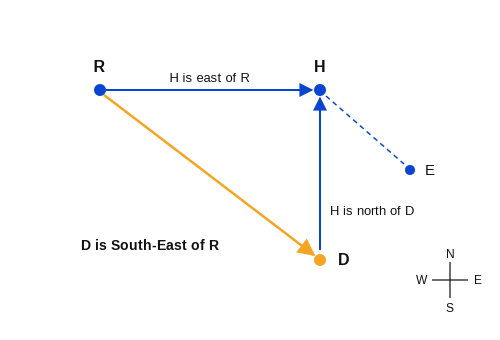
Town H is to the east of town R and to the north of town D. Town E is southeast of town H. In which direction is town D with respect to town R?
नगर H, नगर R के पूर्व में और नगर D के उत्तर में है। नगर E, नगर H के दक्षिण-पूर्व में है। नगर R के सापेक्ष नगर D किस दिशा में है?
  1. ASoutheastदक्षिण-पूर्व
  2. BSouthwestदक्षिण-पश्चिम
  3. CNorthउत्तर
  4. DWestपश्चिम
Show answer

Concept: Place the towns on a grid from the given relations.

  1. H is east of R → H on R's right
  2. D is south of H → D is below H
  3. So D is to the east and to the south of R → South-East (E is not needed)

Trick: East + South together = South-East.

Answer: (A) Southeast

अवधारणा: दिए गए संबंधों से नगरों को ग्रिड पर रखें।

  1. H, R के पूर्व में
  2. D, H के दक्षिण में (H, D के उत्तर में)
  3. अतः D, R के पूर्व और दक्षिण दोनों में → दक्षिण-पूर्व (E की जरूरत नहीं)

ट्रिक: पूर्व + दक्षिण = दक्षिण-पूर्व।

उत्तर: (A) दक्षिण-पूर्व (Southeast)

RRB NTPC Undergraduate CBT 1General Intelligence and ReasoningDirection SenseRRB NTPC Undergraduate CBT 1 2024 · 12 Aug Shift 1 →
Q3697.
Refer to the following number and symbol series and answer the question that follows. Counting to be done from left to right only.
(Left) > 5 * \ + 9 & 6 # 6 4 $ & / @ # $ & 8 3 < (Right)
How many such symbols are there that are immediately preceded by a number and also immediately followed by another symbol?
निम्नलिखित संख्या और प्रतीक श्रृंखला का संदर्भ लीजिए और उसके बाद दिए गए प्रश्न का उत्तर दीजिए। गिनती केवल बाएँ से दाएँ की जानी है।
(बाएँ) > 5 * \ + 9 & 6 # 6 4 $ & / @ # $ & 8 3 < (दाएँ)
ऐसे कितने प्रतीक हैं जिनके ठीक पहले एक संख्या है और ठीक बाद एक अन्य प्रतीक भी है?
  1. AFourचार
  2. BTwoदो
  3. COneएक
  4. DThreeतीन
Show answer

Concept: Check every symbol: the element just before must be a number and the one just after must be a symbol.

  1. 5 * \ → * qualifies
  2. 4 $ & → $ qualifies
  3. Others fail: 9 & 6, 6 # 6 (followed by numbers); 3 < has nothing after it

Trick: Scan for the pattern number-symbol-symbol only.

Answer: (B) Two

अवधारणा: हर प्रतीक जाँचें: ठीक पहले संख्या और ठीक बाद प्रतीक होना चाहिए।

  1. 5 * \ → * सही
  2. 4 $ & → $ सही
  3. बाकी नहीं: 9 & 6, 6 # 6 (बाद में संख्या); 3 < के बाद कुछ नहीं

ट्रिक: केवल संख्या-प्रतीक-प्रतीक पैटर्न खोजें।

उत्तर: (B) दो (Two)

RRB NTPC Undergraduate CBT 1General Intelligence and ReasoningSymbol-Number SeriesRRB NTPC Undergraduate CBT 1 2024 · 12 Aug Shift 1 →
Q3698.
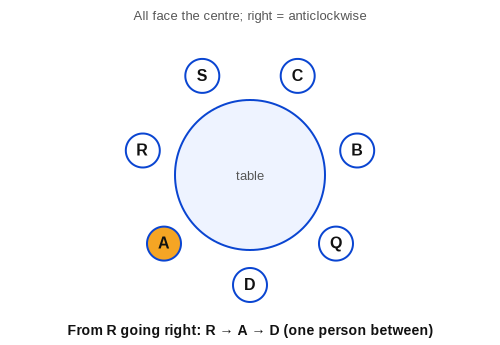
A, B, C, D, Q, R and S are sitting around a circular table, facing the centre of the table. Q sits to the immediate right of D. Only three people sit between Q and S, when counted from the left of Q. Only three people sit between D and C. A sits to the immediate right of R. How many people sit between D and R, when counted from the right of R?
A, B, C, D, Q, R और S एक वृत्ताकार मेज़ के चारों ओर मेज़ के केंद्र की ओर मुख करके बैठे हैं। Q, D के ठीक दाएँ बैठा है। Q के बाएँ से गिनने पर, Q और S के बीच केवल तीन व्यक्ति बैठे हैं। D और C के बीच केवल तीन व्यक्ति बैठे हैं। A, R के ठीक दाएँ बैठा है। R के दाएँ से गिनने पर, D और R के बीच कितने व्यक्ति बैठे हैं?
  1. AOneएक
  2. BFourचार
  3. CThreeतीन
  4. DTwoदो
Show answer

Concept: Facing the centre: right = anticlockwise, left = clockwise.

  1. Q is immediately right of D; going left (clockwise) from Q, three people sit before S
  2. Three people between D and C; one such seat is S's, so C sits next to S
  3. A is immediately right of R → R and A take the two seats left after D, i.e. order to the right: D, Q, B, C, S, R, A
  4. From R going right: R → A → D → one person (A) between

Trick: Always draw the circle and mark right/left as anticlockwise/clockwise first.

Answer: (A) One

अवधारणा: केंद्र की ओर मुख: दायाँ = वामावर्त (anticlockwise), बायाँ = दक्षिणावर्त।

  1. Q, D के ठीक दाएँ; Q के बाएँ गिनने पर तीन व्यक्तियों के बाद S
  2. D और C के बीच तीन व्यक्ति → C, S के बगल में
  3. A, R के ठीक दाएँ → दाएँ क्रम: D, Q, B, C, S, R, A
  4. R के दाएँ से: R → A → D → बीच में एक (A)

ट्रिक: पहले वृत्त बनाकर दायाँ/बायाँ दिशा तय करें।

उत्तर: (A) एक (One)

RRB NTPC Undergraduate CBT 1General Intelligence and ReasoningCircular Seating ArrangementRRB NTPC Undergraduate CBT 1 2024 · 12 Aug Shift 1 →
Q3699.
In the following triads, each group of letters is related to the subsequent one following a certain logic. Select from the given options, the one which follows the same logic. JUNK - UJNK - KUJN
LACK - ALCK - KALC
निम्नलिखित त्रिकों में, अक्षरों का प्रत्येक समूह एक निश्चित तर्क का अनुसरण करते हुए अगले समूह से संबंधित है। दिए गए विकल्पों में से उस विकल्प का चयन कीजिए जो समान तर्क का अनुसरण करता है। JUNK - UJNK - KUJN
LACK - ALCK - KALC
  1. ABUNS - UBNS - SUNB
  2. BMOST - OMST - OSTM
  3. CFROM - RFOM - MRFO
  4. DMOCK - MCOK - KCOM
Show answer

Concept: Step 1: swap the first two letters. Step 2: move the last letter to the front.

  1. JUNK → UJNK → KUJN; LACK → ALCK → KALC
  2. FROM → RFOM → MRFO ✓
  3. BUNS → UBNS should give SUBN, not SUNB; MOST → OMST should give TOMS

Trick: Check both steps on every option; most options break at step 2.

Answer: (C) FROM - RFOM - MRFO

अवधारणा: चरण 1: पहले दो अक्षर अदला-बदली। चरण 2: अंतिम अक्षर आगे लाएँ।

  1. JUNK → UJNK → KUJN; LACK → ALCK → KALC
  2. FROM → RFOM → MRFO ✓
  3. BUNS → UBNS से SUBN बनना चाहिए, SUNB नहीं

ट्रिक: हर विकल्प पर दोनों चरण जाँचें।

उत्तर: (C) FROM - RFOM - MRFO

RRB NTPC Undergraduate CBT 1General Intelligence and ReasoningLetter Analogy (Triads)RRB NTPC Undergraduate CBT 1 2024 · 12 Aug Shift 1 →
Q3700.
If + means −, − means ×, × means ÷ and ÷ means +, then what will come in place of the question mark (?) in the following equation?
51 + 8 − 8 ÷ 80 × 4 = ?
यदि + का अर्थ −, − का अर्थ ×, × का अर्थ ÷ और ÷ का अर्थ + है, तो निम्नलिखित समीकरण में प्रश्न चिह्न (?) के स्थान पर क्या आएगा?
51 + 8 − 8 ÷ 80 × 4 = ?
  1. A26
  2. B20
  3. C14
  4. D7
Show answer

Concept: Replace the symbols, then apply BODMAS.

  1. 51+8−8÷80×4 becomes 51−8×8+80÷4
  2. =51−64+20
  3. =7

Trick: Do the symbol swap on paper first; never compute with the printed signs.

Answer: (D) 7

अवधारणा: चिह्न बदलें, फिर BODMAS लगाएँ।

  1. 51−8×8+80÷4
  2. =51−64+20
  3. =7

ट्रिक: पहले चिह्न बदलकर लिखें, फिर गणना करें।

उत्तर: (D) 7

RRB NTPC Undergraduate CBT 1General Intelligence and ReasoningMathematical OperationsRRB NTPC Undergraduate CBT 1 2024 · 12 Aug Shift 1 →