Question bank

Q&A: practice questions with answers

Search questions on any topic. Filter by exam category, exam, subject and topic, try the question, then open the answer and explanation.

Courses – airGurukul

20,719 questions found.

Q3961.
Why is the biodiversity of the Lakshadweep Islands lower than that of the Andaman and Nicobar Islands?
लक्षद्वीप द्वीपसमूह की जैव विविधता अंडमान और निकोबार द्वीपसमूह की तुलना में कम क्यों है?
  1. ASmaller land area and lack of forest coverछोटा भू-क्षेत्र और वन आवरण का अभाव
  2. BVolcanic eruptions and infertile soilज्वालामुखी विस्फोट और अनुपजाऊ मिट्टी
  3. CExcess human population densityअत्यधिक मानव जनसंख्या घनत्व
  4. DHigher altitude and cold temperatureअधिक ऊँचाई और ठंडा तापमान
Show answer

Concept: Biodiversity depends largely on land area, habitat variety and forest cover.

  1. Lakshadweep is a group of tiny coral atolls with total land area of only about 32 sq km and almost no natural forests (mostly coconut).
  2. Andaman & Nicobar islands are large (about 8,249 sq km), hilly and covered with dense tropical rainforests – hence very rich biodiversity.
  3. Lakshadweep is not volcanic or cold; the cause is small land area and lack of forests.

Yaad rakhein: Small coral atolls + no forest = low biodiversity.

Answer: (A) Smaller land area and lack of forest cover

अवधारणा: जैव विविधता मुख्यतः भूमि क्षेत्र, आवासों की विविधता और वन आवरण पर निर्भर करती है।

  1. लक्षद्वीप छोटे प्रवाल एटॉल का समूह है जिसका कुल भू-क्षेत्र केवल लगभग 32 वर्ग km है और प्राकृतिक वन लगभग नहीं हैं (मुख्यतः नारियल)।
  2. अंडमान-निकोबार बड़े (लगभग 8,249 वर्ग km), पहाड़ी और घने उष्णकटिबंधीय वर्षावनों वाले हैं – इसलिए वहाँ जैव विविधता बहुत अधिक है।
  3. लक्षद्वीप ज्वालामुखीय या ठंडा नहीं है; कारण है छोटा भू-क्षेत्र और वनों का अभाव।

याद रखें: छोटे प्रवाल एटॉल + वन नहीं = कम जैव विविधता।

उत्तर: (A) छोटा भू-क्षेत्र और वन आवरण का अभाव
RRB NTPC Undergraduate CBT 1General AwarenessIndian geography – islandsRRB NTPC Undergraduate CBT 1 2024 · 11 Aug Shift 1 →
Q3962.
Nepal shares its border with which of the following Indian states?
नेपाल की सीमा निम्नलिखित में से किस भारतीय राज्य से लगती है?
  1. ABiharबिहार
  2. BHimachal Pradeshहिमाचल प्रदेश
  3. COdishaओडिशा
  4. DMeghalayaमेघालय
Show answer

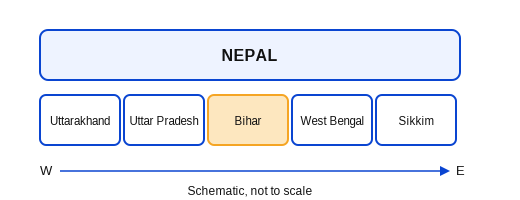
Concept: Nepal shares its border with five Indian states.

  1. From west to east: Uttarakhand, Uttar Pradesh, Bihar, West Bengal and Sikkim.
  2. Uttar Pradesh has the longest border with Nepal; Bihar is second.
  3. Himachal Pradesh borders China (Tibet); Odisha and Meghalaya have no border with Nepal (Meghalaya borders Bangladesh).

Yaad rakhein: Nepal neighbours: "U-U-B-W-S" (Uttarakhand, UP, Bihar, WB, Sikkim).

Answer: (A) Bihar

अवधारणा: नेपाल भारत के पाँच राज्यों से सीमा साझा करता है।

  1. पश्चिम से पूर्व: उत्तराखंड, उत्तर प्रदेश, बिहार, पश्चिम बंगाल और सिक्किम।
  2. नेपाल के साथ सबसे लंबी सीमा उत्तर प्रदेश की है; बिहार दूसरे स्थान पर।
  3. हिमाचल प्रदेश की सीमा चीन (तिब्बत) से लगती है; ओडिशा और मेघालय की नेपाल से कोई सीमा नहीं (मेघालय बांग्लादेश से लगता है)।

याद रखें: नेपाल के पड़ोसी: "उ-उ-बि-प-सि" (उत्तराखंड, UP, बिहार, पश्चिम बंगाल, सिक्किम)।

उत्तर: (A) बिहार

RRB NTPC Undergraduate CBT 1General AwarenessIndian geography – bordersRRB NTPC Undergraduate CBT 1 2024 · 11 Aug Shift 1 →
Q3963.
Which general molecular structure identifies the class of organic compounds known as diazonium compounds or diazonium salts?
कौन-सी सामान्य आण्विक संरचना उन कार्बनिक यौगिकों के वर्ग की पहचान कराती है जिन्हें डाइएज़ोनियम यौगिक या डाइएज़ोनियम लवण (diazonium salts) कहा जाता है?
  1. AR−C≡N
  2. BR−N2+X−
  3. CR2C=NR′
  4. DR−CO−NR′R″
Show answer

Concept: Diazonium salts contain the diazonium group −N2+ (two nitrogen atoms joined by a triple bond) attached to an alkyl/aryl group, with a counter anion.

  1. General formula: R−N2+X−, e.g. benzenediazonium chloride C6H5N2+Cl−.
  2. R−C≡N is a nitrile; R2C=NR′ is an imine; R−CO−NR′R″ is an amide.

Yaad rakhein: Diazo = "two nitrogens" → N2+.

Answer: (B) R−N2+X−

अवधारणा: डायज़ोनियम लवणों में −N2+ समूह (त्रिबंध से जुड़े दो नाइट्रोजन परमाणु) एल्किल/एरिल समूह से जुड़ा होता है, साथ में एक ऋणायन होता है।

  1. सामान्य सूत्र: R−N2+X−, जैसे बेंज़ीनडायज़ोनियम क्लोराइड C6H5N2+Cl−।
  2. R−C≡N नाइट्राइल है; R2C=NR′ इमीन; R−CO−NR′R″ एमाइड।

याद रखें: डाय-ज़ो = "दो नाइट्रोजन" → N2+।

उत्तर: (B) R−N2+X−

RRB NTPC Undergraduate CBT 1General AwarenessChemistry – organic compoundsRRB NTPC Undergraduate CBT 1 2024 · 11 Aug Shift 1 →
Q3964.
In June 2025, which event further intensified the Israel–Iran conflict?
जून 2025 में, किस घटना ने इज़राइल–ईरान संघर्ष को और तीव्र कर दिया?
  1. AIsrael's first strikes on Iran's nuclear facilitiesईरान के परमाणु प्रतिष्ठानों पर इज़राइल के पहले हमले
  2. BIran's missile attack on Tel Avivतेल अवीव पर ईरान का मिसाइल हमला
  3. CBreakdown of the Joint Comprehensive Plan of Action (JCPoA)संयुक्त व्यापक कार्य योजना (JCPoA) का भंग होना
  4. DKilling of an Iranian generalएक ईरानी जनरल की हत्या
Show answer

Concept: The Israel–Iran conflict escalated sharply in June 2025 (the "12-day war").

  1. On 13 June 2025 Israel launched Operation Rising Lion, striking Iran's nuclear facilities (such as Natanz) and military sites, killing senior commanders and nuclear scientists.
  2. Iran retaliated with missile and drone strikes on Tel Aviv and other cities – a response, not the trigger.
  3. The US later struck Fordow, Natanz and Isfahan (Operation Midnight Hammer) before a ceasefire on 24 June.

Yaad rakhein: June 2025: Israel first ("Rising Lion") → Iran's reply ("True Promise III").

Answer: (A) Israel's first strikes on Iran's nuclear facilities

अवधारणा: जून 2025 में इज़रायल–ईरान संघर्ष तेज़ी से बढ़ा ("12 दिन का युद्ध")।

  1. 13 जून 2025 को इज़रायल ने ऑपरेशन राइज़िंग लायन शुरू कर ईरान के परमाणु केंद्रों (जैसे नतांज़) और सैन्य ठिकानों पर हमला किया।
  2. ईरान ने तेल अवीव आदि पर मिसाइल व ड्रोन हमलों से जवाब दिया – यह प्रतिक्रिया थी, कारण नहीं।
  3. बाद में अमेरिका ने फ़ोर्डो, नतांज़ और इस्फ़हान पर हमला किया; 24 जून को युद्धविराम हुआ।

याद रखें: जून 2025: पहले इज़रायल ("राइज़िंग लायन") → फिर ईरान का जवाब।

उत्तर: (A) ईरान के परमाणु केंद्रों पर इज़रायल का पहला हमला

RRB NTPC Undergraduate CBT 1General AwarenessInternational affairs 2025RRB NTPC Undergraduate CBT 1 2024 · 11 Aug Shift 1 →
Q3965.
What negative consequence did the Revolt of 1857 create in Indian society?
1857 के विद्रोह ने भारतीय समाज में कौन-सा नकारात्मक परिणाम उत्पन्न किया?
  1. ADistrust developed between the Hindu and Muslim communitiesहिंदू और मुस्लिम समुदायों के बीच अविश्वास उत्पन्न हुआ
  2. BIndian handicrafts declinedभारतीय हस्तशिल्प का पतन हुआ
  3. CTribal and peasant movements became weakजनजातीय और किसान आंदोलन कमज़ोर हो गए
  4. DIndian languages and culture declinedभारतीय भाषाओं और संस्कृति का पतन हुआ
Show answer

Concept: In 1857 Hindus and Muslims fought together (Bahadur Shah Zafar as symbolic leader), so the British changed their policy afterwards.

  1. After the revolt the British adopted "divide and rule", favouring one community against the other.
  2. This bred mistrust between Hindu and Muslim communities – a lasting negative consequence for Indian society.
  3. The decline of handicrafts was due to British economic policy and the Industrial Revolution, not the revolt.

Yaad rakhein: 1857 = Hindu-Muslim unity in revolt → British "divide and rule" after it.

Answer: (A) Distrust developed between the Hindu and Muslim communities

अवधारणा: 1857 में हिंदू और मुसलमान साथ लड़े (बहादुर शाह ज़फ़र प्रतीकात्मक नेता), इसलिए अंग्रेज़ों ने बाद में अपनी नीति बदली।

  1. विद्रोह के बाद अंग्रेज़ों ने "फूट डालो और राज करो" नीति अपनाई।
  2. इससे हिंदू और मुस्लिम समुदायों में अविश्वास पैदा हुआ – भारतीय समाज पर एक स्थायी नकारात्मक परिणाम।
  3. हस्तशिल्प का पतन ब्रिटिश आर्थिक नीति और औद्योगिक क्रांति के कारण हुआ, विद्रोह के कारण नहीं।

याद रखें: 1857 = विद्रोह में हिंदू-मुस्लिम एकता → बाद में "फूट डालो, राज करो"।

उत्तर: (A) हिंदू और मुस्लिम समुदायों में अविश्वास पैदा हुआ

RRB NTPC Undergraduate CBT 1General AwarenessModern India – Revolt of 1857RRB NTPC Undergraduate CBT 1 2024 · 11 Aug Shift 1 →
Q3966.
The cost of 2 pens and 19 pencils is ₹118. If the price of a pen decreases by ₹5 and the price of a pencil increases by ₹4, the cost of 5 pens and 8 pencils is ₹144. What is the actual cost of 14 pens and 6 pencils?
2 पेन और 19 पेंसिलों का मूल्य ₹118 है। यदि एक पेन का मूल्य ₹5 कम हो जाए और एक पेंसिल का मूल्य ₹4 बढ़ जाए, तो 5 पेन और 8 पेंसिलों का मूल्य ₹144 होता है। 14 पेन और 6 पेंसिलों का वास्तविक मूल्य कितना है?
  1. A₹318
  2. B₹314
  3. C₹319
  4. D₹321
Show answer

Concept: Form two linear equations in the price of a pen p and a pencil c and solve them.

  1. 2p+19c=118 ...(i)
  2. New prices: 5(p−5)+8(c+4)=144⇒5p−25+8c+32=144⇒5p+8c=137 ...(ii)
  3. (i)×5 − (ii)×2: 95c−16c=590−274⇒79c=316⇒c=4, so p=118−762=21
  4. Required cost =14×21+6×4=294+24=318

Trick: Since 118−19c must be even, c is even; try c=4: p=21 and 5(16)+8(8)=144 ✔.

Answer: (A) ₹318

अवधारणा: पेन का मूल्य p और पेंसिल का c मानकर दो रैखिक समीकरण बनाएँ और हल करें।

  1. 2p+19c=118 ...(i)
  2. नए मूल्य: 5(p−5)+8(c+4)=144⇒5p+8c=137 ...(ii)
  3. (i)×5 − (ii)×2: 79c=316⇒c=4, अतः p=118−762=21
  4. अभीष्ट मूल्य =14×21+6×4=294+24=318

ट्रिक: 118−19c सम होना चाहिए, अतः c सम; c=4 रखें: p=21 और 5(16)+8(8)=144 ✔।

उत्तर: (A) ₹318

RRB NTPC Undergraduate CBT 1MathematicsLinear equationsRRB NTPC Undergraduate CBT 1 2024 · 11 Aug Shift 1 →
Q3967.
The HCF and LCM of two numbers are 91 and 546 respectively. If one number is 182, find the other number.
दो संख्याओं का HCF और LCM क्रमशः 91 और 546 है। यदि एक संख्या 182 है, तो दूसरी संख्या ज्ञात कीजिए।
  1. A273
  2. B91
  3. C364
  4. D182
Show answer

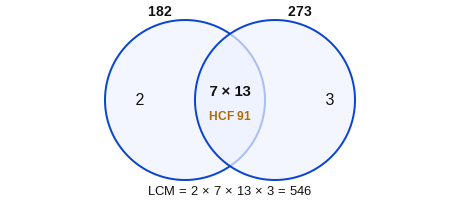
Concept: For two numbers: HCF×LCM=product of the numbers.

  1. 182×x=91×546
  2. x=91×546182=5462=273
  3. Check: 182=2×7×13, 273=3×7×13 → HCF =91, LCM =546 ✔

Trick: Both numbers are multiples of the HCF: 182=91×2, so other =91×3=273 (since 54691=6=2×3).

Answer: (A) 273

अवधारणा: दो संख्याओं के लिए: HCF×LCM=संख्याओं का गुणनफल।

  1. 182×x=91×546
  2. x=91×546182=5462=273
  3. जाँच: 182=2×7×13, 273=3×7×13 → HCF =91, LCM =546 ✔

ट्रिक: दोनों संख्याएँ HCF की गुणज हैं: 182=91×2, अतः दूसरी =91×3=273 (क्योंकि 54691=6=2×3)।

उत्तर: (A) 273

RRB NTPC Undergraduate CBT 1MathematicsHCF and LCMRRB NTPC Undergraduate CBT 1 2024 · 11 Aug Shift 1 →
Q3968.
When a number is increased by 60%, it becomes 3550. What is the number?
जब किसी संख्या में 60% की वृद्धि की जाती है, तो वह 3550 हो जाती है। वह संख्या क्या है?
  1. A2218.75
  2. B6656.25
  3. C4437.5
  4. D1109.375
Show answer

Concept: If a number x is increased by r%, new value =x×100+r100.

  1. x×160100=3550
  2. x=3550×100160=3550×58=177508=2218.75

Trick: 60% increase = multiply by 85; reverse by multiplying with 58.

Answer: (A) 2218.75

अवधारणा: यदि संख्या x में r% वृद्धि हो, तो नया मान =x×100+r100।

  1. x×160100=3550
  2. x=3550×100160=3550×58=177508=2218.75

ट्रिक: 60% वृद्धि = 85 से गुणा; उल्टा करने के लिए 58 से गुणा।

उत्तर: (A) 2218.75

RRB NTPC Undergraduate CBT 1MathematicsPercentage increaseRRB NTPC Undergraduate CBT 1 2024 · 11 Aug Shift 1 →
Q3969.
A dishonest trader claims to sell rice at a profit of 39%, but uses a weight that is 17% less than the marked value while selling. What is the trader's overall profit percentage? (rounded to the nearest whole number)
एक बेईमान व्यापारी 39% के लाभ पर चावल बेचने का दावा करता है, लेकिन बेचते समय अंकित मान से 17% कम भार वाले बाट का उपयोग करता है। व्यापारी का कुल लाभ प्रतिशत कितना है? (निकटतम पूर्ण संख्या तक पूर्णांकित)
  1. A66%
  2. B72%
  3. C67%
  4. D69%
Show answer

Concept: A dishonest seller gains twice: on the marked-up price and on the short weight. Gain%=(price receivedcost of goods given−1)×100.

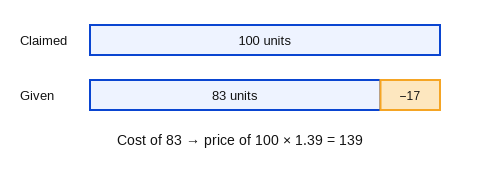
  1. Let cost of 1 unit = ₹1. He claims 100 units and charges 100×1.39=139.
  2. He actually gives 100−17=83 units, costing ₹83.
  3. Gain%=139−8383×100=560083≈67.47%≈67%

Trick: 1+391001−17100=13983≈1.675 → about 67%.

Answer: (C) 67%

अवधारणा: बेईमान विक्रेता दो बार लाभ कमाता है: बढ़े मूल्य से और कम तौल से। लाभ%=(प्राप्त मूल्यदिए गए माल की लागत−1)×100।

  1. 1 इकाई का क्रय मूल्य ₹1 मानें। वह 100 इकाई बताकर 100×1.39=139 लेता है।
  2. वह वास्तव में 100−17=83 इकाई देता है, जिसकी लागत ₹83 है।
  3. लाभ%=139−8383×100=560083≈67.47%≈67%

ट्रिक: 1+391001−17100=13983≈1.675 → लगभग 67%।

उत्तर: (C) 67%

RRB NTPC Undergraduate CBT 1MathematicsProfit and loss – faulty weightsRRB NTPC Undergraduate CBT 1 2024 · 11 Aug Shift 1 →
Q3970.
What is the value of 400+0.0225−9?
400+0.0225−9 का मान क्या है?
  1. A1.54
  2. B14.54
  3. C12.19
  4. D17.15
Show answer

Concept: Take the square root of each term separately, then add/subtract.

  1. 400=20
  2. 0.0225=22510000=15100=0.15
  3. 9=3
  4. 20+0.15−3=17.15

Trick: Decimal places in a square root = half of those in the number: 0.0225 has 4 places → root 0.15 has 2.

Answer: (D) 17.15

अवधारणा: प्रत्येक पद का वर्गमूल अलग-अलग निकालें, फिर जोड़ें/घटाएँ।

  1. 400=20
  2. 0.0225=22510000=15100=0.15
  3. 9=3
  4. 20+0.15−3=17.15

ट्रिक: वर्गमूल में दशमलव स्थान संख्या के आधे होते हैं: 0.0225 में 4 स्थान → मूल 0.15 में 2।

उत्तर: (D) 17.15

RRB NTPC Undergraduate CBT 1MathematicsSquare rootsRRB NTPC Undergraduate CBT 1 2024 · 11 Aug Shift 1 →
Q3971.
What is the largest number that divides 527 and 632 leaving remainders 7 and 8 respectively?
वह सबसे बड़ी संख्या कौन-सी है जिससे 527 और 632 को विभाजित करने पर क्रमशः 7 और 8 शेषफल प्राप्त होते हैं?
  1. A102
  2. B104
  3. C112
  4. D98
Show answer

Concept: If a number N leaves remainders r1,r2 on dividing a,b, then N=HCF(a−r1,b−r2).

  1. 527−7=520 and 632−8=624
  2. 520=23×5×13, 624=24×3×13
  3. HCF=23×13=104
  4. Check: 527=5×10⁴+7, 632=6×10⁴+8 ✔ (and 104>8)

Trick: 624−520=104; the HCF must divide this difference, and 104 itself divides both → answer 104.

Answer: (B) 104

अवधारणा: यदि संख्या N से a,b को भाग देने पर शेष r1,r2 बचें, तो N=HCF(a−r1,b−r2)।

  1. 527−7=520 और 632−8=624
  2. 520=23×5×13, 624=24×3×13
  3. HCF=23×13=104
  4. जाँच: 527=5×10⁴+7, 632=6×10⁴+8 ✔

ट्रिक: 624−520=104; HCF इस अंतर को विभाजित करता है, और 104 दोनों को विभाजित करता है → उत्तर 104।

उत्तर: (B) 104

RRB NTPC Undergraduate CBT 1MathematicsHCF – remaindersRRB NTPC Undergraduate CBT 1 2024 · 11 Aug Shift 1 →
Q3972.
₹74,000 is divided among A, B and C in such a way that 9 times A's share = 3 times B's share = 7 times C's share. What is A's share?
₹74,000 को A, B और C में इस प्रकार बाँटा जाता है कि A के हिस्से का 9 गुना = B के हिस्से का 3 गुना = C के हिस्से का 7 गुना है। A का हिस्सा कितना है?
  1. A₹14,194
  2. B₹13,816
  3. C₹14,000
  4. D₹13,865
Show answer

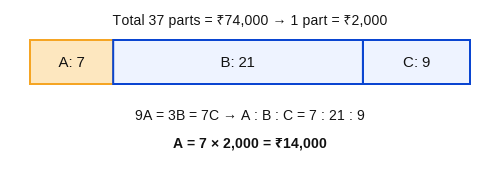
Concept: If 9A=3B=7C=k, then A:B:C=19:13:17; multiply by LCM of 9,3,7=63.

  1. A:B:C=639:633:637=7:21:9
  2. Total parts =7+21+9=37
  3. 1 part =7400037=2000
  4. A=7×2000=14000

Trick: The share is inversely proportional to the multiplier: smallest multiplier 3 (B) gets the largest share.

Answer: (C) ₹14,000

अवधारणा: यदि 9A=3B=7C=k, तो A:B:C=19:13:17; 9,3,7 के LCM =63 से गुणा करें।

  1. A:B:C=639:633:637=7:21:9
  2. कुल भाग =7+21+9=37
  3. 1 भाग =7400037=2000
  4. A=7×2000=14000

ट्रिक: हिस्सा गुणक के व्युत्क्रमानुपाती है: सबसे छोटा गुणक 3 (B) → सबसे बड़ा हिस्सा।

उत्तर: (C) ₹14,000

RRB NTPC Undergraduate CBT 1MathematicsRatio and proportionRRB NTPC Undergraduate CBT 1 2024 · 11 Aug Shift 1 →
Q3973.
Simplify.
x(6x−3)+5(x2−4)+18
सरल कीजिए।
x(6x−3)+5(x2−4)+18
  1. A−11x2−3x+2
  2. B11x2−3x−2
  3. C11x2−3x+2
  4. D−11x2−3x−2
Show answer

Concept: Expand each bracket, then combine like terms.

  1. x(6x−3)=6x2−3x
  2. 5(x2−4)=5x2−20
  3. Sum: 6x2−3x+5x2−20+18=11x2−3x−2

Trick: Put x=1: expression =3+(−15)+18=6; option (B) gives 11−3−2=6 ✔.

Answer: (B) 11x2−3x−2

अवधारणा: प्रत्येक कोष्ठक खोलें, फिर समान पदों को जोड़ें।

  1. x(6x−3)=6x2−3x
  2. 5(x2−4)=5x2−20
  3. योग: 6x2−3x+5x2−20+18=11x2−3x−2

ट्रिक: x=1 रखें: व्यंजक =3+(−15)+18=6; विकल्प (B) 11−3−2=6 ✔।

उत्तर: (B) 11x2−3x−2

RRB NTPC Undergraduate CBT 1MathematicsAlgebraic simplificationRRB NTPC Undergraduate CBT 1 2024 · 11 Aug Shift 1 →
Q3974.
How many prime numbers are there between 466 and 476 (both numbers included)?
466 और 476 के बीच (दोनों संख्याओं सहित) कितनी अभाज्य संख्याएँ हैं?
  1. A1
  2. B2
  3. C3
  4. D5
Show answer

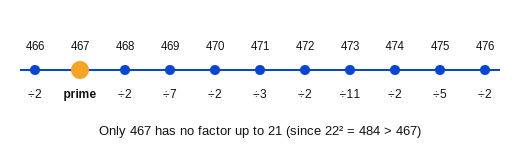
Concept: To test n for primality, check divisibility by primes up to n. Here 476<22, so test 2, 3, 5, 7, 11, 13, 17, 19.

  1. Even numbers 466, 468, 470, 472, 474, 476 are out; 475 ends in 5.
  2. 469=7×67, 471=3×157, 473=11×43
  3. 467 is not divisible by 2, 3, 5, 7, 11, 13, 17 or 19 → prime.
  4. So only one prime: 467.

Trick: Between consecutive odd numbers, quickly test 3 (digit sum), 7 and 11 (alternating sum) first – they remove most candidates.

Answer: (A) 1

अवधारणा: n के अभाज्य होने की जाँच के लिए n तक के अभाज्यों से भाग दें। यहाँ 476<22, अतः 2, 3, 5, 7, 11, 13, 17, 19 जाँचें।

  1. सम संख्याएँ 466, 468, 470, 472, 474, 476 बाहर; 475 के अंत में 5 है।
  2. 469=7×67, 471=3×157, 473=11×43
  3. 467 किसी भी 2, 3, 5, 7, 11, 13, 17, 19 से विभाज्य नहीं → अभाज्य।
  4. अतः केवल एक अभाज्य: 467।

ट्रिक: पहले 3 (अंकों का योग), 7 और 11 (एकांतर योग) जाँचें – अधिकांश संख्याएँ यहीं कट जाती हैं।

उत्तर: (A) 1

RRB NTPC Undergraduate CBT 1MathematicsPrime numbersRRB NTPC Undergraduate CBT 1 2024 · 11 Aug Shift 1 →
Q3975.
79 plates were bought for ₹79 and 13 plates broke during transportation. The trader sold each of the remaining plates at ₹5.90. Find the trader's profit.
₹79 में 79 प्लेटें खरीदी गईं और परिवहन के दौरान 13 प्लेटें टूट गईं। व्यापारी ने शेष प्रत्येक प्लेट ₹5.90 में बेची। व्यापारी का लाभ ज्ञात कीजिए।
  1. A₹314.90
  2. B₹305.40
  3. C₹316.40
  4. D₹310.40
Show answer

Concept: Profit=SP of plates sold−CP of all plates; broken plates add to cost but give no revenue.

  1. CP of 79 plates = ₹79
  2. Plates left =79−13=66
  3. SP =66×5.90=389.40
  4. Profit =389.40−79=310.40

Trick: 66×5.9=66×6−66×0.1=396−6.6=389.4.

Answer: (D) ₹310.40

अवधारणा: लाभ=बेची गई प्लेटों का विक्रय मूल्य−सभी प्लेटों का क्रय मूल्य; टूटी प्लेटें लागत में जुड़ती हैं पर आय नहीं देतीं।

  1. 79 प्लेटों का क्रय मूल्य = ₹79
  2. बची प्लेटें =79−13=66
  3. विक्रय मूल्य =66×5.90=389.40
  4. लाभ =389.40−79=310.40

ट्रिक: 66×5.9=66×6−66×0.1=396−6.6=389.4।

उत्तर: (D) ₹310.40

RRB NTPC Undergraduate CBT 1MathematicsProfit and lossRRB NTPC Undergraduate CBT 1 2024 · 11 Aug Shift 1 →
Q3976.
A woman covers a distance of 282 km at a speed of 47 km/hr, the next 120 km at a speed of 20 km/hr and the next 496 km at a speed of 62 km/hr. What is her average speed (in km/hr) for the whole journey?
एक महिला 282 km की दूरी 47 km/hr की चाल से, अगले 120 km की दूरी 20 km/hr की चाल से और अगले 496 km की दूरी 62 km/hr की चाल से तय करती है। पूरी यात्रा के लिए उसकी औसत चाल (km/hr में) कितनी है?
  1. A52.2
  2. B44.9
  3. C53.6
  4. D46.7
Show answer

Concept: Average speed =total distancetotal time (not the average of the speeds).

  1. Total distance =282+120+496=898km.
  2. Times: 28247=6, 12020=6, 49662=8 hours; total =20 h.
  3. Average speed =89820=44.9km/h.

Trick: Each distance is an exact multiple of its speed – divide first, then add the hours.

Answer: (B) 44.9

अवधारणा: औसत चाल =कुल दूरीकुल समय (चालों का औसत नहीं)।

  1. कुल दूरी =282+120+496=898km।
  2. समय: 28247=6, 12020=6, 49662=8 घंटे; कुल =20 घंटे।
  3. औसत चाल =89820=44.9km/h।

ट्रिक: हर दूरी अपनी चाल का पूरा गुणज है – पहले भाग दें, फिर घंटे जोड़ें।

उत्तर: (B) 44.9

RRB NTPC Undergraduate CBT 1MathematicsAverage speedRRB NTPC Undergraduate CBT 1 2024 · 11 Aug Shift 1 →
Q3977.
Find the volume of a sphere having a diameter of 30 cm. (Take π=227)
30 cm व्यास वाले एक गोले का आयतन ज्ञात कीजिए। (π=227 लीजिए)
  1. A14,130 cm3
  2. B14,230 cm3
  3. C15,230 cm3
  4. D15,130 cm3
Show answer

Concept: Volume of a sphere =43πr3.

  1. Diameter =30cm, so r=15cm and r3=3375.
  2. V=43×227×3375=990007≈14142.9cm3.
  3. The nearest option is 14130cm3 (this exact value comes from π=3.14: 43×3.14×3375=14130).

Trick: 43πr3=4π×r33: 33753=1125, then 4×1125=4500, 4500π.

Answer: (A) 14,130cm3

अवधारणा: गोले का आयतन =43πr3।

  1. व्यास =30cm, अतः r=15cm, r3=3375।
  2. V=43×227×3375=990007≈14142.9cm3।
  3. निकटतम विकल्प 14130cm3 है (यह सटीक मान π=3.14 लेने पर आता है: 43×3.14×3375=14130)।

ट्रिक: 33753=1125, 4×1125=4500, यानी V=4500π।

उत्तर: (A) 14,130cm3

RRB NTPC Undergraduate CBT 1MathematicsVolume of sphereRRB NTPC Undergraduate CBT 1 2024 · 11 Aug Shift 1 →
Q3978.
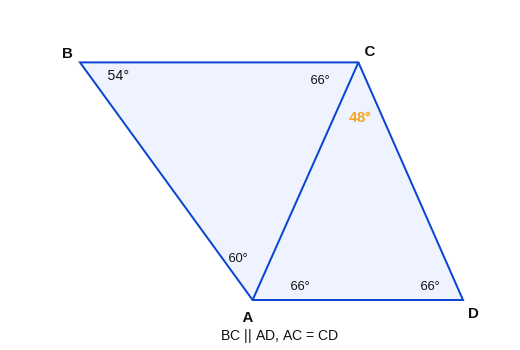
ABCD is a trapezium in which BC ∥ AD and AC = CD. If ∠ABC = 54° and ∠BAC = 60°, then what is the measure (in degrees) of ∠ACD?
ABCD एक समलंब है जिसमें BC ∥ AD और AC = CD है। यदि ∠ABC = 54° और ∠BAC = 60° है, तो ∠ACD का माप (डिग्री में) कितना है?
  1. A184
  2. B48
  3. C171
  4. D181
Show answer

Concept: Parallel lines give equal alternate angles; equal sides of a triangle face equal angles.

  1. In △ABC: ∠ACB=180∘−54∘−60∘=66∘.
  2. BC∥AD, so ∠CAD=∠ACB=66∘ (alternate angles).
  3. AC=CD⇒∠CDA=∠CAD=66∘.
  4. ∠ACD=180∘−66∘−66∘=48∘.

Trick: Once you get 66∘, the answer is simply 180∘−2×66∘.

Answer: (B) 48∘

अवधारणा: समांतर रेखाओं से एकांतर कोण बराबर होते हैं; त्रिभुज की बराबर भुजाओं के सामने के कोण बराबर होते हैं।

  1. △ABC में: ∠ACB=180∘−54∘−60∘=66∘।
  2. BC∥AD, अतः ∠CAD=∠ACB=66∘ (एकांतर कोण)।
  3. AC=CD⇒∠CDA=∠CAD=66∘।
  4. ∠ACD=180∘−66∘−66∘=48∘।

ट्रिक: 66∘ मिलते ही उत्तर =180∘−2×66∘।

उत्तर: (B) 48∘

RRB NTPC Undergraduate CBT 1MathematicsTrapezium and isosceles triangleRRB NTPC Undergraduate CBT 1 2024 · 11 Aug Shift 1 →
Q3979.
By which number will 740705 be divisible?
740705 किस संख्या से विभाज्य होगी?
  1. A12
  2. B4
  3. C5
  4. D9
Show answer

Concept: A number is divisible by 5 if its last digit is 0 or 5.

  1. 740705 ends in 5 → divisible by 5.
  2. It is odd, so not divisible by 4 or 12.
  3. Digit sum =7+4+0+7+0+5=23, not a multiple of 9 (or 3).

Trick: Check the last digit first – it settles 2, 4, 5 and 10 at a glance.

Answer: (C) 5

अवधारणा: जिस संख्या का अंतिम अंक 0 या 5 हो, वह 5 से विभाज्य होती है।

  1. 740705 का अंतिम अंक 5 → 5 से विभाज्य।
  2. संख्या विषम है, इसलिए 4 या 12 से विभाज्य नहीं।
  3. अंकों का योग =23, जो 9 (या 3) का गुणज नहीं।

ट्रिक: पहले अंतिम अंक देखें – 2, 4, 5, 10 तुरंत तय हो जाते हैं।

उत्तर: (C) 5

RRB NTPC Undergraduate CBT 1MathematicsDivisibility rulesRRB NTPC Undergraduate CBT 1 2024 · 11 Aug Shift 1 →
Q3980.
Ritu, Sameer and Isha start a business by investing ₹1,350, ₹1,470 and ₹1,380 respectively. If the total profit at the end of the year is ₹1,330, what will be Isha's share of the profit?
रितु, समीर और ईशा क्रमशः ₹1,350, ₹1,470 और ₹1,380 का निवेश करके एक व्यवसाय शुरू करते हैं। यदि वर्ष के अंत में कुल लाभ ₹1,330 है, तो लाभ में ईशा का हिस्सा कितना होगा?
  1. A₹439
  2. B₹435
  3. C₹437
  4. D₹438
Show answer

Concept: When time is the same, profit is shared in the ratio of investments.

  1. Ratio 1350:1470:1380=135:147:138=45:49:46 (sum 140).
  2. Isha's share =46140×1330=46×9.5=437.

Trick: Divide total profit by the ratio sum first: 1330140=9.5 per part.

Answer: (C) ₹437

अवधारणा: समय समान हो तो लाभ निवेश के अनुपात में बँटता है।

  1. अनुपात 1350:1470:1380=45:49:46 (योग 140)।
  2. ईशा का हिस्सा =46140×1330=46×9.5=437।

ट्रिक: पहले एक भाग का मान: 1330140=9.5।

उत्तर: (C) ₹437

RRB NTPC Undergraduate CBT 1MathematicsPartnershipRRB NTPC Undergraduate CBT 1 2024 · 11 Aug Shift 1 →