Question bank

Q&A: practice questions with answers

Search questions on any topic. Filter by exam category, exam, subject and topic, try the question, then open the answer and explanation.

Courses – airGurukul

20,719 questions found.

Q4081.
Mahesh bought some pens at the rate of ₹180 a dozen. He sold them for ₹19 each. His profit percentage is ______.
(Round off your answer to two decimal places.)
महेश ने ₹180 प्रति दर्जन की दर से कुछ पेन खरीदे। उसने उन्हें ₹19 प्रति पेन की दर से बेचा। उसका लाभ प्रतिशत ______ है।
(अपने उत्तर को दशमलव के दो स्थानों तक पूर्णांकित कीजिए।)
  1. A30.67%
  2. B26.67%
  3. C24.67%
  4. D28.67%
Show answer

Concept: Profit%=SP−CPCP×100 per pen.

  1. CP of one pen =18012= ₹15.
  2. SP of one pen = ₹19, profit = ₹4.
  3. Profit%=415×100=26.67%.

Trick: 115=6.67%, so 415=26.67%.

Answer: (B) 26.67%

अवधारणा: लाभ%=विक्रय मूल्य−क्रय मूल्यक्रय मूल्य×100 (प्रति पेन)।

  1. एक पेन का क्रय मूल्य =18012= ₹15।
  2. एक पेन का विक्रय मूल्य ₹19, लाभ = ₹4।
  3. लाभ%=415×100=26.67%।

ट्रिक: 115=6.67%, अतः 415=26.67%।

उत्तर: (B) 26.67%

RRB NTPC Undergraduate CBT 1MathematicsProfit and LossRRB NTPC Undergraduate CBT 1 2024 · 9 Sep Shift 3 →
Q4082.
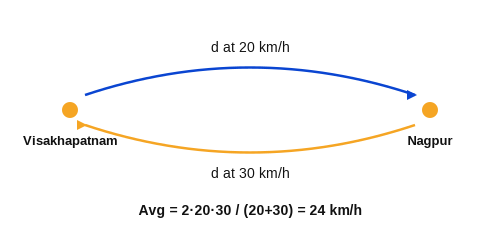
A man goes to Nagpur from Visakhapatnam at a speed of 20 km/hr and returns to Visakhapatnam at speed of 30 km/hr, through the same route. What is his average speed (in km/hr) of the entire journey?
एक व्यक्ति विशाखापत्तनम से नागपुर 20 km/hr की चाल से जाता है और उसी मार्ग से 30 km/hr की चाल से विशाखापत्तनम लौटता है। पूरी यात्रा की उसकी औसत चाल (km/hr में) क्या है?
  1. A24
  2. B23
  3. C22
  4. D26
Show answer

Concept: For equal distances at speeds x and y: average speed =2xyx+y.

  1. x=20, y=30 (same route both ways).
  2. Average =2×20×3020+30=120050=24km/h.

Trick: Average speed for equal distances is always a little less than the simple mean (25).

Answer: (A) 24

अवधारणा: समान दूरी को x व y चाल से तय करने पर औसत चाल =2xyx+y।

  1. x=20, y=30 (एक ही मार्ग से आना-जाना)।
  2. औसत =2×20×3020+30=120050=24km/h।

ट्रिक: समान दूरी पर औसत चाल हमेशा साधारण माध्य (25) से थोड़ी कम होती है।

उत्तर: (A) 24

RRB NTPC Undergraduate CBT 1MathematicsAverage SpeedRRB NTPC Undergraduate CBT 1 2024 · 9 Sep Shift 3 →
Q4083.
A number when increased by 100% gives 2770. The number is:
एक संख्या में 100% की वृद्धि करने पर 2770 प्राप्त होता है। वह संख्या है:
  1. A4155
  2. B2770
  3. C1385
  4. D692.5
Show answer

Concept: Increasing by 100% means the number becomes double.

  1. x+100% of x=2x=2770.
  2. x=27702=1385.

Trick: +100% = ×2, so just halve the result.

Answer: (C) 1385

अवधारणा: 100% बढ़ाने पर संख्या दोगुनी हो जाती है।

  1. x+x का 100%=2x=2770।
  2. x=27702=1385।

ट्रिक: +100% = ×2, इसलिए परिणाम को आधा कर दें।

उत्तर: (C) 1385

RRB NTPC Undergraduate CBT 1MathematicsPercentageRRB NTPC Undergraduate CBT 1 2024 · 9 Sep Shift 3 →
Q4084.
The HCF and the LCM of two numbers are 13 and 1170, respectively. If one of the numbers is 130, find the other one.
दो संख्याओं का HCF और LCM क्रमशः 13 और 1170 है। यदि उनमें से एक संख्या 130 है, तो दूसरी संख्या ज्ञात कीजिए।
  1. A91
  2. B104
  3. C117
  4. D143
Show answer

Concept: Product of two numbers = HCF × LCM.

  1. Other number =13×1170130.
  2. =15210130=117.
  3. Check: HCF(130,117)=13 ✓

Trick: Other number must be a multiple of HCF 13: 117=13×9.

Answer: (C) 117

अवधारणा: दो संख्याओं का गुणनफल = HCF × LCM।

  1. दूसरी संख्या =13×1170130।
  2. =15210130=117।
  3. जाँच: HCF(130,117)=13 ✓

ट्रिक: दूसरी संख्या HCF 13 का गुणज होनी चाहिए: 117=13×9।

उत्तर: (C) 117

RRB NTPC Undergraduate CBT 1MathematicsHCF and LCMRRB NTPC Undergraduate CBT 1 2024 · 9 Sep Shift 3 →
Q4085.
Simplify: 3((63)x2−23x+18)−6(x2+4x−15)
सरल कीजिए: 3((63)x2−23x+18)−6(x2+4x−15)
  1. A93x + 144
  2. B93x − 144
  3. C−93x − 144
  4. D−93x + 144
Show answer

Concept: Simplify the bracket, expand, then combine like terms.

  1. 63=2, so first part =3(2x2−23x+18)=6x2−69x+54.
  2. Second part =6x2+24x−90.
  3. Subtract: 6x2−69x+54−6x2−24x+90=−93x+144.

Trick: The x2 terms cancel; watch the sign: −6×(−15)=+90.

Answer: (D) −93x+144

अवधारणा: कोष्ठक सरल करें, गुणा करके फैलाएँ, फिर समान पद जोड़ें।

  1. 63=2, पहला भाग =3(2x2−23x+18)=6x2−69x+54।
  2. दूसरा भाग =6x2+24x−90।
  3. घटाएँ: 6x2−69x+54−6x2−24x+90=−93x+144।

ट्रिक: x2 पद कट जाते हैं; चिह्न ध्यान रखें: −6×(−15)=+90।

उत्तर: (D) −93x+144

RRB NTPC Undergraduate CBT 1MathematicsAlgebraic SimplificationRRB NTPC Undergraduate CBT 1 2024 · 9 Sep Shift 3 →
Q4086.
What is the discount on a product with a list price of ₹3,000 and a discount rate of 25%?
₹3,000 सूची मूल्य और 25% छूट दर वाले एक उत्पाद पर छूट कितनी है?
  1. A₹1,000
  2. B₹700
  3. C₹750
  4. D₹900
Show answer

Concept: Discount = discount rate × list price.

  1. Discount =25% of 3000=25100×3000.
  2. = ₹750.

Trick: 25% = one-fourth: 3000÷4=750.

Answer: (C) ₹750

अवधारणा: छूट = छूट दर × सूची मूल्य।

  1. छूट =3000 का 25%=25100×3000।
  2. = ₹750।

ट्रिक: 25% = एक-चौथाई: 3000÷4=750।

उत्तर: (C) ₹750

RRB NTPC Undergraduate CBT 1MathematicsDiscountRRB NTPC Undergraduate CBT 1 2024 · 9 Sep Shift 3 →
Q4087.
Aman and Pawan together invested ₹62,800 in a business. At the end of the year, out of a total profit of ₹11,600, Pawan's share was ₹2,900. What was the difference between their investments?
अमन और पवन ने मिलकर एक व्यवसाय में ₹62,800 का निवेश किया। वर्ष के अंत में, ₹11,600 के कुल लाभ में से पवन का हिस्सा ₹2,900 था। उनके निवेशों के बीच का अंतर कितना था?
  1. A₹32,000
  2. B₹31,800
  3. C₹31,400
  4. D₹30,400
Show answer

Concept: For the same time period, profit is shared in the ratio of investments.

  1. Aman's profit =11600−2900= ₹8700; ratio Aman : Pawan =8700:2900=3:1.
  2. Investments: Aman =34×62800= ₹47100, Pawan = ₹15700.
  3. Difference =47100−15700= ₹31400.

Trick: Difference =3−14×62800=12×62800= ₹31400.

Answer: (C) ₹31,400

अवधारणा: समान अवधि में लाभ, निवेश के अनुपात में बँटता है।

  1. अमन का लाभ =11600−2900= ₹8700; अनुपात अमन : पवन =8700:2900=3:1।
  2. निवेश: अमन =34×62800= ₹47100, पवन = ₹15700।
  3. अंतर =47100−15700= ₹31400।

ट्रिक: अंतर =3−14×62800=12×62800= ₹31400।

उत्तर: (C) ₹31,400

RRB NTPC Undergraduate CBT 1MathematicsPartnershipRRB NTPC Undergraduate CBT 1 2024 · 9 Sep Shift 3 →
Q4088.
The product of two consecutive natural numbers is 306. The greater of the two numbers is:
दो क्रमागत प्राकृत संख्याओं का गुणनफल 306 है। दोनों संख्याओं में से बड़ी संख्या है:
  1. A19
  2. B18
  3. C31
  4. D36
Show answer

Concept: Product n(n+1) is close to n2; take 306≈17.5.

  1. Try 17×18=306 ✓.
  2. The two numbers are 17 and 18; greater is 18.

Trick: Last digit 6 → numbers end in 2&3 or 7&8; near 306 gives 17, 18.

Answer: (B) 18

अवधारणा: गुणनफल n(n+1) लगभग n2 होता है; 306≈17.5।

  1. जाँच: 17×18=306 ✓।
  2. संख्याएँ 17 और 18; बड़ी संख्या 18।

ट्रिक: इकाई अंक 6 → संख्याएँ 2-3 या 7-8 पर समाप्त; 306 के पास 17, 18।

उत्तर: (B) 18

RRB NTPC Undergraduate CBT 1MathematicsNumber SystemRRB NTPC Undergraduate CBT 1 2024 · 9 Sep Shift 3 →
Q4089.
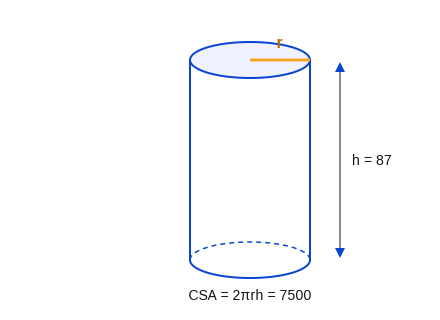
A cylindrical rod has an outer curved surface area of 7500 cm2. If the length of the rod is 87 cm, then the outer radius (in cm) of the rod, correct to two places of decimal, is:
(Take π=227)
एक बेलनाकार छड़ का बाहरी वक्र पृष्ठीय क्षेत्रफल 7500 cm2 है। यदि छड़ की लंबाई 87 cm है, तो दशमलव के दो स्थानों तक सही, छड़ की बाहरी त्रिज्या (cm में) है:
(π=227 लीजिए)
  1. A16.52
  2. B13.71
  3. C16.68
  4. D13.96
Show answer

Concept: Curved surface area of a cylinder =2πrh.

  1. 2×227×r×87=7500.
  2. r=7500×744×87=525003828.
  3. r≈13.71cm.

Trick: Quick estimate: 2πh≈547, and 7500÷547≈13.7.

Answer: (B) 13.71

अवधारणा: बेलन का वक्र पृष्ठीय क्षेत्रफल =2πrh।

  1. 2×227×r×87=7500।
  2. r=7500×744×87=525003828।
  3. r≈13.71cm।

ट्रिक: अनुमान: 2πh≈547, और 7500÷547≈13.7।

उत्तर: (B) 13.71

RRB NTPC Undergraduate CBT 1MathematicsMensuration – CylinderRRB NTPC Undergraduate CBT 1 2024 · 9 Sep Shift 3 →
Q4090.
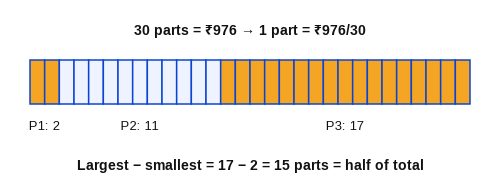
An amount of ₹976 is divided among three persons in the ratio of 2 : 11 : 17. The difference between the largest and the smallest shares (in ₹) in the distribution is:
₹976 की राशि को तीन व्यक्तियों में 2 : 11 : 17 के अनुपात में विभाजित किया जाता है। इस वितरण में सबसे बड़े और सबसे छोटे हिस्सों (₹ में) के बीच का अंतर है:
  1. A488
  2. B531
  3. C495
  4. D517
Show answer

Concept: Share = (its ratio part ÷ total parts) × amount.

  1. Total parts =2+11+17=30; 1 part =97630.
  2. Difference = 17−2=15 parts.
  3. 15×97630=9762= ₹488.

Trick: 15 parts out of 30 is exactly half of ₹976.

Answer: (A) 488

अवधारणा: हिस्सा = (उसके भाग ÷ कुल भाग) × राशि।

  1. कुल भाग =2+11+17=30; 1 भाग =97630।
  2. अंतर = 17−2=15 भाग।
  3. 15×97630=9762= ₹488।

ट्रिक: 30 में से 15 भाग = ₹976 का ठीक आधा।

उत्तर: (A) 488

RRB NTPC Undergraduate CBT 1MathematicsRatio and ProportionRRB NTPC Undergraduate CBT 1 2024 · 9 Sep Shift 3 →
Q4091.
The number 869671195 is divisible by which of the following?
संख्या 869671195 निम्नलिखित में से किससे विभाज्य है?
  1. A5
  2. B13
  3. C12
  4. D15
Show answer

Concept: Divisible by 5 if the last digit is 0 or 5; by 3 if the digit sum is divisible by 3.

  1. Last digit is 5 → divisible by 5 ✓.
  2. Digit sum =8+6+9+6+7+1+1+9+5=52, not divisible by 3 → not by 15 or 12.
  3. It is odd, so not divisible by 12 either.

Trick: Check the easiest rule first – the last digit.

Answer: (A) 5

अवधारणा: 5 से विभाज्य यदि इकाई अंक 0 या 5; 3 से विभाज्य यदि अंकों का योग 3 से विभाज्य।

  1. इकाई अंक 5 → 5 से विभाज्य ✓।
  2. अंकों का योग =8+6+9+6+7+1+1+9+5=52, 3 से विभाज्य नहीं → 15 से भी नहीं।
  3. संख्या विषम है, अतः 12 से भी नहीं।

ट्रिक: सबसे आसान नियम पहले – इकाई अंक देखें।

उत्तर: (A) 5

RRB NTPC Undergraduate CBT 1MathematicsDivisibility RulesRRB NTPC Undergraduate CBT 1 2024 · 9 Sep Shift 3 →
Q4092.
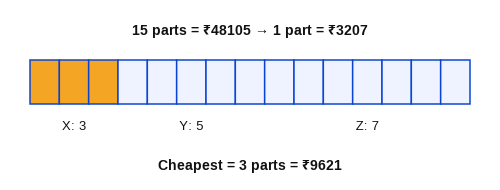
The average price of three items of furniture is ₹16,035. If their prices are in the ratio 3 : 5 : 7, the price of the cheapest item (in ₹) is:
फ़र्नीचर की तीन वस्तुओं का औसत मूल्य ₹16,035 है। यदि उनके मूल्य 3 : 5 : 7 के अनुपात में हैं, तो सबसे सस्ती वस्तु का मूल्य (₹ में) है:
  1. A3,207
  2. B7,483
  3. C5,345
  4. D9,621
Show answer

Concept: Total = average × count; split total in the given ratio.

  1. Total price =3×16035= ₹48105.
  2. Total parts =3+5+7=15; 1 part =4810515= ₹3207.
  3. Cheapest =3×3207= ₹9621.

Trick: Average of the ratio terms is 5 parts = ₹16035, so 1 part = ₹3207 directly.

Answer: (D) 9,621

अवधारणा: कुल = औसत × संख्या; कुल को दिए अनुपात में बाँटें।

  1. कुल मूल्य =3×16035= ₹48105।
  2. कुल भाग =3+5+7=15; 1 भाग =4810515= ₹3207।
  3. सबसे सस्ती =3×3207= ₹9621।

ट्रिक: अनुपात के पदों का औसत 5 भाग = ₹16035, तो सीधे 1 भाग = ₹3207।

उत्तर: (D) 9,621

RRB NTPC Undergraduate CBT 1MathematicsAverage and RatioRRB NTPC Undergraduate CBT 1 2024 · 9 Sep Shift 3 →
Q4093.
Find the value of 14−23×25−23×15−23.
14−23×25−23×15−23 का मान ज्ञात कीजिए।
  1. A1525723
  2. B1521423
  3. C1524323
  4. D1525023
Show answer

Concept: am×bm×cm=(abc)m and a−m=1am.

  1. 14−23×25−23×15−23=(14×25×15)−23.
  2. 14×25×15=5250.
  3. Value =5250−23=1525023.

Trick: 14×15=210, 210×25=5250.

Answer: (D) 1525023

अवधारणा: am×bm×cm=(abc)m तथा a−m=1am।

  1. 14−23×25−23×15−23=(14×25×15)−23।
  2. 14×25×15=5250।
  3. मान =5250−23=1525023।

ट्रिक: 14×15=210, 210×25=5250।

उत्तर: (D) 1525023

RRB NTPC Undergraduate CBT 1MathematicsLaws of ExponentsRRB NTPC Undergraduate CBT 1 2024 · 9 Sep Shift 3 →
Q4094.
By selling an article at 25 of its actual selling price, Aman incurs a loss of 24%.
If he sells it at 81% of its actual selling price, then the profit percentage is:
किसी वस्तु को उसके वास्तविक विक्रय मूल्य के 25 पर बेचने से अमन को 24% की हानि होती है।
यदि वह इसे इसके वास्तविक विक्रय मूल्य के 81% पर बेचता है, तो लाभ प्रतिशत है:
  1. A55.9%
  2. B55.7%
  3. C55.5%
  4. D53.9%
Show answer

Concept: Relate the selling price (SP) to the cost price (CP) using the loss condition.

  1. 25SP=0.76CP (loss 24%).
  2. SP=0.76×52CP=1.9CP.
  3. New price =0.81×1.9CP=1.539CP → profit 53.9%.

Trick: Take CP = 100: 25SP=76 → SP = 190; 81% of 190=153.9.

Answer: (D) 53.9%

अवधारणा: हानि की शर्त से विक्रय मूल्य (SP) को क्रय मूल्य (CP) से जोड़ें।

  1. 25SP=0.76CP (24% हानि)।
  2. SP=0.76×52CP=1.9CP।
  3. नया मूल्य =0.81×1.9CP=1.539CP → लाभ 53.9%।

ट्रिक: CP = 100 लें: 25SP=76 → SP = 190; 190 का 81%=153.9।

उत्तर: (D) 53.9%

RRB NTPC Undergraduate CBT 1MathematicsProfit and LossRRB NTPC Undergraduate CBT 1 2024 · 9 Sep Shift 3 →
Q4095.
If the third proportional of 26 and 52 be x, then what is the value of x?
यदि 26 और 52 का तृतीयानुपाती x है, तो x का मान क्या है?
  1. A107
  2. B104
  3. C102
  4. D106
Show answer

Concept: Third proportional of a and b is x where a:b=b:x, i.e. x=b2a.

  1. x=52226=270426.
  2. x=104.

Trick: 52=2×26, so x=2×52=104 (ratio doubles each time).

Answer: (B) 104

अवधारणा: a और b का तृतीय समानुपाती x: a:b=b:x, अर्थात x=b2a।

  1. x=52226=270426।
  2. x=104।

ट्रिक: 52=2×26, अतः x=2×52=104 (हर बार दोगुना)।

उत्तर: (B) 104

RRB NTPC Undergraduate CBT 1MathematicsThird ProportionalRRB NTPC Undergraduate CBT 1 2024 · 9 Sep Shift 3 →
Q4096.
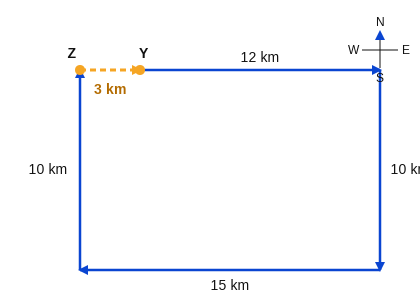
Priya starts from Point Y and drives 12 km towards the east. She then takes a right turn, drives 10 km. She then turns right and drives 15 km. She takes a final right turn, drives 10 km and stops at Point Z. How far (shortest distance) and towards which direction should she drive in order to reach Point Y again? (All turns are 90-degree turns only unless specified)
प्रिया बिंदु Y से चलना शुरू करती है और पूर्व की ओर 12 km गाड़ी चलाती है। फिर वह दाएँ मुड़ती है और 10 km गाड़ी चलाती है। फिर वह दाएँ मुड़ती है और 15 km गाड़ी चलाती है। वह अंतिम बार दाएँ मुड़ती है, 10 km गाड़ी चलाती है और बिंदु Z पर रुक जाती है। बिंदु Y पर फिर से पहुँचने के लिए उसे कितनी दूर (न्यूनतम दूरी) और किस दिशा में गाड़ी चलानी चाहिए? (जब तक निर्दिष्ट न किया जाए, सभी मोड़ केवल 90 डिग्री के हैं)
  1. A9 km towards northउत्तर की ओर 9 km
  2. B3 km towards eastपूर्व की ओर 3 km
  3. C7 km towards southदक्षिण की ओर 7 km
  4. D2 km towards westपश्चिम की ओर 2 km
Show answer

Concept: Trace the path on axes (east = +x, north = +y) and compare the end point with the start.

  1. Y(0, 0) → 12 km east → (12, 0).
  2. Right turn = south 10 km → (12, −10); right = west 15 km → (−3, −10).
  3. Right = north 10 km → Z(−3, 0).
  4. Z is 3 km west of Y, so she must drive 3 km towards east.

Trick: North–south moves cancel (10 and 10); net east–west =12−15=−3 → 3 km west of Y.

Answer: (B) 3 km towards east

अवधारणा: मार्ग को अक्षों पर बनाएँ (पूर्व = +x, उत्तर = +y) और अंतिम बिंदु की तुलना आरंभ से करें।

  1. Y(0, 0) → 12 km पूर्व → (12, 0)।
  2. दाएँ मुड़कर दक्षिण 10 km → (12, −10); दाएँ = पश्चिम 15 km → (−3, −10)।
  3. दाएँ = उत्तर 10 km → Z(−3, 0)।
  4. Z, Y से 3 km पश्चिम में है, अतः उसे 3 km पूर्व की ओर जाना होगा।

ट्रिक: उत्तर-दक्षिण गति कट जाती है (10 और 10); पूर्व-पश्चिम =12−15=−3 → Y से 3 km पश्चिम।

उत्तर: (B) 3 km पूर्व की ओर

RRB NTPC Undergraduate CBT 1General Intelligence and ReasoningDirection and DistanceRRB NTPC Undergraduate CBT 1 2024 · 9 Sep Shift 3 →
Q4097.
What should come in place of the question mark (?) in the given series?
99 100 105 114 127 ?
दी गई श्रृंखला में प्रश्न चिह्न (?) के स्थान पर क्या आना चाहिए?
99 100 105 114 127 ?
  1. A145
  2. B146
  3. C144
  4. D143
Show answer

Concept: Check the differences between consecutive terms.

  1. Differences: 1,5,9,13 – increasing by 4.
  2. Next difference =17.
  3. 127+17=144.

Trick: Second difference constant (4) → add next term of 1, 5, 9, 13, 17.

Answer: (C) 144

अवधारणा: क्रमागत पदों के अंतर देखें।

  1. अंतर: 1,5,9,13 – हर बार 4 बढ़ता है।
  2. अगला अंतर =17।
  3. 127+17=144।

ट्रिक: दूसरा अंतर स्थिर (4) → 1, 5, 9, 13, 17 जोड़ते जाएँ।

उत्तर: (C) 144

RRB NTPC Undergraduate CBT 1General Intelligence and ReasoningNumber SeriesRRB NTPC Undergraduate CBT 1 2024 · 9 Sep Shift 3 →
Q4098.
Select the set in which the numbers are related in the same way as are the numbers of the following sets.
(Note: Operations should be performed on the whole numbers, without breaking down the numbers into their constituent digits. E.g., 13 – Operations on 13 such as
adding/subtracting/multiplying to 13 can be performed. Breaking down 13 into 1 and 3 and then performing mathematical operations on 1 and 3 is not allowed.)
(23, 70, 211)
(12, 37, 112)
उस समुच्चय का चयन कीजिए जिसमें संख्याएँ उसी प्रकार संबंधित हैं जिस प्रकार निम्नलिखित समुच्चयों की संख्याएँ संबंधित हैं।
(ध्यान दें: संख्याओं को उनके घटक अंकों में तोड़े बिना, संक्रियाएँ पूर्ण संख्याओं पर की जानी चाहिए। उदाहरण के लिए, 13 – 13 पर संक्रियाएँ जैसे
13 में जोड़ना/घटाना/गुणा करना आदि किया जा सकता है। 13 को 1 और 3 में तोड़कर फिर 1 और 3 पर गणितीय संक्रियाएँ करने की अनुमति नहीं है।)
(23, 70, 211)
(12, 37, 112)
  1. A(5, 16, 48)
  2. B(22, 45, 105)
  3. C(18, 54, 153)
  4. D(33, 100, 301)
Show answer

Concept: Find the rule linking the three numbers: each term =3×previous+1.

  1. 23×3+1=70, 70×3+1=211 ✓; 12×3+1=37, 37×3+1=112 ✓.
  2. Option (D): 33×3+1=100, 100×3+1=301 ✓.
  3. (A): 5×3+1=16 but 16×3+1=49≠48 ✗.

Trick: Check both steps of every option – (A) passes the first step only.

Answer: (D) (33, 100, 301)

अवधारणा: तीनों संख्याओं का नियम: हर पद =3×पिछला+1।

  1. 23×3+1=70, 70×3+1=211 ✓; 12×3+1=37, 37×3+1=112 ✓।
  2. विकल्प (D): 33×3+1=100, 100×3+1=301 ✓।
  3. (A): 5×3+1=16 पर 16×3+1=49≠48 ✗।

ट्रिक: हर विकल्प के दोनों चरण जाँचें – (A) केवल पहला चरण पास करता है।

उत्तर: (D) (33, 100, 301)

RRB NTPC Undergraduate CBT 1General Intelligence and ReasoningNumber Analogy (Sets)RRB NTPC Undergraduate CBT 1 2024 · 9 Sep Shift 3 →
Q4099.
In the following triads, each group of letters is related to the subsequent one following a certain logic. Select from the given options, the one which follows the same logic. LONG - ONLG - GNOL
EARN - AREN - NRAE
निम्नलिखित त्रिकों में, अक्षरों का प्रत्येक समूह एक निश्चित तर्क का अनुसरण करते हुए अपने बाद वाले समूह से संबंधित है। दिए गए विकल्पों में से उस विकल्प का चयन कीजिए जो समान तर्क का अनुसरण करता है। LONG - ONLG - GNOL
EARN - AREN - NRAE
  1. ACUTE - UCTE - EUTC
  2. BBACK - ACBK - ACKB
  3. CCOIN - OICN - NIOC
  4. DSKIP - SIKP - PIKS
Show answer

Concept: Track letter positions: word 1-2-3-4 → 2-3-1-4, and third = reverse of the first word.

  1. LONG → O N L G (2, 3, 1, 4); GNOL = LONG reversed.
  2. EARN → A R E N (2, 3, 1, 4); NRAE = EARN reversed ✓.
  3. COIN → O I C N (2, 3, 1, 4); NIOC = COIN reversed ✓.
  4. CUTE → UTCE would be needed (not UCTE); BACK, SKIP also fail.

Trick: Check the easy part first – the third term must be the exact reverse of the first.

Answer: (C) COIN - OICN - NIOC

अवधारणा: अक्षरों की स्थिति देखें: शब्द 1-2-3-4 → 2-3-1-4, और तीसरा पद = पहले शब्द का उल्टा।

  1. LONG → O N L G (2, 3, 1, 4); GNOL = LONG उल्टा।
  2. EARN → A R E N (2, 3, 1, 4); NRAE = EARN उल्टा ✓।
  3. COIN → O I C N (2, 3, 1, 4); NIOC = COIN उल्टा ✓।
  4. CUTE से UTCE बनना चाहिए (UCTE नहीं); BACK, SKIP भी गलत।

ट्रिक: पहले आसान भाग देखें – तीसरा पद पहले शब्द का ठीक उल्टा होना चाहिए।

उत्तर: (C) COIN - OICN - NIOC

RRB NTPC Undergraduate CBT 1General Intelligence and ReasoningLetter RearrangementRRB NTPC Undergraduate CBT 1 2024 · 9 Sep Shift 3 →
Q4100.
Seven boxes U, V, W, X, E, F and G are kept one over the other but not necessarily in the same order.
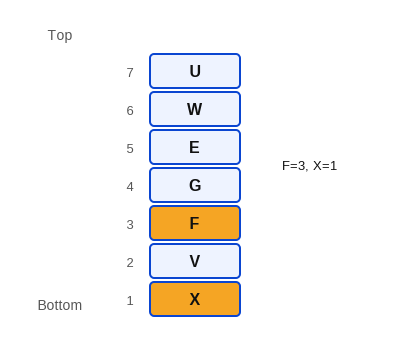
V is kept second from the bottom. Only three boxes are kept between V and W. X is kept at one of the positions below V. Only E is kept between W and G. U is kept at one of the positions above W. How many boxes are kept between F and X?
सात बक्से U, V, W, X, E, F और G एक के ऊपर एक रखे गए हैं, लेकिन आवश्यक नहीं कि इसी क्रम में हों।
V को नीचे से दूसरे स्थान पर रखा गया है। V और W के बीच केवल तीन बक्से रखे गए हैं। X को V के नीचे के किसी एक स्थान पर रखा गया है। W और G के बीच केवल E रखा गया है। U को W के ऊपर के किसी एक स्थान पर रखा गया है। F और X के बीच कितने बक्से रखे गए हैं?
  1. AFourचार
  2. BThreeतीन
  3. COneएक
  4. DTwoदो
Show answer

Concept: Number positions 1 (bottom) to 7 (top) and place the fixed boxes first.

  1. V = 2; three boxes between V and W → W = 6.
  2. X below V → X = 1. Only E between W and G → E = 5, G = 4.
  3. U above W → U = 7; remaining F = 3.
  4. Between F (3) and X (1): only V → one box.

Trick: Fix the 'second from bottom' clue first; everything else follows from it.

Answer: (C) One

अवधारणा: स्थान 1 (नीचे) से 7 (ऊपर) तक लें और निश्चित बॉक्स पहले रखें।

  1. V = 2; V और W के बीच तीन बॉक्स → W = 6।
  2. X, V से नीचे → X = 1। W और G के बीच केवल E → E = 5, G = 4।
  3. U, W से ऊपर → U = 7; शेष F = 3।
  4. F (3) और X (1) के बीच: केवल V → एक बॉक्स।

ट्रिक: 'नीचे से दूसरा' वाला संकेत पहले लगाएँ; बाकी उसी से निकलता है।

उत्तर: (C) एक

RRB NTPC Undergraduate CBT 1General Intelligence and ReasoningBox ArrangementRRB NTPC Undergraduate CBT 1 2024 · 9 Sep Shift 3 →