Question bank

Q&A: practice questions with answers

Search questions on any topic. Filter by exam category, exam, subject and topic, try the question, then open the answer and explanation.

Courses – airGurukul

20,719 questions found.

Q4161.
Wet farming is least likely to be found among which the following Indian states?
निम्नलिखित में से किस भारतीय राज्य में आर्द्र कृषि (wet farming) पाए जाने की संभावना सबसे कम है?
  1. AHaryanaहरियाणा
  2. BAssamअसम
  3. CManipurमणिपुर
  4. DTripuraत्रिपुरा
Show answer

Concept: Wet farming depends on high rainfall (over about 200 cm) or abundant water; crops like rice and jute.

  1. Assam, Manipur and Tripura receive heavy monsoon rain, so wet (rice) farming is common there.
  2. Haryana is a low-rainfall state; its farming is mainly irrigated or dry farming (wheat, bajra).

Yaad rakhein: NE India = wet farming; NW India (Haryana, Rajasthan) = dry/irrigated farming.

Answer: (A) Haryana

अवधारणा: आर्द्र कृषि (wet farming) अधिक वर्षा (लगभग 200 सेमी से अधिक) या प्रचुर जल पर निर्भर है; फसलें जैसे चावल और जूट।

  1. असम, मणिपुर और त्रिपुरा में भारी मानसूनी वर्षा होती है, इसलिए वहाँ आर्द्र (धान) कृषि आम है।
  2. हरियाणा कम वर्षा वाला राज्य है; वहाँ मुख्यतः सिंचित या शुष्क कृषि (गेहूँ, बाजरा) होती है।

याद रखें: पूर्वोत्तर = आर्द्र कृषि; उत्तर-पश्चिम (हरियाणा, राजस्थान) = शुष्क/सिंचित कृषि।

उत्तर: (A) हरियाणा
RRB NTPC Undergraduate CBT 1General AwarenessIndian Agriculture – Farming TypesRRB NTPC Undergraduate CBT 1 2024 · 9 Sep Shift 2 →
Q4162.
What is the name of the ancient Indian text on dramaturgy and theatre?
नाट्यकला और रंगमंच पर प्राचीन भारतीय ग्रंथ का नाम क्या है?
  1. AArthashastraअर्थशास्त्र
  2. BManusmritiमनुस्मृति
  3. CRigvedaऋग्वेद
  4. DNatya Shastraनाट्यशास्त्र
Show answer

Concept: Bharata Muni’s Natya Shastra is the oldest Indian treatise on drama, dance and music.

  1. It describes stagecraft, acting, rasa theory and musical forms – the basis of classical Indian performing arts.
  2. Arthashastra is on statecraft (Kautilya); Manusmriti on law/social code; Rigveda is a collection of hymns.

Yaad rakhein: Natya = drama → Natya Shastra by Bharata Muni (called the fifth Veda).

Answer: (D) Natya Shastra

अवधारणा: भरत मुनि का नाट्यशास्त्र नाटक, नृत्य और संगीत पर सबसे प्राचीन भारतीय ग्रंथ है।

  1. इसमें मंच-कला, अभिनय, रस सिद्धांत और संगीत रूपों का वर्णन है – शास्त्रीय भारतीय कला का आधार।
  2. अर्थशास्त्र राजनीति पर (कौटिल्य); मनुस्मृति विधि/सामाजिक संहिता; ऋग्वेद सूक्तों का संग्रह है।

याद रखें: नाट्य = नाटक → भरत मुनि का नाट्यशास्त्र ("पंचम वेद")।

उत्तर: (D) नाट्यशास्त्र

RRB NTPC Undergraduate CBT 1General AwarenessAncient India – LiteratureRRB NTPC Undergraduate CBT 1 2024 · 9 Sep Shift 2 →
Q4163.
According to the Inter-Services Organisations (Command, Control and Discipline) Act, 2023—effective from May 2025—unified command authority has been granted over personnel from which branches of the Indian Armed Forces?
अंतर-सेवा संगठन (कमान, नियंत्रण और अनुशासन) अधिनियम, 2023—जो मई 2025 से प्रभावी है—के अनुसार, भारतीय सशस्त्र बलों की किन शाखाओं के कार्मिकों पर एकीकृत कमान प्राधिकार प्रदान किया गया है?
  1. ANavy and Air Forceनौसेना और वायु सेना
  2. BArmy and Navyथल सेना और नौसेना
  3. CArmy and Coast Guardथल सेना और तटरक्षक बल
  4. DArmy, Navy, and Air Forceथल सेना, नौसेना और वायु सेना
Show answer

Concept: The Inter-Services Organisations (Command, Control and Discipline) Act, 2023 supports jointness and future theatre commands.

  1. Its rules came into effect in May 2025.
  2. It empowers the Commander-in-Chief / Officer-in-Command of an inter-services organisation to exercise disciplinary and administrative control over personnel of the Army, Navy and Air Force serving under him.

Yaad rakhein: Inter-services = all three services → Army, Navy, Air Force.

Answer: (D) Army, Navy, and Air Force

अवधारणा: अंतर-सेवा संगठन (कमान, नियंत्रण और अनुशासन) अधिनियम, 2023 संयुक्तता और भावी थिएटर कमानों को मज़बूत करता है।

  1. इसके नियम मई 2025 से प्रभावी हुए।
  2. यह अंतर-सेवा संगठन के कमांडर-इन-चीफ़/ऑफ़िसर-इन-कमांड को उसके अधीन कार्यरत थल सेना, नौसेना और वायु सेना के कर्मियों पर अनुशासनात्मक व प्रशासनिक नियंत्रण देता है।

याद रखें: अंतर-सेवा = तीनों सेनाएँ → थल, नौ, वायु सेना।

उत्तर: (D) थल सेना, नौसेना और वायु सेना

RRB NTPC Undergraduate CBT 1General AwarenessCurrent Affairs – DefenceRRB NTPC Undergraduate CBT 1 2024 · 9 Sep Shift 2 →
Q4164.
The critical angle for diamond is approximately _______.
हीरे का क्रांतिक कोण (critical angle) लगभग _______ होता है।
  1. A45°
  2. B24.4°
  3. C60°
  4. D31.8°
Show answer

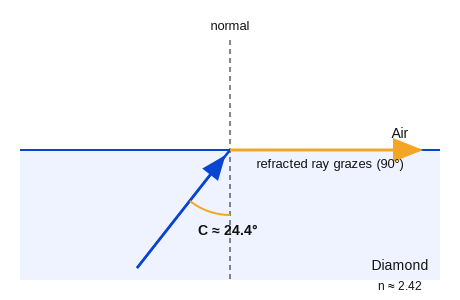
Concept: Critical angle C satisfies sinC=1n (light going from the denser medium to air).

  1. For diamond, n≈2.42.
  2. sinC=12.42≈0.413
  3. C≈24.4∘ – very small, so light undergoes repeated total internal reflection and diamond sparkles.

Yaad rakhein: Bigger n → smaller C. Glass (n=1.5): C≈42∘; water: C≈49∘; diamond: C≈24∘.

Answer: (B) 24.4∘

अवधारणा: क्रांतिक कोण C के लिए sinC=1n (सघन माध्यम से वायु की ओर)।

  1. हीरे के लिए n≈2.42।
  2. sinC=12.42≈0.413
  3. C≈24.4∘ – बहुत छोटा, इसलिए बार-बार पूर्ण आंतरिक परावर्तन होता है और हीरा चमकता है।

याद रखें: n बड़ा → C छोटा। काँच (n=1.5): C≈42∘; जल: C≈49∘; हीरा: C≈24∘।

उत्तर: (B) 24.4∘

RRB NTPC Undergraduate CBT 1General AwarenessPhysics – Total Internal ReflectionRRB NTPC Undergraduate CBT 1 2024 · 9 Sep Shift 2 →
Q4165.
In which of the following states did the Defence Research and Development
Organisation (DRDO) conduct the maiden flight-trials of the Stratospheric Airship Platform in May 2025?
रक्षा अनुसंधान एवं विकास
संगठन (DRDO) ने मई 2025 में निम्नलिखित में से किस राज्य में समतापमंडलीय एयरशिप प्लेटफ़ॉर्म (Stratospheric Airship Platform) का पहला उड़ान-परीक्षण किया?
  1. AOdishaओडिशा
  2. BKarnatakaकर्नाटक
  3. CPunjabपंजाब
  4. DMadhya Pradeshमध्य प्रदेश
Show answer

Concept: A stratospheric airship is a lighter-than-air platform for long-endurance surveillance at about 17 km altitude.

  1. In May 2025 DRDO’s Aerial Delivery Research and Development Establishment (Agra) flew the maiden trial from the Sheopur trial site in Madhya Pradesh.
  2. It reached about 17 km altitude in a flight of around 62 minutes.

Yaad rakhein: Airship trial → Sheopur (MP); missile tests → Odisha (Chandipur/Abdul Kalam Island).

Answer: (D) Madhya Pradesh

अवधारणा: समतापमंडलीय एयरशिप (stratospheric airship) लगभग 17 किमी ऊँचाई पर लंबे समय तक निगरानी करने वाला हवा से हल्का प्लेटफ़ॉर्म है।

  1. मई 2025 में DRDO के एरियल डिलीवरी R&D संस्थान (आगरा) ने मध्य प्रदेश के श्योपुर परीक्षण स्थल से इसकी पहली उड़ान का परीक्षण किया।
  2. इसने लगभग 62 मिनट की उड़ान में लगभग 17 किमी ऊँचाई प्राप्त की।

याद रखें: एयरशिप परीक्षण → श्योपुर (MP); मिसाइल परीक्षण → ओडिशा।

उत्तर: (D) मध्य प्रदेश

RRB NTPC Undergraduate CBT 1General AwarenessCurrent Affairs – DRDORRB NTPC Undergraduate CBT 1 2024 · 9 Sep Shift 2 →
Q4166.
In covering a distance of 162 km, Anmol takes 3 hours more than Nikhil. If Anmol doubles his speed, then he would take 6 hours less than Nikhil. Anmol's speed is:
162 km की दूरी तय करने में अनमोल, निखिल से 3 घंटे अधिक लेता है। यदि अनमोल अपनी चाल दोगुनी कर ले, तो वह निखिल से 6 घंटे कम लेगा। अनमोल की चाल है:
  1. A9 km/hr
  2. B3 km/hr
  3. C5 km/hr
  4. D4 km/hr
Show answer

Concept: Time =DistanceSpeed. Doubling the speed halves the time.

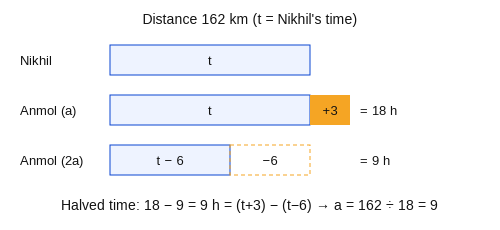
  1. Let Anmol’s speed =a and Nikhil’s time =t. Then 162a=t+3 and 1622a=81a=t−6.
  2. Subtract: 162a−81a=(t+3)−(t−6)=9
  3. 81a=9⇒a=9km/h
  4. Check: Anmol takes 18 h, Nikhil 15 h; at double speed Anmol takes 9 h =15−6 ✓

Trick: The gap 3−(−6)=9 h equals half of Anmol’s time, so his time =18 h and speed =16218=9.

Answer: (A) 9km/hr

अवधारणा: समय =दूरीचाल। चाल दोगुनी करने पर समय आधा हो जाता है।

  1. माना अनमोल की चाल =a और निखिल का समय =t। तब 162a=t+3 और 1622a=81a=t−6।
  2. घटाने पर: 162a−81a=(t+3)−(t−6)=9
  3. 81a=9⇒a=9km/h
  4. जाँच: अनमोल 18 घंटे, निखिल 15 घंटे; दोगुनी चाल पर अनमोल 9 घंटे =15−6 ✓

ट्रिक: अंतर 3−(−6)=9 घंटे = अनमोल के समय का आधा, अतः उसका समय =18 घंटे और चाल =16218=9।

उत्तर: (A) 9km/hr

RRB NTPC Undergraduate CBT 1MathematicsTime, Speed and DistanceRRB NTPC Undergraduate CBT 1 2024 · 9 Sep Shift 2 →
Q4167.
Given that 170.24 = x, 170.51= y and xz = y4, then the value of z is close to:
दिया गया है कि 170.24 = x, 170.51= y और xz = y4 है, तो z का मान लगभग है:
  1. A8.5
  2. B8.9
  3. C10.44
  4. D8.58
Show answer

Concept: Use (am)n=amn and compare powers of the same base.

  1. xz=(170.24)z=170.24z
  2. y4=(170.51)4=172.04
  3. 0.24z=2.04⇒z=2.040.24=8.5

Trick: Same base → just equate exponents: z=4×0.510.24=20424=8.5.

Answer: (A) 8.5

अवधारणा: (am)n=amn लगाकर समान आधार की घातों की तुलना करें।

  1. xz=(170.24)z=170.24z
  2. y4=(170.51)4=172.04
  3. 0.24z=2.04⇒z=2.040.24=8.5

ट्रिक: समान आधार → घातें बराबर करें: z=4×0.510.24=20424=8.5।

उत्तर: (A) 8.5

RRB NTPC Undergraduate CBT 1MathematicsIndicesRRB NTPC Undergraduate CBT 1 2024 · 9 Sep Shift 2 →
Q4168.
What is the median of the following data?
24, 30, 40, 80, 15, 57, 78, 82, 39, 97, 82
निम्नलिखित आँकड़ों की माध्यिका क्या है?
24, 30, 40, 80, 15, 57, 78, 82, 39, 97, 82
  1. A57
  2. B58
  3. C56.5
  4. D57.5
Show answer

Concept: Median = middle value after arranging data in order; for odd n it is the (n+12)th value.

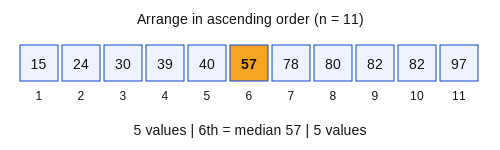
  1. Ascending order: 15, 24, 30, 39, 40, 57, 78, 80, 82, 82, 97 (n=11).
  2. Position =11+12=6
  3. 6th value =57

Trick: Always sort first – the unsorted middle value (57 here by chance) can mislead.

Answer: (A) 57

अवधारणा: माध्यिका = आँकड़ों को क्रम में रखने पर बीच का मान; विषम n के लिए (n+12)वाँ मान।

  1. आरोही क्रम: 15, 24, 30, 39, 40, 57, 78, 80, 82, 82, 97 (n=11)।
  2. स्थान =11+12=6
  3. छठा मान =57

ट्रिक: हमेशा पहले क्रम में लगाएँ।

उत्तर: (A) 57

RRB NTPC Undergraduate CBT 1MathematicsStatistics – MedianRRB NTPC Undergraduate CBT 1 2024 · 9 Sep Shift 2 →
Q4169.
If the longest diagonal of a cube measures 15 cm, then what is the total surface area (in sq. cm) of the cube?
यदि किसी घन के सबसे लंबे विकर्ण की माप 15 cm है, तो घन का संपूर्ण पृष्ठीय क्षेत्रफल (sq. cm में) कितना है?
  1. A540sq.cm
  2. B1803sq.cm
  3. C450sq.cm
  4. D337.50sq.cm
Show answer

Concept: For a cube of edge a: diagonal =3a, total surface area =6a2.

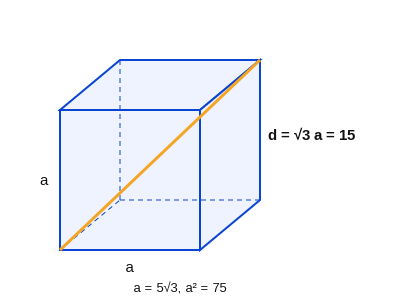
  1. 3a=15⇒a=153=53
  2. a2=75
  3. TSA =6×75=450cm2

Trick: TSA=2d2 directly: 2×152=450.

Answer: (C) 450sq.cm

अवधारणा: भुजा a वाले घन के लिए: विकर्ण =3a, कुल पृष्ठीय क्षेत्रफल =6a2।

  1. 3a=15⇒a=153=53
  2. a2=75
  3. कुल पृष्ठीय क्षेत्रफल =6×75=450cm2

ट्रिक: सीधे TSA=2d2=2×152=450।

उत्तर: (C) 450sq.cm

RRB NTPC Undergraduate CBT 1MathematicsMensuration – CubeRRB NTPC Undergraduate CBT 1 2024 · 9 Sep Shift 2 →
Q4170.
In a store, the price of a bicycle is ₹4,300, with a trade discount of 12%. What is the amount of the discount?
एक स्टोर में, एक साइकिल का मूल्य ₹4,300 है, जिस पर 12% की व्यापारिक छूट है। छूट की राशि कितनी है?
  1. A₹548
  2. B₹524
  3. C₹486
  4. D₹516
Show answer

Concept: Discount =Discount%×Marked price.

  1. Discount =12100×4300
  2. =12×43=516

Trick: 1% of ₹4,300 = ₹43; so 12% = 12×43= ₹516.

Answer: (D) ₹516

अवधारणा: बट्टा =बट्टा%×अंकित मूल्य।

  1. बट्टा =12100×4300
  2. =12×43=516

ट्रिक: ₹4,300 का 1% = ₹43; 12% = 12×43= ₹516।

उत्तर: (D) ₹516

RRB NTPC Undergraduate CBT 1MathematicsDiscountRRB NTPC Undergraduate CBT 1 2024 · 9 Sep Shift 2 →
Q4171.
The current population of a town is 16,362. It increases by 25% and 60% in two successive years but decreases by 50% in the third year. What is the population of the town at the end of the third year?
एक कस्बे की वर्तमान जनसंख्या 16,362 है। यह दो क्रमागत वर्षों में 25% और 60% बढ़ती है, लेकिन तीसरे वर्ष में 50% घट जाती है। तीसरे वर्ष के अंत में कस्बे की जनसंख्या कितनी है?
  1. A16,363
  2. B16,362
  3. C16,358
  4. D16,360
Show answer

Concept: Successive changes multiply: P3=P×(1+r1100)(1+r2100)(1−r3100).

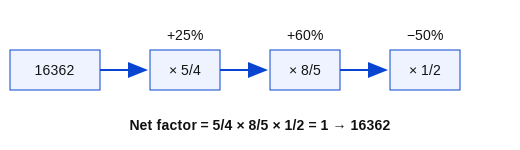
  1. Factors: +25%→54, +60%→85, −50%→12
  2. Net factor =54×85×12=1
  3. Population =16362×1=16362

Trick: If the net multiplier is 1, the answer is the starting value – no calculation needed.

Answer: (B) 16,362

अवधारणा: क्रमिक परिवर्तन गुणा होते हैं: P3=P×(1+r1100)(1+r2100)(1−r3100)।

  1. गुणक: +25%→54, +60%→85, −50%→12
  2. कुल गुणक =54×85×12=1
  3. जनसंख्या =16362×1=16362

ट्रिक: कुल गुणक 1 हो तो उत्तर प्रारंभिक मान ही है।

उत्तर: (B) 16,362

RRB NTPC Undergraduate CBT 1MathematicsPercentage – PopulationRRB NTPC Undergraduate CBT 1 2024 · 9 Sep Shift 2 →
Q4172.
Arun bought some pencils at the rate of ₹180 a dozen. He sold them for ₹18 each. His profit percentage is ______%.
अरुण ने ₹180 प्रति दर्जन की दर से कुछ पेंसिलें खरीदीं। उसने उन्हें ₹18 प्रति पेंसिल की दर से बेच दिया। उसका लाभ प्रतिशत ______% है।
  1. A20
  2. B18
  3. C22
  4. D24
Show answer

Concept: Profit%=SP−CPCP×100, per unit.

  1. CP of 1 pencil =18012= ₹15
  2. SP of 1 pencil = ₹18, profit = ₹3
  3. Profit%=315×100=20%

Trick: Compare per dozen: SP =18×12=216 vs CP 180 → 36180=20%.

Answer: (A) 20

अवधारणा: लाभ%=विक्रय मूल्य−क्रय मूल्यक्रय मूल्य×100, प्रति इकाई।

  1. 1 पेंसिल का क्रय मूल्य =18012= ₹15
  2. 1 पेंसिल का विक्रय मूल्य = ₹18, लाभ = ₹3
  3. लाभ%=315×100=20%

ट्रिक: प्रति दर्जन: विक्रय मूल्य =18×12=216, क्रय मूल्य 180 → 36180=20%।

उत्तर: (A) 20

RRB NTPC Undergraduate CBT 1MathematicsProfit and LossRRB NTPC Undergraduate CBT 1 2024 · 9 Sep Shift 2 →
Q4173.
An amount of ₹552 is divided among three persons in the ratio of 19 : 11 : 18. The difference between the largest and the smallest shares (in ₹) in the distribution is:
₹552 की राशि को तीन व्यक्तियों में 19 : 11 : 18 के अनुपात में बाँटा जाता है। इस वितरण में सबसे बड़े और सबसे छोटे हिस्सों (₹ में) के बीच का अंतर है:
  1. A5
  2. B105
  3. C92
  4. D12
Show answer

Concept: Value of 1 part =TotalSum of ratio terms.

  1. Sum of terms =19+11+18=48
  2. 1 part =55248=11.5
  3. Difference =(19−11)×11.5=8×11.5=92

Trick: Find only the difference of terms (8 parts) – no need to compute each share.

Answer: (C) 92

अवधारणा: 1 भाग का मान =कुलअनुपात पदों का योग।

  1. पदों का योग =19+11+18=48
  2. 1 भाग =55248=11.5
  3. अंतर =(19−11)×11.5=8×11.5=92

ट्रिक: केवल पदों का अंतर (8 भाग) निकालें – हर हिस्सा निकालने की ज़रूरत नहीं।

उत्तर: (C) 92

RRB NTPC Undergraduate CBT 1MathematicsRatio and ProportionRRB NTPC Undergraduate CBT 1 2024 · 9 Sep Shift 2 →
Q4174.
If X=sin2θ1+cosθ−sinθcotθ−cscθ, then the value of (X−1) is:
यदि X=sin2θ1+cosθ−sinθcotθ−cscθ है, तो (X−1) का मान है:
  1. Acos2θ−cot2θ
  2. Bcsc2θ+cot2θ
  3. Csec2θ−tan2θ
  4. Dsin2θ+tan2θ
Show answer

Concept: Use sin2θ=1−cos2θ and sec2θ−tan2θ=1.

  1. sin2θ1+cosθ=(1−cosθ)(1+cosθ)1+cosθ=1−cosθ
  2. cotθ−cscθ=cosθ−1sinθ, so sinθcotθ−cscθ=sin2θcosθ−1=−(1+cosθ)
  3. X=(1−cosθ)+(1+cosθ)=2⇒X−1=1
  4. Among the options only sec2θ−tan2θ=1.

Trick: Put θ=90∘: X=11−10−1=2, so X−1=1; check options at θ=45∘: only sec2−tan2=2−1=1.

Answer: (C) sec2θ−tan2θ

अवधारणा: sin2θ=1−cos2θ और sec2θ−tan2θ=1 का प्रयोग करें।

  1. sin2θ1+cosθ=(1−cosθ)(1+cosθ)1+cosθ=1−cosθ
  2. cotθ−cscθ=cosθ−1sinθ, अतः sinθcotθ−cscθ=sin2θcosθ−1=−(1+cosθ)
  3. X=(1−cosθ)+(1+cosθ)=2⇒X−1=1
  4. विकल्पों में केवल sec2θ−tan2θ=1।

ट्रिक: θ=90∘ रखें: X=11−10−1=2, अतः X−1=1; θ=45∘ पर केवल sec2−tan2=2−1=1।

उत्तर: (C) sec2θ−tan2θ

RRB NTPC Undergraduate CBT 1MathematicsTrigonometry – IdentitiesRRB NTPC Undergraduate CBT 1 2024 · 9 Sep Shift 2 →
Q4175.
The value of (30 + 3−2 + 3−1) × 27 is _______.
(30 + 3−2 + 3−1) × 27 का मान _______ है।
  1. A39
  2. B3
  3. C23
  4. D32
Show answer

Concept: a0=1 and a−n=1an.

  1. 30+3−2+3−1=1+19+13
  2. Multiply each term by 27: 27+3+9
  3. =39

Trick: Multiplying by 27=33 just raises each power by 3: 33+31+32=27+3+9.

Answer: (A) 39

अवधारणा: a0=1 और a−n=1an।

  1. 30+3−2+3−1=1+19+13
  2. प्रत्येक पद को 27 से गुणा करें: 27+3+9
  3. =39

ट्रिक: 27=33 से गुणा करने पर हर घात में 3 जुड़ता है: 33+31+32=27+3+9।

उत्तर: (A) 39

RRB NTPC Undergraduate CBT 1MathematicsIndices – SimplificationRRB NTPC Undergraduate CBT 1 2024 · 9 Sep Shift 2 →
Q4176.
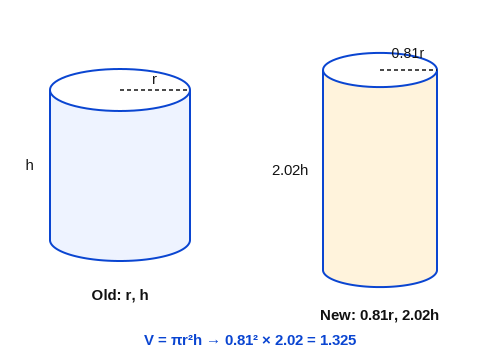
If the radius of the base of a right circular cylinder is decreased by 19% and its height is increased by 102%, then what is the percentage increase (closest integer) in its volume?
यदि एक लंब वृत्तीय बेलन के आधार की त्रिज्या 19% घटा दी जाए और इसकी ऊँचाई 102% बढ़ा दी जाए, तो इसके आयतन में प्रतिशत वृद्धि (निकटतम पूर्णांक) कितनी है?
  1. A12%
  2. B33%
  3. C26%
  4. D14%
Show answer

Concept: Volume of a cylinder V=πr2h, so the new volume factor = (radius factor)2×(height factor).

  1. Radius factor =1−0.19=0.81; height factor =1+1.02=2.02.
  2. New volume factor =0.812×2.02=0.6561×2.02=1.3253.
  3. Increase =32.53%≈33%.

Trick: Successive change: −19,−19,+102 → −19−19+361100=−34.39; then −34.39+102−34.39×102100≈32.5%.

Answer: (B) 33%

अवधारणा: बेलन का आयतन V=πr2h, इसलिए नया आयतन गुणक = (त्रिज्या गुणक)2×(ऊँचाई गुणक)।

  1. त्रिज्या गुणक =1−0.19=0.81; ऊँचाई गुणक =1+1.02=2.02।
  2. नया आयतन गुणक =0.812×2.02=0.6561×2.02=1.3253।
  3. वृद्धि =32.53%≈33%।

ट्रिक: त्रिज्या पर दो बार −19% और ऊँचाई पर +102% – क्रमागत प्रतिशत सूत्र से भी ≈32.5% आता है।

उत्तर: (B) 33%

RRB NTPC Undergraduate CBT 1MathematicsMensuration – CylinderRRB NTPC Undergraduate CBT 1 2024 · 9 Sep Shift 2 →
Q4177.
A TV is listed at ₹80,000. A customer can either avail of a single discount of 28% or two successive discounts of 20% and 10%. Which discount option is better, and what is the monetary difference?
एक TV का सूचीबद्ध मूल्य ₹80,000 है। एक ग्राहक या तो 28% की एकल छूट या 20% और 10% की दो क्रमागत छूटें प्राप्त कर सकता है। कौन-सा छूट विकल्प बेहतर है, और मौद्रिक अंतर कितना है?
  1. ABoth the discount are the same ; ₹0दोनों छूटें समान हैं ; ₹0
  2. BSingle discount of 28% ; ₹1,50028% की एकल छूट ; ₹1,500
  3. CTwo successive discounts of 20% and 10% ; ₹1,60020% और 10% की दो क्रमागत छूटें ; ₹1,600
  4. DSingle discount of 28% ; ₹1,00528% की एकल छूट ; ₹1,005
Show answer

Concept: Two successive discounts a% and b% equal a single discount of (a+b−ab100)%.

  1. Equivalent single discount =20+10−20×10100=28%.
  2. Single discount offered is also 28%.
  3. Price paid in both cases =80000×0.72= ₹57,600, so difference = ₹0.

Trick: Multiply the "pay" factors: 0.8×0.9=0.72 → same as 28% off.

Answer: (A) Both the discounts are the same; ₹0

अवधारणा: दो क्रमागत छूटें a% और b% एकल छूट (a+b−ab100)% के बराबर होती हैं।

  1. समतुल्य एकल छूट =20+10−20×10100=28%।
  2. दी गई एकल छूट भी 28% है।
  3. दोनों स्थितियों में भुगतान =80000×0.72= ₹57,600; अंतर = ₹0।

ट्रिक: "भुगतान" गुणक गुणा करें: 0.8×0.9=0.72 → 28% छूट के बराबर।

उत्तर: (A) दोनों छूट समान; ₹0

RRB NTPC Undergraduate CBT 1MathematicsSuccessive DiscountRRB NTPC Undergraduate CBT 1 2024 · 9 Sep Shift 2 →
Q4178.
Which of the following ratios is the greatest?
निम्नलिखित में से कौन-सा अनुपात सबसे बड़ा है?
  1. A38 : 83
  2. B35 : 77
  3. C47 : 67
  4. D50 : 62
Show answer

Concept: Convert each ratio to a decimal (or compare with 12) and pick the largest.

  1. 3883≈0.458, 3577≈0.455 (both below 12).
  2. 4767≈0.701.
  3. 5062≈0.806 – the largest.

Trick: The ratio whose antecedent is closest to its consequent is largest here: 50 vs 62.

Answer: (D) 50:62

अवधारणा: प्रत्येक अनुपात को दशमलव में बदलें (या 12 से तुलना करें) और सबसे बड़ा चुनें।

  1. 3883≈0.458, 3577≈0.455 (दोनों 12 से कम)।
  2. 4767≈0.701।
  3. 5062≈0.806 – सबसे बड़ा।

ट्रिक: जिस अनुपात में दोनों पद सबसे पास हों, वह यहाँ सबसे बड़ा: 50 और 62।

उत्तर: (D) 50:62

RRB NTPC Undergraduate CBT 1MathematicsComparison of RatiosRRB NTPC Undergraduate CBT 1 2024 · 9 Sep Shift 2 →
Q4179.
A can do a work in 12 days and B can do the same work in 21 days. If they work on it together for 3 days, then what fraction of the work is left?
A किसी कार्य को 12 दिनों में कर सकता है और B उसी कार्य को 21 दिनों में कर सकता है। यदि वे 3 दिनों तक एक साथ उस पर कार्य करते हैं, तो कार्य का कितना भाग शेष रहता है?
  1. A2528
  2. B1528
  3. C1728
  4. D2728
Show answer

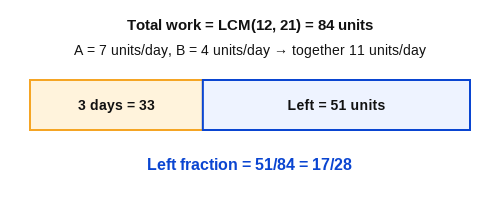
Concept: Take total work = LCM of the days; efficiency = work ÷ days.

  1. Total work =LCM(12,21)=84 units.
  2. A =7 units/day, B =4 units/day; together 11 units/day.
  3. In 3 days: 33 units done; left =84−33=51 units.
  4. Fraction left =5184=1728.

Trick: Work done =3(112+121)=1128, so left =1−1128.

Answer: (C) 1728

अवधारणा: कुल कार्य = दिनों का LCM लें; दक्षता = कार्य ÷ दिन।

  1. कुल कार्य =LCM(12,21)=84 इकाई।
  2. A =7 इकाई/दिन, B =4 इकाई/दिन; मिलकर 11 इकाई/दिन।
  3. 3 दिन में: 33 इकाई; शेष =84−33=51 इकाई।
  4. शेष भाग =5184=1728।

ट्रिक: किया गया कार्य =3(112+121)=1128, शेष =1−1128।

उत्तर: (C) 1728

RRB NTPC Undergraduate CBT 1MathematicsTime and WorkRRB NTPC Undergraduate CBT 1 2024 · 9 Sep Shift 2 →
Q4180.
The average of first 166 even numbers is
प्रथम 166 सम संख्याओं का औसत है
  1. A168
  2. B167
  3. C166.5
  4. D167.5
Show answer

Concept: Average of the first n even numbers =n+1.

  1. First 166 even numbers: 2,4,…,332.
  2. Average =2+3322=167.
  3. Formula check: n+1=166+1=167.

Yaad rakhein: First n even → n+1; first n odd → n; first n natural → n+12.

Answer: (B) 167

अवधारणा: पहली n सम संख्याओं का औसत =n+1।

  1. पहली 166 सम संख्याएँ: 2,4,…,332।
  2. औसत =2+3322=167।
  3. सूत्र से: n+1=166+1=167।

याद रखें: पहली n सम → n+1; पहली n विषम → n; पहली n प्राकृत → n+12।

उत्तर: (B) 167

RRB NTPC Undergraduate CBT 1MathematicsAverage of Even NumbersRRB NTPC Undergraduate CBT 1 2024 · 9 Sep Shift 2 →