Question bank

Q&A: practice questions with answers

Search questions on any topic. Filter by exam category, exam, subject and topic, try the question, then open the answer and explanation.

Courses – airGurukul

20,719 questions found.

Q4281.
Which of the following ratios is the greatest?
निम्नलिखित में से कौन-सा अनुपात सबसे बड़ा है?
  1. A37 : 56
  2. B38 : 75
  3. C33 : 54
  4. D35 : 80
Show answer

Concept: Write each ratio as a fraction (decimal) and compare.

  1. 3756≈0.661
  2. 3875≈0.507
  3. 3354≈0.611
  4. 3580=0.4375 → largest is 37:56

Trick: Only 37:56 and 33:54 are above 12 comfortably; cross-multiply: 37×54=1998>33×56=1848.

Answer: (A) 37:56

अवधारणा: हर अनुपात को भिन्न (दशमलव) में बदलकर तुलना करें।

  1. 3756≈0.661
  2. 3875≈0.507
  3. 3354≈0.611
  4. 3580=0.4375 → सबसे बड़ा 37:56

ट्रिक: वज्र-गुणन: 37×54=1998>33×56=1848।

उत्तर: (A) 37:56

RRB NTPC Undergraduate CBT 1MathematicsComparison of ratiosRRB NTPC Undergraduate CBT 1 2024 · 9 Sep Shift 1 →
Q4282.
Increasing a number by 80% gives 2430. Find the number.
किसी संख्या में 80% की वृद्धि करने पर 2430 प्राप्त होता है। वह संख्या ज्ञात कीजिए।
  1. A4050
  2. B2700
  3. C675
  4. D1350
Show answer

Concept: Increasing a number by 80% multiplies it by 1.8.

  1. x×180100=2430
  2. x=2430×100180=1350

Trick: 180%→2430, so 10%→135 and 100%→1350.

Answer: (D) 1350

अवधारणा: किसी संख्या में 80% वृद्धि = संख्या ×1.8।

  1. x×180100=2430
  2. x=2430×100180=1350

ट्रिक: 180%→2430, तो 10%→135 और 100%→1350।

उत्तर: (D) 1350

RRB NTPC Undergraduate CBT 1MathematicsPercentageRRB NTPC Undergraduate CBT 1 2024 · 9 Sep Shift 1 →
Q4283.
Eight times the present age of P is 12 years more than the present age of Q. After 8 years, three times the age of Q at that time will be 28 years less than eight times the age of P. Find the present age (in years) of Q.
P की वर्तमान आयु का आठ गुना, Q की वर्तमान आयु से 12 वर्ष अधिक है। 8 वर्ष बाद, उस समय Q की आयु का तीन गुना, P की आयु के आठ गुने से 28 वर्ष कम होगा। Q की वर्तमान आयु (वर्षों में) ज्ञात कीजिए।
  1. A12
  2. B8
  3. C15
  4. D7
Show answer

Concept: Form two linear equations from the two conditions and solve.

  1. Now: 8P=Q+12
  2. After 8 years: 3(Q+8)=8(P+8)−28⇒3Q+24=8P+36
  3. Put 8P=Q+12: 3Q+24=Q+48⇒2Q=24
  4. Q=12 years (and P=3)

Trick: Check option (A): Q=12⇒P=3; later 3×20=60 and 8×11−28=60 ✓

Answer: (A) 12

अवधारणा: दोनों शर्तों से दो रैखिक समीकरण बनाकर हल करें।

  1. अभी: 8P=Q+12
  2. 8 वर्ष बाद: 3(Q+8)=8(P+8)−28⇒3Q+24=8P+36
  3. 8P=Q+12 रखने पर: 2Q=24
  4. Q=12 वर्ष (P=3)

ट्रिक: विकल्प (A) जाँचें: Q=12,P=3; बाद में 3×20=60=8×11−28 ✓

उत्तर: (A) 12

RRB NTPC Undergraduate CBT 1MathematicsProblems on agesRRB NTPC Undergraduate CBT 1 2024 · 9 Sep Shift 1 →
Q4284.
Abhay and Bharat can complete a certain work in 5 and 15 days, respectively. They started working together and after 2 days, Bharat left the work. In how many days will Abhay complete the remaining work?
अभय और भरत किसी कार्य को क्रमशः 5 और 15 दिनों में पूरा कर सकते हैं। उन्होंने एक साथ कार्य करना शुरू किया और 2 दिनों के बाद भरत ने कार्य छोड़ दिया। अभय शेष कार्य को कितने दिनों में पूरा करेगा?
  1. A113
  2. B213
  3. C413
  4. D313
Show answer

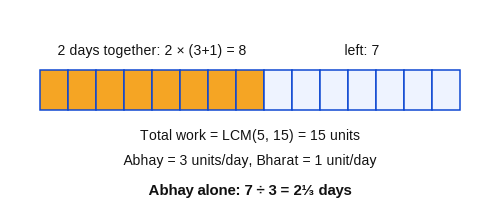
Concept: Take total work = LCM of the days; find each person’s daily units.

  1. Total =LCM(5,15)=15 units; Abhay =3/day, Bharat =1/day
  2. In 2 days together: 2×(3+1)=8 units
  3. Remaining =15−8=7 units
  4. Abhay alone: 73=213 days

Trick: Work done together =2(15+115)=815; rest 715×5=73 days.

Answer: (B) 213

अवधारणा: कुल कार्य = दिनों का LCM; फिर प्रत्येक का प्रतिदिन कार्य निकालें।

  1. कुल =15 इकाई; अभय =3/दिन, भरत =1/दिन
  2. 2 दिन साथ में: 2×4=8 इकाई
  3. शेष =7 इकाई
  4. अभय अकेला: 73=213 दिन

ट्रिक: 2(15+115)=815; शेष 715×5=73 दिन।

उत्तर: (B) 213

RRB NTPC Undergraduate CBT 1MathematicsTime and workRRB NTPC Undergraduate CBT 1 2024 · 9 Sep Shift 1 →
Q4285.
The number 740705 is divisible by which of the following?
संख्या 740705 निम्नलिखित में से किससे विभाज्य है?
  1. A12
  2. B9
  3. C4
  4. D5
Show answer

Concept: Apply the divisibility tests for 5, 4, 9 and 12 (= 3 and 4).

  1. Last digit is 5 → divisible by 5 ✓
  2. Last two digits 05 → not divisible by 4, hence not by 12
  3. Digit sum 7+4+0+7+0+5=23 → not divisible by 9 (or 3)

Yaad rakhein: An odd number can never be divisible by 4 or 12 — check the last digit first.

Answer: (D) 5

अवधारणा: 5, 4, 9 और 12 (= 3 और 4) के विभाज्यता नियम लगाएँ।

  1. अंतिम अंक 5 → 5 से विभाज्य ✓
  2. अंतिम दो अंक 05 → 4 से नहीं, अतः 12 से भी नहीं
  3. अंकों का योग =23 → 9 (या 3) से नहीं

याद रखें: विषम संख्या कभी 4 या 12 से विभाज्य नहीं होती — पहले अंतिम अंक देखें।

उत्तर: (D) 5

RRB NTPC Undergraduate CBT 1MathematicsDivisibility rulesRRB NTPC Undergraduate CBT 1 2024 · 9 Sep Shift 1 →
Q4286.
Mahesh bought some sharpeners at the rate of ₹150 per dozen. He sold them at the rate of ₹21 per sharpener. His profit percentage is ______%.
महेश ने ₹150 प्रति दर्जन की दर से कुछ शार्पनर खरीदे। उसने उन्हें ₹21 प्रति शार्पनर की दर से बेचा। उसका लाभ प्रतिशत ______% है।
  1. A66
  2. B70
  3. C72
  4. D68
Show answer

Concept: Profit%=SP−CPCP×100 per sharpener.

  1. CP of one sharpener =15012=12.5 (₹)
  2. SP =21 (₹), profit =21−12.5=8.5 (₹)
  3. Profit%=8.512.5×100=68%

Trick: Compare per dozen: SP =21×12=252 vs CP 150 → 102150×100=68%.

Answer: (D) 68

अवधारणा: प्रति शार्पनर लाभ%=SP−CPCP×100।

  1. एक शार्पनर का CP =15012=12.5 (₹)
  2. SP =21 (₹), लाभ =8.5 (₹)
  3. लाभ%=8.512.5×100=68%

ट्रिक: दर्जन के हिसाब से: SP =252, CP =150 → 102150×100=68%।

उत्तर: (D) 68

RRB NTPC Undergraduate CBT 1MathematicsProfit and lossRRB NTPC Undergraduate CBT 1 2024 · 9 Sep Shift 1 →
Q4287.
The marked price of a jacket is ₹2,400. If it is sold at a discount of 20%, find the selling price.
एक जैकेट का अंकित मूल्य ₹2,400 है। यदि इसे 20% की छूट पर बेचा जाता है, तो विक्रय मूल्य ज्ञात कीजिए।
  1. A₹1,900
  2. B₹1,980
  3. C₹1,920
  4. D₹2,000
Show answer

Concept: SP=MP×100−discount%100.

  1. Discount =20% of 2400 =480 (₹)
  2. SP =2400−480=1920 (₹)

Trick: 20% off means pay 80%: 2400×0.8=1920.

Answer: (C) ₹1,920

अवधारणा: SP=MP×100−छूट%100।

  1. छूट =2400 का 20%=480 (₹)
  2. SP =2400−480=1920 (₹)

ट्रिक: 20% छूट = 80% चुकाना: 2400×0.8=1920।

उत्तर: (C) ₹1,920

RRB NTPC Undergraduate CBT 1MathematicsDiscountRRB NTPC Undergraduate CBT 1 2024 · 9 Sep Shift 1 →
Q4288.
Find the average weight of a family of five members whose weights are 40 kg, 49 kg, 56 kg, 73 kg and 37 kg, respectively.
पाँच सदस्यों वाले एक परिवार का औसत वज़न ज्ञात कीजिए, जिनके वज़न क्रमशः 40 kg, 49 kg, 56 kg, 73 kg और 37 kg हैं।
  1. A52 kg
  2. B53 kg
  3. C51 kg
  4. D50 kg
Show answer

Concept: Average=Sum of observationsNumber of observations.

  1. Sum =40+49+56+73+37=255kg
  2. Average =2555=51kg

Trick: Assume 50: deviations −10,−1,+6,+23,−13 sum to +5; 50+55=51.

Answer: (C) 51 kg

अवधारणा: औसत=सभी का योगसंख्या।

  1. योग =40+49+56+73+37=255kg
  2. औसत =2555=51kg

ट्रिक: 50 मानें: विचलन −10,−1,+6,+23,−13 का योग +5; 50+1=51।

उत्तर: (C) 51 kg

RRB NTPC Undergraduate CBT 1MathematicsAverageRRB NTPC Undergraduate CBT 1 2024 · 9 Sep Shift 1 →
Q4289.
By selling an article at 27 of its actual selling price, Manav incurs a loss of 24%. If he sells this article at 55% of its actual selling price, find the profit percentage.
किसी वस्तु को उसके वास्तविक विक्रय मूल्य के 27 पर बेचने पर मानव को 24% की हानि होती है। यदि वह इस वस्तु को उसके वास्तविक विक्रय मूल्य के 55% पर बेचता है, तो लाभ प्रतिशत ज्ञात कीजिए।
  1. A48.7%
  2. B46.9%
  3. C47.6%
  4. D46.3%
Show answer

Concept: Express the actual SP in terms of CP using the loss condition, then use the second selling price.

  1. 27S=76% of CP =0.76C
  2. S=7×0.76C2=2.66C
  3. New SP =55% of S=0.55×2.66C=1.463C
  4. Profit =46.3%

Trick: Let CP =100: 27S=76⇒S=266; 55% of 266 =146.3 → 46.3% profit.

Answer: (D) 46.3%

अवधारणा: हानि वाली शर्त से वास्तविक SP को CP के रूप में लिखें, फिर दूसरा विक्रय मूल्य निकालें।

  1. 27S=CP का 76%=0.76C
  2. S=2.66C
  3. नया SP =S का 55%=1.463C
  4. लाभ =46.3%

ट्रिक: CP =100 लें: 27S=76⇒S=266; 266 का 55%=146.3 → 46.3% लाभ।

उत्तर: (D) 46.3%

RRB NTPC Undergraduate CBT 1MathematicsProfit and lossRRB NTPC Undergraduate CBT 1 2024 · 9 Sep Shift 1 →
Q4290.
The marked price of an article is ₹280. A discount of 12.5% is given on the marked price and a profit of 40% is earned. Find the cost price of the article.
एक वस्तु का अंकित मूल्य ₹280 है। अंकित मूल्य पर 12.5% की छूट दी जाती है और 40% का लाभ अर्जित होता है। वस्तु का क्रय मूल्य ज्ञात कीजिए।
  1. A₹165
  2. B₹180
  3. C₹175
  4. D₹185
Show answer

Concept: SP = MP after discount; CP =SP×100100+profit%.

  1. SP =280×87.5100=245 (₹)
  2. CP =245×100140=175 (₹)

Trick: 12.5%=18: SP =280×78=245; 40%=25: CP =245×57=175.

Answer: (C) ₹175

अवधारणा: छूट के बाद SP; फिर CP=SP×100100+लाभ%।

  1. SP =280×87.5100=245 (₹)
  2. CP =245×100140=175 (₹)

ट्रिक: 12.5%=18: SP =280×78=245; CP =245×57=175।

उत्तर: (C) ₹175

RRB NTPC Undergraduate CBT 1MathematicsMarked price, discount and profitRRB NTPC Undergraduate CBT 1 2024 · 9 Sep Shift 1 →
Q4291.
M and N start a business. M invests ₹43,000 more than N for 6 months and N invests for 7 months. M's share is ₹472 more than that of N, out of a total profit of ₹3,304. Find the capital contributed by M.
M और N एक व्यवसाय शुरू करते हैं। M, N से ₹43,000 अधिक 6 महीनों के लिए निवेश करता है और N, 7 महीनों के लिए निवेश करता है। ₹3,304 के कुल लाभ में से M का हिस्सा N के हिस्से से ₹472 अधिक है। M द्वारा लगाई गई पूँजी ज्ञात कीजिए।
  1. A₹1,20,400
  2. B₹1,20,000
  3. C₹1,20,600
  4. D₹1,21,400
Show answer

Concept: Profit share ∝ capital × time.

  1. Shares: M + N =3304, M − N =472 ⇒ M =1888, N =1416; ratio =4:3
  2. Let N’s capital =x; M’s =x+43000
  3. 6(x+43000)7x=43⇒18x+774000=28x
  4. x=77400; M =77400+43000=1,20,400 (₹)

Trick: Check (A): M =120400, N =77400; 120400×6:77400×7=722400:541800=4:3 ✓

Answer: (A) ₹1,20,400

अवधारणा: लाभ का हिस्सा ∝ पूँजी × समय।

  1. M + N =3304, M − N =472 ⇒ M =1888, N =1416; अनुपात =4:3
  2. N की पूँजी =x, M की =x+43000
  3. 6(x+43000)7x=43⇒10x=774000
  4. x=77400; M =1,20,400 (₹)

ट्रिक: (A) जाँचें: 120400×6:77400×7=4:3 ✓

उत्तर: (A) ₹1,20,400

RRB NTPC Undergraduate CBT 1MathematicsPartnershipRRB NTPC Undergraduate CBT 1 2024 · 9 Sep Shift 1 →
Q4292.
An amount of ₹10,00,000 is invested in a bank at 11% per annum rate of interest, compounded annually. On maturity, the amount payable becomes ₹13,67,631. Find the period of investment.
₹10,00,000 की राशि किसी बैंक में 11% वार्षिक ब्याज दर पर, वार्षिक रूप से संयोजित चक्रवृद्धि ब्याज पर निवेश की जाती है। परिपक्वता पर देय राशि ₹13,67,631 हो जाती है। निवेश की अवधि ज्ञात कीजिए।
  1. A3 years3 वर्ष
  2. B1 year1 वर्ष
  3. C2.5 years2.5 वर्ष
  4. D3.5 years3.5 वर्ष
Show answer

Concept: A=P(1+r100)n.

  1. 13676311000000=(1.11)n
  2. 1.112=1.2321, 1.113=1.367631
  3. So n=3 years

Trick: 1113=1367631 — the six digits after 1 are the giveaway for a cube.

Answer: (A) 3 years

अवधारणा: A=P(1+r100)n।

  1. 13676311000000=(1.11)n
  2. 1.112=1.2321, 1.113=1.367631
  3. अतः n=3 वर्ष

ट्रिक: 1113=1367631 याद रखें।

उत्तर: (A) 3 वर्ष

RRB NTPC Undergraduate CBT 1MathematicsCompound interestRRB NTPC Undergraduate CBT 1 2024 · 9 Sep Shift 1 →
Q4293.
A can complete a work in 9 days and B can complete the same work in 18 days. If they work together for 5 days, what part of the work will be left?
A किसी कार्य को 9 दिनों में पूरा कर सकता है और B उसी कार्य को 18 दिनों में पूरा कर सकता है। यदि वे 5 दिनों तक एक साथ कार्य करते हैं, तो कार्य का कितना भाग शेष रहेगा?
  1. A16
  2. B76
  3. C56
  4. D116
Show answer

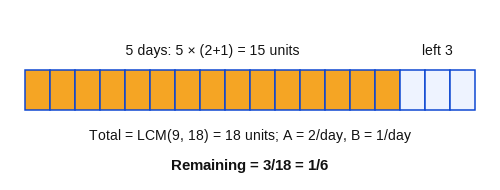
Concept: Total work = LCM of days; find work done together and subtract.

  1. Total =LCM(9,18)=18 units; A =2/day, B =1/day
  2. Together =3 units/day; in 5 days =15 units
  3. Remaining =18−15=3 units =318=16

Trick: 5(19+118)=5×16=56 done, so 16 left.

Answer: (A) 16

अवधारणा: कुल कार्य = दिनों का LCM; साथ में किया कार्य घटाएँ।

  1. कुल =18 इकाई; A =2/दिन, B =1/दिन
  2. साथ में 3/दिन; 5 दिन में 15 इकाई
  3. शेष =3 इकाई =16

ट्रिक: 5(19+118)=56 हुआ, शेष 16।

उत्तर: (A) 16

RRB NTPC Undergraduate CBT 1MathematicsTime and workRRB NTPC Undergraduate CBT 1 2024 · 9 Sep Shift 1 →
Q4294.
The perimeter of a square is 160 m. Find its area (in m2).
एक वर्ग का परिमाप 160 m है। इसका क्षेत्रफल (m2 में) ज्ञात कीजिए।
  1. A1600
  2. B1588
  3. C1572
  4. D1597
Show answer

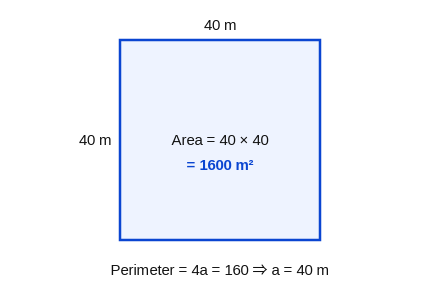
Concept: Square: perimeter =4a, area =a2.

  1. 4a=160⇒a=40m
  2. Area =402=1600m2

Trick: Area of a square =(perimeter4)2.

Answer: (A) 1600

अवधारणा: वर्ग: परिमाप =4a, क्षेत्रफल =a2।

  1. 4a=160⇒a=40m
  2. क्षेत्रफल =402=1600m2

ट्रिक: वर्ग का क्षेत्रफल =(परिमाप4)2।

उत्तर: (A) 1600

RRB NTPC Undergraduate CBT 1MathematicsSquare: perimeter and areaRRB NTPC Undergraduate CBT 1 2024 · 9 Sep Shift 1 →
Q4295.
Simplify the following:
2((32)x2−28x+14)−3(x2+6x−11)
निम्नलिखित को सरल कीजिए:
2((32)x2−28x+14)−3(x2+6x−11)
  1. A−74x−61
  2. B74x−61
  3. C74x+61
  4. D−74x+61
Show answer

Concept: Open the brackets carefully (sign of −3 changes every term), then combine like terms.

  1. 2(32x2−28x+14)=3x2−56x+28
  2. −3(x2+6x−11)=−3x2−18x+33
  3. Add: 3x2−3x2−56x−18x+28+33=−74x+61

Yaad rakhein: A negative multiplier flips every sign inside: −3×(−11)=+33.

Answer: (D) −74x+61

अवधारणा: कोष्ठक सावधानी से खोलें (−3 हर पद का चिह्न बदलता है), फिर समान पद जोड़ें।

  1. 2(32x2−28x+14)=3x2−56x+28
  2. −3(x2+6x−11)=−3x2−18x+33
  3. जोड़ने पर: −74x+61

याद रखें: ऋणात्मक गुणक अंदर के सभी चिह्न बदल देता है: −3×(−11)=+33।

उत्तर: (D) −74x+61

RRB NTPC Undergraduate CBT 1MathematicsAlgebraic simplificationRRB NTPC Undergraduate CBT 1 2024 · 9 Sep Shift 1 →
Q4296.
A, B, C, D, J, K and L are sitting around a circular table, facing the centre of the table. Only one person sits between A and L when counted from the left of L. K sits third to the right of J. C sits third to the left of B. K sits to the immediate right of C. D is not an immediate neighbour of C.
How many people sit between D and L when counted from the right of D?
A, B, C, D, J, K और L एक वृत्ताकार मेज़ के चारों ओर मेज़ के केंद्र की ओर मुख करके बैठे हैं। L के बाएँ से गिनने पर A और L के बीच केवल एक व्यक्ति बैठा है। K, J के दाएँ से तीसरे स्थान पर बैठा है। C, B के बाएँ से तीसरे स्थान पर बैठा है। K, C के ठीक दाएँ बैठा है। D, C का निकटतम पड़ोसी नहीं है।
D के दाएँ से गिनने पर D और L के बीच कितने व्यक्ति बैठे हैं?
  1. AThreeतीन
  2. BTwoदो
  3. CFourचार
  4. DOneएक
Show answer

Concept: When everyone faces the centre, "right" means anticlockwise and "left" means clockwise.

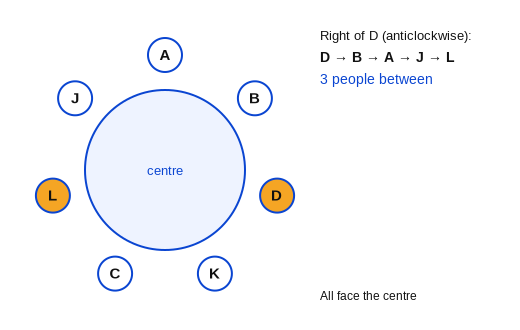
  1. C sits third to the left of B and K is immediately right of C, so B, K, C occupy a fixed block (going clockwise: B, _, K, C).
  2. K is third to the right of J and A is second to the left of L; D is not a neighbour of C. The only arrangement that works, clockwise: A, B, D, K, C, L, J.
  3. From D going right (anticlockwise): D → B → A → J → L, so B, A, J sit between them.

Trick: Draw the circle with arrows marking the right (anticlockwise) direction first; then place the fixed pairs.

Answer: (A) Three

अवधारणा: जब सभी केंद्र की ओर मुख करके बैठे हों, तो "दाएँ" = वामावर्त (anticlockwise) और "बाएँ" = दक्षिणावर्त (clockwise)।

  1. C, B के बाएँ तीसरे स्थान पर और K, C के ठीक दाएँ है — B, K, C एक निश्चित समूह बनाते हैं।
  2. K, J के दाएँ तीसरा है, A, L के बाएँ दूसरा है और D, C का पड़ोसी नहीं है। एकमात्र व्यवस्था (दक्षिणावर्त): A, B, D, K, C, L, J।
  3. D के दाएँ से गिनने पर: D → B → A → J → L, यानी बीच में B, A, J (तीन)।

ट्रिक: पहले वृत्त पर "दाएँ" की दिशा (वामावर्त) का तीर बना लें, फिर निश्चित जोड़ियाँ रखें।

उत्तर: (A) तीन

RRB NTPC Undergraduate CBT 1General Intelligence and ReasoningCircular seating arrangementRRB NTPC Undergraduate CBT 1 2024 · 9 Sep Shift 1 →
Q4297.
Based on the English alphabetical order, three of the following four letter-clusters are alike in a certain way and thus form a group. Which letter-cluster DOES NOT belong to that group? (Note: The odd letter-cluster is not based on the number of consonants/vowels or their position in the letter-cluster.)
अंग्रेज़ी वर्णमाला क्रम के आधार पर, निम्नलिखित चार अक्षर-समूहों में से तीन किसी निश्चित प्रकार से एकसमान हैं और इस प्रकार एक समूह बनाते हैं। कौन-सा अक्षर-समूह उस समूह से संबंधित नहीं है? (ध्यान दें: असंगत अक्षर-समूह, उस अक्षर-समूह में व्यंजनों/स्वरों की संख्या या उनके स्थान पर आधारित नहीं है।)
  1. ASVR
  2. BKNJ
  3. CNQM
  4. DUXS
Show answer

Concept: Check the alphabet gaps between consecutive letters of each group.

  1. SVR: S +3 = V, V −4 = R
  2. KNJ: K +3 = N, N −4 = J; NQM: N +3 = Q, Q −4 = M
  3. UXS: U +3 = X, X −5 = S ✗

Trick: Write the pattern as (+3,−4); the group that breaks it is the odd one.

Answer: (D) UXS

अवधारणा: हर समूह के क्रमागत अक्षरों के बीच वर्णमाला का अंतर देखें।

  1. SVR: S +3 = V, V −4 = R
  2. KNJ और NQM: +3, −4
  3. UXS: U +3 = X, X −5 = S ✗

ट्रिक: पैटर्न (+3,−4) है; जो इसे तोड़े वही विषम।

उत्तर: (D) UXS

RRB NTPC Undergraduate CBT 1General Intelligence and ReasoningOdd one out (letter groups)RRB NTPC Undergraduate CBT 1 2024 · 9 Sep Shift 1 →
Q4298.
Each of the digits in the number 36719542 is arranged in ascending order from left to right. The position(s) of how many digits will remain unchanged as compared to that in the original number?
संख्या 36719542 के प्रत्येक अंक को बाएँ से दाएँ आरोही क्रम में व्यवस्थित किया जाता है। मूल संख्या की तुलना में कितने अंकों का/के स्थान अपरिवर्तित रहेगा/रहेंगे?
  1. ANoneकोई नहीं
  2. BTwoदो
  3. COneएक
  4. DThreeतीन
Show answer

Concept: Write the original and the rearranged numbers one under the other and compare each place.

  1. Original: 3 6 7 1 9 5 4 2
  2. Ascending: 1 2 3 4 5 6 7 9
  3. No place has the same digit in both rows.

Trick: Compare position by position — do not count digits that merely appear in both.

Answer: (A) None

अवधारणा: मूल संख्या और व्यवस्थित संख्या को एक-दूसरे के नीचे लिखकर हर स्थान की तुलना करें।

  1. मूल: 3 6 7 1 9 5 4 2
  2. आरोही क्रम: 1 2 3 4 5 6 7 9
  3. किसी भी स्थान पर अंक समान नहीं है।

ट्रिक: स्थान-दर-स्थान तुलना करें।

उत्तर: (A) None (कोई नहीं)

RRB NTPC Undergraduate CBT 1General Intelligence and ReasoningDigit arrangementRRB NTPC Undergraduate CBT 1 2024 · 9 Sep Shift 1 →
Q4299.
What will come in place of the question mark (?) in the given series?
10 13 19 28 40 ?
दी गई श्रृंखला में प्रश्न चिह्न (?) के स्थान पर क्या आएगा?
10 13 19 28 40 ?
  1. A60
  2. B52
  3. C55
  4. D50
Show answer

Concept: Look at the differences between consecutive terms.

  1. Differences: 13−10=3, 19−13=6, 28−19=9, 40−28=12
  2. They increase by 3 (multiples of 3), so next difference =15
  3. 40+15=55

Trick: Differences 3, 6, 9, 12, … → next is 15.

Answer: (C) 55

अवधारणा: क्रमागत पदों का अंतर देखें।

  1. अंतर: 3, 6, 9, 12
  2. अगला अंतर =15
  3. 40+15=55

ट्रिक: अंतर 3 के गुणज में बढ़ रहे हैं।

उत्तर: (C) 55

RRB NTPC Undergraduate CBT 1General Intelligence and ReasoningNumber seriesRRB NTPC Undergraduate CBT 1 2024 · 9 Sep Shift 1 →
Q4300.
If '÷' and '−' are interchanged and '×' and '+' are interchanged, what will come in place of the question mark (?) in the following equation?
93 × 9 ÷ 9 − 3 × 8 + 23 × 6 ÷ 3 − 3 × 2 = ?
यदि '÷' और '−' को आपस में बदल दिया जाए तथा '×' और '+' को आपस में बदल दिया जाए, तो निम्नलिखित समीकरण में प्रश्न चिह्न (?) के स्थान पर क्या आएगा?
93 × 9 ÷ 9 − 3 × 8 + 23 × 6 ÷ 3 − 3 × 2 = ?
  1. A235
  2. B274
  3. C290
  4. D266
Show answer

Concept: Replace the signs first, then solve using BODMAS.

  1. After swapping: 93+9−9÷3+8×23+6−3÷3+2
  2. Division/multiplication: 9÷3=3, 8×23=184, 3÷3=1
  3. 93+9−3+184+6−1+2=290

Yaad rakhein: Rewrite the whole expression with the new signs before calculating — never swap in your head.

Answer: (C) 290

अवधारणा: पहले चिह्न बदलें, फिर BODMAS से हल करें।

  1. बदलने के बाद: 93+9−9÷3+8×23+6−3÷3+2
  2. 9÷3=3, 8×23=184, 3÷3=1
  3. 93+9−3+184+6−1+2=290

याद रखें: पूरा व्यंजक नए चिह्नों के साथ दोबारा लिखें, फिर गणना करें।

उत्तर: (C) 290

RRB NTPC Undergraduate CBT 1General Intelligence and ReasoningMathematical operations (symbol interchange)RRB NTPC Undergraduate CBT 1 2024 · 9 Sep Shift 1 →